
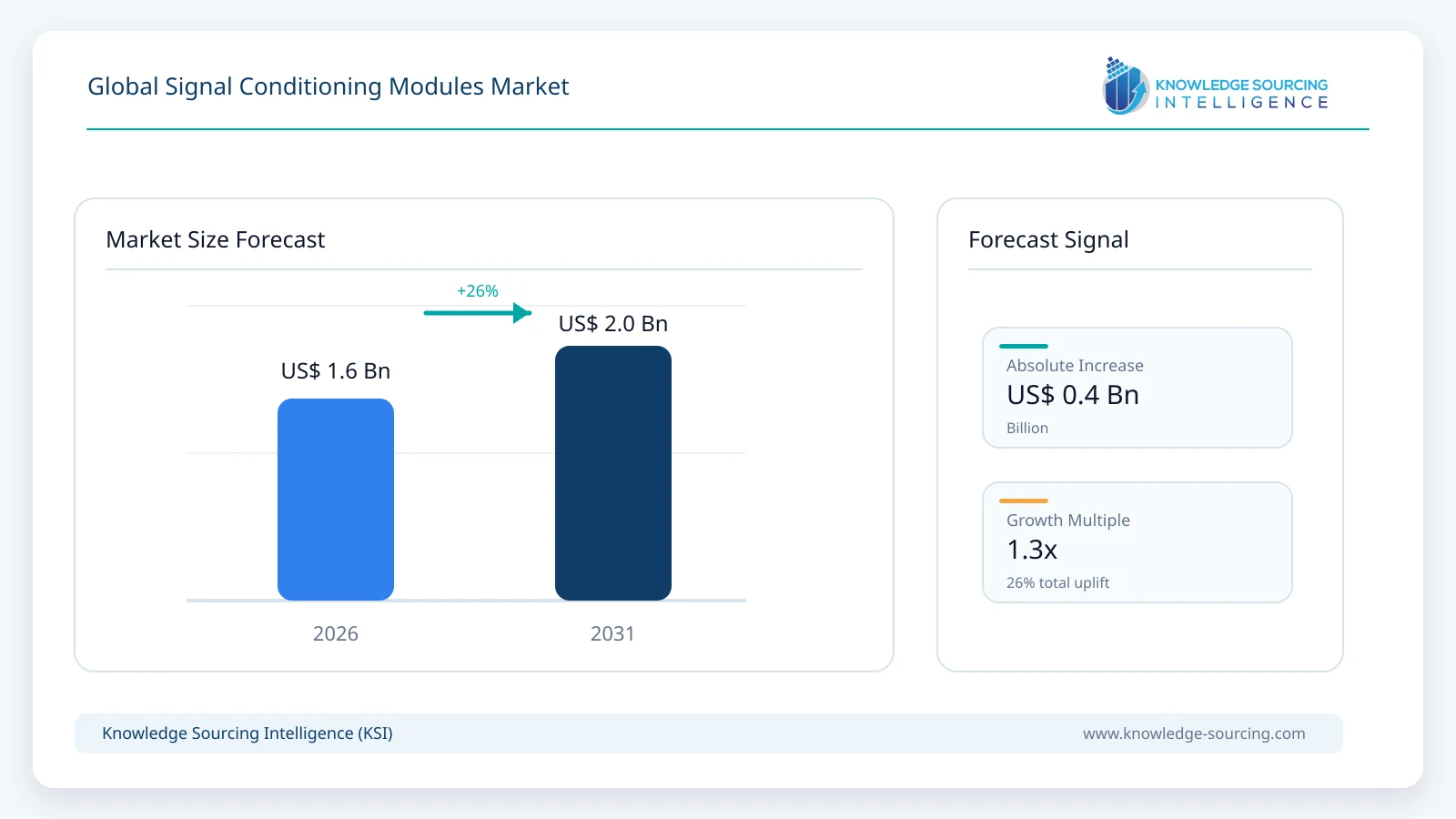
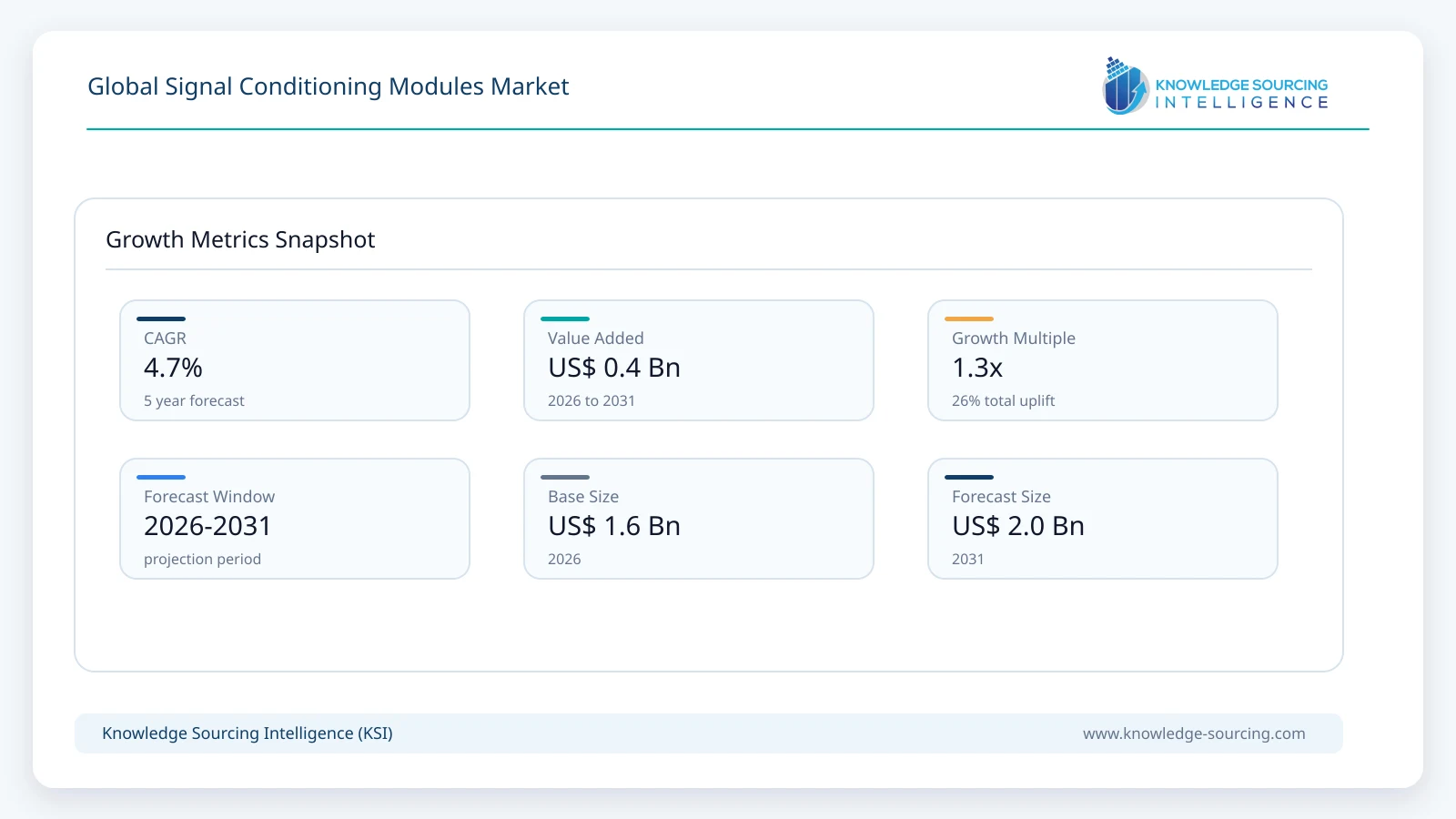
The Global Signal Conditioning Modules Market is forecast to grow at a CAGR of 4.7%, reaching USD 2.03 billion in 2031 from USD 1.61 billion in 2026.
Highlights:
- 1Industrial automation upgrades continue to expand demand for high-accuracy signal conditioning across process industries.
- 2Digital transformation of manufacturing is increasing adoption of configurable and isolated signal conditioning modules.
- 3Process control and data acquisition remain commercially important application areas across multiple industries.
- 4Energy, water, chemical processing, and semiconductor manufacturing continue investing in instrumentation modernization.
- 5Suppliers are expanding configurable, compact, and network-compatible product portfolios to support Industrial Internet of Things (IIoT) architectures.
Market Overview
Demand continues to be driven by modernization of industrial automation infrastructure rather than replacement of a single product category. Manufacturing facilities are replacing aging instrumentation with digital control architectures that require higher signal integrity, greater electromagnetic compatibility, flexible input configurations, and remote diagnostics. According to the International Energy Agency, industrial electrification and digital technologies are becoming central components of manufacturing efficiency strategies, increasing investment in connected industrial assets and measurement infrastructure.
Purchasing decisions increasingly emphasize lifecycle reliability instead of initial equipment cost. End users evaluate isolation accuracy, long-term calibration stability, channel density, operating temperature range, electromagnetic interference resistance, safety certification, communication compatibility, and ease of integration with existing automation platforms. These considerations are particularly important in industries where measurement errors can affect production yield, process safety, environmental compliance, or equipment availability.
Value creation across the market is distributed among semiconductor suppliers, module manufacturers, industrial automation vendors, systems integrators, and aftermarket service providers. Manufacturers increasingly differentiate their offerings through configurable universal inputs, compact DIN rail designs, integrated diagnostics, software-assisted configuration, and compatibility with Industrial Ethernet and digital automation ecosystems. Official product portfolios from industrial automation suppliers also show broader integration of configurable analog converters, signal isolators, and temperature conditioning modules to simplify plant modernization while reducing engineering effort.
Key Market Indicators
Indicator | Latest Evidence | Commercial Meaning |
Industrial digitalization | Industrial digital technologies remain a priority in manufacturing investment | Expands demand for reliable sensor interface hardware supporting automated operations. |
Product architecture | Universal configurable analog and temperature signal conditioners | Buyers increasingly prefer flexible modules that reduce inventory and installation complexity. |
Primary demand sectors | Manufacturing, energy, water, chemicals, transportation, aerospace | Diversified end-user exposure reduces dependence on any single industry. |
Common applications | Process control, data acquisition, machine monitoring, test and measurement | Multiple application areas create recurring replacement and modernization demand. |
Customer priorities | Signal isolation, accuracy, diagnostics, configuration flexibility | Product differentiation increasingly depends on performance rather than price alone. |
Key indicator: Industrial facilities are deploying more connected sensors and automated control systems across production assets.
Commercial meaning: Every additional measurement point requires dependable signal conversion and isolation, supporting sustained demand for signal conditioning modules.
Market Drivers
Expansion of brownfield industrial automation upgrades.
Much of the addressable demand originates from modernization of existing industrial facilities rather than construction of entirely new plants. Oil and gas operators, power utilities, chemical manufacturers, and water treatment facilities continue replacing legacy analog instrumentation while retaining large portions of existing process infrastructure. Signal conditioning modules enable these hybrid environments by providing compatibility between older field devices and modern digital control platforms. Product portfolios introduced by industrial automation suppliers increasingly emphasize configurable inputs, compact installation, and simplified commissioning, reflecting customer preference for retrofit-friendly solutions rather than complete control-system replacement.
Higher instrumentation density in process industries is increasing demand for configurable signal interfaces.
Process plants are deploying a larger number of intelligent transmitters, temperature sensors, pressure instruments, flow meters, vibration sensors, and load-monitoring devices to improve operational visibility and maintenance planning. Every additional measurement point requires reliable signal isolation, filtering, amplification, or conversion before data reaches control platforms. Buyers increasingly prefer universal signal conditioning modules that support multiple input types, including thermocouples, RTDs, voltage, current, frequency, and bridge sensors, reducing spare-part inventories and simplifying engineering. Schneider Electric's Harmony Analog portfolio reflects this procurement trend through configurable modules designed to interface diverse field devices with standardized automation systems.
Industrial data acquisition and predictive maintenance are raising accuracy requirements across measurement systems.
Manufacturers are expanding condition-monitoring programs that depend on continuous, high-quality sensor data rather than periodic manual inspections. Machine health analytics, vibration monitoring, rotating equipment diagnostics, and asset performance management all require stable analog signals with low electrical noise and high common-mode rejection. Signal conditioning modules therefore become critical components within the measurement chain rather than simple interface devices. Official product documentation from Analog Devices highlights integrated isolation, filtering, linearization, surge protection, and precision signal conversion functions specifically developed for industrial monitoring, test systems, and process automation environments.
Market Restraints and Challenges
Complex qualification requirements extend procurement and replacement cycles.
Signal conditioning modules are deployed in process industries where measurement reliability directly affects safety, product quality, and regulatory compliance. As a result, customers rarely replace interface hardware without extensive validation, calibration, and compatibility testing. Industries such as oil and gas, pharmaceuticals, aerospace, and power generation often require compliance with functional safety, electromagnetic compatibility, hazardous-area, and industry-specific certification standards before installation. These qualification processes lengthen sales cycles, increase engineering costs, and create barriers for smaller suppliers that lack extensive application support or certification resources. Suppliers therefore compete not only through product performance but also through documentation, technical assistance, and long-term product availability.
Electrical noise, harsh operating conditions, and system compatibility remain persistent engineering constraints.
Industrial installations expose signal conditioning modules to electromagnetic interference, temperature variation, vibration, surge events, and electrically noisy environments. Maintaining measurement accuracy under these conditions requires high-quality isolation, filtering, surge protection, and stable analog circuitry, increasing product design complexity and manufacturing costs. Yokogawa's product specifications emphasize extended operating life, integrated noise countermeasures, environmental durability, and field-configurable inputs to address these operating challenges, illustrating that reliability remains a primary purchasing criterion rather than an optional product feature. These technical requirements raise development costs and lengthen product qualification timelines for manufacturers serving mission-critical industries.
Pressure for greater functionality without increasing installation footprint is raising product development costs.
Industrial customers increasingly expect a single module to support multiple sensor technologies, wider operating ranges, software configuration, diagnostics, communication interfaces, and compact DIN rail installation. Delivering this combination while maintaining precision, electrical isolation, and long-term calibration stability requires greater analog integration and more sophisticated semiconductor designs. Texas Instruments notes that industrial signal-chain devices must accurately sense, condition, and measure real-world signals before further processing, while its industrial signal conditioner portfolio continues to add functions such as diagnostics, sensor linearization, protection, and communication capability. These expectations increase research and development expenditure and shorten product refresh cycles, particularly for suppliers targeting higher-value industrial automation projects.
Major Segment Analysis
Process Control Application
Process control represents a commercially important application for signal conditioning modules because continuous manufacturing operations depend on stable, accurate, and electrically isolated measurement signals to maintain product quality, operational safety, and regulatory compliance. Industries including oil and gas, chemicals, power generation, food processing, water treatment, and pharmaceuticals operate thousands of field instruments that transmit analog signals from pressure, temperature, flow, level, and analytical sensors to distributed control systems and programmable logic controllers. Signal conditioning modules provide the interface that converts, isolates, filters, and standardizes these measurements before they are processed by automation platforms, reducing measurement errors caused by electrical noise or incompatible signal formats. Schneider Electric's Harmony Analog portfolio illustrates this trend through configurable signal conditioners supporting voltage, current, temperature, and electrical measurement inputs for industrial automation applications.
Purchasing decisions within this segment extend beyond signal conversion accuracy. Plant operators increasingly prioritize universal input capability, three-way galvanic isolation, compact DIN rail installation, software-assisted configuration, diagnostic functions, and compliance with international industrial standards to simplify maintenance and reduce lifecycle costs. Suppliers compete by expanding configurable product portfolios that minimize engineering effort while improving compatibility with modern digital control architectures. As industrial facilities continue modernizing brownfield assets rather than replacing complete automation systems, process control applications are expected to remain a consistent source of replacement and retrofit demand across the forecast period.
Regional Analysis
Region | Main Demand Signal | Principal Constraint |
North America | Process automation upgrades, aerospace, semiconductor manufacturing, energy infrastructure | Lengthy qualification cycles in regulated industries |
Europe | Industrial modernization, energy transition, chemical processing, machinery manufacturing | Strict safety, EMC, and environmental compliance requirements |
Asia Pacific | Manufacturing expansion, electronics production, industrial automation investment | Cost sensitivity and varying automation maturity across economies |
Middle East and Africa | Oil and gas projects, desalination, utilities, industrial diversification | Dependence on imported automation equipment and specialized technical support |
North America maintains a mature demand environment driven by modernization of industrial facilities rather than greenfield expansion alone. Process industries continue investing in measurement reliability, predictive maintenance, and digital automation to improve operational efficiency and equipment availability. Aerospace manufacturing, semiconductor fabrication, water infrastructure, and energy facilities require highly reliable signal isolation and conditioning because measurement integrity directly affects production continuity and regulatory compliance. Buyers generally place greater emphasis on lifecycle reliability, technical support, and system compatibility than on initial acquisition cost.
European demand is supported by established process industries, advanced manufacturing, and regulatory expectations covering safety, environmental performance, and industrial reliability. Chemical processing, pharmaceuticals, food manufacturing, and renewable energy facilities continue upgrading instrumentation to improve operational efficiency while complying with increasingly stringent industrial standards. Suppliers serving European customers therefore compete through certified products, engineering support, and long-term availability rather than price alone. Product portfolios emphasize international approvals, configurable operation, and compact cabinet installation to simplify modernization projects.
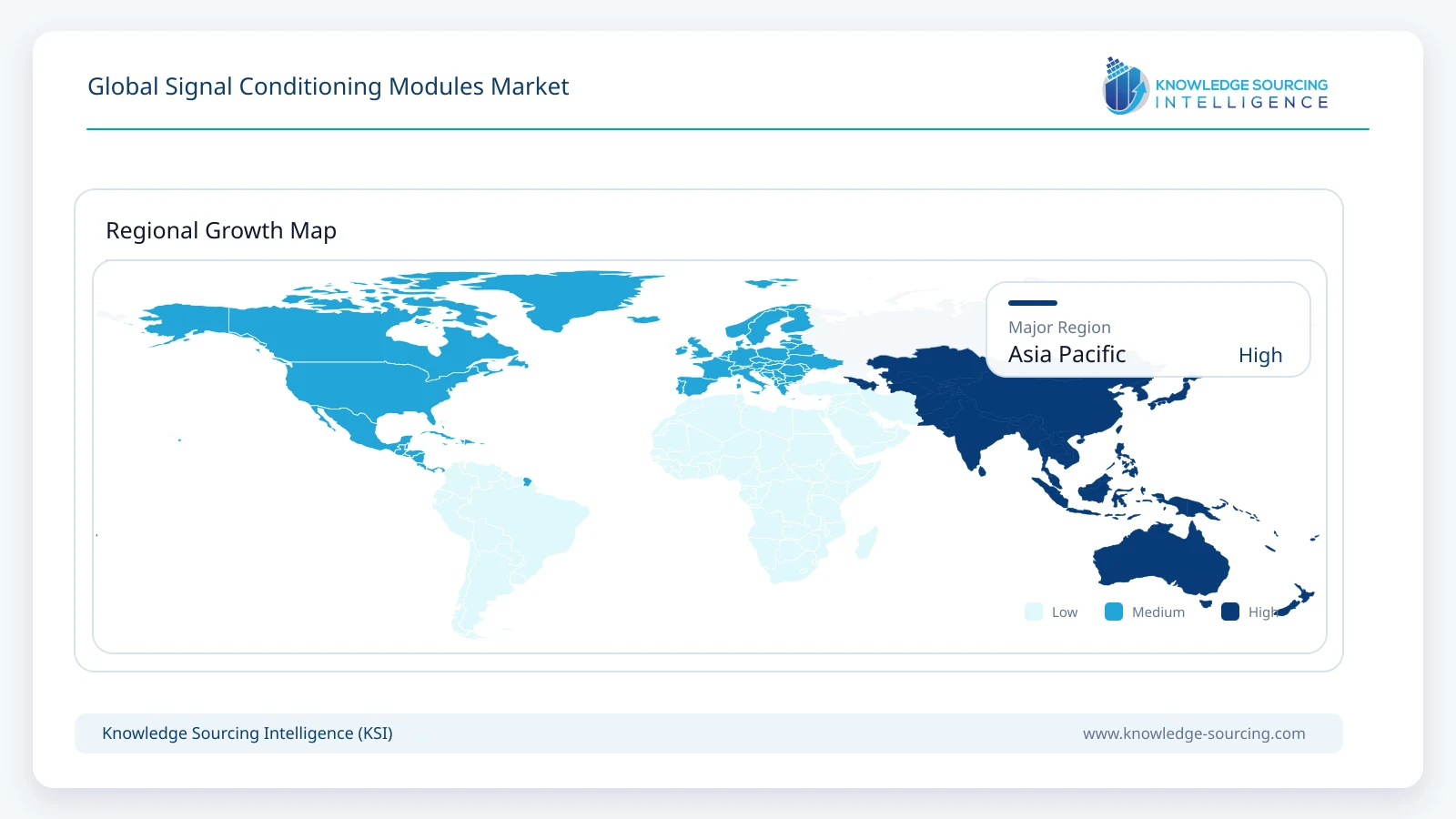
Asia Pacific continues to represent the broadest manufacturing base for industrial automation equipment, supported by expanding semiconductor fabrication, electronics manufacturing, automotive production, power infrastructure, and process industries across China, Japan, South Korea, India, and Southeast Asia. Increasing instrumentation density within manufacturing plants creates sustained demand for configurable signal conditioning modules capable of integrating diverse sensor technologies into standardized automation platforms. At the same time, purchasing priorities differ across the region, with advanced manufacturing economies emphasizing precision and diagnostics, while emerging industrial markets remain comparatively sensitive to installation costs and maintenance requirements.
The Middle East and Africa present opportunities linked primarily to oil and gas production, petrochemical facilities, water treatment infrastructure, mining operations, and industrial diversification programs. Signal conditioning modules support reliable instrumentation in electrically demanding environments where equipment must withstand high temperatures, electrical interference, and continuous operation. Procurement decisions often favor internationally certified products supported by regional engineering and service capabilities because many industrial facilities depend on imported automation technologies and long operating lifecycles.
Competitive Landscape
Competition in the global signal conditioning modules market is driven by product performance, application expertise, certification capability, and integration with broader industrial automation platforms rather than price alone. The market combines diversified industrial automation suppliers with specialist analog semiconductor and instrumentation companies, creating a moderately fragmented competitive structure. Texas Instruments, Analog Devices, Inc., and TE Connectivity strengthen the value chain through precision analog, signal-chain, sensing, and interface technologies, while Rockwell Automation, Siemens AG, Phoenix Contact, Yokogawa Corporation, Advantech Co., Ltd., AMETEK, Inc., and Dataforth Corporation compete through complete automation portfolios, industrial networking, and application-specific signal conditioning solutions. Texas Instruments' 2025 Annual Report notes that its Analog business, including Signal Chain products that sense, condition, and measure real-world signals, generated approximately 79% of company revenue, with industrial remaining one of its largest end markets.
Competitive differentiation increasingly depends on configurable universal-input modules, galvanic isolation, functional safety compliance, compact DIN rail designs, software-based configuration, and compatibility with Industrial Ethernet and digital control architectures. Suppliers are expanding regional engineering support, strengthening long-term product availability, and investing in higher-performance analog technologies to address customers' demand for reliable retrofit solutions, predictive maintenance, and digitally connected industrial assets. Recent industry performance also indicates improving demand across industrial automation and data center applications, supporting continued investment in analog and signal-chain technologies.
Recent Developments
March 2026 – Triad Semiconductor commercially released TS5510 Universal AFE: Triad Semiconductor launched its TS5510 two-channel analog front end, integrating microphone and line-level signal handling, high dynamic range, and configurable conditioning for professional audio and electronic systems.
March 2026 – DEWETRON launched TRION3-24xx ACC/LV modules: DEWETRON introduced isolated low-voltage and IEPE signal conditioning modules with 24-bit ADCs, improved filtering, and synchronized acquisition, expanding precision measurement capabilities for automotive, aerospace, and industrial testing applications.
January 2026 – Aimtron Electronics acquired ICS Company: Aimtron completed acquisition of US-based ICS Company, expanding electronics design and manufacturing capabilities, including system-level solutions involving signal processing, embedded electronics, and specialized industrial applications.
July 2025 – Rohde & Schwarz acquired ZES ZIMMER Electronic Systems: Rohde & Schwarz completed acquisition of ZES ZIMMER, strengthening its test and measurement portfolio with precision power measurement solutions supporting signal analysis, conditioning, and electrification applications.
Regulatory and Policy Environment
Signal conditioning modules are regulated indirectly through electrical safety, electromagnetic compatibility (EMC), functional safety, hazardous-area certification, and industrial automation standards rather than through product-specific legislation. Consequently, manufacturers must demonstrate compliance with internationally recognized technical standards before products can be deployed in regulated industries such as oil and gas, power generation, chemical processing, pharmaceuticals, transportation, and water infrastructure. These compliance requirements influence product design, certification costs, development timelines, and market entry strategies.
Electrical safety remains a primary requirement across industrial automation equipment. International standards developed by the International Electrotechnical Commission (IEC), including IEC 61010 for electrical equipment used in measurement and control applications, establish safety requirements that influence insulation design, protection against electric shock, temperature limits, and equipment testing. Products integrated into industrial control systems must also satisfy electromagnetic compatibility requirements to ensure reliable operation in electrically noisy industrial environments.
Hazardous-area applications impose additional certification obligations for suppliers serving oil and gas, petrochemical, mining, and other process industries. Signal conditioning modules intended for explosive atmospheres commonly require ATEX certification for the European market together with IECEx approval for international deployment. Commercial products from Phoenix Contact illustrate the breadth of these requirements by carrying CE marking, ATEX, IECEx, Safety Integrity Level (SIL) certification under IEC 61508, and compliance with EN 61326 electromagnetic compatibility requirements. These approvals increase engineering and documentation costs but remain essential for suppliers competing in safety-critical applications.
Industrial automation customers are also placing greater emphasis on interoperability and functional safety as plants adopt digitally connected control architectures. Recent IEC publications continue expanding standards covering programmable controllers, industrial communication, and safety-oriented industrial networks, including IEC 61131 equipment requirements and IEC 62541 OPC Unified Architecture Safety. These standards encourage suppliers to design products capable of supporting secure communication, reliable diagnostics, and long-term compatibility with modern automation platforms rather than focusing solely on analog signal conversion.
Industry standards developed by the International Society of Automation (ISA) further influence engineering practices through guidance covering industrial automation systems, intelligent device management, cybersecurity, factory acceptance testing, and instrumentation. Although these standards are generally voluntary, they are widely referenced in industrial projects, procurement specifications, and contractual requirements, making compliance an important competitive consideration for equipment manufacturers and system integrators.
Outlook and Strategic Implications
Industrial automation investment is expected to remain the principal demand catalyst for signal conditioning modules throughout the 2026–2031 forecast period. Rather than replacing complete control systems, manufacturers are likely to continue modernizing brownfield facilities by integrating legacy field instrumentation with digital automation platforms. This approach favors configurable signal conditioning modules that support multiple sensor types, higher measurement accuracy, integrated diagnostics, and simplified commissioning while extending the useful life of installed industrial assets.
The competitive environment is also expected to shift toward higher-value products incorporating universal inputs, improved electrical isolation, software-based configuration, and compatibility with Industrial Ethernet and Industrial Internet of Things (IIoT) architectures. Suppliers investing in precision analog technologies, configurable hardware platforms, and application engineering support should be better positioned to address customer requirements across process industries, utilities, semiconductor manufacturing, transportation, and advanced manufacturing. At the same time, compliance with evolving international safety, EMC, cybersecurity, and functional safety standards will remain an important barrier to entry, reinforcing the competitive position of manufacturers with established certification capabilities, global technical support, and long-term product lifecycle management.
Signal Conditioning Modules Market Scope:
| Report Metric | Details |
|---|---|
| Total Market Size in 2026 | USD 1.61 billion |
| Total Market Size in 2031 | USD 2.03 billion |
| Forecast Unit | USD Billion |
| Growth Rate | 4.7% |
| Study Period | 2021 to 2031 |
| Historical Data | 2021 to 2024 |
| Base Year | 2025 |
| Forecast Period | 2026 – 2031 |
| Segmentation | Input, Form, End-User, Geography |
| Companies |
|
Market Segmentation
By Input
Temperature Input
Process Input (Voltage / Current: 4–20 mA, 0–10 V)
Frequency / Pulse Input
LVDT / RVDT Input
Strain Gauge / Load Cell Input
RTD / Thermocouple Input
Bridge / Input Sensors
By Application
Data Acquisition
Process Control
Test and Measurement
Industrial Automation
Machine Monitoring and Diagnostics
Others
By Form
DIN Rail- / Rack-Mounted Modules
Standalone / Modular Modules
By End-User
Oil and Gas
Energy and Power
Chemical Processing
Food and Beverage
Metal and Mining
Paper and Pulp
Water and Wastewater
Aerospace and Defense
Automotive
Pharmaceuticals
Semiconductor and Electronics Manufacturing
Others
By Geography
North America
USA
Canada
Mexico
South America
Brazil
Argentina
Others
Europe
United Kingdom
Germany
France
Spain
Others
Middle East and Africa
Saudi Arabia
UAE
Israel
Others
Asia Pacific
China
Japan
India
South Korea
Taiwan
Thailand
Indonesia
Others
Table of Contents
1. INTRODUCTION
1.1. Market Overview
1.2. Market Definition
1.3. Scope of the Study
1.4. Market Segmentation
1.5. Currency
1.6. Assumptions
1.7. Base and Forecast Years Timeline
1.8. Key Benefits for the Stakeholder
2. RESEARCH METHODOLOGY
2.1. Research Design
2.2. Research Processes
3. EXECUTIVE SUMMARY
3.1. Key Findings
3.2. Analyst View
4. MARKET DYNAMICS
4.1. Market Drivers
4.2. Market Restraints
4.3. Porter’s Five Forces Analysis
4.3.1. Bargaining Power of Suppliers
4.3.2. Bargaining Power of Buyers
4.3.3. Threat of New Entrants
4.3.4. Threat of Substitutes
4.3.5. Competitive Rivalry in the Industry
4.4. Industry Value Chain Analysis
4.5. Analyst View
5. GLOBAL SIGNAL CONDITIONING MODULES MARKET, BY INPUT
5.1. Introduction
5.2. Temperature Input
5.3. Process Input (Voltage/Current, 4–20 mA, 0–10 V)
5.4. Frequency/Pulse Input
5.5. LVDT/RVDT Input
5.6. Strain Gauge/Load Cell Input
5.7. RTD/Thermocouple Input
5.8. Bridge/Input Sensors
6. GLOBAL SIGNAL CONDITIONING MODULES MARKET, BY APPLICATION
6.1. Introduction
6.2. Data Acquisition
6.3. Process Control
6.4. Test and Measurement
6.5. Industrial Automation
6.6. Machine Monitoring and Diagnostics
6.7. Others
7. GLOBAL SIGNAL CONDITIONING MODULES MARKET, BY FORM
7.1. Introduction
7.2. DIN rail-/rack-mounted modules
7.3. Standalone/modular modules
8. GLOBAL SIGNAL CONDITIONING MODULES MARKET, BY END-USER
8.1. Introduction
8.2. Oil and Gas
8.3. Energy and Power
8.4. Chemical Processing
8.5. Food and Beverage
8.6. Metal and Mining
8.7. Paper and Pulp
8.8. Water and Wastewater
8.9. Aerospace and Defense
8.10. Automotive
8.11. Pharmaceuticals
8.12. Semiconductor and Electronics Manufacturing
8.13. Others
9. GLOBAL SIGNAL CONDITIONING MODULES MARKET, BY GEOGRAPHY
9.1. Introduction
9.2. North America
9.2.1. By Input
9.2.2. By Application
9.2.3. By Form
9.2.4. By End-User
9.2.5. By Country
9.2.5.1. USA
9.2.5.1.1. Market Trends and Opportunities
9.2.5.1.2. Growth Prospects
9.2.5.2. Canada
9.2.5.2.1. Market Trends and Opportunities
9.2.5.2.2. Growth Prospects
9.2.5.3. Mexico
9.2.5.3.1. Market Trends and Opportunities
9.2.5.3.2. Growth Prospects
9.3. South America
9.3.1. By Input
9.3.2. By Application
9.3.3. By Form
9.3.4. By End-User
9.3.5. By Country
9.3.5.1. Brazil
9.3.5.1.1. Market Trends and Opportunities
9.3.5.1.2. Growth Prospects
9.3.5.2. Argentina
9.3.5.2.1. Market Trends and Opportunities
9.3.5.2.2. Growth Prospects
9.3.5.3. Others
9.3.5.3.1. Market Trends and Opportunities
9.3.5.3.2. Growth Prospects
9.4. Europe
9.4.1. By Input
9.4.2. By Application
9.4.3. By Form
9.4.4. By End-User
9.4.5. By Country
9.4.5.1. United Kingdom
9.4.5.1.1. Market Trends and Opportunities
9.4.5.1.2. Growth Prospects
9.4.5.2. Germany
9.4.5.2.1. Market Trends and Opportunities
9.4.5.2.2. Growth Prospects
9.4.5.3. France
9.4.5.3.1. Market Trends and Opportunities
9.4.5.3.2. Growth Prospects
9.4.5.4. Spain
9.4.5.4.1. Market Trends and Opportunities
9.4.5.4.2. Growth Prospects
9.4.5.5. Others
9.4.5.5.1. Market Trends and Opportunities
9.4.5.5.2. Growth Prospects
9.5. Middle East and Africa
9.5.1. By Input
9.5.2. By Application
9.5.3. By Form
9.5.4. By End-User
9.5.5. By Country
9.5.5.1. Saudi Arabia
9.5.5.1.1. Market Trends and Opportunities
9.5.5.1.2. Growth Prospects
9.5.5.2. UAE
9.5.5.2.1. Market Trends and Opportunities
9.5.5.2.2. Growth Prospects
9.5.5.3. Israel
9.5.5.3.1. Market Trends and Opportunities
9.5.5.3.2. Growth Prospects
9.5.5.4. Others
9.5.5.4.1. Market Trends and Opportunities
9.5.5.4.2. Growth Prospects
9.6. Asia Pacific
9.6.1. By Input
9.6.2. By Application
9.6.3. By Form
9.6.4. By End-User
9.6.5. By Country
9.6.5.1. China
9.6.5.1.1. Market Trends and Opportunities
9.6.5.1.2. Growth Prospects
9.6.5.2. Japan
9.6.5.2.1. Market Trends and Opportunities
9.6.5.2.2. Growth Prospects
9.6.5.3. India
9.6.5.3.1. Market Trends and Opportunities
9.6.5.3.2. Growth Prospects
9.6.5.4. South Korea
9.6.5.4.1. Market Trends and Opportunities
9.6.5.4.2. Growth Prospects
9.6.5.5. Taiwan
9.6.5.5.1. Market Trends and Opportunities
9.6.5.5.2. Growth Prospects
9.6.5.6. Thailand
9.6.5.6.1. Market Trends and Opportunities
9.6.5.6.2. Growth Prospects
9.6.5.7. Indonesia
9.6.5.7.1. Market Trends and Opportunities
9.6.5.7.2. Growth Prospects
9.6.5.8. Others
9.6.5.8.1. Market Trends and Opportunities
9.6.5.8.2. Growth Prospects
10. COMPETITIVE ENVIRONMENT AND ANALYSIS
10.1. Major Players and Strategy Analysis
10.2. Market Share Analysis
10.3. Mergers, Acquisitions, Agreements, and Collaborations
10.4. Competitive Dashboard
11. COMPANY PROFILES
11.1. Texas Instruments
11.2. Rockwell Automation
11.3. Phoenix Contact
11.4. Analog Devices, Inc.
11.5. TE Connectivity
11.6. Yokogawa Corporation
11.7. AMETEK, Inc.
11.8. Siemens AG
11.9. Advantech Co., Ltd.
11.10. Dataforth Corporation
LIST OF FIGURES
LIST OF TABLES
Navigate
Trusted by the world's leading organizations











