
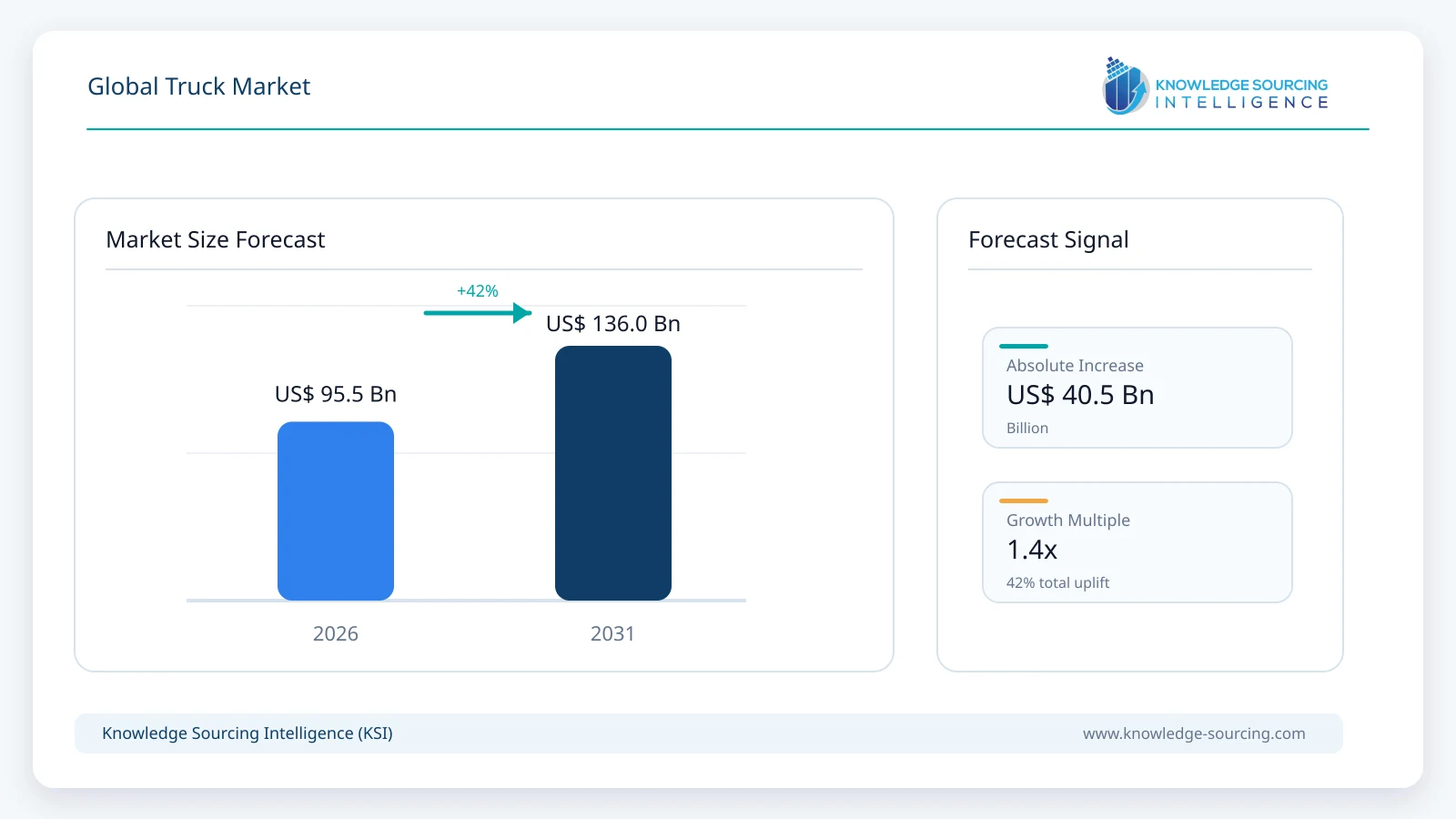
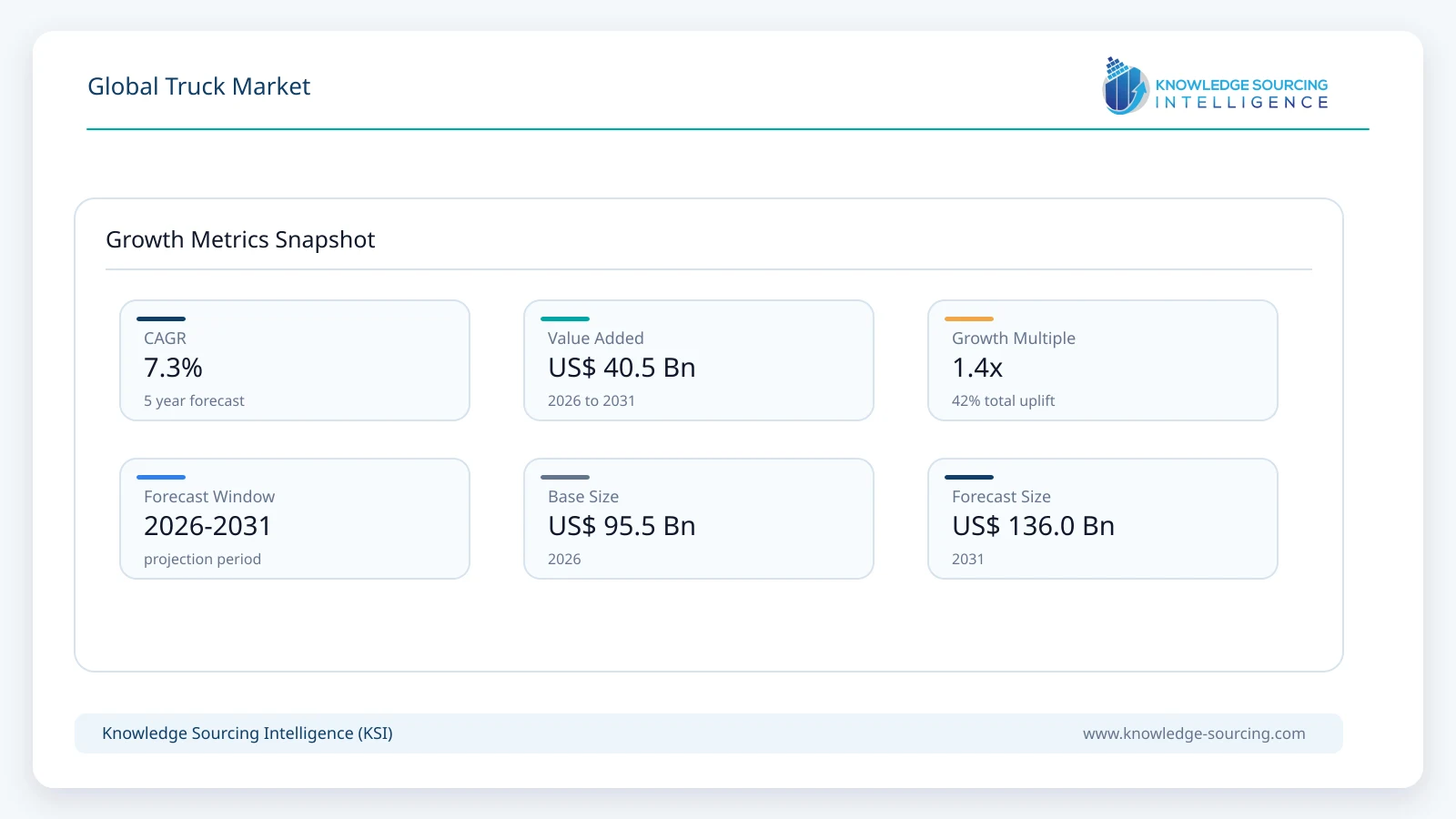
The Global truck Market is expected to reach USD 136.0 billion in 2031, growing at a CAGR of 7.3% between 2026 and 2031, from USD 95.5 billion in 2026.
Highlights:
- 1Battery-electric trucksgain momentum with major manufacturers unveiling lowliner models for sustainable long-haul operations.
- 2AI-powered navigation systemsdeliver precise routing compliant with European road regulations for commercial fleets.
- 3Driverless trucksin mining sectors have successfully transported over three million tonnes, proving commercial viability.
- 4Hydrogen mobility initiativesin Germany bring together OEMs and energy partners to scale fuel-cell truck infrastructure.
Market Overview
Global truck demand continues to be supported by sustained commercial freight mobility, increasing industrial movement, construction activity, mining, infrastructure development, and fleet replacement requirements. These factors reinforce the essential role of trucks, which continue to form the backbone of road-based goods transportation.
According to data by ACEA, in the EU alone, 6 million trucks were in circulation in 2025, while more than 460,000 trucks were produced on its territory, indicating a sizeable existing vehicle stock alongside continued truck manufacturing activity across the region.
Additionally, fleet replacement and modernization continue to be key drivers, with the average truck age being 14 years in the EU, encouraging operators to upgrade older vehicles with newer trucks that provide improved fuel efficiency, safety, and connectivity features, along with enhanced emissions performance.
Truck electrification is accelerating worldwide. Full electric truck sales in 2025 more than doubled compared with 2024, rising to 9% of total global truck sales, as per the IEA. This was mainly due to China, which accounted for one in four truck sales in the country during 2025.
According to the IEA, the global production of electric trucks also increased significantly, to almost 440,000 units in 2025, more than double the level in 2024. China accounted for over 90% of global electric truck production, reinforcing its position as a key hub for electric commercial-vehicle manufacturing.
Development of alternative powertrains is moving beyond urban delivery vehicles to long-haul and heavy-duty applications. In September 2026, Volvo Trucks started series production of its next-generation electric trucks, including the FH Aero Electric, which offers up to 700 km range, while other models deliver up to 470 km.
Truck manufacturers are improving the efficiencies of both conventional and alternative-fuel vehicles. In January 2026, Volvo stated that around 33,000 FH Aero trucks were ordered across Europe in 2025 due to the aerodynamic treatment offering up to 7% greater fuel economy compared with the previous regular FH model.
Recent product launches are promoting the market for electric heavy-duty trucks globally. For example, in September 2026, Volvo launched an electric truck configuration for gross combination weights of up to 80 tonnes, with ranges of 450 km at 64 tonnes and, for heavy-load applications, 420 km at its upper limit of 76 tonnes.
The connected and digitally enabled fleet technologies are playing an increasingly important role in this market expansion as manufacturers develop products to improve uptime through predictive maintenance and driver assistance, enable fleet energy management, enhance telematics to increase vehicle utilization, and offer a wide range of fleet-management solutions that can leverage cloud computing capabilities.
Market Drivers
Growth in E-Commerce, Freight Transportation, and Last-Mile Delivery
Growth in e-commerce, cross-border trade, parcel volumes, and faster delivery networks are creating increasing demand for road-based freight capacity and supporting demand for trucks across long-haul, regional, urban, and last-mile applications.
The rise in global trade is leading to an increase in the underlying demand for freight transportation. Global trade in H1 2025 grew to around USD 500 billion, according to UN Trade and Development, with an estimated full-year 2025 trade beyond USD 35 trillion, which is a rise of $2.2 trillion from the previous year. This is fuelling demand for freight movement through supply chains.
U.S. e-commerce continued growing in 2025, with the U.S. Census Bureau estimating seasonally adjusted retail e-commerce sales at $304.2 billion during the second quarter of 2025, up 5.3% year-on-year, and accounting for 16.3% of total retail sales.
Additionally, U.S. e-commerce sales continued to grow in 2026, growing 12.2% year-over-year in Q2 to $340.2 billion and capturing a record 17.1% of overall retail sales as demand for distribution and delivery capacity remained strong.
The large volume of freight generated by China's parcel economy is also contributing to market demand. According to the State Post Bureau of the People’s Republic of China, the country's postal industry handled 216.52 billion total parcels in 2025, of which 198.95 billion were express parcels, a year-on-year gain of 13.6%, while intercity express volumes surged by 15% to 178.94 billion parcels through commercial delivery channels.
Cross-border parcel activity is also growing, as China's international/Hong Kong/Macau/Taiwan express volume rose to 4.22 billion parcels in 2025, an increase of 8.8 %, supporting demand for trucks connecting fulfillment centers to ports, airports, and distribution hubs.
Major Segment Analysis
Battery Electric
By powertrain type, the global truck market is segmented into internal combustion engine (ICE), battery electric, hybrid electric, and others, where battery electric is expected to expand as fleets transition towards zero-emission vehicles.
The establishment of stringent global VOC standards is driving innovation in heavy-duty commercial powertrains, creating new opportunities. The battery electric truck segment is expected to show considerable growth fueled by the growing sustainable fuel transition.
Continued efforts to minimize carbon emissions worldwide, followed by net-zero emission targets set by regions, have encouraged electrification of their commercial vehicle fleets, which has positively influenced the global market trajectory.
According to the International Energy Agency’s “Global EV Outlook 2026”, in 2025, global electric truck sales exceeded over 400,000 units, of which battery electric constituted nearly 97%, followed by other modules.
Growing technological advancement in e-mobility, followed by electrification commitments by global OEMs, has amplified the percentage share of electric truck modules in global sales, especially in heavy-freight truck (HFT), where sales share rose from 3% in 2024 to 9% in 2025, and for medium freight truck (MFT), it rose from 6% to 9%.
The growing market shift has encouraged major truck manufacturers to invest in new model development. For instance, in 14th September 2026, Volvo launched a new electric model with a total weight capacity of 80 tons and features a battery providing 640 kWh of usable energy. The company has also launched a new generation of FM, FH, and FMX electric trucks in April this year.
Nations such as China are dominating global electric truck registrations, fueled by their strong technological infrastructure and government-backed funding incentivizing electric fleet production. Continued growth in electric truck registrations in such markets has propelled the market landscape for battery electric modules. In 2025, the nation recorded 405,000 units of electric registrations and accounted for nearly 94% of global registrations.
Geographical Outlook
Asia Pacific: China
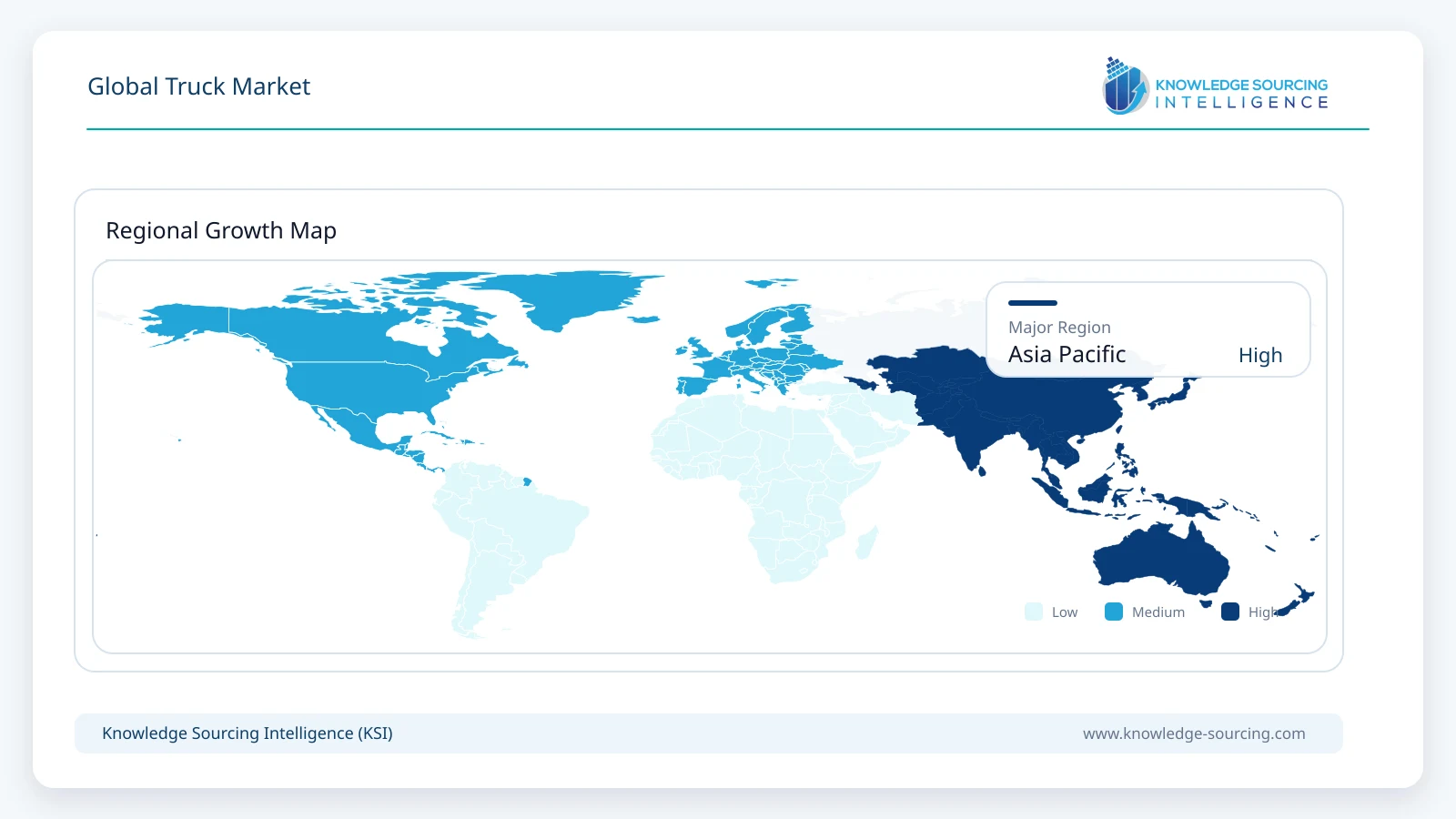
The Chinese truck market is transitioning toward new-energy powertrains, intelligent connected vehicles, AI-enabled vehicle systems, and automated freight operations.
Trends and Insights
Rapid electrification of heavy trucks is becoming a major market trend. China's Ministry of Transport reported that sales of new-energy heavy trucks reached approximately 140,000 units in the first half of 2026, up 78.6% year-on-year.
In 2025, the five largest conventional truck manufacturers in China (Sinotruk, BAIC, FAW, Shaanxi and Dongfeng) together accounted for less than half of electric truck sales, despite representing nearly 90% of the overall Chinese truck market.
Government policy is explicitly promoting the large-scale deployment of electric heavy trucks. In 2026, 11 Chinese government departments issued an implementation plan supporting new-energy heavy trucks across long-haul freight, ports, mines, steel plants, power plants, logistics parks, and other high-utilization applications. The plan also prioritizes replacing older commercial freight vehicles with new-energy heavy trucks.
AI and software are becoming increasingly integrated into commercial vehicles. Chinese truck manufacturers are developing intelligent driving systems, smart cockpits, autonomous control systems, connected-vehicle platforms, and AI-enabled digital tools for vehicle development and fleet operations. This shifts truck technology from conventional mechanical and telematics systems toward software-defined and intelligent vehicle platforms.
Chinese truck manufacturers are increasingly investing in intelligent driving, smart cockpits, new-energy powertrains, autonomous control systems, and AI-enabled digital platforms. These technologies are being applied across vehicle development, fleet management, operational optimization, and commercial-vehicle applications.
High-power charging infrastructure is expanding rapidly to support electric freight. China has installed 71,500 charging piles at over 98 percent of its expressway service areas, with 19 provincial-level regions ensuring complete coverage in all townships, as stated by NEA.
The government is specifically developing charging and swapping infrastructure for electric heavy trucks. China plans to establish more than 3,000 charging and battery-swapping stations for electric heavy trucks along major freight routes and at ports, mines, factories and logistics parks. This infrastructure expansion is important because heavy trucks require significantly higher utilization and faster replenishment than typical passenger EVs.
China's heavy-truck manufacturing industry is increasingly adopting automated and flexible production technologies. For example, in November 2025, Comau developed a fully automated body-in-white production line for Beijing Foton Daimler Automotive's new A6 platform, designed for premium heavy-duty trucks. The solution supports modular production, manufacturing flexibility, and a shorter time-to-market, highlighting the growing use of advanced automation in China's truck manufacturing ecosystem.
Company Profiles
Tata Motors Limited approaches the global truck market through a multi-pronged strategy focused on international geographic expansion, sustainable mobility, cost optimization, and modular design. The company targets rapid growth across emerging markets in South Asia (SAARC), the Middle East, Africa, and Latin America by offering vehicles engineered for lower Total Cost of Ownership (TCO), higher payloads, and driver comfort.
To build a globally competitive footprint, Tata Motors focuses on a multi-fuel transition strategy—offering conventional diesel alongside alternative fuel powertrains (CNG, LNG, hydrogen) and zero-emission battery-electric commercial vehicles. Upgrading cabin safety standards to global metrics (such as ECE R29-03) and integrating smart, connected fleet management systems form critical pillars to compete directly against international commercial vehicle giants.
Key Developments
September 2026 – Volvo Trucks launches new 80-tonne electric truck: Volvo Trucks introduced a heavy-duty electric truck designed for combinations up to 80 tonnes, with ranges reaching 450 km depending on operating weight.
May 2026 – Volvo Trucks launches new powertrain range: Volvo Trucks announced an all-new 13-litre combustion-engine platform alongside new electric drivetrains, including electric trucks offering ranges of up to 700 km.
May 2026 – Daimler Truck acquires eStar Truck & Van: Daimler Truck expanded its European retail operations through the acquisition of UK-based eStar Truck & Van, adding six locations across Greater Manchester and Liverpool.
February 2026 – Daimler Truck introduces Gen 6 engines: Daimler Truck unveiled new Gen 6 DD13, DD15, and DD16 heavy-duty diesel engines for North America, designed to meet US EPA 2027 emissions requirements.
Global Truck Market Scope:
| Report Metric | Details |
|---|---|
| Total Market Size in 2026 | USD 95.5 billion |
| Total Market Size in 2031 | USD 136.0 billion |
| Forecast Unit | USD Billion |
| Growth Rate | 7.3% |
| Study Period | 2021 to 2031 |
| Historical Data | 2021 to 2024 |
| Base Year | 2025 |
| Forecast Period | 2026 – 2031 |
| Segmentation | Truck Type, Body Type, Powertrain, Transmission Type, End User, Geography |
| Companies |
|
| Customization Scope | 15% Free Customization included with purchase — Request Custom Breakdown → |
| Sample & Data Access | PDF Sample, Excel Databook & Analyst Briefing — Download Free Sample → |
Market Segmentation
By Truck Type
Light-Duty (<6 tonnes)
Medium-Duty (6–16 tonnes)
Heavy-Duty (16 tonnes)
By Body Type
Flatbed Trucks
Box / Dry Van Trucks
Refrigerated Trucks
Tanker Trucks
Dump/ Tipper Trucks
Others
By Powertrain
Internal Combustion Engine (ICE)
Battery Electric
Hybrid Electric
Others
By Transmission Type
Manual Gearboxes
Automatic Gearboxes
Semi-Automatic Gearboxes
By End User
Logistics and Transportation
Construction
Mining
Retail and E-commerce
Manufacturing
Agriculture
Others
By Geography
North America
United States
Canada
Mexico
South America
Brazil
Argentina
Others
Europe
Germany
United Kingdom
France
Spain
Others
Middle East and Africa
Saudi Arabia
Israel
Others
Asia Pacific
China
Japan
India
South Korea
Others
Table of Contents
1. EXECUTIVE SUMMARY
2. MARKET SNAPSHOT
2.1. Market Overview
2.2. Market Definition
2.3. Scope of the Study
2.4. Market Segmentation
3. MARKET DYNAMICS
3.1. Market Drivers
3.2. Market Restraints
3.3. Market Opportunities
3.4. Porter’s Five Forces Analysis
3.5. Industry Value Chain Analysis
4. BUSINESS LANDSCAPE
4.1. Regulatory and Emissions Standards Landscape
4.2. Truck Manufacturing and Component Ecosystem
4.3. Commercial Vehicle Supply Chain and Raw Material Landscape
4.4. Truck Production, Sales and Registration Landscape
4.5. Strategic Recommendation
5. TECHNOLOGICAL OUTLOOK
5.1. Battery Electric Truck Technologies
5.2. Hydrogen Fuel Cell Truck Technologies
5.3. Advanced Battery and Megawatt Charging Technologies
5.4. ADAS and Autonomous Truck Technologies
5.5. Connected Truck and Fleet Management Technologies
6. GLOBAL TRUCK MARKET BY TRUCK TYPE (2021-2031)
6.1. Introduction
6.2. Light-Duty (<6 tonnes)
6.3. Medium-Duty (6–16 tonnes)
6.4. Heavy-Duty (16 tonnes)
7. GLOBAL TRUCK MARKET BY BODY TYPE (2021-2031)
7.1. Introduction
7.2. Flatbed Trucks
7.3. Box / Dry Van Trucks
7.4. Refrigerated Trucks
7.5. Tanker Trucks
7.6. Dump/ Tipper Trucks
7.7. Others
8. GLOBAL TRUCK MARKET BY POWERTRAIN (2021-2031)
8.1. Introduction
8.2. Internal Combustion Engine (ICE)
8.3. Battery Electric
8.4. Hybrid Electric
8.5. Others
9. GLOBAL TRUCK MARKET BY TRANSMISSION TYPE (2021-2031)
9.1. Introduction
9.2. Manual Gearboxes
9.3. Automatic Gearboxes
9.4. Semi-Automatic Gearboxes
10. GLOBAL TRUCK MARKET BY END USER (2021-2031)
10.1. Introduction
10.2. Logistics and Transportation
10.3. Construction
10.4. Mining
10.5. Retail and E-commerce
10.6. Manufacturing
10.7. Agriculture
10.8. Others
11. GLOBAL TRUCK MARKET BY GEOGRAPHY (2021-2031)
11.1. Introduction
11.2. North America
11.2.1. By Truck Type
11.2.2. By Body Type
11.2.3. By Powertrain
11.2.4. By Transmission Type
11.2.5. By End User
11.2.6. By Country
11.2.6.1. United States
11.2.6.2. Canada
11.2.6.3. Mexico
11.3. South America
11.3.1. By Truck Type
11.3.2. By Body Type
11.3.3. By Powertrain
11.3.4. By Transmission Type
11.3.5. By End User
11.3.6. By Country
11.3.6.1. Brazil
11.3.6.2. Argentina
11.3.6.3. Others
11.4. Europe
11.4.1. By Truck Type
11.4.2. By Body Type
11.4.3. By Powertrain
11.4.4. By Transmission Type
11.4.5. By End User
11.4.6. By Country
11.4.6.1. Germany
11.4.6.2. United Kingdom
11.4.6.3. France
11.4.6.4. Spain
11.4.6.5. Others
11.5. Middle East and Africa
11.5.1. By Truck Type
11.5.2. By Body Type
11.5.3. By Powertrain
11.5.4. By Transmission Type
11.5.5. By End User
11.5.6. By Country
11.5.6.1. Saudi Arabia
11.5.6.2. Israel
11.5.6.3. Others
11.6. Asia Pacific
11.6.1. By Truck Type
11.6.2. By Body Type
11.6.3. By Powertrain
11.6.4. By Transmission Type
11.6.5. By End User
11.6.6. By Country
11.6.6.1. China
11.6.6.2. Japan
11.6.6.3. India
11.6.6.4. South Korea
11.6.6.5. Others
12. COMPETITIVE ENVIRONMENT AND ANALYSIS
12.1. Major Players and Strategy Analysis
12.2. Market Share Analysis
12.3. Mergers, Acquisitions, Agreements, and Collaborations
12.4. Competitive Dashboard
13. COMPANY PROFILES
13.1. Daimler Truck Holding AG
13.2. Tata Motors Limited
13.3. AB Volvo
13.4. Dongfeng Motor Corporation
13.5. Volkswagen Group
13.6. Iveco Group N.V.
13.7. Isuzu Motors Limited
13.8. PACCAR Inc
13.9. Hino Motors, Ltd. (ARCHION Group)
13.10. China FAW Group Co., Ltd.
14. RESEARCH METHODOLOGY
15. LIST OF FIGURES
16. LIST OF TABLES





Frequently asked questions
What is the projected growth for the Global Truck Market?
The Global Truck Market is projected to reach USD 136.0 billion by 2031 at a 7.3% CAGR.
What are the primary drivers for the Global Truck Market forecast?
Freight, industrial movement, construction, and fleet replacement drive growth.
Which country is a leader in electric truck manufacturing?
China accounted for over 90% of global electric truck production in 2025.
What new technologies are gaining momentum in the truck market?
Battery-electric, AI navigation, driverless, and hydrogen trucks are key technologies.
How are electric truck sales progressing globally?
Global electric truck sales more than doubled in 2025, reaching 9% of total.
Are long-haul electric truck options becoming available?
Yes, new electric trucks like Volvo FH Aero offer up to 700 km range.
Cite this report
Knowledge Sourcing Intelligence. (Oct 2026). Global Truck Market - Strategic Insights and Forecasts (2026-2031). https://www.knowledge-sourcing.com/report/global-truck-market