
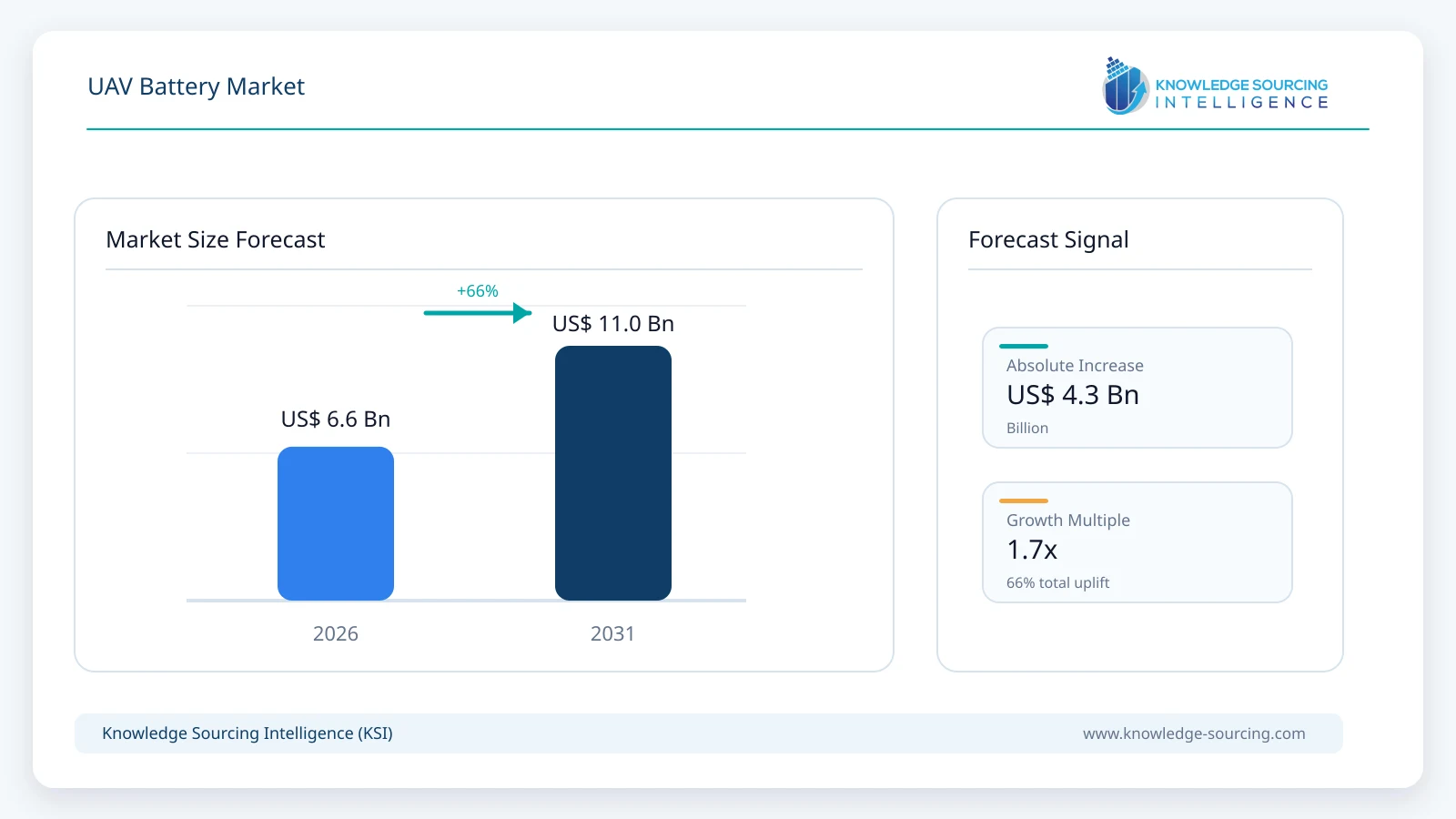
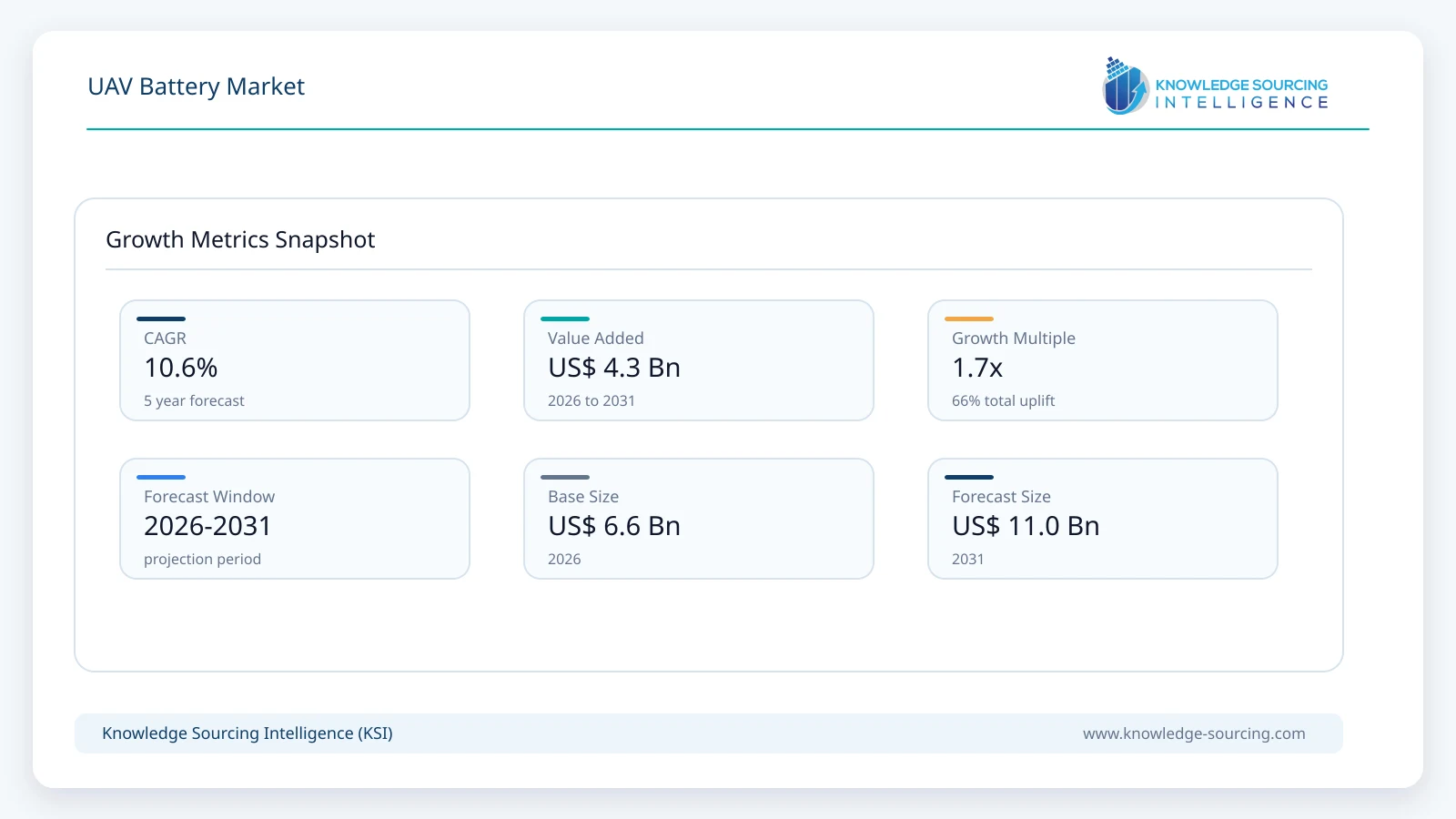
The global UAV Battery Market, with a 10.6% CAGR, is anticipated to reach USD 10.96 billion in 2031 from USD 6.62 billion in 2026.
Highlights:
- 1High-payload commercial transport requirements generate extreme power draw pressures, accelerating the structural transition toward solid-state chemistry platforms that deliver elevated gravimetric thresholds.
- 2Stringent domestic data protection and aerospace component laws restrict traditional reliance on unverified supply loops, increasing the demand for localized, strictly certified cell assembly centers.
- 3Continuous operational cycles within automated agricultural spray programs degrade standard lithium cells rapidly, forcing fleet procurement managers to adopt high-cycle cell architectures that offer extended lifespans.
- 4Harsh environmental operations in defense reconnaissance missions induce structural and thermal stress on standard cell casings, intensifying the engineering push for advanced composite housings that preserve internal cell equilibrium.
Industrial flight applications demand unprecedented airborne endurance levels, forcing a structural shift in cell procurement protocols toward specialized aerospace power configurations. Traditional battery formats exhibit steep voltage drops under high-discharge conditions, which limit the real-world utility of heavier industrial platforms during sustained aerial maneuvers. This operational barrier creates absolute architectural dependencies on next-generation chemical formulations designed specifically to maintain stable voltage plateaus under maximum motor loads.
National aviation authorities are simultaneously imposing strict flight-safety certifications on energy storage cells to mitigate thermal runaway risks in inhabited public zones. These evolving safety guidelines force drone operators to phase out unmonitored power packs, directly increasing the deployment of intelligent battery management networks equipped with localized telemetry sensors. Consequently, advanced battery selection serves as a critical strategic lever for programmatic fleet scaling, directly determining both single-flight economics and long-term asset amortization rates.
Market Dynamics
Drivers
Multi-rotor delivery logistics platforms require constant high-current discharges during vertical ascent phases, driving immediate demand for low-internal-resistance cell designs.
Strict maritime and coastal border surveillance mandates require uninterrupted flight windows, which force the integration of high-capacity fuel cell hybrids over standard solid chemistries.
Precision agricultural mapping initiatives are utilizing heavy multispectral sensor arrays, increasing enterprise dependence on ultra-lightweight power configurations to maximize single-flight acreage coverage.
Tactical military operations are expanding the deployment of loitering munitions and small reconnaissance units, intensifying immediate procurement of reliable, fast-charging battery packs for rapid field redeployment.
Restraints and Opportunities
Volatile raw material supply chains for high-purity lithium and cobalt elements create persistent price barriers, restricting short-term cost reduction initiatives for large-scale commercial fleet buyers.
Volumetric efficiency limitations in standard ambient cooling frameworks restrict high-capacity battery installations, presenting immediate development opportunities for integrated phase-change material thermal jackets.
Stringent international air freight restrictions on high-watt-hour lithium transport disrupt international supply movements, driving structural investments in decentralized regional assembly and charging networks.
Rapid advancements in localized silicon-anode integration present clear paths toward overcoming current gravimetric limits, unlocking potential opportunities for prolonged industrial flight operations without expanding physical battery dimensions.
Supply Chain Analysis
The supply network for unmanned aerial vehicle energy cells functions as a highly specialized, non-linear system where chemical purity directly dictates flight safety margins. Upstream operations depend completely on the strict extraction and processing of battery-grade lithium, cobalt, and high-purity synthetic graphite. These raw elements undergo critical synthesis into active cathode and anode materials, where minor particulate contamination introduces severe thermal risks. Midstream component manufacturers convert these processed materials into individual power cells, combining them with advanced separation films and specialized liquid or solid electrolytes.
Downstream systems integration companies assemble these single cells into balanced multi-cell configurations, embedding localized battery monitoring circuit boards to ensure voltage equilibrium during high-discharge flight phases. The primary operational vulnerability resides in the extreme concentration of anode and cathode precursor refinement facilities within limited geographical zones. This spatial imbalance exposes aerospace defense contractors and commercial operators to sudden logistics disruptions and regulatory export bottlenecks. Consequently, Tier 1 drone manufacturers are restructuring component validation processes by executing direct long-term supply agreements with localized chemical processors to ensure manufacturing continuity.
Government Regulations
Regulatory Body | Regional Jurisdiction | Core Policy | Documented Market Operational Impact |
European Union Aviation Safety Agency (EASA) | European Union | Regulation (EU) 2019/945 and 2019/947 | Establishes mandatory design verification and manufacturing quality standards for propulsion battery containment, forcing the implementation of standardized internal thermal runaway isolation layers. |
Federal Aviation Administration (FAA) | United States | 14 CFR Part 89 (Remote ID) and Airworthiness Directives | Demands continuous power allocation for tracking transmitters, driving structural shifts toward dedicated, isolated backup cell channels within the primary unmanned aircraft electrical system. |
International Civil Aviation Organization (ICAO) | International / Global Air Transit | Doc 9284 - Safe Transport of Dangerous Goods by Air | Imposes strict state-of-charge limitations (maximum 30% capacity) on bulk air cargo shipments of lithium batteries, forcing regional distributors to build localized post-shipping charging centers. |
State Council of the People's Republic of China | China | Export Control Law on Unmanned Aerial Systems (2024 Framework) | Controls the outbound movement of high-specification engines, lasers, and high-capacity propulsion cells, compelling international operators to diversify component sourcing paths. |
Key Developments
May 2026: Tattu introduced its 5.0 Smart Battery Platform for 100 kg-class agricultural and logistics UAVs. The system combines 6C fast charging, intelligent battery management, lifecycle monitoring, and high-discharge performance to improve fleet utilization, reduce downtime, and support heavier payload drone operations.
March 2026: NEO Battery Materials closed the acquisition of a 3.2-acre expansion site in South Korea. The facility will mass-produce customized silicon-enhanced pouch-cells to supply non-Chinese battery supply chains for defense drones.
May 2025: Factorial Inc. officially shipped its first solid-state lithium-metal battery cells to Avidrone Aerospace. This milestone marked the drone sector's inaugural flight deployment of Factorial’s proprietary, safety-focused FEST electrolyte platform.
April 2025: Amprius unveiled its 450 Wh/kg SiCore™ cell, targeting aviation and UAV applications requiring extended endurance. The battery delivers exceptionally high energy density while remaining suitable for near-term mass production, enabling longer flight times and improved mission capabilities for advanced drones.
Market Segmentation
By UAV Type
Low-altitude long-endurance platforms require continuous, low-amplitude current distribution over extended timeframes to ensure steady flight profiles during atmospheric monitoring missions. This specialized operational requirement shifts procurement focus away from explosive discharge capabilities toward maximum volumetric energy density values. Cell degradation mechanisms accelerate when these units operate in turbulent lower-atmospheric boundaries, which forces the development of chemical structures that tolerate constant micro-adjustments in throttle positioning.
Medium-altitude long-endurance architectures handle heavier defensive and commercial tracking payloads, generating significant structural power demands that standard small-scale cells cannot satisfy. Operators are deploying heavy multi-cell packs to maintain operational stability across diverse thermal zones, creating acute engineering trade-offs between overall payload capacity and physical battery weight. This structural tension accelerates the adoption of advanced cell monitoring technologies that dynamically reallocate energy reserves based on changing power demands.
High-altitude long-endurance configurations function in extreme low-temperature environments, creating severe chemical performance challenges that lead to rapid voltage decay in standard commercial batteries. Survival in these upper-atmospheric zones requires integrated thermal management systems that consume a portion of the stored energy to maintain functional internal cell temperatures. This continuous self-heating requirement forces aircraft designers to integrate ultra-high-efficiency fuel cell systems or advanced lithium-sulfur variants capable of operating reliably without causing structural weight overloads.
By Battery Type
Fuel cell installations are expanding within the heavy commercial sector because traditional battery formats cannot support long-endurance flight missions without adding excessive weight. These hydrogen-based propulsion systems deliver high gravimetric efficiency values, which allow large industrial platforms to operate continuously for multiple hours. This extended performance window reduces the operational downtime associated with frequent battery swaps, modifying field infrastructure requirements toward centralized gas compression and delivery setups.
Lithium-ion cells dominate standard commercial flight fleets due to their predictable discharge curves and established manufacturing ecosystems. This high market penetration creates widespread manufacturing dependencies, exposing fleet operators to volatile raw material pricing in the upstream battery metals market. To mitigate these financial and operational vulnerabilities, manufacturers are adjusting internal cell architectures by integrating silicon-composite anodes to increase energy density without altering standard physical formats.
Nickel-cadmium configurations remain restricted to highly specialized, legacy defense architectures where absolute operational reliability under extreme mechanical vibration overrides weight optimization goals. These cells provide robust physical resilience and long storage lifespans, allowing tactical defense units to remain inactive for extended periods without experiencing critical cell degradation. However, environmental directives and low energy-to-weight ratios are driving the transition toward lighter, more stable solid-state alternatives.
Lithium polymer packs remain popular for agile, small-scale aerial systems due to their flexible form factors and excellent high-rate discharge capabilities during sudden high-velocity maneuvers. This high discharge characteristic creates significant thermal management challenges during rapid acceleration phases, requiring advanced structural ventilation pathways within the drone chassis. Consequently, operators are balancing short-term performance benefits against shorter cycle lives, which increases ongoing asset replacement costs for large-scale logistics operations.
Regional Analysis
North America
North American commercial flight programs are deploying heavy automated transport fleets to optimize regional logistics routes, creating substantial demand for advanced, high-watt-hour energy storage units. This industrial push relies heavily on the expansion of certified drone flight corridors near major urban supply hubs, which shifts engineering requirements toward fully redundant, dual-pack power architectures. Stringent military modernization programs across the United States defense sector are simultaneously funneling capital into ruggedized cell manufacturing, ensuring reliable performance in demanding environments. These defense requirements restrict reliance on foreign components, forcing battery manufacturers to build domestic assembly plants to secure long-term government supply contracts. Consequently, the regional market is moving toward vertically integrated supply structures that prioritize absolute security of supply over short-term component cost reductions.
South America
South American agricultural enterprises are expanding precision spraying and crop monitoring operations across large geographical regions, which accelerates the adoption of long-range unmanned flight systems. This operational expansion creates immediate demand for high-cycle-life batteries capable of resisting degradation under humid, high-ambient-temperature conditions. Local flight operators face high import tariffs on fully assembled foreign power systems, which encourages domestic service partners to develop localized repackaging and cell maintenance capabilities. This regional dynamic shift procurement priorities toward battery types that allow modular element replacement, bypassing the need to import complete power assemblies. Furthermore, the expansion of large mining operations in remote mountain corridors is driving the adoption of specialized topographic mapping drones, which further increases regional demand for low-temperature-tolerant battery packs.
Europe
European drone operators are adopting advanced autonomous flight platforms in response to strict regional carbon reduction mandates across industrial transport sectors, accelerating the transition away from internal combustion propulsion. This regulatory environment creates stringent safety testing requirements for all energy storage units operating within shared airspace corridors, accelerating the adoption of smart battery systems with built-in fault isolation mechanics. The regional market depends heavily on strict compliance with unified aviation safety guidelines, which effectively blocks unmonitored or uncertified battery imports from entering commercial operations. This regulatory barrier forces local manufacturers to invest in self-diagnostic circuit integration, which increases initial equipment costs but lowers long-term liability risks for corporate fleet users. Additionally, the rapid growth of offshore wind energy inspections is driving the demand for specialized, moisture-resistant battery enclosures capable of withstanding saltwater corrosion during extended coastal deployment cycles.
Middle East and Africa
Middle Eastern infrastructure modernization initiatives are driving the deployment of long-endurance inspection drones along expansive cross-country oil and water pipeline networks, requiring specialized energy cells that resist high-heat degradation. Extreme ambient field temperatures cause rapid thermal acceleration in standard lithium chemistries, forcing local state enterprises to demand custom phase-change cooling structures within all imported power modules. This technical environment shifts procurement toward specialized chemical variants that maintain structural stability up to high operating limits without experiencing cell swelling. Meanwhile, African wildlife conservation and border enforcement agencies are expanding their use of long-range reconnaissance aircraft, which increases the demand for quiet, high-efficiency fuel cell propulsion setups over nosier mechanical options.
Asia Pacific
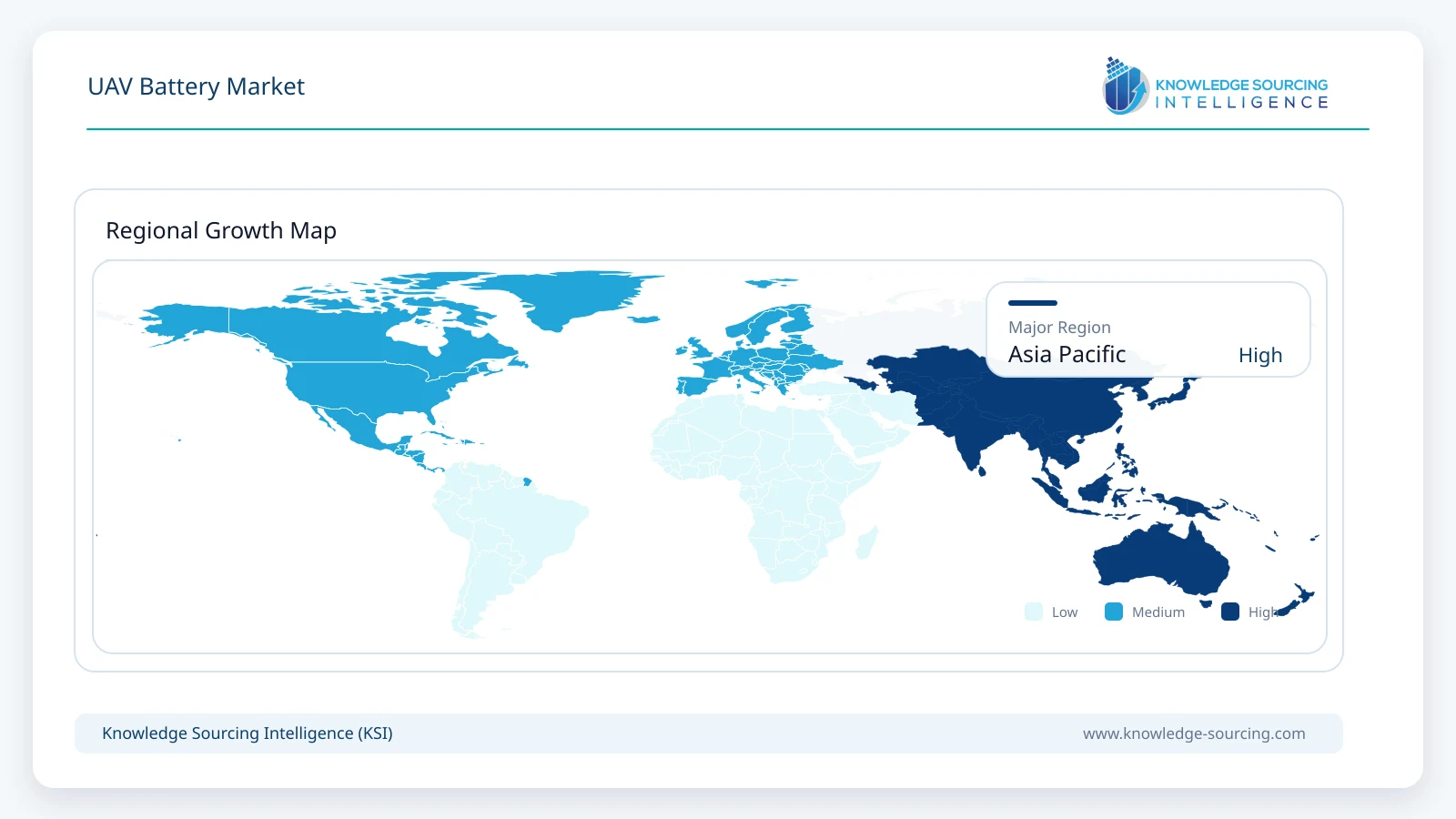
Asia Pacific manufacturing facilities are expanding high-volume production lines for multi-rotor aircraft, creating a highly concentrated hub for global battery component distribution. Localized access to major chemical processing facilities and anode-cathode fabrication plants allows regional manufacturers to test and deploy new material formulations much faster than global competitors. This manufacturing advantage encourages rapid commercial experimentation with silicon-anode and solid-state alternatives, attracting global aerospace firms looking to source high-density power cells. Furthermore, domestic agricultural automation policies in major economies are driving the mass deployment of localized spraying fleets, ensuring continuous domestic demand for high-discharge battery packs. This sustained internal demand enables regional manufacturers to achieve significant economies of scale, lowering production costs and reinforcing the region's position as a primary supplier of global aerospace energy components.
Competitive Landscape
Ballard Power Systems
Denchi Power Limited
Sion Power Corporation
Tadiran Batteries
OXIS Energy
H3 Dynamics
Ultracharge
MicroMultiCopter Aero Technology Co., Ltd.
Hylium Industries INC.
Company Profiles
Ballard Power Systems
Ballard Power Systems strategically focuses on the engineering design and high-volume manufacture of high-density proton exchange membrane fuel cells for long-endurance flight operations. The company provides specialized zero-emission hydrogen modules that replace conventional heavy battery architectures, which allows commercial operators to significantly extend drone flight times.
Denchi Power Limited
Denchi Power Limited specializes in the design and production of ruggedized, high-reliability lithium-ion battery configurations for critical defense and aerospace applications. The organization constructs high-durability power systems featuring advanced internal management electronics to ensure constant telemetry reporting and complete operational safety under severe combat conditions.
Sion Power Corporation
Sion Power Corporation leads the commercialization of next-generation lithium-metal battery chemistries designed to replace standard low-density options in advanced air mobility. The enterprise utilizes proprietary Licerion technology to deliver elevated gravimetric energy densities, which significantly improve the payload capacity of autonomous platforms.
Analyst View
Autonomous flight operations are expanding globally, which creates an immediate structural requirement for lighter, higher-density energy storage solutions. Advanced chemical configurations and smart power monitoring modules are successfully overcoming legacy airborne endurance barriers, which accelerates corporate and military investment in long-range drone logistics networks.
UAV Battery Market Scope:
| Report Metric | Details |
|---|---|
| Total Market Size in 2026 | USD 6.62 billion |
| Total Market Size in 2031 | USD 10.96 billion |
| Forecast Unit | Billion |
| Growth Rate | 10.6% |
| Study Period | 2021 to 2031 |
| Historical Data | 2021 to 2024 |
| Base Year | 2025 |
| Forecast Period | 2026 – 2031 |
| Segmentation | UAV Type, Battery Type, Geography |
| Companies |
|
Market Segmentation
By UAV Type
Low-altitude long-endurance (LALE)
Medium-altitude long-endurance (MALE)
High-altitude long-endurance (HALE)
Others
By Battery Type
Fuel Cell
Lithium-ion
Nickel-cadmium
Lithium Polymer
Others
By Geography
North America
USA
Canada
Mexico
South America
Brazil
Argentina
Others
Europe
Germany
France
United Kingdom
Spain
Others
Middle East and Africa
Saudi Arabia
UAE
Others
Asia Pacific
China
India
Japan
South Korea
Indonesia
Thailand
Others
Table of Contents
1. EXECUTIVE SUMMARY
2. MARKET SNAPSHOT
2.1. Market Overview
2.2. Market Definition
2.3. Scope of the Study
2.4. Market Segmentation
3. BUSINESS LANDSCAPE
3.1. Market Drivers
3.2. Market Restraints
3.3. Market Opportunities
3.4. Porter’s Five Forces Analysis
3.5. Industry Value Chain Analysis
3.6. Policies and Regulations
3.7. Strategic Recommendations
4. TECHNOLOGICAL OUTLOOK
5. GLOBAL UAV BATTERY MARKET BY UAV TYPE
5.1. Introduction
5.2. Low-altitude long-endurance (LALE)
5.3. Medium-altitude long-endurance (MALE)
5.4. High-altitude long-endurance (HALE)
5.5. Others
6. GLOBAL UAV BATTERY MARKET BY BATTERY TYPE
6.1. Introduction
6.2. Fuel cell
6.3. Lithium-ion
6.4. Nickel-cadmium
6.5. Lithium polymer
6.6. Others
7. GLOBAL UAV BATTERY MARKET BY GEOGRAPHY
7.1. Introduction
7.2. North America
7.2.1. USA
7.2.2. Canada
7.2.3. Mexico
7.3. South America
7.3.1. Brazil
7.3.2. Argentina
7.3.3. Others
7.4. Europe
7.4.1. Germany
7.4.2. France
7.4.3. United Kingdom
7.4.4. Spain
7.4.5. Others
7.5. Middle East and Africa
7.5.1. Saudi Arabia
7.5.2. UAE
7.5.3. Others
7.6. Asia Pacific
7.6.1. China
7.6.2. India
7.6.3. Japan
7.6.4. South Korea
7.6.5. Indonesia
7.6.6. Thailand
7.6.7. Others
8. COMPETITIVE ENVIRONMENT AND ANALYSIS
8.1. Major Players and Strategy Analysis
8.2. Market Share Analysis
8.3. Mergers, Acquisitions, Agreements, and Collaborations
8.4. Competitive Dashboard
9. COMPANY PROFILES
9.1. Ballard Power Systems
9.2. Denchi Power Limited
9.3. Sion Power Corporation
9.4. Tadiran Batteries
9.5. OXIS Energy
9.7. Ultracharge
9.8. MicroMultiCopter Aero Technology Co., Ltd.
9.9. Hylium Industries INC.
10. APPENDIX
10.1. Currency
10.2. Assumptions
10.3. Base and Forecast Years Timeline
10.4. Key benefits for the stakeholders
10.5. Research Methodology
10.6. Abbreviations
LIST OF FIGURES
LIST OF TABLES
Navigate
Trusted by the world's leading organizations











