
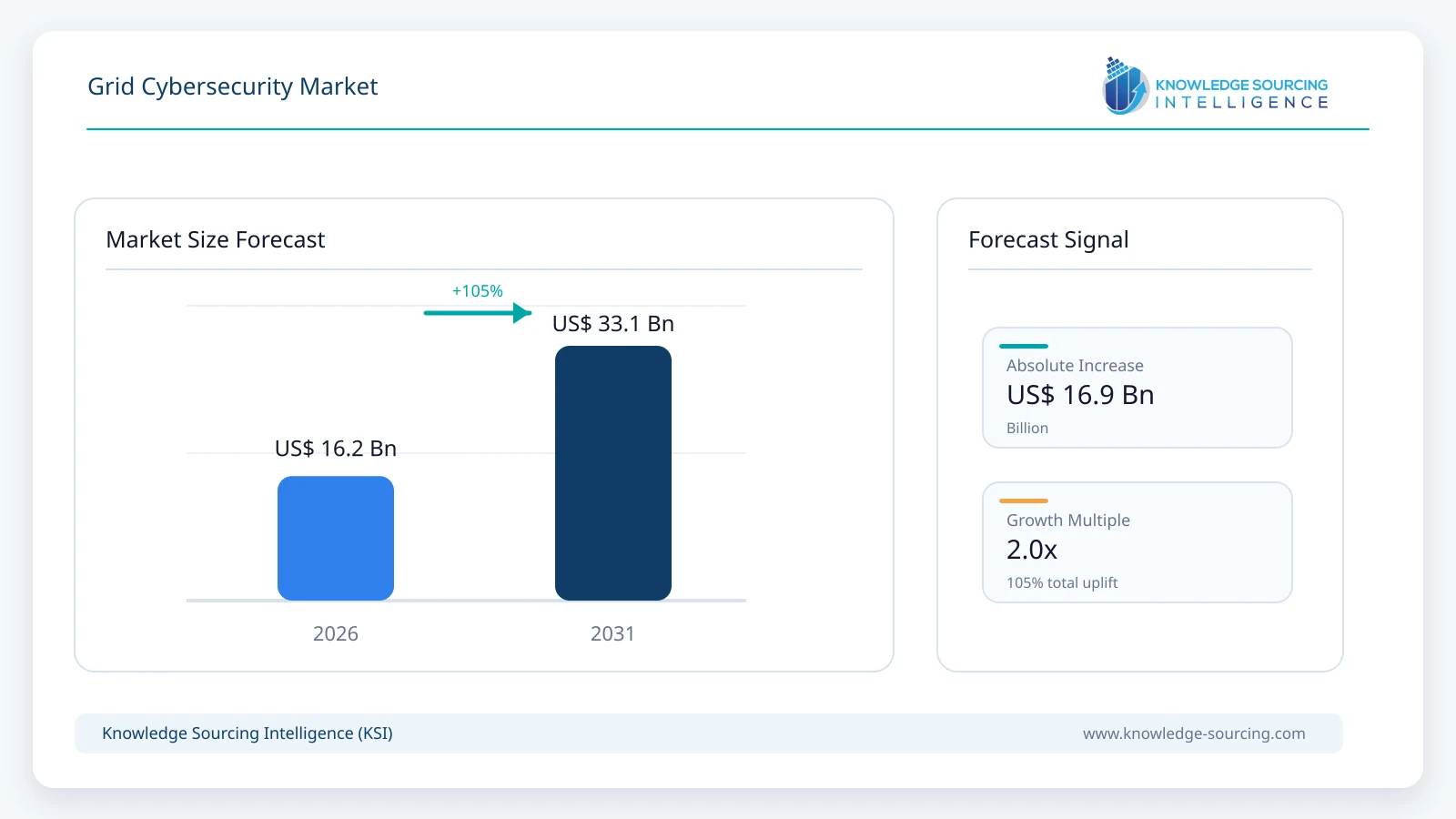
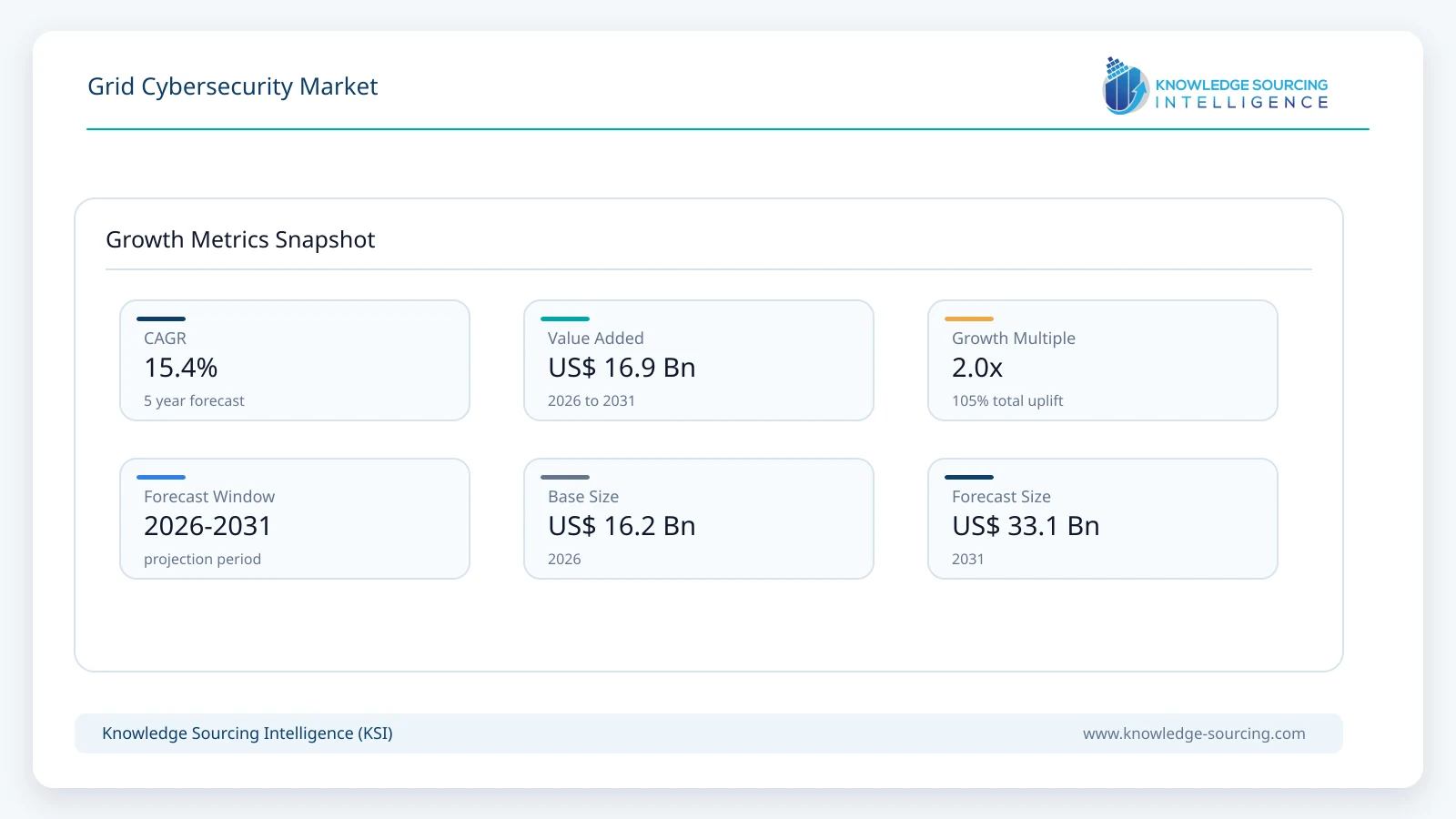
The Grid Cybersecurity Market is projected to increase from USD 16.18 billion in 2026 to USD 33.11 billion in 2031, growing at a CAGR of 15.4% over the forecast period.
Highlights:
- 1Operational technology that has been built over time is still a limiting factor in the deployment of security within live grid environments.
- 2Apart from the mandatory cybersecurity standards, zero trust architecture of critical infrastructure networks is recognized as one of the top market growth drivers.
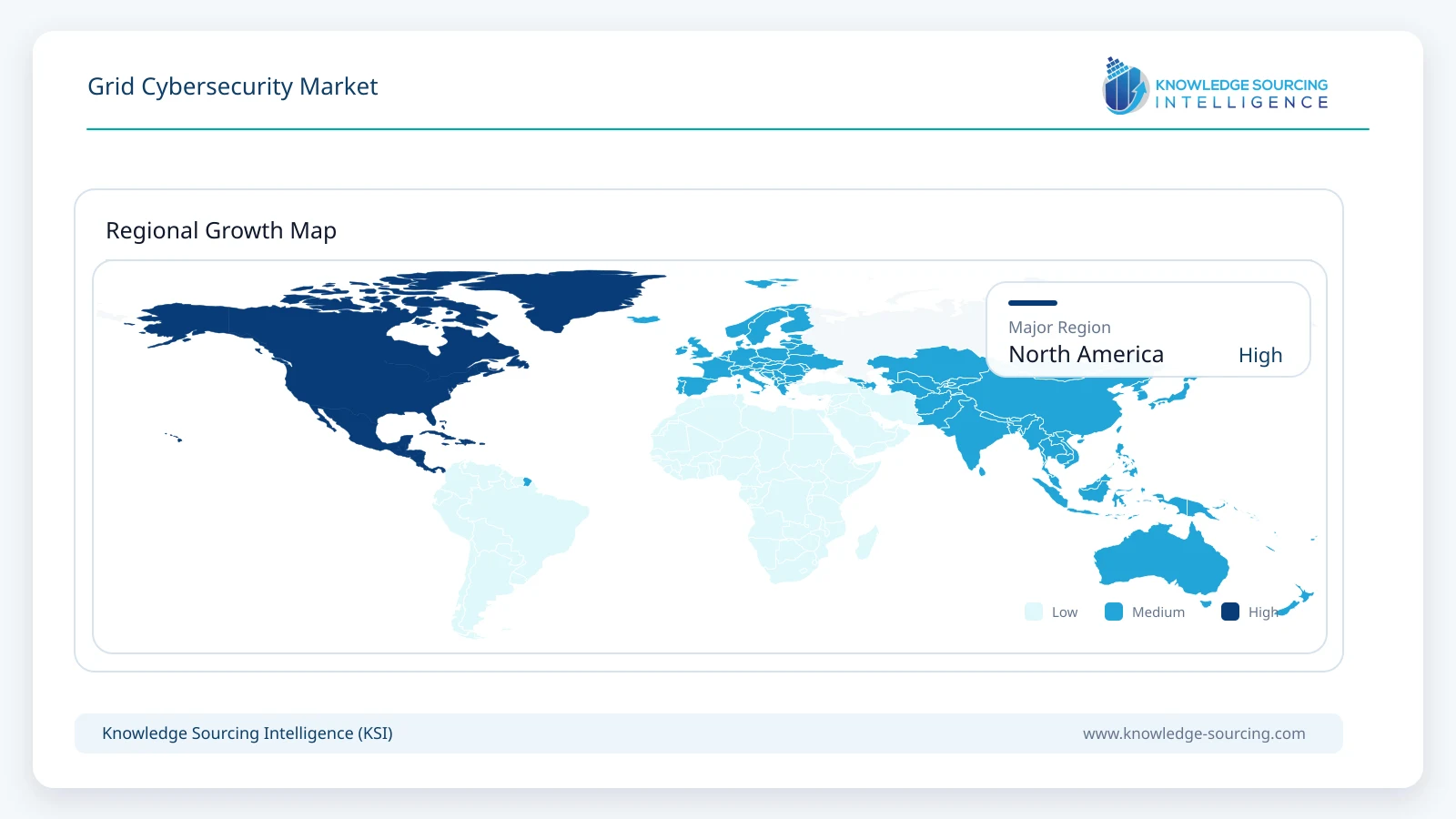
- 3North America remains a key market driven by regulatory support and investments, while Asia-Pacific is projected to be the fastest-growing region, supported by accelerating grid digitalization.
- 4Increasing volumes of grid telemetry data and security events are opening the door to AI-assisted threat detection in utility settings.
The market segments are solutions (software and hardware to shield the grid infrastructure and maintain data integrity) and services (consulting, integration and managed security). Services are expected to grow, albeit holding a smaller share, in the related smart-grid security research space as utilities struggle to design and operate security in a mix of legacy infrastructure and new systems.
Cybersecurity solutions are deployed through both on-premises and cloud-based models, with adoption patterns evolving as organizations modernize their infrastructure. Cloud-based solutions are gaining traction due to their scalability, flexibility, and integration with advanced analytics and operational platforms. Security requirements span generation, transmission, distribution, and the growing ecosystem of distributed energy resources and grid-edge devices.
On the investment and regulatory front, North America is leading the way with mandatory reliability standards and federal programs for the protection of critical infrastructure; Europe is progressing with NIS2 and national energy-security regulations. The region is likely to see the fastest growth among regions, with grid expansion and digitalization expected to pick up momentum in China, India, Japan, and Southeast Asia. Importation taxes on security appliances and sensors have increased the cost of implementation and the time for some upgrades, while incentivizing software and cloud-based security appliances.
Market Dynamics
Market Drivers
As more and more assets are networked, the grid digitalization project, smart meter and substation automation deployment, and the increasing deployment of connected distributed energy resources, are increasing the number of assets that must be protected.
The growing volume of cyber threats to critical infrastructure, along with the growing geopolitical danger, is driving utilities and regulators to place greater importance on grid resilience and invest in specific security initiatives.
Advanced security controls are becoming a necessity for utilities and grid operators as mandatory cybersecurity requirements and stricter regulatory requirements of the critical infrastructure protection is forcing it.
A move toward cloud-based grid operations and the adoption of a zero trust architecture are driving demand for secure identity-based access control and continuous monitoring in utility networks.
Market Restraints & Opportunities
The pace of security deployment is slowed by legacy operational technology which may not be easily patchable or replaceable, long asset lifecycles, and the need to avoid disruption to operational activities while grid is in use.
The cost of security appliances, network hardware, sensors and encryption modules, which are imported to the country, has increased the cost of implementing grid protection, and there is a shortage of professionals who have the expertise of both cybersecurity and power systems.
However, AI-enhanced threat detection, alongside managed security services and software-driven protection models, are opening up significant opportunity for vendors with the ability to provide protection for legacy environments without disrupting operations and meet increasingly stringent standards for utilities.
Key Developments
October 2026: Fibocom, a leading global provider of wireless communication modules and AI solutions, collaboarted with India-based IoT ODM Grid-OS to advance smart payment and vehicle tracking applications in India.
June 2026: Toshiba Corporation announced the launch of the GridDB Startup Program, a strategic initiative that will empower startups in building and scaling real-time industrial solutions on GridDB Cloud, Toshiba’s distributed time-series database for Big Data and IoT systems.
Grid Cybersecurity Market Segmentation
The market is segmented by component, deployment mode, grid segment, end user, and geography.
By Component
Solutions
Solutions account for a greater proportion of spending, for the monitoring, segmentation, secure remote access, endpoint and identity controls and security analytics of industrial networks.
Dragos, Inc. provides industrial control system threat detection and response used by utilities and grid operators.
Nozomi Networks Inc. offers network visibility and threat detection for operational technology environments, including power utilities.
By Deployment Mode
On-Premises and Cloud
On-premises systems remain the majority because regulation favors defined network boundaries and control systems demand high availability, while cloud deployment is growing fastest as utilities move analytics and operations to the cloud.
Siemens AG integrates security into its grid and substation automation portfolio and provides utility cybersecurity services.
Cisco Systems, Inc. supplies industrial networking and security for substations and utility field networks.
By Grid Segment
Transmission and Distribution
Transmission and distribution networks are central to spending, as operators secure substations, SCADA systems and the growing population of grid-edge devices that connect to them.
ABB Ltd. and Schneider Electric SE combine grid automation and distributed energy management with embedded cybersecurity capabilities.
Regional Analysis
North America
North America leads on regulation and investment, supported by mandatory reliability and cybersecurity standards for the bulk power system, federal critical-infrastructure programs and a dense base of security vendors.
Europe
Europe's market is shaped by NIS2 and national energy-security measures, with utilities investing in resilience as grids integrate large volumes of renewable and distributed generation.
Asia-Pacific
Asia-Pacific is expected to be among the fastest-growing regions as grid expansion and digitalization accelerate in China, India, Japan and Southeast Asia, alongside rising attention to critical-infrastructure protection.
Middle East and Africa
The Middle East and Africa are investing in grid modernization and smart-grid programs, particularly in the Gulf states, with security increasingly built into new projects.
South America
South America is a developing market, with utilities in Brazil and neighboring countries expanding smart-metering and digital substations and beginning to raise security spending.
List of Companies
Siemens AG
ABB Ltd.
Schneider Electric SE
General Electric Company (GE Vernova)
Honeywell International Inc.
Cisco Systems, Inc.
IBM Corporation
Fortinet, Inc.
Palo Alto Networks, Inc.
Dragos, Inc.
Nozomi Networks Inc.
Claroty Ltd.
Competitive Landscape
Siemens AG
Siemens offers grid automation, substation and energy-management technology with integrated security and utility cybersecurity services, benefiting from its installed base across transmission and distribution networks.
Dragos, Inc.
Dragos specializes in industrial control system security, providing threat detection, intelligence and incident response widely used by electric utilities.
Nozomi Networks Inc.
Nozomi Networks supplies operational technology visibility and threat detection, with deployments across utilities, energy and critical infrastructure.
Analyst View
The Grid Cybersecurity market is expanding quickly as the grid becomes more digital, more distributed and more exposed. Estimates differ widely by scope, so headline figures should be read against definition. Regulation and a worsening threat environment are turning security into a core reliability requirement, while legacy equipment and tariff-driven cost pressure slow deployment. Services and cloud-delivered models are growing faster than the base, and zero trust and AI-assisted detection are shaping product roadmaps. Vendors that can protect legacy operational technology without disrupting operations, integrate security into grid automation platforms, and offer managed services are best positioned to capture the next phase of spending.
Grid Cybersecurity Market Scope:
| Report Metric | Details |
|---|---|
| Total Market Size in 2026 | USD 16.18 billion |
| Total Market Size in 2031 | USD 33.11 billion |
| Forecast Unit | USD Billion |
| Growth Rate | 15.4% |
| Study Period | 2021 to 2031 |
| Historical Data | 2021 to 2024 |
| Base Year | 2025 |
| Forecast Period | 2026 – 2031 |
| Segmentation | Component, Deployment Mode, Grid Segment, End User, Geography |
| Companies |
|
Market Segmentation
By Component
Solutions
Services
By Deployment Mode
On-Premises
Cloud
Hybrid
By Grid Segment
Generation
Transmission
Distribution
Distributed Energy Resources
By End User
Electric Utilities
Independent Power Producers
Government & Regulatory Bodies
Others
By Geography
North America
USA
Canada
Mexico
South America
Brazil
Others
Europe
Germany
France
United Kingdom
Others
Middle East and Africa
UAE
Saudi Arabia
Others
Asia Pacific
China
India
Japan
Others
Table of Contents
1. EXECUTIVE SUMMARY
2. MARKET SNAPSHOT
2.1. Market Overview
2.2. Market Definition
2.3. Scope of the Study
2.4. Market Segmentation
3. BUSINESS LANDSCAPE
3.1. Market Drivers
3.2. Market Restraints
3.3. Market Opportunities
3.4. Porter's Five Forces Analysis
3.5. Industry Value Chain Analysis
3.6. Policies and Regulations (NERC CIP, NIS2, Critical Infrastructure Protection)
3.7. Strategic Recommendations
4. TECHNOLOGICAL OUTLOOK
4.1. Zero Trust for Critical Infrastructure
4.2. OT Network Monitoring & Intrusion Detection
4.3. Securing Distributed Energy Resources
4.4. AI-Augmented Threat Detection
5. GRID CYBERSECURITY MARKET BY COMPONENT
5.1. Introduction
5.2. Solutions
5.3. Services
6. GRID CYBERSECURITY MARKET BY DEPLOYMENT MODE
6.1. Introduction
6.2. On-Premises
6.3. Cloud
6.4. Hybrid
7. GRID CYBERSECURITY MARKET BY GRID SEGMENT
7.1. Introduction
7.2. Generation
7.3. Transmission
7.4. Distribution
7.5. Distributed Energy Resources
8. GRID CYBERSECURITY MARKET BY END USER
8.1. Introduction
8.2. Electric Utilities
8.3. Independent Power Producers
8.4. Government & Regulatory Bodies
8.5. Others
9. GRID CYBERSECURITY MARKET BY GEOGRAPHY
9.1. Introduction
9.2. North America
9.2.1. USA
9.2.2. Canada
9.2.3. Mexico
9.3. South America
9.3.1. Brazil
9.3.2. Others
9.4. Europe
9.4.1. Germany
9.4.2. France
9.4.3. United Kingdom
9.4.4. Others
9.5. Middle East and Africa
9.5.1. UAE
9.5.2. Saudi Arabia
9.5.3. Others
9.6. Asia Pacific
9.6.1. China
9.6.2. India
9.6.3. Japan
9.6.4. Others
10. COMPETITIVE ENVIRONMENT AND ANALYSIS
10.1. Major Players and Strategy Analysis
10.2. Market Share Analysis
10.3. Mergers, Acquisitions, Agreements, and Collaborations
10.4. Competitive Dashboard
11. COMPANY PROFILES
11.1. Siemens AG
11.2. ABB Ltd.
11.3. Schneider Electric SE
11.4. General Electric Company (GE Vernova)
11.5. Honeywell International Inc.
11.6. Cisco Systems, Inc.
11.7. IBM Corporation
11.8. Fortinet, Inc.
11.9. Palo Alto Networks, Inc.
11.10. Dragos, Inc.
11.11. Nozomi Networks Inc.
11.12. Claroty Ltd.
12. APPENDIX
12.1. Currency
12.2. Assumptions
12.3. Base and Forecast Years Timeline
12.4. Key Benefits for the Stakeholders
12.5. Research Methodology
12.6. Abbreviations
Navigate
Trusted by the world's leading organizations











