
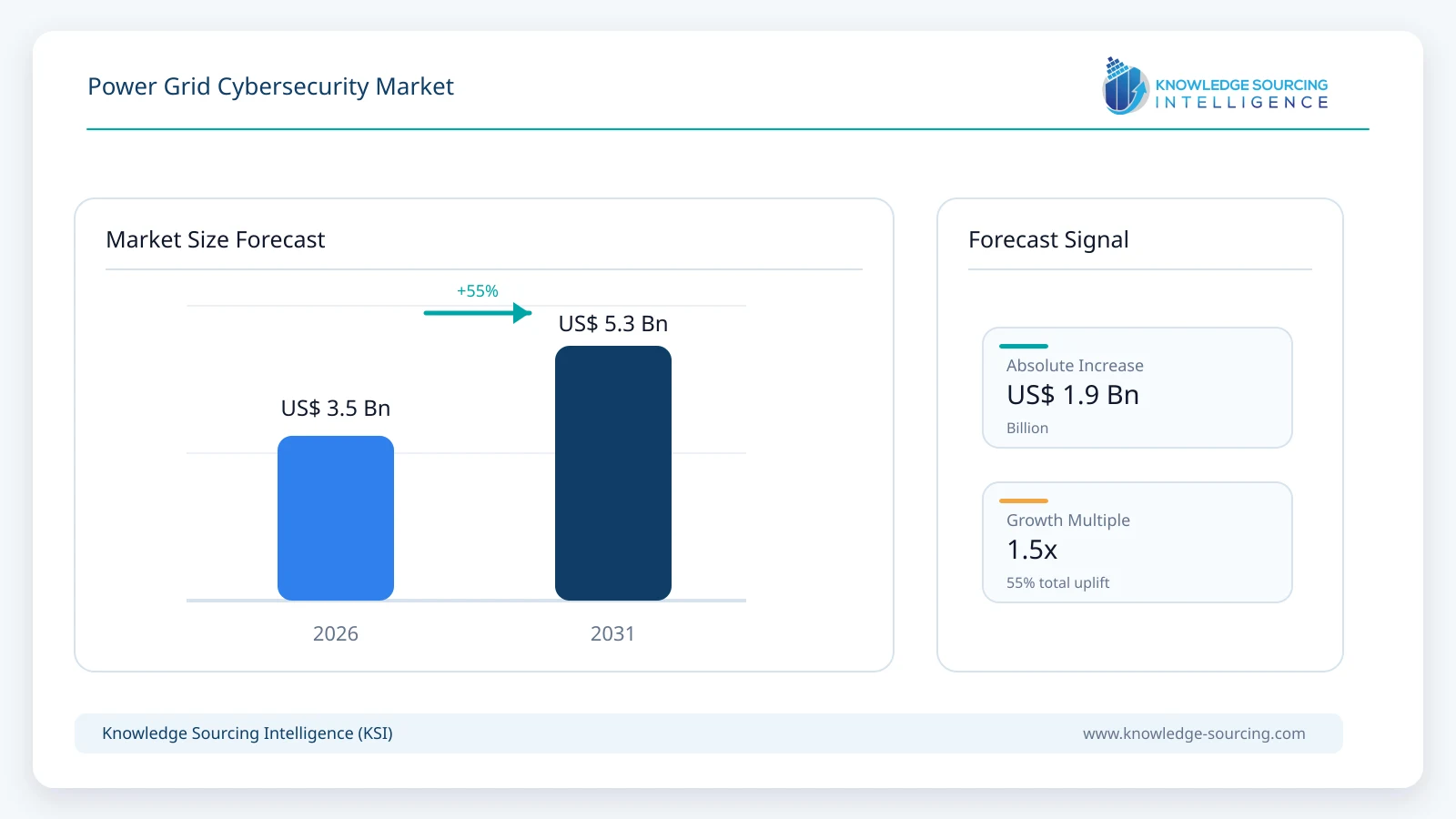
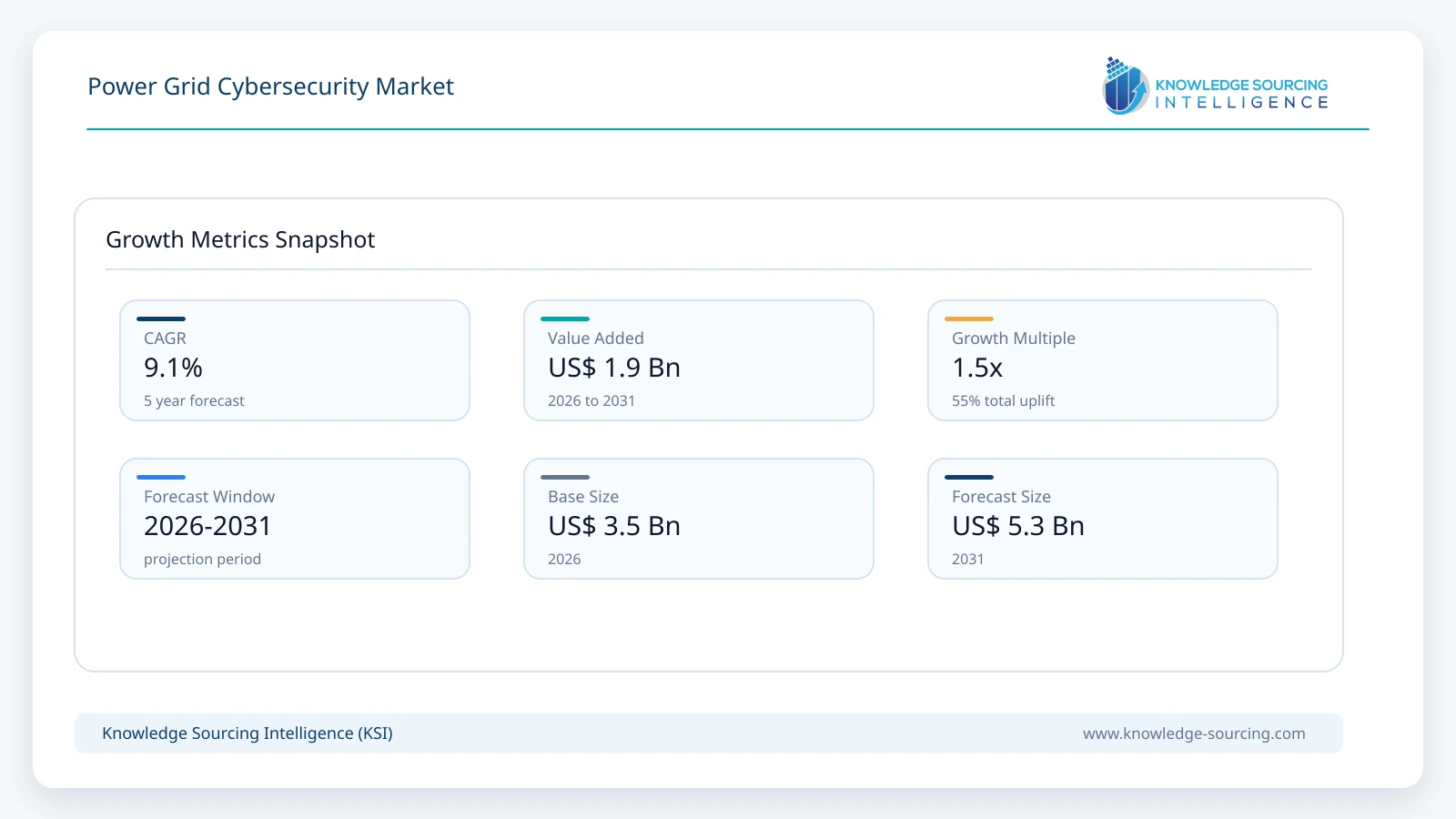
The Power Grid Cybersecurity Market is forecast to grow at a CAGR of 9.1%, reaching USD 5.35 billion in 2031 from USD 3.46 billion in 2026.
Highlights:
- 1The current focus on power-grid cybersecurity is mainly focused on enterprise-inspired IT along with OT and ICS types of approaches.
- 2Smart meters, networked substations, distributed energy resources (DERs) and smart EVs, storage systems and IoT devices are driving the number of connected endpoints in electricity systems.
- 3Utilities and equipment suppliers are designing cybersecurity into the product during development, engineering, commissioning, and lifecycle management.
- 4The rise in requirements for continuous security monitoring, documentation, and incident-response processes due to this lack of visibility into the types of connections or flows that exist between information networks and control networks.
Utilities are required to layer protection onto generation assets, transmission networks, distribution systems, substations, control centers, and communication infrastructure as well as distributed energy resources, at the same time. Power-grid cybersecurity ranges from hardware and security solutions to cybersecurity software, monitoring platforms, managed services, vulnerability assessment, incident response, secure remote access, network segmentation, endpoint protection, identity management, threat intelligence, and security compliance.
The trend that can heavily influence the market is due to the convergence of information technology and operational technology. In addition, legacy power infrastructure was often built on isolated control systems and long asset lifecycles; however, modern grids rely more heavily on standardized communication protocols, connected sensors, cloud applications, remote access, and interoperable digital platforms.
Additionally, utilities are deploying security controls much closer to operational assets. For instance, Siemens identifies OT/ICS asset inventory, vulnerability-risk prioritization, secure remote access, continuous OT/ICS network monitoring, insider-threat detection, and incident response within its Noedra Shield grid cybersecurity framework.
Increased deployment of smart grids and digital substations is adding to the demand. Hence, a core challenge for the market ecosystem comes down to utilities needing to accelerate digital transformation; otherwise, they increase the odds that compromised digital systems can influence physical electricity operations.
Power Grid Cybersecurity Market Key Highlights
Market Dynamics
Market Drivers
Increasing Digitalization of Electricity Grids: utilities are incorporating smart meters, intelligent protection systems, various types of sensors for remote monitoring, and connected grid-management platforms, from building digital substations to using automated distribution systems, to improve reliable and efficient operation. Digitalization is simultaneously highlighted by the IEA as increasing the efficiency of electricity systems and also raising cybersecurity threats.
Expansion of Distributed Energy Resources: Distributed solar, battery storage, EV chargers, flexible loads, and other DERs alter the way in which electricity travels through distribution networks. Moreover, these resources are becoming progressively automated and administered from a distance. As per strategic planning material from NERC, DERs and distribution-side aggregators expand the current attack surface, and the threat landscape is expected to see an increase in threats from lone actors and state-sponsored hackers. This is encouraging utilities to deploy cybersecurity controls across DER communication systems, aggregation platforms, distribution-management systems, and other endpoints in the network.
Cybersecurity Threat Landscape on Critical Infrastructure: Since power systems impact hospitals, transportation, telecommunications, financial institutions, industrial facilities, and households, electricity infrastructure continues to be a high-value target. North America experienced a steadily evolving threat landscape in 2025, with an increasing frequency of new threats never before seen in bulk power system security, including approximately 1,900 member and partner organizations receiving electricity-security information and risk-mitigation resources from NERC. It is therefore the growing sophistication of cyber threats that is forcing utilities to transition from reactive incident response to continuous monitoring, threat detection, vulnerability management, and resilience planning.
Increasing Regulatory and Compliance Requirements: Power utilities are critical infrastructure operators who face sector-specific cybersecurity regulations. NERC CIP obligations for North American utilities and the growing number of international operators with other standards, including IEC 62443, IEC 62351, NIST, NIS2, and national cybersecurity framework standards. GE Vernova includes its support for compliance with NERC CIP, NESA IAS, and the EU NIS Directive for grid cybersecurity solutions, while its grid offerings have also been certified to IEC 62443-2-4 and IEC 62443-3-3. This is increasing the recurring demand for services in areas such as cybersecurity assessment & monitoring, compliance reporting, vulnerability management, and managed security.
Market Restraints & Opportunities
Power infrastructure often has an operational life of decades, so new digital systems must work alongside older equipment that could not have been designed to connect to a network because it did not exist at the time. The IEA stated that since electricity infrastructure can be in use for over 50 years, this will lead to combinations of modern digital devices and legacy assets.
Migrating legacy equipment solely for cybersecurity reasons is expensive and operationally disruptive. As such, utilities increasingly need compensating controls, including network segmentation, secure gateways, monitoring solutions that are resilient, patch management at the virtual level, and controlled remote access.
OT cybersecurity domains are developing managed services, cybersecurity assessments, vulnerability management, incident-response programs, continuous monitoring, and security operations centers in response to the lack of specialized OT cybersecurity expertise.
Rising grid telemetry and cybersecurity event volumes are presenting analytical opportunities to augment threat detection with AI.
Key Developments
May 2026: The Pacific Northwest National Laboratory inaugurated its EVE@PNNL, i.e., Enhanced Visibility and Event Response capability, to bolster U.S. energy security. This model initially functioned in a grid-control-room-like environment, leveraging AI-driven analytics paired with advanced sensing and real-world simulation, and used adaptive controls, anomaly detection, autonomous reconfiguration, and controlled islanding.
March 2026: Cybersecurity-monitoring demonstration launched at a Japanese grid-scale battery-energy-storage facility by Panasonic Holdings, its subsidiary Panasonic Solution Technologies, and ITOCHU. For this trial, they implemented both signature detection of known attacks and some elements of behaviour profiler analysis designed for energy-management and power-control communications.
Market Segmentation
The market is segmented by component, security type,application, end user, and geography.
By Component: Hardware & Solutions
The Hardware & Solutions component category was one of the largest, as cybersecurity must increasingly be embedded directly within the physical and communication infrastructure that connects grid assets.
This segment consists of purpose-built dedicated security infrastructure, such as industrial firewalls, secure gateway network-security appliances, intrusion-detection systems, secure routers and endpoint-security appliances as access-control devices, substation cybersecurity equipment, and other devices.
Power grids with availability and deterministic performance as critical demands require security architectures that must also work within the context of higher-order flow factors in order to preserve their ability to deliver on-demand services at low latencies. The Schneider grid cybersecurity strategy includes secure connected products, IEC 62351 role-based access control (RBAC), and IEC 62443-based OT security.
Additionally, the segment is progressing toward integrated OT security appliances that merge network segmentation, secure remote access, threat detection, and industrial-protocol visibility into one box versus needing separate solutions like traditional IT firewalls.
By Security Type: Network Security
Network Security segmentation is one of the prominent security domains, as power systems are even more value-dependent on the integrated communication system interconnecting substation–control centers– protection devices and SCADA/field equipment and distributed energy resources.
Network-security solutions include segmentation, secure communication in various types of tunnels, access control, traffic monitoring, intrusion detection and prevention, secure remote access, and threat-detection functions for IT-OT integrated environments.
Schneider Electric cites the growing need for cybersecurity as control systems have become more open and interconnected, with communication networks being vulnerable and legacy systems potentially threatening grid reliability. Similarly, Siemens also offers OT/ICS network monitoring and secure remote access with Noedra Shield architecture.
The segment is growing with utilities embracing zero-trust philosophies, network segmentation, encrypted communications methods, identity-based access controls, and continuous monitoring to help contain any breach from spilling over into critical operational systems and finances.
By Application: Substantial Automation & Security
Substation Automation & Security is a significant application area because of the modernization trends that include intelligent electronic devices, digital protection systems, SCADA automated control, and communication networks with remote-access capabilities at modern substations.
Further, digital substations provide better operational visibility and automation; however, with that comes increased reliance on software, communication protocols, and connected devices.
Siemens is a provider of grid security solutions that address product security, system security, operational security, patch management, asset management, and SIEM-based monitoring for substations. Other components of Siemens' grid-security portfolio include SIPROTEC and SICAM security updates.
Hitachi Energy integrates cybersecurity into its grid automation products and systems through security-development processes, threat modeling, security design reviews, individual user accounts, event logging, and security testing.
The segment has transitioned from perimeter protection to security-by-design across intelligent substations, where asset visibility, authentication, monitoring, secure engineering, vulnerability management, and incident response become core components of substation modernization.
Regional Analysis
North America Market Analysis
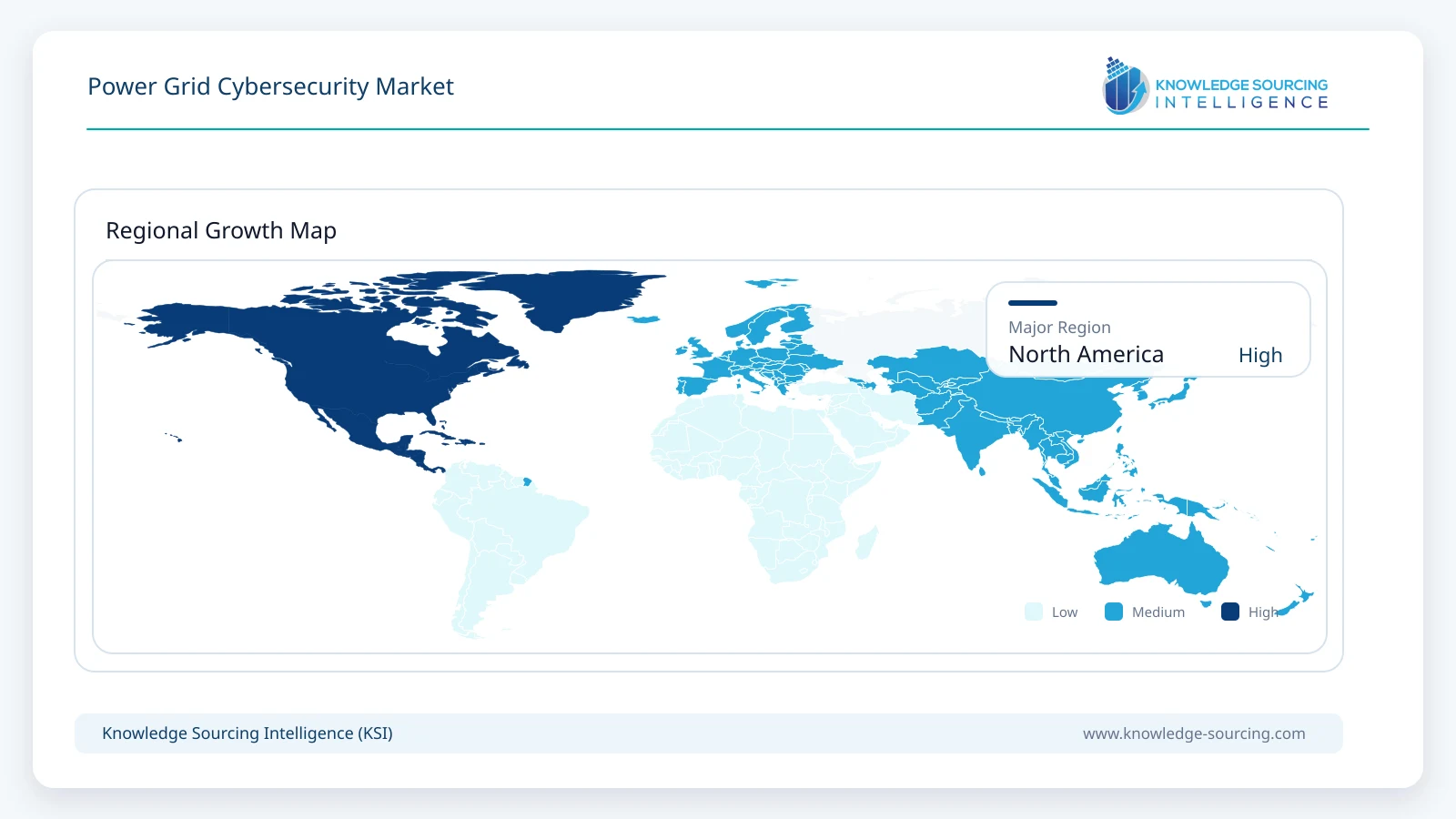
North American power-grid cybersecurity is a major market globally driven by established critical-infrastructure cybersecurity requirements that come together with extensive electricity infrastructure, advanced grid automation, and a broad base of digitalization factors. North America will continue as the leading region due to NERC CIP mandates, large-scale utility cybersecurity initiatives, digital-substation rollouts, smart-grid investments, and growing DER penetration.
South America Market Analysis
South America is also an emerging power-grid cybersecurity market with electric utilities looking at upgrading their ageing transmission and distribution networks and increasing the level of renewable generation connected to power systems. Brazil is the most dominant regional market for opportunity due to the size of its electricity system, asset base in hydro generation with newer, more distributed capacity from wind and solar, and distributed electricity infrastructure.
Europe Market Analysis
Europe power grid cybersecurity market is growing due to factors suc as the widespread evolution of electricity systems in Europe, such as digitalization, renewable integration, decentralization, and cross-border interconnection, which will pave the way for power-grid cybersecurity development. Germany, the UK, France, Spain, and Nordic countries are expanding renewable generation and digital grid infrastructure, increasing connected assets and communication interfaces needing to be protected.
Middle East and Africa Market Analysis
The market in the Middle East & Africa is evolving as various utilities are expanding power infrastructure, modernising substations, deploying smart-grid technologies and incorporating large-size renewable-energy projects. Saudi Arabia and the UAE constitute another important market for these initiatives, with major solar generation and transmission systems incorporating advanced communication technologies.
Asia Pacific Market Analysis
Asia Pacific is one of the fastest-growing markets due to rapidly increasing electricity demand, large-scale renewable deployment, expansion of power transmission infrastructure, smart-grid investments, and broad industry digitalization in countries like China, Japan, South Korea, India, and Australia. China is a significant region in digital electricity infrastructure and renewable integration, while India scales up smart-grid, actionable approvals for distribution automation, renewable energy, and transmission projects.
List of Companies
Siemens Energy
ABB
Schneider Electric
GE Vernova
Hitachi Energy
Mitsubishi Electric
UL Solutions
DER Security Corp
Enspi Technologies
Fortinet
Siemens Energy
Siemens Energy is strongly positioned in this market with its Noedra Shield, a suite of defensive grid cybersecurity solutions designed for use in OT/ICS environments, deployed across substations, grid assets, and control infrastructure. It includes asset inventory, vulnerability-risk prioritization, secure remote access, continuous OT/ICS network monitoring for reconnaissance detection and data exfiltration alerting, insider-threat detection and investigation capabilities, incident response workflows, and compliance reporting.
ABB
ABB integrates security throughout automation, electrical, digital, and grid portfolios. It focuses on product, system, and service security and vulnerability management with cybersecurity advisories. ABB positions itself on cybersecurity for a range of critical infrastructure, such as digital substations, automation systems, grid-management platforms, and connected electrical infrastructure.
Schneider Electric
Schneider Electric offers end-to-end grid cybersecurity coverage of connected products, systems, and processes. Its grid cybersecurity architecture uses IEC 62351 role-based access controls and OT security based on IEC 62443. Its EcoStruxure for Power and Grid ecosystem links grid products, edge control, applications, analytics, and services, and its cybersecurity service covers assessment, design-enabled implementation, monitoring, maintenance, and training.
Analyst View
The power grid cybersecurity market is shifting from traditional IT security to combined OT/IT as well as cyber-physical protection, with the growth of smart grids, digital substations, DERs, and remote operations. Network security is a major security type, and constant surveillance, secure remote access, vulnerability management, and security-by-design are becoming the new normal. There are also more opportunities in managed cybersecurity and AI-assisted threat detection, which is anticipated to boost the market growth in the coming years.
Power Grid Cybersecurity Market Scope:
| Report Metric | Details |
|---|---|
| Total Market Size in 2026 | USD 3.46 billion |
| Total Market Size in 2031 | USD 5.35 billion |
| Forecast Unit | USD Billion |
| Growth Rate | 9.1% |
| Study Period | 2021 to 2031 |
| Historical Data | 2021 to 2024 |
| Base Year | 2025 |
| Forecast Period | 2026 – 2031 |
| Segmentation | Component, Security Type, Application, End User, Geography |
| Companies |
|
Market Segmentation
By Component
Hardware & Solutions
Services
By Security Type
Network Security
Endpoint Security
Application Security
Cloud Security
Others
By Application
Smart Grid Monitoring
Power Generation Management
Transmission & Distribution Management
Substation Automation & Security
By End User
Electric Utilities
Energy & Power
Government & Regulatory Bodies
Others
By Geography
North America
USA
Canada
Mexico
South America
Brazil
Argentina
Others
Europe
United Kingdom
Germany
France
Others
Middle East and Africa
Saudi Arabia
UAE
Others
Asia Pacific
China
Japan
India
South Korea
Others
Table of Contents
1. EXECUTIVE SUMMARY
2. MARKET SNAPSHOT
2.1. Market Overview
2.2. Market Definition
2.3. Scope of the Study
2.4. Market Segmentation
3. MARKET DYNAMIC
3.1. Market Drivers
3.2. Market Restraints
3.3. Market Opportunities
3.4. Porter’s Five Forces Analysis
3.5. Industry Value Chain Analysis
4. BUSINESS LANDSCAPE
4.1. Regulatory and Standards Landscape
4.2. Cyber Risk, Incident Response, Resilience and Operational Impact Analysis
4.3 Power Grid Cybersecurity Investment, Procurement and Pricing Analysis
4.4. Import/ Export Analysis
4.5. Strategic Recommendations
5. TECHNOLOGICAL OUTLOOK
5.1. Network, Communication and Device Security Technologies
5.2. Threat Detection, Security Analytics and AI-Enabled Cybersecurity Technologies
5.3. Zero-Trust, Identity, Access Control and Data Security Technologies
5.4. Grid-Edge, DER, Renewable Energy and Next-Generation Cybersecurity Technologies
6. POWER GRID CYBERSECURITY MARKET BY COMPONENT
6.1. Introduction
6.2. Hardware & Solutions
6.3. Services
7. POWER GRID CYBERSECURITY MARKET BY SECURITY TYPE
7.1. Introduction
7.2. Network Security
7.3. Endpoint Security
7.4. Application Security
7.5. Cloud Security
7.6. Others
8. POWER GRID CYBERSECURITY MARKET BY APPLICATION
8.1. Introduction
8.2. Smart Grid Monitoring
8.3. Power Generation Management
8.4. Transmission & Distribution Management
8.5. Substation Automation & Security
9. POWER GRID CYBERSECURITY MARKET BY END USER
9.1. Introduction
9.2. Electric Utilities
9.3. Energy & Power
9.3. Government & Regulatory Bodies
9.4. Others
Industrial10. POWER GRID CYBERSECURITY MARKET BY GEOGRAPHY
10.1. Introduction
10.2. North America
10.2.1. USA
10.2.2. Canada
10.2.3. Mexico
10.3. South America
10.3.1. Brazil
10.3.2. Argentina
10.3.3. Others
10.4. Europe
10.4.1. United Kingdom
10.4.2. Germany
10.4.3. France
10.4.4. Others
10.5. Middle East and Africa
10.5.1. Saudi Arabia
10.5.2. UAE
10.5.3. Others
10.6. Asia Pacific
10.6.1. China
10.6.2. Japan
10.6.3. India
10.6.4. South Korea
10.6.5. Others
11. COMPETITIVE ENVIRONMENT AND ANALYSIS
11.1. Major Players and Strategy Analysis
11.2. Market Share Analysis
11.3. Mergers, Acquisitions, Agreements, and Collaborations
11.4. Competitive Dashboard
12. COMPANY PROFILES
12.1. Siemens Energy
12.2. ABB
12.3. Schneider Electric
12.4. GE Vernova
12.5. Hitachi Energy
12.6. Mitsubishi Electric
12.7. UL Solutions
12.8. DER Security Corp
12.9. Enspi Technologies
12.10. Fortinet
13. APPENDIX
13.1. Currency
13.2. Assumptions
13.3. Base and Forecast Years Timeline
13.4. Key benefits for the stakeholders
13.5. Research Methodology
13.6. Abbreviations
Navigate
Trusted by the world's leading organizations











