
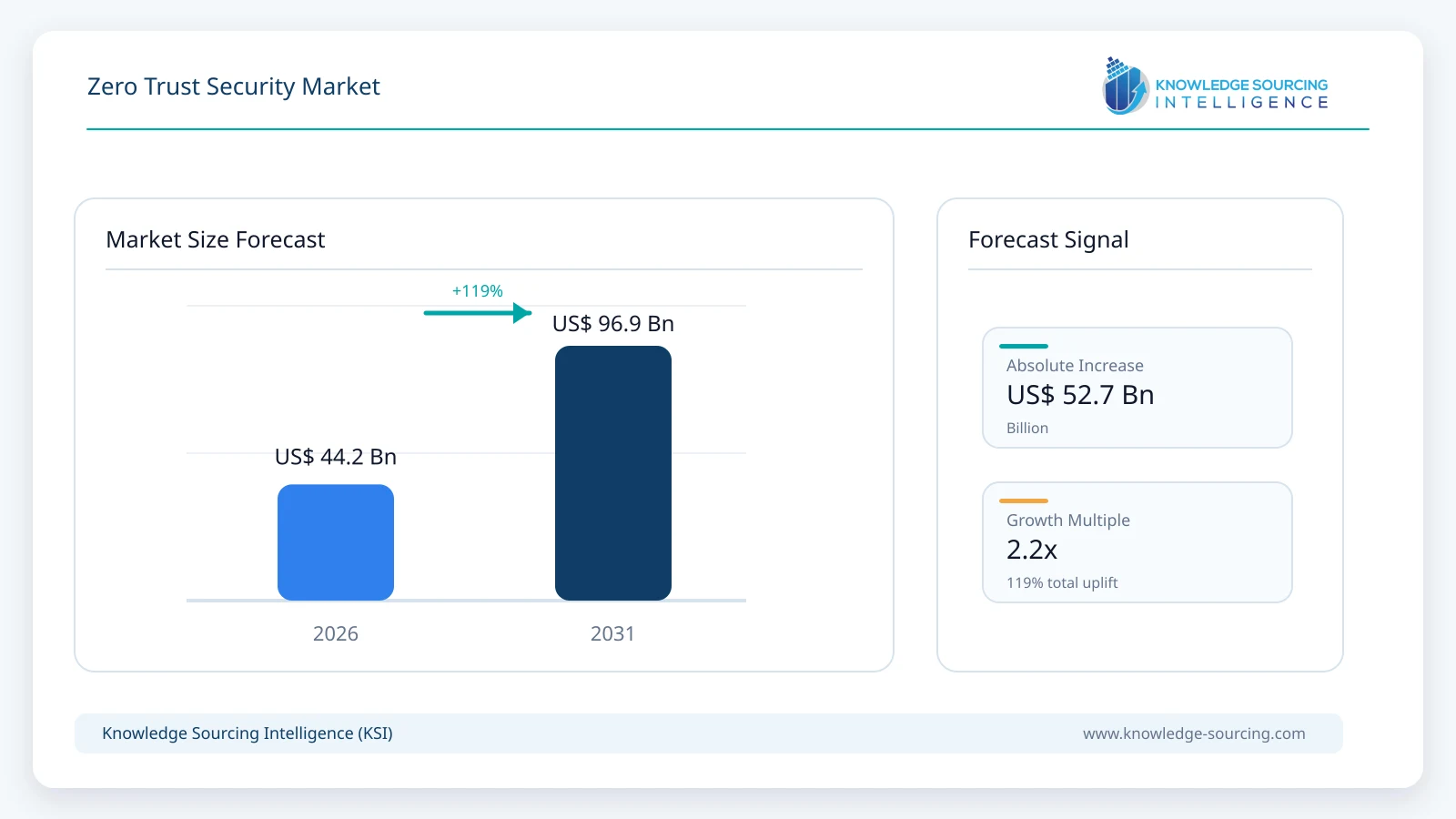
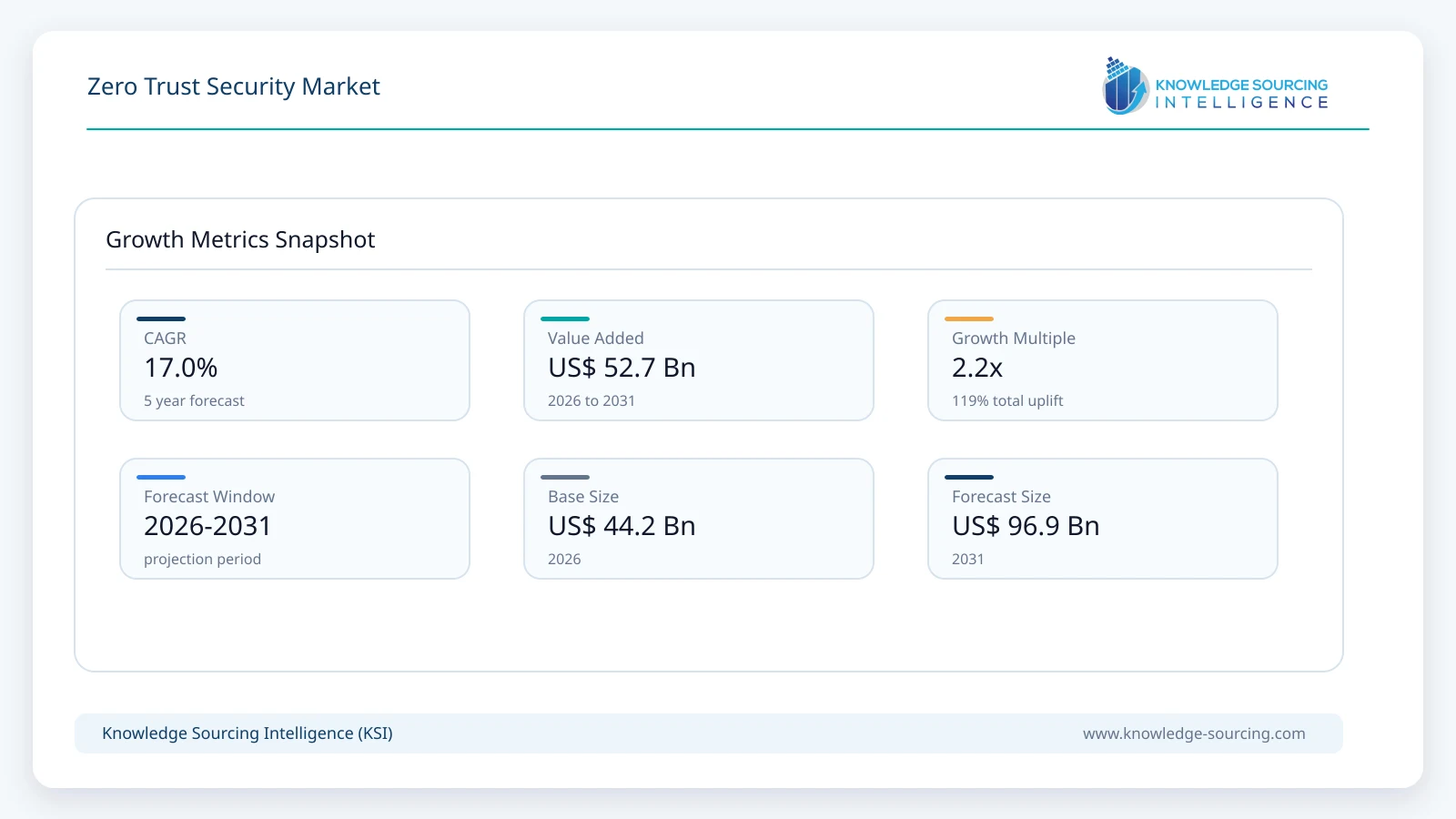
The Zero Trust Security Market is expected to increase from USD 44.18 billion in 2026 to USD 96.87 billion in 2031, registering a CAGR of 17.0% during forecast period.
Highlights:
- 1The network perimeter's collapse and the rise of remote and hybrid work, mobile and IoT endpoints have made implicit trust security models impossible to maintain, creating a need for constant, identity-based verification.
- 2As ransomware becomes more frequent, more sophisticated, and more damaging as are the costs of breaches boards and regulators are increasingly putting lateral movement and blast radius protection at the top of their list when it comes to architecture.
- 3Public-sector organizations and regulated industries are being driven towards implementing zero trust principles by regulatory and policy requirements, such as U.S. federal zero trust strategy requirements, NIST SP 800-207 guidance and European regulations including NIS2 and DORA.
- 4Enterprises are continuing to adopt cloud and SaaS, and the majority of those that have adopted zero trust report that cloud security is the most important driver for adopting cloud access, identity and workload-protection controls.
Zero Trust Security Market Key Market Highlights:
Large companies make up about three quarters of market revenue, which is attributable to their higher complexity, regulatory risk and security spending.
Single-factor authentication approaches are rapidly losing ground to multi-factor and passwordless approaches, and identity is becoming the single control plane of zero trust architectures.
By 2026, it's estimated that about major organizations will have started implementing zero trust as a core component of their security policies, and the biggest motivation will be cloud security.
As the number of ransomware and supply-chain attacks has increased, and government mandates and cyber-insurance policies start to require it, zero trust has gone from a strategic goal to a financed operational program.
On-premises deployment remains a significant segment of the market, supported by legacy data-center infrastructure, data-control requirements and security needs in regulated industries, while cloud deployment is gaining traction as organizations adopt security-service-edge platforms and cloud-based identity services to reduce reliance on appliance-based architectures. In terms of authentication types, multi-factor authentication is increasingly replacing single-factor methods, while passwordless authentication and phishing-resistant credentials are reshaping authentication strategies by improving security and simplifying user access.
Larger organizations generate about three-quarters of revenue due to complexity, regulatory compliance, and higher security budgets, but SMBs are implementing zero trust security via cloud-based, subscription-based platforms that are much easier to implement. Network access control, identity verification, endpoint security, cloud workload security and data protection are the main use cases by application and cloud workload security and data protection are among the fastest-growing ones as workloads move off-premises.
Banking, financial services and insurance, IT and telecommunications, government and defense and healthcare are the top user verticals, with strict regulation and high-value data. On the regional side, North America is expected to be the biggest market, supported by stringent federal zero trust guidelines, and Asia-Pacific is projected to see the highest growth rate at annually until 2031, driven by the expansion of the digital economy and an increase in cyber incidents.
Market Dynamics
Market Drivers
Market Restraints & Opportunities
Despite their best efforts, the challenge of integrating with legacy applications and infrastructure, the complexity of re-architecting access policies across a variety of environments, and a lack of qualified security architects are continuing to delay deployments and time to value.
The cost of imported security hardware, network appliances, and authentication devices have risen due to tariffs and pressure in supply chains, making the deployments appliance-based more difficult.
However, the transformation of point products to platforms, the addition of AI to help continuously assess and score risk, and the growing trend of managed zero trust services are opening up significant opportunity for vendors to lower implementation burden and provide tangible risk reduction.
Key Developments
September 2026: NVIDIA announced NVIDIA Open Agent Safety Platform, an open software platform and reference system design to strengthen AI security from agent testing to deployment, with full-stack governance and control across software and the hardware, compute and robotics systems that run agents.
August 2026: DXC Technology announced a strategic partnership with Primary, becoming the exclusive managed services provider for Primary's AI-native Zero Trust Platform. The joint offering helps enterprises securely deploy and scale AI by governing how AI agents and enterprise AI applications access data, while strengthening security, identity, and compliance.
March 2026: ThreatLocker®, the global leader in Zero Trust cybersecurity, announced the addition of Zero Trust network and cloud access solutions that enforce device-based verification to restrict unauthorized access to cloud services and networks.
Zero Trust Security Market Segmentation
The market is segmented by offering, deployment mode, organization size, authentication type, application, end-user vertical, and geography.
By Offering
Solutions
Solutions make up the bulk of spending and include zero trust network access, endpoint and data security, security analytics and orchestration platforms, identity and access management and micro-segmentation.
Zscaler, Inc. offers a cloud-native zero trust exchange that offers secure private-application and private-Internet access without the need for traditional network perimeters.
Palo Alto Networks, Inc. provides a comprehensive platform from network security to cloud security and endpoint security, all based on the principles of zero trust.
By Deployment Mode
Cloud
Cloud deployment is the fastest-growing mode, as security-service-edge platforms and cloud-delivered identity controls replace appliance-based architectures and extend consistent policy to distributed users and workloads.
Cloudflare, Inc. provides zero trust access and secure web gateway services delivered from its global edge network.
Okta, Inc. supplies cloud-based workforce and customer identity services that anchor many zero trust implementations.
By Authentication Type
Multi-Factor Authentication
Multi-factor authentication is steadily displacing single-factor methods, with passwordless and phishing-resistant credentials becoming the preferred approach for high-assurance access to enterprise resources.
Cisco Systems, Inc. offers multi-factor authentication and device-trust capabilities through its Duo Security portfolio.
Microsoft Corporation integrates conditional access, identity protection and endpoint signals through Microsoft Entra and Defender.
Regional Analysis
North America Market Analysis
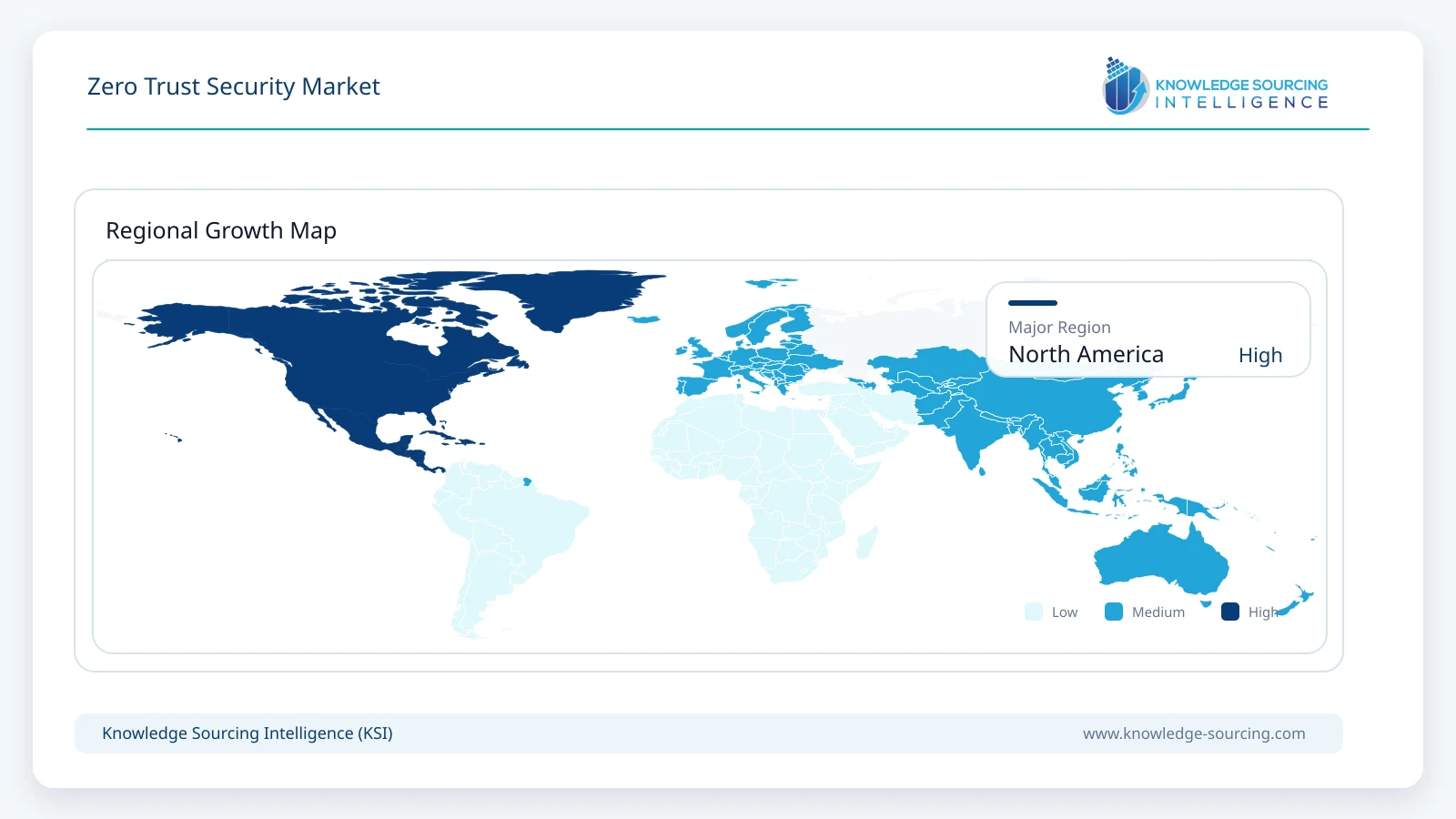
North America holds the largest regional share, supported by federal zero trust mandates, a high incidence of targeted cyberattacks, and a dense concentration of leading security and identity vendors across the United States and Canada.
Europe Market Analysis
Europe's market is shaped by regulation including NIS2, DORA and GDPR, which is raising security and operational-resilience obligations across financial services, critical infrastructure and public-sector organizations.
Asia-Pacific Market Analysis
Asia-Pacific is the fastest-growing region, driven by rapid digital-economy expansion, rising cyber-incident volumes, and government-led security modernization programs in China, India, Japan, Australia and Southeast Asia.
Middle East and Africa Market Analysis
The Middle East and Africa are seeing accelerating investment in zero trust as Gulf states pursue national cybersecurity strategies and critical-infrastructure protection alongside large-scale digital-transformation programs.
South America Market Analysis
South America is a developing market, with financial institutions and telecommunications operators in Brazil and neighboring countries increasing spending on identity and access controls in response to rising fraud and ransomware activity.
List of Companies
Microsoft Corporation
Cisco Systems, Inc.
Palo Alto Networks, Inc.
Zscaler, Inc.
CrowdStrike Holdings, Inc.
Okta, Inc.
Cloudflare, Inc.
Broadcom Inc. (Symantec)
Check Point Software Technologies Ltd.
IBM Corporation
Fortinet, Inc.
Akamai Technologies, Inc.
Competitive Landscape
Microsoft Corporation
Microsoft embeds zero trust controls across identity, endpoint, cloud and productivity through Entra, Defender and Intune, leveraging its installed base to offer a broad, integrated platform for conditional access and continuous verification.
Zscaler, Inc.
Zscaler is a leading pure-play zero trust vendor, delivering secure access to applications and the internet through a cloud-native architecture that connects users directly to resources rather than to the network.
Palo Alto Networks, Inc.
Palo Alto Networks pursues platformization, combining network, cloud and security-operations capabilities into an integrated zero trust offering aimed at consolidating customers' fragmented security tooling.
Okta, Inc.
Okta provides cloud-native workforce and customer identity services, positioning identity as the control plane for zero trust and extending into privileged access and identity threat protection.
Analyst View
The Zero Trust Security market has shifted from concept and theory to common practice; maximum organizations are implementing security strategy based on Zero Trust Security. The budge has shifted from identity being the periphery to becoming the central control plane, and the shift from passwords to multi-factor and passwordless authentication has changed where the money goes. While on-premises revenues remain a small majority of current revenues, cloud-based offerings are surging and Asia-Pacific is expected to see the highest growth rates, as digital economy growth outstrips security maturity.
Zero Trust Security Market Scope:
| Report Metric | Details |
|---|---|
| Total Market Size in 2026 | USD 44.18 billion |
| Total Market Size in 2031 | 96.87 billion |
| Forecast Unit | USD Billion |
| Growth Rate | 17.0% |
| Study Period | 2021 to 2031 |
| Historical Data | 2021 to 2024 |
| Base Year | 2025 |
| Forecast Period | 2026 – 2031 |
| Segmentation | Offering, Deployment Mode, Authentication Type, Application, End-User Vertical, Geography |
| Companies |
|
Market Segmentation
By Offering
Solutions
Services
By Deployment Mode
On-Premises
Cloud
By Authentication Type
Multi-Factor Authentication
Single-Factor Authentication
By Application
Network Access Control
Identity Verification
Endpoint Security
Cloud Workload Security
Data Protection
By End-User Vertical
BFSI
IT & Telecom
Government & Defense
Healthcare
Others
By Geography
North America
USA
Canada
Mexico
South America
Brazil
Others
Europe
Germany
France
United Kingdom
Others
Middle East and Africa
UAE
Saudi Arabia
Others
Asia Pacific
China
India
Japan
Others
Table of Contents
1. EXECUTIVE SUMMARY
2. MARKET SNAPSHOT
2.1. Market Overview
2.2. Market Definition
2.3. Scope of the Study
2.4. Market Segmentation
3. BUSINESS LANDSCAPE
3.1. Market Drivers
3.2. Market Restraints
3.3. Market Opportunities
3.4. Porter's Five Forces Analysis
3.5. Industry Value Chain Analysis
3.6. Policies and Regulations (NIST SP 800-207, NIS2, DORA)
3.7. Strategic Recommendations
4. TECHNOLOGICAL OUTLOOK
4.1. Identity-Centric Security & Passwordless Authentication
4.2. Security Service Edge (SSE) & ZTNA
4.3. Micro-Segmentation
4.4. AI-Driven Continuous Trust Scoring
5. ZERO TRUST SECURITY MARKET BY OFFERING
5.1. Introduction
5.2. Solutions
5.3. Services
6. ZERO TRUST SECURITY MARKET BY DEPLOYMENT MODE
6.1. Introduction
6.2. On-Premises
6.3. Cloud
7. ZERO TRUST SECURITY MARKET BY AUTHENTICATION TYPE
7.1. Introduction
7.2. Multi-Factor Authentication
7.3. Single-Factor Authentication
8. ZERO TRUST SECURITY MARKET BY APPLICATION
8.1. Introduction
8.2. Network Access Control
8.3. Identity Verification
8.4. Endpoint Security
8.5. Cloud Workload Security
8.6. Data Protection
9. ZERO TRUST SECURITY MARKET BY END-USER VERTICAL
9.1. Introduction
9.2. BFSI
9.3. IT & Telecom
9.4. Government & Defense
9.5. Healthcare
9.6. Others
10. ZERO TRUST SECURITY MARKET BY GEOGRAPHY
10.1. Introduction
10.2. North America
10.2.1. USA
10.2.2. Canada
10.2.3. Mexico
10.3. South America
10.3.1. Brazil
10.3.2. Others
10.4. Europe
10.4.1. Germany
10.4.2. France
10.4.3. United Kingdom
10.4.4. Others
10.5. Middle East and Africa
10.5.1. UAE
10.5.2. Saudi Arabia
10.5.3. Others
10.6. Asia Pacific
10.6.1. China
10.6.2. India
10.6.3. Japan
10.6.4. Others
11. COMPETITIVE ENVIRONMENT AND ANALYSIS
11.1. Major Players and Strategy Analysis
11.2. Market Share Analysis
11.3. Mergers, Acquisitions, Agreements, and Collaborations
11.4. Competitive Dashboard
12. COMPANY PROFILES
12.1. Microsoft Corporation
12.2. Cisco Systems, Inc.
12.3. Palo Alto Networks, Inc.
12.4. Zscaler, Inc.
12.5. CrowdStrike Holdings, Inc.
12.6. Okta, Inc.
12.7. Cloudflare, Inc.
12.8. Broadcom Inc. (Symantec)
12.9. Check Point Software Technologies Ltd.
12.10. IBM Corporation
12.11. Fortinet, Inc.
12.12. Akamai Technologies, Inc.
13. APPENDIX
13.1. Currency
13.2. Assumptions
13.3. Base and Forecast Years Timeline
13.4. Key Benefits for the Stakeholders
13.5. Research Methodology
13.6. Abbreviations
Navigate
Trusted by the world's leading organizations











