
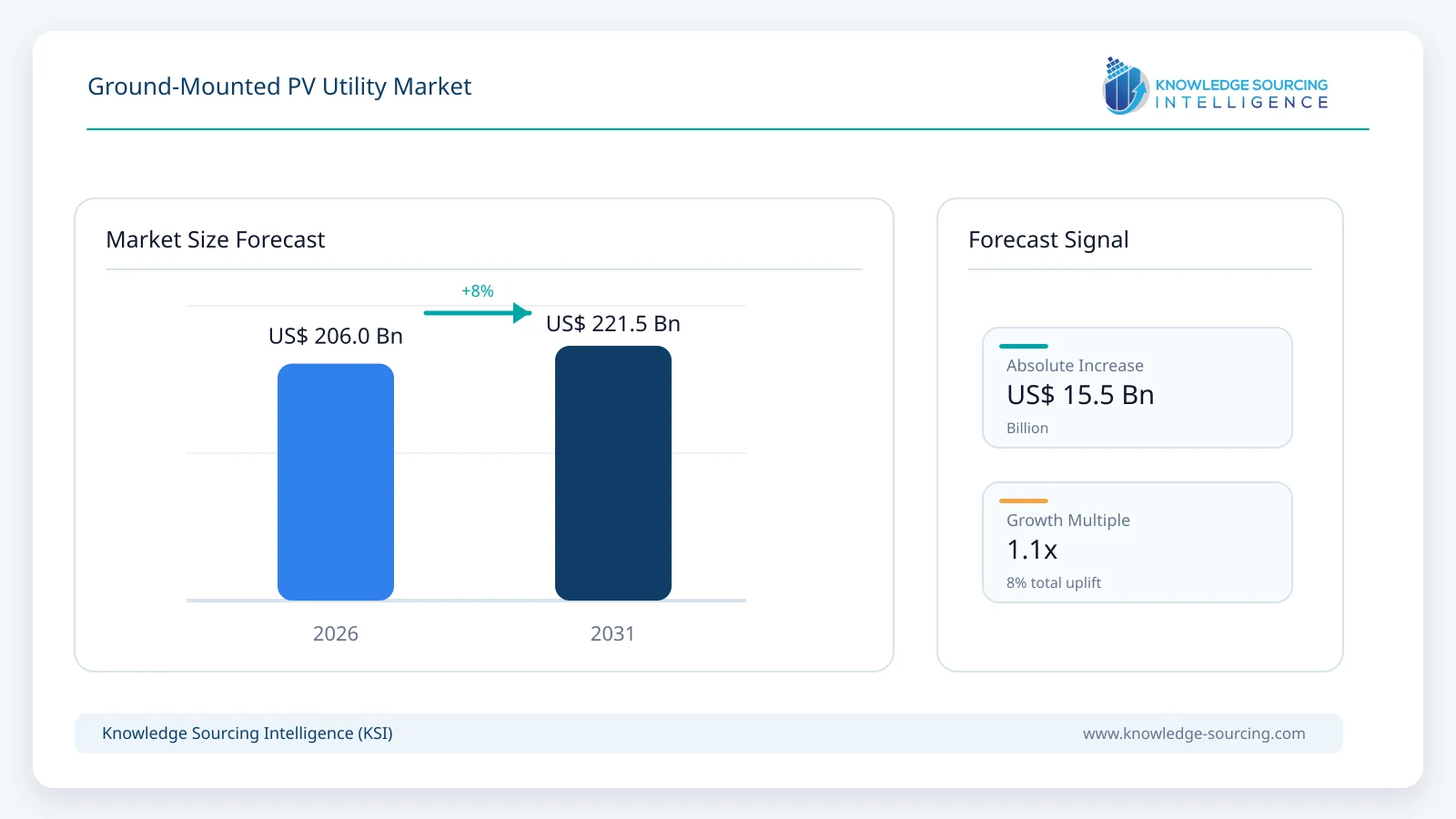
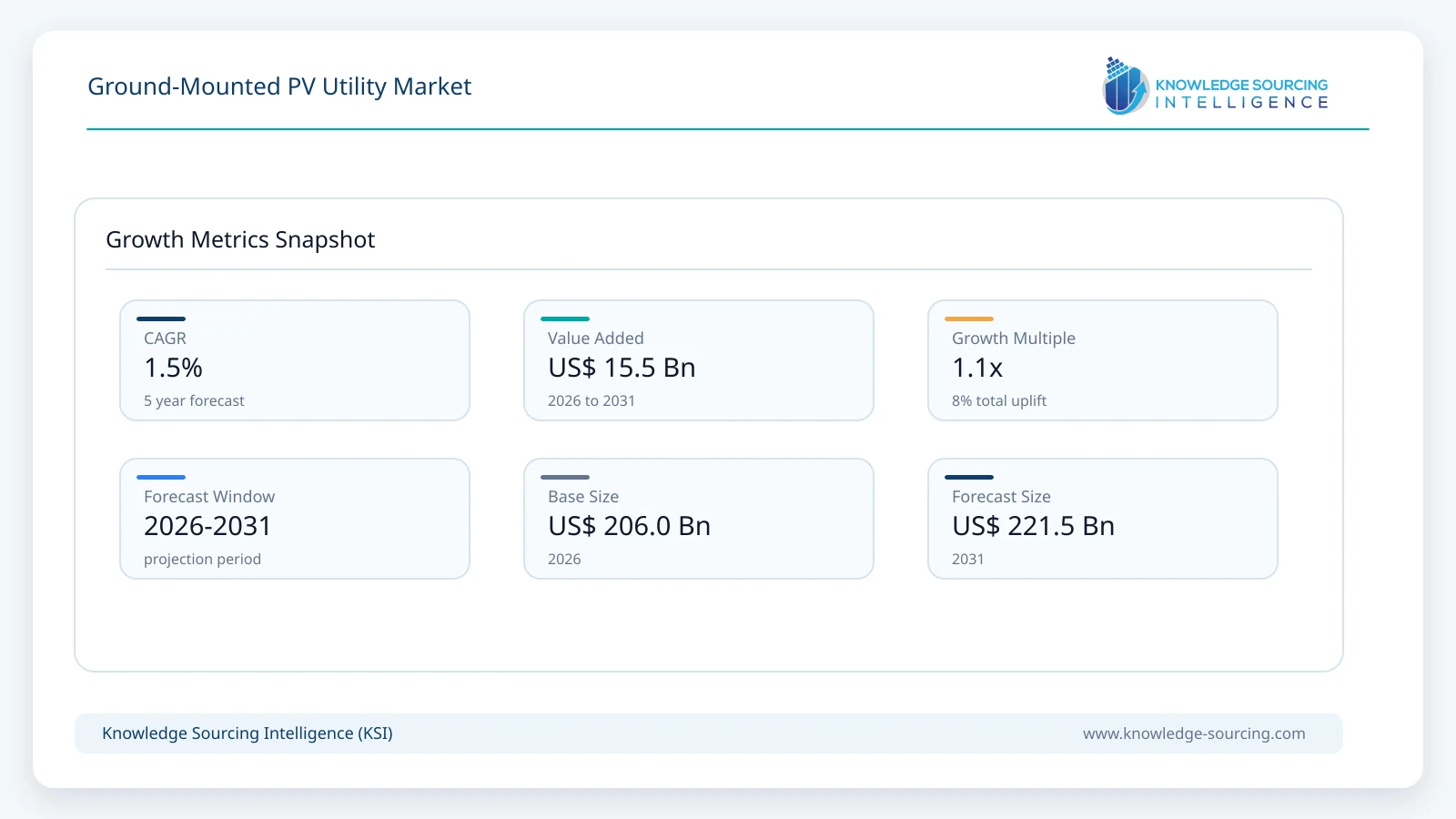
The global ground-mounted PV utility market is forecast to expand at a CAGR of 1.5%, increasing from USD 206.0 billion in 2026 to USD 221.5 billion by 2031.
Highlights:
- 1Single-axis tracking accounts for approximately 59% of global ground-mounted utility PV market value in 2026supported by bifacial modules and higher energy yield across large projects.
- 2Projects above 100 MW account for approximately 68% of market value in 2026reflecting the scale of utility procurement in China, India, the Middle East and the United States.
- 3Balance-of-system, EPC and development activities account for more than half of total project value in 2026as module and inverter costs continue to decline.
- 4Asia Pacific accounts for approximately 70% of global market value in 2026led by China and India.
- 5China represents the largest country market in 2026although installation growth moderates following changes to domestic solar pricing mechanisms.
Utility-scale solar remains central to global renewable deployment. Solar PV additions exceeded 600 GW in 2025, and the IEA expects utility-scale and distributed PV together to account for nearly 80% of global renewable-capacity expansion through 2030. Distributed applications represent about 42% of expected PV growth, leaving utility-scale installations as the larger individual deployment category. SolarPower Europe expects total global solar additions of approximately 612 GW in 2026 after the exceptional 2025 installation surge, followed by renewed growth toward the end of the decade.
Project economics continue to improve even as regional cost differences remain substantial. IRENA reported a global weighted-average installed cost of USD 691/kW for utility-scale solar PV commissioned in 2024, with India and China materially below the global average and the United States and several European markets significantly higher. Lower equipment costs are reducing capital expenditure, while grid interconnection, land, civil works, permitting, and electrical balance-of-system costs are accounting for a larger proportion of project value.
Market Trends
Tracking Systems Gain Wider Utility-Scale Adoption
Single-axis trackers continue to gain ground across large projects where higher yield justifies additional mechanical and control-system cost. Bifacial modules strengthen the economics of tracking because rear-side generation benefits from improved irradiance capture and row spacing. Tracker suppliers are also extending product ranges for steeper terrain, high wind, hail and difficult soil conditions. Nextpower and ARRAY Technologies introduced new international tracker configurations in 2026, while both companies are expanding foundation and electrical balance-of-system offerings around their core tracker platforms.
Utility PV Moves Toward Integrated Plant Platforms
Suppliers are broadening from single components toward bundled solutions that combine structures, foundations, electrical systems, software, and power conversion. Nextpower is expanding from tracking into foundations and electrical balance of system, while Sungrow introduced a utility-scale inverter and medium-voltage turnkey platform in 2026. This reduces interface complexity for developers and EPC contractors, particularly on very large sites where installation speed, commissioning and lifecycle performance have a material effect on project economics.
Extreme-Weather Engineering Becomes More Important
Developers are placing greater emphasis on wind, hail, flooding and terrain resilience as projects expand into more geographically diverse locations. ARRAY introduced a 60-degree tracker variant in 2026 to improve hail-risk mitigation while maintaining project economics, and tracker suppliers are adding faster stow response, terrain-following foundations and enhanced structural design. Insurers and lenders are increasingly involved in these decisions because weather-related losses can affect availability, financing terms and long-term project returns.
Solar and Storage Are Increasingly Co-Located
Ground-mounted PV plants are increasingly being developed alongside utility-scale battery systems in markets with high solar penetration, constrained grids or evening peak demand. Storage can improve dispatchability, reduce curtailment and increase the value of grid connections, particularly where midday solar prices are weak. The solar portion remains a distinct project-cost pool, but co-location is influencing site design, interconnection planning, inverter architecture and EPC procurement across the utility segment.
Market Drivers
Utility-Scale Solar Remains the Largest Source of New Renewable Capacity
Solar PV accounted for more than three-quarters of global renewable-capacity additions in 2025, with China commissioning nearly 370 GW of solar PV, India almost 50 GW and Saudi Arabia nearly 7 GW. Utility-scale projects remain particularly important in countries where governments and utilities procure large blocks of generation through auctions or long-term contracts. The IEA expects solar PV to continue providing the largest contribution to electricity-supply growth through the end of the decade.
Declining Installed Costs Sustain Project Pipelines
Utility-scale PV has become one of the lowest-cost sources of new electricity in many markets. IRENA reported a global weighted-average LCOE of about USD 0.044/kWh for newly commissioned utility-scale solar projects in 2025, while installed costs have continued to decline through higher module efficiency, lower equipment prices, and more efficient balance-of-system design. Falling capital requirements allow developers to bid lower tariffs and expand projects into markets that previously required stronger subsidy support.
Large Auctions and Corporate PPAs Support Project Scale
Competitive renewable-energy auctions remain a major source of utility-scale solar demand in India, Saudi Arabia, the UAE, China and other large markets. Corporate PPAs are also supporting project development in the United States, Europe, Latin America and Asia as technology companies, industrial users and data-center operators seek long-term renewable-electricity supply. These mechanisms provide the revenue visibility needed to finance large ground-mounted projects and support multi-gigawatt procurement pipelines.
Electricity Demand Growth Increases the Need for New Generation
Electricity consumption is rising through data centers, electrification, industrial expansion, cooling demand, and electric transport. Solar PV can be deployed more quickly than many conventional generation technologies and is increasingly combined with storage where grid flexibility is limited. This supports continuing utility-scale project development even in markets where solar already accounts for a substantial share of daytime generation.
Market Restraints and Challenges
Grid Constraints Delay Commissioning
Transmission congestion and interconnection queues are becoming major constraints in several large solar markets. Utility-scale projects may secure land, permits, and equipment before network capacity is available, increasing development timelines and financing costs. Grid constraints are particularly important in parts of Europe, the United States, China, Australia and other markets where renewable capacity has expanded faster than transmission infrastructure.
Falling Equipment Prices Limit Revenue Growth
The value of the market does not increase at the same rate as installed capacity because module, inverter and balance-of-system costs continue to decline. IRENA expects utility-scale PV installed costs to fall materially through the second half of the decade. This benefits developers and electricity consumers but limits revenue growth for equipment suppliers and EPC contractors unless they gain volume, add higher-value services or expand into storage and digital plant-management systems.
Land, Permitting and Community Acceptance Create Project Risk
Large ground-mounted projects require extensive land, transmission access and permitting. Agricultural land competition, environmental review, local opposition and biodiversity requirements can extend project-development timelines. Developers are responding through brownfield development, agrivoltaics, lower-impact foundation systems and improved site design, but land availability remains an important constraint in densely populated markets.
Segment Analysis
By Mounting Configuration: Single-Axis Tracking
Single-axis tracking is expected to generate approximately USD 145 billion in project value by 2031, retaining the largest mounting configuration. Its commercial position is strongest in regions with high direct irradiance and large project sites, including the United States, the Middle East, India, Australia and parts of Latin America. Bifacial modules, terrain-adaptive structures and improved control software continue to strengthen tracker economics. Fixed-tilt systems remain important where wind, terrain, project size, maintenance requirements or lower capital expenditure make simpler structures preferable.
By Project Size: Above 100 MW
Projects above 100 MW are forecast to account for approximately USD 161 billion by 2031. Large projects benefit from procurement scale, standardized engineering and lower unit development costs, and they dominate utility programmes in China, India, the Middle East and parts of the United States. Multi-gigawatt solar parks are becoming more common, although transmission availability increasingly determines how quickly these developments can be commissioned. Smaller 10-100 MW plants remain relevant in constrained grids and markets where projects are developed closer to load centers.
By System Component: Balance of System, EPC and Development
Balance-of-system, EPC and development activities are expected to generate approximately USD 128 billion by 2031. As module and inverter costs decline, foundations, structures, cabling, substations, civil works, interconnection and project execution account for a larger proportion of total installed cost. Regional labor, permitting and grid-connection conditions also create wider cost differences in these categories than in globally traded modules. This increases the commercial importance of EPC capability, site engineering and project standardization.
Major Region: Asia Pacific
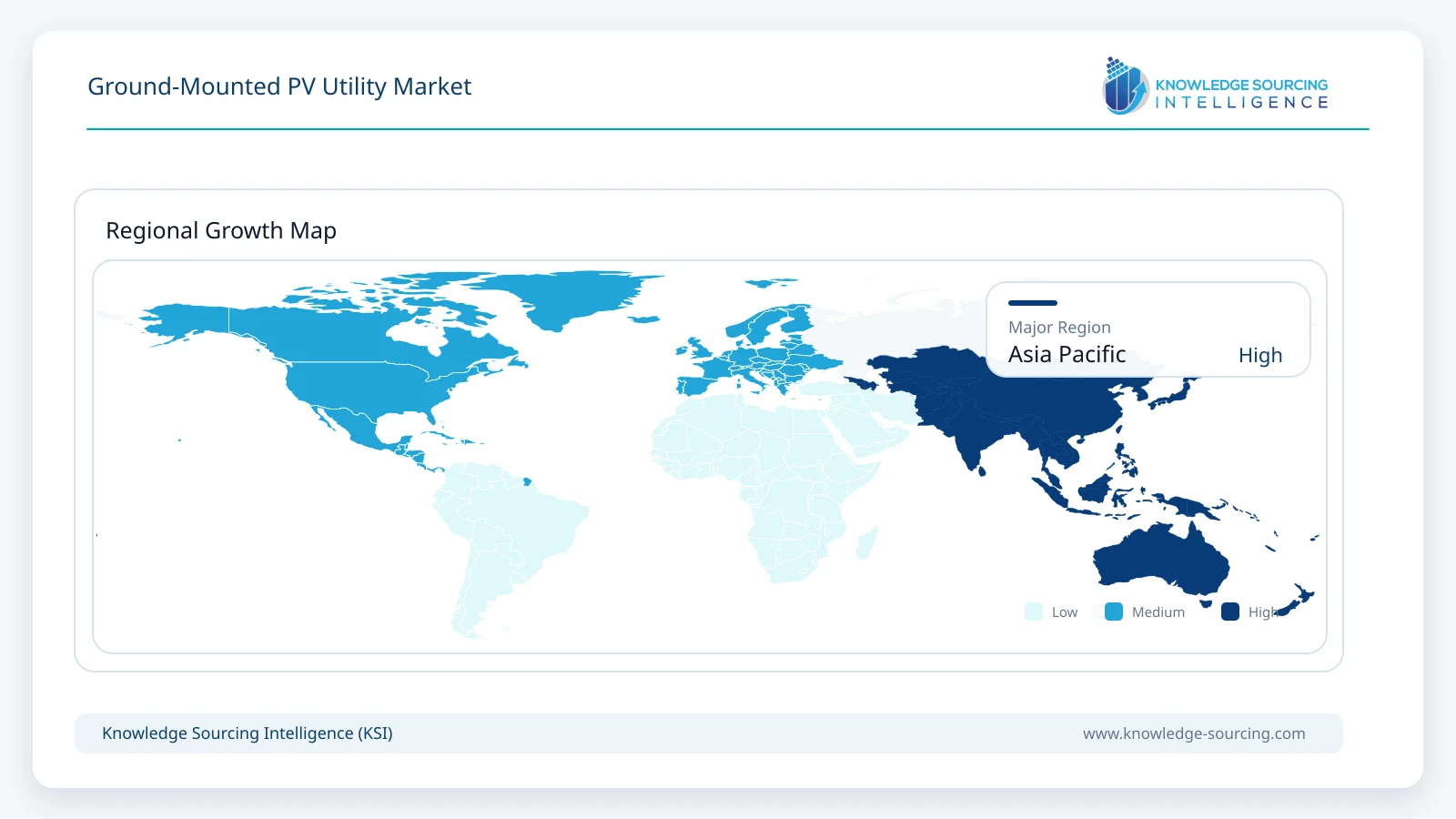
Asia Pacific is forecast to account for approximately USD 154 billion of market value by 2031. China remains the largest utility-scale solar market, while India continues to expand through central and state procurement, solar parks and private PPAs. Australia, Southeast Asia and selected Central Asian markets add further project activity. The region benefits from a large domestic manufacturing base for modules, inverters and mounting equipment, which lowers equipment costs and supports very large project pipelines.
Major Country: China
China is expected to remain the largest country market through 2031, generating approximately USD 105 billion in annual utility-scale ground-mounted PV project value. Domestic deployment remains concentrated in large renewable-energy bases and centralized projects, while policy changes introduced in 2025 have reduced the incentive for the installation rush seen under earlier tariff structures. China also has the world's largest solar manufacturing supply chain, giving developers access to low-cost modules, inverters and balance-of-system equipment and allowing projects to achieve some of the lowest installed costs globally.
Competitive Environment and Analysis
Competition spans module manufacturers, inverter suppliers, tracker and foundation companies, EPC contractors and project developers. LONGi, JinkoSolar, Trina Solar, JA Solar, Canadian Solar and First Solar are major module suppliers to utility-scale projects, while Sungrow, Huawei Digital Power, Power Electronics and SMA Solar Technology compete in large-scale power conversion. Nextpower, ARRAY Technologies and GameChange Solar are prominent tracker and structural-system providers.
Project developers and independent power producers such as ACWA Power, Masdar, NextEra Energy Resources, EDF Renewables, Lightsource bp and Adani Green Energy influence equipment selection and project standards through multi-gigawatt pipelines. Large developers increasingly procure components across several regions, creating opportunities for suppliers that can provide consistent technical performance, bankability, and local manufacturing or service capability.
The competition is moving toward broader system integration. Tracker companies are adding foundations, electrical balance of system, and software, while inverter suppliers are integrating medium-voltage equipment and storage interfaces. Module manufacturers are also emphasizing products optimized for utility-scale installation speed, high temperatures and long-term energy yield. Suppliers that reduce total plant cost rather than competing only on component price are becoming more important in procurement decisions.
Recent Developments
August 2026: ARRAY Technologies reported a record USD 2.5 billion order book, 37% higher year on year, after surpassing 100 GW of cumulative tracker deliveries.
August 2026: Nextpower expanded its NX PowerMerge electrical balance-of-system backlog beyond 2 GW following a new utility-scale project award in the United States.
June 2026: Sungrow launched the SG510HX and MVS turnkey utility-scale PV solution, combining a 511.5 kW string inverter with a medium-voltage station for large solar plants.
June 2026: ARRAY launched the DuraTrack D2S tracker for international projects, extending its utility-scale portfolio to two-row configurations.
January 2026: Nextpower Arabia secured a 2.25 GW tracker supply agreement with Larsen & Toubro for ACWA Power's Bisha Solar project in Saudi Arabia.
Market Outlook
Global utility-scale ground-mounted PV deployment will continue increasing through 2031 as solar remains one of the lowest-cost and fastest-deployable sources of new electricity generation. Annual installed capacity is expected to grow substantially from 2026 levels, supported by China, India, the Middle East, the United States and new markets across Africa, Latin America and Asia.
The total market value in terms of revenues will rise at a much slower pace than capacity because installed costs continue to decline. Equipment suppliers will therefore depend increasingly on higher shipment volumes, integrated system offerings, local manufacturing, digital services and storage-linked projects rather than on higher selling prices. Balance-of-system and EPC activities will account for a larger share of total project economics as modules and inverters become less expensive.
Grid availability will become a greater determinant of project timing. Markets with transmission expansion, storage deployment and faster interconnection procedures will be better positioned to sustain high utility-scale solar additions. Projects will also incorporate more advanced trackers, resilient structures and plant-level control systems as developers seek to improve energy yield and protect long-term asset performance.
Ground-Mounted PV Utility Market Scope:
| Report Metric | Details |
|---|---|
| Total Market Size in 2026 | USD 206.0 billion |
| Total Market Size in 2031 | USD 221.5 billion |
| Forecast Unit | Billion |
| Growth Rate | 1.5% |
| Study Period | 2021 to 2031 |
| Historical Data | 2021 to 2024 |
| Base Year | 2025 |
| Forecast Period | 2026 – 2031 |
| Segmentation | Mounting Configuration, Project Size, System Component, Geography |
| Companies |
|
Market Segmentation
By Mounting Configuration
Single-Axis Tracking
Fixed-Tilt
Other Tracking Configurations
By Project Size
10-100 MW
100-500 MW
Above 500 MW
By System Component
PV Modules
Inverters and Medium-Voltage Equipment
Mounting, Tracking and Foundations
Electrical Balance of System
Civil Works, Installation, EPC and Development
By Geography
North America
United States
Canada
Mexico
South America
Brazil
Chile
Argentina
Others
Europe
Spain
Germany
France
Italy
United Kingdom
Others
Middle East and Africa
Saudi Arabia
United Arab Emirates
South Africa
Egypt
Morocco
Others
Asia Pacific
China
India
Australia
Japan
South Korea
Vietnam
Others
Table of Contents
1. INTRODUCTION
1.1. Market Overview
1.2. Market Definition
1.3. Scope of the Study
1.4. Market Segmentation
1.5. Currency
1.6. Assumptions
1.7. Base and Forecast Years Timeline
2. RESEARCH METHODOLOGY
2.1. Research Design
2.2. Research Process
3. EXECUTIVE SUMMARY
3.1. Key Findings
4. MARKET DYNAMICS
4.1. Market Drivers
4.2. Market Restraints
4.3. Market Opportunities
4.4. Porter's Five Forces Analysis
4.5. Industry Value Chain Analysis
4.6. Regulatory and Policy Landscape
4.7. Analyst View
5. GROUND-MOUNTED PV UTILITY MARKET BY MOUNTING CONFIGURATION
5.1. Introduction
5.2. Single-Axis Tracking
5.3. Fixed-Tilt
5.4. Other Tracking Configurations
6. GROUND-MOUNTED PV UTILITY MARKET BY PROJECT SIZE
6.1. Introduction
6.2. 10-100 MW
6.3. 100-500 MW
6.4. Above 500 MW
7. GROUND-MOUNTED PV UTILITY MARKET BY SYSTEM COMPONENT
7.1. Introduction
7.2. PV Modules
7.3. Inverters and Medium-Voltage Equipment
7.4. Mounting, Tracking and Foundations
7.5. Electrical Balance of System
7.6. Civil Works, Installation, EPC and Development
8. GROUND-MOUNTED PV UTILITY MARKET BY GEOGRAPHY
8.1. North America
8.1.1. United States
8.1.2. Canada
8.1.3. Mexico
8.2. South America
8.2.1. Brazil
8.2.2. Chile
8.2.3. Argentina
8.2.4. Others
8.3. Europe
8.3.1. Spain
8.3.2. Germany
8.3.3. France
8.3.4. Italy
8.3.5. United Kingdom
8.3.6. Others
8.4. Middle East and Africa
8.4.1. Saudi Arabia
8.4.2. United Arab Emirates
8.4.3. South Africa
8.4.4. Egypt
8.4.5. Morocco
8.4.6. Others
8.5. Asia Pacific
8.5.1. China
8.5.2. India
8.5.3. Australia
8.5.4. Japan
8.5.5. South Korea
8.5.6. Vietnam
8.5.7. Others
9. COMPETITIVE ENVIRONMENT AND ANALYSIS
9.1. Major Players and Strategy Analysis
9.2. Market Share Analysis
9.3. Mergers, Acquisitions, Agreements, and Collaborations
9.4. Competitive Dashboard
10. COMPANY PROFILES
10.1. LONGi Green Energy Technology Co., Ltd.
10.2. JinkoSolar Holding Co., Ltd.
10.3. Trina Solar Co., Ltd.
10.4. JA Solar Technology Co., Ltd.
10.5. Canadian Solar Inc.
10.6. First Solar, Inc.
10.7. Sungrow Power Supply Co., Ltd.
10.8. Huawei Digital Power Technologies Co., Ltd.
10.9. Power Electronics S.L.
10.10. SMA Solar Technology AG
10.11. Nextpower Inc.
10.12. ARRAY Technologies, Inc.
10.13. GameChange Solar LP
10.14. ACWA Power Company
10.15. Masdar
10.16. NextEra Energy Resources, LLC
10.17. EDF Renewables
10.18. Lightsource bp
10.19. Adani Green Energy Limited
11. APPENDIX
11.1. Currency
11.2. Assumptions
11.3. Base and Forecast Years Timeline
11.4. Research Methodology
11.5. Abbreviations
Navigate
Trusted by the world's leading organizations











