
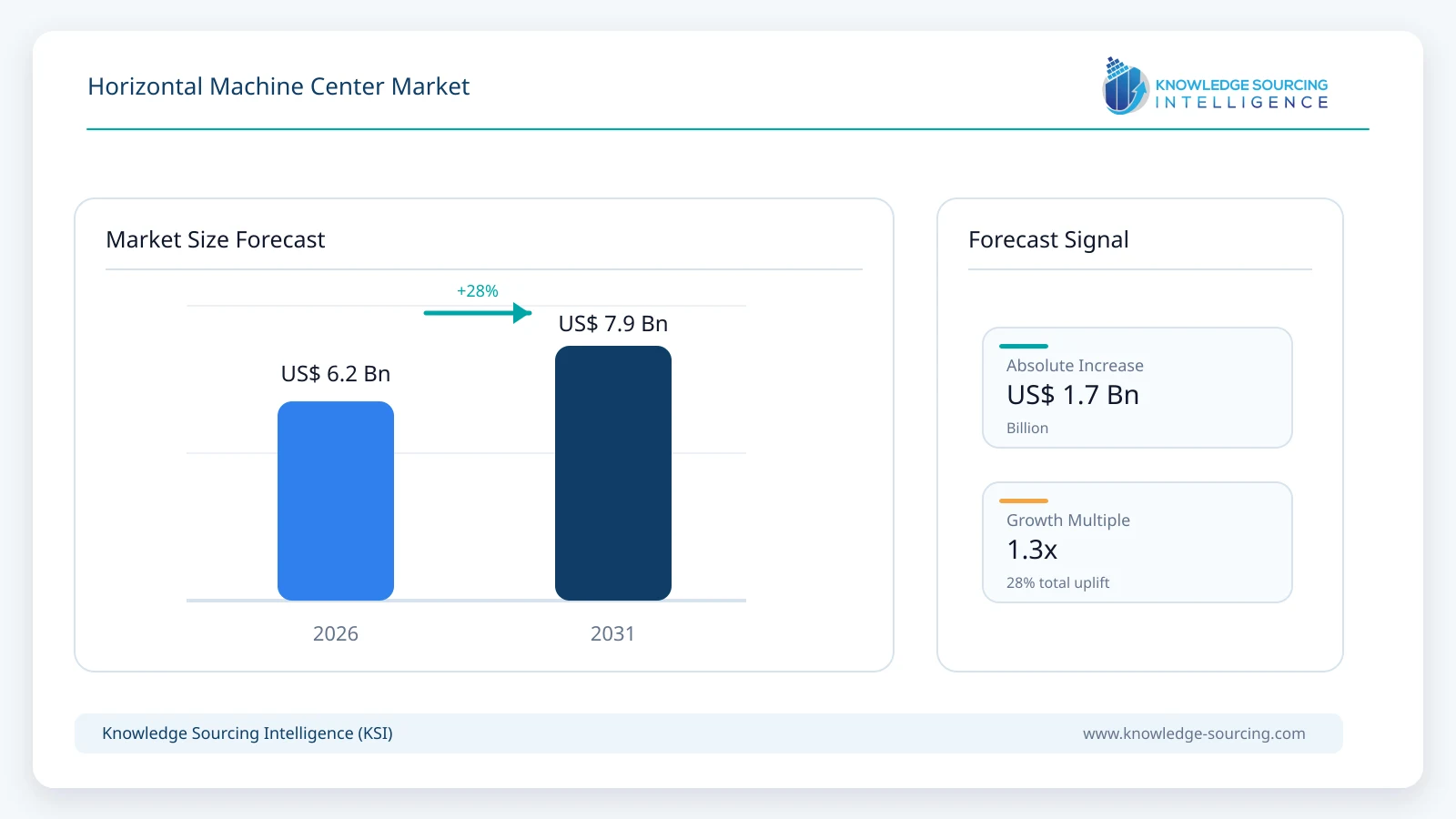
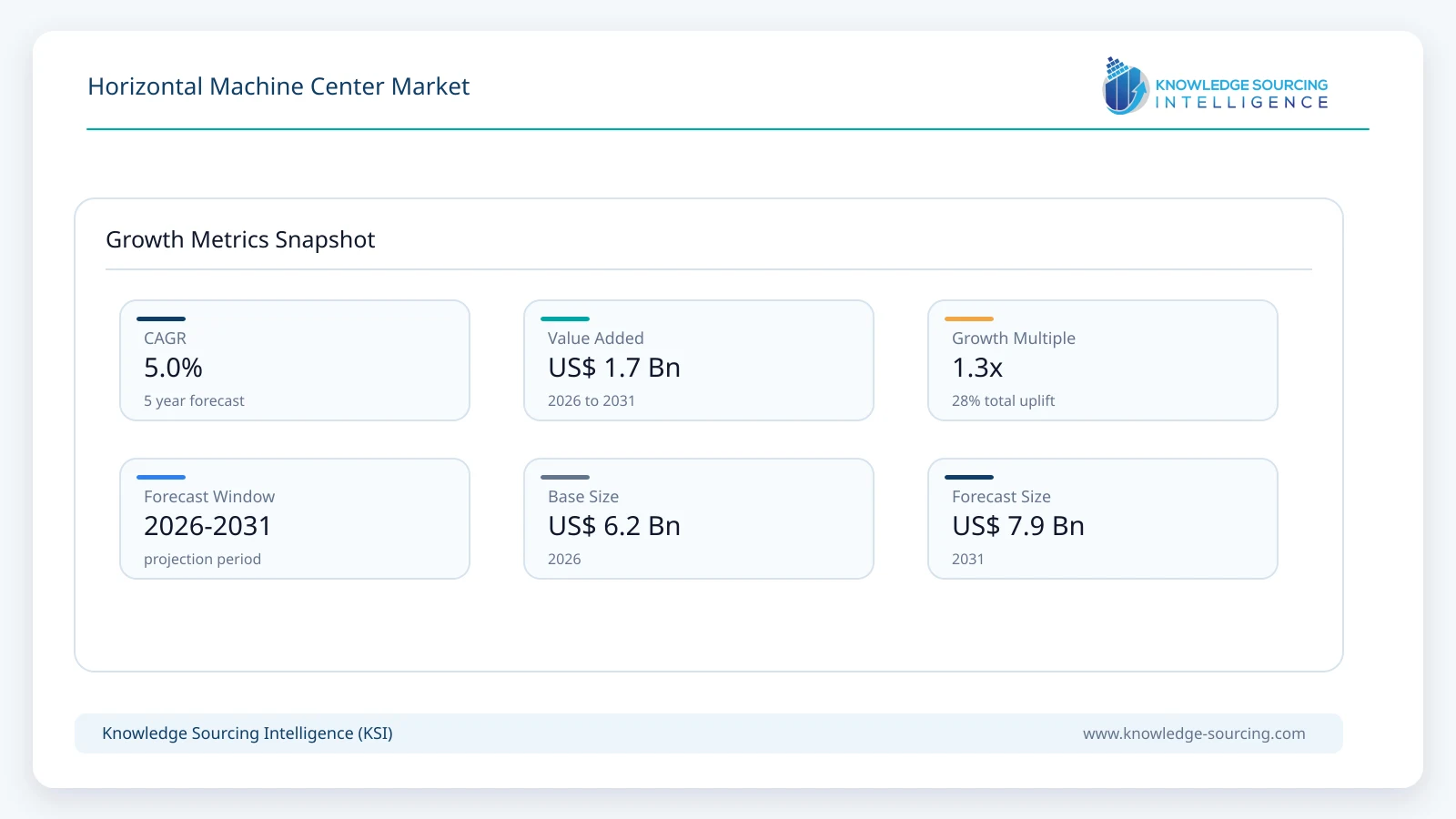
The Horizontal Machine Center Market is expected to expand at a 5.05% CAGR, reaching USD 7.89 billion in 2031 from USD 6.17 billion in 2026.
Highlights:
- 1Four-axis horizontal machining centers account for approximately 56% of global market value in 2026 and remain the dominant configuration for production machining.
- 2Machines using 500 mm to 630 mm pallets represent approximately 44% of market value in 2026 due to their broad applicability across automotive, machinery and aerospace components.
- 3Automotive accounts for approximately 31% of horizontal machine center demand in 2026, supported by high-volume machining of powertrain, chassis and structural components.
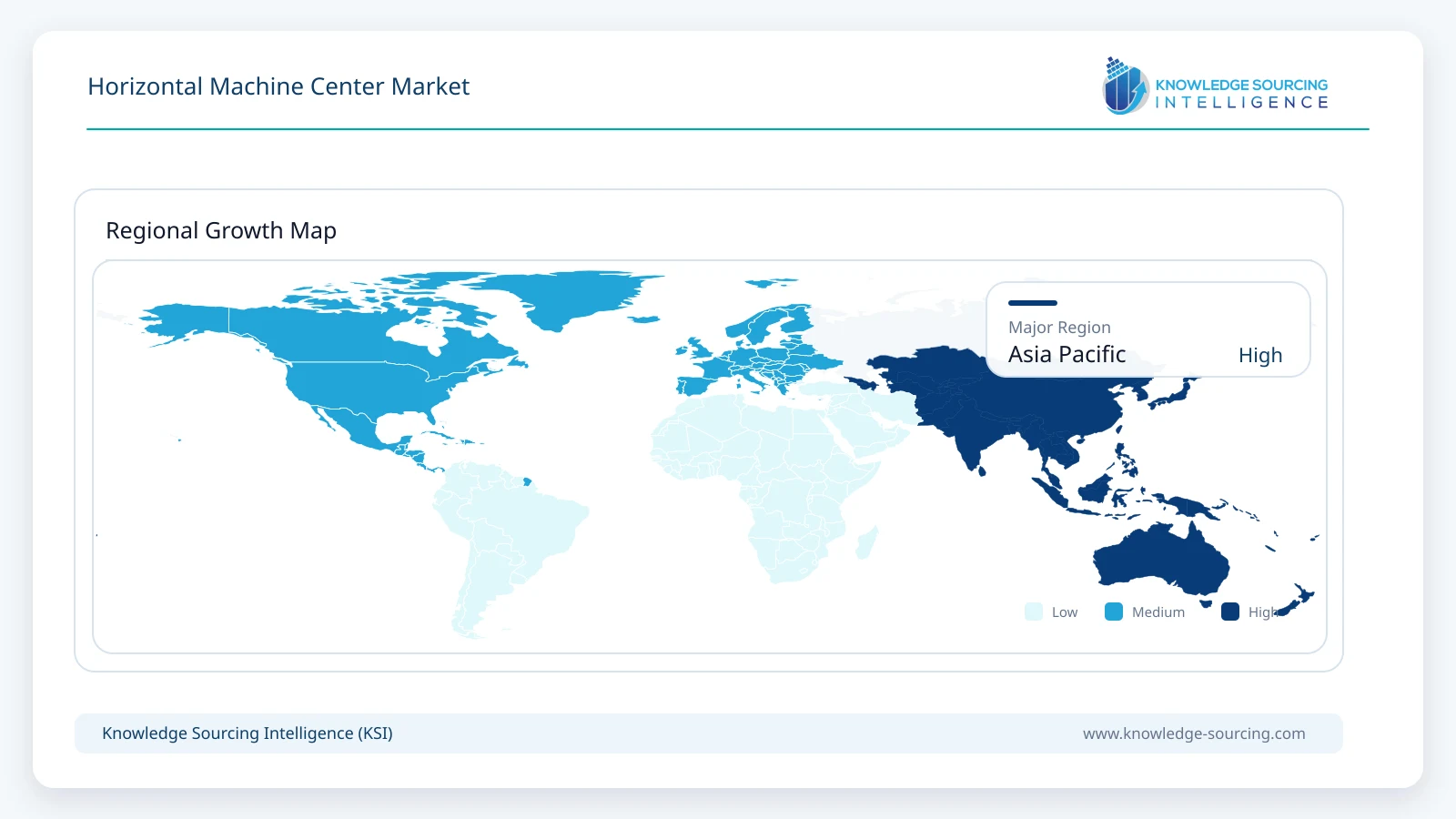
- 4Asia Pacific represents approximately 46% of global market value in 2026, supported by large machine-tool and manufacturing industries in China, Japan, South Korea and India.
- 5Five-axis horizontal machining centers are projected to grow at approximately 7.5% annually through 2031 as manufacturers consolidate complex machining operations into fewer setups.
Horizontal machining centers combine CNC-controlled milling, drilling, boring, tapping and related operations with pallet-based workholding and horizontal spindle orientation. Their ability to machine several faces of a component with limited repositioning makes them important in production environments where manufacturers require high spindle utilization, repeatability and automation.
Industry data demonstrate the commercial importance of the equipment category. Japan produced 3,230 horizontal machining centers worth JPY 108.1 billion in 2024. Although horizontal machines represented far fewer units than vertical machining centers, they accounted for approximately 12% of the total value of Japanese machine-tool production, reflecting their substantially higher average equipment value.
Investment conditions strengthened further entering 2026. U.S. manufacturing-technology orders reached USD 2.77 billion during the first five months of 2026, up 31.9% from the same period of 2025. AMT also noted that machinery order values were increasing considerably faster than unit volumes, partly because manufacturers were adding greater automation and purchasing increasingly sophisticated equipment.
Market Trends
Automation Is Becoming Integral to Horizontal Machining
Horizontal machining centers are increasingly being purchased as components of automated manufacturing cells rather than as standalone machines. Pallet changers already allow workpieces to be prepared while machining is underway, but manufacturers are extending this concept through pallet pools, robotic loading, automated tool management and production-scheduling software.
Mazak’s HCN NEO platform supports automated systems ranging from relatively small pallet changers to PALLETECH installations containing as many as 240 pallets and multiple loading stations. The associated software provides production scheduling, tool and material preparation and remote operation monitoring. Okuma is demonstrating the same direction at IMTS 2026, where its MB-5000HII horizontal machining center is paired with a tower pallet changer designed to enable extended unattended production.
This matters particularly for manufacturers facing skilled-labor constraints. Greater pallet and tool capacity allows machining to continue across breaks, overnight shifts and periods with fewer operators. The commercial value of an HMC is therefore increasingly determined by total cell productivity rather than the specification of the machine alone.
Five-Axis Capability Is Moving Into Horizontal Platforms
Five-axis machining has traditionally been associated strongly with specialist aerospace and complex-component production, but suppliers are expanding horizontal five-axis platforms across a wider range of part sizes. Makino introduced the a630iT in 2026 as a five-axis horizontal machining center designed for five-sided and simultaneous machining of large and heavy components. The machine uses a trunnion-style architecture and the company’s new Pro7 control.
HELLER is similarly expanding its F-series five-axis horizontal machining centers. DN Solutions presented the F 6000 at SIMTOS 2026 following its acquisition of HELLER, combining HELLER’s horizontal machining technology with DN Solutions’ broader manufacturing and distribution platform.
Five-axis capability allows manufacturers to machine more surfaces without repeatedly removing and reclamping a component. This is particularly valuable for aerospace structures, complex housings, energy components and precision industrial parts where additional setups increase cycle time and introduce dimensional error.
Control Software Is Increasing Machine Productivity
Machine-tool development is moving beyond spindle speed and axis travel toward software that improves process stability and machine utilization. Makino’s 2026 update to its a51nx and a61nx horizontal machining centers incorporates functions including process tracing, feed optimization, vibration stabilization, tool verification and schedule management.
Similar changes are occurring across major OEM portfolios. Modern CNC controls increasingly monitor cutting conditions, machine status, tools and production schedules while supporting connectivity with factory-management systems. This allows manufacturers to respond to tool wear, unexpected vibration and process deviations before they cause scrap or extended downtime.
Software also strengthens the economic case for automation. A highly automated pallet system produces limited benefit if machine stoppages still require frequent operator intervention. Condition monitoring, tool-life management and process optimization therefore increasingly determine how many productive hours manufacturers can obtain from expensive horizontal equipment.
Market Drivers
Recovery in Manufacturing Technology Investment
Capital spending on manufacturing equipment strengthened significantly in 2026. U.S. orders for metalworking machinery reached USD 5.74 billion during 2025, 22.5% above 2024, before continuing to grow strongly during the first five months of 2026. Japan’s machine-tool industry also entered 2026 with improving order momentum, with December 2025 orders reaching JPY 158.6 billion and recording the sixth consecutive month of year-on-year growth.
Horizontal machining centers benefit disproportionately when manufacturers move from basic capacity additions toward productivity-oriented investment because these machines generally carry higher capital costs but support automation, palletized production and multi-face machining. Their economics improve when manufacturers operate them for extended hours and spread the investment across larger production volumes.
The current investment cycle is therefore supporting demand not simply for more machines, but for more capable production systems with larger tool magazines, automated pallets and connected controls.
Aerospace Manufacturing Requires Complex Multi-Face Machining
Aircraft and aerospace components frequently involve complex geometries, tight tolerances and high-value materials. Structural parts, landing-gear components, housings and propulsion-system components may require machining across multiple faces while maintaining positional accuracy.
Horizontal and five-axis machining centers can reduce the number of setups required for these parts. Makino’s expansion of its horizontal five-axis portfolio and HELLER’s F-series development reflect continued OEM investment in equipment intended for such complex work. The higher value of aerospace components also supports investment in machines with advanced process control and automation because reducing scrap and setup errors can materially affect production economics.
Large aircraft backlogs and continued investment in defense manufacturing provide a long-term equipment requirement even though individual machine-tool orders can remain cyclical. Aerospace also supports faster adoption of five-axis HMCs because manufacturers place a greater premium on consolidating operations and maintaining accuracy across complex geometries.
Automotive and Industrial Production Supports High-Utilization HMC Cells
Automotive manufacturing remains a major application for horizontal machining centers because engine components, transmission housings, structural castings and other precision parts are often produced in repetitive high-volume environments. HMCs allow several sides of a component to be machined while automated pallet handling supports continuous production.
The technology is also extending into general machinery, energy equipment and precision industrial components. Manufacturers can use a common HMC platform across multiple part families by changing fixtures, programs and tooling, improving capital utilization compared with highly dedicated transfer-line equipment.
Automation further broadens this appeal. Instead of assigning operators continuously to individual machines, manufacturers can combine multiple HMCs with pallet pools, tool management and robotic systems. This is becoming increasingly important as machinery buyers seek both additional capacity and greater output per manufacturing worker.
Market Restraints
High Initial Investment Limits Adoption Among Smaller Manufacturers
Horizontal machining centers generally require greater investment than basic vertical machining centers because of their machine structure, pallet-changing systems, rotary axes and larger automation options. Additional spending may also be required for fixtures, tooling, pallet pools, robotics and production-management software.
The economics are attractive when a machine maintains high utilization, but the investment can be difficult to justify for manufacturers producing small batches or highly variable work. Smaller machine shops may therefore continue using vertical machining centers unless productivity improvements, labor savings or multi-face machining requirements provide a clear payback.
Financing conditions also influence purchasing decisions because machining centers are long-lived capital assets. Periods of uncertainty can cause manufacturers to postpone equipment purchases even when underlying demand remains healthy.
Advanced Equipment Requires Process and Programming Expertise
Five-axis machining, large pallet systems and automated production cells reduce manual intervention during production but increase the complexity of process planning. Manufacturers need programmers, applications engineers and maintenance personnel capable of managing CNC programs, tooling, fixtures, automation interfaces and process-control systems.
A poorly configured automated HMC can simply reproduce machining problems for longer periods without operator intervention. Manufacturers therefore need robust process validation and monitoring before moving toward lights-out production.
Machine builders are responding with increasingly automated controls, training and applications support, but skills availability remains an important constraint, particularly among smaller manufacturers adopting advanced machining for the first time.
Segment Analysis
By Axis Type: Four-Axis Horizontal Machining Centers
Four-axis horizontal machining centers are projected to reach approximately USD 4.28 billion by 2031. They remain the core configuration for high-volume HMC applications because a rotary B-axis allows manufacturers to index workpieces and machine several faces while retaining the rigidity and relatively straightforward kinematics of a conventional machining center.
Four-axis platforms are widely used across automotive, industrial machinery and general precision manufacturing. Current products such as Makino’s a51nx/a61nx series and Okuma’s MB-5000HII combine this architecture with advanced control software and pallet automation.
Five-axis machines increase to approximately USD 2.57 billion by 2031 as aerospace and complex-component manufacturers increasingly require simultaneous machining and fewer setups. Three-axis configurations remain relevant where components require simpler machining, but the long-term value shift favors four- and five-axis systems.
By Pallet Size: 500 mm to 630 mm
Horizontal machining centers with approximately 500 mm to 630 mm pallets are projected to reach around USD 3.50 billion by 2031. This range provides a useful balance between machine footprint and workpiece capacity and is widely represented across leading OEM portfolios.
Okuma’s MB-5000HII uses a 500 mm-class pallet and can accommodate substantially larger workpieces around it, while Makino, Mazak, DN Solutions and several Japanese and European suppliers offer extensive product families around the 500 mm and 630 mm classes.
Smaller 400 mm-class machines remain important for compact precision components and high-volume manufacturing where floor-space efficiency matters. Larger machines above 630 mm serve heavy components, aerospace structures, energy equipment and industrial machinery. The mid-sized category nevertheless maintains the broadest cross-industry application base.
By End User: Automotive
Automotive applications are projected to reach approximately USD 2.38 billion by 2031. The segment continues to use horizontal machining centers for repetitive machining of cast and forged parts where cycle time, dimensional consistency and equipment utilization are critical.
Demand is gradually changing as electric vehicles reduce the number of conventional engine and transmission components in some vehicle platforms. This does not remove automotive machining demand, however. Manufacturers continue to require machined structural castings, suspension components, electric-drive housings and other precision components, while hybrid and internal-combustion vehicle production remains substantial globally.
Aerospace and defense grows more rapidly than automotive through the forecast period because its component mix increasingly favors five-axis machining, high-value materials and process consolidation. General industrial machinery also remains a substantial customer base because HMC flexibility allows manufacturers to process multiple component families using common equipment.
Regional Outlook
Asia Pacific
Asia Pacific remains the largest regional horizontal machine center market and is projected to reach approximately USD 3.78 billion by 2031. The region combines large manufacturing industries with a substantial domestic machine-tool production base across Japan, China, South Korea and Taiwan, while India continues expanding automotive, aerospace and general manufacturing capacity.
Japan alone provides a useful indication of HMC activity. Japanese manufacturers produced 3,230 horizontal machining centers worth JPY 108.1 billion in 2024, and the Japan Machine Tool Builders’ Association lists Makino, JTEKT, Matsuura, Yamazaki Mazak, Kitamura, Shibaura Machine and several other domestic manufacturers as suppliers of horizontal machining centers.
Regional competition is also intensifying through Korean manufacturers. DN Solutions completed its acquisition of Germany’s HELLER in January 2026, combining DN Solutions’ scale and Asian manufacturing presence with HELLER’s high-end horizontal machining technology.
China remains a major source of manufacturing investment and machine-tool demand, while India is attracting additional automotive, aerospace, electronics and industrial equipment production. These trends maintain Asia Pacific’s leading position throughout the forecast period.
Competitive Environment and Analysis
The horizontal machine center industry includes large diversified machine-tool manufacturers alongside specialists with strong positions in palletized and multi-axis machining. Yamazaki Mazak, Makino, Okuma, DN Solutions, HELLER, DMG MORI and JTEKT maintain extensive HMC portfolios across different pallet sizes, spindle configurations and automation levels. Japanese suppliers including Matsuura, Kitamura, Shibaura Machine and Enshu also maintain established positions in precision horizontal machining.
Product competition increasingly revolves around complete manufacturing productivity rather than conventional machine specifications alone. Manufacturers differentiate through pallet automation, larger tool magazines, thermal stability, process monitoring, software integration and the ability to run reliably for extended unattended periods.
Consolidation is also changing the competitive landscape. DN Solutions completed its acquisition of HELLER in January 2026 after announcing the transaction in August 2025. DN Solutions stated that the combination would bring its consolidated sales close to EUR 2 billion and broaden its capabilities in high-end machining centers and precision engineering.
The installed service network remains another important competitive factor. HMC customers frequently operate equipment for many years and depend on access to spare parts, spindle service, application engineering and CNC support. Manufacturers with broad regional service coverage consequently retain an advantage in automotive and aerospace accounts where machine downtime carries a high production cost.
Recent Developments
September 2026: Okuma is presenting the MB-5000HII with a tower pallet changer and the GENOS M4000H-e with an integrated two-pallet automatic pallet changer at IMTS 2026, emphasizing automated horizontal machining and unattended production.
August 2026: Makino previewed the new a630iT five-axis horizontal machining center ahead of its IMTS 2026 debut, incorporating a trunnion-style architecture and new Pro7 CNC control.
June 2026: Makino introduced the latest a51nx/a61nx Version C horizontal machining centers with additional process monitoring, feed optimization, tool verification and production-management capabilities.
May 2026: Yamazaki Mazak released the HCN-8800 NEO horizontal machining center, extending the HCN NEO family into larger workpieces and heavy-duty machining.
April 2026: DN Solutions and HELLER presented the new F 6000 five-axis horizontal machining center at SIMTOS 2026 following the combination of the two machine-tool businesses.
January 2026: DN Solutions completed the acquisition of HELLER, combining two substantial machine-tool portfolios and strengthening its position in horizontal and five-axis machining systems.
Market Outlook
The horizontal machine center market growth is increasingly being accelerated with the automation and machining capabilities being incorporated into each. Pallet systems, advanced CNC software, five-axis functionality and process monitoring are augmenting the value of equipment while enabling manufacturers to obtain more productive hours from each machine.
Four-axis machines remain the principal market configuration and continue to serve large-volume manufacturing effectively, while five-axis horizontal machining centers gain importance in aerospace and other complex-component industries. Mid-sized machines based around 500 mm to 630 mm pallets retain the broadest application base because they can address automotive components, industrial equipment and a significant range of aerospace work without requiring the footprint of large HMC systems.
Automotive remains the largest end-user industry, while aerospace and defense provide stronger opportunities for advanced five-axis systems. Asia Pacific maintains the largest regional position due to its combination of end-user manufacturing activity and extensive machine-tool production capacity.
The market’s competitive focus is consequently shifting from individual machine performance toward the productivity of the entire machining system. Equipment capable of operating with automated pallets, larger tool inventories, process monitoring and limited operator intervention is positioned to capture a growing share of investment as manufacturers seek higher output from constrained labor and factory space.
Horizontal Machine Center Market Scope
| Report Metric | Details |
|---|---|
| Total Market Size in 2026 | USD 6.17 billion |
| Total Market Size in 2031 | USD 7.89 billion |
| Forecast Unit | Billion |
| Growth Rate | 5.05% |
| Study Period | 2021 to 2031 |
| Historical Data | 2021 to 2024 |
| Base Year | 2025 |
| Forecast Period | 2026 – 2031 |
| Segmentation | Axis Type, Pallet Size, End User, Geography |
| Companies |
|
Market Segmentation
By Axis Type
3 Axis
4 Axis
5 Axis
By Pallet Size
Up to 400 mm
500 mm to 630 mm
Above 630 mm
By End User
Automotive
Aerospace and Defense
Industrial Machinery
Energy and Power
Electronics and Semiconductor Equipment
Others
By Geography
North America
United States
Canada
Mexico
South America
Brazil
Argentina
Others
Europe
Germany
France
United Kingdom
Italy
Others
Middle East and Africa
Saudi Arabia
UAE
South Africa
Others
Asia Pacific
China
Japan
India
South Korea
Taiwan
Others
Table of Contents
1. INTRODUCTION
1.1. Market Overview
1.2. Market Definition
1.3. Scope of the Study
1.4. Market Segmentation
1.5. Currency
1.6. Assumptions
1.7. Base and Forecast Years
1.8. Key Benefits to Stakeholders
2. RESEARCH METHODOLOGY
2.1. Research Design
2.2. Secondary Research
2.3. Market Estimation
2.4. Segment Modelling
2.5. Data Triangulation and Validation
3. EXECUTIVE SUMMARY
3.1. Key Findings
3.2. Horizontal Machine Center Market Size, 2026-2031
3.3. Axis Type Outlook
3.4. Pallet Size Outlook
3.5. End-User Outlook
3.6. Regional Opportunity Summary
4. MARKET DYNAMICS
4.1. Market Drivers
4.1.1. Recovery in Manufacturing Technology Investment
4.1.2. Aerospace Demand for Complex Multi-Face Machining
4.1.3. Automotive and Industrial Production Automation
4.2. Market Restraints
4.2.1. High Initial Equipment and Automation Cost
4.2.2. Advanced Programming and Process Skill Requirements
4.3. Porter’s Five Forces Analysis
4.4. Industry Value Chain Analysis
5. TECHNOLOGICAL OUTLOOK
5.1. Five-Axis Horizontal Machining
5.2. Pallet Pool and Flexible Manufacturing Systems
5.3. Robotic Machine Loading
5.4. Process Monitoring and Adaptive Control
5.5. Tool Management and Automated Scheduling
5.6. Lights-Out Manufacturing
6. HORIZONTAL MACHINE CENTER MARKET BY AXIS TYPE
6.1. 3 Axis
6.2. 4 Axis
6.3. 5 Axis
7. HORIZONTAL MACHINE CENTER MARKET BY PALLET SIZE
7.1. Up to 400 mm
7.2. 500 mm to 630 mm
7.3. Above 630 mm
8. HORIZONTAL MACHINE CENTER MARKET BY END USER
8.1. Automotive
8.2. Aerospace and Defense
8.3. Industrial Machinery
8.4. Energy and Power
8.5. Electronics and Semiconductor Equipment
8.6. Others
9. HORIZONTAL MACHINE CENTER MARKET BY GEOGRAPHY
9.1. North America
9.1.1. United States
9.1.2. Canada
9.1.3. Mexico
9.2. South America
9.2.1. Brazil
9.2.2. Argentina
9.2.3. Others
9.3. Europe
9.3.1. Germany
9.3.2. France
9.3.3. United Kingdom
9.3.4. Italy
9.3.5. Others
9.4. Middle East and Africa
9.4.1. Saudi Arabia
9.4.2. UAE
9.4.3. South Africa
9.4.4. Others
9.5. Asia Pacific
9.5.1. China
9.5.2. Japan
9.5.3. India
9.5.4. South Korea
9.5.5. Taiwan
9.5.6. Others
10. COMPETITIVE ENVIRONMENT AND ANALYSIS
10.1. Major Players and Strategy Analysis
10.2. Market Share Analysis
10.3. Mergers, Acquisitions, Agreements, and Collaborations
10.4. Competitive Dashboard
11. COMPANY PROFILES
11.1. Yamazaki Mazak Corporation
11.2. Makino Milling Machine Co., Ltd.
11.3. Okuma Corporation
11.4. DN Solutions
11.5. HELLER
11.6. DMG MORI Co., Ltd.
11.7. JTEKT Corporation
11.8. Matsuura Machinery Corporation
11.9. Kitamura Machinery Co., Ltd.
11.10. Hyundai WIA Corporation
11.11. Shibaura Machine Co., Ltd.
11.12. Enshu Limited
11.13. Haas Automation, Inc.
11.14. GROB-WERKE GmbH & Co. KG
11.15. NIDEC Machine Tool Corporation
12. APPENDIX
Navigate
Trusted by the world's leading organizations











