
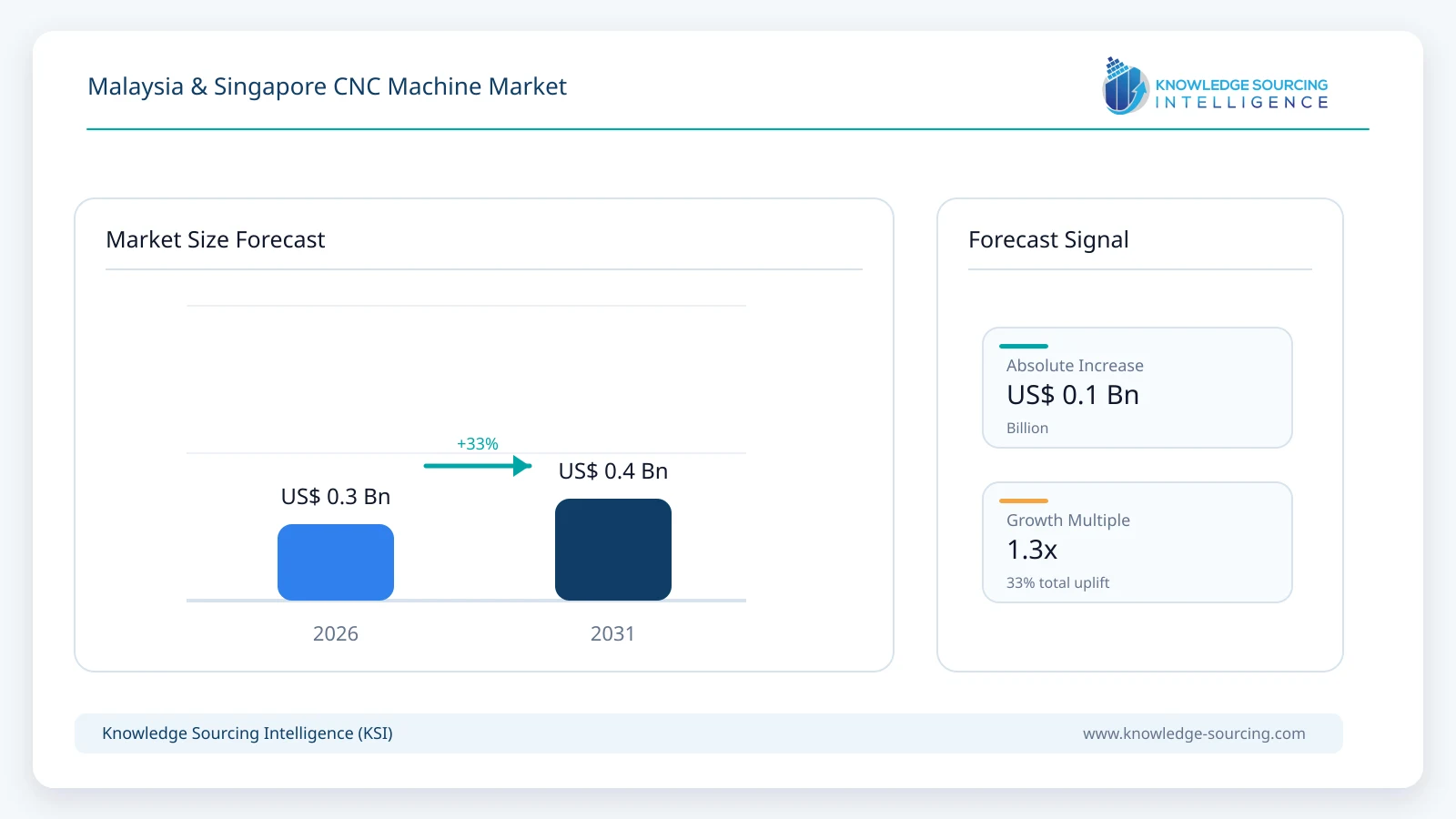
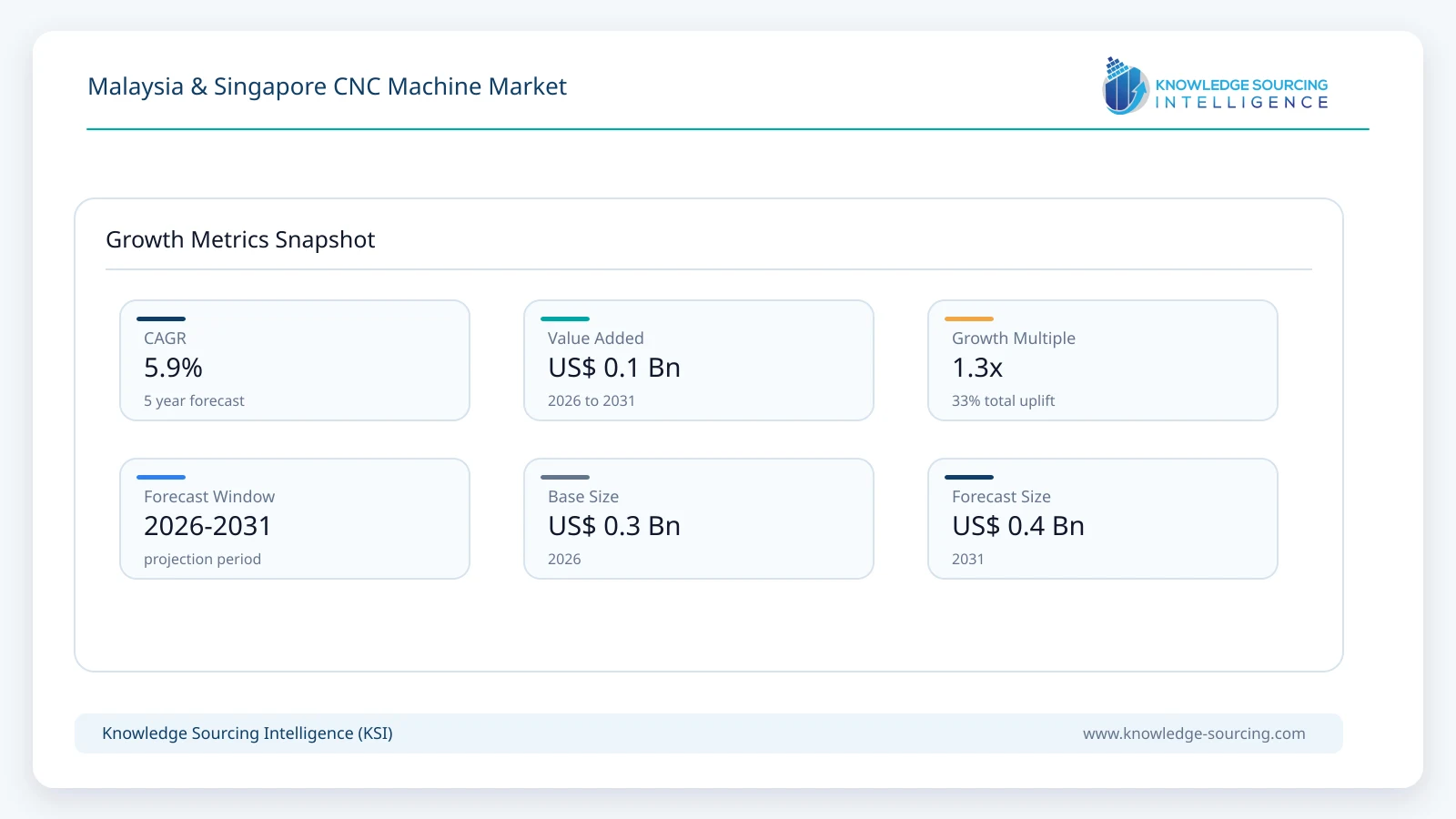
The Malaysia and Singapore CNC Machine market is forecast to grow at a CAGR of 5.9%, reaching USD 0.4 billion in 2031 from USD 0.3 billion in 2026.
Highlights:
- 1Growing Industrial DemandIncreasing need for precision in the automotive and aerospace sectors.
- 2AI IntegrationAdoption of AI enhances automation, accuracy, and design sophistication.
- 3High CostsExpensive installation and maintenance hinder broader CNC machine adoption.
- 4Automation TrendShift to smart manufacturing boosts CNC machine market growth.
A CNC machine is a machine that offers automated control of machine tools using computers. It helps to minimize setup time and reduce the tool time of the machines. This machine increases the efficiency of various machines operating in a plant. In the CNC machine, various pre-programmed software is dedicated to the movements of tools and machinery in the factory. These machines control various machinery ranges, like lathes, mills, and grinders.
One of the major drivers of the Malaysian and Singapore CNC machine market is the increase in the industrial landscape in these nations. The CNC machine is used in various industrial applications, like in the electronics industry, where these machines offer the processing capability of conductive and non-conductive metals. Similarly, in the aerospace industry, these machines are used to manufacture various airplane parts, like wings, frames, bulkheads, and landing gears. The aerospace industry in Singapore is among the biggest contributors to the GDP of the nation. The Singapore Economic Development Board stated that in 2022, the aerospace industry's total output was observed at about US$9.5 billion (Singapore $13.1 billion), with an annual growth of about 6.1%. Similarly, the nation has a vast oil and gas industry, contributing about US$2.2 billion (Singapore $3.04 billion) in the same year.
Rising trade in the region is among the major factors pushing the demand for industrial products in the Malaysian and Singapore markets. The import of 'horizontal lathes numerically controlled' by Singapore was US$7,522.84K in 2021 and reached US$15,161.25K in 2023. Imports by Malaysia were US$22,079.17K in 2023 for 'horizontal lathes numerically controlled', according to the WITS (World Integrated Trade Solution).
Some of the major companies include Hwacheon, Tsugami, and ARRK.
Hwacheon offers a range of options that allow automatic machining and complex workpieces.
Tsugami offers a B0125-III CNC Precision Automatic Lathe, which is an automatic programming system, guide-bush type or guide-bushless type, and weighs 2,000 Kg.
ARRK offers CNC machining for software-controlled machinery to make precision cuts. Plastic and metal components can be prototyped or produced with medium or low-volume CNC machining.
Market Drivers:
The increase in vehicle production is anticipated to propel market growth.
The CNC machine is an important component in the automotive manufacturing industry globally. It is generally used by all major automotive producers worldwide, which offers multiple benefits to manufacturers. CNC machines are used in the production of vehicle chassis and various body parts and components. They can also be used to produce frames, brackets, mounting points, and body panels.
The increase in automotive production in Malaysia and Singapore is expected to boost the CNC machine market in these countries. Automotive vehicle production in Malaysia witnessed a significant increase in recent years and is expected to rise further in the future. According to the International Organization of Motor Vehicle Manufacturers, Malaysia produced 724,891 cars and 49,709 commercial vehicles in 2023, an increase of 10% from the previous year. Malaysia produced 702,275 vehicles in 2022, reaching 774,600 in 2023; the total production was 481,651 in 2021.
Additionally, the efforts by the government to promote industrial automation, coupled with the advent of Industry 4.0, will expand the market opportunity for CNC machines in various end-user sectors, such as energy & power, automotive, electrical & electronics, and construction, among others. As per the updates from the Malaysian Investment Development Authority, the country currently hosts around 50 companies that provide advanced-level factory automation systems. In 2020, the Automation Project Initiative (API) was also launched by the Authority to support businesses in the adoption of smart manufacturing technologies in the long term.
Furthermore, the rising integration of AI into CNC machining is anticipated to expand several opportunities, coupled with the rising digitalization trend and shift from traditional machine operations. Companies in the upcoming years are expected to embrace the integration of automation with AI, as it results in several benefits to machine shops. Some of these advantages include high-order accuracy, increased inventory, and strict quality control, among others. In addition to this, the integration also provides a higher level of sophistication and enhanced designs with advanced software. For instance, the potential of AI will expand multifold in the upcoming years with generative design software, such as Autodesk, which directly connects to AI-assisted CNC machining for subtractive manufacturing and better results.
Market Restraints:
The high installation and maintenance costs associated with CNC machines are expected to hamper market growth.
The inclusion of brand-new computer numerical control machines, including sensors, routers, and lathes, among other components, into the company’s operations. It is considered quite expensive and is anticipated to restrict its application across various sectors in the coming years. The overall costs include installation, shipping, maintenance, and other transportation expenses. Additionally, these machines also require periodic upgrades to their system to remain compatible with the manufacturing process for which they are applied. Therefore, these factors are expected to impact the adoption of CNC machines across Malaysia and Singapore, especially across the cost-sensitive regions of the countries.
Segment Analysis:
The Industrial segment is anticipated to propel market growth.
The rising number of older adults in Malaysia and Singapore is anticipated to boost labor costs in different industries. Therefore, the adoption of automation will expand, thereby fueling market expansion for CNC machines until the forecast period. A wide variety of CNC machines, such as milling machines, plasma cutters, drilling machines, and lathe machines, are set up according to the specific needs of these industries' end products. These machines reduce wastage and decrease overall production costs, coupled with higher speed, with minimal human involvement.
The aerospace & defense sector is also experiencing substantial growth
Malaysia and Singapore are significant contributors in the aerospace and defense sectors and employ CNC machining for high-precision component production for aircraft, defense systems, and other military equipment. Singapore is a major aerospace manufacturing hub focusing on cutting-edge technology, such as Industry 4.0, smart manufacturing, and automation.
Following this, the International Trade Administration stated that Singapore is Asia's number-one one-stop solutions supplier for aircraft Maintenance, Repair, and Overhaul (MRO) requirements, accounting for 10% of worldwide MRO output. The aerospace and defense market size in the nation is around USD 6 billion in 2024 and is estimated to reach USD 11.7 billion within the next five years.
With the continued push to increase the aerospace and defense industry over the next 3–5 years in Singapore, more than USD 750 million has been invested, and more than 10 new projects have been developed. Moreover, the nation shows a strong CAGR since the defense budget is projected to increase from USD 10 billion to USD 12 billion, and the acquisition budget from USD 493 million to USD 714 million from 2024 to 2028
Meanwhile, Malaysia is emerging as a chief manufacturing center, focusing on aerospace production, MRO services, and high-precision defense components. The country is spending on CNC capabilities and workforce development, which is being supported by government initiatives like the Malaysia Aerospace Industry Blueprint 2030. It aims to establish Malaysia as Southeast Asia's most important aerospace marketplace. Currently, there are more than 200 aerospace companies within the country, from both international and local players in the industry.
Moreover, in June 2023, the Malaysia External Trade Development Corporation, or MATRADE, and the National Aerospace Industry Corporation Malaysia, or NAICO, announced Malaysia's participation at the 54th International Paris Airshow, IPAS 2023. Organized by the Salon International de l'Aéronautique et de l'Espace (SIAE), a subsidiary of GIFAS, the French Aerospace Industries Association, this prestigious event was held from 19-25 June 2023 at Le Bourget Parc des Expositions. These initiatives further drive the aerospace industry's growth in the region.
Regarding trade performance, Malaysia's aerospace industry was RM24.04 billion in 2022, with exports growing by 9.1% to RM6.32 billion compared to RM5.79 billion in 2021. The biggest export items of Malaysia for the aerospace sector are spare parts for planes or helicopters, aircraft, and parts thereof. While Singapore leads in technological innovation, Malaysia is gradually growing its presence in the sector, driven by international partnerships and the thrust of local industry support.
Geographical Outlook:
By province, Kuala Lumpur is anticipated to lead the market growth
By province, the Malaysian and Singapore CNC machine market has been segmented into Kuala Lumpur, Johor Bahru, Jurong East, and others. The CNC machine market in Kuala Lumpur is experiencing significant growth, driven primarily by the increasing production of motor vehicles in Malaysia. The Malaysian automotive sector has shown remarkable resilience and expansion, with vehicle production rising from approximately 702,275 units in 2022 to around 774,600 units in 2023. This surge represents a robust growth trajectory and highlights the nation's commitment to enhancing its manufacturing capabilities.
The automotive industry is a critical consumer of CNC machines, which are essential for producing high-precision components like chassis, body panels, and various engine parts. As manufacturers strive to meet both domestic and international demand, the reliance on advanced CNC technologies becomes increasingly vital.
One of the key drivers of this growth is the government's strategic initiatives aimed at promoting industrial automation and technological advancement within the automotive sector. The Malaysian government has been proactive in facilitating investments in modern manufacturing technologies, including CNC machines. This aligns with the broader trend of Industry 4.0, which emphasizes automation and data exchange in manufacturing processes. As a result, companies are investing in CNC machinery to enhance their production efficiency and product quality, thus positioning themselves competitively in both local and global markets.
In addition to the automotive sector, other industries, such as aerospace and electronics, are also contributing to the demand for CNC machines. The growing emphasis on high-precision machining across these sectors reinforces the positive outlook for Kuala Lumpur's CNC machine market. As these trends evolve, Kuala Lumpur is well-positioned to capitalize on its strategic advantages, ensuring sustained growth in the CNC machine industry over the coming years.
Key Developments:
June 2026: Yamazaki Mazak Malaysia showcased the QRX CNC turning center, VC-Ez IP vertical machining center, VARIAXIS C-600 five-axis center, and INTEGREX j-200 NEO at METALTECH & AUTOMEX 2026.
June 2026: Makino introduced the next-generation a51nx and a61nx Version C horizontal machining centers, featuring Pro6 Control and iKnowledge technologies for improved productivity and process stability.
May 2026: Yamazaki Mazak presented the QRX-50 MSY SG, VC-Ez 510 IP, INTEGREX j-200 NEO, and VARIAXIS C-600 at METALTECH & AUTOMEX 2026 in Kuala Lumpur.
List of Top Malaysia And Singapore CNC Machine Companies:
Mitutoyo, a leading player in Malaysia, provides a wide range of smart factory solutions for CNC coordinate measuring machines. The company's head office is located in Kuala Lumpur, and it has various regional offices across the country.
Tsugami is one of the leading companies in CNC machine manufacturing. The company is determined to provide products with higher accuracy and precision at the most affordable price range. Various products under its broad portfolio include the CNC automatic lathe and CNC grinding, among others. It has various groups of companies, such as TSUGAMI Universal Pte. Ltd., that address the demand of the Singapore market.
Makino is a global producer of CNC machines propelled by emerging technologies and provides vertical machining centers. It provides a complete set of solutions, such as machine tool sub-components and engineering services as well.
Robo CNC Sdn. Bhd is an authorized company dealer that provides Haas CNC machines across Malaysia. It provides a one-stop solution for all manufacturing processes.
Malaysia And Singapore CNC Machine Market Scope
| Report Metric | Details |
|---|---|
| Total Market Size in 2026 | USD 0.3 billion |
| Total Market Size in 2031 | USD 0.4 billion |
| Forecast Unit | Billion |
| Growth Rate | 5.9% |
| Study Period | 2021 to 2031 |
| Historical Data | 2021 to 2024 |
| Base Year | 2025 |
| Forecast Period | 2026 – 2031 |
| Segmentation | Type, Axis, Industry Vertical |
| Companies |
|
Market Segmentation
By Type
- Lathe Machine
- Milling Machine
- Laser Cutting Machine
- Plasma Cutting Machine
- Welding Machine
- Winding Machine
- Grinding Machine
- Others
By Axis
- 2-axis
- 2.5-axis
- 3-axis
- 4-axis
- 5-axis
- 6-axis
By Industry Vertical
- Aerospace and Defense
- Energy & Power
- Automotive
- Industrial
- Construction
- Electrical & Electronics
- Others
By Province
- Kuala Lumpur
- Johor Bahru
- Jurong East
- Others
Table of Contents
1. Introduction
1.1. Market Overview
1.2. Market Definition
1.3. Scope of the Study
1.4. Market Segmentation
1.5. Currency
1.6. Assumptions
1.7. Base and Forecast Years Timeline
1.8. Key Benefits for the Stakeholders
2. Research Methodology
2.1. Research Design
2.2. Research Process
2.3. Data Validation
3. Executive Summary
3.1. Key Findings
3.2. Analyst View
4. Market Dynamics
4.1. Market Drivers
4.2. Market Restraints
4.3. Porter’s Five Forces Analysis
4.3.1. Bargaining Power of Supplier
4.3.2. Bargaining Power of Buyers
4.3.3. Threat of New Entrants
4.3.4. Threat of Substitutes
4.3.5. Competitive Rivalry in the Industry
4.4. Industry Value Chain Analysis
5. Malaysia and Singapore CNC Machine Market By Type
5.1. Introduction
5.2. Lathe Machine
5.3. Milling Machine
5.4. Laser Cutting Machine
5.5. Plasma Cutting Machine
5.6. Welding Machine
5.7. Winding Machine
5.8. Grinding Machine
5.9. Others
6. Malaysia and Singapore CNC Machine Market By Axis
6.1. Introduction
6.2. 2-axis
6.3. 2.5-axis
6.4. 3-axis
6.5. 4-axis
6.6. 5-axis
6.7. 6-axis
7. Malaysia and Singapore CNC Machine Market By Industry Vertical
7.1. Introduction
7.2. Aerospace and Defense
7.3. Energy & Power
7.4. Automotive
7.5. Industrial
7.6. Construction
7.7. Electrical & Electronics
7.8. Others
8. Malaysia and Singapore CNC Machine Market By Province
8.1. Introduction
8.2. Kuala Lumpur
8.3. Johor Bahru
8.4. Jurong East
8.5. Others
9. Competitive Environment and Analysis
9.1. Major Players and Strategy Analysis
9.2. Emerging Players and Market Lucrativeness
9.3. Mergers, Acquisitions, Agreements, and Collaborations
9.4. Competitive Dashboard
10. Company Profiles
10.1. Haas Automation, Inc. (Robo CNC Sdn. Bhd)
10.2. Mazak Singapore
10.3. Mitsubishi Electric Corporation
10.4. ARRK Corporation
10.5. Makino
10.6. Tsugami
10.7. Mitutoyo
10.8. Hwacheon
Navigate
Trusted by the world's leading organizations











