
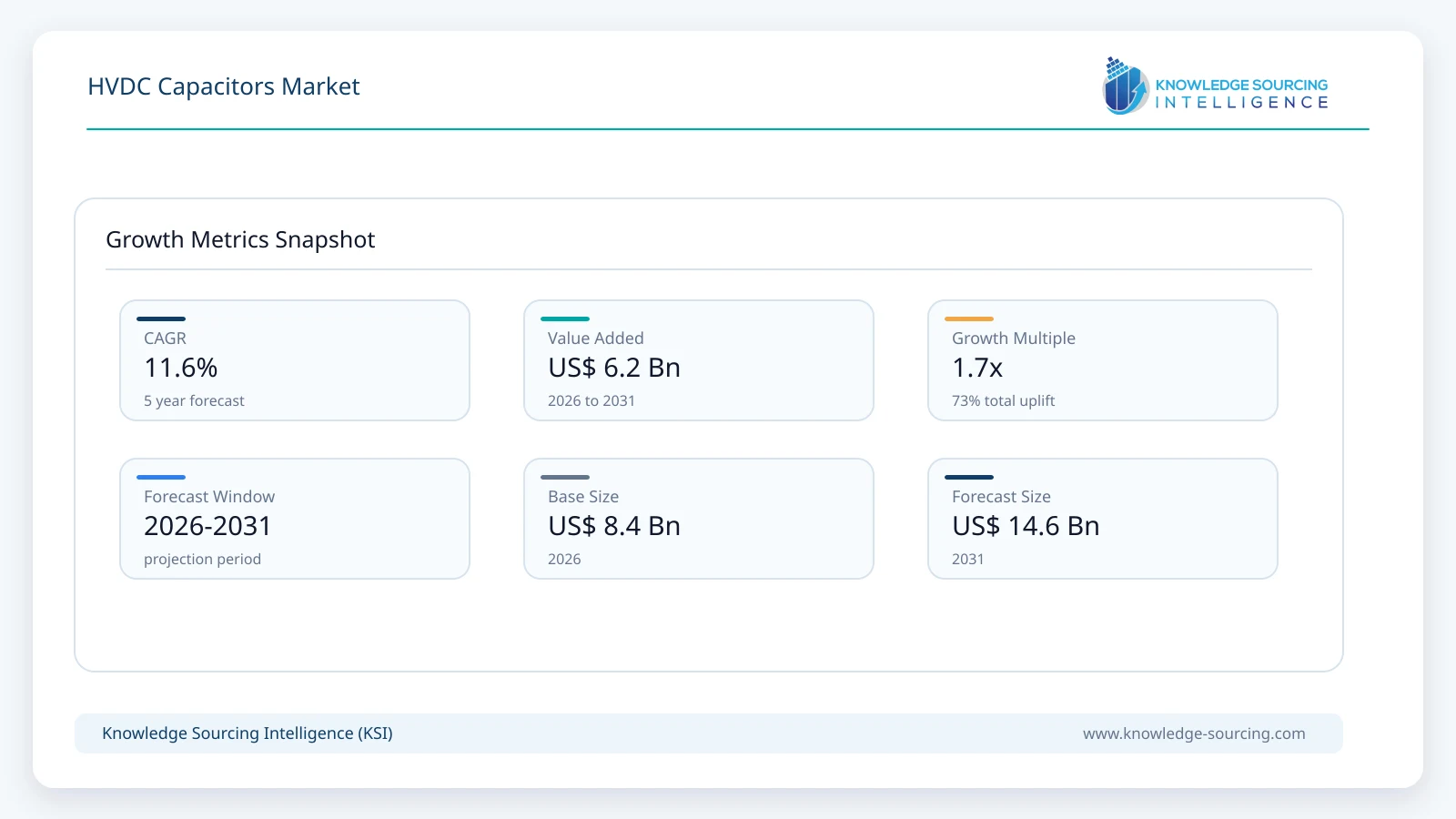
The HVDC Capacitors Market is forecast to grow at a CAGR of 11.6%, reaching USD 14.61 billion in 2031 from USD 8.44 billion in 2026.
Highlights:
- 1Long-distance renewable-power evacuation is creating new HVDC converter-station requirements and associated capacitor procurement.
- 2DC-link and converter capacitors are becoming commercially important as VSC and modular multilevel converter deployments expand.
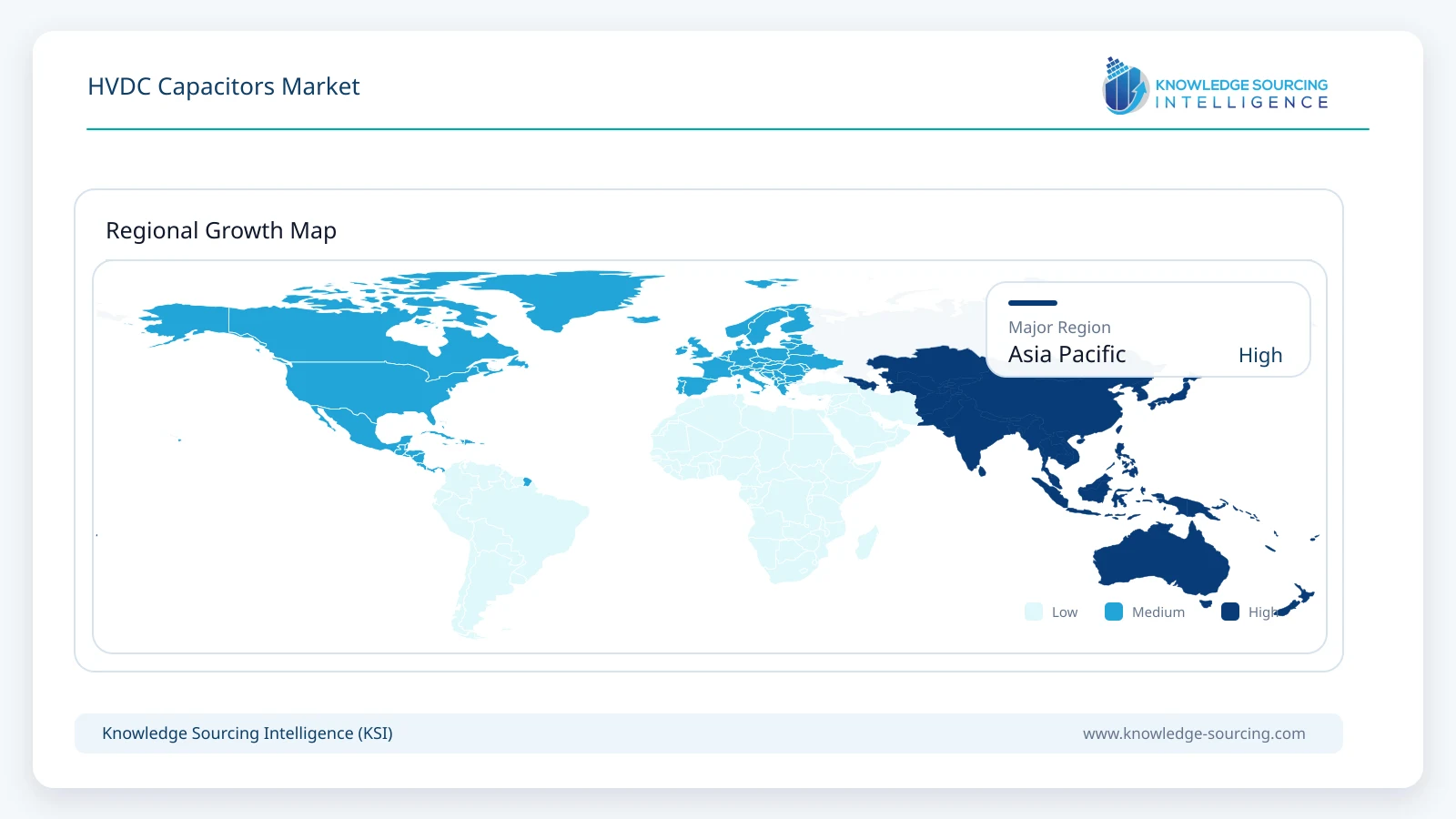
- 3Asia Pacific presents a major project pipeline, supported by large transmission investments in China and India and expanding renewable-power zones.
- 4Europe is strengthening the demand base through offshore wind connections and coordinated high-capacity transmission projects.
- 5IEC standards are placing greater emphasis on consistent converter performance, testing, loss determination, and equipment qualification.
- 6Competition is separating into system-level HVDC suppliers and specialist capacitor manufacturers competing on reliability, customization, lifecycle performance, and delivery capability.
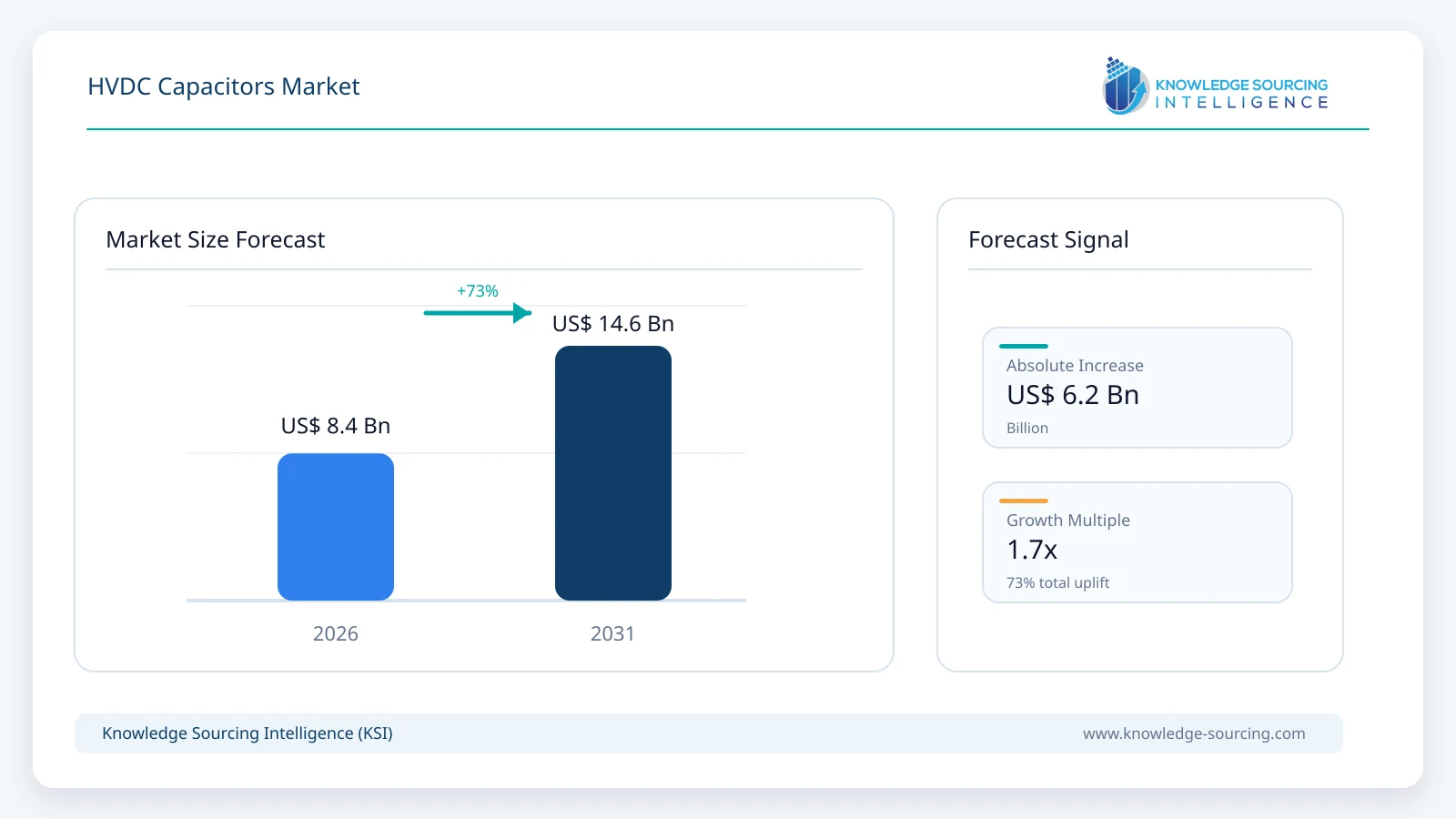
The HVDC capacitors market covers capacitor units, capacitor banks, and power-electronic capacitor assemblies designed for use within high-voltage direct-current transmission systems and their converter stations. These products perform several electrical functions, including DC voltage smoothing, harmonic filtering, energy storage, semiconductor protection, commutation, damping, and transient suppression. The market therefore sits between the capacitor industry and the high-voltage transmission equipment industry, with demand determined primarily by the number, rating, configuration, and technology of HVDC projects being commissioned or upgraded.
HVDC capacitors are not interchangeable with standard industrial capacitors. Buyers specify electrical characteristics around the converter topology, DC voltage, ripple current, impulse current, insulation level, thermal conditions, mechanical configuration, service life, and failure behavior. For large transmission projects, capacitor selection also becomes part of the converter station's protection and reliability architecture. Hitachi Energy, for example, supplies wet-type DC filter capacitors specifically for HVDC applications and dry DC-link capacitors for voltage-source converter applications. Its DryDCap product is specified for converter applications at up to 2,600 V with capacitance from 4 to 9.6 mF, illustrating the application-specific nature of this product category.
The demand environment is being shaped by three related investment patterns. Utilities are expanding long-distance transmission capacity to connect remote generation with load centers. Transmission operators are also adding subsea and underground links where conventional overhead AC expansion faces geographic or permitting constraints. At the same time, existing HVDC assets are entering modernization cycles, creating demand for replacement converter equipment and associated passive components. Hitachi Energy's 2025 award for a 950-km, 6-GW HVDC connection between Rajasthan and Uttar Pradesh provides a direct example of how renewable-power evacuation creates a substantial downstream equipment requirement.
The buyer base is concentrated among transmission system operators, utilities, independent transmission developers, EPC contractors, converter-station integrators, and large industrial users with specialized DC transmission or conversion requirements. Procurement decisions are rarely based on capacitor price alone. A lower unit price can be commercially unattractive if it introduces higher losses, shorter service intervals, greater footprint, difficult maintenance, or additional qualification work for the converter supplier.
For HVDC system integrators, supplier qualification and reliability history carry considerable weight. A capacitor failure can affect converter availability and may require costly station intervention. Consequently, buyers place substantial emphasis on dielectric stability, self-healing behavior where applicable, insulation performance, thermal management, impulse-current capability, low inductance, quality consistency, and documented testing. Vishay's DC-link power-electronic capacitor portfolio, for example, emphasizes high impulse-current capability, low inductance, and long reliability expectations for HVDC and STATCOM applications.
The industry has a mixed structure. Large HVDC system suppliers can influence capacitor specifications because they design the converter station architecture and control the system integration process. Specialist capacitor manufacturers compete by supplying engineered units that meet particular electrical and mechanical requirements. This creates two procurement routes: capacitors may be purchased directly by system integrators, or their specifications may be embedded in a larger converter-station contract.
Revenue is consequently influenced by project rating rather than simply project count. A 2-GW or 6-GW HVDC project can require materially different capacitor quantities, ratings, and configurations from a smaller interconnection. VSC and LCC architectures also create different component requirements. Hitachi Energy describes its HVDC Classic technology as primarily serving bulk-power transmission and AC-system interconnections, while HVDC Light uses VSC technology for applications including compact converter stations.
Adoption patterns will therefore vary by application. LCC remains relevant for very high-capacity bulk transmission and established interconnections, while VSC is gaining importance in offshore wind connections, renewable-energy evacuation, asynchronous grid connections, and projects requiring controllable power flow or compact converter stations. The capacitor opportunity follows this technology allocation rather than expanding uniformly across every HVDC installation.
Market Drivers
Expansion of Renewable-Energy Transmission Corridors
The strongest underlying demand mechanism is the need to move electricity from generation locations to consumption centers. Large renewable projects are often located far from major load centers, creating transmission requirements that cannot always be addressed efficiently through conventional AC networks.
HVDC provides a suitable architecture for long-distance bulk transmission because it allows controlled transfer of large quantities of electricity and can connect systems with different operating characteristics. For capacitor suppliers, this translates into equipment demand at converter stations rather than directly at generation assets.
India illustrates this mechanism clearly. In April 2025, Hitachi Energy announced its selection for a 950-km HVDC system connecting the Bhadla renewable-energy zone in Rajasthan with Fatehpur in Uttar Pradesh. The system is designed to transmit 6 GW of power. Such projects create demand for multiple converter-station components, including filtering and DC-side capacitor systems.
Buyers increasingly evaluate capacitor suppliers according to their ability to meet project-specific ratings while maintaining consistent delivery schedules. Suppliers responding with standardized platforms that can be customized for voltage, capacitance, thermal characteristics, enclosure dimensions, and connection arrangements can reduce engineering effort and qualification time.
Growth of VSC-Based HVDC Applications
VSC technology is widening the range of situations in which HVDC can be deployed. VSC systems are particularly relevant where controllability, grid support, compact converter stations, and offshore connections are important.
The capacitor implications are material because VSC converter architectures use DC-side energy storage and filtering arrangements that differ from traditional LCC systems. Hitachi Energy specifically markets dry DC-link capacitors for VSC converter applications, including HVDC-Light-type systems.
The buyer requirement is therefore shifting toward capacitors that combine high energy density with low inductance, stable electrical characteristics, controlled failure behavior, and compatibility with modern converter configurations. Product development is responding accordingly. Vishay offers DC-link products emphasizing low ESR, low ESL, high ripple-current capability, and long operating life.
For suppliers, VSC adoption creates an opportunity to move beyond commodity capacitor supply into application-engineered components. The commercial advantage comes from being qualified early in the converter design cycle, where electrical specifications and mechanical interfaces are established.
HVDC Asset Modernization and Replacement Demand
New transmission projects are not the only source of demand. A growing installed base of HVDC links creates an aftermarket opportunity as converter controls, valves, protection equipment, filters, and associated passive components require modernization.
Refurbishment can be economically attractive to utilities because it extends the useful life of an existing transmission asset while avoiding the cost and permitting requirements of a completely new corridor. GE Vernova's December 2025 contract with POWERGRID to refurbish India's 1,000-MW Chandrapur back-to-back HVDC link demonstrates this demand mechanism. The project includes replacement of legacy converter valves and upgrades to HVDC controls and protection systems.
Capacitor demand from refurbishment will not necessarily equal demand from new-build projects. Some existing capacitor banks can remain in service while other units may require replacement or redesign following converter upgrades. Suppliers that can reproduce legacy electrical characteristics while improving reliability can therefore access a specialized replacement market.
Increasing Power Density in Converter Equipment
Converter-station designers are under pressure to reduce equipment footprint while increasing transmission capacity. This requirement places greater importance on capacitor energy density, heat dissipation, insulation design, and mechanical packaging.
Hitachi Energy's dry DC-link design emphasizes high energy density and low inductance, while KYOCERA AVX offers high-power film capacitor designs for DC filtering, DC links, renewable-energy converters, substations, and transmission applications. Its TRAFIM range, for example, covers DC-filtering applications up to 6,000 V and emphasizes controlled self-healing and long-life performance.
For buyers, higher energy density can reduce station footprint and simplify mechanical integration. For suppliers, however, higher power density increases the technical burden around thermal management and dielectric reliability. This raises the importance of design engineering rather than simply increasing production volume.
Expansion of Grid Infrastructure for Electrification
Electricity demand is creating a broader transmission investment requirement. Grid operators must accommodate new generation, electrified transport, industrial loads, data centers, and other large electricity-consuming facilities. GE Vernova reported that its Electrification segment entered 2026 with a record backlog and cited customer investment in electricity demand, grid stability, and national infrastructure requirements.
HVDC capacitors benefit indirectly from this investment because new transmission infrastructure can require high-capacity conversion equipment. The demand effect will be strongest where transmission projects involve long distances, subsea connections, asynchronous systems, or large renewable-energy evacuation requirements.
Market Restraints and Challenges
High Reliability Requirements Raise Qualification Costs
HVDC capacitors operate within systems where component failure can affect transmission availability. Buyers therefore require extensive qualification, testing, and documentation before approving new suppliers.
This creates a barrier for manufacturers without an established high-voltage reference base. Qualification also lengthens sales cycles because capacitor suppliers may need to complete design validation, type testing, factory acceptance procedures, and project-specific engineering.
The commercial impact is two-sided. Established suppliers benefit from technical credibility, while buyers face fewer sourcing alternatives. New entrants can mitigate this constraint by developing application-specific products, partnering with converter manufacturers, and building reference installations before targeting large transmission tenders.
Raw-Material and Specialized Component Costs
HVDC capacitor manufacturing depends on high-quality dielectric films, metallization systems, aluminum materials, impregnation fluids where applicable, insulation materials, terminals, bushings, and specialized mechanical components. Volatility in these inputs can affect margins, particularly where project contracts fix prices for extended periods.
The issue is more pronounced for customized products because suppliers cannot always substitute materials without repeating qualification work. Buyers may seek price protection and dual sourcing, while manufacturers need tighter procurement planning and greater manufacturing flexibility.
Long Project Cycles Delay Revenue Recognition
HVDC projects frequently move through feasibility, permitting, procurement, engineering, manufacturing, installation, testing, and commissioning over several years. Capacitor demand can therefore be visible well before actual revenue is recognized.
This creates a forecasting challenge for suppliers. A large project award does not automatically translate into immediate capacitor shipments. Delays in converter-station engineering or cable installation can shift component delivery schedules.
Suppliers can reduce exposure by maintaining a balanced order portfolio across new-build projects, refurbishment programs, and industrial power-electronics applications.
Technology-Specific Design Requirements
LCC and VSC systems impose different technical requirements. A capacitor design suitable for one converter architecture may not be optimal for another.
This reduces the usefulness of a single standardized product portfolio. Suppliers must maintain application engineering capabilities and understand converter topology, harmonic behavior, transient conditions, thermal requirements, and mechanical integration.
The commercial consequence is that engineering capability becomes a competitive factor. Manufacturers that rely entirely on catalog products may find it harder to participate in high-value transmission projects where the capacitor forms part of a customized converter package.
Project Concentration Creates Order Volatility
The HVDC market is characterized by relatively large individual projects. A small number of awards can therefore influence annual demand materially.
For capacitor manufacturers, project concentration can create uneven production requirements and working-capital pressure. A supplier may need to reserve manufacturing capacity long before shipment while managing uncertain project schedules.
Framework agreements, regional manufacturing capacity, modular product platforms, and aftermarket programs can help reduce this volatility.
Major Segment Analysis
DC-Link and Converter Capacitors
DC-link and converter capacitors represent one of the most commercially important application areas because they perform essential energy-storage, voltage-stabilization, filtering, and switching-support functions within power-conversion systems.
Their importance increases as VSC and modular multilevel converter architectures expand. In these systems, capacitor characteristics directly affect converter stability, switching performance, energy storage, transient response, and semiconductor protection. The capacitor is therefore evaluated as part of the converter design rather than as an isolated passive component.
Buyer requirements center on capacitance stability, voltage endurance, ripple-current capability, low ESR and ESL, low inductance, thermal performance, mechanical robustness, and predictable end-of-life behavior. For converter manufacturers, reliability over decades of transmission operation is more important than maximizing initial capacitance per unit cost.
Product evidence from established suppliers shows how the technical requirements are evolving. Hitachi Energy's DryDCap is designed for VSC converter applications and emphasizes high energy density, low inductance, dry construction, and reduced environmental risk associated with leakage. Vishay's power-electronic capacitor products for HVDC and STATCOM applications emphasize high impulse-current capability, low inductance, and reliability.
KYOCERA AVX also supplies power film capacitors across high-voltage applications, including DC filtering, power transmission, renewable-energy converters, and substations. Its product range includes both dry and oil-impregnated film technologies and voltage ratings extending into high-power applications.
Commercial competition in this segment is therefore based on more than capacitance and price. Suppliers compete through electrical performance, customization, factory capacity, qualification history, lifecycle economics, and integration support. Buyers also prefer suppliers capable of delivering repeatable performance across large capacitor banks, where variation between individual units can complicate balancing and protection.
The segment should remain strategically important through 2031 because converter architecture is becoming more sophisticated while transmission projects are increasing in capacity. Demand will be particularly influenced by VSC-based renewable-energy connections, grid interconnections, and modernization projects requiring new converter equipment.
Regional Analysis
North America
North American demand is being supported by transmission reinforcement, renewable generation integration, grid reliability investment, and growing electricity requirements from large industrial and digital infrastructure loads.
The United States presents the largest commercial opportunity in the region because of its transmission scale and the need to connect geographically dispersed generation to load centers. HVDC adoption is still project-specific rather than universal, so capacitor demand will depend heavily on the progression of individual long-distance transmission corridors.
Buyer behavior favors established suppliers with strong qualification records and domestic or regional service capabilities. Procurement also places importance on delivery certainty because transmission projects can face extended permitting and construction schedules.
Canada presents opportunities through long-distance transmission requirements, hydroelectric resources, and interprovincial power flows. Mexico represents a smaller opportunity but can benefit from grid modernization and industrial electricity demand.
Europe
Europe is one of the most important regions for VSC-related HVDC capacitor demand because offshore wind development requires high-capacity links between offshore generation and onshore grids.
Germany, the United Kingdom, Norway, Sweden, France, and Spain all have transmission requirements linked to renewable generation, interconnection, and system balancing. The scale of European offshore-grid development creates demand for converter stations where compact VSC architectures are particularly relevant.
The December 2025 BalWin5 award illustrates the scale of the European pipeline. GE Vernova and Seatrium were selected for a 2.2-GW offshore HVDC grid connection linking North Sea wind generation with Germany's transmission network.
The European procurement environment also favors suppliers able to satisfy stringent technical, environmental, and safety requirements. Local manufacturing and European service capacity can strengthen supplier positioning, particularly where transmission operators seek long-term support.
Asia Pacific
Asia Pacific is expected to remain a central demand region because of its large electricity systems, renewable-energy deployment, industrialization, and extensive long-distance transmission requirements.
China has developed substantial HVDC expertise and large-scale transmission infrastructure, creating a mature domestic demand base. India is another major opportunity because renewable-energy zones are geographically separated from large consumption centers.
India's project pipeline provides particularly strong evidence. The 950-km Rajasthan-to-Uttar Pradesh HVDC project and the 2.5-GW Khavda-to-South Olpad VSC project demonstrate demand from both large renewable evacuation corridors and advanced VSC applications.
Japan and South Korea offer demand associated with grid interconnection, renewable integration, and sophisticated power infrastructure. Australia has opportunities linked to long-distance renewable transmission and grid-strengthening projects. Indonesia and Thailand present longer-term opportunities as electricity systems expand and renewable penetration increases.
Regional competition will favor suppliers that combine technical qualification with local production or engineering support. Project localization is becoming important because large transmission contracts can include domestic manufacturing and execution requirements.
Middle East and Africa
The Middle East provides opportunities through grid expansion, renewable energy development, industrial electrification, and cross-border transmission. Saudi Arabia and the United Arab Emirates are particularly relevant because of large-scale energy infrastructure investment.
HVDC demand in the region is likely to remain concentrated in major transmission projects rather than broad-based utility procurement. Buyers place a premium on high-temperature performance, long service life, reliability, and support for remote installations.
Africa presents a more uneven opportunity profile. South Africa has a comparatively developed electricity infrastructure base but faces investment and grid-capacity constraints. Other African markets can generate selective HVDC opportunities where large renewable resources require long-distance transmission.
South America
Brazil represents the principal opportunity because of its large electricity system, geographically dispersed generation resources, and extensive transmission network. HVDC can be commercially attractive where generation and consumption centers are separated by long distances.
Argentina and other South American markets provide more selective opportunities. Financing conditions, project bankability, regulatory stability, and transmission investment capacity will determine the timing of new HVDC projects.
For capacitor suppliers, regional sales may therefore depend heavily on participation in major EPC or converter-station contracts rather than broad local distribution.
Competitive Landscape
The competitive structure includes two broad groups within the supplied company set. Hitachi Energy Ltd. and GE Vernova Inc. have system-level HVDC capabilities, giving them influence over converter-station architecture and component specifications. Vishay Intertechnology, Inc., Samwha Capacitor Co., Ltd., LIFASA (International Capacitors, S.A.), KYOCERA AVX, Mersen, CRE New Energy Technology Co., Ltd., Eaton Corporation plc, and General Atomics Electromagnetic Systems provide broader capacitor, power-electronics, electrical equipment, or specialized technology capabilities.
Competition is therefore not uniform across the listed companies. System suppliers compete through complete HVDC solutions, project execution, controls, converter technology, lifecycle services, and transmission references. Specialist capacitor manufacturers compete more directly through dielectric technology, voltage capability, low inductance, thermal performance, customization, reliability, manufacturing consistency, and delivery.
Product differentiation is increasingly centered on system integration. Hitachi Energy's portfolio illustrates the distinction between wet-type DC filter capacitors for HVDC and dry DC-link capacitors for VSC converters. LIFASA's technical documentation similarly identifies separate capacitor applications for filtering, commutation, damping, and general HVDC use, confirming that application-specific engineering remains central to competition.
Vishay and KYOCERA AVX have broad film-capacitor portfolios that allow them to serve multiple power-electronics applications. Vishay's DC-link products cover industrial, renewable-energy, and high-power conversion applications, while KYOCERA AVX offers film technologies spanning DC filtering, power transmission, substations, and renewable-energy conversion.
The competitive model also favors suppliers with geographically distributed manufacturing and application engineering. Large HVDC contracts can require synchronized deliveries to converter-station construction schedules, making production capacity and logistics part of the commercial proposition.
Partnerships with converter suppliers and EPC contractors can provide an additional route to market. Component suppliers that achieve approved-vendor status early in the project design cycle are more likely to secure repeat orders because changing a qualified capacitor after detailed engineering can introduce testing and schedule risks.
Recent Developments
June 2026: Hitachi Energy launched AxoniQ, a portfolio enabling scalable multi-terminal HVDC grids through advanced power electronics and control, supporting expanding demand for high-voltage DC infrastructure.
June 2026: TDK showcased its MKP DC-link capacitors for 800-VDC solid-state transformer infrastructure at PCIM Europe 2026, highlighting capacitor applications in emerging high-voltage DC power systems.
April 2026: Hitachi Energy and Adani Energy Solutions commissioned Mumbai’s HVDC city-center infeed, increasing external electricity supply by 50% and strengthening India’s high-voltage transmission infrastructure.
December 2025: GE Vernova received an award from Adani Energy Solutions for a 2.5-GW ±500-kV VSC-based HVDC system connecting Khavda with South Olpad in India. Commercial relevance: The project represents the highest-rated VSC-based HVDC system planned in India at the time of announcement and strengthens the requirement for advanced DC-link and converter capacitor technologies.
Regulatory and Policy Environment
HVDC capacitor suppliers operate within a technical compliance environment shaped by international standards, national grid codes, utility specifications, and project-specific testing requirements.
IEC 61803 is particularly relevant because it establishes procedures for determining power losses in HVDC converter stations. The 2026 edition expanded the standard to cover both LCC and VSC converter stations, including MMC-type VSC systems. This update is commercially relevant because it provides a common framework for evaluating converter-station losses across the two major HVDC technology families.
IEC 62501:2024 addresses electrical testing of VSC valves used in HVDC transmission and back-to-back links. While it does not constitute a capacitor standard, its relevance reflects the broader qualification environment surrounding converter equipment. Capacitor suppliers participating in VSC projects must therefore operate within converter-level testing and reliability requirements.
IEC TR 62543 provides technical guidance on VSC-based HVDC systems, including two-level, three-level, multilevel, modular multilevel, and cascaded converter configurations. This matters for capacitor manufacturers because converter topology influences energy-storage requirements, switching behavior, filtering, and component stresses.
IEC 60871 provides requirements for high-voltage shunt capacitors and capacitor banks used in AC systems and power-filter applications. It addresses performance, testing, safety, installation, and operating considerations. Although HVDC capacitor applications can require additional project-specific specifications, the standard provides useful technical context for high-voltage capacitor engineering and qualification.
National transmission regulations also influence procurement. Grid operators typically establish minimum performance requirements for converter stations, insulation systems, electromagnetic compatibility, protection, fault response, environmental conditions, and reliability. Suppliers must therefore satisfy both international standards and utility-specific technical schedules.
Environmental compliance is another consideration. Dry capacitor technologies can reduce concerns associated with liquid leakage. Hitachi Energy specifically identifies the absence of leakage risk and lower lifecycle environmental impact as characteristics of its dry DC-link technology.
For suppliers, compliance increasingly functions as a market-access requirement rather than a post-sale certification exercise. Qualification evidence must be available during tendering, engineering, factory acceptance, and commissioning stages.
Outlook and Strategic Implications
The HVDC capacitors market through 2031 will be determined primarily by the pace and composition of HVDC transmission investment. The strongest demand opportunity lies where new transmission corridors combine high power ratings with renewable-energy evacuation, offshore generation, asynchronous interconnection, or difficult right-of-way conditions.
Procurement is likely to move further toward application-specific capacitor assemblies. Converter manufacturers and utilities will seek predictable electrical behavior, long service life, controlled failure modes, and compact physical designs. Standard catalog products will continue to serve lower-complexity applications, but major HVDC projects will favor engineered configurations tied closely to converter specifications.
VSC technology deserves particular attention. The growing use of VSC systems in offshore wind, renewable-energy integration, and controllable grid interconnections increases the addressable requirement for DC-link and converter capacitors. The 2025 Khavda-South Olpad award demonstrates that VSC projects are also moving into higher power ratings in emerging transmission markets.
At the same time, LCC should not be treated as a declining niche. Its established position in bulk-power transmission and large interconnections means capacitor suppliers with proven LCC filter and converter-station capabilities will continue to have a substantial installed-base opportunity. The modernization of older HVDC systems can create recurring replacement demand even where new LCC project awards are limited.
Investment priorities for suppliers should center on high-voltage film technology, dry capacitor designs, higher energy density, low-inductance construction, thermal performance, automated quality inspection, and scalable manufacturing. Hitachi Energy's expansion of dry-type capacitor production at its Xi'an facility illustrates the importance of manufacturing scale. The first phase, commissioned in early 2025, reportedly tripled the site's dry-capacitor production capacity.
Manufacturing localization will also influence competitive positioning. Transmission developers increasingly evaluate execution capability alongside equipment performance. Suppliers that can manufacture closer to project markets can reduce logistics exposure and respond more effectively to local-content requirements.
Aftermarket strategy will become more relevant as the installed HVDC base ages. Suppliers can pursue opportunities through replacement capacitors, station upgrades, condition assessment, retrofit packages, and lifecycle support. The refurbishment of India's Chandrapur HVDC link demonstrates how legacy infrastructure can generate new equipment demand without constructing an entirely new transmission corridor.
The principal risks are project delays, permitting constraints, commodity-price volatility, qualification barriers, concentration of orders among a limited number of large HVDC programs, and changes in converter architecture. Suppliers also face the risk that greater capacitor energy density could introduce additional thermal or dielectric stresses if designs are not adequately validated.
Strategically, the strongest position will belong to suppliers that can combine electrical engineering depth with manufacturing reliability and project execution discipline. The market is not likely to be won through the lowest capacitor price. Large transmission buyers are purchasing decades of operating reliability, and the cost of an equipment failure can exceed the initial component-price difference by a wide margin.
Over 2026-2031, the commercial opportunity should therefore be assessed through project pipeline quality rather than headline HVDC announcements alone. Projects that have reached procurement, converter-station contracting, or detailed engineering provide a more meaningful indication of near-term capacitor demand than early-stage transmission concepts. Within that pipeline, VSC-based renewable connections, large bulk-power corridors, offshore wind links, and HVDC refurbishment programs represent the most relevant demand pools.
HVDC Capacitors Market Scope
| Report Metric | Details |
|---|---|
| Total Market Size in 2026 | USD 8.44 billion |
| Total Market Size in 2031 | USD 14.61 billion |
| Forecast Unit | Billion |
| Growth Rate | 11.6% |
| Study Period | 2021 to 2031 |
| Historical Data | 2021 to 2024 |
| Base Year | 2025 |
| Forecast Period | 2026 – 2031 |
| Segmentation | Application, HVDC Technology, Geography |
| Companies |
|
Market Segmentation
By Application
By Hvdc Technology
By Geography
Table of Contents
1. EXECUTIVE SUMMARY
2. MARKET SNAPSHOT
2.1. Market Overview
2.2. Market Definition
2.3. Scope of the Study
2.4. Market Segmentation
3. BUSINESS LANDSCAPE
3.1. Market Drivers
3.2. Market Restraints
3.3. Market Opportunities
3.4. Porter’s Five Forces Analysis
3.5. Industry Value Chain Analysis
3.6. Policies and Regulations
3.7. Strategic Recommendations
4. TECHNOLOGICAL OUTLOOK
4.1. HVDC Capacitor Technologies
4.2. Wet-Type Capacitors
4.3. Dry-Type Capacitors
4.4. Metallized Polypropylene Film Capacitors
4.5. Self-Healing Capacitor Technology
4.6. Emerging Technology Trends
5. HVDC CAPACITORS MARKET BY APPLICATION
5.1. Introduction
5.2. DC Filter Capacitors
5.3. DC-Link and Converter Capacitors
5.4. Commutation Capacitors
5.5. Damping and Snubber Capacitors
5.6. Other Applications
6. HVDC CAPACITORS MARKET BY HVDC TECHNOLOGY
6.1. Introduction
6.2. Line-Commutated Converter (LCC) HVDC
6.3. Voltage-Source Converter (VSC) HVDC
7. HVDC CAPACITORS MARKET BY GEOGRAPHY
7.1. Introduction
7.2. North America
7.2.1. United States
7.2.2. Canada
7.2.3. Mexico
7.3. South America
7.3.1. Brazil
7.3.2. Argentina
7.3.3. Others
7.4. Europe
7.4.1. Germany
7.4.2. France
7.4.3. United Kingdom
7.4.4. Spain
7.4.5. Norway
7.4.6. Sweden
7.4.7. Others
7.5. Middle East and Africa
7.5.1. Saudi Arabia
7.5.2. United Arab Emirates
7.5.3. South Africa
7.5.4. Others
7.6. Asia-Pacific
7.6.1. China
7.6.2. India
7.6.3. Japan
7.6.4. South Korea
7.6.5. Australia
7.6.6. Indonesia
7.6.7. Thailand
7.6.8. Others
8. COMPETITIVE ENVIRONMENT AND ANALYSIS
8.1. Major Players and Strategy Analysis
8.2. Market Share Analysis
8.3. Mergers, Acquisitions, Agreements, and Collaborations
8.4. Competitive Dashboard
9. COMPANY PROFILES
9.1. Hitachi Energy Ltd.
9.2. Vishay Intertechnology, Inc.
9.3. Samwha Capacitor Co., Ltd.
9.4. LIFASA (International Capacitors, S.A.)
9.5. KYOCERA AVX
9.6. Mersen
9.7. CRE New Energy Technology Co., Ltd.
9.8. Eaton Corporation plc
9.9. General Atomics Electromagnetic Systems
9.10. GE Vernova Inc.
10. APPENDIX
10.1. Currency
10.2. Assumptions
10.3. Base and Forecast Years Timeline
10.4. Key Benefits for Stakeholders
10.5. Research Methodology
10.6. Abbreviations
LIST OF FIGURES
LIST OF TABLES
Navigate
Trusted by the world's leading organizations











