
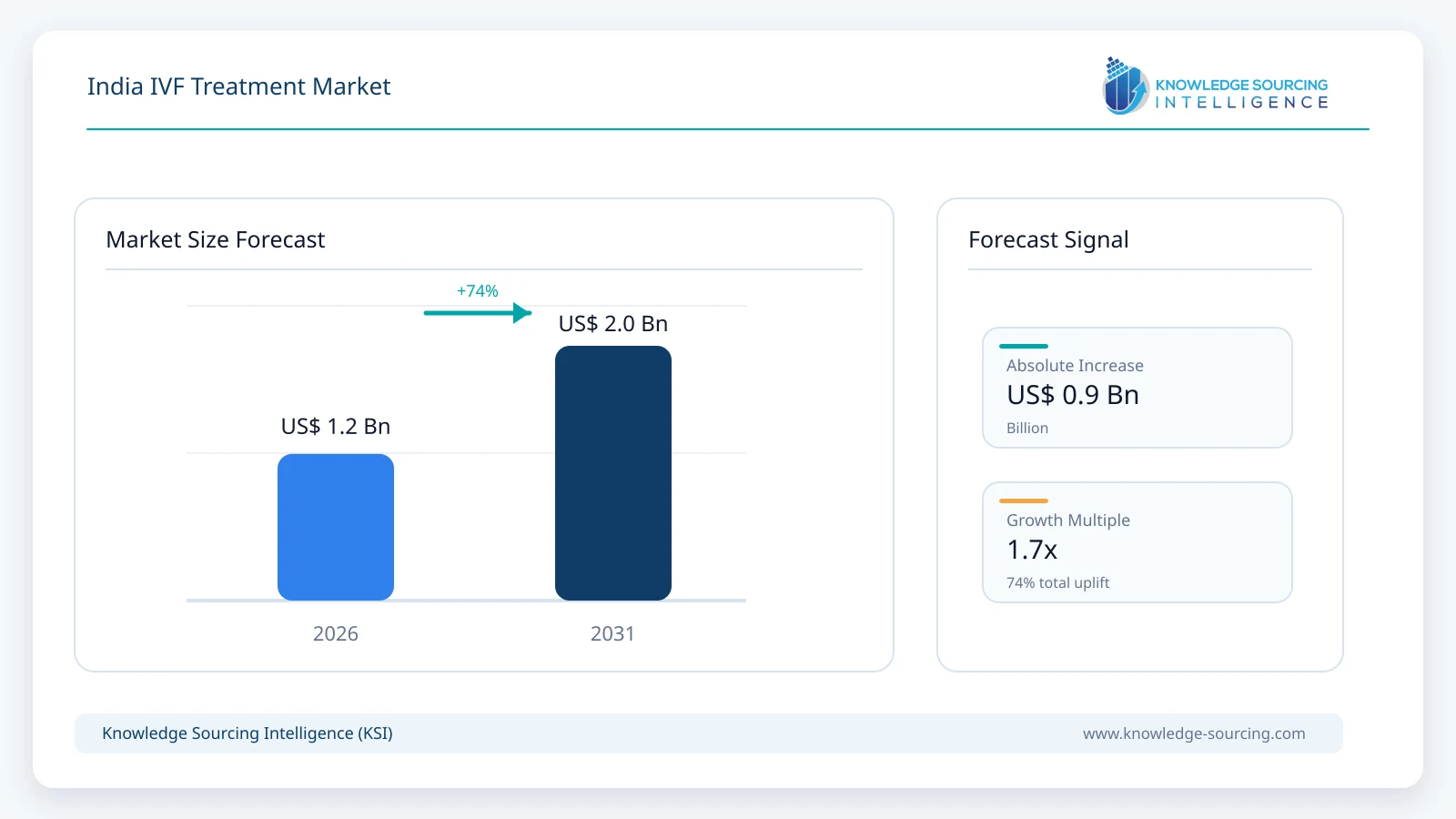
The India IVF Treatment Market is forecast to grow at a CAGR of 11.7%, reaching USD 2.05 billion in 2031 from USD 1.18 billion in 2026.
Highlights:
- 1ICSI-assisted IVF accounts for approximately 66% of treatment revenue in 2026.
- 2Dedicated fertility clinics generate approximately 82% of IVF treatment revenue in 2026.
- 3South India accounts for approximately 35% of national IVF treatment revenue in 2026.
- 4India has 4,670 registered ART clinics, indicating a broad but fragmented provider base.
- 5Frozen-thawed cycles gain share as vitrification and single-embryo strategies become more common.
- 6Organized fertility chains are expanding beyond metros into tier-2 and tier-3 cities.
Market Overview
India's IVF industry combines a large independent-clinic base with rapidly scaling organized fertility networks. Treatment pathways increasingly combine ovarian stimulation, oocyte retrieval, conventional IVF or ICSI fertilization, embryo culture, fresh or frozen embryo transfer, cryopreservation and selected reproductive-genetics services. The commercial opportunity is therefore influenced by both treatment volumes and the mix of laboratory-intensive services used across each patient journey. Larger fertility networks are increasingly standardizing protocols, embryology practices, patient counseling and follow-up across multiple centres, while high-volume hospital-based programs continue to serve medically complex patients.
The supply side is becoming more formalized. The Assisted Reproductive Technology (Regulation) Act, 2021 came into force in January 2022 and established a regulatory framework for ART clinics and banks, while the National ART & Surrogacy Registry functions as the central database for registered providers and service information. The registry's current 4,670 registered ART clinics and 938 registered ART banks illustrate the scale of the ecosystem, but market revenue remains concentrated among specialist fertility chains and high-volume hospital-based centres. Nova IVF Fertility, for example, reports more than 19,000-21,000 IVF treatments annually, demonstrating how a relatively small group of organized networks can account for a meaningful share of national procedure activity even within a very large registered-provider universe.
Affordability remains the main demand-side constraint. Current industry reporting places the cost of an IVF cycle in India at approximately INR 1.5-3.5 lakh, with fertility care still largely outside public healthcare and conventional insurance coverage. Multiple cycles may be required, particularly for older patients or complex infertility cases, increasing total out-of-pocket expenditure. The market therefore expands through a combination of rising treatment awareness, increased clinic accessibility and better clinical conversion rather than unrestricted price growth. Near-term growth remains constrained by household affordability, while organized-network expansion and wider integration of laboratory and diagnostic services support stronger revenue opportunities over the forecast period.
Key Segment Estimates
Segment | Key Subsegment | Revenue Contribution | Details |
Cycle Type | Frozen-Thawed IVF Cycles | USD 0.53 billion | Strongest growth segment, supported by vitrification and increasing use of staged treatment pathways. |
Fertilization Technique | ICSI-Assisted IVF | 66% share | Dominant fertilization technique across higher-complexity and male-factor infertility cases. |
Provider | Dedicated Fertility Clinics | 82% share | Largest treatment channel, supported by specialist teams and fertility-focused laboratory infrastructure. |
Region | South India | 35% share | Largest regional cluster, supported by mature fertility ecosystems and dense specialist networks. |
Market Trends
Organized Fertility Networks Are Scaling Faster Than the Independent Clinic Base
Consolidation and greenfield expansion are changing competitive structure. Large fertility chains are using acquisitions to enter new states and then adding satellite or full-service centres around acquired clinical hubs. Nova IVF Fertility's 2026 acquisition of Kerala-based Craft Fertility included a plan to open 10 additional centres in the state over three to five years, extending access beyond established metro locations. Birla Fertility & IVF used the acquisitions of ARMC IVF and BabyScience during 2024 to broaden its southern and western footprint and build a 50-clinic network. These moves matter because organized platforms can centralize embryology protocols, doctor recruitment, marketing, financing and quality systems while preserving local physician relationships. The result is a market in which the largest networks should grow faster than overall IVF demand, even as independent clinics continue to represent a substantial share of provider count.
Frozen Embryo Transfer Is Becoming a More Important Part of the Treatment Mix
Vitrification, improved embryo survival and more systematic use of cryopreservation are increasing the role of frozen-thawed embryo transfer. Clinics can separate ovarian stimulation and egg retrieval from the later transfer decision, which can improve scheduling flexibility and allows transfer after the patient's endometrium and clinical condition are reassessed. The trend also supports single-embryo strategies and creates recurring revenue from embryo storage and subsequent transfer cycles. Frozen-transfer growth does not mean fresh cycles disappear; the two pathways remain clinically linked because embryos generally originate from a stimulation and retrieval cycle. Commercially, however, a larger installed bank of cryopreserved embryos increases the number of treatment episodes that fertility centres can serve without repeating the entire retrieval process for each transfer attempt.
Pre-Cycle Diagnostics and Genetic Testing Are Moving Closer to the IVF Workflow
Fertility providers are increasingly combining standard IVF workups with genetic and biomarker-based diagnostics for selected patients. In September 2026, MetaQon Precision Health launched a pre-cycle reproductive-intelligence offering in India using whole-genome analysis, blood biomarkers and clinical review to identify risk factors before treatment begins. Preimplantation genetic testing, sperm DNA fragmentation testing and broader reproductive-genetics services are also becoming more visible within organized clinic networks. These tools expand revenue per clinically complex patient, but they should not be treated as universal add-ons because eligibility, evidence thresholds and affordability vary. Their largest commercial impact is likely to be in recurrent IVF failure, advanced maternal age, known genetic-risk cases and patients seeking more detailed pre-treatment assessment rather than across every standard IVF cycle.
Market Drivers
Delayed Parenthood and Higher Infertility Awareness Expand the Treatment Funnel
Demand is being supported by later marriage and childbearing in urban populations, greater workforce participation, lifestyle-related reproductive risks and improved recognition of both male and female infertility. The commercial effect is not simply a rise in diagnosed infertility; it is an increase in the number of couples who progress from evaluation to specialist fertility care. Digital education, doctor-led social content and stronger referral networks are reducing the stigma historically associated with fertility treatment, while organized chains are investing in counseling and first-consultation funnels. Because age is a major determinant of ovarian reserve and IVF success, delayed presentation can also increase treatment intensity and the probability that patients require ICSI, cryopreservation, donor programs or repeated cycles. This supports revenue growth even when patient volumes rise at a slower pace than headline awareness indicators.
Network Expansion Is Improving Access Outside Established Metropolitan Hubs
Clinic expansion is reducing geographic friction for patients who previously travelled repeatedly to Delhi National Capital Region (NCR), Mumbai, Bengaluru, Chennai, Hyderabad or other established fertility clusters. Nova IVF's Kerala expansion, Oasis Fertility's addition of a centre in Kondhwa, Pune, and the large multi-city footprints of Cloudnine and other networks illustrate a broader shift toward distributed care. The operating model increasingly combines local consultations and monitoring with centralized embryology expertise, standardized laboratories and specialist oversight. This is especially relevant for IVF because a treatment cycle requires multiple visits over a relatively short period. Shorter travel distances improve treatment adherence and make the service more accessible to working couples in tier-2 cities, allowing providers to expand volumes without relying solely on the largest metros.
Laboratory Technology Is Improving Standardization and Supporting Premium Services
The laboratory is becoming a more important source of differentiation. Advanced incubators, time-lapse monitoring, vitrification, improved culture media, micromanipulation systems and data-supported embryo assessment can reduce variability across centres when implemented with disciplined quality control. Organized chains can spread the cost of specialized embryologists, lab validation and training across a larger network, creating an advantage over low-volume clinics. Technology also creates premium service layers around ICSI, embryo freezing and selected genetic tests. The commercial opportunity is therefore linked not only to more cycles but also to a gradual shift toward higher-value treatment pathways. Providers that can demonstrate consistent laboratory processes and transparent clinical governance are better positioned to convert patients who increasingly compare multiple clinics before committing to treatment.
Market Restraints
High Out-of-Pocket Cost Limits First-Cycle Conversion and Repeat Treatment
IVF remains expensive relative to household disposable income, and current reporting indicates that most fertility expenditure continues to be paid directly by patients. A standard cycle can cost approximately INR 1.5-3.5 lakh before all optional tests, medications or repeat transfers are considered. The financial burden rises quickly when multiple cycles are required, which can lead patients to postpone treatment, discontinue after an unsuccessful attempt or choose lower-cost clinics despite quality differences. Financing programs and installment-based payment plans improve accessibility but do not remove the underlying affordability constraint. This limits conversion despite a large untreated patient pool and expanding clinic capacity.
Quality Consistency and Outcome Transparency Remain Uneven Across a Large Provider Base
The ART Regulation Act and national registry have raised the minimum compliance framework, but the sheer number of registered providers means clinical quality, laboratory maturity and patient communication can still vary considerably. IVF success rates are difficult to compare without adjusting for age, infertility diagnosis, embryo stage, donor use and whether a clinic reports pregnancy, clinical pregnancy or live birth. Marketing based on non-comparable success metrics can therefore distort patient choice. For organized providers, regulation creates an opportunity to differentiate through auditable protocols, standardized consent and better outcome reporting; for the market as a whole, however, compliance costs and tighter oversight can slow expansion by smaller clinics. Over time, more transparent reporting should favor high-quality networks, but the transition adds operating complexity during the forecast period.
Segment Analysis
By Cycle Type - Frozen-Thawed IVF Cycles
Frozen-thawed IVF is the strongest growth segment within the cycle mix. Frozen-thawed treatment revenue is estimated at approximately USD 0.53 billion in 2026, supported by improved vitrification, greater embryo survival after thawing and the growing use of staged treatment pathways in which retrieval and transfer occur in different cycles. The segment also benefits from patients returning for subsequent frozen transfers without repeating ovarian stimulation and egg retrieval. Fresh IVF remains a large component of the market because it initiates most treatment pathways, while donor egg or donor embryo cycles serve a smaller but clinically important population. Through 2031, the share of frozen transfer is expected to rise gradually rather than displace fresh treatment entirely.
By Fertilization Technique - ICSI-Assisted IVF
ICSI-assisted IVF is the dominant fertilization technique in India, reflecting its established use for male-factor infertility, prior fertilization failure, low oocyte numbers and several higher-complexity IVF pathways. The segment benefits from the wide availability of trained embryologists and micromanipulation systems across organized fertility chains. Conventional insemination IVF remains appropriate for selected patients and can avoid unnecessary intervention where sperm parameters and clinical history support it. The commercial importance of ICSI is therefore linked to both clinical case mix and provider capability. As treatment moves beyond major metros, networks with standardized embryology training and equipment can expand ICSI access more consistently than independent clinics operating at lower cycle volumes.
By Provider - Dedicated Fertility Clinics
Dedicated fertility clinics remain the principal commercial channel because IVF requires repeated monitoring, specialized embryology infrastructure and highly focused reproductive-medicine teams. Large chains can operate hub-and-spoke models, with full IVF laboratories in major centres and consultation or monitoring sites in adjacent cities. Hospital-based fertility centres retain an important role for patients with complex medical conditions, surgical requirements or preference for multidisciplinary care, and the public sector is beginning to add capability, as demonstrated by AIIMS Nagpur's ART Centre inaugurated in November 2025. However, specialist fertility networks are expected to retain the largest share because their operating model is built around high treatment throughput, fertility-specific patient acquisition and laboratory standardization.
By Region - South India
South India is the largest regional cluster, supported by mature fertility ecosystems in Bengaluru, Chennai, Hyderabad, Kochi, Coimbatore and other cities, a long history of private reproductive medicine and dense specialist-provider networks. Recent expansion by Nova IVF, Birla Fertility & IVF, Cloudnine and regional operators reinforces this position. North India, led by Delhi NCR, remains another major treatment hub and benefits from medical tourism and high private-hospital density. West India is expanding rapidly around Mumbai, Pune, Ahmedabad and other urban centres, while East and Central India offer greater whitespace for organized-network penetration. Regional growth through 2031 is therefore expected to be driven less by entirely new demand categories and more by improved access, referral networks and reduced need for long-distance travel during treatment.
Technology Outlook
Artificial Intelligence (AI)-Assisted Embryo Assessment and Time-Lapse Monitoring
Artificial intelligence is increasingly being applied to embryo images and laboratory data to support embryo-ranking decisions, quality assurance and workflow management. Time-lapse incubators can generate longitudinal image sequences without repeatedly removing embryos from controlled culture conditions, creating richer datasets for embryologist review. In the Indian market, adoption will be concentrated initially among larger chains and premium centres because the commercial value depends on adequate case volume, validated algorithms and integration with laboratory protocols. AI should be viewed as decision support rather than a substitute for embryologist judgment. Its near-term value is most likely in standardizing assessment across multi-centre networks, documenting laboratory performance and helping providers manage a larger volume of cycles consistently.
Vitrification, Cryostorage and Frozen Transfer Infrastructure
Vitrification has become central to modern IVF operations because it supports embryo and oocyte freezing with high post-thaw survival when laboratories maintain strong process control. The technology underpins frozen embryo transfer, fertility preservation and treatment strategies that defer transfer to a later cycle. Commercially, this creates recurring demand for cryostorage, tracking systems and subsequent transfer services. It also increases the importance of chain-of-custody controls and compliance under India's ART regulatory framework. Larger providers are likely to invest more heavily in digital inventory systems, alarm monitoring and standardized cryostorage procedures as their stored-patient base expands. These investments increase fixed costs but strengthen patient retention and make reliable laboratory operations a larger competitive differentiator.
Preimplantation Genetic Testing (PGT), Genomics and Precision Pre-Cycle Diagnostics
Genetic testing is expanding from a narrow specialist offering toward a more integrated component of complex fertility care. Preimplantation genetic testing can be relevant for patients with known inherited conditions, recurrent implantation failure, recurrent pregnancy loss or selected age-related risk profiles, while pre-cycle genomic and biomarker tools are emerging as additional decision-support layers. The September 2026 launch of MetaQon's reproductive-intelligence service illustrates the direction of this market. Adoption will remain selective because additional testing raises treatment cost and not every patient benefits from the same diagnostic pathway. Providers that use testing within clear clinical criteria can nevertheless increase treatment personalization and develop higher-value service lines without relying solely on higher IVF cycle volumes.
Technology and Market Indicators
Indicator | Latest Development | Market Impact |
Registered ART clinics | 4,670 registered clinics | Shows a broad national provider base, although treatment volume remains concentrated among high-throughput centres. |
Registered ART banks | 938 registered banks | Indicates the scale of regulated supporting infrastructure for assisted reproduction. |
Nova IVF annual activity | More than 19,000-21,000 IVF treatments annually | Demonstrates the treatment scale achievable within organized fertility networks. |
Typical IVF cycle pricing | Approximately INR 1.5-3.5 lakh per cycle | Affordability remains a major determinant of first-cycle conversion and repeat treatment. |
AIIMS Nagpur ART Centre | Approx. INR 5 crore project cost | Illustrates the gradual expansion of advanced fertility infrastructure into the public healthcare system. |
Competitive Environment
India's competitive landscape is bifurcated between a very large base of independent ART clinics and a smaller group of organized fertility networks with national or multi-state ambitions. Indira IVF, Nova IVF Fertility, Birla Fertility & IVF, Cloudnine Fertility, Apollo Fertility, Oasis Fertility and other chains compete on doctor reputation, laboratory quality, geographic convenience, pricing, financing and perceived success rates. Consolidation is increasing because acquisitions provide immediate access to doctors, local referral relationships and established patient pipelines, while greenfield centres allow chains to extend a standardized operating model into underserved cities.
Competitive advantage is shifting from clinic count alone toward repeatable clinical quality, as networks that can recruit and retain reproductive-medicine specialists, standardize embryology laboratories, maintain regulatory compliance and track outcomes across centres are better positioned to scale. Digital lead generation remains important because many patients research fertility options extensively before the first consultation, but conversion ultimately depends on physician trust, counseling quality, transparent pricing and realistic communication about age-adjusted success. The long tail of independent providers will remain important, particularly in local markets where senior doctors have strong reputations, but organized chains are expected to gain revenue share faster than they gain share of registered clinic count.
The market is also beginning to broaden beyond purely private specialty chains. For instance, AIIMS Nagpur opened a government ART Centre in November 2025, demonstrating that advanced IVF infrastructure can expand within the public system. This is unlikely to displace private providers during the forecast period because public capacity remains limited, but it can improve access and establish additional clinical benchmarks. International patient demand remains another opportunity for leading Indian centres due to the country's treatment-cost advantage and established private-hospital infrastructure.
Recent Developments
September 2026: Nova IVF Fertility announced the opening of its 10th new fertility centre in Vellore, Tamil Nadu, extending its southern India network.
September 2026: MetaQon Precision Health launched Reproductive Intelligence in India, combining whole-genome analysis, biomarkers and clinical review for pre-cycle fertility assessment.
March 2026: Nova IVF Fertility acquired Kerala-based Craft Fertility and announced plans for 10 additional IVF centres in Kerala over three to five years.
January 2026: Oasis Fertility opened a new centre in Kondhwa, Pune, expanding access to fertility services within the city.
November 2025: AIIMS Nagpur inaugurated an ART Centre developed at an approximate project cost of INR 5 crore, the first such government set-up in Maharashtra and Central India.
August 2024: Birla Fertility & IVF acquired 12 BabyScience IVF clinics, taking its network to 50 clinics and strengthening its presence in southern and western India.
India IVF Treatment Market Scope:
| Report Metric | Details |
|---|---|
| Total Market Size in 2026 | USD 1.18 billion |
| Total Market Size in 2031 | USD 2.05 billion |
| Forecast Unit | Billion |
| Growth Rate | 11.7% |
| Study Period | 2021 to 2031 |
| Historical Data | 2021 to 2024 |
| Base Year | 2025 |
| Forecast Period | 2026 – 2031 |
| Segmentation | Cycle Type, Fertilization Technique, Provider, Region |
| Companies |
|
Market Segmentation
By Cycle Type
Fresh IVF Cycles
Frozen-Thawed IVF Cycles
Donor Egg / Donor Embryo IVF Cycles
By Fertilization Technique
ICSI-Assisted IVF
Conventional IVF
By Provider
Dedicated Fertility Clinics
Hospital-Based Fertility Centres
By Region
North India
South India
West India
East India
Central India
Table of Contents
1. EXECUTIVE SUMMARY
2. MARKET SNAPSHOT
2.1. Market Overview
2.2. Market Definition
2.3. Scope of the Study
2.4. Market Segmentation
3. BUSINESS LANDSCAPE
3.1. Market Drivers
3.1.1. Delayed Parenthood and Higher Infertility Awareness Expand the Treatment Funnel
3.1.2. Organized Fertility Networks Are Expanding Access Beyond Metropolitan Hubs
3.1.3. Laboratory Technology Is Improving Standardization and Supporting Premium Services
3.2. Market Restraints
3.2.1. High Out-of-Pocket Cost Limits First-Cycle Conversion and Repeat Treatment
3.2.2. Quality Consistency and Outcome Transparency Remain Uneven
3.3. Market Opportunities
3.4. Porter's Five Forces Analysis
3.5. Industry Value Chain Analysis
3.6. Policies and Regulations
3.7. Strategic Recommendations
4. TECHNOLOGICAL OUTLOOK
4.1. AI-Assisted Embryo Assessment and Time-Lapse Monitoring
4.2. Vitrification, Cryostorage and Frozen Transfer Infrastructure
4.3. PGT, Genomics and Precision Pre-Cycle Diagnostics
5. INDIA IVF TREATMENT MARKET BY CYCLE TYPE
5.1. Introduction
5.2. Fresh IVF Cycles
5.3. Frozen-Thawed IVF Cycles
5.4. Donor Egg / Donor Embryo IVF Cycles
6. INDIA IVF TREATMENT MARKET BY FERTILIZATION TECHNIQUE
6.1. Introduction
6.2. ICSI-Assisted IVF
6.3. Conventional IVF
7. INDIA IVF TREATMENT MARKET BY PROVIDER
7.1. Introduction
7.2. Dedicated Fertility Clinics
7.3. Hospital-Based Fertility Centres
8. INDIA IVF TREATMENT MARKET BY REGION
8.1. Introduction
8.2. North India
8.3. South India
8.4. West India
8.5. East and Central India
9. COMPETITIVE ENVIRONMENT AND ANALYSIS
9.1. Major Players and Strategy Analysis
9.2. Market Share Analysis
9.3. Mergers, Acquisitions, Agreements and Collaborations
9.4. Competitive Dashboard
10. COMPANY PROFILES
10.1. Indira IVF
10.2. Nova IVF Fertility
10.3. Birla Fertility & IVF
10.4. Cloudnine Fertility
10.5. Apollo Fertility
10.6. Oasis Fertility
10.7. ART Fertility Clinics
10.8. Milann Fertility & Birthing Hospital
10.9. Iswarya Fertility Centre
10.10. Motherhood Fertility & IVF
10.11. Ferty9 Fertility Center
10.12. Bavishi Fertility Institute
10.13. Bloom IVF
10.14. Gunasheela Fertility Centre
10.15. Seeds of Innocence
10.16. Morpheus IVF
10.17. Chennai Fertility Center
10.18. Akanksha IVF Centre
10.19. Max Healthcare - Reproductive Medicine
10.20. Manipal Hospitals - Fertility and Reproductive Medicine
11. APPENDIX
11.1. Currency
11.2. Assumptions
11.3. Base and Forecast Years Timeline
11.4. Key Benefits for Stakeholders
11.5. Research Methodology
11.6. Abbreviations
Research Methodology
KSI defines the India IVF treatment market as patient-service revenue generated in India from in vitro fertilization treatment episodes. The scope includes ovarian stimulation and cycle monitoring when part of IVF, oocyte retrieval, conventional IVF or ICSI fertilization, embryo culture, fresh and frozen embryo transfer, directly linked medicines, cryopreservation and selected preimplantation or reproductive-genetic testing where billed as part of the treatment pathway. IUI-only services, unrelated infertility diagnostics, maternity and delivery services, surrogacy compensation or agency fees and sales of IVF laboratory equipment to clinics are excluded. International patients are included only for IVF services delivered in India; airfare, accommodation and unrelated tourism spend are excluded.
The 2026 base is triangulated from current annual IVF-cycle estimates, prevailing patient-price bands, registered ART capacity, organized-provider treatment volumes and the mix of cycle-linked ancillary services. The model does not multiply a historical market value by a single CAGR. KSI applies a non-uniform annual growth path, with volume expansion, greater organized-chain utilization and rising adoption of frozen transfer, ICSI and diagnostics partly offset by affordability, limited insurance coverage and regulatory compliance costs. Public and commercial market estimates are used only as external reasonableness checks because their definitions vary materially between IVF treatment, broader ART services, equipment, cryobanks, medication and surrogacy-related expenditure.
Navigate
Trusted by the world's leading organizations











