
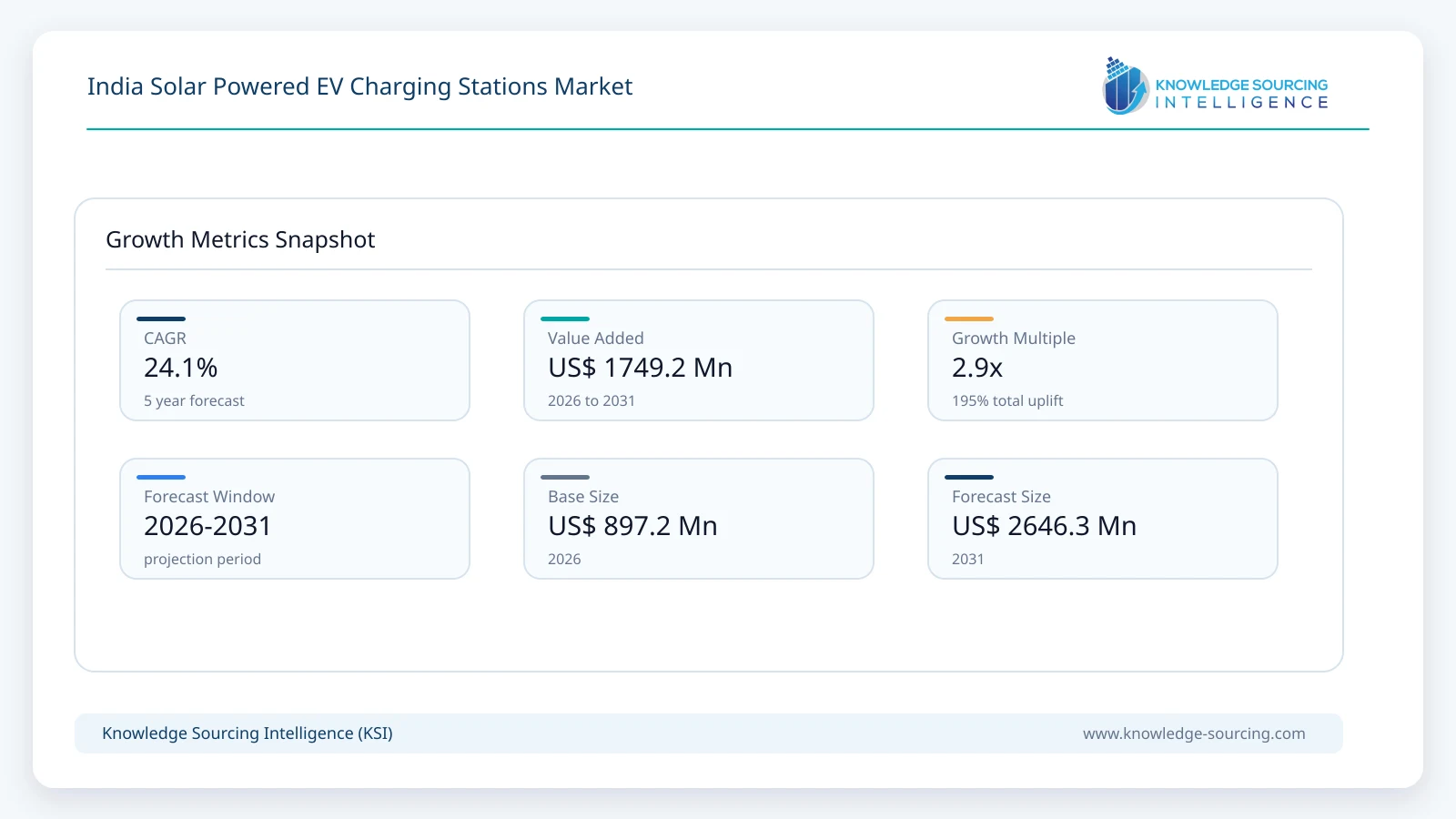
India Solar Powered EV Charging Stations Market is forecast to grow at a CAGR of 24.2%, reaching USD 2,646.4 million in 2031 from USD 897.2 million in 2026.
Highlights:
- 1Solar PV is being deployed more in conjunction with EV chargers and energy storage to offset grid electricity usage.
- 2Grid-tied and hybrid stations are particularly appealing since they ensure battery charging regardless of solar generation variation.
- 3Due to high EV activity and commercial charging demand, deployment is expected to focus on large urban centres like Delhi, Mumbai, Bengaluru, Hyderabad and Chennai.
- 4High-power charging systems for commercial fleets and intercity corridors are increasingly in demand where solar-plus-storage can aid in managing energy needs.
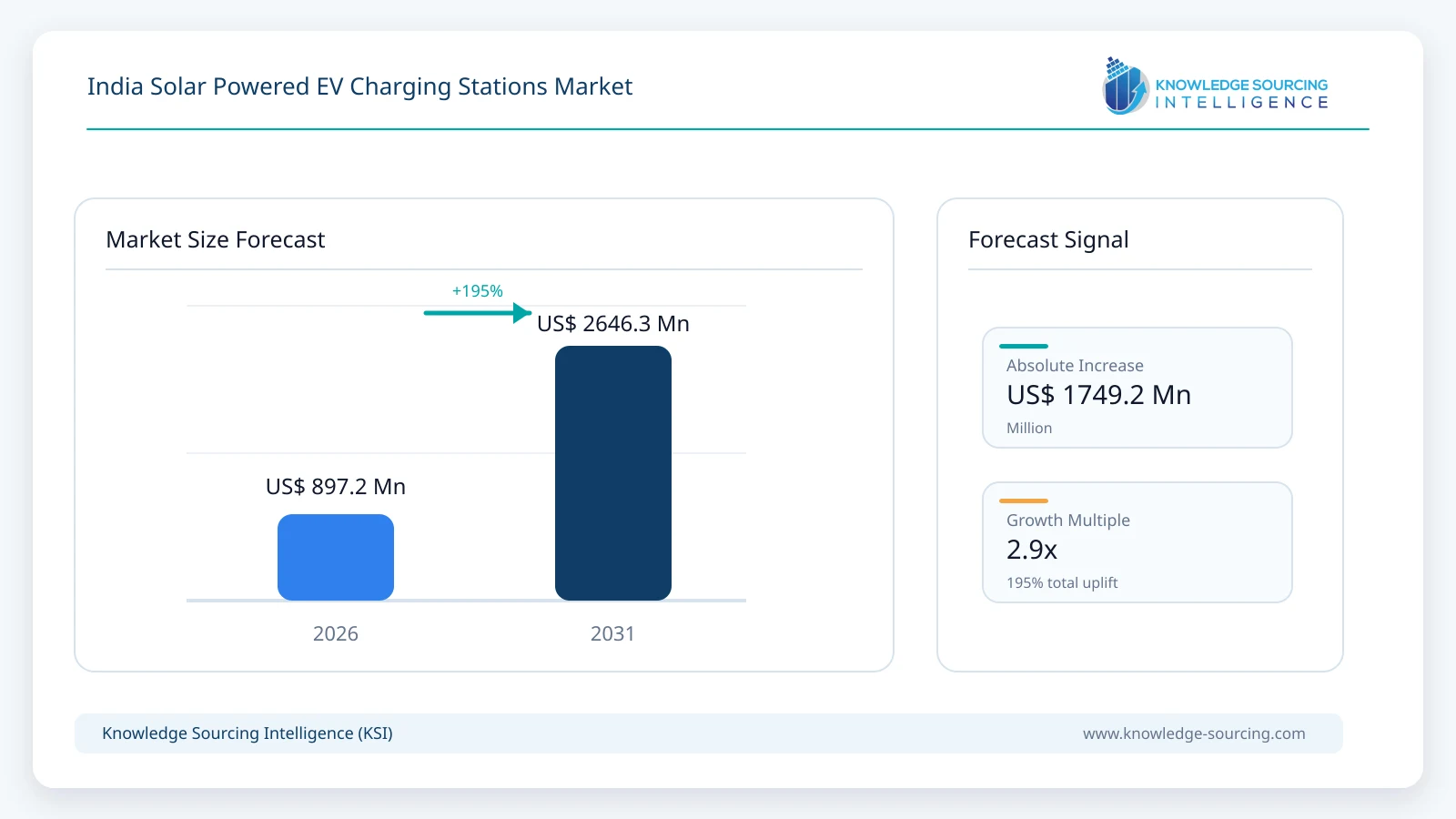
The solar-powered EV Charging Stations market in India is expected to grow, with the growing EV registrations, rise in availability of public charging infrastructure, falling costs of solar generation, and more development of battery-backed charging systems.
India is riding its way through a structural shift of the charging ecosystem from conventional grid-dependent toward an integrated energy infrastructure. Solar PV panels are also interconnected with AC and DC chargers, BESS, inverter/BI-directional converter, smart energy management platform to benefit from flexibility in energy resource licensing. Such architecture allows charging operators to consume solar electricity directly, store excess generation, and discharge to the grid when renewable generation is not enough.
The end-use business is very strong for higher power charging in commercial facilities, fleet operators, highway distribution centers, and remote locations in the country. It is also important to note that solar generation can reduce electricity purchases during the day and BESSs may contribute towards peak load management, as well as provide extra charging capacity without necessitating proportional increases for grid-side load.
In addition, India's EV market is widening its net to include more than just passenger cars. In domestic EV activity, electric two-wheelers and three-wheelers comprise a considerable share of activity, while electric buses, light commercial vehicles, and emerging electric trucks are driving the need for higher-power charging infrastructure. According to the PM E-DRIVE dashboard, as of July 2026, over 27.2 lakh e-2Ws were registered under PM E-DRIVE, displaying the extent of electrification in India's two-wheeler segment. Consequently, solar-powered charging is now relevant across verticals, from residential rooftop systems to high-capacity commercial and highway charging hubs.
Market Dynamics
Market Drivers
Accelerating Electric Vehicle Adoption: With the rise in the number of electric two-wheelers, three-wheelers, passenger vehicles, buses and commercial vehicles, demand for charging points is set to continue steadily. PM E-DRIVE is supporting the transition of India to electric mobility, in terms of incentives and provision for infrastructure covering various categories of EVs. Fleet vehicles, which have predictable operating and charging schedules, are particularly important for solar charging as EV fleets expand. This enables better coordination of solar generation and charging demand.
Increasing Solar Energy Deployment: A seemingly increasing technical basis for solar charging is being created as a result of India's rapidly developing ecosystem for solar generation. EV charging infrastructure can be connected directly with rooftop solar, commercial solar, and distributed generation. The integration of solar charging is especially appealing for commercial properties, as both parking areas and rooftops can serve a double function, producing electricity to be used in EV charging.
Growing Need for Distributed Vitality and Grid Resilience: When EVs charge on a large scale, it can cause localized peaks in electricity demand. An alternative is offered by solar-plus-storage systems, which generate and store electricity on site. BESS, which can be charged when solar availability is high and discharged during the charge peak, will alleviate stress on local distribution infrastructure and provide savings on demand-related electricity costs.
Market Restraints & Opportunities
High upfront cost associated with purchase of PV modules, BESS, inverters, chargers, civil infrastructure & electrical connections is a major restraint. Solar generation is also variable, meaning that the grid needs to be able to provide backup while charging with a conventional source or require batteries.
Additionally, in dense urban areas, site availability is another challenging area. High-power charging stations need considerable electrical infrastructure to start with, along with parking space, safety systems, and adequate vehicle circulation arrangements.
However, these constraints present opportunities in hybrid charging stations and modular BESS energy-management software rooftop/carport solar installations. Hybrid architectures allow operators to supplement solar generation, batteries and grid electricity rather than relying solely on one energy supply.
Key Developments
July 2026: A POM Power India integrated clean-energy solution was commissioned at the Bengaluru campus of Bharat Electronics Limited (BEL). A solar plant with an output capacity of approximately 90 kWp, coupled with a battery energy-storage system rated at approximately120 kWh, including EV charging infrastructure. As part of BEL's SUSTRAGRID project, the installation consists of two DC fast chargers and four AC slow chargers.
August 2026: Indofast Energy partnered with Zeon Charging to set up Quick Interchange Stations at premium malls, metro parking areas and commercial centers of Bengaluru, Hyderabad, Chennai and other Southern markets. The first rollout is at six stations in two locations in Bengaluru city, which includes Orion Mall Rajajinagar.
Market Segmentation
The market is segmented by component, charging type, vehicle type, charging station type, application, and city.
By Component: Solar Photovoltaic (PV) Panels
Solar PV panels are the foremost component segment as the renewable electricity source at the core of designing solar-power charging infrastructure. The panels can be mounted on rooftops; solar carports; dedicated structures or integrated roofing systems.
Specifically, solar canopies could play a key role in the design of commercially owned charging stations where wide parking lots are ideally suited for this function while also providing overhead relief to parked vehicles. Bifacial modules, higher-efficiency panels, and built-in solar roofing systems will better use constrained space.
Visaka Industries — ATUM Solar Roof and ATUM Charge is an example of solar roofing with EV charging. ATUM Charge ties together the company's photovoltaic roof and EV charging into a charge station powered by renewables.
Growing adoption of rooftop solar within the context of India's larger distributed renewable-energy ecosystem will serve to consolidate the addressable market for solar-integrated EV charging.
By Charging Type: DC Charging Stations
DC charging stations make up the majority of the high-value charging segment as they deliver significantly faster charging and are becoming necessary for public, commercial, fleet, and highway applications.
For passenger EVs with long-range trips and commercial vehicles, direct downturn to downtimes in fleet economics makes high-power DC charging critical.
Tata Power EZ CHARGE offers 50/60 kW DC chargers and 30 kW fleet chargers as well as AC charging solutions and e-bus solutions. The network will increase highway, town, domestic, office, and public locations and fleet applications.
Additionally, to use solar power for efficient high-power DC charging, direct coordination between sufficient PV generation, the BESS, inverters, and the grid, and well-coordinated operation strategies are essential because a relatively small solar installation is not capable of continuously delivering all needed power to charge at these levels.
By Vehicle Type: Passenger Electric Vehicles
The largest vehicle type base for solar-powered charging stations is electric passenger vehicles, as the number of electric cars on the road continues to increase and consumers and commercial property owners seek more convenient places to charge in India.
It includes places such as residential communities, homes, offices, shopping centers, hotels, parking facilities, and highways as deployment locations. For instance, solar charging can lower the carbon intensity of charging, while also adding energy-management opportunities for owners of commercial property.
The utility's EZ CHARGE portfolio covering residential, workplace, public, and fleet charging also represents the wider charging ecosystem's needs for passenger EVs.
By City: Delhi Market Analysis
Delhi is among India's largest markets for solar-powered EV charging due to its high urban density, high volume of EV activity, particularly passenger vehicles, extensive public transport electrification, and large base of heavy-duty commercial vehicles.
The city facilitates residential charging in housing societies as well as commercial charging at malls, offices, hotels, and public parking spots. The market reach is also extended by highway and intercity charging requirements around the National Capital Region.
The city has focused on cleaner forms of transport, making ongoing investments in EV charging infrastructure. The solar-powered stations could also help commercial sites lower daytime grid electricity use for charging.
List of Companies
Tata Power
Visaka Industries
Ather Energy
ElectriVa
RoadGrid
Scharge Private Limited
Efuel Chargers
Plugzmart
Everta
Bolt.Earth
Tata Power
Tata Power has created one of the largest integrated EV charging ecosystems in India under its EZ CHARGE platform. The portfolio of the company includes home charging, public charging, workplace charging, and fleet as well as e-bus charging, AC chargers, and DC fast chargers. At present, this network has over 5,500 charge zones under its EZ CHARGE network, while the 3,000 Tata Power charging points are spread across over 620 cities & towns and more than Rs.1.2 lakh home EV chargers.
Visaka Industries
Visaka Industries ATUM Charge is one of the companies most closely aligned with the solar EV charging market. Full integration of EV charging with its ATUM Solar Roof, which Visaka states is 'India's first 100% green EV charging station'. This model turns the solar roof into electricity that is utilized for EV charging, resulting in one renewable-energy and mobility infrastructure.
Ather Energy
Ather Energy is the operator of the Ather Grid public fast-charging network for electric two-wheelers. As per the July 2026 company communication, the network now has over 6,000 fast chargers in more than 395 cities. Ather Grid Fast Charger comes with fast top-ups, from Ather Grid and the Ather Grid app helps users to locate charging stations, queue up their vehicle in order, and make payments.
Analyst View
India solar powered EV charging stations market is transitioning from a pilot-scale renewable charging ecosystem to an integrated commercial energy infrastructure. The biggest opportunity is presented with hybrid solar, BESS, and fast-charging systems that can simultaneously manage intermittent generation from the solar resource while meeting demanding load requirements along with grid constraints. Over the coming years, cities like Delhi, Mumbai, Bengaluru, Hyderabad, and Chennai will primarily be the high-value urban markets, while key enablers for growth will largely come from fleet depots, highway corridors, and commercial solar carports as well as Tier-2/Tier-3 cities. Competitive advantage is moving more towards companies that combine charger hardware with solar integration, BESS, smart energy management, and interoperability.
India Solar Powered EV Charging Stations Market Scope:
| Report Metric | Details |
|---|---|
| Total Market Size in 2026 | USD 897.2 million |
| Total Market Size in 2031 | USD 2,646.4 million |
| Forecast Unit | USD Million |
| Growth Rate | 24.2% |
| Study Period | 2021 to 2031 |
| Historical Data | 2021 to 2024 |
| Base Year | 2025 |
| Forecast Period | 2026 – 2031 |
| Segmentation | Component, Charging Type, Vehicle Type, Charging Station Type, Application, City |
| Companies |
|
Table of Contents
1. EXECUTIVE SUMMARY
2. MARKET SNAPSHOT
2.1. Market Overview
2.2. Market Definition
2.3. Scope of the Study
2.4. Market Segmentation
3. MARKET DYNAMIC
3.1. Market Drivers
3.2. Market Restraints
3.3. Market Opportunities
3.4. Porter’s Five Forces Analysis
3.5. Industry Value Chain Analysis
4. BUSINESS LANDSCAPE
4.1. Policy & Regulatory Landscape
4.2. EV Charging Infrastructure Deployment Landscape
4.3. Business & Revenue Model Landscape
4.4. Import & Domestic Manufacturing Landscape
4.5. Strategic Recommendations
5. TECHNOLOGICAL OUTLOOK
5.1. Solar PV and EV Charging Technology
5.2. Solar-Charger Integration Technology
5.3. Grid-Interactive Charging Technologies
5.4. Smart Charging & Digital Technologies
6. INDIA SOLAR POWERED EV CHARGING STATIONS MARKET BY COMPONENT
6.1. Introduction
6.2. Solar Photovoltaic (PV) Panels
6.3. EV Chargers & MPPT Charge Controller
6.3. Battery Energy Storage System (BESS)
6.4. Power Inverter
6.5. Others
7. INDIA SOLAR POWERED EV CHARGING STATIONS MARKET BY CHARGING TYPE
7.1. Introduction
7.2. AC Charging Stations
7.3. DC Charging Stations
8. INDIA SOLAR POWERED EV CHARGING STATIONS MARKET BY VEHICLE TYPE
8.1. Introduction
8.2. Passenger Electric Vehicles
8.3. Commercial Vehicles
8.4. Electric Buses
8.5. Others
9. INDIA SOLAR POWERED EV CHARGING STATIONS MARKET BY CHARGING STATION TYPE
9.1. Introduction
9.2. Off-Grid Solar EV Charging Station
9.3. Grid-Tied Solar EV Charging Station
9.4. Hybrid Solar EV Charging Station
10. INDIA SOLAR POWERED EV CHARGING STATIONS MARKET BY APPLICATION
10.1. Introduction
10.2. Residential
10.3. Commercial
10.4. Fleet Charging
10.5. Highway & Transit Corridor Charging
10.6. Others
11. INDIA SOLAR POWERED EV CHARGING STATIONS MARKET BY CITY
11.1. Introduction
11.2. Delhi
11.3. Mumbai
11.3. Bengluru
11.4. Hyderabad
11.5. Chennai
11.6. Others
12. COMPETITIVE ENVIRONMENT AND ANALYSIS
12.1. Major Players and Strategy Analysis
12.2. Market Share Analysis
12.3. Mergers, Acquisitions, Agreements, and Collaborations
12.4. Competitive Dashboard
13. COMPANY PROFILES
13.1. Tata Power
13.2. Visaka Industries
13.3. Ather Energy
13.4. ElectriVa
13.5. RoadGrid
13.6. SCharge
13.7. Efuel
13.8. Plugzmart
13.9. Everta
13.10. BoltEarth
14. APPENDIX
14.1. Currency
14.2. Assumptions
14.3. Base and Forecast Years Timeline
14.4. Key benefits for the stakeholders
14.5. Research Methodology
14.6. Abbreviations
Navigate
Trusted by the world's leading organizations











