
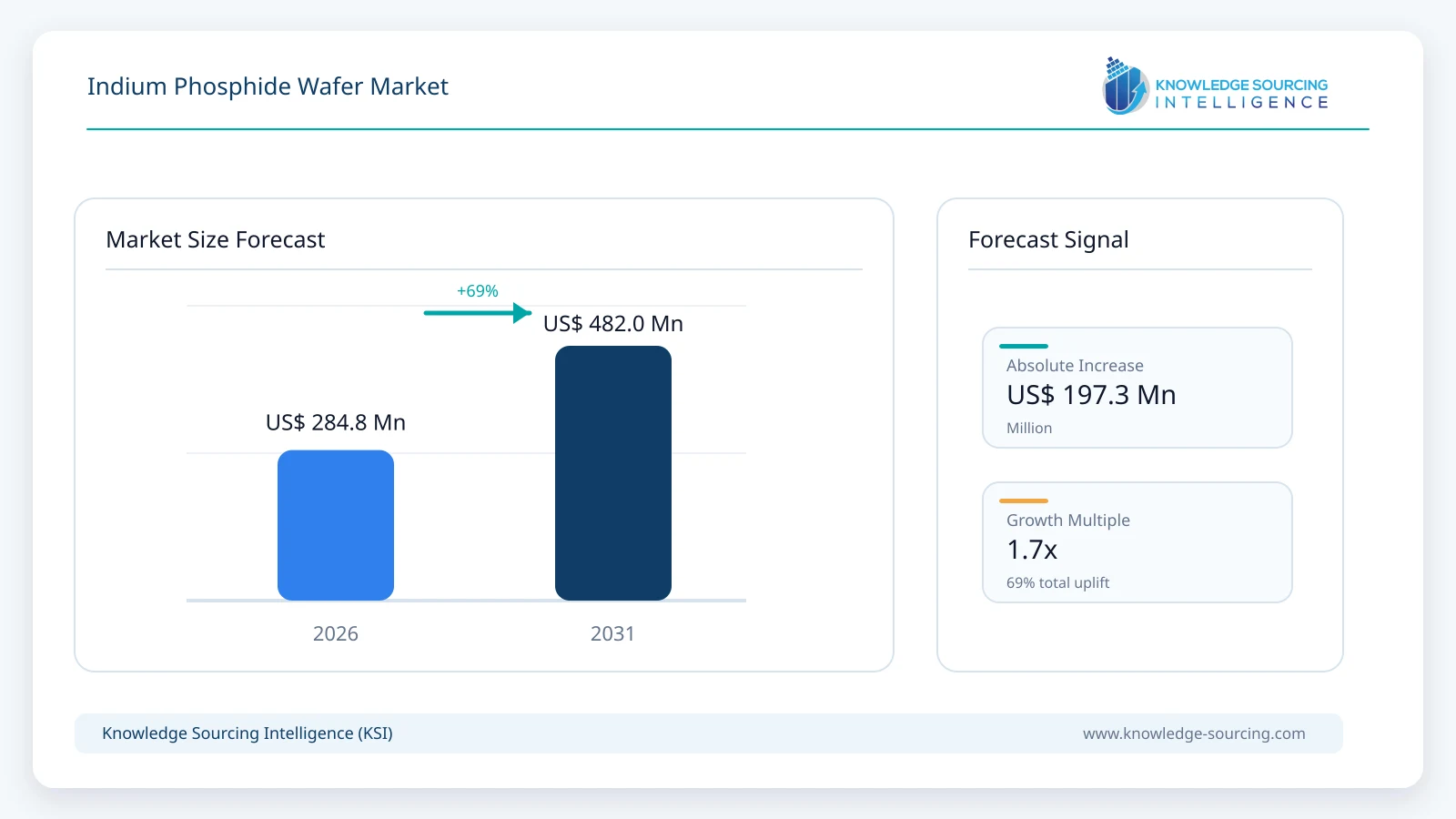
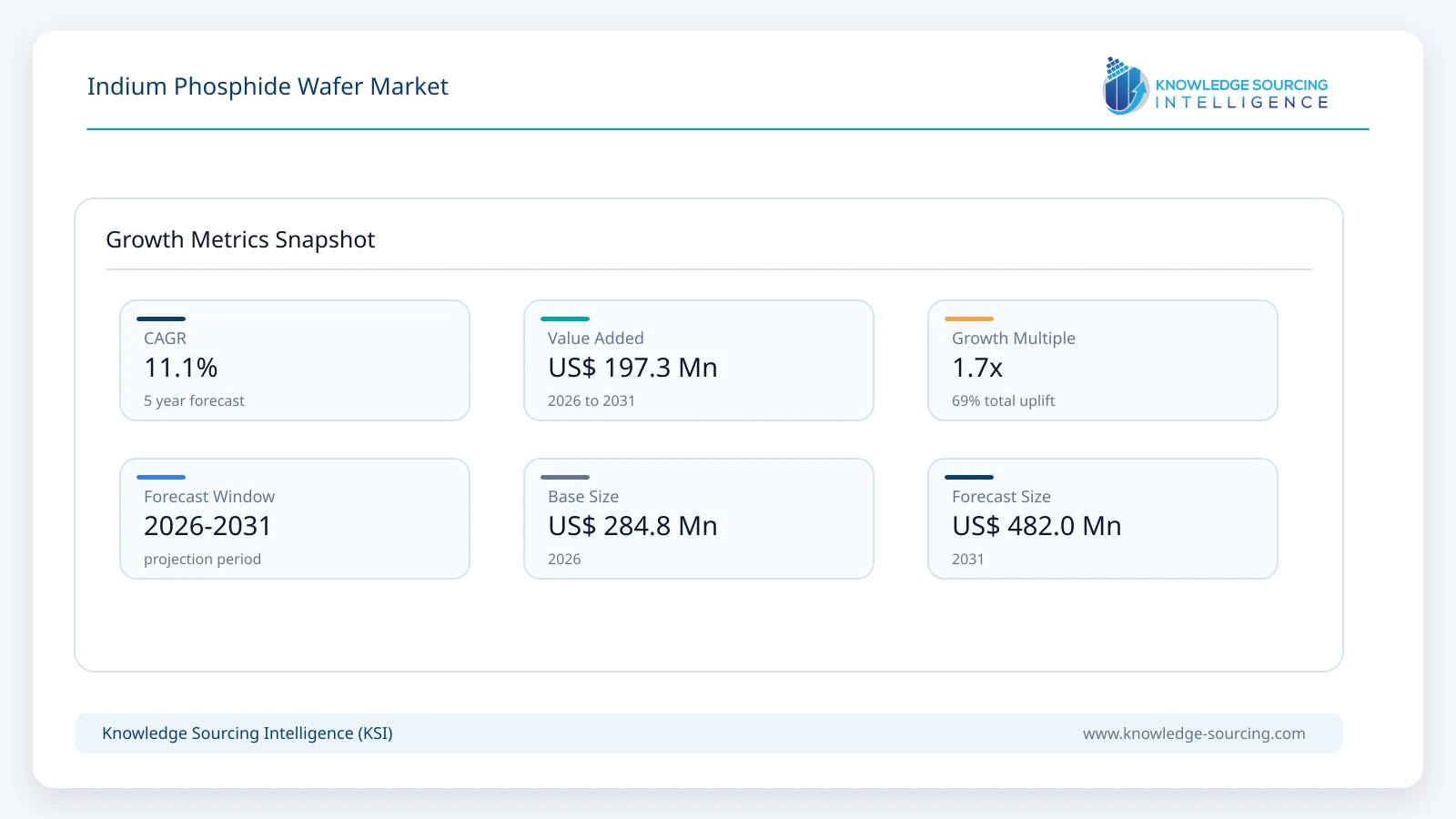
The indium phosphide wafer market is estimated at USD 284.78 million in 2026 and is projected to reach USD 482.04 million by 2031, representing a CAGR of approximately 11.1% during the forecast period.
Highlights:
- 14-inch wafers account for approximately 44% of global InP wafer revenue in 2026.
- 2Telecommunications and datacom represent about 60% of 2026 demand, led by optical connectivity.
- 3N-type wafers contribute approximately 46% of 2026 market value across laser and photonic-device applications.
- 4Asia Pacific accounts for roughly 48% of market revenue due to substrate and photonics manufacturing concentration.
- 5JX Advanced Metals plans to expand InP substrate capacity by approximately seven to ten times.
- 6AXT is doubling InP manufacturing capacity while developing 6-inch substrates for future high-volume production.
Indium phosphide occupies a specialized position within the compound-semiconductor supply chain because it combines high electron velocity with a direct bandgap and strong performance at the wavelengths used in optical communications. The material is therefore used as a substrate for lasers, photodiodes, modulators, amplifiers, high-speed electronic devices and photonic integrated circuits. Unlike silicon wafers, InP substrates are produced in much smaller volumes, require difficult single-crystal growth and polishing processes, and are supplied by a limited number of qualified producers. AXT describes itself as one of only three global providers of high-quality InP substrates, while JX Advanced Metals and Sumitomo Electric are established Japanese suppliers and InPact supplies customers from Europe.
The principal demand shift is occurring inside AI data centers. The transition from 400G toward 800G and 1.6T optical links increases the number and performance requirements of optical engines deployed between accelerators, switches and data-center racks. Coherent demonstrated 200G electro-absorption modulated lasers for 1.6T transceivers and differential EML technology for emerging 400G-per-lane systems at OFC 2026, illustrating how InP remains embedded in the highest-performance optical path even as silicon photonics expands. Rather than replacing InP, silicon photonics increasingly depends on external InP lasers and epi structures to provide efficient optical sources.
Supply is responding, but qualification cycles and crystal-growth constraints keep the market concentrated. JX Advanced Metals has committed up to JPY 120 billion over four years to expand InP substrate production and plans a seven- to ten-fold increase in capacity. AXT completed a USD 632.5 million capital raise in 2026 to support Tongmei InP expansion and R&D in 6-inch substrates. InPact states that its French facility is expanding capacity by up to six times, while European public investment is supporting a 6-inch InP photonic-chip pilot line in Eindhoven. This combination of private and public investment supports long-term wafer demand but also reflects the supply-security concerns created by rapid AI optical growth.
Market Trends
AI Optical Interconnects Are Replacing Telecom Cyclicality with a New Growth Engine
Historically, InP wafer demand was strongly linked to carrier optical-network spending and long-haul telecommunications cycles. AI infrastructure is adding a second, faster-growing demand base. Hyperscale data centers require high-speed optical links to move data between GPUs, switches and storage, and the performance transition from 800G to 1.6T and eventually 3.2T increases laser and detector complexity. Veeco reported more than USD 250 million in orders from multiple customers for equipment supporting InP laser manufacturing, with a substantial portion tied to suppliers of 800G and 1.6T optical transceivers. Coherent has simultaneously expanded its InP laser, modulator and photodiode portfolio for next-generation data-center architectures. This changes the demand profile from periodic telecom upgrades toward a more sustained optical-compute infrastructure cycle.
4-inch Remains the Commercial Core While 6-inch Moves Toward Industrial Scale
Four-inch substrates remain the practical production standard for many InP device lines because qualified epitaxy, lithography and device processes are already established around the format. The industry is nevertheless moving toward larger diameters to improve throughput and lower unit processing cost. AXT is developing 6-inch InP substrates, while the Netherlands is constructing an industrial pilot line for InP photonic chips on 6-inch wafers that is expected to become operational in 2027. The facility is designed to support up to 10,000 wafers per year. The shift will be gradual because larger InP crystal growth, wafer flatness, defect control and downstream process qualification are materially more difficult than scaling silicon wafers.
Silicon Photonics Is Increasing the Strategic Value of InP Rather Than Eliminating It
Silicon photonics provides efficient passive waveguides and scalable CMOS-compatible processing, but silicon is an inefficient light emitter. High-performance platforms therefore increasingly combine silicon photonic circuits with InP lasers, amplifiers or detector structures. IQE and Tower Semiconductor signed a multi-year InP epiwafer supply agreement in June 2026 covering optical connectivity for AI data centers, including 200G-per-lane technology and prototype 400G-per-lane modulators. This hybrid integration model expands the addressable opportunity for InP substrates because increasing silicon-photonics adoption creates additional demand for qualified InP light-source and active-device material.
Supply Security and Capacity Qualification Are Becoming Purchasing Criteria
The InP substrate market is unusually concentrated, and qualification of a new crystal supplier can take considerable time because wafer defectivity, orientation, doping uniformity, surface quality and epitaxial compatibility affect downstream device yield. AXT reported that Chinese export-permit availability constrained InP shipments in late 2025, while JX Advanced Metals has emphasized stable supply and price revisions as part of its large capacity program. Buyers are therefore placing greater value on diversified supply, long-term capacity commitments and regional manufacturing resilience. This favors established producers that can demonstrate repeatable low-defect crystal growth and fund multi-year expansion programs.
Market Drivers
800G, 1.6T and Co-Packaged Optics Increase InP Content in AI Networks
AI clusters require more optical bandwidth as accelerator counts rise and electrical interconnects encounter power and distance limitations. InP-based lasers and detectors are central to this transition because they operate efficiently at telecom wavelengths and can support high-speed modulation. Coherent is developing 200G EMLs for 1.6T transceivers, 400G-per-lane differential EMLs for future 3.2T systems and high-power continuous-wave lasers for co-packaged optics and silicon-photonics pluggables. Each successive bandwidth generation raises performance requirements for the active optical layer, supporting demand for high-quality InP substrate material even when the wider module architecture incorporates silicon photonics.
Large Supplier Investments Are Expanding Addressable Capacity
The strongest evidence of structural demand is the scale of current capacity commitments. JX Advanced Metals plans up to JPY 120 billion of InP substrate investment over four years and a seven- to ten-fold production increase. AXT is doubling capacity in 2026 and funding additional expansion, while InPact is increasing production capacity at its French operation. These programs are much larger than ordinary maintenance investment and indicate that suppliers are preparing for multi-year demand rather than a short inventory cycle. Additional qualified capacity can also unlock demand that would otherwise be constrained by substrate availability.
Integrated Photonics, 6G and Sensing Broaden Demand Beyond Data Centers
Optical communications remain the dominant application, but InP is also used in coherent sensing, infrared detectors, high-frequency electronics, medical photonics and emerging 6G systems. The TNO-led 6-inch pilot line in Eindhoven is being positioned for AI data centers, 6G networks, medical innovation and supercomputing. IQE likewise identifies InP applications in hyperscale data centers, 5G backhaul, defense systems, infrared imaging and healthcare monitoring. These smaller application pools provide diversification and support specialty wafer grades, semi-insulating substrates and customized orientations that carry higher value than commodity material.
Market Restraints
Crystal-Growth Complexity, Limited Qualified Supply and Trade Controls Constrain Scaling
InP is brittle, expensive and more difficult to scale than silicon, and larger wafer diameters require tight control of dislocation density, flatness, doping and surface quality. Device manufacturers also face long qualification cycles because changes in substrate properties can affect epitaxial growth and optical-device yield. The limited number of high-volume suppliers magnifies disruptions: AXT explicitly cited export permits as a constraint on InP shipments in late 2025 and early 2026. Rapid capacity expansion therefore cannot immediately translate into qualified market supply, while larger-diameter migration requires coordinated investment across crystal growth, epitaxy and downstream fabrication.
Indium Phosphide Wafer Market Segment Analysis
By Size
4 inch (100 mm)
The 4-inch format is the largest wafer-size segment in 2026. It offers a practical balance between device throughput and manufacturing maturity, with established availability from JX Advanced Metals, AXT, InPact, IQE substrate operations and other suppliers. Four-inch wafers are widely used for optical communication lasers, photodetectors and photonic integrated devices. Six-inch wafers are expected to record the fastest growth as producers and pilot fabs pursue lower processing cost per device, but 6-inch adoption remains at an earlier qualification stage and will coexist with 3-inch and 4-inch production through the forecast period.
By Applications
Telecommunications
Telecommunications, including datacom optical connectivity, forms the largest application segment. InP substrates are used to manufacture laser diodes, EMLs, photodiodes, modulators and other active components for fibre-optic networks, passive optical networks and data-center transceivers. AI infrastructure is strengthening the segment by increasing high-speed optical links inside and between data centers rather than relying only on carrier-network deployments. Consumer sensing, medical photonics and specialty defense or infrared applications remain smaller but can require high-value customized wafers and provide diversification from communication cycles.
By Doping Type
N-Type
N-type wafers represent the largest doping category because sulfur-, tin- and nominally undoped n-type substrates are widely used across laser, detector and optoelectronic device structures. JX Advanced Metals offers sulfur- and tin-doped InP alongside zinc, iron and undoped products, while AXT supplies sulfur n-type, tin n-type, undoped n-type, zinc p-type and semi-insulating formats. Semi-insulating material remains strategically important for high-frequency electronic devices and specialized photonic applications, but the volume expansion associated with optical transmitters and receivers keeps conductive n-type substrates at the center of current demand.
By Geography
Asia Pacific
Asia Pacific is the largest regional market because Japan and China host major InP crystal-growth capacity while the wider region contains a dense optical-component and semiconductor manufacturing base. JX Advanced Metals, Sumitomo Electric and AXT/Tongmei are central suppliers, and capacity additions in Japan and China reinforce the region's production role.
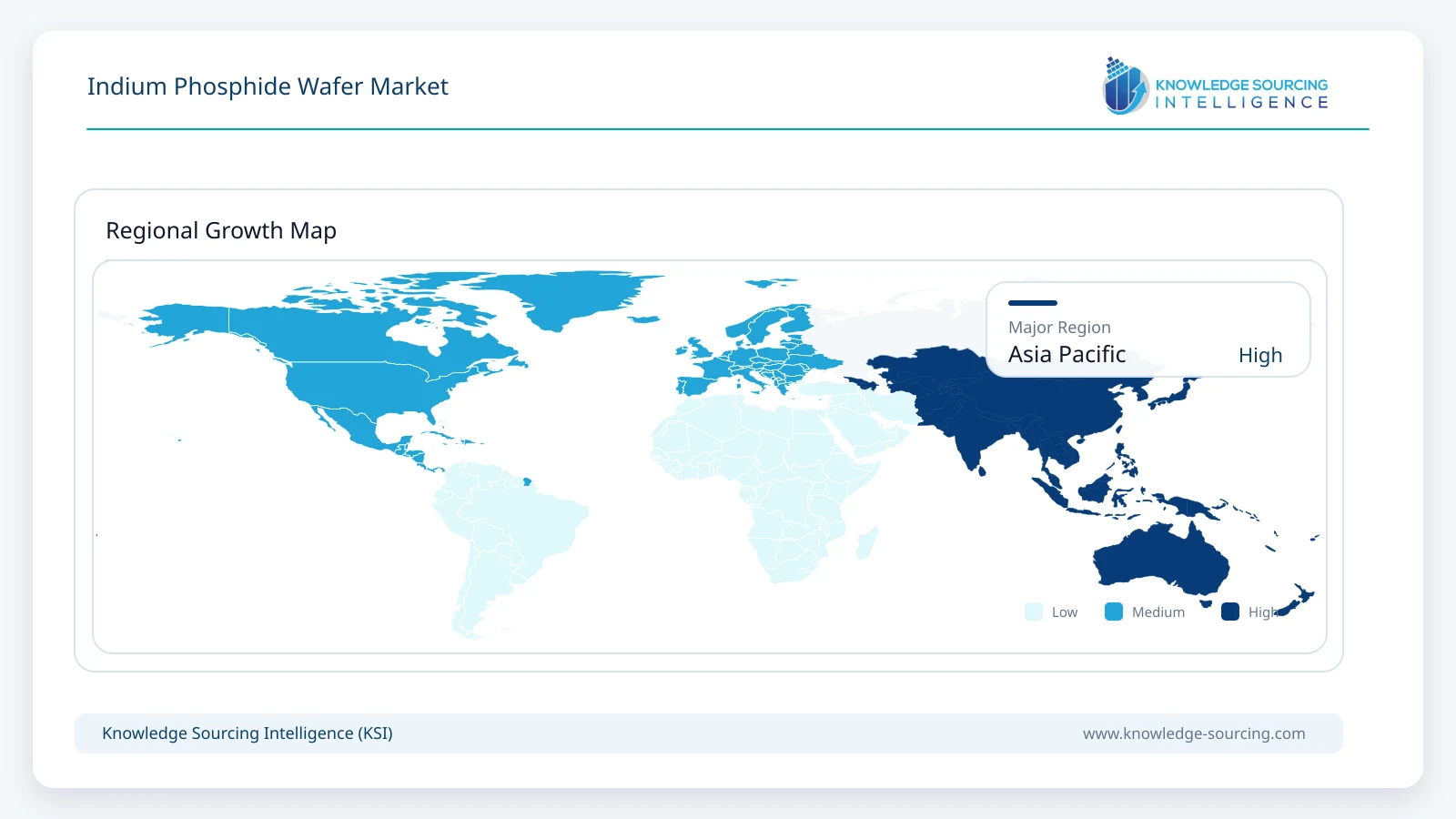
North America represents a major demand center through AI data centers, optical-module vendors and photonics R&D, while Europe is strengthening its position through InPact, IQE and the EU-supported 6-inch photonic pilot line in Eindhoven.
Competitive Environment
The market is concentrated at the high-volume substrate level because growing low-defect InP single crystals requires specialized equipment, process knowledge and long customer qualification cycles. JX Advanced Metals, Sumitomo Electric and AXT are among the most important global substrate suppliers, with InPact providing an established Western production base. IQE participates through both InP substrates and epitaxial wafers, while Vital Materials and several Chinese specialty-material suppliers broaden commercial availability. Competition increasingly centers on qualified capacity, 4-inch yield, 6-inch scale-up, dopant control, epi-ready surface quality and the ability to commit supply for multi-year AI infrastructure ramps.
Vertical integration is also increasing. IQE combines substrates with InP epitaxy, Vital Materials offers substrates alongside epitaxial and laser capabilities, and Sumitomo Chemical has begun mass production of 4-inch InP epitaxial wafers. The market therefore contains both pure-play substrate suppliers and companies that capture value further downstream. For the purposes of this report, only directly attributable InP wafer revenue is included in the market estimate, preventing finished optical components and complete transceiver revenue from inflating the substrate market.
Recent Developments
August 2026: Sumitomo Chemical began mass production and sales of 4-inch InP epitaxial wafers for AI data-center and photonic-electronic convergence applications.
June 2026: JX Advanced Metals approved up to JPY 120 billion of investment to expand InP substrate capacity approximately seven to ten times.
June 2026: IQE and Tower Semiconductor signed a multi-year InP epiwafer supply agreement for AI-driven optical connectivity and silicon-photonics platforms.
May 2026: Veeco announced more than USD 250 million of equipment orders supporting high-volume InP laser manufacturing for 800G and 1.6T optical transceivers.
April 2026: AXT reported a USD 632.5 million capital raise supporting Tongmei InP capacity expansion and development of 6-inch InP substrates.
March 2026: TNO and High Tech Campus Eindhoven began construction of an industrial pilot factory for InP photonic chips on 6-inch wafers.
Indium Phosphide Wafer Market Scope:
| Report Metric | Details |
|---|---|
| Total Market Size in 2026 | USD 284.78 million |
| Total Market Size in 2031 | USD 482.04 million |
| Forecast Unit | Million |
| Growth Rate | 11.1% |
| Study Period | 2021 to 2031 |
| Historical Data | 2021 to 2024 |
| Base Year | 2025 |
| Forecast Period | 2026 – 2031 |
| Segmentation | Size, Applications , Doping Type, Geography |
| Companies |
|
Market Segmentation
BY SIZE
2 inch (50.8 mm)
3 inch (76.2 mm)
4 inch (100 mm)
6 inch (150 mm) and above
BY APPLICATIONS
Consumer Electronics
Medical
Telecommunications
Others
BY DOPING TYPE
Undoped Conductive
N-Type
P-Type
Semi-insulating
BY GEOGRAPHY
North America
USA
Canada
Mexico
South America
Brazil
Argentina
Others
Europe
United Kingdom
Germany
France
Netherlands
Others
Middle East & Africa
Saudi Arabia
UAE
South Africa
Others
Asia Pacific
China
Japan
South Korea
Taiwan
India
Others
Table of Contents
1. EXECUTIVE SUMMARY
2. MARKET SNAPSHOT
2.1. Market Overview
2.2. Market Definition
2.3. Scope of the Study
2.4. Market Segmentation
3. BUSINESS LANDSCAPE
3.1. Market Drivers
3.1.1. 800G, 1.6T and Co-Packaged Optics Increase InP Content in AI Networks
3.1.2. Large Supplier Investments Are Expanding Addressable Capacity
3.1.3. Integrated Photonics, 6G and Sensing Broaden Demand Beyond Data Centers
3.2. Market Restraints
3.2.1. Crystal-Growth Complexity, Limited Qualified Supply and Trade Controls Constrain Scaling
3.3. Market Opportunities
3.4. Porter's Five Forces Analysis
3.5. Industry Value Chain Analysis
3.6. Policies and Regulations
3.7. Strategic Recommendations
4. TECHNOLOGICAL OUTLOOK
4.1. Vertical Gradient Freeze and Crystal Growth
4.2. Wafer Slicing, Polishing and Epi-Ready Surface Preparation
4.3. Conductive and Semi-Insulating Doping
4.4. 4-inch to 6-inch Wafer Transition
4.5. InP Epitaxy and Hybrid Silicon Photonics
5. INDIUM PHOSPHIDE WAFER MARKET BY SIZE
5.1. Introduction
5.2. 2 inch (50.8 mm)
5.3. 3 inch (76.2 mm)
5.4. 4 inch (100 mm)
5.5. 6 inch (150 mm) and above
6. INDIUM PHOSPHIDE WAFER MARKET BY APPLICATIONS
6.1. Introduction
6.2. Consumer Electronics
6.3. Medical
6.4. Telecommunications
6.5. Others
7. INDIUM PHOSPHIDE WAFER MARKET BY DOPING TYPE
7.1. Introduction
7.2. Undoped Conductive
7.3. N-Type
7.4. P-Type
7.5. Semi-insulating
8. INDIUM PHOSPHIDE WAFER MARKET BY GEOGRAPHY
8.1. Introduction
8.2. North America
8.2.1. USA
8.2.2. Canada
8.2.3. Mexico
8.3. South America
8.3.1. Brazil
8.3.2. Argentina
8.3.3. Others
8.4. Europe
8.4.1. United Kingdom
8.4.2. Germany
8.4.3. France
8.4.4. Netherlands
8.4.5. Others
8.5. Middle East & Africa
8.5.1. Saudi Arabia
8.5.2. UAE
8.5.3. South Africa
8.5.4. Others
8.6. Asia Pacific
8.6.1. China
8.6.2. Japan
8.6.3. South Korea
8.6.4. Taiwan
8.6.5. India
8.6.6. Others
9. COMPETITIVE ENVIRONMENT AND ANALYSIS
9.1. Major Players and Strategy Analysis
9.2. Market Share Analysis
9.3. Capacity Expansion, Partnerships and Supply Agreements
9.4. Competitive Dashboard
10. COMPANY PROFILES
10.1. JX Advanced Metals Corporation
10.2. Sumitomo Electric Industries, Ltd.
10.3. AXT, Inc.
10.4. InPact
10.5. IQE plc
10.6. Vital Materials Co., Limited
10.7. Sumitomo Chemical Co., Ltd.
10.8. Intelligent Epitaxy Technology, Inc. (IntelliEPI)
10.9. Xiamen Powerway Advanced Material Co., Ltd.
10.10. Western Minmetals (SC) Corporation
10.11. Century Goldray Semiconductor Co., Ltd.
10.12. Wafer World, Inc.
10.13. Weixin Optoelectronics Technology (Shenzhen) Co., Ltd.
10.14. Shanghai Xinkehui New Material Co., Ltd.
10.15. American Elements
10.16. Advanced Engineering Materials (AEM)
10.17. ATT Advanced Elemental Materials Co., Ltd.
11. APPENDIX
11.1. Currency
11.2. Assumptions
11.3. Base and Forecast Years Timeline
11.4. Key Benefits for Stakeholders
11.5. Research Methodology
11.6. Abbreviations
Navigate
Trusted by the world's leading organizations











