
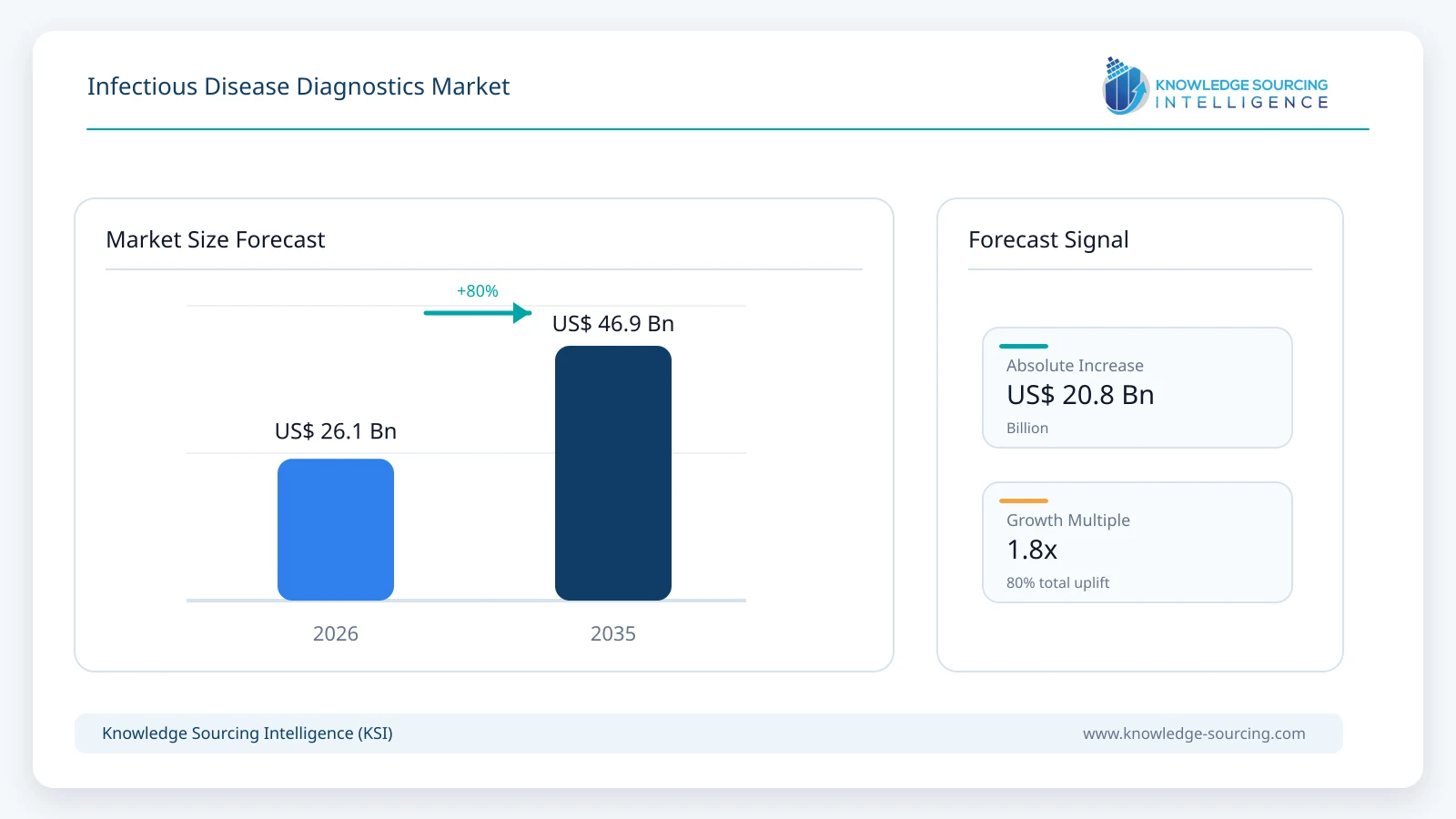
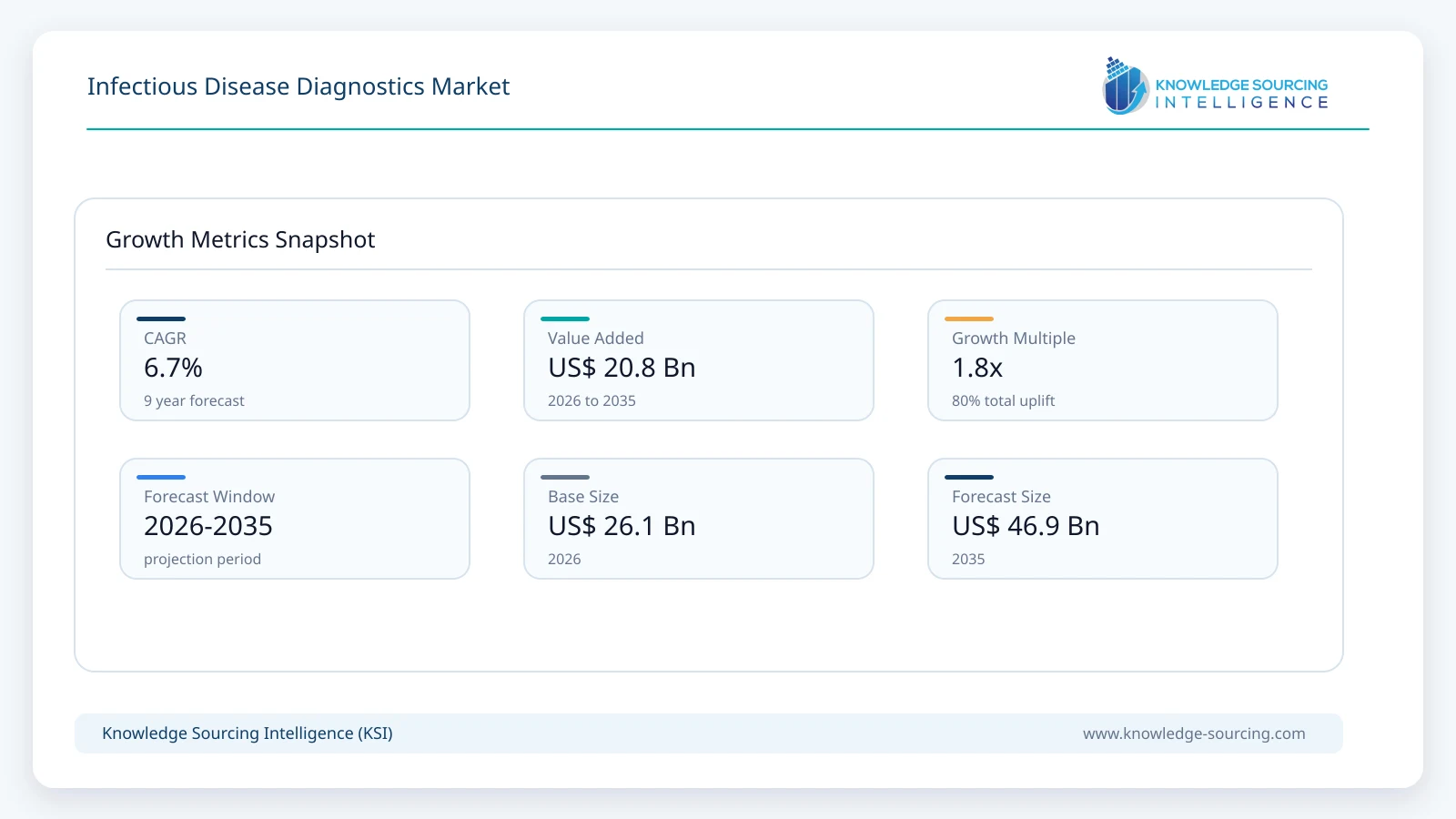
The Infectious Disease Diagnostics Market is expected to grow at a CAGR of 6.7% from a market value of USD 26.1 billion in 2026 to USD 46.9 billion in 2035.
Highlights:
- 1Rising antimicrobial resistance is increasing demand for rapid pathogen identification because clinicians require targeted antimicrobial selection before resistance spreads within healthcare facilities.
- 2Expansion of multiplex molecular diagnostics is reducing diagnostic turnaround time, allowing healthcare providers to manage respiratory, bloodstream, gastrointestinal, and sexually transmitted infections more efficiently.
- 3Public health surveillance programs are increasing adoption of genomic sequencing technologies because variant monitoring and outbreak investigation require higher-resolution pathogen characterization.
- 4Laboratory automation is reducing manual workflow dependency, encouraging healthcare systems to replace fragmented diagnostic processes with integrated testing platforms.
The infectious disease diagnostics market comprises technologies that detect pathogens, host immune responses, microbial nucleic acids, and infection-associated biomarkers to support clinical diagnosis and public health surveillance. The market serves hospitals, clinical laboratories, physician offices, reference laboratories, academic institutions, and decentralized healthcare settings through molecular diagnostics, immunoassays, microbiology systems, sequencing platforms, and digital laboratory solutions.
The increasing burden of antimicrobial resistance is transforming diagnostic demand because clinicians require earlier organism identification together with resistance profiling before selecting targeted therapies. Conventional culture methods remain clinically valuable but frequently require longer processing times, creating demand for molecular techniques that deliver actionable information during initial patient management. Healthcare providers are therefore incorporating multiplex PCR, syndromic respiratory panels, bloodstream infection testing, and rapid antimicrobial susceptibility technologies into routine diagnostic pathways.
National preparedness initiatives continue to influence procurement priorities because governments recognize diagnostic infrastructure as an essential component of pandemic readiness. Investments are supporting laboratory modernization, genomic surveillance networks, decentralized testing capacity, and digital reporting systems that strengthen infectious disease monitoring across healthcare systems. These initiatives are increasing adoption of scalable platforms capable of supporting both routine clinical testing and emergency outbreak response.
Manufacturers are responding by expanding integrated diagnostic ecosystems that combine high-throughput analyzers, automated sample preparation, cloud-enabled informatics, and recurring reagent portfolios. This strategy strengthens customer retention because laboratories increasingly prefer standardized workflows that reduce operational complexity while improving testing consistency.
Market Dynamics
Market Drivers
Increasing Antimicrobial Resistance Is Expanding Demand for Rapid Molecular Diagnostics: Antimicrobial resistance creates clinical uncertainty because empirical treatment frequently delays optimal therapy while increasing inappropriate antibiotic exposure. Healthcare providers are increasingly adopting molecular diagnostics that identify pathogens together with resistance-associated genetic markers during early patient management. Conventional microbiology continues to provide definitive confirmation, yet its longer turnaround time limits immediate treatment optimization. Diagnostic manufacturers are expanding rapid PCR panels, automated microbiology systems, and resistance detection assays that support antimicrobial stewardship programs.
Expanding Genomic Surveillance Is Increasing Adoption of Next-Generation Sequencing: Pathogen surveillance depends upon genomic characterization because emerging variants influence disease transmission, vaccine effectiveness, and therapeutic selection. National surveillance programs are expanding sequencing capacity across reference laboratories to strengthen outbreak monitoring and public health preparedness. Laboratory infrastructure increasingly requires bioinformatics integration alongside sequencing technologies to manage larger genomic datasets. Diagnostic companies are responding by developing automated sequencing workflows and standardized analysis software that simplify routine implementation.
Decentralized Testing Is Accelerating Point-of-Care Diagnostic Adoption: Healthcare delivery increasingly emphasizes earlier diagnosis because delayed testing contributes to disease transmission and prolonged hospitalization. Point-of-care molecular diagnostics are expanding into emergency departments, outpatient clinics, pharmacies, and community healthcare settings where rapid clinical decisions improve patient management. Healthcare providers continue requiring laboratory-quality analytical performance despite decentralized deployment. Manufacturers are developing compact automated systems that minimize operator complexity while maintaining diagnostic accuracy.
Laboratory Automation Is Improving Operational Efficiency: Clinical laboratories process increasing testing volumes while facing workforce shortages and operational cost pressures. Automation is reducing manual sample handling, improving workflow consistency, and supporting standardized quality management across diagnostic laboratories. High-throughput molecular platforms increasingly integrate sample preparation, amplification, detection, and reporting within unified workflows. Manufacturers continue investing in software-enabled laboratory automation that improves throughput while reducing hands-on technician time.
Market Restraints
High capital investment requirements for advanced molecular analyzers limit adoption among smaller healthcare facilities despite increasing clinical demand.
Reimbursement variability across healthcare systems reduces financial incentives for laboratories to implement newer high-complexity molecular diagnostic technologies.
Regulatory validation requirements for multiplex molecular assays increase development timelines, clinical evidence generation, and commercialization costs.
Market Opportunities
Syndromic Testing Panels Are Expanding Clinical Utility: Healthcare providers increasingly manage patients presenting with similar clinical symptoms caused by multiple pathogens. Syndromic testing identifies numerous infectious agents simultaneously, reducing sequential testing while improving treatment decisions. Laboratories continue requiring assays that balance analytical breadth with operational simplicity. Manufacturers are expanding respiratory, gastrointestinal, bloodstream, meningitis, and sexually transmitted infection panels that increase diagnostic efficiency.
Artificial Intelligence Is Supporting Diagnostic Interpretation: Diagnostic platforms generate increasingly complex molecular and genomic datasets that require efficient interpretation before clinical reporting. Artificial intelligence is assisting laboratories by improving workflow prioritization, quality assurance, and result interpretation across high-volume testing environments. Healthcare systems continue integrating digital pathology, laboratory information systems, and bioinformatics into unified diagnostic workflows. Manufacturers are incorporating AI-enabled software into laboratory ecosystems that improve operational efficiency while supporting clinical decision-making.
Public Health Preparedness Is Driving Laboratory Modernization: Governments recognize diagnostic infrastructure as a national preparedness asset because future outbreaks require scalable laboratory capacity. Public investments continue supporting laboratory automation, molecular testing capability, and genomic surveillance infrastructure across regional healthcare systems. Healthcare organizations increasingly prioritize flexible diagnostic platforms capable of responding to routine clinical demand alongside emerging infectious threats. Manufacturers are developing scalable testing systems that accommodate changing public health priorities.
Digital Connectivity Is Strengthening Population-Level Disease Surveillance: Healthcare organizations increasingly require diagnostic platforms that integrate directly with electronic reporting systems because infectious disease surveillance depends upon timely data exchange. Laboratory software is supporting automated reporting while reducing administrative burden across healthcare facilities. Manufacturers are enhancing interoperability between diagnostic instruments, laboratory information systems, and public health databases to improve surveillance efficiency.
Disease & Epidemiology Analysis
Infectious diseases continue to represent a significant global healthcare burden because bacterial, viral, fungal, and parasitic pathogens remain major contributors to morbidity and mortality across developed and emerging healthcare systems. Respiratory infections, bloodstream infections, gastrointestinal diseases, tuberculosis, sexually transmitted infections, viral hepatitis, HIV, influenza, dengue, malaria, and healthcare-associated infections collectively sustain consistent demand for laboratory diagnostics throughout acute and community care settings.
Emerging infectious diseases are increasing surveillance requirements because pathogen evolution, international travel, urbanization, and climate-related ecological changes continue influencing disease transmission patterns. Healthcare systems are strengthening diagnostic capacity through molecular testing, genomic surveillance, and integrated reporting networks that enable earlier outbreak detection. Diagnostic manufacturers are responding by expanding multiplex assays capable of identifying both established pathogens and newly emerging infectious agents within single testing workflows. This transition improves laboratory preparedness while supporting population-level disease monitoring.
Treatment Guidelines Landscape
Organization | Disease Area | Diagnostic Recommendation | Clinical Impact |
World Health Organization (WHO) | Tuberculosis | Rapid molecular testing is recommended as the initial diagnostic test for many patients with suspected tuberculosis. | Earlier diagnosis supports faster treatment initiation and reduces transmission. |
World Health Organization (WHO) | HIV | Molecular diagnostic testing supports early infant diagnosis and viral load monitoring. | Improves treatment monitoring and long-term disease management. |
U.S. Centers for Disease Control and Prevention (CDC) | Respiratory Viral Diseases | Multiplex molecular testing is recommended for selected hospitalized or high-risk patients when clinically appropriate. | Supports targeted infection control and treatment decisions. |
Infectious Diseases Society of America (IDSA) | Antimicrobial Stewardship | Rapid molecular diagnostics should complement antimicrobial stewardship programs. | Reduces unnecessary antimicrobial exposure while improving targeted therapy. |
Market Segmentation
By Product Type
Reagents and kits represent the largest recurring revenue component within the infectious disease diagnostics market because every diagnostic workflow depends on consumables regardless of the installed instrument base. Healthcare providers are increasing testing frequency for respiratory infections, bloodstream infections, healthcare-associated infections, and sexually transmitted diseases, creating sustained demand for assay-specific consumables. Instrument installations create long-term purchasing dependency because laboratories must continue using validated reagents that meet regulatory and quality requirements. Manufacturers are expanding multiplex assay menus, antimicrobial resistance panels, and high-sensitivity molecular reagents to increase clinical utility across existing platforms. This recurring procurement model strengthens revenue stability while encouraging companies to prioritize assay development over standalone hardware expansion.
By Technology
PCR remains the reference molecular technology for infectious disease diagnosis because it provides high analytical sensitivity, specificity, and relatively rapid turnaround across a broad spectrum of pathogens. Clinical laboratories are expanding PCR utilization beyond single-pathogen detection toward multiplex respiratory, gastrointestinal, bloodstream, and sexually transmitted infection panels that improve diagnostic efficiency. Conventional microbiology continues to provide culture confirmation and susceptibility testing, yet longer processing times increase dependence on rapid molecular methods for initial clinical decisions. Manufacturers are integrating automated sample preparation, amplification, and digital reporting into unified PCR platforms that simplify laboratory workflows. These technological improvements reinforce PCR as the dominant molecular diagnostic platform for routine infectious disease testing.
By Disease Type
Viral infections account for a substantial proportion of infectious disease diagnostic demand because early pathogen identification directly influences antiviral therapy, infection control, and public health surveillance. Healthcare systems are expanding routine molecular testing for influenza, respiratory syncytial virus, SARS-CoV-2, HIV, hepatitis viruses, dengue, and other emerging viral diseases as outbreak preparedness becomes a long-term priority. Clinical decision-making requires highly sensitive molecular assays because viral load and early-stage infection frequently determine treatment timing and transmission risk. Diagnostic manufacturers are expanding multiplex viral panels, quantitative molecular assays, and genomic surveillance capabilities that improve variant detection and epidemiological monitoring.
Regional Analysis
North America Market Analysis
North America represents one of the most technologically advanced infectious disease diagnostics markets because healthcare systems emphasize early diagnosis, antimicrobial stewardship, and public health preparedness. Hospitals and reference laboratories are increasing investments in automated molecular diagnostics as growing testing volumes require higher operational efficiency and standardized workflows. Laboratory workforce shortages continue to limit manual processing capacity, creating sustained demand for integrated diagnostic platforms that reduce hands-on laboratory operations. Manufacturers are expanding high-throughput PCR systems, multiplex syndromic testing, automated microbiology, and sequencing-enabled surveillance solutions that address these operational challenges. The region also benefits from a strong reimbursement infrastructure for many molecular diagnostic applications, encouraging healthcare providers to adopt advanced testing technologies across the hospital network.
Europe Market Analysis
Europe maintains a strong demand for infectious disease diagnostics because antimicrobial resistance surveillance, cross-border disease monitoring, and standardized healthcare delivery remain major regional priorities. National healthcare systems are expanding molecular testing capabilities as rapid diagnosis supports evidence-based antimicrobial prescribing and infection prevention initiatives. Public laboratories continue to modernize diagnostic infrastructure to improve laboratory efficiency while addressing increasing testing complexity associated with multidrug-resistant pathogens. Manufacturers are responding through expanded multiplex molecular assay portfolios and integrated laboratory automation that improves operational consistency. European regulatory harmonization supports diagnostic quality while encouraging manufacturers to generate stronger clinical evidence before commercialization.
Asia Pacific Market Analysis
Asia Pacific is experiencing rapid expansion in infectious disease diagnostics because population growth, urbanization, emerging infectious diseases, and improving healthcare infrastructure continue increasing diagnostic demand. Governments are investing in laboratory modernization as stronger diagnostic capacity supports national disease surveillance, outbreak preparedness, and healthcare resilience. Healthcare providers are expanding molecular testing beyond tertiary hospitals toward regional laboratories and decentralized healthcare facilities where earlier diagnosis improves patient management. Countries including China, Japan, South Korea, India, Singapore, and Australia continue strengthening genomic surveillance networks following increased recognition of pandemic preparedness requirements.
Rest of the World
The Rest of the World region demonstrates increasing demand for infectious disease diagnostics because healthcare systems continue strengthening laboratory capacity to address endemic infectious diseases alongside emerging epidemic threats. Latin America, the Middle East, and Africa remain affected by tuberculosis, HIV, viral hepatitis, dengue, malaria, and healthcare-associated infections that require accurate laboratory diagnosis for effective disease management. Governments are expanding diagnostic access through national disease control programs supported by international public health organizations. Healthcare infrastructure limitations continue restricting widespread adoption of sophisticated laboratory technologies, creating demand for decentralized molecular diagnostics and rapid point-of-care testing solutions that require limited technical expertise.
Regulatory Landscape
The infectious disease diagnostics market operates under increasingly stringent regulatory frameworks because diagnostic accuracy directly influences clinical decision-making and public health surveillance. Regulatory agencies are strengthening analytical and clinical performance requirements while introducing accelerated pathways for diagnostics addressing emerging infectious diseases. Manufacturers are increasingly generating real-world evidence, multicenter validation data, and post-market performance monitoring to support regulatory compliance and global commercialization. These evolving requirements are encouraging companies to develop standardized molecular assays and software-enabled quality management systems that facilitate approvals across multiple jurisdictions.
The regulatory landscape is also shifting toward harmonized quality standards and lifecycle oversight of in vitro diagnostic (IVD) devices. The European Union's In Vitro Diagnostic Regulation (IVDR), the U.S. FDA's Quality System Regulation, and WHO prequalification programs are increasing emphasis on clinical evidence, traceability, cybersecurity, and post-market surveillance. Sponsors are therefore investing earlier in regulatory planning to accelerate market access while minimizing approval delays for new infectious disease diagnostic platforms.
Pipeline Analysis
The infectious disease diagnostics pipeline is increasingly focusing on multiplex molecular assays, syndromic testing panels, rapid antimicrobial resistance (AMR) detection, and next-generation sequencing (NGS)-based pathogen identification rather than traditional single-pathogen assays. Manufacturers are expanding PCR-based respiratory, gastrointestinal, bloodstream infection, sexually transmitted infection, and tropical disease panels to improve diagnostic efficiency while reducing laboratory turnaround time.
Pipeline activity is also advancing toward integrated diagnostic ecosystems combining automated sample preparation, AI-enabled data interpretation, digital connectivity, and cloud-based bioinformatics. Sponsors including Roche, Abbott, Danaher (Cepheid), bioMérieux, QIAGEN, Illumina, Hologic, BD, DiaSorin, and OraSure are continuing to expand assay menus, automation capabilities, and decentralized testing platforms to strengthen infectious disease surveillance and antimicrobial stewardship. The growing emphasis on point-of-care molecular diagnostics and genomic surveillance is expected to remain a key innovation driver through the forecast period.
Reimbursement Landscape
Reimbursement policies significantly influence the adoption of infectious disease diagnostics because healthcare providers require adequate payment to justify investment in advanced molecular technologies. Established reimbursement pathways exist for many PCR-based infectious disease tests in North America and parts of Europe, while reimbursement for newer multiplex panels, genomic sequencing, and antimicrobial resistance assays remains variable across healthcare systems. This variability affects laboratory purchasing decisions and the pace of technology adoption.
Healthcare payers are increasingly recognizing the economic value of rapid diagnostics because earlier pathogen identification reduces unnecessary antimicrobial use, shortens hospital stays, lowers healthcare-associated infection rates, and improves patient outcomes. As additional health-economic evidence becomes available, reimbursement coverage is gradually expanding for high-value molecular diagnostics that demonstrate measurable clinical and economic benefits.
Competitive Landscape
F. Hoffmann-La Roche Ltd.
A global leader in molecular diagnostics with the cobas® portfolio, Roche combines high-throughput automation with extensive infectious disease assay coverage. Its strategy focuses on integrated laboratory ecosystems, digital connectivity, and menu expansion.
Abbott Laboratories
Abbott offers infectious disease diagnostics across molecular, immunoassay, and rapid testing platforms through its Alinity and ID NOW portfolios. The company emphasizes decentralized testing and workflow automation.
Danaher Corporation
Through Cepheid and Beckman Coulter, Danaher provides rapid PCR, microbiology, and laboratory automation solutions. The company continues expanding syndromic molecular diagnostics and antimicrobial resistance testing.
Illumina Inc.
Illumina is a leading provider of next-generation sequencing platforms supporting infectious disease surveillance and pathogen genomics. Its strategy centers on scalable sequencing workflows and bioinformatics integration.
DiaSorin S.p.A.
DiaSorin develops molecular and immunodiagnostic solutions through its LIAISON® platforms for infectious disease detection. The company continues expanding assay menus and laboratory automation capabilities.
bioMérieux SA
bioMérieux specializes in clinical microbiology, syndromic molecular diagnostics, and antimicrobial susceptibility testing. Its strategy supports antimicrobial stewardship through rapid pathogen identification.
QIAGEN N.V.
QIAGEN provides sample preparation technologies, PCR assays, and syndromic testing through the QIAstat-Dx platform. The company is strengthening integrated molecular diagnostic workflows and companion bioinformatics.
Becton, Dickinson and Company (BD)
BD offers automated microbiology systems, molecular diagnostics, and specimen collection solutions for infectious disease management. Its portfolio focuses on improving laboratory efficiency and bloodstream infection diagnosis.
Hologic, Inc.
Hologic delivers high-throughput molecular diagnostics through its Panther® platform, particularly in sexually transmitted and viral infections. The company continues expanding automated assay menus for clinical laboratories.
OraSure Technologies Inc.
OraSure develops rapid point-of-care and self-testing solutions for infectious diseases, particularly HIV. Its strategy focuses on expanding decentralized diagnostics and improving access in community healthcare settings.
Key Developments
July 2026: Seegene launched the industry's first Global Million Clinical Study evaluating 1 million real patient test records to validate a syndromic PCR testing strategy that checks multiple viruses and bacteria simultaneously with a single test, going beyond conventional targeted testing that tests each pathogen individually.
April 2026: Karius Inc collaborated with Mayo Clinic Laboratories to make Karius Spectrum and Karius Focus BAL metagenomic infectious disease diagnostic tests available through Mayo Clinic Laboratories, providing streamlined sample submission and test reporting within 24 hours of laboratory arrival.
April 2026: Bruker launched MyGenius PRO®, a fully automated PCR-based molecular diagnostics system delivering up to 144 results in 8 hours with the first result in 100 minutes, supporting random access and continuous sample loading for high-throughput walkaway automation in infectious disease diagnostics.
Strategic Insights and Future Market Outlook
The infectious disease diagnostics market is evolving from standalone laboratory testing toward integrated diagnostic ecosystems that combine molecular platforms, automation, sequencing, bioinformatics, and digital reporting. Healthcare systems are prioritizing rapid and actionable diagnostics because antimicrobial resistance, emerging pathogens, and recurrent outbreaks are increasing the clinical value of early pathogen identification. This transformation is strengthening demand for multiplex molecular assays, automated laboratory workflows, and decentralized point-of-care testing across both developed and emerging healthcare markets.
Innovation is increasingly shifting toward AI-enabled result interpretation, cloud-connected laboratory information systems, genomic surveillance, and comprehensive syndromic testing panels. Sponsors are expanding strategic collaborations with healthcare providers, academic institutions, and public health agencies to accelerate product development while improving regulatory readiness. Continued investment in laboratory modernization, public health preparedness, and antimicrobial stewardship is expected to sustain long-term demand for advanced infectious disease diagnostic technologies through 2035.
The competitive landscape is expected to remain innovation-driven, with leading manufacturers focusing on expanding recurring reagent revenues, strengthening software capabilities, and integrating sequencing with routine molecular diagnostics. Companies that successfully combine automation, high clinical performance, regulatory compliance, and scalable digital ecosystems are likely to strengthen their market position as infectious disease management becomes increasingly dependent on rapid, data-driven diagnostic decision-making.
Infectious Disease Diagnostics Market Scope:
| Report Metric | Details |
|---|---|
| Total Market Size in 2026 | USD 26.1 billion |
| Total Market Size in 2035 | USD 46.9 billion |
| Forecast Unit | USD Billion |
| Growth Rate | 6.7% |
| Study Period | 2021 to 2035 |
| Historical Data | 2021 to 2024 |
| Base Year | 2025 |
| Forecast Period | 2026 – 2035 |
| Segmentation | Product, Technology, End User, Geography |
| Companies |
|
Market Segmentation
Product
Technology
End User
Geography
- North America
- South America
- Europe
- Middle East and Africa
- Asia Pacific
Table of Contents
1. EXECUTIVE SUMMARY
1.1 Market Snapshot
1.2 Key Findings
1.3 Analyst Insights
1.4 Strategic Recommendations
2. RESEARCH METHODOLOGY
2.1 Research Design
2.2 Data Collection Methodology
2.3 Market Size Estimation
2.4 Forecasting Model
2.5 Assumptions & Limitations
3. GLOBAL INFECTIOUS DISEASE DIAGNOSTICS MARKET OVERVIEW, SIZE & FORECAST
3.1 Market Definition & Scope
3.2 Infectious Disease Diagnostics Industry Overview
3.3 Industry Evolution
3.4 Key Market Trends
3.5 Historical Market Size Analysis (2021–2025)
3.6 Market Forecast (2026–2035)
3.7 Infectious Disease Burden and Unmet Diagnostic Needs
3.8 Disease Prevalence Analysis
3.9 Diagnosed Patient Population Analysis
3.10 Testing Volume Analysis
3.11 Diagnostic Testing Pathway Analysis
4. MARKET DYNAMICS
4.1 Market Drivers
4.2 Market Restraints
4.3 Market Opportunities
4.4 Market Challenges
5. INDUSTRY LANDSCAPE
5.1 Industry Value Chain Analysis
5.2 Pricing Analysis
5.3 Reimbursement Landscape
6. INNOVATION LANDSCAPE
6.1 Emerging Diagnostic Technologies
6.2 Product Innovation
6.3 Clinical Trial Analysis
6.4 Diagnostic Pipeline Analysis
6.5 Artificial Intelligence Integration in Infectious Disease Diagnostics
6.6 Digital Health and Connected Diagnostics
7. REGULATORY LANDSCAPE
7.1 Regulatory Framework
7.2 Approval Pathways
7.3 Compliance Requirements
8. GLOBAL INFECTIOUS DISEASE DIAGNOSTICS MARKET LANDSCAPE ANALYSIS
8.1 Analysis by Technology Platform
8.2 Analysis by Testing Methodology
8.3 Analysis by Sample Type
8.4 Analysis by Clinical Application
8.5 Analysis by End User
9. GLOBAL INFECTIOUS DISEASE DIAGNOSTICS MARKET SEGMENT ANALYSIS (2021–2035)
9.1 By Product
9.1.1 Instruments & Analyzers
9.1.2 Reagents & Kits
9.1.3 Software & Services
9.2 By Technology
9.2.1 Polymerase Chain Reaction (PCR)
9.2.2 Isothermal Nucleic Acid Amplification
9.2.3 Next-Generation Sequencing (NGS)
9.2.4 Immunoassays
9.2.5 Clinical Microbiology
9.2.6 Other Molecular Diagnostic Technologies
9.3 By Test Type
9.3.1 Laboratory-based Testing
9.3.2 Point-of-Care Testing
9.4 By Disease Type
9.4.1 Viral Infections
9.4.1.1 COVID-19
9.4.1.2 Influenza
9.4.1.3 HIV/AIDS
9.4.1.4 Hepatitis
9.4.1.5 Human Papillomavirus (HPV)
9.4.1.6 Others
9.4.2 Bacterial Infections
9.4.2.1 Tuberculosis (TB)
9.4.2.2 Hospital-Acquired Infections (HAIs)
9.4.2.3 Methicillin-resistant Staphylococcus aureus (MRSA)
9.4.2.4 Sexually Transmitted Bacterial Infections
9.4.2.5 Others
9.4.3 Fungal Infections
9.4.4 Parasitic Infections
9.5 By Sample Type
9.5.1 Blood
9.5.2 Serum
9.5.3 Urine
9.5.4 Stool
9.5.5 Tissue Biopsy
9.5.6 Other Sample Types
9.6 By End User
9.6.1 Hospitals & Clinics
9.6.2 Diagnostic Laboratories
9.6.3 Academic & Research Institutes
9.6.4 Other End Users
10. GLOBAL INFECTIOUS DISEASE DIAGNOSTICS MARKET GEOGRAPHICAL ANALYSIS (2021–2035)
10.1 North America
10.2 Europe
10.3 Asia-Pacific
10.4 South America
10.5 Middle East & Africa
11. GLOBAL INFECTIOUS DISEASE DIAGNOSTICS MARKET COUNTRY ANALYSIS (2021–2035)
11.1 United States
11.2 Canada
11.3 Germany
11.4 United Kingdom
11.5 France
11.6 Italy
11.7 Spain
11.8 Japan
11.9 China
11.10 India
11.11 South Korea
11.12 Australia
11.13 Brazil
11.14 Mexico
11.15 Saudi Arabia
11.16 South Africa
12. COMPETITIVE LANDSCAPE
12.1 Market Share Analysis
12.2 Strategic Developments
12.3 Mergers & Acquisitions, Partnerships & Collaborations
12.4 Product Launches
13. COMPANY PROFILES
13.1 F. Hoffmann-La Roche Ltd.
13.1.1 Company Overview
13.1.2 Financials
13.1.3 Product Portfolio
13.1.4 Recent Developments
13.2 Abbott Laboratories
13.3 Danaher Corporation
13.4 Illumina Inc.
13.5 DiaSorin S.p.A.
13.6 bioMérieux SA
13.7 QIAGEN N.V.
13.8 Becton, Dickinson and Company
13.9 Hologic, Inc.
13.10 OraSure Technologies Inc.
14. GLOBAL INFECTIOUS DISEASE DIAGNOSTICS MARKET COMMERCIAL FORECAST ANALYSIS
14.1 Molecular Diagnostic Tests
14.2 Immunoassay-Based Diagnostic Tests
14.3 Clinical Microbiology Diagnostics
14.4 Rapid Antigen Diagnostic Tests
14.5 Point-of-Care Molecular Diagnostics
14.6 Multiplex Syndromic Panels
14.7 Next-Generation Sequencing-Based Infectious Disease Diagnostics
15. INVESTMENT & FUNDING ANALYSIS
15.1 Venture Capital Trends
15.2 Government Funding
15.3 R&D Investments
16. FUTURE OUTLOOK
16.1 Key Growth Opportunities
16.2 Future Industry Trends
Navigate
Trusted by the world's leading organizations











