
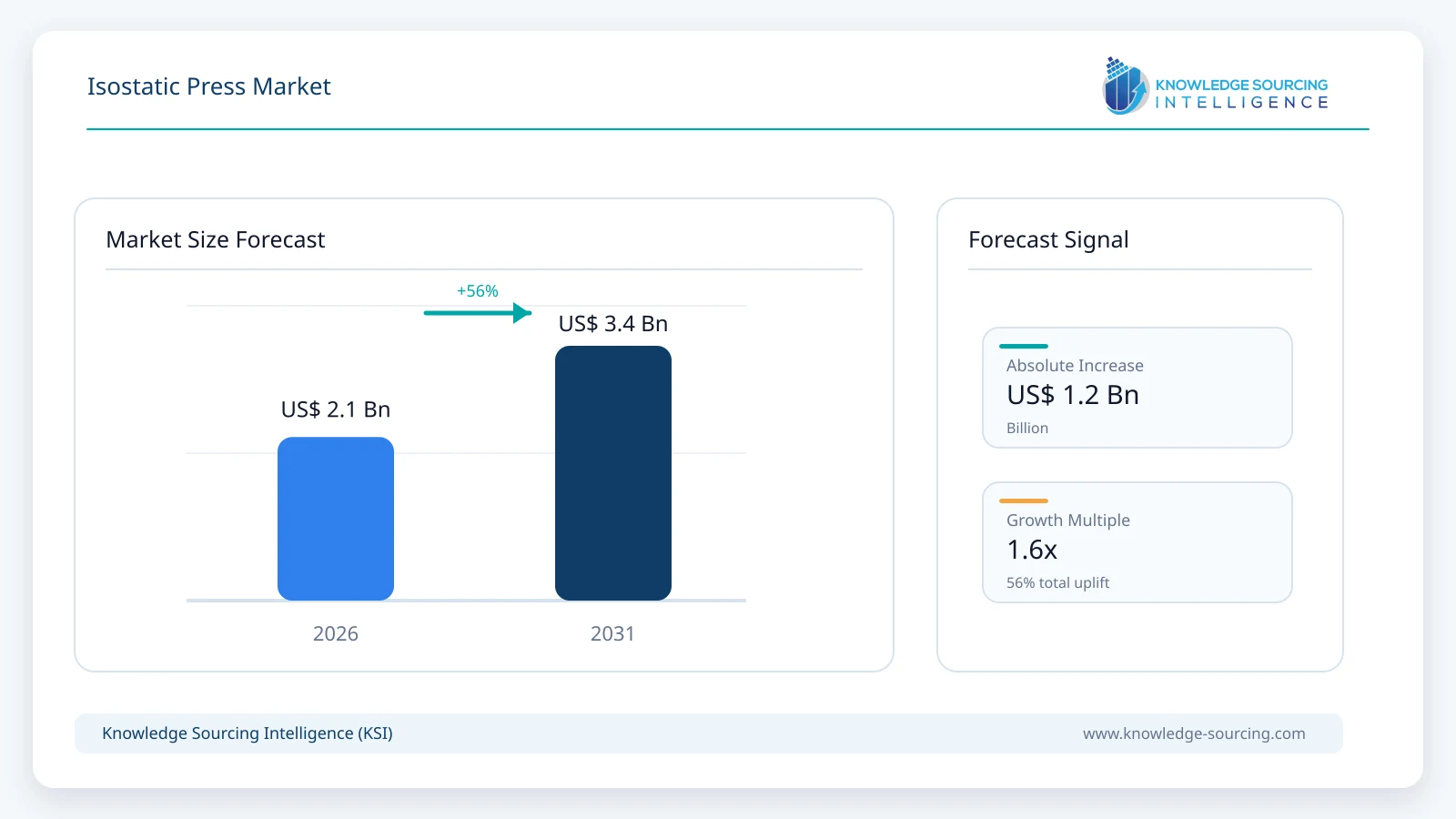
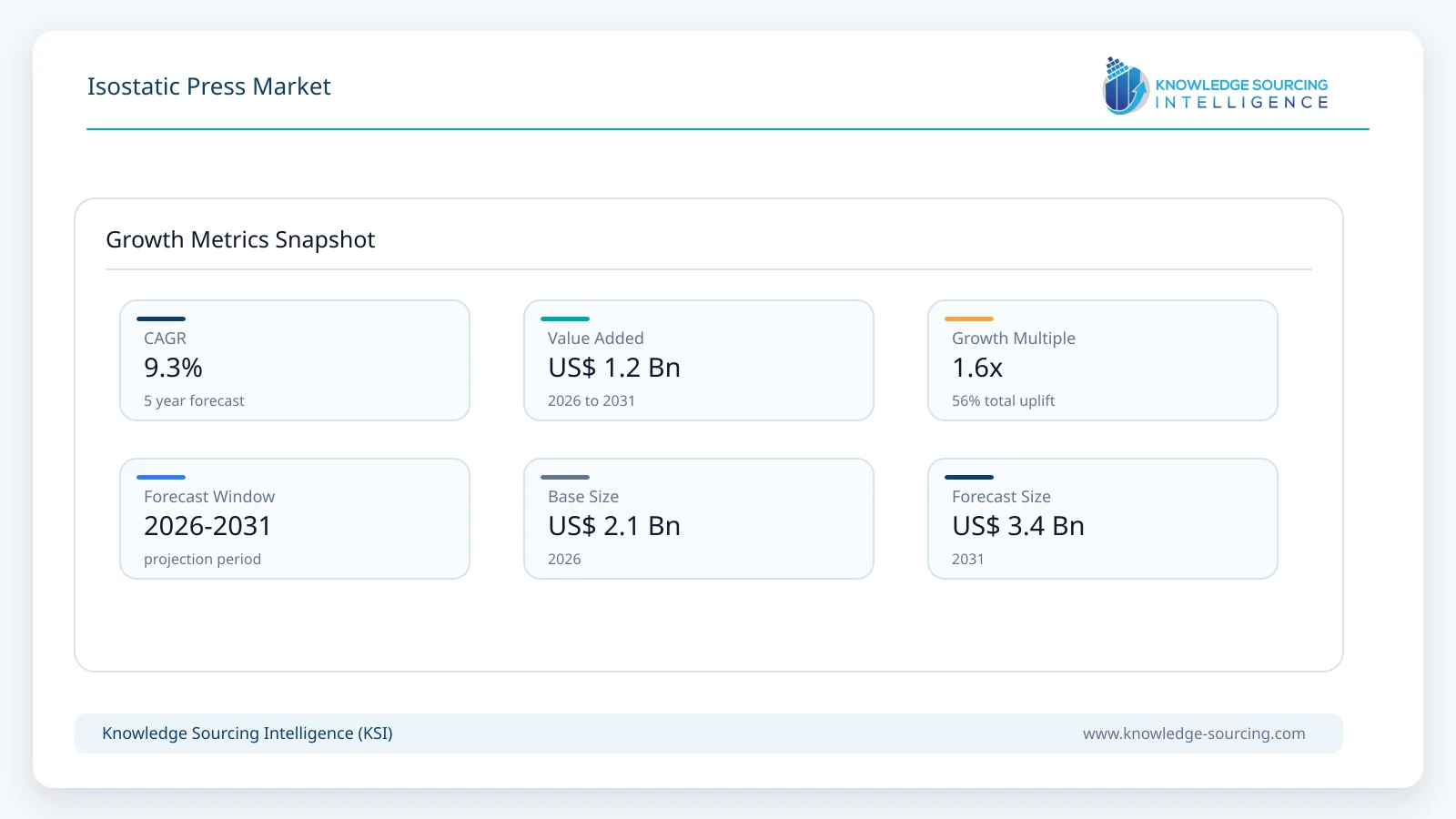
The global isostatic press market is estimated at USD 2.15 billion in 2026 and is forecast to reach approximately USD 3.35 billion in 2031, representing a CAGR of 9.3% across the forecast period.
Highlights:
- 1Hot isostatic pressing (HIP) accounts for approximately 63% of 2026 market revenue because aerospace, medical, energy and additive-manufacturing parts carry much higher processing value than conventional powder compaction.
- 2Commercial processing and tolling services represent approximately 55% of 2026 revenue, reflecting the high capital cost and specialist operating requirements of large HIP systems.
- 3Aerospace and defense applications account for approximately 34% of 2026 revenue and remain the largest end-use segment.
- 4North America represents approximately 36% of 2026 revenue, supported by aerospace, defense, medical-device and metal-additive-manufacturing demand.
- 5Growth is being driven by additive-manufacturing qualification, turbine and rocket components, medical implants, PM-HIP near-net-shape production and high-density ceramic/electronic materials.
The revised estimate is materially below broad figures that mix the value of finished components, food HPP systems, or adjacent heat-treatment revenue into the same market. The installed-base evidence supports a specialized capital-equipment and process-services industry rather than a near-USD 10 billion standalone equipment market. American Isostatic Presses reports more than 1,000 installations over three decades, Nikkiso reports thousands of CIP vessel deliveries over more than 40 years, and Bodycote operates more than 50 HIP vessels in the world’s largest commercial HIP network. These data points are consistent with a low-single-digit-billion-dollar global market when equipment and commercial processing are combined, but not with a USD 9-10 billion equipment-only market.
The non-uniform forecast reflects a gradual acceleration as new aerospace and defense production programs, metal additive manufacturing, and capacity investments move from qualification into recurring production. Growth is moderated by the long service life of pressure vessels, high project lead times, stringent safety certification and the tendency of smaller manufacturers to outsource rather than buy equipment.
Isostatic Press Market Trends
HIP Moves Deeper into Metal Additive Manufacturing
HIP is increasingly treated as a production step rather than a repair process for high-value metal AM parts. Quintus continues to position HIP and integrated high-pressure heat treatment for aerospace, medical, rocket and industrial applications, while service providers are expanding capacity around recurring AM qualification work. The shift raises utilization of existing vessels and supports purchases of medium and large production systems with rapid cooling and integrated heat-treatment capability.
Toll Processing Gains Share
Large HIP systems require pressure-vessel expertise, inert-gas infrastructure, safety systems and substantial capital expenditure. That economics favors commercial tolling for customers with irregular loads or qualification-stage volumes. Bodycote operates more than 50 HIP vessels globally, and newer capacity additions from Wallwork, Paulo, Aalberts and regional specialists are expanding outsourced processing availability.
Warm Isostatic Pressing Broadens the Addressable Market
WIP is gaining relevance in multilayer ceramic devices, electronics packaging and emerging solid-state battery manufacturing. Nikkiso and EPSI both market warm isostatic systems for controlled temperature and pressure processing. These applications broaden isostatic pressing beyond traditional powder metallurgy and casting densification.
Large Vessels Remain a Bottleneck
The market is constrained by the engineering complexity of very large pressure vessels and furnaces. Large-part aerospace, energy and PM-HIP projects require substantial chamber dimensions, high uniformity and stringent code compliance. This creates long lead times and favors established suppliers with pressure-vessel design records, service networks and certification capability.
Isostatic Press Market Segment Analysis
By Process Type
Hot Isostatic Pressing
HIP is estimated at approximately USD 1.35 billion in 2026, or 63% of the market. Its revenue intensity is higher than CIP because large HIP systems are more expensive and because commercial service providers monetize repeated processing cycles. Aerospace engine parts, structural castings, medical implants, superalloys, additive-manufactured components and PM-HIP near-net-shape parts account for a large share of HIP demand. CIP remains important in ceramics, refractory materials, hard metals and powder compaction, while WIP is expanding in electronics and battery-related applications.
By Offering
Processing Services
Commercial processing and tolling services are estimated at approximately USD 1.18 billion in 2026, or 55% of market revenue. The segment benefits from outsourcing by component manufacturers that cannot justify owning a high-pressure vessel or need access to larger chambers, validated cycles and aerospace/medical quality systems. Equipment, upgrades, controls and aftermarket support account for the remaining 45%.
By End User
Aerospace and Defense
Aerospace and defense is estimated at approximately USD 0.73 billion in 2026, representing 34% of market revenue. HIP is used to densify turbine components, castings, structural parts, rocket hardware and additive-manufactured metal components where fatigue performance and defect control are critical. The segment also supports higher margins because customers require validated processes, traceability and tightly controlled thermal-pressure cycles.
By Geography
North America
North America is estimated at approximately USD 0.77 billion in 2026, or 36% of the market. The region combines large aerospace and defense production, medical-device manufacturing, metal additive manufacturing and a broad commercial heat-treatment base.
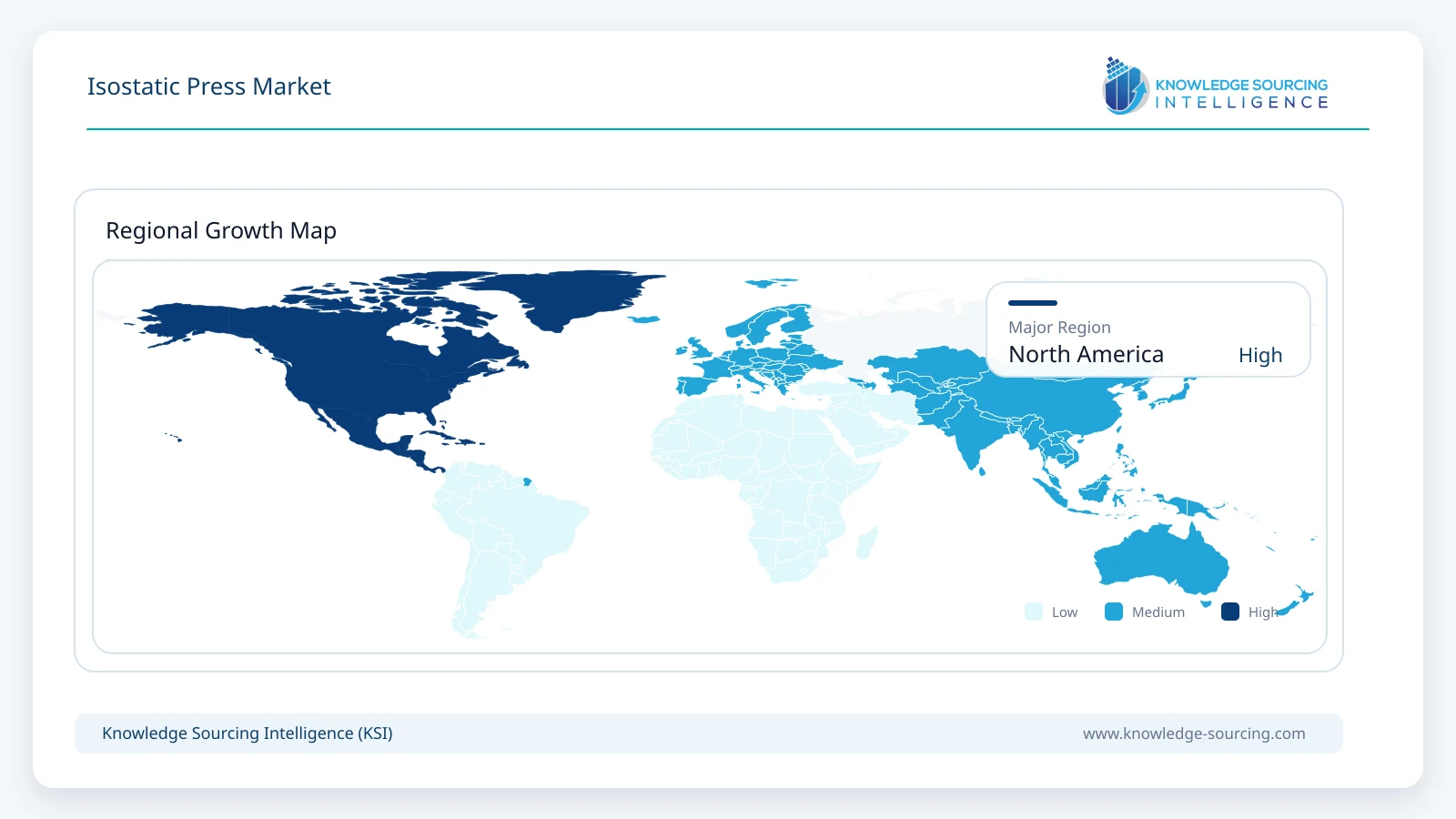
Europe follows closely because of aerospace, industrial gas turbine and advanced engineering demand, while Asia Pacific has a strong equipment and ceramics/electronics manufacturing base led by Japan and China.
Market Drivers
Qualification of additively manufactured metal parts for aerospace, defense, medical and energy applications.
Higher use of titanium, nickel superalloys and complex castings that benefit from porosity elimination.
Expansion of PM-HIP near-net-shape manufacturing for large, high-value components.
Growth in advanced ceramics, hard metals, electronic substrates and battery-material compaction.
Outsourcing of HIP capacity by manufacturers seeking to avoid major capital expenditure.
Market Restraints
Long equipment replacement cycles and limited annual unit volumes.
High capital cost, site preparation, inert-gas requirements and pressure-vessel certification.
Lengthy qualification cycles in aerospace, defense and medical applications.
Energy intensity and maintenance requirements for large high-temperature vessels.
Potential substitution by improved casting, forging or AM process control in applications where HIP is not mandatory.
Competitive Environment
The market combines a concentrated group of specialist equipment manufacturers with a fragmented service layer. Kobe Steel and its Quintus Technologies subsidiary form the most visible global equipment group, while American Isostatic Presses, EPSI and Nikkiso maintain differentiated HIP, CIP and WIP offerings. Competition centers on vessel size, pressure/temperature envelope, rapid cooling, automation, energy efficiency, cycle time and after-sales support.
On the service side, Bodycote has the largest global HIP network, while Wallwork, Paulo, Aalberts and regional heat-treatment specialists are adding capacity near aerospace, medical and additive-manufacturing clusters. The service model becomes increasingly attractive as customers seek validated capacity without carrying the fixed cost of a press.
Recent Developments
September 2026: Wallwork stated that its second Quintus HIP system, commissioned in late 2025, had doubled capacity at its Manchester HIP Centre; the broader HIP investment totals about GBP 20 million.
2026: Quintus continued to expand its HIP/HPHT positioning for metal additive manufacturing, including training and application work with the EOS Additive Mind Academy.
2025: Bodycote reported a strong HIP Product Fabrication order book, including a roughly USD 10 million defense contract, underscoring demand for qualified PM-HIP and related processing.
2025-2026: Nikkiso continued marketing CIP and warm isostatic laminator systems for ceramics, electronics and battery-related applications, indicating broader non-HIP growth opportunities.
Market Outlook
The market is expected to remain structurally attractive because isostatic pressing solves defect and density problems that become more important as component value rises. HIP should outgrow conventional CIP, while WIP gains from electronics and battery-related applications. Services are likely to retain a slight majority of market revenue as manufacturers favor outsourced capacity for large or irregular loads. The strongest demand should remain concentrated around aerospace, defense, medical implants, industrial gas turbines, advanced ceramics and metal additive manufacturing.
Isostatic Press Market Scope:
| Report Metric | Details |
|---|---|
| Total Market Size in 2026 | USD 2.15 billion |
| Total Market Size in 2031 | 3.35 billion |
| Forecast Unit | Billion |
| Growth Rate | 9.3% |
| Study Period | 2021 to 2031 |
| Historical Data | 2021 to 2024 |
| Base Year | 2025 |
| Forecast Period | 2026 – 2031 |
| Segmentation | Process Type, Offering, End-User, Geography |
| Companies |
|
Market Segmentation
By Process Type
Hot Isostatic Pressing
Cold Isostatic Pressing
Warm Isostatic Pressing
By Offering
Equipment and Systems
Processing and Tolling Services
Aftermarket and Upgrades
By End User
Aerospace and Defense
Medical
Energy and Power
Automotive and Industrial
Electronics, Ceramics and Batteries
Others
By Geography
North America
South America
Europe
Middle East and Africa
Asia Pacific
Table of Contents
1. INTRODUCTION
1.1. Market Overview
1.2. Market Definition and Scope
1.3. Currency and Assumptions
2. RESEARCH METHODOLOGY
2.1. Secondary Research
2.2. Primary Validation
2.3. Market Estimation and Triangulation
3. EXECUTIVE SUMMARY
3.1. Key Findings
3.2. Global Market Size, 2026-2031
4. MARKET DYNAMICS
4.1. Drivers
4.2. Restraints
4.3. Opportunities
5. ISOSTATIC PRESS MARKET BY PROCESS TYPE
5.1. Hot Isostatic Pressing
5.2. Cold Isostatic Pressing
5.3. Warm Isostatic Pressing
6. ISOSTATIC PRESS MARKET BY OFFERING
6.1. Equipment and Systems
6.2. Processing and Tolling Services
6.3. Aftermarket and Upgrades
7. ISOSTATIC PRESS MARKET BY END USER
7.1. Aerospace and Defense
7.2. Medical
7.3. Energy and Power
7.4. Automotive and Industrial
7.5. Electronics, Ceramics and Batteries
7.6. Others
8. ISOSTATIC PRESS MARKET BY GEOGRAPHY
8.1. North America
8.2. South America
8.3. Europe
8.4. Middle East and Africa
8.5. Asia Pacific
9. COMPETITIVE ENVIRONMENT AND ANALYSIS
9.1. Equipment Supplier Positioning
9.2. Service Provider Capacity
9.3. Recent Developments
10. COMPANY PROFILES
10.1. Kobe Steel / Quintus Technologies
10.2. American Isostatic Presses, Inc.
10.3. EPSI
10.4. Nikkiso Co., Ltd.
10.5. Bodycote plc
10.6. Wallwork Group
10.7. Paulo
10.8. Aalberts Surface Technologies
10.9. Stack Metallurgical Group
10.10. Lake City Heat Treating
11. APPENDIX
11.1. Assumptions
11.2. Abbreviations
Navigate
Trusted by the world's leading organizations











