
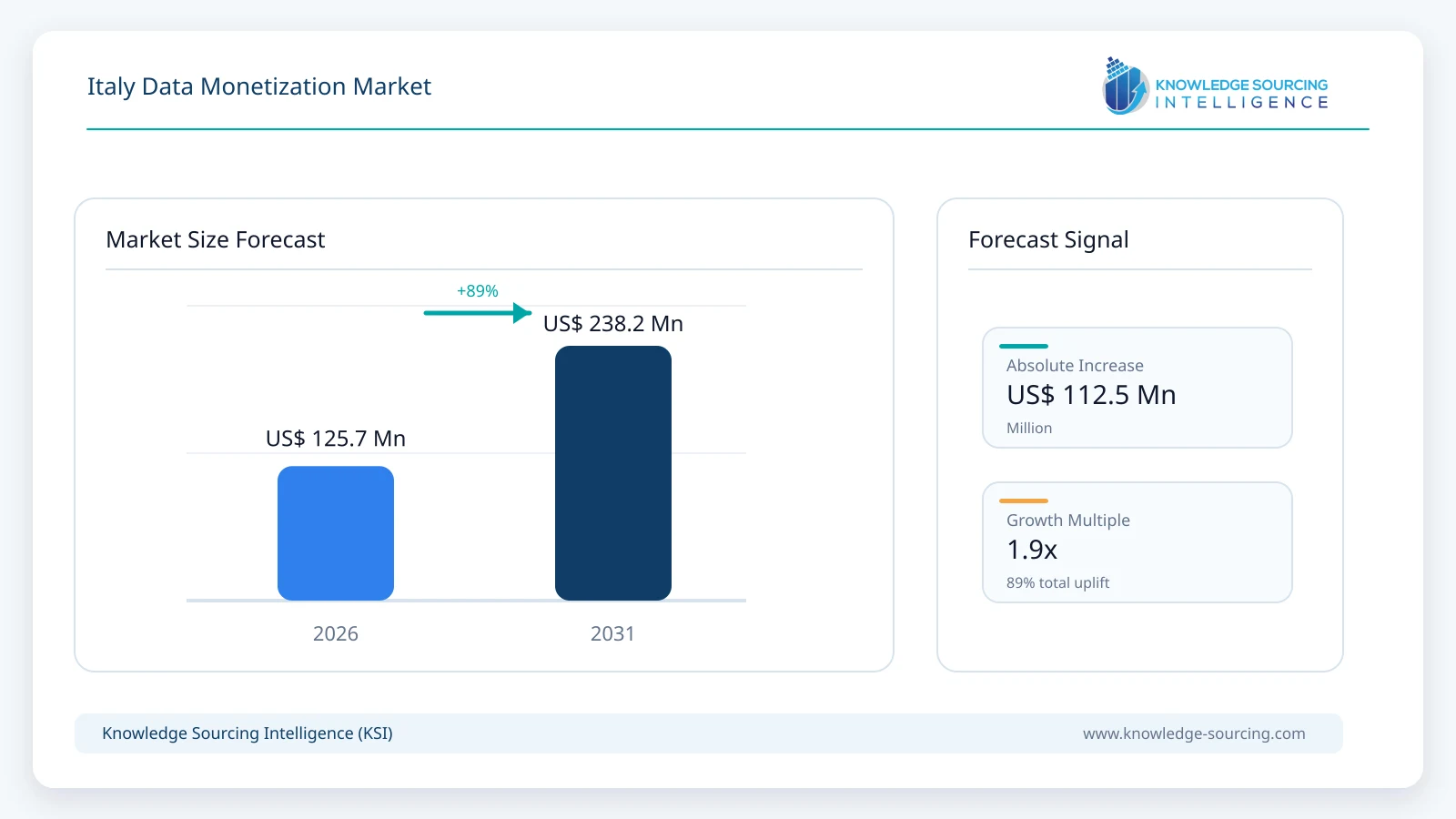
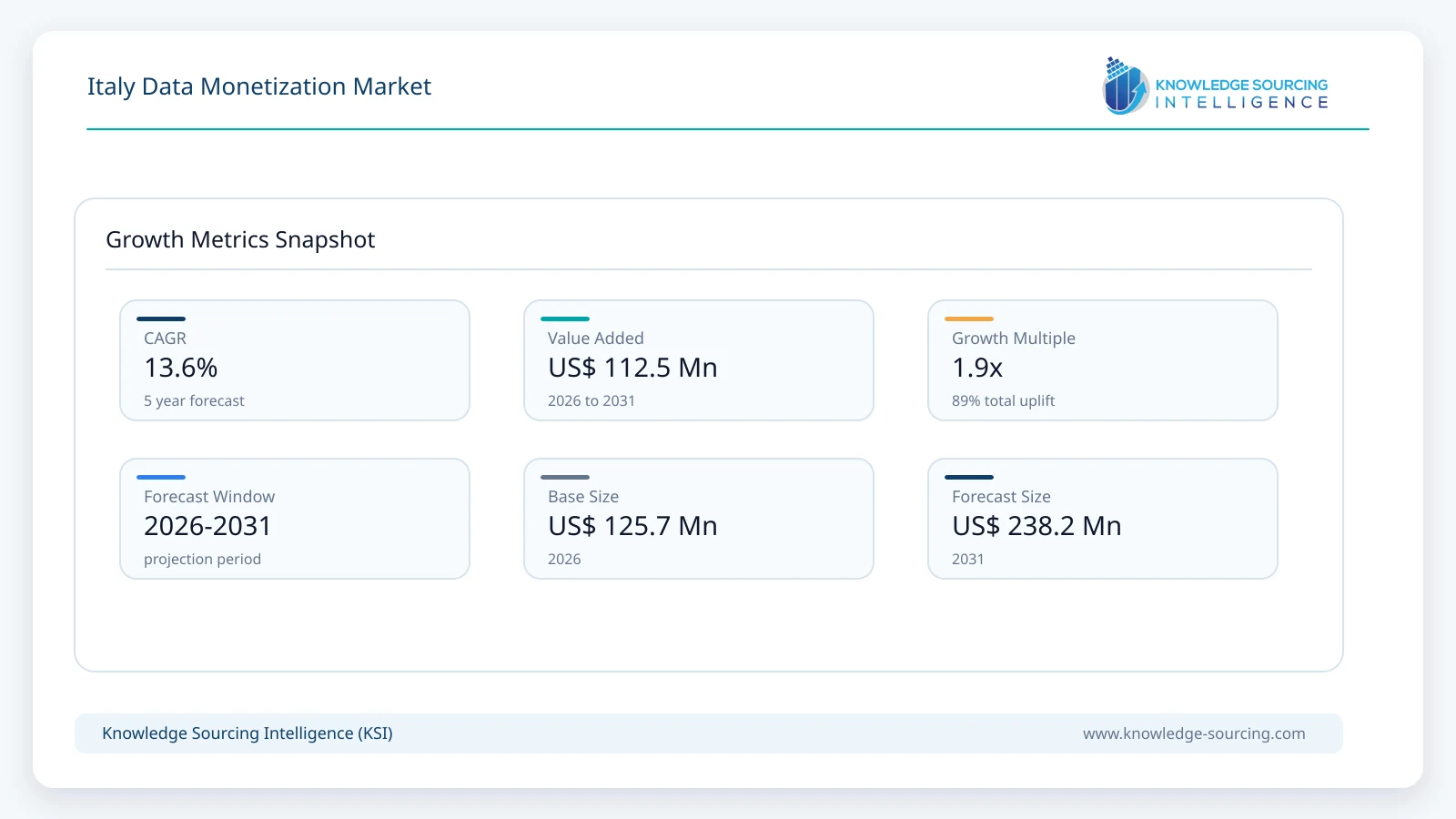
The Italian data monetization is forecast to grow at a CAGR of 13.6%, reaching USD 238.2 million in 2031 from USD 125.7 million in 2026.
Highlights:
- 1Enterprise data assets are increasingly treated as revenue-generating business resources.
- 2Cloud migration programs are expanding the volume of monetizable enterprise data.
- 3Manufacturing, BFSI, and retail sectors account for the strongest commercial demand.
- 4Regulatory requirements are increasing investment in governance, security, and data quality.
- 5Large enterprises remain the primary adopters due to data scale and integration capabilities.
- 6Public-sector digitalization initiatives are strengthening the broader data ecosystem.
Demand conditions are being shaped by Italy's broader digital transformation agenda. The European Commission reports that Italy's National Recovery and Resilience Plan (PNRR) allocates substantial funding toward digital infrastructure, public-sector digitalization, Industry 4.0 adoption, connectivity, and cloud modernization initiatives. These programs are expanding the volume, quality, and accessibility of digital information generated across both public and private sectors, creating conditions that support commercial data utilization. According to the European Commission, more than one-quarter of Italy's recovery plan resources support digital objectives, including digitalization of public administration, broadband expansion, and innovation investments for industrial modernization.
Commercial value creation in this market is increasingly linked to the ability of enterprises to convert fragmented operational information into actionable intelligence. Italian organizations historically maintained data across isolated business systems, limiting visibility across supply chains, customer interactions, production environments, and financial operations. The growing adoption of cloud architectures, advanced analytics, artificial intelligence, and application programming interfaces (APIs) is enabling organizations to integrate previously disconnected datasets and develop monetization strategies that extend beyond conventional reporting functions.
Buyer priorities are evolving accordingly. Procurement decisions are increasingly driven by data governance capabilities, interoperability, regulatory compliance, cybersecurity controls, scalability, and integration with existing enterprise software environments. Organizations are placing less emphasis on standalone analytics tools and greater emphasis on platforms capable of supporting enterprise-wide data commercialization initiatives. As a result, technology providers are increasingly positioning data monetization offerings as part of broader digital transformation, cloud, and artificial intelligence programs rather than isolated software deployments.
The distribution of value within the market extends beyond software providers. Consulting firms, cloud infrastructure vendors, system integrators, cybersecurity specialists, managed service providers, and data governance solution providers are capturing increasing shares of enterprise spending. Organizations often require extensive integration, data quality improvement, governance design, compliance implementation, and workforce training before monetization initiatives can generate measurable returns.
Key Market Indicators
Indicator | Latest Evidence | Commercial Meaning |
Digital transition funding under Italy's recovery plan | €13.4 billion allocated to digital transition and innovation of the production system | Expands enterprise data generation and analytics investment. |
Public administration digitalization funding | €6.1 billion | Increases demand for secure data platforms and governance solutions. |
Connectivity investment | €5.3 billion | Supports broader digital ecosystem participation and cloud adoption. |
Public administration cloud target | 75% of public administrations using cloud services by 2026 | Expands data availability and cloud-based monetization opportunities. |
Broadband target | 100% high-speed broadband coverage for enterprises and households by 2026 | Supports wider digital service and data-driven business models. |
Enterprise AI utilization | 8% of Italian enterprises reported AI use in 2024 | Indicates substantial untapped potential for advanced data monetization. |
Sources: European Commission, Department for Digital Transformation, ISTAT.
Market Drivers
Expansion of cloud-based enterprise architectures.
Cloud infrastructure is becoming a foundational requirement for scalable data monetization. Italy's Cloud Strategy promotes secure cloud adoption, standardized data management, and migration of public-sector workloads to cloud environments. The strategy includes the National Strategic Hub and cloud qualification mechanisms designed to improve data accessibility, resilience, and governance. As organizations migrate workloads from legacy systems to cloud environments, the ability to aggregate, analyze, share, and commercialize data improves considerably.
Technology providers are responding by integrating analytics, artificial intelligence, governance, and monetization capabilities into cloud-native platforms. This trend is expected to strengthen throughout the forecast period as organizations seek greater operational flexibility and lower infrastructure complexity.
Industry 4.0 investments across manufacturing and industrial sectors.
Italy maintains one of Europe's largest manufacturing bases, with strong concentrations in machinery, automotive, industrial equipment, and specialized production systems. Recovery-plan investments supporting Industry 4.0 technologies are encouraging the adoption of connected machinery, industrial IoT systems, predictive maintenance platforms, and digital production environments. These deployments generate large volumes of operational data that can be monetized through efficiency improvements, service offerings, and supply-chain optimization.
Manufacturers increasingly view production data as a commercial asset rather than an operational by-product. Demand is therefore shifting toward platforms capable of integrating factory, logistics, procurement, and customer information into unified analytical environments.
Growing emphasis on artificial intelligence deployment.
Although AI adoption remains relatively low in Italy compared with several European peers, recent government and enterprise initiatives indicate increasing investment in AI-enabled business processes. AI systems require high-quality, governed, and accessible data to produce commercial outcomes. As organizations expand AI initiatives, investment in data monetization platforms becomes increasingly necessary because the economic value of AI depends heavily on underlying data quality and availability.
Digitalization of public administration and public services.
Italy's digital transformation strategy seeks wider use of digital identity systems, cloud services, online public services, and interoperable government platforms. These initiatives increase the availability of structured public-sector information while creating demand for governance, analytics, and secure data-sharing frameworks. The resulting ecosystem improvements support broader commercial adoption of data-driven business models across private-sector organizations.
Market Restraints and Challenges
Persistent digital skills shortages.
Digital skills remain a structural challenge across the Italian economy. ISTAT data shows that basic digital competency levels remain below European targets, limiting the ability of organizations to scale advanced analytics and data monetization initiatives. The shortage affects data engineering, governance, analytics, artificial intelligence, and cybersecurity functions. Organizations frequently report difficulties recruiting specialized talent required for large-scale data transformation programs.
Fragmented enterprise data environments.
Many Italian organizations continue to operate legacy technology infrastructures developed through years of acquisitions, departmental investments, and standalone software deployments. Data often resides across disconnected operational systems, increasing integration costs and extending implementation timelines. The challenge is particularly visible among mid-sized enterprises that lack the resources of larger organizations.
Regulatory and compliance complexity.
Data monetization strategies must comply with European and Italian requirements governing privacy, data sovereignty, cybersecurity, cross-border transfers, and sector-specific controls. Organizations seeking to commercialize customer or operational data must invest heavily in governance, consent management, data lineage, and audit capabilities. These requirements increase implementation costs and lengthen project approval cycles.
Uneven digital maturity across enterprise segments.
Large organizations generally possess the resources necessary to deploy advanced data platforms, whereas many small and medium-sized enterprises remain focused on basic digitalization priorities. Academic and industry research continues to identify a measurable digital divide between large enterprises and SMEs in Italy, affecting the pace at which advanced monetization models can be adopted.
Major Segment Analysis
Cloud Deployment Model
The cloud segment represents the most commercially important deployment category within Italy's data monetization market because it directly addresses several requirements that underpin successful monetization initiatives: scalability, data accessibility, computational capacity, integration flexibility, and cost efficiency.
Cloud environments enable organizations to aggregate information from multiple business functions while supporting advanced analytics, machine learning, and data-sharing ecosystems. The Italian government's cloud strategy and public-sector migration initiatives are reinforcing confidence in cloud-based operating models while encouraging broader adoption of secure cloud infrastructure. Organizations pursuing monetization strategies increasingly require environments capable of processing growing data volumes without extensive capital investment in on-premises infrastructure.
Demand is particularly strong among large enterprises in manufacturing, banking, retail, and telecommunications sectors, where multiple data sources must be integrated into unified analytical environments. Purchasing decisions are heavily influenced by security certifications, data sovereignty requirements, interoperability, and integration with existing enterprise systems. These considerations favor vendors capable of combining cloud infrastructure with governance, cybersecurity, analytics, and consulting capabilities.
Competitive Landscape
The Italian data monetization market exhibits characteristics of a technology-led and service-intensive competitive environment. Competition extends beyond software functionality and increasingly depends on integration capability, cloud expertise, governance frameworks, cybersecurity credentials, industry specialization, and consulting support.
SAP and IBM maintain strong positions among large enterprises due to their extensive enterprise software footprints and ability to integrate monetization capabilities with broader business-process platforms. Google competes through cloud infrastructure, artificial intelligence, analytics services, and scalable data management environments.
Accenture and Infosys frequently compete through consulting-led engagements that combine strategy, implementation, governance, and managed services. Their ability to support enterprise-wide transformation programs often differentiates them from software-focused competitors.
Thales and Cisco strengthen their positions through cybersecurity, secure data management, networking, and compliance-oriented capabilities. As regulatory requirements become increasingly important, security and governance functions are becoming more closely linked with monetization initiatives.
Barriers to entry remain relatively high because successful deployments require expertise across analytics, cloud infrastructure, governance, integration, cybersecurity, and regulatory compliance. Customer switching costs can also increase once data architectures become embedded within enterprise operations.
Recent Developments
April 2026: Italian research network GARR and Cubbit launched Italy’s first federated geo-distributed storage network. The platform enables secure data sharing, sovereignty, and value creation from distributed research datasets, supporting advanced data monetization opportunities.
March 2026: Onetag acquired Italian ad-tech company Aryel, combining immersive advertising technology with AI-driven data intelligence. The acquisition enhances audience monetization, programmatic advertising effectiveness, and data-driven value exchange across digital ecosystems.
January 2026: digitalAudience acquired Rayn.io, an AI-native audience intelligence platform. The deal strengthened privacy-compliant data collaboration, identity resolution, and real-time audience analytics, expanding monetization capabilities for European publishers and advertisers.
December 2025: Dedagroup acquired an initial 39% stake in Istella, an Italian AI and data-analysis specialist. The transaction expanded advanced analytics capabilities, helping enterprises monetize proprietary datasets through AI-driven business applications.
Regulatory and Policy Environment
The regulatory environment is shaped primarily by European Union data governance, privacy, cybersecurity, and digital-market frameworks, together with national digital transformation initiatives. Italy's cloud strategy places strong emphasis on sovereignty, security, certification, and classification of public-sector data. These requirements influence procurement decisions and technology architecture across both public and private organizations.
Italia Digitale 2026 further supports digital infrastructure development, cloud migration, online public services, and digital skills programs. These initiatives create conditions that encourage wider adoption of data-driven business models while simultaneously increasing compliance expectations.
Outlook and Strategic Implications
The Italian data monetization market is expected to develop alongside broader investments in cloud infrastructure, industrial digitalization, artificial intelligence, and public-sector modernization. Revenue opportunities are likely to concentrate among vendors capable of combining analytics, governance, security, cloud infrastructure, and implementation services into integrated offerings.
Several factors will determine market performance between 2026 and 2031:
Enterprise success in improving data quality and governance.
Progress in cloud migration and legacy-system modernization.
Availability of digital and analytical talent.
Adoption of AI-driven business processes.
Regulatory developments affecting data use and sovereignty.
Continued execution of national digital transformation programs.
Organizations that treat data as a managed business asset rather than a by-product of operations are likely to capture greater economic value from analytics, automation, customer intelligence, and ecosystem partnerships during the forecast period.
Italy Data Monetization Market Scope:
| Report Metric | Details |
|---|---|
| Total Market Size in 2026 | USD 125.7 million |
| Total Market Size in 2031 | USD 238.2 million |
| Forecast Unit | Million |
| Growth Rate | 13.6% |
| Study Period | 2021 to 2031 |
| Historical Data | 2021 to 2024 |
| Base Year | 2025 |
| Forecast Period | 2026 – 2031 |
| Segmentation | Offering, Deployment Model, Enterprise Size, End-User Industry |
| Companies |
|
Market Segmentation
By Offering
- Solution
- Services
By Deployment Model
- On-Premises
- Cloud
By Enterprise Size
- Small
- Medium
- Large
By End-User Industry
- Retail
- Manufacturing
- Automotive
- BFSI
- Media and Entertainment
- Others
Table of Contents
1. INTRODUCTION
1.1. Market Overview
1.3. Market Definition
1.4. Market Segmentation
2. RESEARCH METHODOLOGY
2.1. Research Data
2.2. Assumptions
3. EXECUTIVE SUMMARY
3.1. Research Highlights
4. MARKET DYNAMICS
4.1. Market Drivers
4.2. Market Restraints
4.3. Porter’s Five Forces Analysis
4.3.1. Bargaining Power of Suppliers
4.3.2. Bargaining Power of Buyers
4.3.3. Threat of Substitutes
4.3.4. The Threat of New Entrants
4.3.5. Competitive Rivalry in Industry
4.4. Industry Value Chain Analysis
5. ITALY DATA MONETIZATION MARKET BY OFFERING
5.1. Introduction
5.2. Solution
5.3. Services
6. ITALY DATA MONETIZATION MARKET BY DEPLOYMENT MODEL
6.1. Introduction
6.2. On-Premises
6.3. Cloud
7. ITALY DATA MONETIZATION MARKET BY ENTERPRISE SIZE
7.1. Introduction
7.2. Small
7.3. Medium
7.4. Large
8. ITALY DATA MONETIZATION MARKET BY END-USER INDUSTRY
8.1. Introduction
8.2. Retail
8.3. Manufacturing
8.4. Automotive
8.5. BFSI
8.6. Media and Entertainment
8.7. Others
9. COMPETITIVE ENVIRONMENT AND ANALYSIS
9.1. Major Players and Strategy Analysis
9.2. Emerging Players and Market Lucrativeness
9.3. Mergers, Acquisitions, Agreements, and Collaborations
9.4. Vendor Competitiveness Matrix
10. COMPANY PROFILES
10.1. Accenture
10.2. SAP
10.3. Google
10.4. IBM
10.5. Thales
10.6. Cisco Systems, Inc.
10.7. Infosys Ltd.
Navigate
Trusted by the world's leading organizations











