
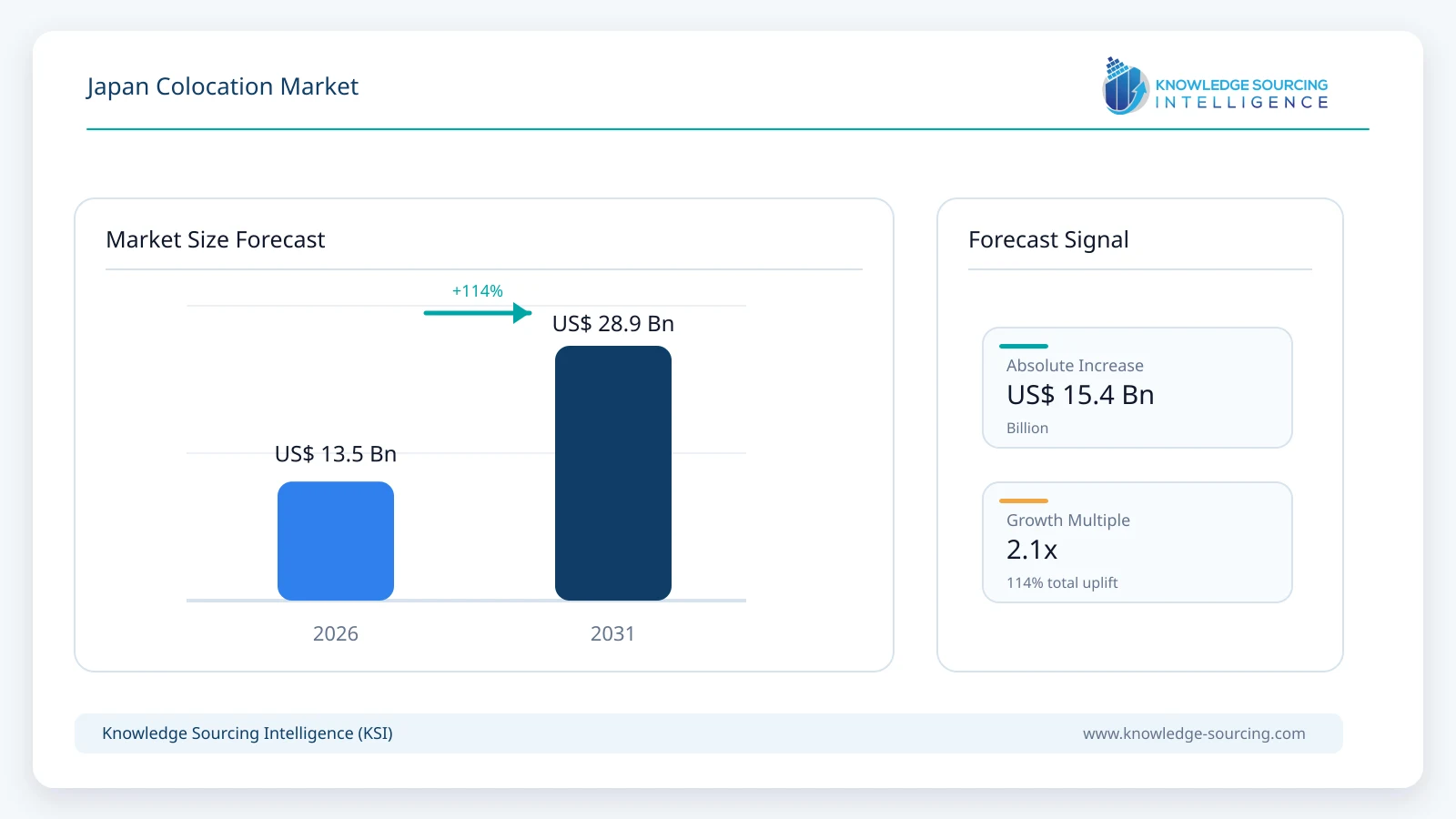
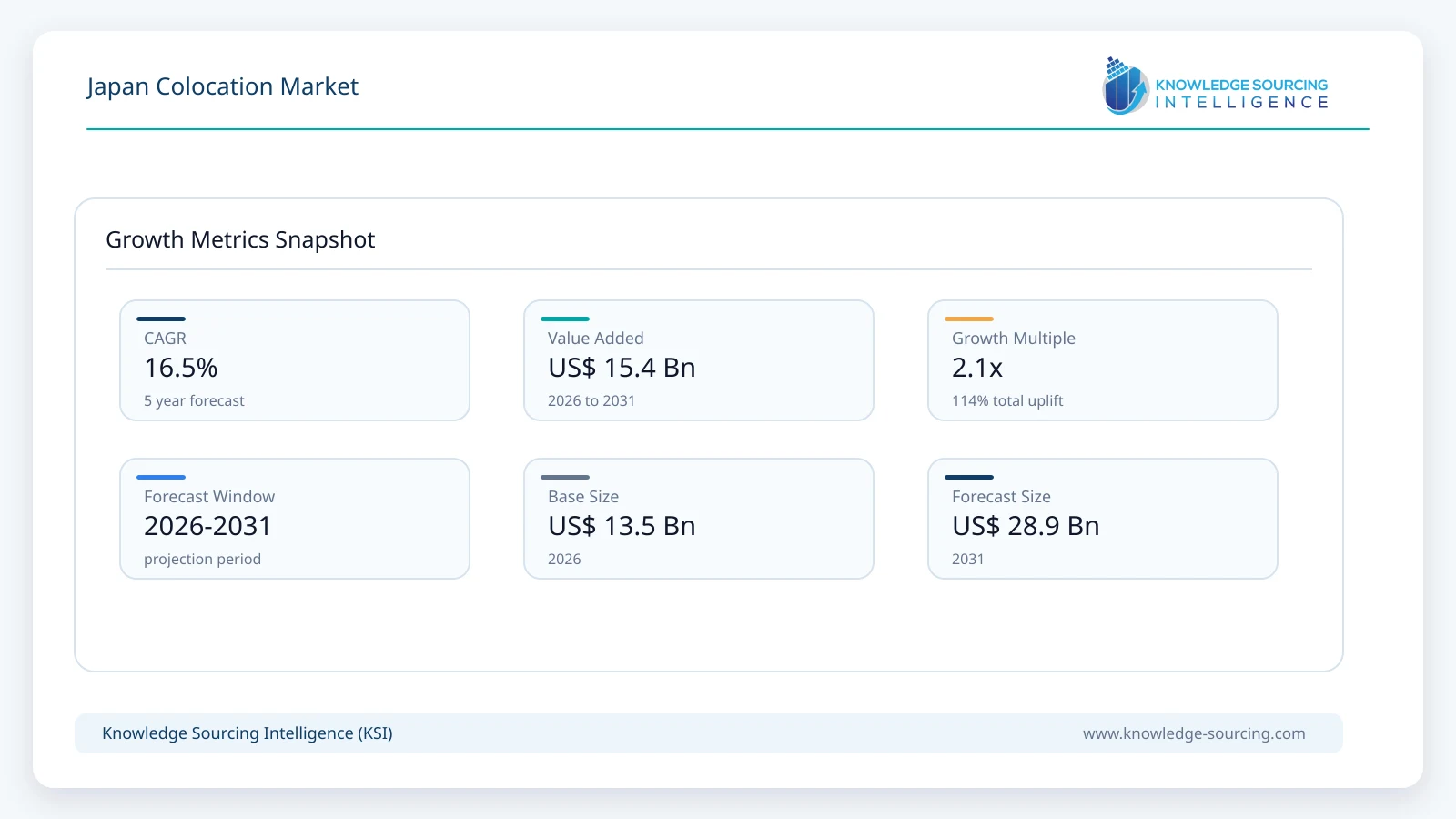
The Japan Colocation market is forecast to grow at a CAGR of 16.5%, reaching USD 28.9 billion in 2031 from USD 13.5 billion in 2026.
Highlights:
- 1Expansion of AI computing and enterprise hybrid IT strategies continues to stimulate demand for carrier-neutral colocation facilities.
- 2Wholesale colocation represents a commercially important segment due to hyperscale cloud expansion and enterprise infrastructure consolidation.
- 3Tokyo and Osaka remain the principal investment destinations because of extensive connectivity ecosystems and enterprise concentration.
- 4Higher rack densities and advanced cooling technologies are influencing procurement requirements across new deployments.
- 5Government policies supporting digital infrastructure, cybersecurity, and energy efficiency shape investment priorities.
- 6Competition increasingly centers on available power capacity, interconnection ecosystems, sustainability initiatives, and operational resilience.
The Japan colocation market comprises third-party data center facilities that provide secure physical space, power, cooling, network connectivity, and operational support for enterprise IT infrastructure. Organizations use colocation services to host servers and networking equipment without owning and operating dedicated data center facilities. The market includes retail colocation for smaller deployments, wholesale colocation for hyperscale and enterprise requirements, and hybrid colocation models that combine dedicated infrastructure with cloud connectivity. Demand extends across banking, telecommunications, manufacturing, healthcare, retail, media, and public sector organizations seeking resilient infrastructure with predictable operating costs.
Japan remains one of Asia's most mature digital infrastructure markets due to its advanced telecommunications ecosystem, high enterprise IT spending, dense urban business clusters, and strong internet penetration. Tokyo and Osaka serve as the primary colocation hubs because they offer extensive fiber connectivity, carrier-neutral ecosystems, proximity to enterprise headquarters, and direct access to domestic and international subsea cable networks. Enterprise buyers increasingly prioritize facilities capable of supporting high-density workloads, low-latency connectivity, and uninterrupted operations for mission-critical applications.
Procurement decisions have shifted beyond rack pricing toward total infrastructure value. Buyers evaluate power availability, renewable energy procurement, disaster resilience, carrier diversity, physical security certifications, operational transparency, and expansion flexibility before selecting colocation providers. Large enterprises frequently negotiate multi-year agreements with scalable capacity options, while small and medium-sized businesses seek modular deployments with integrated managed services that reduce operational complexity.
The expansion of cloud computing has not diminished colocation demand. Instead, enterprise IT architectures increasingly combine public cloud services with colocated infrastructure to balance regulatory compliance, application performance, data sovereignty, and cost management. Financial institutions continue to deploy latency-sensitive systems within carrier-neutral colocation facilities, while manufacturers use interconnected infrastructure to support industrial automation, digital engineering, and production analytics.
Infrastructure investment remains another defining characteristic of the market. Operators continue expanding power capacity, cooling efficiency, and interconnection services to accommodate artificial intelligence (AI), high-performance computing (HPC), and data-intensive enterprise applications. Facilities designed for liquid cooling and higher rack densities are attracting greater interest as computing requirements exceed the capabilities of conventional enterprise server rooms.
The market also benefits from Japan's emphasis on business continuity. Earthquake preparedness, redundant power infrastructure, geographically distributed deployments, and stringent operational standards influence buyer purchasing behavior. Consequently, colocation providers differentiate themselves through facility resilience, operational reliability, and ecosystem connectivity rather than price competition alone.
Market Drivers
Expansion of Hybrid Enterprise Infrastructure
Japanese enterprises increasingly combine on-premises infrastructure with public cloud platforms to optimize workload placement. Mission-critical databases, financial systems, and latency-sensitive applications frequently remain within colocation facilities while customer-facing applications utilize cloud environments. Buyers therefore seek providers offering direct cloud connectivity, flexible capacity expansion, and reliable interconnection services. Operators continue investing in carrier-neutral ecosystems that simplify hybrid infrastructure deployment and improve application performance.
Growing AI and High-Performance Computing Requirements
Artificial intelligence adoption has substantially increased enterprise demand for power-intensive computing environments. AI model training, engineering simulations, and advanced analytics require infrastructure supporting higher rack densities and sophisticated cooling technologies. Organizations often determine that upgrading internal facilities is less economical than deploying workloads within specialized colocation data centers. This trend supports premium pricing for facilities capable of delivering higher electrical capacity and operational reliability.
Business Continuity and Disaster Preparedness
Japan's exposure to earthquakes and other natural hazards makes infrastructure resilience a primary procurement consideration. Enterprises increasingly distribute workloads across multiple geographically separated facilities to reduce operational risk. Colocation providers offering redundant power systems, seismic engineering, continuous monitoring, and comprehensive disaster recovery capabilities benefit from sustained enterprise demand. Long-term service agreements frequently reflect the importance buyers assign to operational continuity rather than solely infrastructure costs.
Continued Growth in Enterprise Digital Services
Financial services, e-commerce, healthcare, manufacturing, and telecommunications continue generating substantial volumes of operational data requiring secure processing and storage. Expanding digital payment systems, connected manufacturing environments, streaming services, and online retail platforms require scalable infrastructure with predictable availability. Colocation providers respond by increasing available power capacity, improving network connectivity, and expanding managed infrastructure services to accommodate evolving enterprise workloads.
Market Restraints and Challenges
Power Availability Constraints
Obtaining sufficient electrical capacity has become a significant challenge, particularly within major metropolitan areas such as Tokyo. Utility limitations can delay new facility commissioning and restrict expansion opportunities for existing campuses. Operators increasingly collaborate with utility providers, improve energy efficiency, and diversify regional development strategies to mitigate capacity constraints.
Rising Construction and Operating Costs
Construction materials, specialized electrical equipment, cooling infrastructure, and skilled labor continue increasing capital expenditure requirements for new facilities. Higher energy costs further influence operating margins. Providers seek long-term customer contracts, improved operational efficiency, and energy optimization technologies to maintain financial performance without reducing service quality.
Sustainability Expectations
Enterprise customers increasingly evaluate environmental performance during procurement. Carbon reduction commitments require operators to improve power usage effectiveness, increase renewable electricity procurement, and adopt efficient cooling technologies. Achieving these objectives often requires substantial investment, particularly for legacy facilities requiring modernization.
Limited Land Availability in Prime Locations
Suitable development sites within major connectivity hubs remain scarce. Competition for strategically located land raises acquisition costs and extends project development timelines. Operators therefore expand into secondary metropolitan locations while strengthening interconnection capabilities to maintain competitive service offerings.
Major Segment Analysis
Wholesale Colocation
Wholesale colocation represents one of the most commercially significant segments because it supports hyperscale cloud providers, telecommunications companies, financial institutions, and multinational enterprises requiring substantial dedicated infrastructure capacity. Customers typically procure large data halls or customized deployment areas under multi-year contractual agreements, allowing operators to generate stable recurring revenue while achieving high infrastructure utilization.
Buyer priorities within this segment extend beyond physical space. Organizations evaluate guaranteed power allocation, network diversity, sustainability performance, future expansion capability, and service-level commitments before finalizing procurement decisions. Dedicated technical support, customizable infrastructure, and flexible expansion options further influence supplier selection.
Competition within wholesale colocation increasingly centers on available electrical capacity, campus scalability, and ecosystem connectivity rather than pricing. Providers capable of delivering higher-density infrastructure for AI and advanced computing workloads secure stronger competitive positioning. Revenue opportunities continue expanding as hyperscale cloud deployment, enterprise infrastructure consolidation, and digital service growth require larger dedicated hosting environments.
Competitive Landscape
The Japan colocation market demonstrates moderate concentration, with competition based primarily on infrastructure quality, operational reliability, connectivity ecosystems, and expansion capability. Providers differentiate themselves through carrier-neutral connectivity, scalable campus development, sustainability initiatives, and advanced cooling technologies supporting higher-density workloads.
Strategic partnerships with cloud providers, telecommunications operators, renewable energy suppliers, and network carriers strengthen competitive positioning by expanding customer ecosystems and improving service integration. Geographic expansion remains focused on Tokyo and Osaka while selected operators pursue additional regional capacity to address power constraints and enterprise resilience requirements.
Technology investment increasingly targets liquid cooling readiness, AI infrastructure support, intelligent facility management, automation, and energy optimization. Competitive differentiation also depends on operational certifications, physical security standards, customer support capabilities, and long-term infrastructure scalability.
The competitive environment includes Equinix Inc., Digital Realty (MC Digital Realty), AT TOKYO Corporation, NTT Communications Corporation, KDDI Corporation, Colt Data Centre Services, IDC Frontier Inc., Fujitsu Limited, Princeton Digital Group, and AirTrunk.
Recent Developments
June 2026: DigitalBridge and Japan Extensive Infrastructure (JEXI) formed Nippon Gateway Infrastructure (NGI), launching a new Japan-focused colocation platform with NEC-acquired data center assets in the Greater Tokyo and Greater Osaka regions.
June 2026: Equinix Japan, NTT East, and Sakura Internet announced plans to begin a 2026 proof-of-concept using IOWN APN to connect Ishikari Data Center and Equinix Tokyo facilities for low-latency, high-capacity AI and distributed computing workloads.
April 2026: AirTrunk announced continued expansion of its Tokyo hyperscale data center capacity to address growing AI and cloud infrastructure requirements. The investment strengthens regional wholesale colocation availability and supports enterprise demand for high-density computing.
October 2025: Digital Realty and Mitsubishi Corporation (MC Digital Realty) expanded data center capacity and cloud connectivity capabilities in Japan. The project enhances enterprise hybrid infrastructure deployment and strengthens carrier-neutral interconnection services.
Regulatory and Policy Environment
Japan's colocation industry operates within a regulatory framework covering cybersecurity, data protection, energy management, construction standards, and telecommunications infrastructure. The Act on the Protection of Personal Information (APPI) establishes obligations regarding personal data management, influencing infrastructure deployment and operational governance for enterprise customers handling sensitive information.
The government's digital policy initiatives encourage modernization of public services and enterprise information systems, indirectly supporting demand for resilient colocation infrastructure. Standards relating to information security management, operational continuity, and facility resilience influence procurement requirements across regulated industries, particularly banking, healthcare, and government organizations.
Energy efficiency policies continue shaping infrastructure investment decisions. Operators increasingly adopt efficient cooling technologies, renewable electricity procurement, intelligent energy management systems, and environmental reporting practices to satisfy enterprise sustainability requirements and national decarbonization objectives.
Compliance with internationally recognized operational and information security standards further strengthens customer confidence, particularly among multinational organizations seeking consistent governance across global infrastructure portfolios.
Outlook and Strategic Implications
Over the next five years, enterprise infrastructure investment in Japan is expected to emphasize scalable power capacity, AI-ready facilities, sustainability performance, and resilient network ecosystems. Procurement strategies will increasingly favor providers capable of supporting hybrid architectures through integrated cloud connectivity and flexible expansion options.
Wholesale deployments are expected to account for a substantial share of new infrastructure investment as hyperscale cloud providers and large enterprises continue consolidating computing resources. High-density cooling technologies, intelligent facility automation, and renewable energy procurement will become important competitive differentiators as operational efficiency gains greater commercial importance.
Power availability, construction costs, and sustainability compliance will remain principal risks affecting project economics. Providers capable of securing reliable utility access, optimizing energy consumption, and developing geographically diversified campuses will strengthen long-term competitive positioning.
For enterprise customers, supplier selection will increasingly prioritize resilience, operational transparency, scalability, ecosystem connectivity, and environmental performance. As AI workloads, industrial digitization, and hybrid IT architectures continue expanding, colocation facilities will remain a central component of Japan's digital infrastructure strategy and enterprise technology investment planning.
Japan Colocation market Scope
| Report Metric | Details |
|---|---|
| Total Market Size in 2026 | USD 13.5 billion |
| Total Market Size in 2031 | USD 28.9 billion |
| Forecast Unit | Billion |
| Growth Rate | 16.5% |
| Study Period | 2021 to 2031 |
| Historical Data | 2021 to 2024 |
| Base Year | 2025 |
| Forecast Period | 2026 – 2031 |
| Segmentation | Type, Enterprise Size, Industry Vertical |
| Companies |
|
Market Segmentation
By Type
- Retail Colocation
- Wholesale Colocation
- Hybrid Colocation
By Enterprise Size
- Small Enterprises
- Medium Enterprises
- Large Enterprises
By Industry Vertical
- BFSI
- IT & Telecommunications
- Healthcare
- Government
- Manufacturing
- Retail & E-Commerce
- Media and Entertainment
- Others
Table of Contents
1. INTRODUCTION
1.1. Market Overview
1.2. Market Definition
1.3. Scope of the Study
1.4. Market Segmentation
1.5. Currency
1.6. Assumptions
1.7. Base and Forecast Years Timeline
1.8. Key Benefits to the Stakeholders
2. RESEARCH METHODOLOGY
2.1. Research Design
2.2. Research Processes
3. EXECUTIVE SUMMARY
3.1. Key Findings
4. MARKET DYNAMICS
4.1. Market Drivers
4.2. Market Restraints
4.3. Porter's Five Forces Analysis
4.3.1. Bargaining Power of Suppliers
4.3.2. Bargaining Power of Buyers
4.3.3. Threat of New Entrants
4.3.4. Threat of Substitutes
4.3.5. Competitive Rivalry in the Industry
4.4. Industry Value Chain Analysis
4.5. Analyst View
5. JAPAN COLOCATION MARKET BY TYPE
5.1. Introduction
5.2. Retail Colocation
5.2.1. Market Trends and Opportunities
5.2.2. Growth Prospects
5.3. Wholesale Colocation
5.3.1. Market Trends and Opportunities
5.3.2. Growth Prospects
5.4. Hybrid Colocation
5.4.1. Market Trends and Opportunities
5.4.2. Growth Prospects
6. JAPAN COLOCATION MARKET BY ENTERPRISE SIZE
6.1. Introduction
6.2. Small Enterprises
6.2.1. Market Trends and Opportunities
6.2.2. Growth Prospects
6.3. Medium Enterprises
6.3.1. Market Trends and Opportunities
6.3.2. Growth Prospects
6.4. Large Enterprises
6.4.1. Market Trends and Opportunities
6.4.2. Growth Prospects
7. JAPAN COLOCATION MARKET BY INDUSTRY VERTICAL
7.1. Introduction
7.2. BFSI
7.2.1. Market Trends and Opportunities
7.2.2. Growth Prospects
7.3. IT & Telecommunications
7.3.1. Market Trends and Opportunities
7.3.2. Growth Prospects
7.4. Healthcare
7.4.1. Market Trends and Opportunities
7.4.2. Growth Prospects
7.5. Government
7.5.1. Market Trends and Opportunities
7.5.2. Growth Prospects
7.6. Manufacturing
7.6.1. Market Trends and Opportunities
7.6.2. Growth Prospects
7.7. Retail & E-Commerce
7.7.1. Market Trends and Opportunities
7.7.2. Growth Prospects
7.8. Media and Entertainment
7.8.1. Market Trends and Opportunities
7.8.2. Growth Prospects
7.9. Others
7.9.1. Market Trends and Opportunities
7.9.2. Growth Prospects
8. COMPETITIVE ENVIRONMENT AND ANALYSIS
8.1. Major Players and Strategy Analysis
8.2. Market Share Analysis
8.3. Mergers, Acquisitions, Agreements, and Collaborations
8.4. Competitive Dashboard
9. COMPANY PROFILES
9.1. Equinix Inc.
9.2. Digital Realty (MC Digital Realty)
9.3. AT TOKYO Corporation
9.4. NTT Communications Corporation
9.5. KDDI Corporation
9.6. Colt Data Centre Services
9.7. IDC Frontier Inc.
9.8. Fujitsu Limited
9.9. Princeton Digital Group
9.10. AirTrunk
LIST OF FIGURES
LIST OF TABLES
Navigate
Trusted by the world's leading organizations











