
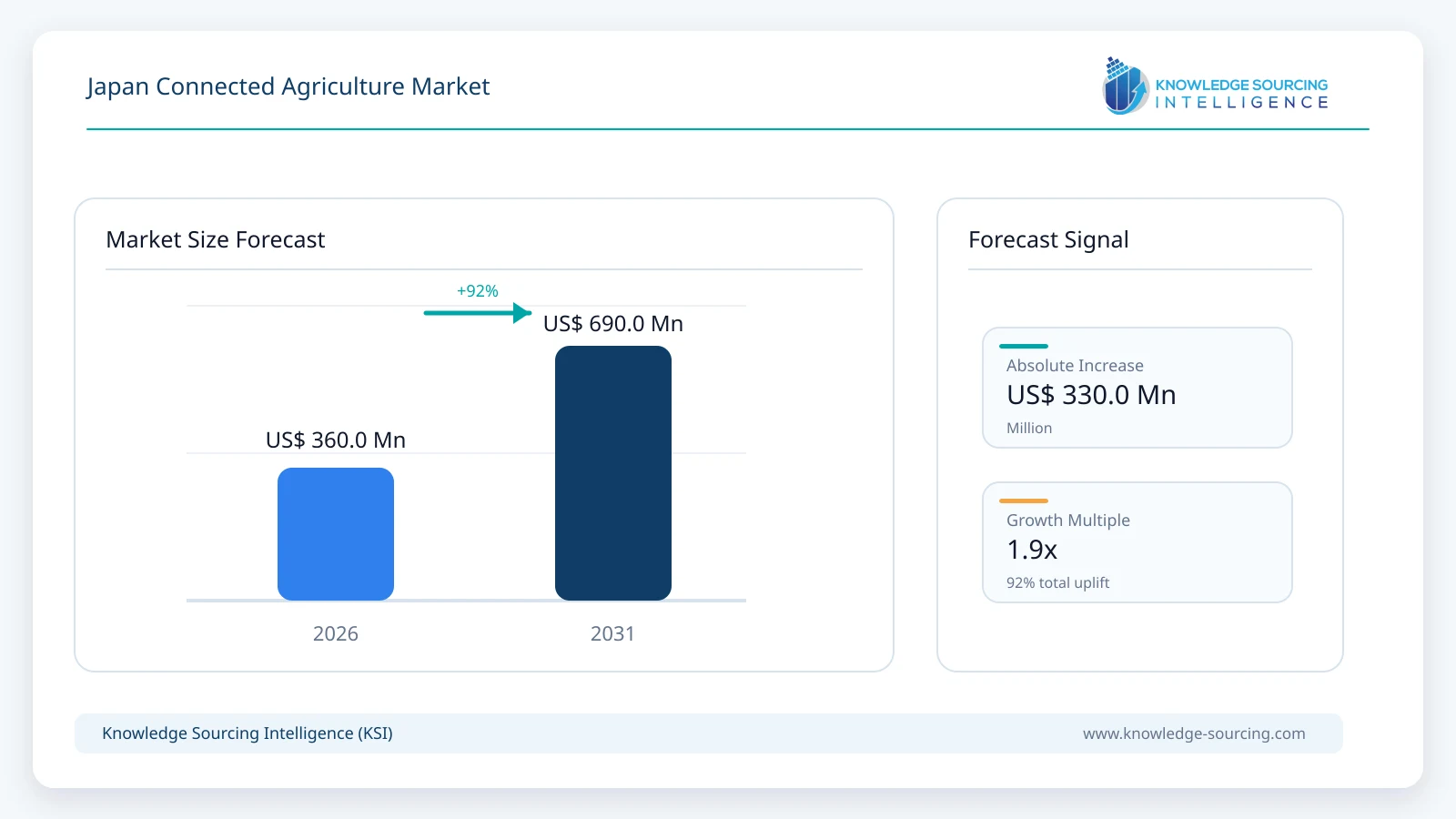
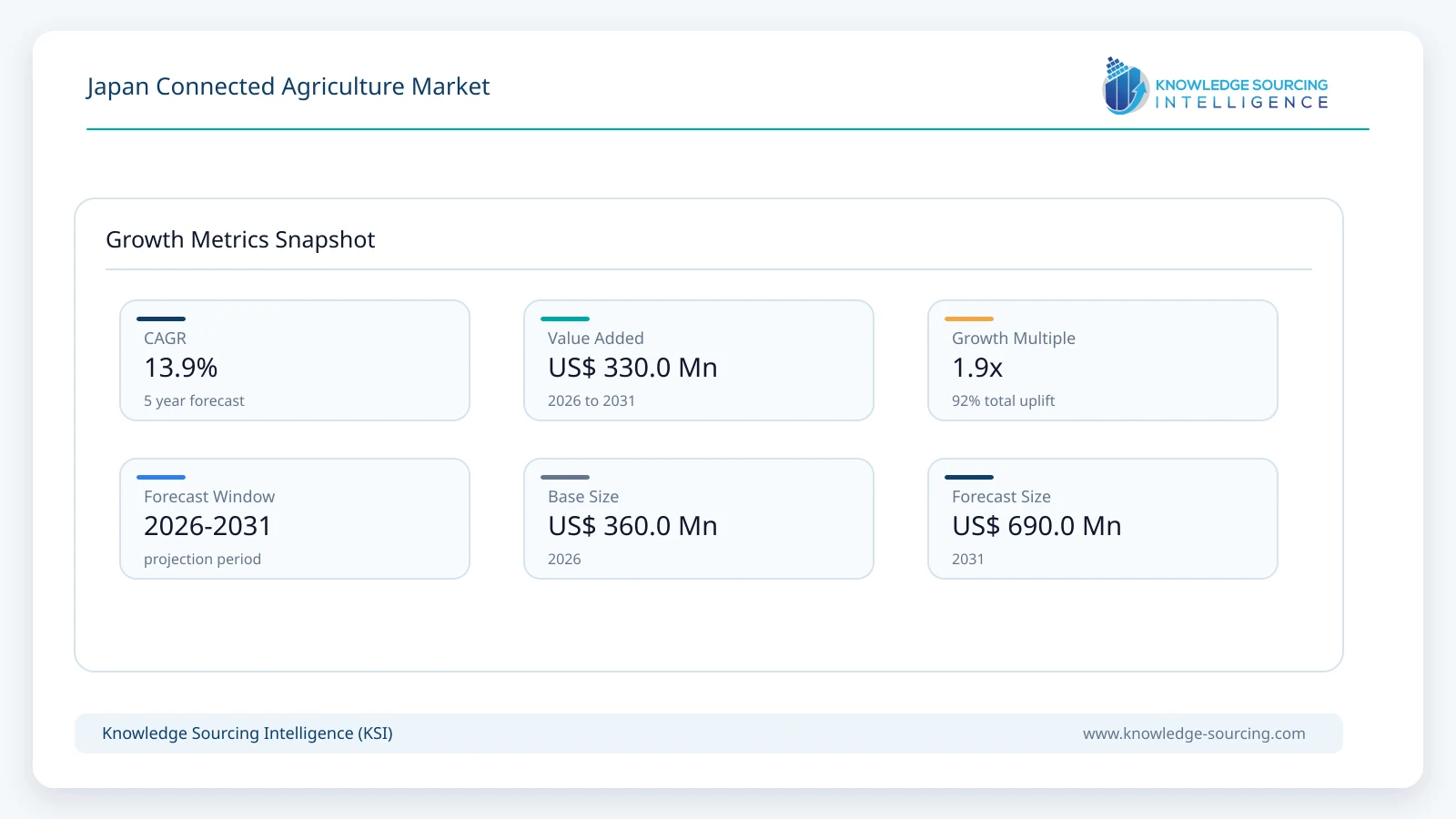
The Japan connected agriculture market is estimated at USD 360.0 million in 2026 and is projected to reach USD 690.0 million by 2031, growing at a CAGR of 13.9% during the forecast period.
Highlights:
- 1Robotics and automation account for approximately 31% of connected-agriculture revenue in 2026.
- 2Precision farming represents approximately 36% of the market by application in 2026.
- 3Small and medium farms generate approximately 56% of market revenue despite consolidation toward larger operating units.
- 4Hokkaido accounts for approximately 26% of national connected-agriculture spending in 2026.
- 5Agricultural drone spraying covered about 1.097 million hectares in FY2023, demonstrating scaled field adoption.
- 6Japan had 6,316 agricultural support-service operators in 2025, expanding access to shared smart equipment and digital services.
Connected agriculture in Japan sits at the intersection of agricultural machinery, information technology, telecommunications and service outsourcing. Adoption is strongest where digital systems can compensate directly for labor scarcity, reduce the skill required to execute precision field work or make expensive equipment available across multiple farms. In rice and broad-acre farming, this includes RTK-GNSS guidance, straight-driving assistance, variable-rate application, digital work records and increasingly autonomous tractors and combines. In horticulture, protected cultivation and livestock, connected agriculture is more sensor- and software-intensive, relying on environmental monitoring, automated control, AI-based imaging and herd-management platforms. The commercial market therefore includes both equipment-linked digital systems and recurring software or service revenue, but not the entire selling price of conventional machinery on which a connected function may be installed.
Government policy has moved from demonstration toward implementation. The Smart Agriculture Technology Utilization Promotion Act came into force in October 2024 and created a framework for promoting plans that use smart technologies to improve agricultural productivity. MAFF's smart-agriculture program now covers demonstration, data utilization, satellite technologies, agricultural support services, drone adoption, automated-machinery safety and rural communications infrastructure. This is important commercially because the main constraint is no longer whether technology can work in Japanese farming; it is whether farms can finance, share and operate systems at an economically viable scale. Policy emphasis on agricultural support services, leasing, sharing and contract work is therefore broadening the addressable market beyond farms able to purchase advanced systems outright.
Published market estimates vary substantially because definitions differ. A 2026 Yano Research release estimates Japan's FY2025 smart-agriculture market at JPY 45.502 billion and projects JPY 96.904 billion by FY2031. Its scope includes agricultural cloud, smart water management, management support, precision agriculture, satellite remote sensing, drone solutions and agricultural robots, while excluding the hardware value of agricultural machinery and drones. An older MAFF compilation cited a much broader 2025 Japan smart-agriculture estimate of approximately USD 1.371 billion covering smart-agriculture hardware, software and services. The connected-agriculture market focuses on digital connectivity and data-driven technologies that enable smarter agricultural operations, distinguishing it from broader categories that also include conventional machinery and equipment.
Market Trends
Automation Is Moving from Operator Assistance Toward Remote Supervision
Japan's first phase of smart mechanization focused on guidance and operator assistance; the next phase is increasingly centered on remote supervision and multi-machine operation. Kubota announced in August 2026 that its new Agri Robo Tractor MR Series will include domestically manufactured unmanned tractors capable of autonomous operation under remote monitoring, with a planned Japan launch in April 2027. Yanmar continues to broaden its SMARTPILOT lineup with straight-driving assist and autonomous functions across different tractor sizes, while ISEKI's 2026 BJ series includes RTK-based straight-driving assistance and connected machine-data functions. The commercial significance is larger than the tractor itself: higher automation increases demand for positioning, connectivity, fleet monitoring, data storage, safety systems and service support, creating recurring connected-agriculture revenue around the equipment lifecycle.
Agriculture Is Shifting from Technology Ownership to Technology Access
High upfront cost remains a major barrier for Japan's fragmented farm base, encouraging a shift from ownership toward contract services, sharing and leasing. MAFF reported 6,316 agricultural support-service operators in 2025, 615 more than in 2020. These businesses can spread drone, autonomous-machinery and digital-platform costs across multiple farms and convert irregular capital purchases into service expenditure. The model is especially important for spraying, remote sensing, crop monitoring and seasonal machinery because utilization rates can be raised across a wider customer base. OPTiM's drone spraying service illustrates this transition: the company reported approximately 26,000 hectares of domestic drone-spraying activity in FY2024 using digital mapping, routing and AI-enabled timing. As service density increases, connected agriculture can penetrate smaller farms without requiring each operator to become an advanced technology owner.
AI Is Moving from Advisory Analytics into Farm Operations
Japanese agriculture is beginning to use AI not only for post-season analysis but for real-time operational support. NEC has demonstrated Local 5G and AI image analysis for disease detection in large Hokkaido fields, while Sagri uses satellite data and AI to map farmland conditions and identify consolidation opportunities. In livestock, Farmnote's cloud platform combines herd records, wearable data and AI, and the company reported more than 370,000 cattle under paid Farmnote Cloud contracts by late 2025. In 2026 it extended this architecture through Farmnote MCP and Farmnote Intelligence so AI agents can work with farm operating data. AI adoption should therefore raise the value of connected datasets generated by sensors, machinery, drones and livestock devices, increasing platform revenue even when the underlying hardware base grows more slowly.
Market Drivers
A Shrinking and Aging Agricultural Workforce Creates a Structural Need for Labor-Saving Technology
The strongest demand driver is demographic. MAFF reports that Japan's core agricultural workforce fell to 1.036 million people in 2025 from 2.40 million in 2000, while the average age reached 67.7 years. The ministry also notes that the workforce could fall to around one-quarter of the current level over the next two decades if structural trends continue. Connected systems directly address this problem by reducing field passes, automating steering, enabling one person to supervise several operations, digitizing records and replacing physical scouting with cameras, drones and remote sensing. This creates a durable economic case for technology even when agricultural output volumes are relatively stable. The market is therefore driven by labor substitution and skill transfer more than by simple expansion of cultivated land.
Government Policy and Standards Are Lowering Adoption Friction
Japan's policy framework is increasingly oriented toward deployment at scale. The Smart Agriculture Technology Utilization Promotion Act formalizes support for technology-use and development plans, while MAFF maintains programs for smart-agriculture demonstrations, agricultural data use through WAGRI, satellite applications, drone adoption and automated-machinery safety. Guidelines for autonomous agricultural machines and communications infrastructure reduce uncertainty for vendors and farm operators, while support for agricultural service companies creates a route to market for high-cost assets. This policy architecture does not eliminate the need for commercial return, but it reduces early adoption friction and gives equipment makers, telecom operators and software vendors a clearer framework for building interoperable products and services.
Farm Consolidation and Higher-Value Production Improve Technology Economics
Although Japan retains many small farms, farmland is gradually concentrating in larger operating entities, particularly in Hokkaido and major rice-producing regions. Larger farms can spread GNSS, sensing, drones and management software across more hectares, improving utilization and payback. At the same time, high-value horticulture and livestock operations can justify connected systems on a per-hectare or per-animal basis because environmental control, disease detection, labor scheduling and quality management have direct effects on output value. This dual structure supports two commercial models: automation-heavy precision agriculture for larger field operations and sensor/software-intensive systems for greenhouses, livestock and specialty crops. Vendors able to package hardware, software and after-sales support for each model are positioned more favorably than providers selling isolated devices.
Market Restraints
Fragmented Farms and High Upfront Costs Limit Direct Equipment Ownership
Japan's large population of small and part-time agricultural operators makes the economics of dedicated high-cost systems difficult outside major producing areas. RTK-enabled machinery, autonomous platforms, advanced environmental control and robotic harvesting systems require capital expenditure as well as training and maintenance. A technology may deliver clear labor savings but still fail an individual farm's payback test if annual utilization is low. This is why shared infrastructure, contractor models and equipment leasing are central to future penetration. Vendors that depend exclusively on direct equipment sales to individual farms face a narrower addressable market than companies that can support recurring service, rental or cooperative deployment.
Interoperability, Connectivity and Workflow Integration Remain Uneven
Connected agriculture becomes more valuable when machinery, sensor, weather, field, livestock and business data can move across systems, yet the Japanese market still contains proprietary platforms and uneven integration between equipment generations. Rural communications coverage is generally strong by global standards but specific large fields, mountainous areas and protected-cultivation facilities can still create connectivity constraints, which is why local 5G, edge computing and dedicated farm-network solutions remain active development areas. Data ownership, cybersecurity, API compatibility and the ability to preserve records when equipment suppliers change also influence purchasing decisions. These issues slow full-stack integration even when individual smart devices are already commercially proven.
Segment Analysis
By Type: Solutions Remain the Largest Revenue Pool, While Platforms and Services Grow Faster
Solutions remain the larger type segment because Japan's connected-agriculture spending still contains substantial device, positioning, sensing, automation-control and field-system value. However, Platforms & Services are forecast to grow faster, at approximately 15.6% annually through 2031, as farms and agricultural support companies add cloud management, remote monitoring, AI analytics, satellite services, maintenance subscriptions and contract operations around installed equipment. The recurring model is particularly attractive in Japan because it spreads technology cost over time and reduces the need for each farm to own specialist equipment. Over the forecast period, the market mix therefore shifts gradually away from one-time connected-system purchases toward ongoing software and service relationships.
By Technology: AI and Data Analytics Are the Fastest-Growing Technology Layer
AI and data analytics are projected to grow at approximately 17.3% annually between 2026 and 2031, faster than the overall market. The segment benefits from a growing installed base of sensor, drone, machinery and livestock data that can be converted into operational recommendations. Satellite imagery is being used for crop-growth and farmland analysis, computer vision supports disease detection and robotic harvesting, and livestock platforms increasingly combine behavioral data with AI-driven alerts. Robotics and automation remain the largest technology pool, but AI creates an additional monetization layer on top of physical systems and can be deployed through subscriptions across farms that do not own autonomous machinery.
By Application: Smart Greenhouses Gain as Environmental Control and Harvest Automation Converge
Precision farming remains the central application for connected agriculture in Japan, especially in rice, cereals and large Hokkaido operations. Smart greenhouses, however, are expected to expand at approximately 15.4% annually through 2031 as environmental sensors, cloud control, computer vision and harvesting robots are combined in high-value horticulture. SERAKU's Midori Cloud is already deployed at more than 2,400 locations across all 47 prefectures, while companies such as AGRIST and inaho are commercializing AI-enabled harvesting robotics. Greenhouse economics differ from broad-acre farming because connected technology can be evaluated against output per square metre, labor hours and quality consistency, supporting higher technology intensity even on relatively small physical footprints.
By Farm Size: Large Farms Grow Faster as Farmland and Capital Concentrate
Small and medium farms remain the larger revenue pool because they dominate Japan's farm count and increasingly access technology through service providers. Large farms are forecast to grow faster, at approximately 15.0% annually, because larger field areas and multi-site operations improve the utilization of guidance, autonomous equipment, drone mapping and enterprise farm-management platforms. Hokkaido is the clearest example, where dairy and broad-acre operations can support connected systems at scale. The distinction between farm sizes will also blur as contractors operate advanced equipment across multiple small farms, effectively creating large-scale technology utilization without large-scale farm ownership.
By Region: Hokkaido Leads, While Adoption Broadens Across Major Rice and Horticulture Regions
Hokkaido remains the leading regional market because its large farms, dairy concentration and labor requirements create strong economics for GNSS guidance, autonomous machinery, livestock monitoring and remote sensing. Tohoku is important for rice-focused precision agriculture and drone services, while Kanto combines high-value horticulture with proximity to technology vendors and research institutions. Kyushu and Okinawa have strong potential in protected cultivation, livestock and drone applications, and central Japan supports a diverse mix of field crops and horticulture. Regional growth will depend less on telecom availability than on crop economics, farm structure, service-provider density and the availability of technology packages adapted to local production systems.
Competitive Landscape
Competition in Japan is divided among agricultural machinery manufacturers, positioning and sensor providers, telecom and IT groups, specialist agtech platforms and robotics startups. Kubota, Yanmar and ISEKI have the strongest ability to integrate connected functions directly into machinery and dealer-service networks. Topcon provides positioning and precision-agriculture technology that can be fitted across equipment brands. OPTiM, NEC, NTT AgriTechnology, Fujitsu and SERAKU compete through software, AI, communications, environmental monitoring and service platforms, while Sagri and Kokusai Kogyo focus heavily on satellite and geospatial intelligence. Farmnote has established a strong livestock-data position, and startups such as AGRIST and inaho target labor-intensive horticultural harvesting with robotics.
The competitive advantage is shifting from single-product capability toward interoperability and commercial deployment. Farmers increasingly need a complete workflow: sensing, connectivity, data interpretation, machine execution and support. Machinery companies are therefore adding cloud platforms and remote monitoring, while IT companies are moving closer to field operations through Local 5G, edge computing, AI and robotics partnerships. Service providers are also becoming strategically important because they aggregate demand across farms. Over the forecast period, the most defensible positions are likely to combine installed hardware, proprietary data, local support and recurring software or service revenue rather than depend on one-off device sales.
Recent Developments
August 2026: Kubota announced Agri Robo Tractor MR Series models capable of unmanned autonomous operation under remote monitoring, with a Japan launch planned for April 2027.
July 2026: Farmnote introduced Farmnote MCP, extending its livestock-management data architecture so AI agents can work with farm operational data.
June 2026: ISEKI announced the BJ tractor series with RTK-based straight-driving assistance and Agri Support 2 connected machine and work-information functions.
July 2025: Sagri was selected for Toyama Prefecture's Digi-PoC project to use satellite data and AI for farmland visualization, labor-shortage analysis and consolidation planning.
May 2025: NTT, NTT EAST and NTT AgriTechnology demonstrated remote operation of a strawberry-harvesting robot in Akita from Tokyo using edge-computing-based network control.
Japan Connected Agriculture Market Scope
| Report Metric | Details |
|---|---|
| Total Market Size in 2026 | USD 360.0 million |
| Total Market Size in 2031 | USD 690.0 million |
| Forecast Unit | Million |
| Growth Rate | 13.9% |
| Study Period | 2021 to 2031 |
| Historical Data | 2021 to 2024 |
| Base Year | 2025 |
| Forecast Period | 2026 – 2031 |
| Segmentation | Type, Technology Type, Application, Farm Size, Region |
| Companies |
|
Market Segmentation
By Type
Solutions
Platforms & Services
By Technology Type
IoT Devices and Sensors
AI and Data Analytics
Robotics and Automation
Connectivity Infrastructure
By Application
Precision Farming
Smart Greenhouses
Livestock Monitoring
Fish Farming
Field Operations Management
Others
By Farm Size
Large Farms
Small & Medium Farms
By Region
Hokkaido
Tohoku
Kanto
Chubu
Kansai, Chugoku and Shikoku
Kyushu and Okinawa
Table of Contents
1. EXECUTIVE SUMMARY
2. MARKET SNAPSHOT
2.1. Market Overview
2.2. Market Definition
2.3. Scope of the Study
2.4. Market Segmentation
3. BUSINESS LANDSCAPE
3.1. Market Drivers
3.1.1. Shrinking and Aging Agricultural Workforce Creates Structural Demand for Labor-Saving Technology
3.1.2. Government Policy and Standards Are Lowering Adoption Friction
3.1.3. Farm Consolidation and Higher-Value Production Improve Technology Economics
3.2. Market Restraints
3.2.1. Fragmented Farms and High Upfront Costs Limit Direct Equipment Ownership
3.2.2. Interoperability, Connectivity and Workflow Integration Remain Uneven
3.3. Market Opportunities
3.4. Porter's Five Forces Analysis
3.5. Industry Value Chain Analysis
3.6. Policies and Regulations
3.7. Strategic Recommendations
4. TECHNOLOGICAL OUTLOOK
4.1. Autonomous and Remotely Supervised Agricultural Machinery
4.2. AI, Computer Vision and Edge Analytics
4.3. Satellite Remote Sensing, RTK-GNSS and Variable-Rate Systems
4.4. Farm Data Platforms, APIs and Rural Connectivity
5. JAPAN CONNECTED AGRICULTURE MARKET BY TYPE
5.1. Introduction
5.2. Solutions
5.3. Platforms & Services
6. JAPAN CONNECTED AGRICULTURE MARKET BY TECHNOLOGY TYPE
6.1. Introduction
6.2. IoT Devices and Sensors
6.3. AI and Data Analytics
6.4. Robotics and Automation
6.5. Connectivity Infrastructure
7. JAPAN CONNECTED AGRICULTURE MARKET BY APPLICATION
7.1. Introduction
7.2. Precision Farming
7.3. Smart Greenhouses
7.4. Livestock Monitoring
7.5. Fish Farming
7.6. Field Operations Management
7.7. Others
8. JAPAN CONNECTED AGRICULTURE MARKET BY FARM SIZE
8.1. Introduction
8.2. Large Farms
8.3. Small & Medium Farms
9. JAPAN CONNECTED AGRICULTURE MARKET BY REGION
9.1. Introduction
9.2. Hokkaido
9.3. Tohoku
9.4. Kanto
9.5. Chubu
9.6. Kansai, Chugoku and Shikoku
9.7. Kyushu and Okinawa
10. COMPETITIVE ENVIRONMENT AND ANALYSIS
10.1. Major Players and Strategy Analysis
10.2. Market Share Analysis
10.3. Mergers, Acquisitions, Agreements and Collaborations
10.4. Competitive Dashboard
11. COMPANY PROFILES
11.1. Kubota Corporation
11.2. Yanmar Holdings Co., Ltd.
11.3. ISEKI & Co., Ltd.
11.4. Topcon Corporation
11.5. OPTiM Corporation
11.6. NTT AgriTechnology Corporation
11.7. NEC Corporation
11.8. Fujitsu Limited
11.9. Sagri Co., Ltd.
11.10. Farmnote Holdings Inc.
11.11. SERAKU Co., Ltd.
11.12. inaho Inc.
11.13. Kokusai Kogyo Co., Ltd.
11.14. AGRIST Inc.
11.15. Yamaha Motor Co., Ltd.
11.16. Trimble Inc.
11.17. DJI Agriculture
11.18. XAG Co., Ltd.
12. APPENDIX
12.1. Currency
12.2. Assumptions
12.3. Base and Forecast Years Timeline
12.4. Key Benefits for Stakeholders
12.5. Research Methodology
12.6. Abbreviations
Navigate
Trusted by the world's leading organizations











