
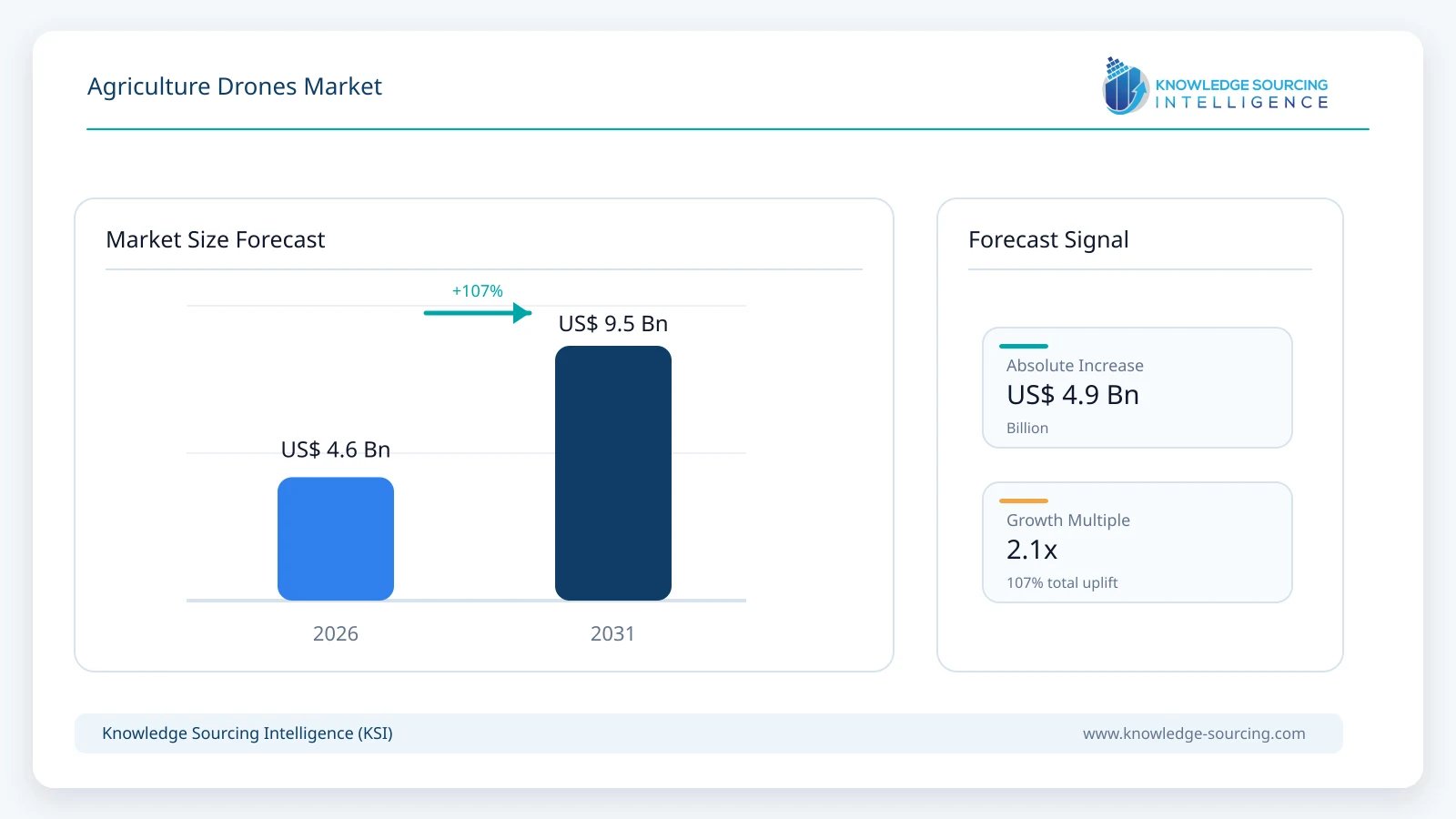
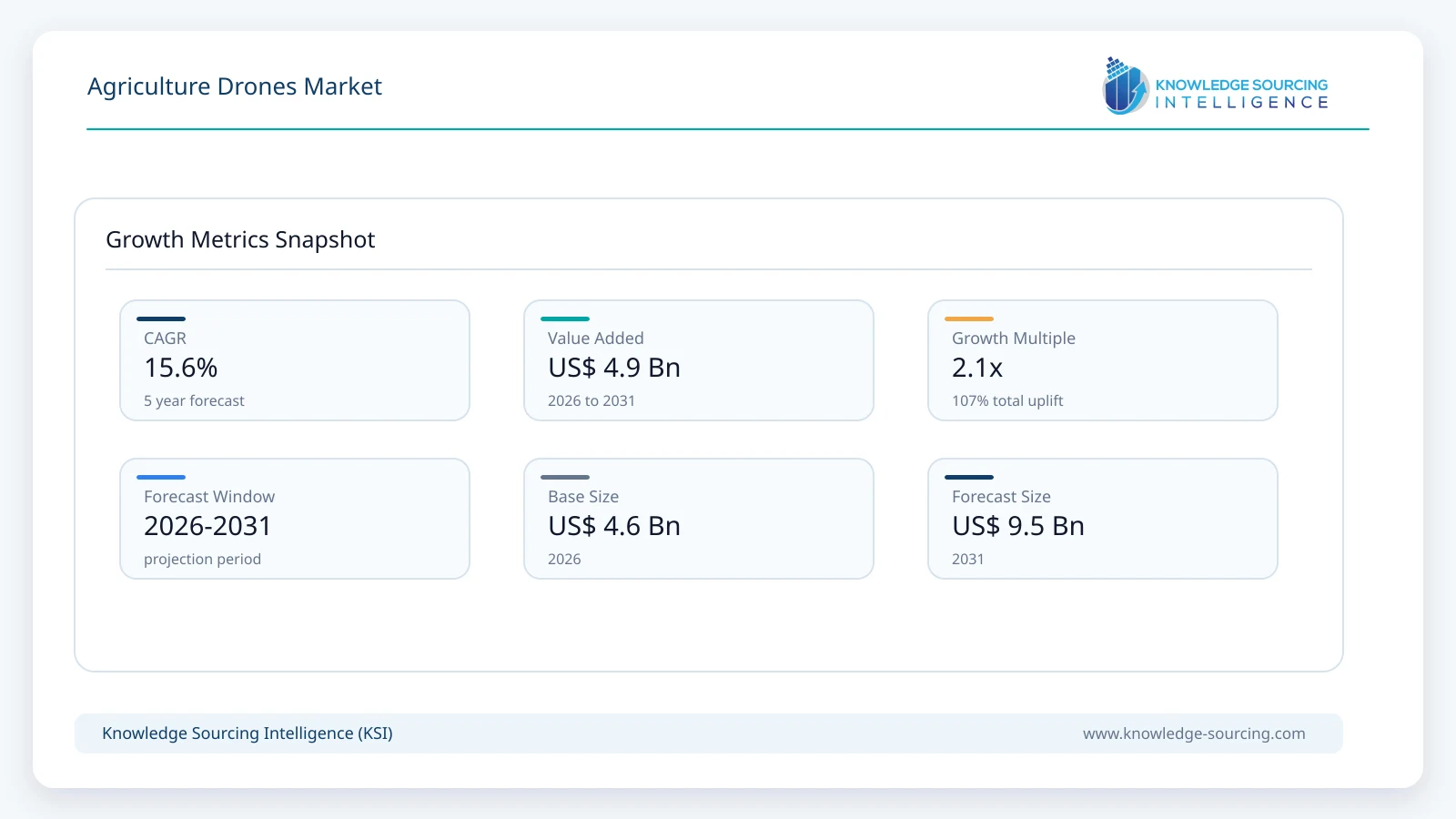
The Agriculture Drones Market is forecast to grow at a CAGR of 15.6%, reaching USD 9.50 billion in 2031 from USD 4.60 billion in 2026.
Highlights:
- 1Precision agriculture investment continues to increase demand for aerial data collection and targeted crop treatment.
- 2Agricultural spraying remains a commercially important application due to labor shortages and input optimization.
- 3Government support for digital farming and precision agriculture is accelerating commercial drone deployment.
- 4Software integration, analytics, and autonomous flight capabilities increasingly influence buyer purchasing decisions.
- 5Regulatory approval frameworks and pilot certification requirements continue to shape market adoption across regions.
Market Overview
The market includes unmanned aerial vehicles (UAVs), onboard sensors, navigation systems, imaging equipment, software platforms, and associated services designed for agricultural applications such as spraying, field mapping, crop scouting, soil assessment, and livestock monitoring. Demand increasingly comes from commercial farms, agricultural service providers, cooperatives, plantation operators, and government-supported farming programs seeking higher operational efficiency while reducing labor dependence and input costs.
Purchasing decisions increasingly depend on measurable operational outcomes rather than hardware specifications alone. Buyers evaluate payload capacity, flight endurance, spraying precision, imaging quality, software compatibility, autonomous navigation, after-sales support, regulatory compliance, and integration with existing farm management platforms. Drone manufacturers are therefore expanding beyond aircraft sales by offering cloud-based analytics, subscription software, maintenance services, operator training, and fleet management capabilities.
Government initiatives supporting digital agriculture, precision input application, and sustainable farming practices continue to strengthen commercial demand. Several countries are introducing subsidy programs, pilot projects, and regulatory frameworks that encourage drone adoption while improving operational safety. At the same time, manufacturers continue investing in artificial intelligence, machine vision, autonomous obstacle avoidance, battery performance, and variable-rate application technologies to improve productivity across diverse crop conditions.
Commercial value is distributed across both hardware and recurring software and service revenues. Hardware sales remain important during initial deployment, but long-term customer relationships increasingly depend on software subscriptions, maintenance contracts, replacement batteries, precision analytics, and operator support. This transition is encouraging suppliers to strengthen ecosystem offerings rather than competing solely on aircraft performance.
Key Market Indicators
Indicator | Latest Evidence | Commercial Meaning |
DJI agricultural drones operated area | More than 500 million hectares (2024) | Demonstrates increasing commercial acceptance of agricultural UAV operations worldwide. |
FAA registered commercial drones (United States) | Over 420,000 registered drones (2025) | Expanding commercial UAV ecosystem supports wider agricultural drone deployment. |
Global agricultural support under digital farming initiatives | Growing government-backed precision agriculture programs (2024–2025) | Public investment continues encouraging farm-level technology adoption. |
European CAP digital agriculture support | Precision farming remains eligible under Common Agricultural Policy measures | Policy incentives support adoption of precision farming technologies including drones. |
China's low-altitude economy policy | National policy support expanded during 2024–2025 | Encourages commercial UAV manufacturing, deployment, and agricultural applications. |
Key indicator: DJI reported that its agricultural drones had cumulatively treated more than 500 million hectares globally by 2024.
Commercial meaning: Large-scale operational deployment demonstrates that agricultural drones are increasingly being integrated into routine crop management rather than limited pilot projects.
Market Drivers
Expansion of precision spraying to reduce chemical use and labor dependence.
Commercial farms increasingly require precise pesticide and fertilizer application as labor shortages, rising agrochemical costs, and environmental regulations raise operating expenses. Agricultural drones enable variable-rate spraying, reducing overspray while improving coverage in difficult terrain. Government agencies in countries including China, India, Japan, and several European markets continue promoting precision agriculture practices through demonstration programs and financial incentives. Manufacturers including DJI, XAG, and Yamaha Motor have expanded spraying platforms with larger payloads, automated route planning, and intelligent flow control, reflecting growing customer demand for higher operational efficiency rather than simple equipment replacement.
Government-backed digital agriculture programs are accelerating adoption.
National agricultural modernization strategies increasingly incorporate unmanned aerial systems within broader precision farming initiatives. India's drone subsidy programs under the Namo Drone Didi Scheme and agricultural mechanization initiatives encourage farmer producer organizations and cooperatives to adopt drone services. The European Union continues supporting digital agriculture through the Common Agricultural Policy, while China's low-altitude economy policies encourage broader commercial UAV deployment. These initiatives reduce financial barriers for first-time buyers and encourage service providers to expand agricultural drone fleets, creating recurring demand for equipment, software, maintenance, and pilot training.
Integration of artificial intelligence and farm management software is increasing commercial value.
Buyers increasingly evaluate drones as part of complete digital farming ecosystems rather than standalone aircraft. Multispectral imaging, machine learning algorithms, cloud analytics, and automated flight planning enable growers to identify crop stress, estimate biomass, detect pest infestations, and optimize irrigation decisions using operational data collected throughout the growing season. Companies such as Trimble, DroneDeploy, Sentera, and AgEagle continue strengthening software interoperability with farm management platforms, reflecting customer demand for actionable insights instead of raw aerial imagery. This evolution increases recurring software revenue while strengthening customer retention.
Growth of agricultural drone service providers broadens market accessibility.
High-capital agricultural equipment has traditionally limited technology adoption among small and medium-sized farms. Service-based business models are reducing this constraint by allowing growers to purchase spraying, mapping, or crop monitoring services without investing directly in aircraft ownership. Agricultural cooperatives, custom applicators, and specialized drone operators increasingly provide seasonal services across multiple farms, improving equipment utilization rates and lowering adoption barriers. Manufacturers are responding by designing fleet management software, maintenance programs, and operator certification services that support commercial service businesses rather than only individual farm ownership.
Market Restraints and Challenges
Regulatory approval and pilot certification requirements continue to delay deployment.
Agricultural drone operations remain subject to aviation regulations governing pilot licensing, flight permissions, operating altitude, visual line-of-sight requirements, and pesticide application rules. Although regulatory frameworks continue evolving, approval procedures differ considerably across countries and, in some cases, across regional jurisdictions. Commercial operators serving multiple markets must satisfy varying certification requirements, increasing compliance costs and extending deployment timelines. Manufacturers continue investing in remote identification, geofencing, and safety systems to meet changing regulatory expectations, but regulatory fragmentation remains a practical challenge for international expansion.
Battery endurance and payload limitations restrict operational efficiency.
Despite steady improvements in battery technology, flight duration remains constrained when drones operate with heavy liquid payloads during spraying missions. Larger commercial farms often require multiple battery replacements and frequent refilling cycles, reducing productivity compared with conventional ground equipment or manned aerial spraying under certain operating conditions. Manufacturers continue improving battery-swapping systems, lightweight materials, and propulsion efficiency; however, endurance remains an operational limitation for high-volume agricultural applications, particularly across extensive row-crop operations.
High initial investment and service infrastructure requirements affect purchasing decisions.
Commercial agricultural drone deployment involves considerably more than aircraft acquisition. Buyers must also invest in batteries, charging equipment, maintenance, software subscriptions, operator training, regulatory compliance, insurance, and replacement components. In regions where authorized service networks remain limited, equipment downtime can extend during peak farming periods, reducing operational value. Several manufacturers have responded by expanding dealer networks, localized technical support, and maintenance partnerships, yet service availability continues influencing purchasing decisions, particularly in developing agricultural markets.
Major Segment Analysis
Spraying Application
Spraying represents the most commercially important application segment because it delivers direct operational savings through lower chemical use, improved application accuracy, and reduced labor requirements. Unlike imaging-only deployments, spraying drones generate measurable returns within a single growing season by applying pesticides, herbicides, fungicides, and liquid fertilizers with controlled dosage and targeted coverage. Adoption is particularly strong in high-value crops, orchards, vineyards, rice cultivation, sugarcane, cotton, and plantation agriculture, where terrain or crop density limits the efficiency of conventional ground equipment.
Buyer priorities extend beyond payload capacity. Commercial operators evaluate droplet consistency, obstacle avoidance, automated route planning, variable-rate application, refill time, battery-swapping efficiency, and compatibility with farm management software. Manufacturers including DJI, XAG, Yamaha Motor, and others continue increasing payload capacity while improving autonomous flight and precision spraying functions. Even so, operational productivity remains dependent on battery endurance, local aviation rules, weather conditions, and certified pilot availability. As agricultural service providers expand drone-based spraying across multiple farms, this application continues to shape equipment specifications, software development, and aftermarket service revenue throughout the broader agriculture drones market.
Regional Analysis
Region | Main Demand Signal | Principal Constraint |
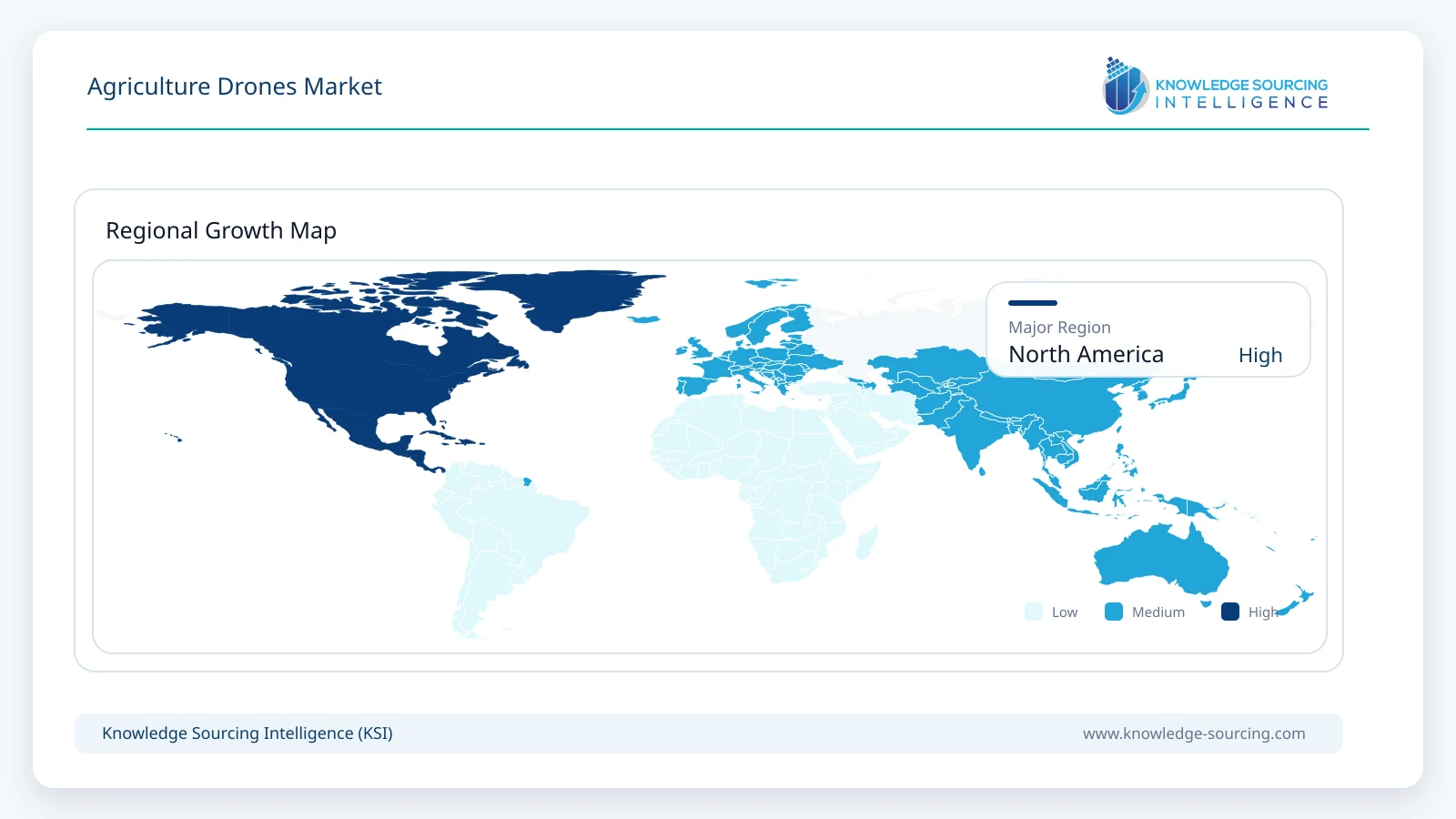
North America | Large commercial farms, precision agriculture adoption, FAA regulatory framework | Airspace compliance and operator certification |
Europe | CAP support, sustainability policies, precision input management | Strict aviation and pesticide application rules |
Asia Pacific | Government incentives, large agricultural workforce, domestic manufacturing | Diverse regulations and uneven rural service infrastructure |
South America | Expansion of commercial farming and plantation agriculture | Infrastructure gaps and regulatory maturity |
Middle East and Africa | Water efficiency, smart irrigation, food security initiatives | Limited technical skills and service availability |
North America
Large-scale commercial farming and widespread adoption of precision agriculture technologies continue supporting agriculture drone demand across North America. The United States benefits from an established commercial UAV ecosystem under Federal Aviation Administration regulations, while digital agriculture platforms are already integrated into many farming operations. Demand is concentrated in row crops, specialty crops, and large agricultural enterprises seeking more efficient pesticide application and crop monitoring. Canada increasingly applies drone technology for grain production, forestry management, and remote agricultural operations, whereas adoption in Mexico is expanding through commercial horticulture and export-oriented farming.
Europe
Environmental compliance increasingly shapes purchasing decisions across Europe. The European Union's Common Agricultural Policy encourages resource-efficient farming practices, while tighter restrictions on pesticide use create demand for more accurate application technologies that minimize chemical drift and unnecessary input use. Countries including Germany, France, Spain, and the United Kingdom continue investing in digital agriculture, research partnerships, and precision farming projects. Buyers generally prioritize software interoperability, regulatory compliance, environmental reporting, and long-term operating reliability over maximum payload capacity, encouraging suppliers to strengthen integrated hardware and software offerings.
Asia Pacific
Asia Pacific combines extensive agricultural activity with active government support for agricultural modernization, making it one of the most commercially important regions for agriculture drones. China remains central to both manufacturing and domestic deployment, supported by national policies promoting the low-altitude economy and smart agriculture. Japan continues building on decades of unmanned agricultural aviation experience, while India is expanding adoption through subsidy programs, pilot projects, and support for farmer producer organizations. South Korea, Taiwan, Thailand, and Indonesia are also increasing precision farming investments, particularly for rice cultivation, plantation crops, and horticulture. The region combines equipment manufacturing capacity with growing domestic demand, strengthening both production and deployment.
South America
Commercial agriculture across Brazil and Argentina continues creating demand for aerial crop monitoring and precision spraying technologies. Large soybean, corn, cotton, and sugarcane operations benefit from drone-based field assessment and targeted chemical application, particularly where field size and labor availability favor mechanized farming. Export-oriented agricultural production also encourages growers to improve traceability and optimize input use. Adoption outside the largest farming regions remains constrained by uneven service infrastructure, operator availability, and differences in national regulatory frameworks, although commercial drone service providers are gradually expanding regional coverage.
Middle East and Africa
Water scarcity, food security strategies, and precision irrigation initiatives are encouraging selective adoption of agricultural drones across parts of the Middle East and Africa. Israel continues contributing through agricultural technology development, while Saudi Arabia and the United Arab Emirates increasingly support digital farming projects designed to improve productivity under challenging climatic conditions. Adoption across many African markets remains at an earlier stage because of limited technical expertise, financing constraints, and developing regulatory systems. Nevertheless, government-supported agricultural modernization programs and donor-funded precision agriculture initiatives are gradually expanding commercial opportunities for drone manufacturers and service providers.
Competitive Landscape
Competition in the agriculture drones market is technology-driven but increasingly influenced by software capability, regulatory compliance, service coverage, and ecosystem integration rather than aircraft performance alone. DJI and XAG maintain extensive agricultural drone portfolios with continued investment in autonomous flight, higher payload systems, intelligent spraying, and cloud-based farm management. Yamaha Motor retains a strong position in unmanned agricultural aviation through its long-established helicopter platforms, while AgEagle Aerial Systems, Sentera, Trimble, DroneDeploy, PrecisionHawk, American Robotics, and Parrot Drone SAS strengthen their positions through imaging, analytics, mapping software, and enterprise data services.
Competitive differentiation increasingly depends on providing complete operational solutions that combine aircraft, sensors, analytics, maintenance, operator training, and regulatory support. Suppliers are expanding dealer networks, developing application-specific software, improving interoperability with precision agriculture platforms, and introducing artificial intelligence for automated crop analysis. High regulatory compliance costs, established distribution channels, software ecosystems, and after-sales support create meaningful barriers for new entrants, particularly in commercial farming markets where operational reliability is a primary purchasing criterion.
Recent Developments
July 2025 – DJI launches Agras T100, T70P, and T25P globally: DJI expanded its agriculture drone portfolio with the global introduction of the Agras T100, T70P, and T25P, offering higher payloads, AI-assisted flight, precision spraying, and spreading capabilities for large-scale farming.
May 2025 – John Deere acquires Sentera: John Deere acquired Sentera to integrate drone-based aerial imaging, agronomic analytics, and weed-mapping capabilities into the John Deere Operations Center, strengthening precision agriculture workflows and data-driven crop management.
January 2025 – Sentera expands SMARTSCRIPT™ Weeds integration before acquisition: Sentera enhanced its SMARTSCRIPT™ Weeds platform, enabling drone-generated weed maps and targeted herbicide prescriptions compatible with precision sprayers, improving chemical-use efficiency and crop management for commercial farms.
Regulatory and Policy Environment
Agriculture drone deployment depends on the interaction between aviation regulations, agricultural chemical rules, data governance requirements, and environmental policies. Civil aviation authorities increasingly define operational standards covering pilot certification, aircraft registration, remote identification, operating altitude, and beyond-visual-line-of-sight permissions. While these frameworks improve operational safety, they also increase compliance costs for manufacturers and commercial service providers operating across multiple jurisdictions.
Agricultural regulations further influence market development through rules governing pesticide application, chemical drift management, environmental protection, and operator certification. The European Union's Common Agricultural Policy continues encouraging precision agriculture practices that improve resource efficiency and environmental performance. China has incorporated low-altitude economy development into broader industrial policy, supporting commercial UAV manufacturing and deployment. India has expanded drone regulations alongside agricultural support programs, creating a clearer pathway for commercial operations while strengthening pilot certification and operational safety requirements.
Data management is becoming another policy consideration. High-resolution aerial imagery collected by agricultural drones increasingly requires compliance with national privacy, cybersecurity, and data storage rules, particularly where cloud-based analytics platforms process operational information. Suppliers therefore continue investing in secure software architectures, local data management capabilities, and compliance functions to meet evolving customer and regulatory expectations.
Outlook and Strategic Implications
Commercial demand during the 2026–2031 forecast period is expected to be shaped less by initial drone adoption and more by the expansion of integrated precision agriculture ecosystems. Buyers increasingly seek complete operational platforms that combine autonomous flight, imaging, spraying, analytics, and decision-support software within a single workflow. This shift favors suppliers capable of delivering recurring software services, technical support, operator training, and seamless compatibility with farm management systems rather than competing solely on aircraft specifications.
Artificial intelligence, multispectral imaging, and automated route optimization are expected to improve operational efficiency and strengthen the business case for commercial drone deployment. Continued advances in battery technology, obstacle avoidance, autonomous navigation, and payload management should further expand applications across both large commercial farms and agricultural service providers. At the same time, regulatory harmonization and improvements in rural service infrastructure will remain important conditions for broader market penetration.
Strategic priorities across the value chain are likely to include:
Manufacturers: Expand integrated hardware-software ecosystems, strengthen regional service networks, and improve battery performance while ensuring compliance with evolving aviation regulations.
Agricultural service providers: Scale fleet operations, diversify service offerings beyond spraying, and invest in operator training and data analytics capabilities to improve customer retention.
Technology providers: Develop interoperable software platforms that integrate drone-generated data with broader precision agriculture systems, enabling more efficient farm management and stronger recurring revenue.
Policymakers and regulators: Balance operational safety with commercial scalability by simplifying certification procedures, supporting pilot training, and establishing consistent standards for agricultural drone operations.
The competitive environment is expected to remain focused on operational reliability, software functionality, regulatory compliance, and service capability. Suppliers that combine autonomous technologies with scalable digital agriculture platforms and localized customer support are likely to strengthen their commercial position as agriculture drones become an increasingly routine component of precision farming operations.
Agriculture Drones Market Scope:
| Report Metric | Details |
|---|---|
| Total Market Size in 2026 | USD 4.60 billion |
| Total Market Size in 2031 | USD 9.50 billion |
| Forecast Unit | USD Billion |
| Growth Rate | 15.6% |
| Study Period | 2021 to 2031 |
| Historical Data | 2021 to 2024 |
| Base Year | 2025 |
| Forecast Period | 2026 – 2031 |
| Segmentation | Type, Application, Geography |
| Companies |
|
Market Segmentation
By Type
Fixed Wing
Multi-Rotor
Hybrid
By Application
Spraying
Field Mapping
Crop Scouting
Soil and Field Analysis
Crop Health Monitoring
Planting and Seeding
Livestock Monitoring
Others
By Geography
North America
USA
Canada
Mexico
South America
Brazil
Argentina
Others
Europe
United Kingdom
Germany
France
Spain
Others
Middle East and Africa
Saudi Arabia
UAE
Israel
Others
Asia Pacific
China
Japan
India
South Korea
Taiwan
Thailand
Indonesia
Others
Table of Contents
1. INTRODUCTION
1.1. Market Overview
1.2. Market Definition
1.3. Scope of the Study
1.4. Market Segmentation
1.5. Currency
1.6. Assumptions
1.7. Base and Forecast Years Timeline
1.8. Key Benefits to the Stakeholder
2. RESEARCH METHODOLOGY
2.1. Research Design
2.2. Research Processes
3. EXECUTIVE SUMMARY
3.1. Key Findings
3.2. CXO Perspective
4. MARKET DYNAMICS
4.1. Market Drivers
4.2. Market Restraints
4.3. Porter’s Five Forces Analysis
4.3.1. Bargaining Power of Suppliers
4.3.2. Bargaining Power of Buyers
4.3.3. Threat of New Entrants
4.3.4. Threat of Substitutes
4.3.5. Competitive Rivalry in the Industry
4.4. Industry Value Chain Analysis
4.5. Analyst View
5. AGRICULTURE DRONES MARKET, BY TYPE
5.1. Introduction
5.2. Fixed Wing
5.2.1. Market Trends and Opportunities
5.2.2. Growth Prospects
5.2.3. Geographic Lucrativeness
5.3. Multi-Rotor
5.3.1. Market Trends and Opportunities
5.3.2. Growth Prospects
5.3.3. Geographic Lucrativeness
5.4. Hybrid
5.4.1. Market Trends and Opportunities
5.4.2. Growth Prospects
5.4.3. Geographic Lucrativeness
6. AGRICULTURE DRONES MARKET, BY APPLICATION
6.1. Introduction
6.2. Spraying
6.2.1. Market Trends and Opportunities
6.2.2. Growth Prospects
6.2.3. Geographic Lucrativeness
6.3. Field Mapping
6.3.1. Market Trends and Opportunities
6.3.2. Growth Prospects
6.3.3. Geographic Lucrativeness
6.4. Crop Scouting
6.4.1. Market Trends and Opportunities
6.4.2. Growth Prospects
6.4.3. Geographic Lucrativeness
6.5. Soil and Field Analysis
6.5.1. Market Trends and Opportunities
6.5.2. Growth Prospects
6.5.3. Geographic Lucrativeness
6.6. Crop Health Monitoring
6.6.1. Market Trends and Opportunities
6.6.2. Growth Prospects
6.6.3. Geographic Lucrativeness
6.7. Planting and Seeding
6.7.1. Market Trends and Opportunities
6.7.2. Growth Prospects
6.7.3. Geographic Lucrativeness
6.8. Livestock Monitoring
6.8.1. Market Trends and Opportunities
6.8.2. Growth Prospects
6.8.3. Geographic Lucrativeness
6.9. Others
6.9.1. Market Trends and Opportunities
6.9.2. Growth Prospects
6.9.3. Geographic Lucrativeness
7. AGRICULTURE DRONES MARKET, BY GEOGRAPHY
7.1. Introduction
7.2. North America
7.2.1. By Type
7.2.2. By Application
7.2.3. By Country
7.2.3.1. USA
7.2.3.1.1. Market Trends and Opportunities
7.2.3.1.2. Growth Prospects
7.2.3.2. Canada
7.2.3.2.1. Market Trends and Opportunities
7.2.3.2.2. Growth Prospects
7.2.3.3. Mexico
7.2.3.3.1. Market Trends and Opportunities
7.2.3.3.2. Growth Prospects
7.3. South America
7.3.1. By Type
7.3.2. By Application
7.3.3. By Country
7.3.3.1. Brazil
7.3.3.1.1. Market Trends and Opportunities
7.3.3.1.2. Growth Prospects
7.3.3.2. Argentina
7.3.3.2.1. Market Trends and Opportunities
7.3.3.2.2. Growth Prospects
7.3.3.3. Others
7.3.3.3.1. Market Trends and Opportunities
7.3.3.3.2. Growth Prospects
7.4. Europe
7.4.1. By Type
7.4.2. By Application
7.4.3. By Country
7.4.3.1. United Kingdom
7.4.3.1.1. Market Trends and Opportunities
7.4.3.1.2. Growth Prospects
7.4.3.2. Germany
7.4.3.2.1. Market Trends and Opportunities
7.4.3.2.2. Growth Prospects
7.4.3.3. France
7.4.3.3.1. Market Trends and Opportunities
7.4.3.3.2. Growth Prospects
7.4.3.4. Spain
7.4.3.4.1. Market Trends and Opportunities
7.4.3.4.2. Growth Prospects
7.4.3.5. Others
7.4.3.5.1. Market Trends and Opportunities
7.4.3.5.2. Growth Prospects
7.5. Middle East and Africa
7.5.1. By Type
7.5.2. By Application
7.5.3. By Country
7.5.3.1. Saudi Arabia
7.5.3.1.1. Market Trends and Opportunities
7.5.3.1.2. Growth Prospects
7.5.3.2. UAE
7.5.3.2.1. Market Trends and Opportunities
7.5.3.2.2. Growth Prospects
7.5.3.3. Israel
7.5.3.3.1. Market Trends and Opportunities
7.5.3.3.2. Growth Prospects
7.5.3.4. Others
7.5.3.4.1. Market Trends and Opportunities
7.5.3.4.2. Growth Prospects
7.6. Asia Pacific
7.6.1. By Type
7.6.2. By Application
7.6.3. By Country
7.6.3.1. China
7.6.3.1.1. Market Trends and Opportunities
7.6.3.1.2. Growth Prospects
7.6.3.2. Japan
7.6.3.2.1. Market Trends and Opportunities
7.6.3.2.2. Growth Prospects
7.6.3.3. India
7.6.3.3.1. Market Trends and Opportunities
7.6.3.3.2. Growth Prospects
7.6.3.4. South Korea
7.6.3.4.1. Market Trends and Opportunities
7.6.3.4.2. Growth Prospects
7.6.3.5. Taiwan
7.6.3.5.1. Market Trends and Opportunities
7.6.3.5.2. Growth Prospects
7.6.3.6. Thailand
7.6.3.6.1. Market Trends and Opportunities
7.6.3.6.2. Growth Prospects
7.6.3.7. Indonesia
7.6.3.7.1. Market Trends and Opportunities
7.6.3.7.2. Growth Prospects
7.6.3.8. Others
7.6.3.8.1. Market Trends and Opportunities
7.6.3.8.2. Growth Prospects
8. COMPETITIVE ENVIRONMENT AND ANALYSIS
8.1. Major Players and Strategy Analysis
8.2. Market Share Analysis
8.3. Mergers, Acquisitions, Agreements, and Collaborations
8.4. Competitive Dashboard
9. COMPANY PROFILES
9.1. Parrot Drone SAS
9.2. DJI
9.3. XAG Co., Ltd.
9.4. AgEagle Aerial Systems Inc.
9.5. Trimble Inc.
9.6. Yamaha Motor Co., Ltd.
9.7. Sentera, Inc.
9.8. American Robotics
9.9. Dronedeploy
9.10. PrecisionHawk
LIST OF FIGURES
LIST OF TABLES
Navigate
Trusted by the world's leading organizations











