
Japan Electronic Health Records (EHR) Market Size:
The Japan Electronic Health Records (EHR) market is estimated to grow at a CAGR of 4.81% during the forecast period, reaching a market size of USD 1.215 billion in 2030, from USD 0.961 billion in 2025.
Highlights:
- 1Health Professionals Shortages and Demand for DigitalizationWith a declining adult population, there is a growing shortage of healthcare professionals as well. For example, as per a 2022 white paper from the Ministry of Health, Labour, and Welfare (MHLW), there are projections of medical and welfare workers of 960,000 by 2040, underscoring the potential for digital health, which includes electronic health records systems.
- 2Growing Government Mandates and Support for EHROne of the major factors driving the market is increasing government support for EHR implementation. For instance, the Japanese government is actively promoting the adoption and interoperability of EMRs, including EHRs, to accelerate the digitalization of healthcare. In 2022, the government of Japan introduced the “Medical Digital Transformation (DX) Promotion Plan,” which focuses on standardizing and accelerating the digitization of healthcare by promoting policies that expand the use of cloud-based EMRs, AI-driven patient care, and improved data portability and security, actively driving the widespread adoption of EHRs in the market. The government has roughly allocated USD 400 million (JPY 61.7 billion) for the promotion of digital health innovation in its FY2024 budget.
- 3Ageing Population and Need for Efficient ManagementJapan’s pace of ageing population is higher than any other country. As of 2021, the older population in Japan accounts for 28.9% of the total population, and this percentage is predicted to reach 37.7% in 2050. This is driving the demand for more effective healthcare systems, propelling governments to push healthcare facilities to go for digitalization, driving the market growth of EHRs.
Japan Electronic Health Records (EHR) Market Key Highlights:
- The Japan EHR market is experiencing steady moderate growth at a CAGR of 4.81% during the forecast period, driven by increasing focus of the government on the digitalization of the healthcare system, and growing ageing population and declining healthcare professionals, leading to the need for digitalization of healthcare.
- The market is mature, steadily driving the continuous need for EHR with growing digitalization and adoption.
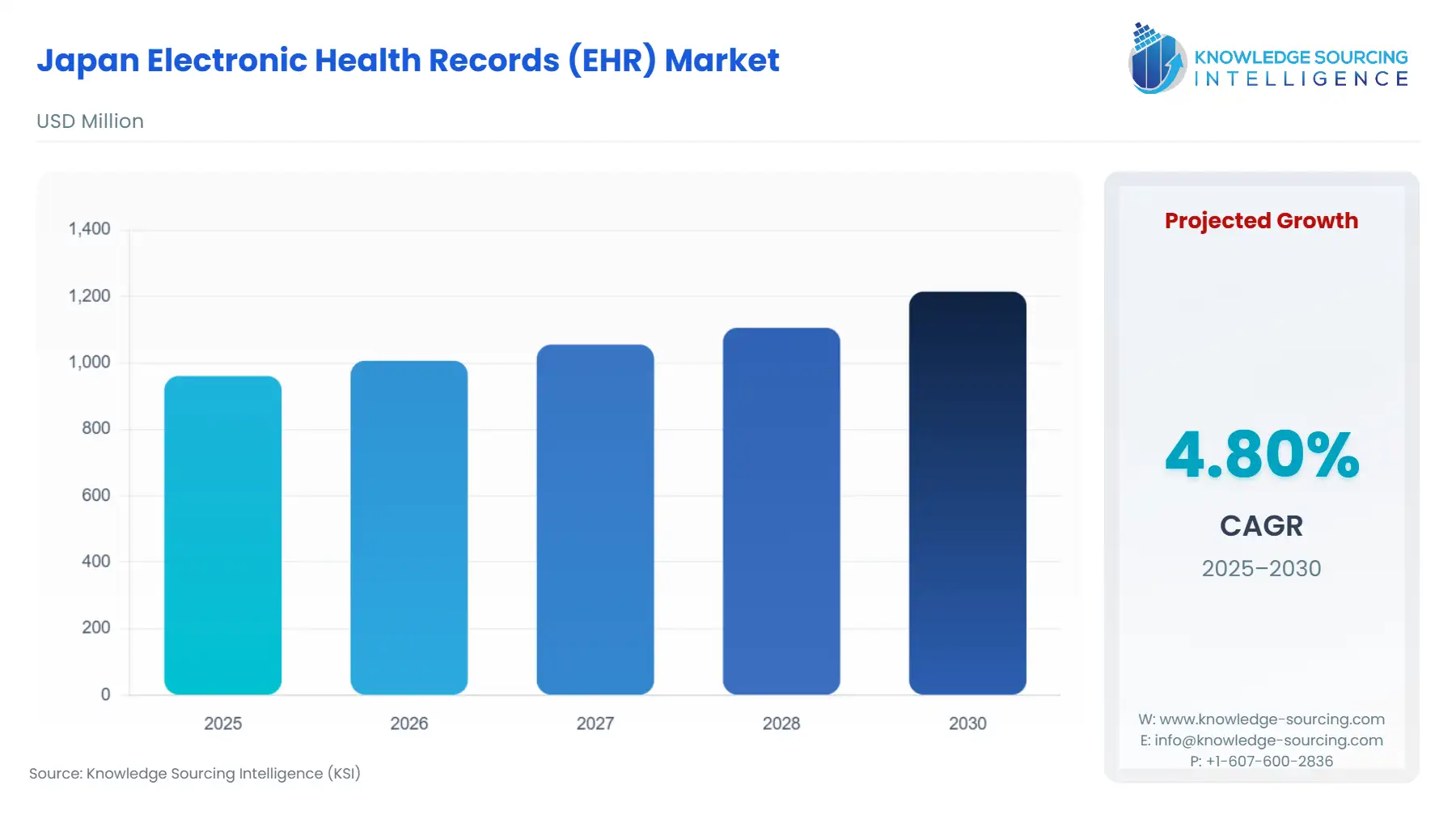
The Japan EHR market is experiencing steady moderate growth at a CAGR of 4.81% during the forecast period. The market is driven by the increasing focus of the government on the digitalization of the healthcare system. It is significantly driving the market of EHRs in the country. Also, with the world’s highest ageing population trend, there is effective demand for interoperability of medical information of patients, giving a boost to the adoption of EHRs. This growth in the ageing population has also led to a decline in the adult population, increasing the shortages of healthcare professionals. This, in turn, is driving the need for effective management, leading to higher adoption of EHRs. At the same time, healthcare providers are also increasingly adopting electronic health records systems for their operational efficiency and streamlining their workflows.
Japan Electronic Health Records (EHR) Market Overview & Scope
The Japan Electronic Health Records (EHR) Market is segmented by:
- Product: By product, cloud-based EHR and on-premise EHR are major two major types of product. Cloud-based EHRs are the dominant product adopted in the market, driven by their benefits such as accessibility from any location, cost-effectiveness by drastically reducing the upfront costs and hardware and IT staff costs. On the other hand, on-premise EHR holds significance, particularly among organizations requiring complete control.
- Type: By type, acute, ambulatory and post-acute are major categories. Acute EHRs are specifically designed for electronic documentation of a patient's medical information during the acute care settings, such as in an emergency room. These are in demand due to their real-time updates, integration with other systems and help in maintaining workflow. The ambulatory EHR is designed for outpatient healthcare settings. They comprise a key significant share due to their demand for managing patient interactions, utilising patient portals and supporting billing and coding. Post-care EHR is also a growing segment.
- End User: Hospitals, clinics, pharmacies, laboratories and others mainly demand these electronic health records. Hospitals are the dominant segment due to the higher volume of demand for electronic health records systems.
Top Trends Shaping the Japan Electronic Health Records (EHR) Market
- Cloud Computing and AI-driven Solutions
- The adoption of cloud computing and AI-driven solutions is making the EHR market grow. There is an increasing demand for cloud-based EHR, due to its scalability, cost-effectiveness and affordability. For example, in March 2023, Fujitsu Limited launched a new cloud-based EHR. It is compatible with the next-generation standards framework HL7 FHIR.
- The market is also growing towards more advanced EHR solutions, driving the integration of EHR with AI. The same company, Fujitsu, is leveraging AI-based into the healthcare system to make a digital health ecosystem.
Japan Electronic Health Records (EHR) Market Growth Drivers vs. Challenges
Drivers:
Challenges:
- High Implementation and Maintenance Costs: Many smaller hospitals and clinics delay adoption due to higher implementation costs. Even for large hospitals, it is an extra cost. Besides, the advanced EHR systems, such as those integrated with AI, require a high implementation cost in software, hardware, training, and maintenance, slowing down the adoption. Additionally, the ongoing maintenance costs make this burdensome for small and medium-sized hospitals or clinics.
- Data Security and Patient Privacy Concerns: Data security and privacy concerns are one of the major restraining factors for the market growth. Japanese healthcare providers must comply with the Act on the Protection of Personal Information (APPI) and related data protection laws, which have key impose rigorous requirements for handling, storing, and sharing patient health information. This is limiting the adoption in hospitals and clinics due to the risk of data breaches and cyberattacks. Also, these security issues make the implementation process complex and costly, further limiting the adoption.
Japan Electronic Health Records (EHR) Market Competitive Landscape
The market is moderately fragmented but heavily dominated by domestic players who cater to the country’s specific healthcare needs and regulations. Some major players in the market are: Fujitsu Limited, M3, Inc., TIS Inc., Epic Systems Corporation, Oracle Health, Wemex Corporation, and Henry Schein., A2 Healthcare
- Product Launch: In 2025, Wemex Corporation, which is a subsidiary of PHC Holdings, launched the Medicom-HRf Hybrid Cloud, an integrated EMR system for clinics in Japan. The product comes with Medicom Cloud Operation Continuity System, which immediately switches over to cloud operation during emergencies and natural disasters, helping with medical records viewing and image capture functions using regular tablets and devices.
Japan Electronic Health Records (EHR) Market Scope:
| Report Metric | Details |
|---|---|
| Study Period | 2021 to 2031 |
| Historical Data | 2021 to 2024 |
| Base Year | 2025 |
| Forecast Period | 2026 – 2031 |
| Report Metric | Details |
| Japan Electronic Health Records (EHR) Market Size in 2025 | USD 0.961 billion |
| Japan Electronic Health Records (EHR) Market Size in 2030 | USD 1.215 billion |
| Growth Rate | CAGR of 4.81% |
| Study Period | 2020 to 2030 |
| Historical Data | 2020 to 2023 |
| Base Year | 2024 |
| Forecast Period | 2025 – 2030 |
| Forecast Unit (Value) | USD Billion |
| Segmentation |
|
| List of Major Companies in the Japan Electronic Health Records (EHR) Market |
|
| Customization Scope | Free report customization with purchase |
Japan Electronic Health Records (EHR) Market Segmentation:
- By Product
- On-Premise
- Cloud-Based
- By Type
- Acute
- Ambulatory
- Post-Acute
- By End-User
- Hospitals
- Clinics
- Pharmacies
- Laboratories
- Others
Our Best-Performing Industry Reports:
- Healthcare Natural Language Processing (NLP) Market
- Healthcare Compliance Software Market
- Healthcare Data Storage Market
Market Segmentation
By Product
By Type
By End-user
Table of Contents
1. EXECUTIVE SUMMARY
2. MARKET SNAPSHOT
2.1. Market Overview
2.2. Market Definition
2.3. Scope of the Study
2.4. Market Segmentation
3. BUSINESS LANDSCAPE
3.1. Market Drivers
3.2. Market Restraints
3.3. Market Opportunities
3.4. Porter’s Five Forces Analysis
3.5. Industry Value Chain Analysis
3.6. Policies and Regulations
3.7. Strategic Recommendations
4. TECHNOLOGICAL OUTLOOK
5. Japan Electronic Health Records (EHR) Market BY PRODUCT
5.1. Introduction
5.2. On-Premise
5.3. Cloud-Based
6. Japan Electronic Health Records (EHR) Market BY TYPE
6.1. Introduction
6.2. Acute
6.3. Ambulatory
6.4. Post-Acute
7. Japan Electronic Health Records (EHR) Market BY End-User
7.1. Introduction
7.2. Hospitals
7.3. Clinics
7.4. Pharmacies
7.5. Laboratories
7.6. Others
8. COMPETITIVE ENVIRONMENT AND ANALYSIS
8.1. Major Players and Strategy Analysis
8.2. Market Share Analysis
8.3. Mergers, Acquisitions, Agreements, and Collaborations
8.4. Competitive Dashboard
9. COMPANY PROFILES
9.1. Fujitsu Limited
9.2. M3, Inc.
9.3. TIS Inc.
9.4. Epic Systems Corporation
9.5. Oracle Health
9.6. Wemex Corporation
9.7. Henry Schein
9.8. A2 Healthcare
10. RESEARCH METHODOLOGY
Navigate
Trusted by the world's leading organizations











