
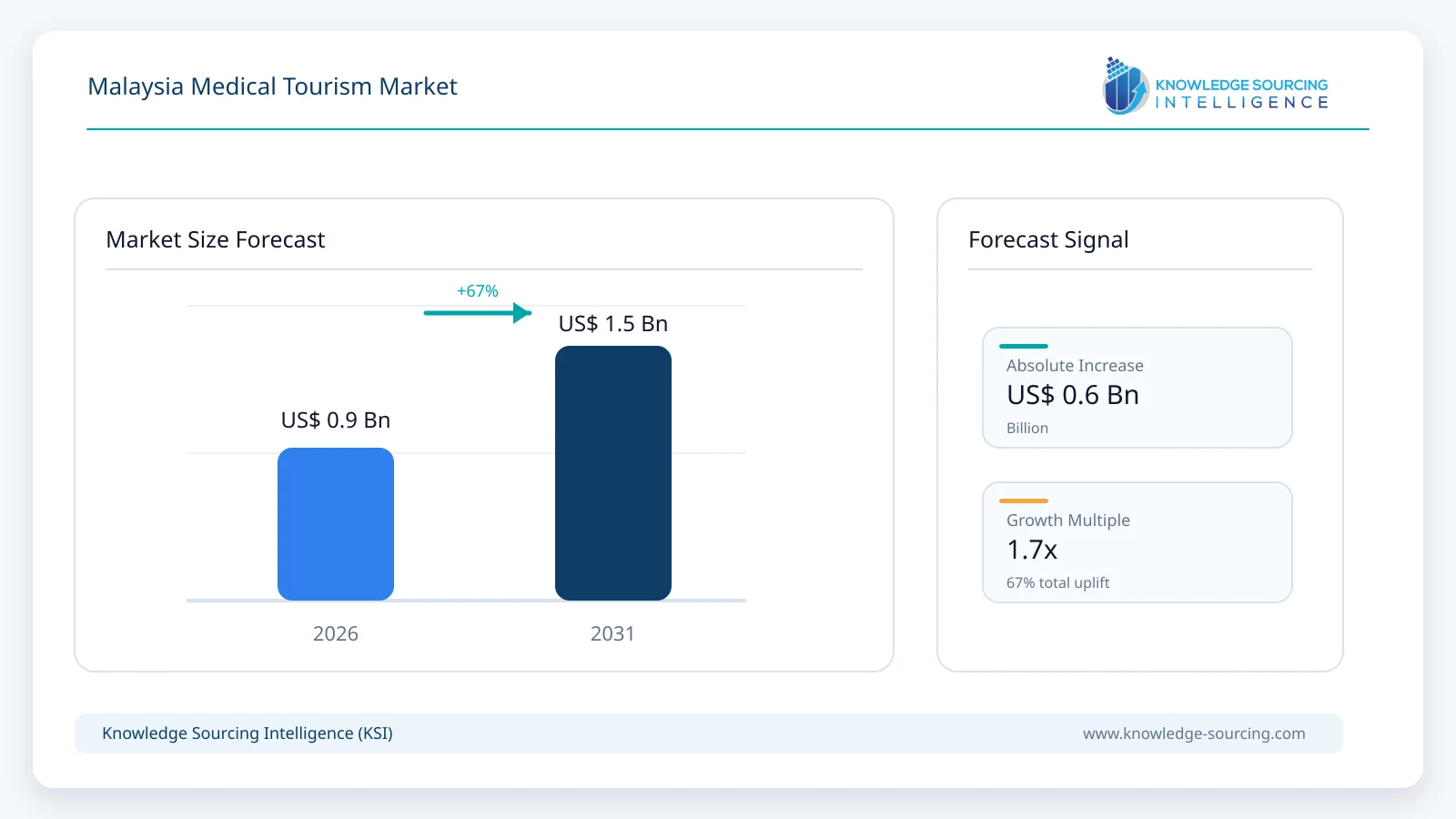
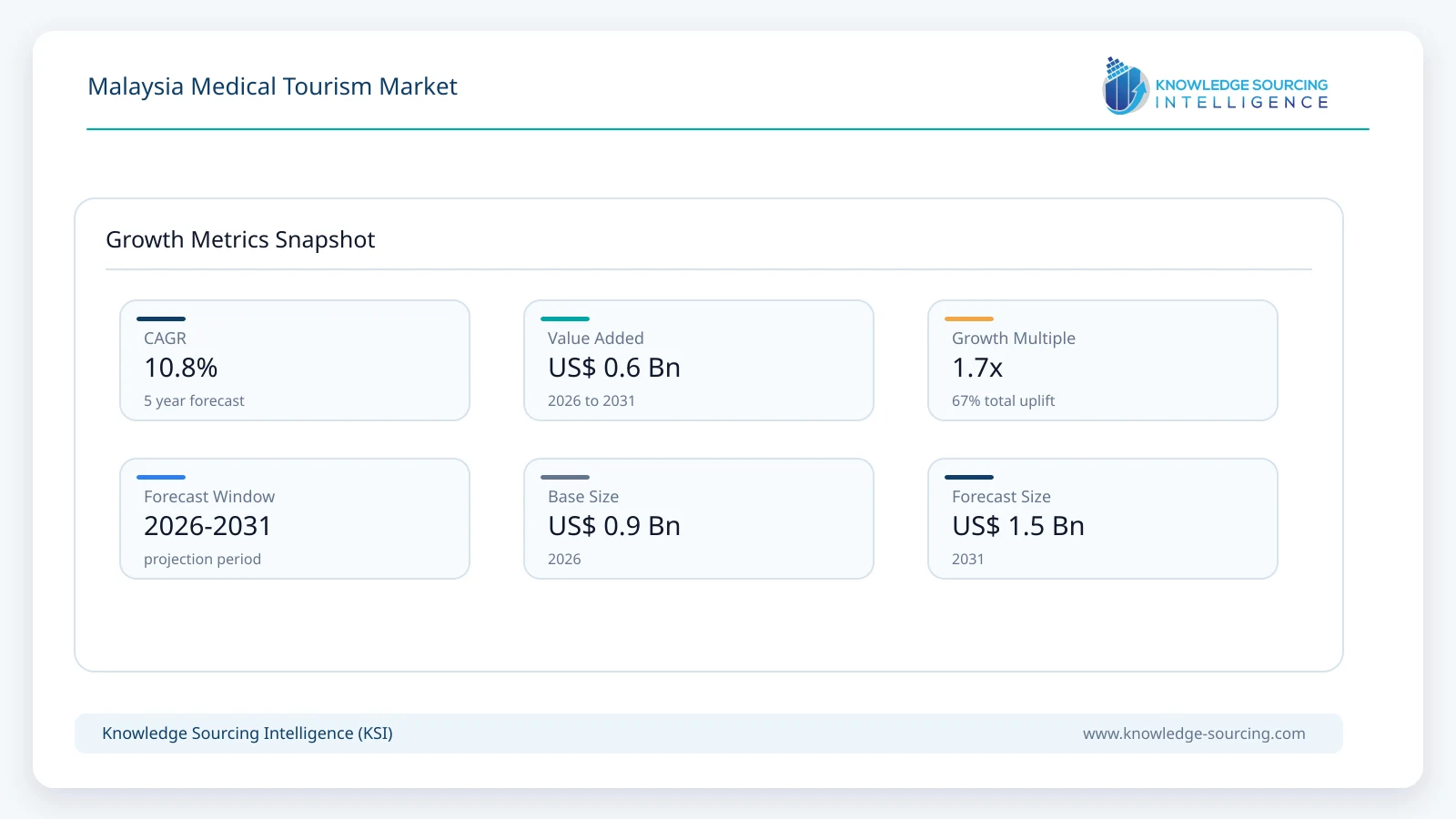
The Malaysia medical tourism market is valued at USD 0.91 billion in 2026 and is expected to reach approximately USD 1.52 billion by 2031, expanding at a CAGR of about 10.8% during the forecast period.
Highlights:
- 1Indonesia contributes roughly 64% of 2026 healthcare-travel revenue and remains Malaysia's anchor source market.
- 2Cardiovascular treatment generates about USD 210 million in 2026 through specialist referral demand.
- 3 Private multispecialty hospitals capture approximately 82% of revenue through integrated international-patient programs.
- 4Penang accounts for about 31% of 2026 revenue, supported by strong Indonesian patient flows.
- 5China is the fastest-growing major source market as referral channels and direct engagement expand.
- 6Malaysia recorded about 1.84 million healthcare travellers and RM3.34 billion revenue during 2025.
Malaysia has developed one of Southeast Asia's most institutionalized healthcare travel ecosystems. The Malaysia Healthcare Travel Council, operating under the Ministry of Health, coordinates national branding, overseas promotion and provider participation, while private hospitals handle international patient conversion, treatment planning, language support and post-treatment coordination. The result is a more organized market than one based solely on independent medical-tourism facilitators. In 2024, Malaysia welcomed approximately 1.59 million healthcare travellers and generated RM2.72 billion in revenue. By 2025, healthcare traveller volume had risen to about 1.84 million and revenue to approximately RM3.34 billion, exceeding the government's RM3.0 billion target and marking the highest reported achievement since MHTC was established. This provides a strong operating base for the 2026 forecast rather than requiring a top-down global market allocation.
Demand is nevertheless concentrated. Indonesia generated about RM2.2 billion of Malaysia's healthcare travel revenue in 2025 through nearly 970,000 visits, making bilateral connectivity and patient confidence in Malaysian providers central to the market. Malaysia is actively reducing this concentration by developing China, Cambodia and other regional corridors. MHTC reported more than 120,000 healthcare travellers from China in 2025 and over RM200 million in revenue, with Chinese traveller volumes expanding rapidly between 2023 and 2025. Cambodia exceeded 12,000 healthcare travellers in 2025, while structured referrals from government and institutional partners are also becoming more visible. Malaysia Year of Medical Tourism 2026 is designed to support this diversification while shifting the competitive message from affordable care alone toward clinical quality, specialist depth and end-to-end patient experience.
Market Trends
International Patient Management Is Becoming a Hospital-Owned Capability
Leading hospital groups increasingly manage the international patient journey directly. Dedicated teams review records before travel, arrange specialist appointments, estimate treatment costs, coordinate airport or accommodation support and maintain contact after discharge. This reduces reliance on fragmented third-party facilitators and gives providers greater control over clinical communication and pricing transparency. The trend is especially important for complex care, where international patients need multidisciplinary review before committing to travel. IHH Healthcare Malaysia, KPJ Healthcare, Sunway Healthcare and other groups now combine medical expertise with concierge-style coordination across multiple hospitals. For Malaysia, this strengthens repeat referrals and allows providers to build relationships with physicians, employers, insurers and government bodies in source countries rather than competing only for one-off consumer leads.
Malaysia Is Shifting from High Volume toward Higher-Value Specialty Care
The next growth phase is increasingly tied to revenue intensity rather than patient counts alone. Malaysia has historically attracted regional patients for health screening, diagnostics, dental services, fertility treatment and elective procedures, but provider investment is moving toward oncology, cardiology, orthopaedics, robotic surgery and other complex specialties. The Flagship Medical Tourism Hospital program reinforces this direction by evaluating clinical excellence, technology, patient experience and international brand strength. Island Hospital was named the inaugural flagship winner in December 2025, while Institut Jantung Negara, Mahkota Medical Centre and Subang Jaya Medical Centre received distinction awards in specialist and strategic categories. These programs encourage hospitals to compete on measurable medical capability and not solely on treatment price.
Source-Market Development Is Moving Beyond Traditional Indonesian Corridors
Indonesia remains essential, particularly for Penang, Kuala Lumpur and Melaka providers, but Malaysia is expanding direct market development in China, Cambodia and other ASEAN economies. MHTC's 2026 activities include healthcare expos, hospital familiarization programs and institutional referral development. China is particularly important because traveller volume rose from about 50,000 in 2021 to more than 120,000 in 2025, while revenue increased to more than RM200 million. Cambodia remains much smaller but is being cultivated through consumer-facing healthcare expos and hospital participation. This diversification matters because a broader source base lowers exposure to airline disruptions, currency changes, bilateral policy shifts or changes in patient preference in any single country.
Market Drivers
Competitive Treatment Costs and Regional Accessibility Support Repeat Demand
Malaysia benefits from a favorable combination of treatment cost, quality and travel convenience for patients from Southeast Asia. Short-haul connectivity from Indonesian cities, widespread use of English and Malay, cultural familiarity and relatively simple travel logistics reduce the non-medical cost of treatment. For patients needing repeat diagnostics, oncology cycles, fertility procedures or post-operative review, travel convenience can be as important as the initial procedure price. The ringgit's relative affordability against several source-country currencies has also strengthened the value proposition. These factors support repeat visits and family-accompanied treatment patterns, particularly from Indonesia, where Malaysia has developed a strong reputation for private specialist care.
Hospital Capacity and Technology Investment Are Expanding the Addressable Case Mix
Private providers are expanding both bed capacity and high-acuity technology. Sunway Healthcare's disclosed expansion program includes additional capacity at Sunway Medical Centre Sunway City and Sunway Medical Centre Velocity during 2026, with further expansion planned in Penang. Columbia Asia opened a new wing at its Cheras hospital in April 2026, increasing beds and adding specialist services, while IHH Healthcare continues to deepen its Malaysian network and is developing a new Gleneagles Hospital Kuching for 2028. The competitive effect is broader than bed numbers. New oncology systems, robotic surgery, advanced imaging, cardiac laboratories and digital patient workflows increase the number of complex cases Malaysian providers can accept from abroad and support higher revenue per patient.
Malaysia Year of Medical Tourism 2026 Provides Coordinated National Promotion
MYMT 2026 gives the sector a coordinated national campaign under the 'Healing Meets Hospitality' positioning. The program links medical services with the wider visitor experience while emphasizing quality, affordability and service. MHTC has used the campaign to intensify market activations in Indonesia, China and Cambodia and to involve a broad group of hospitals and specialist centers. This national coordination is commercially relevant because individual hospitals benefit from destination-level marketing that would be expensive to replicate independently. It also allows Malaysia to present a consistent healthcare brand while hospitals compete within the country on specialty expertise, physician reputation and patient experience.
Market Restraints
High Dependence on Indonesia Creates Concentration Risk
Malaysia's strongest source market is also its largest structural risk. Indonesia contributed close to two-thirds of healthcare travel revenue in 2025, so changes in bilateral air connectivity, currency movements, domestic hospital capability or patient sentiment can materially affect Malaysia's inbound volumes. Indonesian healthcare infrastructure is improving, and large domestic hospital groups continue to expand specialist services in major cities. Malaysia therefore cannot assume that historical cross-border patient patterns will continue unchanged. The response is not to reduce focus on Indonesia, which remains highly valuable, but to raise treatment complexity, deepen referral relationships and develop additional source markets so that industry growth does not depend on a single corridor.
Price Transparency and Post-Treatment Continuity Remain Important Conversion Barriers
International patients compare providers across countries and increasingly expect clear quotations, outcome information, accreditation, physician credentials and defined follow-up plans. Treatment costs can change after diagnostic review, while complications after the patient returns home may require coordination with local physicians. This is especially relevant for oncology, cardiac procedures, fertility treatment and complex surgery where care extends beyond one hospital stay. Malaysian providers that can standardize pre-arrival assessment, explain what is included in quoted prices and maintain remote follow-up are better positioned to reduce this friction. Providers without these capabilities may struggle to convert more informed patients even if their headline treatment prices are competitive.
Malaysia Medical Tourism Market Segment Analysis
By Treatment Type
Cardiovascular Treatment
Cardiovascular treatment is the largest revenue-generating segment because Malaysia combines established cardiology expertise with high-value diagnostics, interventional procedures and surgery. Institut Jantung Negara remains an important national specialist institution, while major private hospitals operate cardiac centers supported by catheterization laboratories, imaging and surgical capability. MHTC has previously positioned cardiology as one of Malaysia's priority healthcare travel strengths. Demand is particularly suitable for cross-border care because many cardiac cases involve clear diagnostic pathways, significant cost differences and the need for timely intervention. The segment also benefits from preventive screening and second-opinion demand, creating a pipeline from diagnostics into higher-value procedures.
By Treatment Type
Oncology Is Expected to Grow Faster than the Overall Market
Oncology is projected to be one of the fastest-growing major treatment categories, with an estimated CAGR of about 12.7% through 2031. Growth is supported by rising cancer incidence across ASEAN, uneven access to advanced radiation and multidisciplinary cancer care in source markets, and continued investment by Malaysian hospitals in imaging, radiotherapy, surgery and systemic treatment. Cancer care also produces repeat patient interactions over a longer period than many elective procedures, increasing revenue per international patient when providers can coordinate treatment cycles and follow-up efficiently. The main constraint is continuity after patients return home, making digital record exchange and physician-to-physician coordination important competitive capabilities.
By Service Provider
Private Multispecialty Hospitals
Private multispecialty hospitals dominate international patient revenue because they combine advanced diagnostics, multiple specialties, intensive-care capability and dedicated international patient services in one setting. Groups such as IHH Healthcare Malaysia, KPJ Healthcare, Sunway Healthcare and Asia OneHealthcare can manage complex cases across cardiology, oncology, orthopaedics, gastroenterology and neurology while providing concierge support for patients and accompanying family members. Their network scale also allows source-market outreach to be centralized across multiple hospitals. The segment's competitive advantage is strongest where providers can demonstrate both clinical quality and a consistent service experience rather than relying on the reputation of individual physicians alone.
By Service Provider
Specialist Hospitals and Clinics Are Expanding Faster in Selected Niches
Specialist providers are growing faster in fertility, ophthalmology, orthopaedics, cardiovascular care and oncology because they can build a focused international brand around a narrower set of procedures. Malaysia has an established fertility proposition and a concentration of specialist centers using advanced embryology and reproductive technology, while eye and orthopaedic providers benefit from elective demand with relatively predictable treatment pathways. Specialist centers can also respond quickly to digital inquiries and package diagnostics, procedures and follow-up around a clearly defined clinical problem. Their limitation is that complex patients with multiple co-morbidities may still require transfer or collaboration with a multispecialty hospital.
By Patient Source Market
Indonesia Remains the Core Market
Indonesia will remain Malaysia's largest source market through the forecast period because of proximity, longstanding patient familiarity and established referral networks. Penang and Melaka benefit from strong western Indonesian flows, while Kuala Lumpur attracts higher-acuity cases from across the country. The 2025 record of nearly 970,000 Indonesian healthcare visits and more than RM2.2 billion in revenue demonstrates the depth of this corridor. Growth is expected to become more value-led as Malaysian providers compete for complex specialist cases rather than relying only on screening and routine treatment. Direct outreach in Jakarta, Medan, Yogyakarta and other cities supports this strategy.
By Patient Source Market
China Offers the Strongest Diversification Opportunity
China is the most important emerging source market because traveller numbers and revenue are rising from a much smaller base than Indonesia. MHTC reported that Chinese healthcare traveller arrivals exceeded 120,000 in 2025 and generated more than RM200 million in revenue. Direct promotional activity in Guangzhou and engagement with private healthcare institutions are intended to deepen referrals. Malaysia's challenge is to differentiate itself from other regional destinations competing for Chinese patients, particularly Thailand and Singapore. Specialist treatment, Mandarin-language coordination, digital pre-consultation and transparent service packages will therefore be more important than destination awareness alone.
By Destination
Penang Is Malaysia's Most Established Cross-Border Medical Cluster
Penang has an unusually strong healthcare tourism identity because of its geographic accessibility to Indonesia, concentration of recognized private hospitals and long history of international patients. Island Hospital's selection as Malaysia's first Flagship Medical Tourism Hospital reinforces the state's position, while Gleneagles Hospital Penang, Penang Adventist Hospital, Sunway Medical Centre Penang and other providers broaden the treatment base. The cluster benefits from repeat patients and word-of-mouth referrals from Sumatra, but providers are also expanding higher-value cardiology, oncology, orthopaedic and diagnostic services. Penang's outlook therefore depends on maintaining its Indonesian franchise while moving further into complex specialist care.
By Destination
Johor Is Expected to Record the Fastest Growth
Johor is expected to be the fastest-growing destination cluster, with an estimated CAGR of about 12.1% through 2031. Its advantages include proximity to Singapore and Indonesia, expanding private hospital infrastructure and the ability to serve patients seeking a lower-cost alternative within a highly connected regional corridor. IHH, KPJ and other providers operate hospitals in the state, while the wider Johor-Singapore economic relationship can improve specialist access and patient mobility over time. Johor starts from a smaller medical-tourism base than Kuala Lumpur or Penang, so new capacity and cross-border marketing can translate into faster percentage growth even if absolute revenue remains lower.
Technology Outlook
Digital Pre-Arrival Assessment and Patient Navigation
Digital intake is becoming the first stage of the international patient journey. Hospitals increasingly allow patients to submit medical records, imaging and laboratory results before travel so specialists can provide an initial opinion and treatment plan. This improves conversion because the patient receives clearer information on suitability, likely duration and expected cost before purchasing flights or arranging accommodation. It also helps hospitals identify cases requiring additional tests before arrival. Over time, AI-assisted document summarization, multilingual communication and automated case routing can reduce administrative workload while keeping clinical decisions with physicians. The strongest platforms will integrate inquiry management with appointments, financial counselling and post-discharge communication rather than operating as stand-alone lead forms.
Robotics, Advanced Imaging and Precision Treatment Increase Case Complexity
Malaysia's leading private hospitals are using technology as a differentiator in high-value international care. Robotic surgery, advanced radiotherapy, high-resolution imaging, minimally invasive cardiac procedures and precision diagnostics allow providers to accept cases that previously might have travelled to Singapore, Australia or other higher-cost destinations. IHH's planned Gleneagles Hospital Kuching is expected to include AI-assisted diagnostics, robotic surgery and advanced imaging, while existing major hospital groups continue to invest in high-acuity technology. These investments support medical tourism only when hospitals also have the specialist teams, clinical governance and patient coordination required to translate equipment into reliable outcomes.
Remote Follow-Up Is Extending Care beyond the Hospital Stay
Cross-border treatment creates an inherent continuity problem after discharge. Teleconsultation, digital imaging exchange, medication review and structured follow-up programs allow Malaysian specialists to remain involved after the patient returns home. This is particularly important for oncology, fertility, orthopaedics and cardiac care, where outcomes may depend on multiple consultations over several months. Stronger post-treatment systems also improve referral confidence among physicians and institutional partners in source countries. The technology opportunity is therefore not simply telemedicine as a separate service, but a longitudinal patient record and communication workflow that connects pre-travel evaluation, in-country treatment and post-travel follow-up.
Competitive Environment
Malaysia's competitive environment is led by large private hospital groups, flagship tertiary hospitals and specialist centers with strong international patient capabilities. IHH Healthcare Malaysia has one of the broadest national networks and an international brand portfolio spanning Gleneagles, Pantai, Prince Court and Island Hospital. KPJ Healthcare operates a large domestic hospital network with established health-tourism activity, while Sunway Healthcare is expanding capacity in the Klang Valley and Penang. Asia OneHealthcare combines Columbia Asia Malaysia with major tertiary assets including Subang Jaya Medical Centre and Beacon Hospital, creating another scaled platform. Institut Jantung Negara remains differentiated by cardiovascular specialization, while HMI Medical, Thomson Hospital Kota Damansara and specialist fertility, eye and orthopaedic providers compete in narrower high-value niches.
Competition is shifting from simply having internationally recognized facilities toward demonstrated specialist outcomes, referral relationships and a seamless international patient journey. The Flagship Medical Tourism Hospital program raises the visibility of hospitals that meet national benchmarks in clinical quality, technology, service and branding. International recognition also matters: multiple IHH Healthcare Malaysia hospitals appeared in global and regional hospital rankings during 2026, reinforcing provider credibility. At the same time, capacity expansion is increasing competition for specialists and international patients. Hospital groups that can coordinate multiple specialties, maintain transparent quotations and offer remote follow-up should be better positioned to convert higher-acuity cases than providers that rely mainly on price or destination marketing.
The market also remains highly regional. Penang hospitals compete strongly for Indonesian patients, Melaka providers benefit from proximity and established referral networks, Kuala Lumpur and Selangor dominate high-complexity tertiary care, and Johor is developing as a cross-border cluster linked to Singapore and Indonesia. This geographic specialization means competitive analysis should not be reduced to a single national market-share table. Source-market relationships, specialty mix and destination convenience differ significantly by provider, and these differences determine where each hospital can grow most effectively.
Recent Developments
September 2026: Malaysia and Indonesia discussed broader health cooperation, with Malaysia citing more than RM2.2 billion from Indonesian health tourism in 2025.
August 2026: MHTC returned to Yogyakarta after Indonesian healthcare travel generated a record RM2.2 billion for Malaysia during 2025.
June 2026: MHTC launched its first healthcare expo in Cambodia as 2025 Cambodian healthcare-travel revenue reached RM30.3 million.
May 2026: MHTC expanded its China-market program after Chinese healthcare travellers exceeded 120,000 and RM200 million in 2025 revenue.
April 2026: Columbia Asia Hospital Cheras opened an expanded wing, increasing bed capacity and adding higher-complexity specialties.
February 2026: IHH Healthcare Malaysia signed a structured referral agreement enabling Libyan civil servants to receive specialist treatment in Malaysia.
December 2025: Island Hospital was named Malaysia's inaugural Flagship Medical Tourism Hospital, with IJN, Mahkota and Subang Jaya Medical Centre also recognized.
Malaysia Medical Tourism Market Scope:
| Report Metric | Details |
|---|---|
| Total Market Size in 2026 | USD 0.91 billion in 2026 |
| Total Market Size in 2031 | USD 1.52 billion |
| Forecast Unit | Billion |
| Growth Rate | 10.8% |
| Study Period | 2021 to 2031 |
| Historical Data | 2021 to 2024 |
| Base Year | 2025 |
| Forecast Period | 2026 – 2031 |
| Segmentation | Treatment Type, Service Provider, Patient Source Market , Destination |
| Companies |
|
Market Segmentation
BY TREATMENT TYPE
Cardiovascular Treatment
Cancer / Oncology Treatment
Orthopedic and Spine Treatment
Fertility and Reproductive Treatment
Health Screening and Diagnostics
Ophthalmology Treatment
Dental Treatment
Cosmetic and Bariatric Treatment
Neurology and Neurosurgery
Other Specialized Treatments
BY SERVICE PROVIDER
Private Multispecialty Hospitals
Specialist Hospitals and Centers
Specialty Clinics
BY PATIENT SOURCE MARKET
Indonesia
China
Cambodia and Other Southeast Asia
Middle East and South Asia
Europe, Oceania and Others
BY DESTINATION
Kuala Lumpur and Selangor
Penang
Melaka
Johor
Other Malaysia
Table of Contents
1. EXECUTIVE SUMMARY
2. MARKET SNAPSHOT
2.1. Market Overview
2.2. Market Definition
2.3. Scope of the Study
2.4. Market Segmentation
3. BUSINESS LANDSCAPE
3.1. Market Drivers
3.1.1. Competitive Treatment Costs and Regional Accessibility Support Repeat Demand
3.1.2. Hospital Capacity and Technology Investment Are Expanding the Addressable Case Mix
3.1.3. Malaysia Year of Medical Tourism 2026 Provides Coordinated National Promotion
3.2. Market Restraints
3.2.1. High Dependence on Indonesia Creates Concentration Risk
3.2.2. Price Transparency and Post-Treatment Continuity Remain Important Conversion Barriers
3.3. Market Opportunities
3.4. Porter's Five Forces Analysis
3.5. Industry Value Chain Analysis
3.6. Policies and Regulations
3.7. Strategic Recommendations
4. TECHNOLOGICAL OUTLOOK
4.1. Digital Pre-Arrival Assessment and Patient Navigation
4.2. Robotics, Advanced Imaging and Precision Treatment
4.3. Remote Follow-Up and Cross-Border Care Coordination
5. MALAYSIA MEDICAL TOURISM MARKET BY TREATMENT TYPE
5.1. Introduction
5.2. Cardiovascular Treatment
5.3. Cancer / Oncology Treatment
5.4. Orthopedic and Spine Treatment
5.5. Fertility and Reproductive Treatment
5.6. Health Screening and Diagnostics
5.7. Ophthalmology Treatment
5.8. Dental Treatment
5.9. Cosmetic and Bariatric Treatment
5.10. Neurology and Neurosurgery
5.11. Other Specialized Treatments
6. MALAYSIA MEDICAL TOURISM MARKET BY SERVICE PROVIDER
6.1. Introduction
6.2. Private Multispecialty Hospitals
6.3. Specialist Hospitals and Centers
6.4. Specialty Clinics
7. MALAYSIA MEDICAL TOURISM MARKET BY PATIENT SOURCE MARKET
7.1. Introduction
7.2. Indonesia
7.3. China
7.4. Cambodia and Other Southeast Asia
7.5. Middle East and South Asia
7.6. Europe, Oceania and Others
8. MALAYSIA MEDICAL TOURISM MARKET BY DESTINATION
8.1. Introduction
8.2. Kuala Lumpur and Selangor
8.3. Penang
8.4. Melaka
8.5. Johor
8.6. Other Malaysia
9. COMPETITIVE ENVIRONMENT AND ANALYSIS
9.1. Major Players and Strategy Analysis
9.2. Market Share Analysis
9.3. Mergers, Acquisitions, Agreements and Collaborations
9.4. Competitive Dashboard
10. COMPANY PROFILES
10.1. IHH Healthcare Malaysia
10.2. KPJ Healthcare Berhad
10.3. Sunway Healthcare Group
10.4. Asia OneHealthcare
10.5. Institut Jantung Negara Sdn Bhd
10.6. HMI Medical / Mahkota Medical Centre
10.7. TMC Life Sciences Berhad / Thomson Hospital Kota Damansara
10.8. Penang Adventist Hospital
10.9. Aurelius Healthcare
10.10. KMI Healthcare
10.11. MSU Medical Centre
10.12. Alpha IVF & Women's Specialists
10.13. Sunfert International Fertility Centre
10.14. Optimax Holdings Berhad
10.15. ALTY Orthopaedic Hospital
10.16. Hospital Picaso
10.17. Northern Heart Hospital Penang
10.18. Avisena Healthcare
11. APPENDIX
11.1. Currency
11.2. Assumptions
11.3. Base and Forecast Years Timeline
11.4. Key Benefits for Stakeholders
11.5. Research Methodology
11.6. Abbreviations
Navigate
Trusted by the world's leading organizations











