
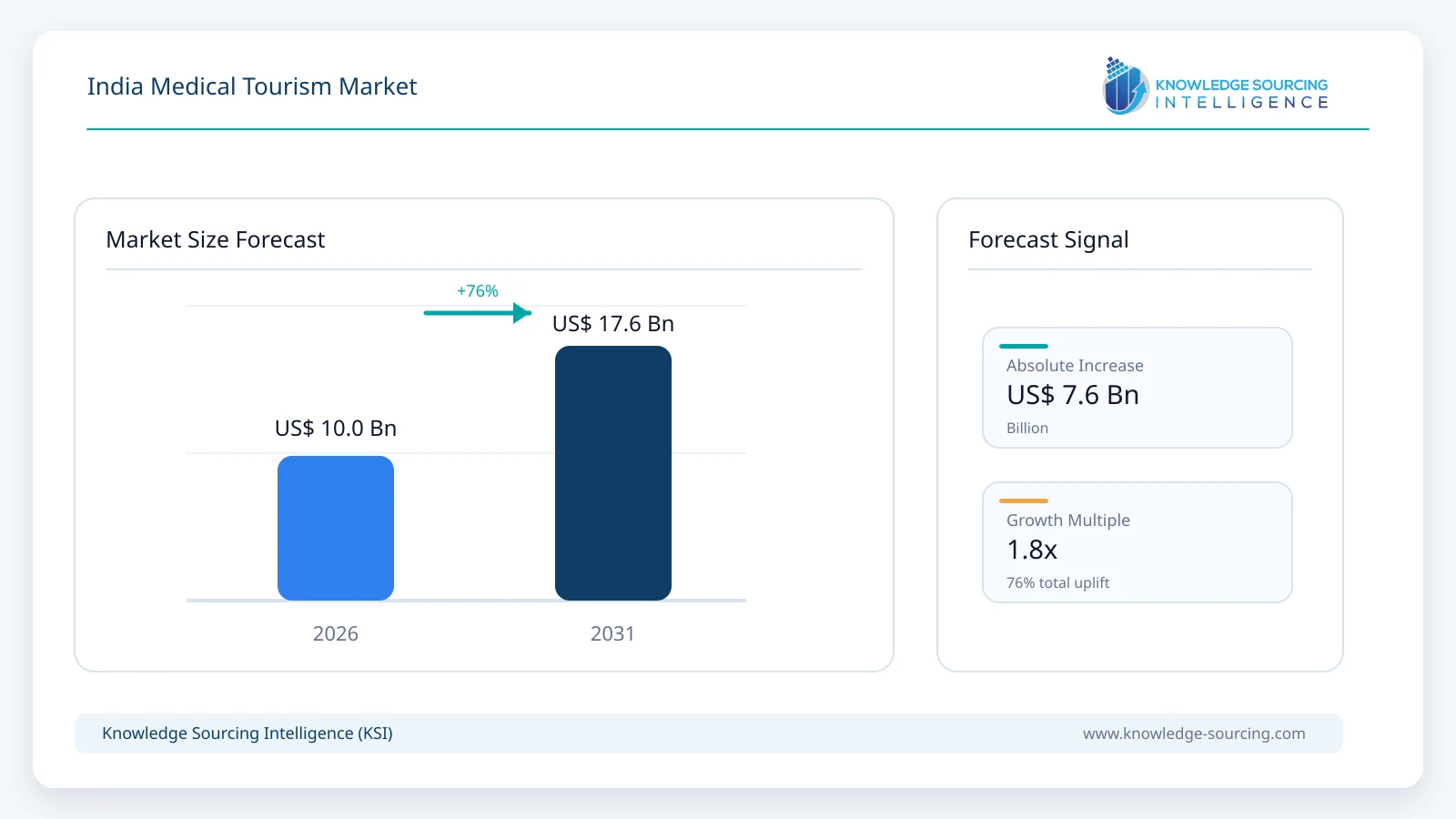
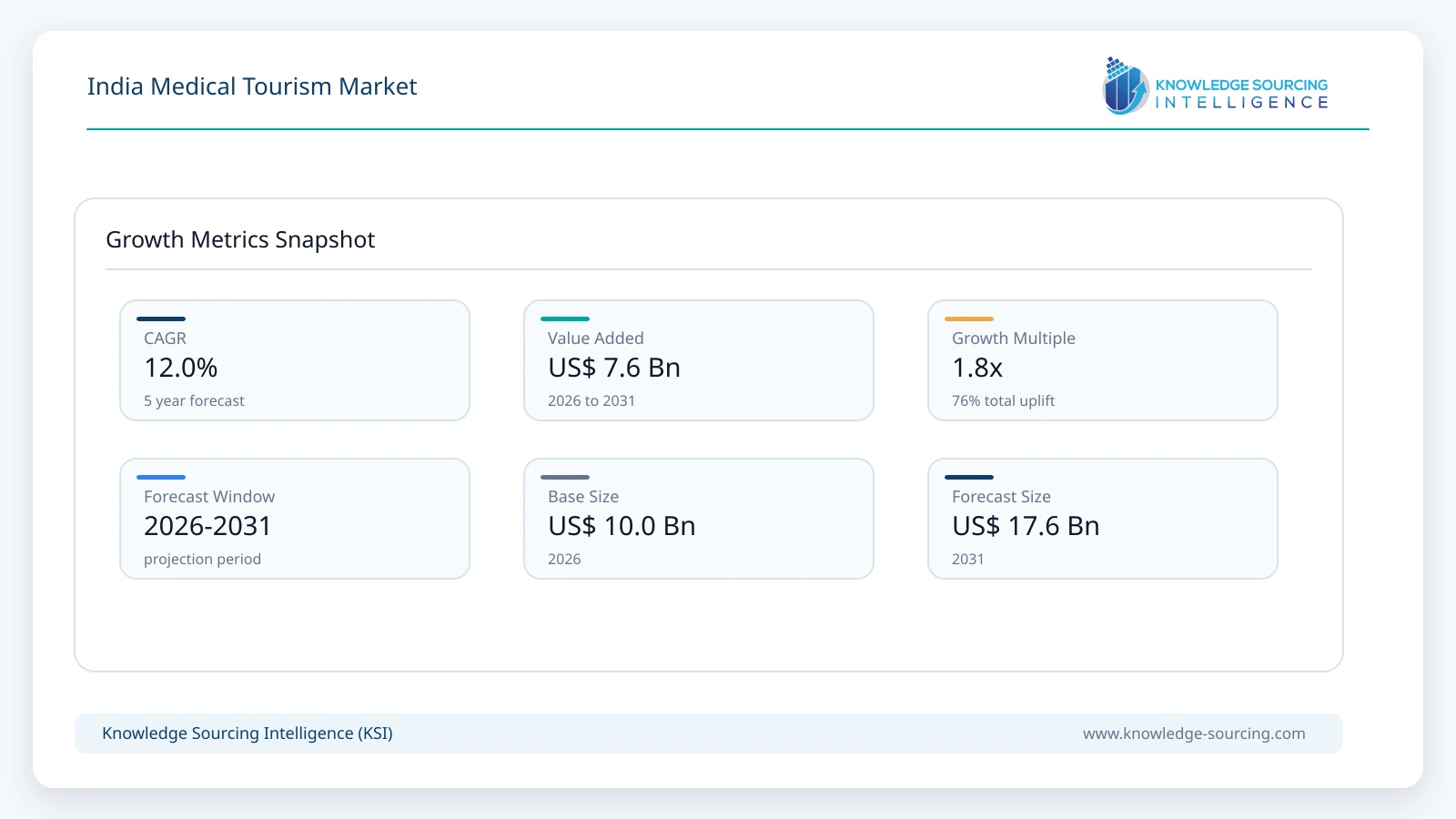
The India medical tourism market is estimated at USD 10.0 billion in 2026 and is projected to reach approximately USD 17.6 billion by 2031, growing at about 12.0% CAGR over the forecast period.
Highlights:
- 1Cardiovascular treatment generates an estimated USD 2.15 billion of market revenue in 2026.
- 2Private multispecialty hospital networks account for approximately 76% of medical-tourism revenue in 2026.
- 3North India represents roughly 37% of India medical-tourism revenue in 2026.
- 4Bangladesh contributed about 64% of India medical-purpose foreign arrivals in 2025, creating source-market concentration risk.
- 5India received 507,244 foreign nationals specifically for medical treatment in 2025.
- 6The 2026 Union Budget proposed five Regional Medical Hubs in partnership with the private sector.
Market Overview
India's medical-tourism proposition is built around the combination of specialist depth, hospital scale and a wide treatment-cost differential relative to higher-cost healthcare systems. In May 2026, the Government of India described India as a major Medical Value Travel destination and cited an industry estimate of USD 8.7 billion for 2025, rising to USD 16.2 billion by 2030. The same government material highlights more than 50 JCI-accredited and over 1,700 NABH-accredited hospitals as part of the quality infrastructure supporting international patient confidence. These figures should not be treated as a substitute for a market model because definitions vary materially across published estimates, particularly on whether wellness, accommodation, travel and attendant spending are included.
Inbound volumes remain substantial but have not followed a straight upward path. Bureau of Immigration data show 659,356 medical-purpose foreign arrivals in 2023 and 644,387 in 2024. Full-year 2025 arrivals declined to 507,244, with Bangladesh alone accounting for 325,127 patients. Iraq, Uzbekistan, Somalia, Turkmenistan, Oman and Kenya were among the other leading source markets. The decline demonstrates why a forecast based only on historic CAGR propagation would be unreliable. Political conditions, visa access, air connectivity and cross-border payment constraints can alter patient flows quickly, while revenue can still grow faster than patient numbers if the mix shifts toward complex oncology, cardiovascular, transplant and neuroscience cases.
The policy environment is becoming more structured. The e-Medical Visa and e-Medical Attendant Visa framework has been extended to nationals of more than 170 countries, while the Heal in India platform is being developed as an end-to-end gateway for international patients. The 2026 Union Budget proposed five Regional Medical Hubs combining clinical care, education and research with private-sector participation. In September 2026, the Ministry of Commerce and Industry called for wider hospital participation in the Heal in India gateway and emphasized a seamless international patient journey, trained caregivers and stronger global promotion. These initiatives support market formalization, but execution quality, transparent pricing and reliable post-treatment continuity will determine whether policy interest converts into durable patient growth.
Market Trends
Hospital-Led International Patient Programs Are Replacing Fragmented Facilitation
Large hospital groups are increasingly internalizing functions that were historically handled by independent medical-tourism agents. International patient teams now review medical records before travel, arrange specialist video consultations, issue treatment plans and estimates, support visa documentation, coordinate airport transfers and interpreters, and manage post-discharge follow-up. This model gives hospitals greater control over clinical communication and patient experience while reducing information loss between the facilitator and treating team. Independent facilitators remain important in source markets where local language, financing and referral networks are decisive, but the competitive advantage is shifting toward providers that can offer a verifiable, hospital-owned patient pathway from first inquiry through remote follow-up after the patient returns home.
Complex Care Is Increasing Revenue per International Patient
Medical tourism demand is moving beyond low-complexity elective procedures toward higher-value oncology, cardiac, neurological, transplant, robotic, and advanced orthopedic care. These cases require multidisciplinary teams, intensive diagnostics, longer hospital stays, and coordinated rehabilitation, increasing revenue per episode even when total inbound patient volumes are volatile. Indian hospital chains are expanding quaternary-care capacity and deploying robotic surgery, advanced radiation oncology, transplant programs, and precision diagnostics to differentiate from competing destinations. This mix shift is strategically important because India cannot rely only on the headline of cheaper care; complex procedures create stronger clinical differentiation and make international accreditation, infection-control systems, outcome reporting and specialist reputation more important purchase criteria.
Teleconsultation Is Becoming Part of the Cross-Border Care Continuum
Telemedicine is reducing friction before and after travel. A prospective patient can now send imaging and laboratory records, obtain a specialist opinion, compare treatment pathways and receive an indicative cost before booking travel. After discharge, the same platform can support medication review, wound assessment, rehabilitation guidance and consultation with local physicians. This is particularly relevant for oncology, transplants, cardiac surgery and fertility treatment, where follow-up extends beyond the physical stay in India. The effect is not simply digital convenience: hospitals that maintain a structured remote relationship can reduce perceived continuity-of-care risk, one of the main barriers to international treatment, and can expand referral networks without establishing a full physical presence in every source country.
Market Drivers
The Cost-Quality Differential Remains India's Core International Advantage
India's strongest demand driver remains the gap between the cost of advanced treatment in India and in higher-cost healthcare systems. In September 2026, the Ministry of Commerce and Industry described Indian healthcare costs as 60-80% lower in many areas while emphasizing clinical excellence and advanced technologies. The savings are particularly relevant for self-pay patients and for treatments where insurance coverage in the home market is limited or waiting periods are long. Cost alone, however, is insufficient for complex procedures. The combination of lower treatment cost with internationally accredited hospitals, specialist concentration, English-language communication and relatively rapid scheduling converts the price differential into a credible cross-border healthcare proposition rather than simple low-cost competition.
Government Facilitation Is Reducing Travel and Information Friction
Medical tourism involves more administrative friction than leisure travel because patients may require medical documentation, attendants, longer stays, post-operative mobility support and coordination with hospitals before arrival. India's e-Medical and attendant visa framework, the Heal in India portal and proposed medical-travel concierge functions address these barriers directly. The 2026 Regional Medical Hub proposal could further integrate hospitals, research, education and patient-support infrastructure at selected destinations. Government involvement also improves destination visibility in source markets where patients may be unfamiliar with individual Indian providers. The commercial opportunity therefore extends beyond hospitals to accredited facilitators, interpreters, recovery providers, medical transport, digital patient-navigation platforms and specialized accommodation services that can integrate with clinical pathways.
Private Hospital Capacity Expansion Is Increasing the Supply of Advanced Care
Large private hospital groups continue to add beds, acquire regional networks and deepen specialty capabilities. Aster Quality Care commenced operations in July 2026 following the combination of Aster DM Healthcare and Quality Care India, creating a broader hospital platform across multiple Indian cities. Other listed groups, including Apollo Hospitals, Max Healthcare and Fortis Healthcare, continue to invest in new hospitals, brownfield additions and higher-acuity specialties. Capacity growth matters for medical tourism because international patients are concentrated in tertiary and quaternary hospitals rather than the overall hospital base. New bed capacity in oncology, transplants, cardiac sciences, neurosciences and advanced orthopedics expands the number of hospitals capable of competing for international referrals and can reduce dependence on a small set of metro facilities.
Market Restraints
Dependence on a Small Number of Source Countries Creates Demand Volatility
India's inbound medical market remains highly concentrated by country of origin. Bangladesh represented almost two-thirds of medical-purpose foreign arrivals in 2025, meaning political disruption, visa restrictions, currency controls, travel advisories or changes in cross-border medical access can materially affect national volumes. The 2025 decline in medical-purpose arrivals illustrates this exposure. Providers are responding by expanding outreach in Africa, the Middle East and Central Asia, but source-market diversification requires local referral relationships, language support, brand recognition and consistent follow-up. A hospital can therefore have strong clinical capacity without immediately converting that capacity into international demand if the commercial referral network in target countries is weak.
Quality Transparency and Post-Treatment Continuity Remain Uneven
International patients compare not only price but also accreditation, physician credentials, outcomes, complication management, pricing transparency, and recourse if problems occur after returning home. India's leading hospitals provide sophisticated international-patient services, but quality and communication are not uniform across the wider provider base. Inconsistent package quotations, unclear exclusions, variable facilitator practices and limited cross-border continuity can reduce trust. The market will therefore increasingly reward providers that publish clear treatment pathways, maintain recognized accreditation, document outcomes, coordinate medical records securely and establish post-treatment links with physicians in the patient's home country. These requirements raise the competitive threshold for smaller providers and informal facilitators.
Segment Analysis
By Treatment Type - Cardiovascular Treatment
Cardiovascular treatment remains the largest revenue segment because India combines high specialist density with established cardiac-surgery programs, catheter-based interventions, and advanced diagnostics. International patients typically seek coronary artery bypass grafting, valve surgery, angioplasty, electrophysiology, and complex pediatric cardiac procedures where the absolute cost difference against higher-cost systems can be substantial. Cardiac programs are also relatively standardized, making it easier for hospitals to provide pre-arrival case review and package estimates. The segment benefits from a mature referral ecosystem across South Asia, Africa and the Middle East, although provider differentiation increasingly depends on outcomes, intensive-care capability and the ability to handle complex co-morbid patients rather than price alone.
By Treatment Type - Oncology Is Expected to Outpace the Overall Market
Oncology is expected to be one of the fastest-growing major treatment categories through 2031. Demand is supported by rising cancer incidence in source markets, gaps in access to advanced radiation therapy and complex surgery, and the increasing availability in India of PET-CT, robotic oncology, high-precision radiotherapy, bone-marrow transplantation and molecular diagnostics. Oncology also produces a longer care relationship than many elective procedures because patients may require staging, surgery, chemotherapy, radiation, and repeated follow-up. Hospitals that can coordinate these services under one clinical team are better positioned to capture international cases, while teleconsultation allows treatment planning to begin before travel and follow-up to continue after the patient returns home.
By Service Provider - Private Multispecialty Hospitals
Private multispecialty hospital networks dominate the market because international patients generally require advanced infrastructure, high-acuity specialists, dedicated international desks, and predictable scheduling. Large chains can also invest in interpreters, airport coordination, international marketing, remote second opinions, and source-country liaison offices. Scale strengthens negotiating leverage with insurers, governments and institutional referral partners. Public institutions remain clinically important, particularly for selected high-complexity procedures, but capacity constraints and less standardized international-patient navigation limit their commercial share. The private segment is therefore expected to retain its leadership even as specialty hospitals and focused centers expand in oncology, fertility, ophthalmology, orthopedics and rehabilitation.
By Source Region - South Asia Remains the Largest Patient Pool
South Asia remains the largest source region by patient count because of geographic proximity, transport links, cultural familiarity and the large contribution from Bangladesh. The region supports substantial volumes across cardiac care, oncology, orthopedics, nephrology and diagnostics, although average revenue per patient can be lower than for complex referrals from the Middle East or Africa. The strategic issue is concentration rather than lack of demand. Providers are therefore likely to continue defending South Asian referral networks while deliberately building a more balanced mix across Iraq and the wider Middle East, East and West Africa, and Central Asian markets such as Uzbekistan and Turkmenistan.
By Source Region - Central Asia and Africa Offer Faster Diversification Potential
Central Asia and Africa are attractive expansion markets because specialist availability and advanced tertiary-care infrastructure remain uneven across several countries, while India offers direct or improving air links and a broad treatment portfolio. Uzbekistan and Turkmenistan are already visible among leading source markets, and African arrivals show a high medical-purpose share relative to many other world regions. Growth requires more than advertising: hospitals need local physician referral relationships, language and visa support, financing solutions and trusted post-treatment follow-up. Providers that develop these capabilities can reduce dependence on Bangladesh while increasing the share of complex procedures that carry higher revenue per case.
By Destination Region - North India Leads International Patient Revenue
North India is the largest destination region, led by Delhi NCR's concentration of large tertiary and quaternary hospitals, international air connectivity and established referral networks. The region has deep capacity in cardiac sciences, oncology, neurosciences, orthopedics, transplants and fertility treatment, with major operators including Max Healthcare, Fortis, Medanta, Apollo, Artemis and Marengo Asia. Delhi NCR's advantage is reinforced by the density of specialists and multiple hospitals capable of providing second opinions within the same metropolitan area. Competition is intense, however, and international patient experience, outcome transparency and package clarity are becoming stronger differentiators.
By Destination Region - South India Is Expanding through Capacity and Specialty Depth
South India is expected to gain share through hospital expansion in Bengaluru, Hyderabad, Chennai, Kochi and other regional hubs. The region combines strong tertiary-care capacity with large technology and life-sciences ecosystems and established expertise in cardiac care, oncology, transplants and neurosciences. Aster's expansion and the creation of Aster Quality Care increase scale across southern markets, while Apollo, Manipal, KIMS, Yashoda and other networks maintain substantial international programs. South India also has a differentiated opportunity in integrated medical and wellness travel, particularly where modern clinical treatment can be combined with accredited Ayurveda, rehabilitation and recovery services without blurring the distinction between evidence-based clinical care and general wellness tourism.
Technology Outlook
Digital International-Patient Gateways and AI-Assisted Triage
International patient platforms are evolving from lead-generation forms into structured clinical intake systems. Patients can upload imaging, laboratory reports and medical histories, while hospital teams route cases to the appropriate specialty and prepare preliminary treatment plans. AI-assisted document classification, translation and triage can reduce administrative turnaround time, but clinical decisions must remain under physician oversight. The government's planned Heal in India gateway can accelerate standardization if hospital profiles, accreditation, treatment pathways and payment functions are integrated into a trusted national interface.
Robotics, Precision Oncology and Advanced Diagnostics
Technology is an important differentiator for high-value medical tourism because patients travelling internationally often do so for treatment unavailable, delayed or more expensive at home. Robotic surgery, image-guided interventions, advanced radiotherapy, molecular diagnostics and high-end transplant infrastructure allow Indian providers to compete on capability rather than price alone. Capital intensity means these technologies will remain concentrated in larger hospital networks and specialty centers, reinforcing the competitive advantage of scaled providers. The commercial value of technology will depend increasingly on published outcomes and specialist experience rather than on equipment ownership as a marketing claim.
Remote Follow-Up and Cross-Border Care Coordination
Post-discharge continuity is becoming a core part of the medical-tourism product. Secure video consultations, digital prescriptions, rehabilitation monitoring and structured data exchange can reduce the need for repeated travel and provide reassurance after complex procedures. Hospitals that establish referral partnerships with physicians and diagnostics providers in source countries can create a two-way care pathway in which pre-treatment testing and post-treatment monitoring occur locally while the high-complexity intervention occurs in India. This hybrid model can improve patient confidence and increase repeat referrals from physicians, insurers and institutional partners.
Competitive Environment
Competition is concentrated among large private hospital networks and high-acuity specialty providers with strong international patient departments. Apollo Hospitals, Max Healthcare, Fortis Healthcare, Medanta, Manipal Hospitals, Narayana Health and Aster Quality Care are among the most visible scaled providers, while regional groups such as Yashoda Hospitals, KIMS Hospitals, Shalby and HCG compete strongly in selected specialties and geographies. International demand is not distributed evenly across each network; it tends to cluster in flagship hospitals with established specialists, transplant permissions, advanced oncology or cardiac infrastructure and international accreditation.
Hospital consolidation is raising the competitive threshold. The July 2026 commencement of Aster Quality Care combined Aster DM Healthcare with Quality Care India, bringing Aster, CARE Hospitals, Evercare and KIMSHEALTH under a broader operating platform. Larger networks can spread the cost of international marketing, digital patient acquisition, source-country partnerships and multilingual support across more facilities. They can also route patients internally to the most appropriate hospital based on specialty, bed availability and physician expertise. This network effect is increasingly important as international patients expect rapid case review and predictable scheduling.
The next phase of competition is likely to focus on measurable clinical quality and the end-to-end patient experience. Price remains important, but leading providers are differentiating through outcomes, accreditation, advanced technology, specialist reputation, transparent package estimates, dedicated case managers and post-treatment telemedicine. Government efforts to formalize the Heal in India gateway may improve market visibility but could also make hospital comparisons easier. Providers with inconsistent pricing, limited outcome data or weak follow-up capabilities will face greater pressure as the market becomes more transparent.
Recent Developments
September 2026: The Ministry of Commerce and Industry called for wider hospital participation in the Heal in India gateway and set out a five-point plan for medical value tourism.
July 2026: Aster Quality Care began operations following the merger of Aster DM Healthcare and Quality Care India, creating a 39-hospital platform across 28 cities.
July 2026: The Government highlighted the Ayush Visa framework and continued promotion of accredited Ayush-based medical value travel.
May 2026: A Government of India backgrounder cited the India medical-tourism market at about USD 8.7 billion in 2025 and USD 16.2 billion by 2030.
February 2026: The Union Budget proposed support for five Regional Medical Hubs through partnerships between states and the private sector.
2025: India recorded 507,244 foreign nationals arriving specifically for medical treatment, with Bangladesh remaining the largest source market.
India Medical Tourism Market Scope:
| Report Metric | Details |
|---|---|
| Total Market Size in 2026 | USD 10.0 billion |
| Total Market Size in 2031 | USD 17.6 billion |
| Forecast Unit | Billion |
| Growth Rate | 12.0% |
| Study Period | 2021 to 2031 |
| Historical Data | 2021 to 2024 |
| Base Year | 2025 |
| Forecast Period | 2026 – 2031 |
| Segmentation | Treatment Type, Service Provider, Patient Source Region, Destination Region |
| Companies |
|
| Customization Scope | 15% Free Customization included with purchase — Request Custom Breakdown → |
| Sample & Data Access | PDF Sample, Excel Databook & Analyst Briefing — Download Free Sample → |
Market Segmentation
By Treatment Type
Cardiovascular Treatment
Cancer / Oncology Treatment
Orthopedic and Spine Treatment
Neurology and Neurosurgery
Organ Transplant
Fertility and Reproductive Treatment
Cosmetic and Bariatric Treatment
Dental Treatment
Ophthalmology Treatment
AYUSH and Integrated Treatment
Other Specialized Treatments
By Service Provider
Private Multispecialty Hospitals
Public Hospitals
Specialty Hospitals and Clinics
Accredited AYUSH and Wellness Centres
By Patient Source Region
South Asia
Middle East
Africa
Central Asia and CIS
Southeast Asia
Europe, North America and Others
By Destination Region
North India
Delhi NCR
Other North India
South India
Chennai
Bengaluru
Hyderabad
Kerala
Other South India
West India
Mumbai
Other West India
East and Northeast India
Table of Contents
Table of Contents
1. EXECUTIVE SUMMARY
2. MARKET SNAPSHOT
2.1. Market Overview
2.2. Market Definition
2.3. Scope of the Study
2.4. Market Segmentation
3. BUSINESS LANDSCAPE
3.1. Market Drivers
3.1.1. The Cost-Quality Differential Remains India's Core International Advantage
3.1.2. Government Facilitation Is Reducing Travel and Information Friction
3.1.3. Private Hospital Capacity Expansion Is Increasing the Supply of Advanced Care
3.2. Market Restraints
3.2.1. Dependence on a Small Number of Source Countries Creates Demand Volatility
3.2.2. Quality Transparency and Post-Treatment Continuity Remain Uneven
3.3. Market Opportunities
3.4. Porter's Five Forces Analysis
3.5. Industry Value Chain Analysis
3.6. Policies and Regulations
3.7. Strategic Recommendations
4. TECHNOLOGICAL OUTLOOK
4.1. Digital International-Patient Gateways and AI-Assisted Triage
4.2. Robotics, Precision Oncology and Advanced Diagnostics
4.3. Remote Follow-Up and Cross-Border Care Coordination
5. INDIA MEDICAL TOURISM MARKET BY TREATMENT TYPE
5.1. Introduction
5.2. Cardiovascular Treatment
5.3. Cancer / Oncology Treatment
5.4. Orthopedic and Spine Treatment
5.5. Neurology and Neurosurgery
5.6. Organ Transplant
5.7. Fertility and Reproductive Treatment
5.8. Cosmetic and Bariatric Treatment
5.9. Dental Treatment
5.10. Ophthalmology Treatment
5.11. AYUSH and Integrated Treatment
5.12. Other Specialized Treatments
6. INDIA MEDICAL TOURISM MARKET BY SERVICE PROVIDER
6.1. Introduction
6.2. Private Multispecialty Hospitals
6.3. Public Hospitals
6.4. Specialty Hospitals and Clinics
6.5. Accredited AYUSH and Wellness Centres
7. INDIA MEDICAL TOURISM MARKET BY PATIENT SOURCE REGION
7.1. Introduction
7.2. South Asia
7.3. Middle East
7.4. Africa
7.5. Central Asia and CIS
7.6. Southeast Asia
7.7. Europe, North America and Others
8. INDIA MEDICAL TOURISM MARKET BY DESTINATION REGION
8.1. Introduction
8.2. North India
8.2.1. Delhi NCR
8.2.2. Other North India
8.3. South India
8.3.1. Chennai
8.3.2. Bengaluru
8.3.3. Hyderabad
8.3.4. Kerala
8.3.5. Other South India
8.4. West India
8.4.1. Mumbai
8.4.2. Other West India
8.5. East and Northeast India
9. COMPETITIVE ENVIRONMENT AND ANALYSIS
9.1. Major Players and Strategy Analysis
9.2. Market Share Analysis
9.3. Mergers, Acquisitions, Agreements and Collaborations
9.4. Competitive Dashboard
10. COMPANY PROFILES
10.1. Apollo Hospitals Enterprise Limited
10.2. Max Healthcare Institute Limited
10.3. Fortis Healthcare Limited
10.4. Global Health Limited (Medanta)
10.5. Manipal Hospitals
10.6. Narayana Health
10.7. Aster Quality Care Limited
10.8. KIMS Hospitals
10.9. Yashoda Hospitals
10.10. HCG - Healthcare Global Enterprises Limited
10.11. Shalby Limited
10.12. Artemis Hospitals
10.13. Marengo Asia Hospitals
10.14. Kokilaben Dhirubhai Ambani Hospital
10.15. Jaslok Hospital and Research Centre
10.16. CK Birla Hospitals
10.17. Ruby Hall Clinic
10.18. Sir H. N. Reliance Foundation Hospital and Research Centre
10.19. Asian Institute of Medical Sciences
10.20. Rainbow Children's Medicare Limited
11. APPENDIX
11.1. Currency
11.2. Assumptions
11.3. Base and Forecast Years Timeline
11.4. Key Benefits for Stakeholders
11.5. Research Methodology
11.6. Abbreviations
Research Methodology
KSI defines the India medical tourism market as revenue generated in India from healthcare services delivered to international patients whose principal travel purpose is medical treatment, including hospital and clinic treatment, diagnostics, rehabilitation and directly linked patient-coordination services. International airfare and unrelated leisure expenditure are excluded. Accredited AYUSH treatment is included where treatment or therapeutic care is the principal purpose of travel; general wellness tourism is excluded. The 2026 base estimate triangulates Bureau of Immigration medical-purpose arrivals, the Government of India's cited 2025 industry benchmark, treatment-intensity assumptions, the mix of tertiary and quaternary procedures, hospital capacity and provider expansion. The forecast uses a non-uniform annual path, with slower near-term volume normalization followed by stronger growth as source-country diversification, regional hubs, digital patient navigation and high-acuity capacity expansion improve conversion. Published third-party market estimates are used as reasonableness checks rather than as direct inputs.





Frequently asked questions
What is the projected market size of India medical tourism by 2031?
The India Medical Tourism Market is projected to reach USD 17.6 billion by 2031 at a 12.0% CAGR.
Which treatment type generates the highest revenue in India's medical tourism?
Cardiovascular treatment generates an estimated USD 2.15 billion revenue in 2026.
Which hospital type dominates India's medical tourism revenue?
Private multispecialty hospital networks account for approximately 76% of 2026 revenue.
Which region within India leads in medical tourism revenue?
North India represents approximately 37% of India's medical-tourism revenue in 2026.
Which country is the largest source market for India's medical tourism?
Bangladesh contributed about 64% of India's medical foreign arrivals in 2025.
What are the primary drivers for India's medical tourism market growth?
Specialist depth, hospital scale, and treatment-cost differential drive growth.
Cite this report
Knowledge Sourcing Intelligence. (Sep 2026). India Medical Tourism Market - Strategic Insights and Forecasts (2026-2031). https://www.knowledge-sourcing.com/report/india-medical-tourism-market