
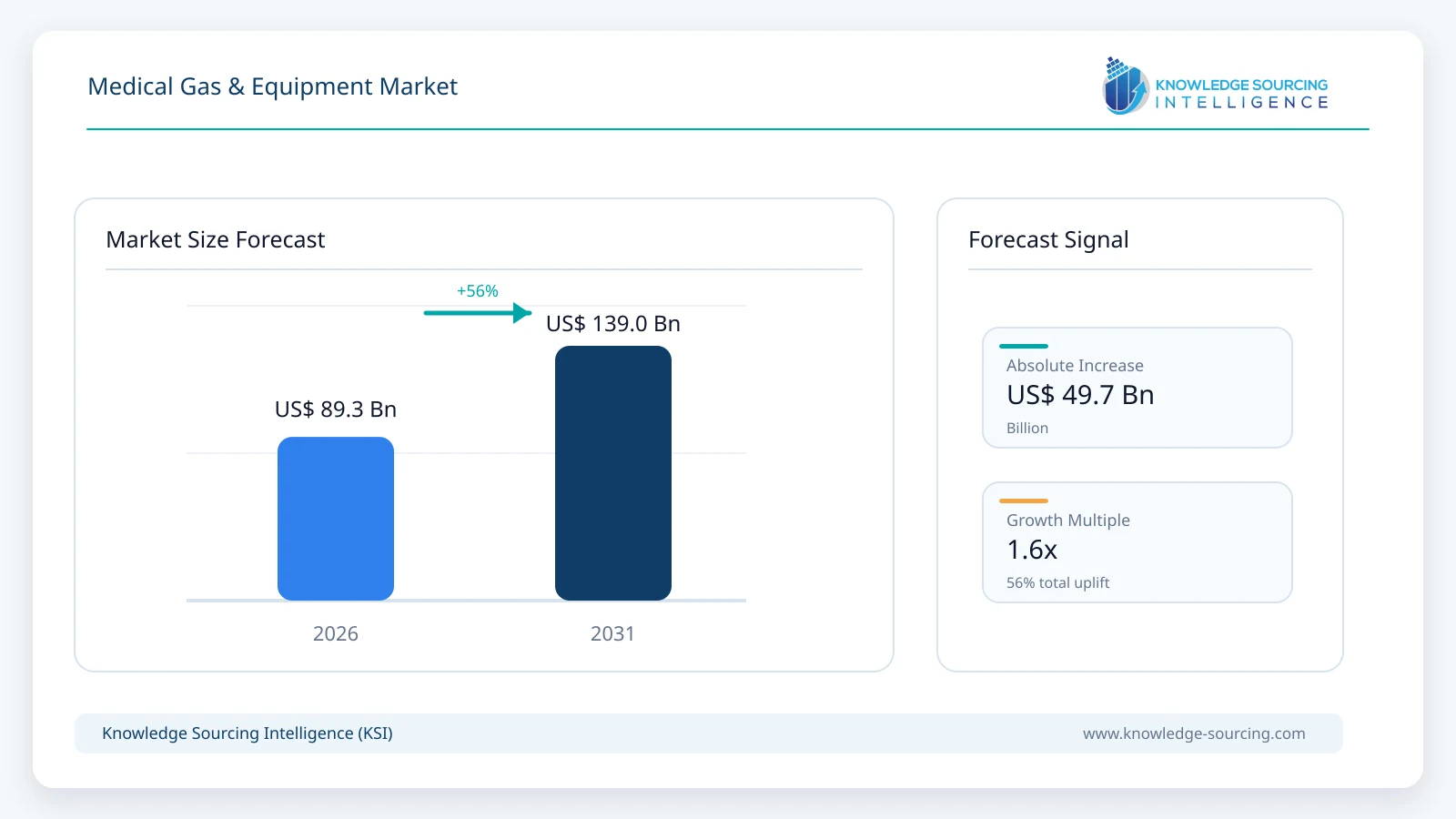
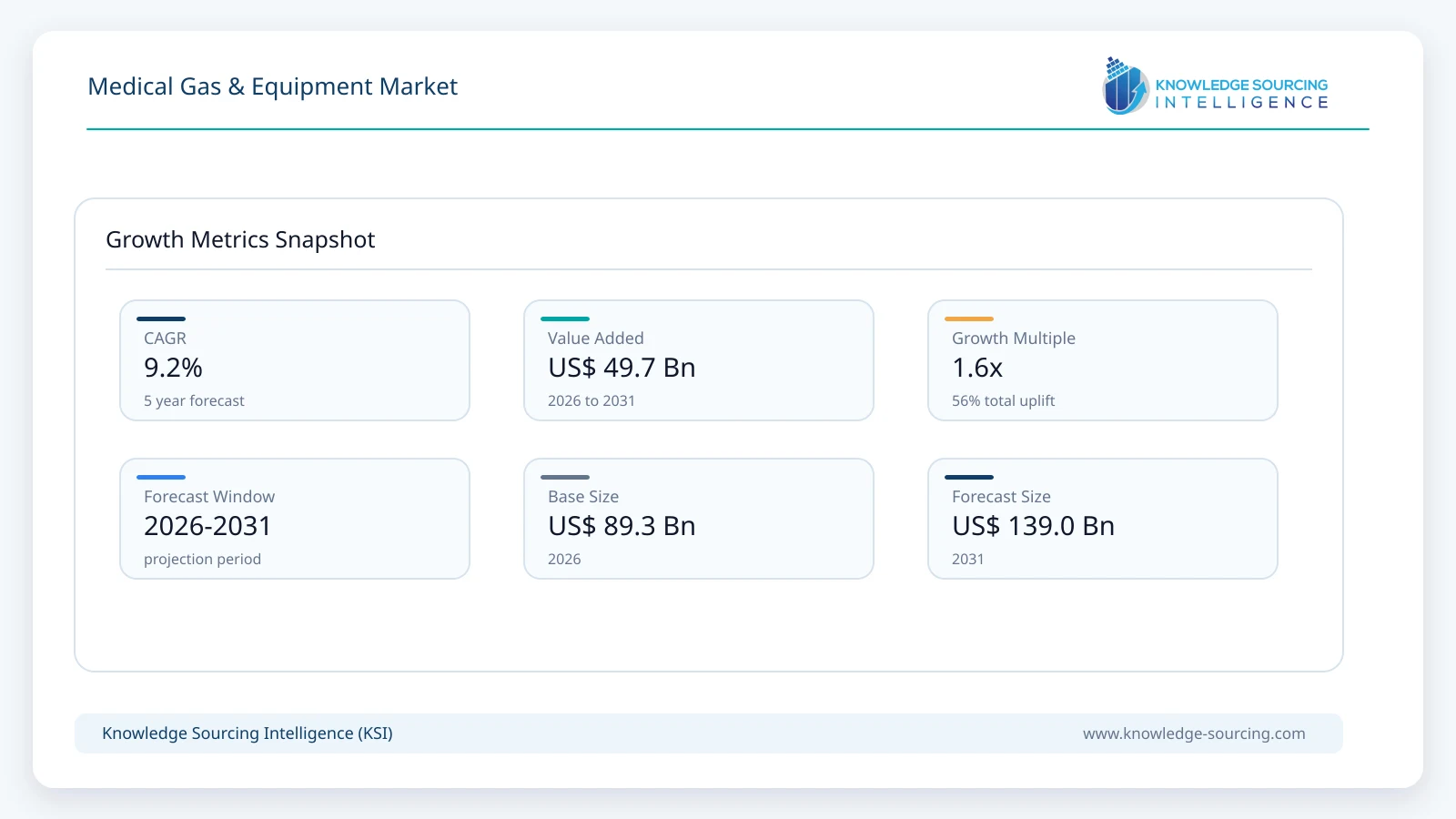
The Medical Gas and Equipment Market is forecast to grow at a CAGR of 9.2%, reaching USD 139.0 billion in 2031 from USD 89.3 billion in 2026.
Highlights:
- 1Hospitals are expanding their intensive care units, which leads to increased demand for centralized medical gas pipeline systems that replace portable cylinder systems with integrated systems.
- 2The prevalence of chronic respiratory diseases is rising, which drives home healthcare oxygen systems to become more common because patients need long-term oxygen therapy for their conditions outside of hospitals.
- 3Healthcare procurement is moving towards bundled service contracts, which supply chain companies use to optimize their operations, so industrial gas suppliers are adding medical equipment to their offerings.
- 4The implementation of stricter regulations for gas purity and delivery safety standards results in higher certification demands, which increase operational expenses while creating barriers for unqualified suppliers.
Medical gases and equipment are regarded as a category of medical equipment that includes nitrogen, oxygen, and helium, among others. The medical gas equipment market can be classified into three categories: pure gas, mixtures of one or more components, including air, nitrous oxide, and carbon dioxide, which are regarded as essential in multiple healthcare and medical applications. Medical equipment includes ventilators, oxygen concentrators, gas delivery systems, anaesthesia machines, respiratory therapy devices, hyperbaric chambers, and medical gas cylinders. These devices are crucial in various medical disciplines and are regulated by regulatory bodies like the FDA for quality and safety.
The rise in a few chronic disorders, such as cancer, diabetes, asthma, and
disorders, will act as a major driver accelerating the medical gas-equipment market’s growth rate. Moreover, the upsurge relating to the incidences of preterm births, and the growing prevalence of respiratory diseases, especially on account of the increasing count of tobacco smokers, including the mounting pollution level, is boosting the market domain. Moreover, the involvement of the various public organizations in supporting the adoption of this medical gas equipment is further leading to propel the domain size.
Market Dynamics
Market Drivers
The rise in demand from hospitals is anticipated to spur the market growth
Medical gas and equipment play an imperative role in the hospital industry, which is witnessing a significant surge in demand with the increasing number of hospitals across the globe. To deliver and provide efficient treatment to patients requiring critical care, there are various medical equipment such as cryogenic products, flowmeters, regulators, and even medical air compressors and others as well. This equipment is therefore the mainstay in Intensive Care Units (ICUs) and Operating Theatres (OTs) across hospitals.
With such an increase in the demand for medical gas and equipment in the healthcare industry, multiple government funds in healthcare are increasingly investing, which is driving the market growth. For instance, taking the example of India, the healthcare sector in India is expanding at a brisk pace, especially since the government has allowed foreign direct investment (FDI) in the industry.
Rising incidence of chronic diseases will drive the growth of the market
The medical gas and equipment market is expected to experience sustained growth due to the increasing prevalence of chronic respiratory conditions, cardiovascular diseases, home healthcare needs, the aging population, critical care and emergency medicine, preventive healthcare measures, technological advancements, and increased focus on respiratory health. Chronic respiratory conditions like COPD and asthma require medical gases like oxygen for therapeutic purposes, while cardiovascular diseases, including heart failure, may require oxygen for patients experiencing respiratory distress.
The growing preference for home healthcare fuels the demand for portable and home-use medical gas equipment, including devices for oxygen therapy and other respiratory support. Technological advancements in medical gas delivery systems and equipment contribute to improved patient care and management of chronic diseases. Public health campaigns and initiatives focusing on respiratory health also contribute to increased awareness of chronic respiratory conditions, leading to earlier diagnosis and treatment.
Market Restraints & Opportunities
Centralized pipeline systems and advanced equipment system implementation become difficult for smaller facilities and developing regions because of high upfront costs and supply chain issues, which affect special equipment. The system needs to be operated. The system provides for upcoming markets because it uses modular components, subscription services, and public-private partnerships for infrastructure development. The pharmaceutical and biotech industries require high-purity gases for their manufacturing and research activities, while sustainability initiatives promote energy-efficient on-site generation, which decreases transportation emissions.
Key Developments
July 2026: SOL Group acquired 100% of Danish respiratory-care company Nowus Healthcare A/S, marking its entry into the Nordic market and expanding VIVISOL’s international home-respiratory-care operations.
July 2025: GCE Medical introduced its latest addition to the clinical portfolio namely, the Duplex PNP200. It is a two-stage medical gas manifold created for hospitals' highly efficient pipeline delivery systems.
June 25, 2026: Dynarex launched its Resp-O? Portable Oxygen Concentrator, offering 90% oxygen concentration, adjustable 1–6 LPM flow, multiple power options, and a lightweight design for mobile oxygen therapy.
February 2026: BeaconMedaes unveiled three new medical gas pipeline products: the MER (Emergency Reserve Manifold), MPR (Pressure Reducing Set), and LBV (Line Ball Valve Assemblies). All these new solutions come equipped with advanced safety features, increased testability, and the option for connectivity.
August 2025: Coregas released its innovative IVRx 1-touch medical oxygen solution, which is a portable, one-click valve regulator that unites the oxygen cylinder valve, regulator, and flow meter into a single system.
Market Segmentation
The market is segmented by type, application, end-user, and geography.
By Type: Medical Gas System
Medical gas systems function as the fundamental supply network throughout hospitals, which mainly consists of oxygen, carbon dioxide, nitrous oxide, and medical air. The need for respiratory and anesthesia gases is rising because hospitals require these gases to support surgical procedures and emergency medical treatment. Hospitals are upgrading their infrastructure by replacing cylinder-based systems with centralized pipeline networks, which will enhance safety and operational effectiveness. Organizations are now adopting standardized purity systems because regulatory requirements demand this, which leads to organizations making long-term financial commitments to their permanent gas distribution networks.
By Application: Therapeutic Applications
The present demand for oxygen therapy is increasing because it serves therapeutic purposes that are required for treating respiratory diseases, intensive care, and post-operative recovery situations. Continuous oxygen delivery systems have become the preferred choice because hospitalization times for patients with chronic diseases have increased. The use of controlled gases in imaging and respiratory diagnostics is expanding, which enables the development of diagnostic applications that support precision-based clinical workflows.
By End User: Hospital
Hospitals consume the most gas from centralized systems, which deliver gas supplies to multiple hospital areas. The hospital expansion plans are creating higher demand because they focus on developing essential medical facilities and operating rooms. The adoption of home healthcare services is growing because chronic respiratory patients now use domiciliary oxygen systems, which decrease their need for hospital visits. Pharmaceutical companies are increasing controlled gas usage in manufacturing environments as process precision requirements are intensifying. The consumption patterns of ambulatory care facilities and diagnostic centers remain constant because procedural healthcare drives their operational needs.
Regional Analysis
North America Market Analysis
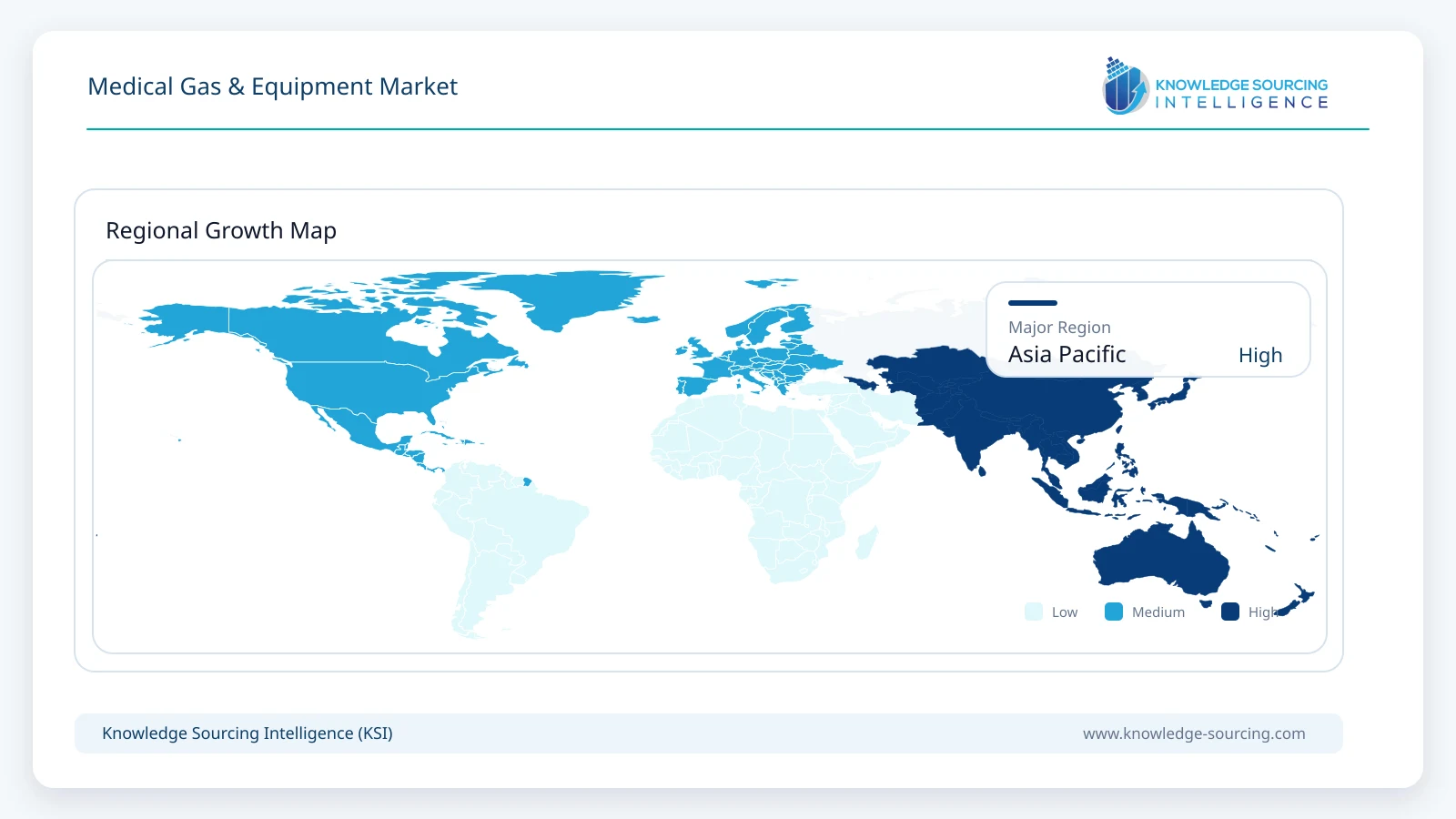
North America will witness a surge in this market during the projected period. The medical gas equipment market of North America dominates in terms of its market share and market revenue, which is said to flourish its dominance during the forecast period. The presence of key players in the North American region, along with the well-established healthcare and pharmaceutical region, is a driving factor leading towards the dominance of North America in the medical gas equipment market. North America's advanced healthcare infrastructure, strict regulatory standards, high healthcare expenditure, technological advancements, and growing demand for home healthcare contribute to its dominant market position in the medical gas and equipment industry.
South America Market Analysis
The medical gas infrastructure in South America is experiencing continuous growth because hospital modernization initiatives are being implemented across Brazil, Argentina, Chile, and Colombia. Tertiary care hospitals that undergo hospital upgrades now need centralized oxygen and medical gas pipeline systems because of increased demand for medical gases and equipment. The government-funded hospital expansion projects in public healthcare systems are creating procurement cycles because these projects require dedicated respiratory care infrastructure.
Europe Market Analysis
The healthcare industry in Europe demands medical gas systems because they operate under strict safety regulations. Hospitals are replacing outdated gas distribution systems with new integrated networks that meet current regulations. Sustainability requirements drive organizations to adopt energy-efficient systems, which use digital monitoring for their procurement choices. Healthcare systems choose to work with fewer suppliers because it helps them manage compliance risks, which leads to more use of established industrial gas suppliers. The rise of home healthcare services is driven by the growing need for long-term oxygen therapy among the aging population.
Middle East and Africa Market Analysis
The Middle East and Africa region features two distinct medical gas systems and equipment, which connect advanced Gulf healthcare systems with underdeveloped African regions. High-capacity centralized gas systems are becoming more popular in urban hospital clusters because governments are funding tertiary healthcare infrastructure projects. The healthcare modernization movement in Gulf Cooperation Council (GCC) nations is increasing the demand for integrated medical gas pipeline systems in major hospital construction projects.
Asia Pacific Market Analysis
The Asia Pacific region is currently undergoing extensive infrastructure development because new hospitals are being constructed in emerging markets, while healthcare modernization efforts are underway. Public healthcare systems are expected to need centralized oxygen systems because they are developing their critical care services. The government-backed healthcare expansion initiatives are creating infrastructure deployment needs that face challenges because of limited available capital investment resources. Hospitals are moving to pipeline infrastructure for medical gas equipment because they want to use medical gas equipment more effectively. Industrial gas suppliers are increasing their regional production capabilities to satisfy growing demand for oxygen.
List of Companies
Linde Plc
GCE Group
Rotarex
SOL Group
Messer Group
Medicop
Indutrade AB
MEC Medical Ltd.
Air Liquide Group
Air Products and Chemicals, Inc.
Nippon Sanso Holdings Corporation
Atlas Copco Group
Amico Corporation
Linde plc
Linde plc functions as an international industrial gas company that maintains a strong presence in the worldwide medical oxygen and healthcare gas distribution market. The company maintains its structural distinction through its vast air separation facilities and its enduring agreements for healthcare product distribution. Hospitals are adopting outsourced gas supply systems, which results in higher demand for the company's medical gases.
GCE Group
The GCE Group provides hospitals with gas distribution equipment and medical gas systems that enable scientists to control gas flow in their research. The product demand of the company has risen because hospitals implement new safety measures for their critical gas delivery systems. The company concentrates on developing modular equipment solutions that enable hospitals to build their systems according to their operational needs. The company benefits from increased market demand for certified flow control systems because regulatory agencies require their implementation.
Analyst View
The medical gas and equipment market will experience continuous growth until 2031 because of changing demographics and advancements in healthcare and technological progress. Companies that develop portable and home-based solutions together with smart monitoring systems and regional infrastructure will gain market growth, but must overcome regulatory challenges and manage their expenses. The sector presents stable opportunities that match the national trend toward better healthcare access and improved patient-centered medical treatment.
Medical Gas and Equipment Market Scope:
| Report Metric | Details |
|---|---|
| Total Market Size in 2026 | USD 89.3 billion |
| Total Market Size in 2031 | USD 139.0 billion |
| Forecast Unit | Billion |
| Growth Rate | 9.2% |
| Study Period | 2021 to 2031 |
| Historical Data | 2021 to 2024 |
| Base Year | 2025 |
| Forecast Period | 2026 – 2031 |
| Segmentation | Type, Application, End-user, Geography |
| Companies |
|
Market Segmentation
By Type
By Application
By End-user
By Geography
Table of Contents
1. EXECUTIVE SUMMARY
2. MARKET SNAPSHOT
2.1. Market Overview
2.2. Market Definition
2.3. Scope of the Study
2.4. Market Segmentation
3. BUSINESS LANDSCAPE
3.1. Market Drivers
3.2. Market Restraints
3.3. Market Opportunities
3.4. Porter’s Five Forces Analysis
3.5. Industry Value Chain Analysis
3.6. Policies and Regulations
3.7. Strategic Recommendations
4. TECHNOLOGICAL OUTLOOK
5. MEDICAL GAS AND EQUIPMENT MARKET BY TYPE
5.1. Introduction
5.2. Medical Gas
5.2.1. Oxygen
5.2.2. Carbon Dioxide
5.2.3. Nitrogen
5.2.4. Nitrous Oxide
5.2.5. Medical Air
5.2.6. Helium
5.2.7. Others
5.3. Medical Gas Equipment
6. MEDICAL GAS AND EQUIPMENT MARKET BY APPLICATION
6.1. Introduction
6.2. Therapeutic Applications
6.3. Diagnostic Applications
6.4. Pharmaceutical Manufacturing & Research
6.5. Others
7. MEDICAL GAS AND EQUIPMENT MARKET BY END-USER
7.1. Introduction
7.2. Hospitals
7.3. Home Healthcare
7.4. Pharmaceutical Companies
7.5. Others
8. MEDICAL GAS AND EQUIPMENT MARKET BY GEOGRAPHY
8.1. Introduction
8.2. North America
8.2.1. By Type
8.2.2. By Application
8.2.3. By End-User
8.2.4. By Country
8.2.4.1. USA
8.2.4.2. Canada
8.2.4.3. Mexico
8.3. South America
8.3.1. By Type
8.3.2. By Application
8.3.3. By End-User
8.3.4. By Country
8.3.4.1. Brazil
8.3.4.2. Argentina
8.3.4.3. Others
8.4. Europe
8.4.1. By Type
8.4.2. By Application
8.4.3. By End-User
8.4.4. By Country
8.4.4.1. United Kingdom
8.4.4.2. Germany
8.4.4.3. France
8.4.4.4. Italy
8.4.4.5. Others
8.5. Middle East and Africa
8.5.1. By Type
8.5.2. By Application
8.5.3. By End-User
8.5.4. By Country
8.5.4.1. Saudi Arabia
8.5.4.2. UAE
8.5.4.3. Others
8.6. Asia Pacific
8.6.1. By Type
8.6.2. By Application
8.6.3. By End-User
8.6.4. By Country
8.6.4.1. China
8.6.4.2. Japan
8.6.4.3. South Korea
8.6.4.4. Others
9. COMPETITIVE ENVIRONMENT AND ANALYSIS
9.1. Major Players and Strategy Analysis
9.2. Market Share Analysis
9.3. Mergers, Acquisitions, Agreements, and Collaborations
9.4. Competitive Dashboard
10. COMPANY PROFILES
10.1. Linde Plc
10.2. GCE Group
10.3. Rotarex
10.4. SOL Group
10.5. Messer Group
10.6. Medicop
10.7. Indutrade AB
10.8. MEC Medical Ltd.
10.9. Air Liquide Group
10.10. Air Products and Chemicals, Inc.
10.11. Nippon Sanso Holdings Corporation
10.12. Atlas Copco Group
10.13. Amico Corporation
11. APPENDIX
11.1. Currency
11.2. Assumptions
11.3. Base and Forecast Years Timeline
11.4. Key benefits for the stakeholders
11.5. Research Methodology
11.6. Abbreviations
Navigate
Trusted by the world's leading organizations











