
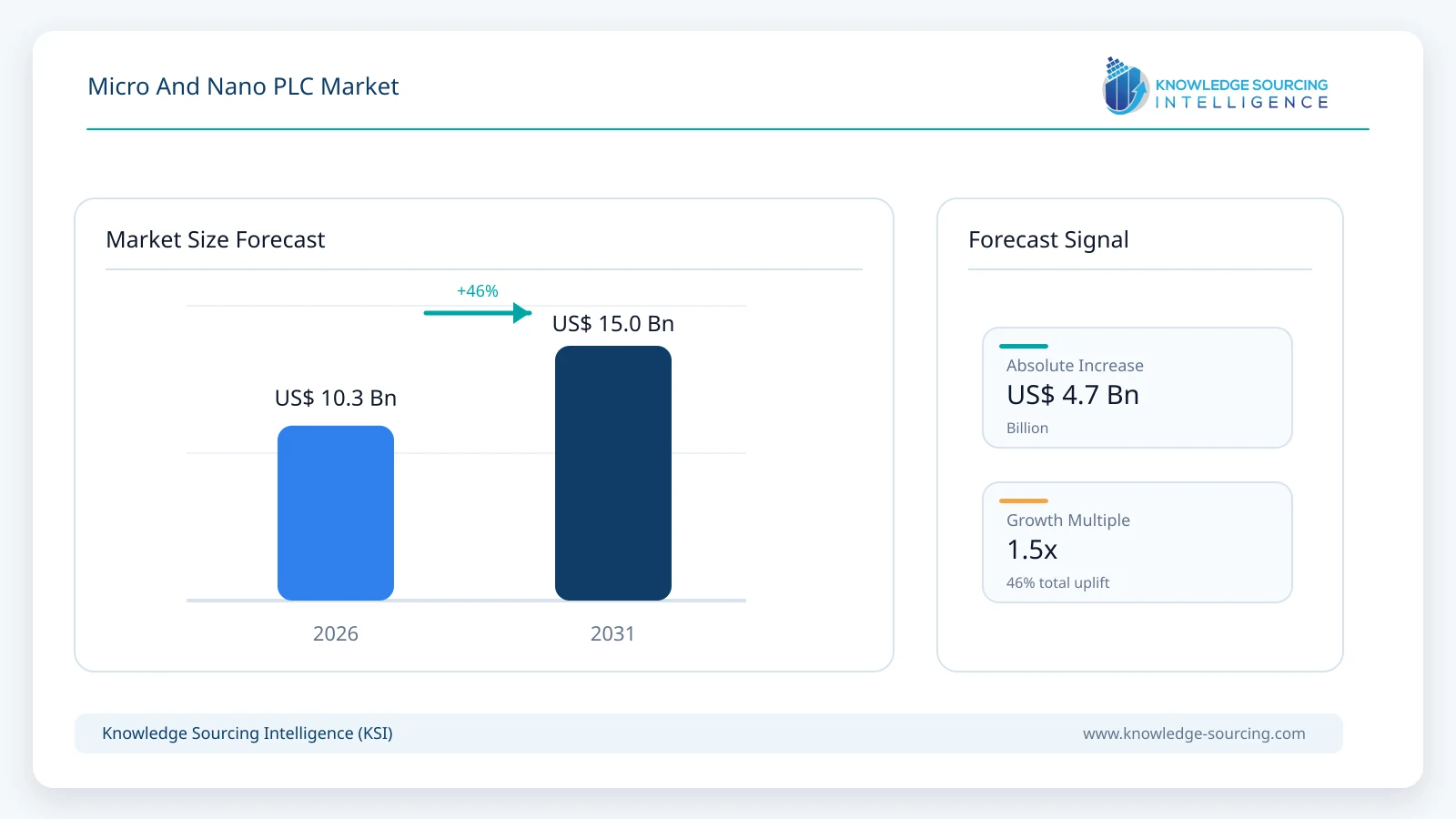
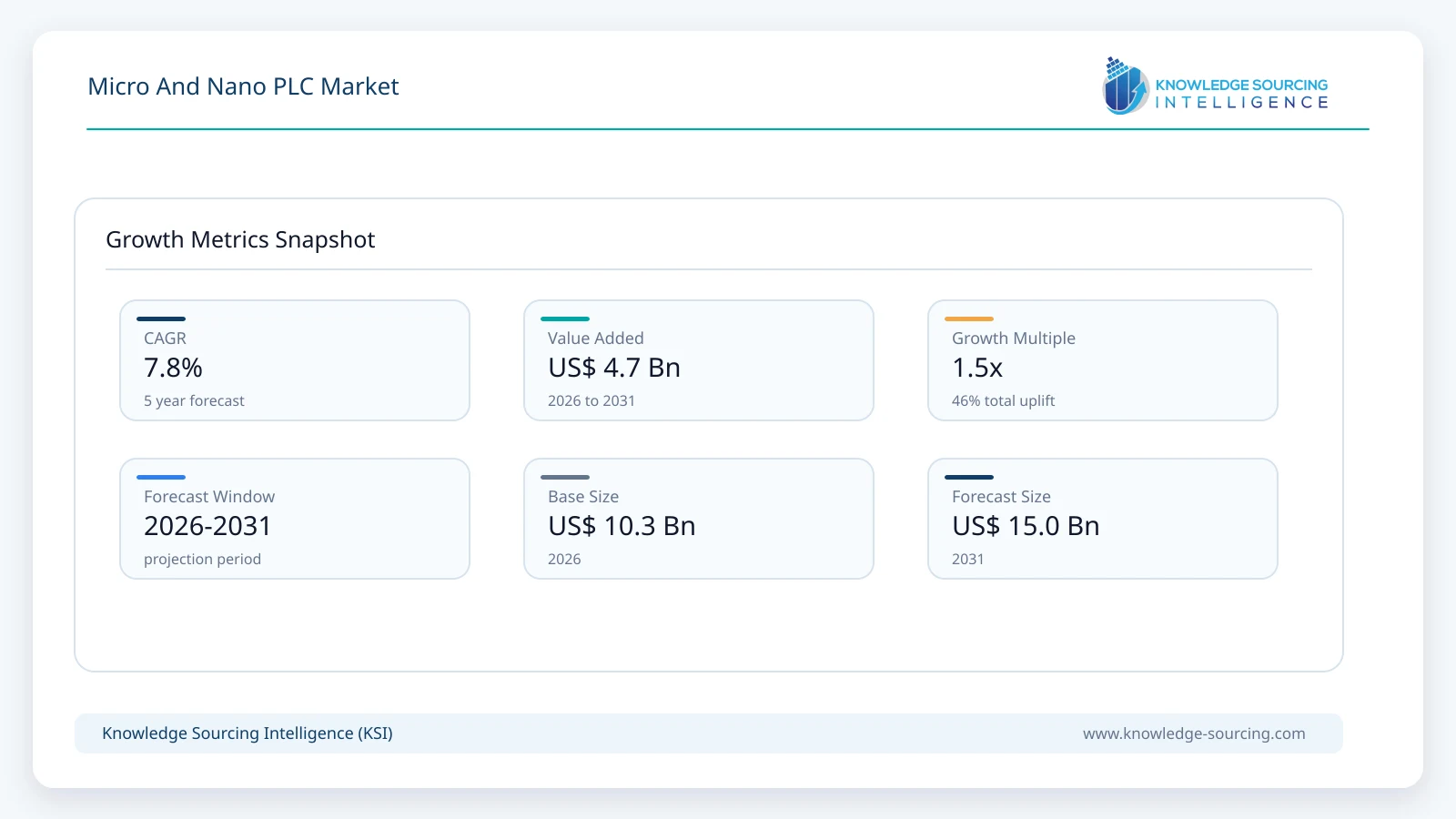
The micro and nano PLC market is forecast to grow from USD 10.3 billion in 2026 to USD 15.0 billion in 2031, representing a CAGR of 7.8% during the forecast period.
Highlights:
- 1Micro PLCs account for approximately 78.0% of global micro and nano PLC revenue in 2026.
- 2Hardware represents approximately 69.0% of global 2026 market revenue.
- 3Fixed and compact architectures account for approximately 58.0% of global micro and nano PLC revenue in 2026.
- 4Automotive and machine-building applications represent approximately 24.0% of global 2026 market revenue.
- 5Asia Pacific accounts for approximately 39.0% of global micro and nano PLC revenue in 2026.
- 6Cybersecurity, Ethernet connectivity, motion control and edge-data access are becoming standard requirements even in compact controllers.
Market Overview
The micro and nano programmable logic controller market covers compact industrial controllers designed for small and medium automation tasks, typically with lower I/O counts and smaller footprints than large modular PLC or PAC systems. The scope includes controller hardware, directly associated engineering software and product-linked services for micro PLCs, nano PLCs, smart relays and compact controllers used in machines, building systems and small industrial processes. Large high-end modular PLC platforms, distributed control systems and dedicated motion controllers are excluded where they fall outside compact PLC architectures.
The market remains centered on hardware but is increasingly differentiated by software and connectivity. Siemens' SIMATIC S7-1200 G2, Schneider Electric's Modicon M221, Rockwell Automation's Micro800 family, Mitsubishi Electric's MELSEC iQ-F, Omron's CP2E and ABB's AC500-eCo illustrate the core competitive set. These products are designed for cost-sensitive control tasks but increasingly include Ethernet, web servers, motion functions, data collection, cybersecurity features and integration with cloud or industrial-edge platforms.
The market includes hardware, software and associated services. Hardware accounts for the majority of revenue, but engineering software, communication modules, I/O expansion, lifecycle support and integration increase the economic value beyond CPU sales alone. The installed base spans packaging machines, material handling, HVAC, water systems, food processing, small production lines, utilities and OEM machinery.
Product development is shifting toward greater capability without losing compact form factors. Siemens' S7-1200 G2 reduces DIN-rail footprint while adding higher processing performance, improved motion control, NFC-based diagnostics and stronger safety options. Omron positions CP2E around machine-to-machine communication and data collection, while WAGO's PFC100 and Phoenix Contact's PLCnext controllers bring Linux, CODESYS, cybersecurity and cloud connectivity into compact industrial controllers.
The forecast to 2031 assumes steady industrial automation spending, continued replacement of relay logic and older compact PLCs, increased machine connectivity and stronger demand for cybersecurity-compliant controllers. Growth is moderated by long controller replacement cycles, intense price competition and the expansion of low-cost regional PLC suppliers in China and other Asian markets.
Micro and Nano PLC Market Trends
Compact PLCs Gain Higher-End Motion and Safety Functions
The boundary between micro PLCs and larger machine controllers is moving upward. Siemens' S7-1200 G2 adds coordinated motion, improved processing and fail-safe capabilities while retaining a compact footprint. IDEC's FC6A Plus supports large I/O expansion despite being positioned as a micro PLC. This allows machine builders to use compact controllers in applications that previously required larger modular systems.
Ethernet and IIoT Connectivity Become Standard
Compact PLCs are increasingly expected to communicate directly with HMIs, drives, databases and cloud-connected systems. Omron CP2E includes Ethernet and serial connectivity for machine-to-machine communication, Schneider's M221 supports modern machine architectures, and WAGO combines Linux, CODESYS and web visualization in small controllers.
Cybersecurity Moves into Entry-Level Automation
Security requirements are extending from enterprise and large-control systems into small machines. WAGO highlights SSL/TLS, VPN and firewall capability in PFC100, while Phoenix Contact's PLCnext compact controllers are designed around IEC 62443-aligned security. The EU Cyber Resilience Act and customer security requirements are reinforcing this shift.
Software Ecosystems Increase Vendor Lock-In
Engineering environments such as Siemens TIA Portal, Rockwell Connected Components Workbench, Schneider EcoStruxure Machine Expert - Basic and Mitsubishi GX Works link compact PLCs to broader automation ecosystems. Familiar programming environments, libraries and device integration can influence controller selection as strongly as hardware specifications.
Segment Analysis
By Type - Micro PLC
Micro PLCs are estimated at approximately USD 8.00 billion in 2026. The segment dominates because micro PLCs offer sufficient processing, communications and I/O expansion for a wide range of OEM machines and small industrial systems while remaining less expensive and easier to engineer than high-end modular platforms. Siemens S7-1200 G2, Schneider M221, Rockwell Micro800, Mitsubishi iQ-F, Omron CP2E and ABB AC500-eCo all target this broad middle ground. Their capabilities now extend into Ethernet networking, motion control, web diagnostics and data collection, which is expanding addressable applications without eliminating the cost and footprint advantages that define the micro PLC category.
By Component - Hardware
Hardware is estimated at approximately USD 7.07 billion in 2026. The segment includes CPU units, integrated and expansion I/O, communication modules and compact controller hardware sold as part of micro and nano PLC systems. Hardware remains the largest revenue pool because every installation requires a physical controller and many applications add I/O or communications beyond the base CPU. Software is increasingly important for engineering and connectivity, but much of the programming environment is bundled, low-cost or used to support hardware sales. As a result, the shift toward more capable compact CPUs, safety functions and integrated Ethernet continues to sustain hardware value.
By Architecture - Fixed and Compact PLC
Fixed and compact PLC architectures are estimated at approximately USD 5.95 billion in 2026. These controllers integrate CPU, power, communications and a defined set of I/O within a small housing, making them attractive for packaging machines, HVAC, pumps, conveyors, small assembly equipment and building automation. The architecture reduces cabinet space, wiring and engineering effort and aligns directly with the cost-sensitive applications served by nano and entry-level micro PLCs. Expandable compact platforms blur the boundary with modular PLCs, but fixed-form controllers remain the largest architecture because a substantial portion of small-machine automation does not require extensive distributed I/O.
By Industry Vertical - Automotive and Machine Building
Automotive and machine-building applications are estimated at approximately USD 2.46 billion in 2026. The segment is the largest demand pool because compact PLCs are widely embedded in conveyors, assembly cells, test stands, welding auxiliaries, packaging equipment, robotics peripherals and supplier machinery. Machine builders value standardized programming environments, small panel footprints and the ability to reuse controller libraries across multiple equipment models. The introduction of stronger motion control and diagnostics in products such as Siemens S7-1200 G2 further increases the suitability of micro PLCs for OEM machinery that previously required larger controllers.
By Geography - Asia Pacific
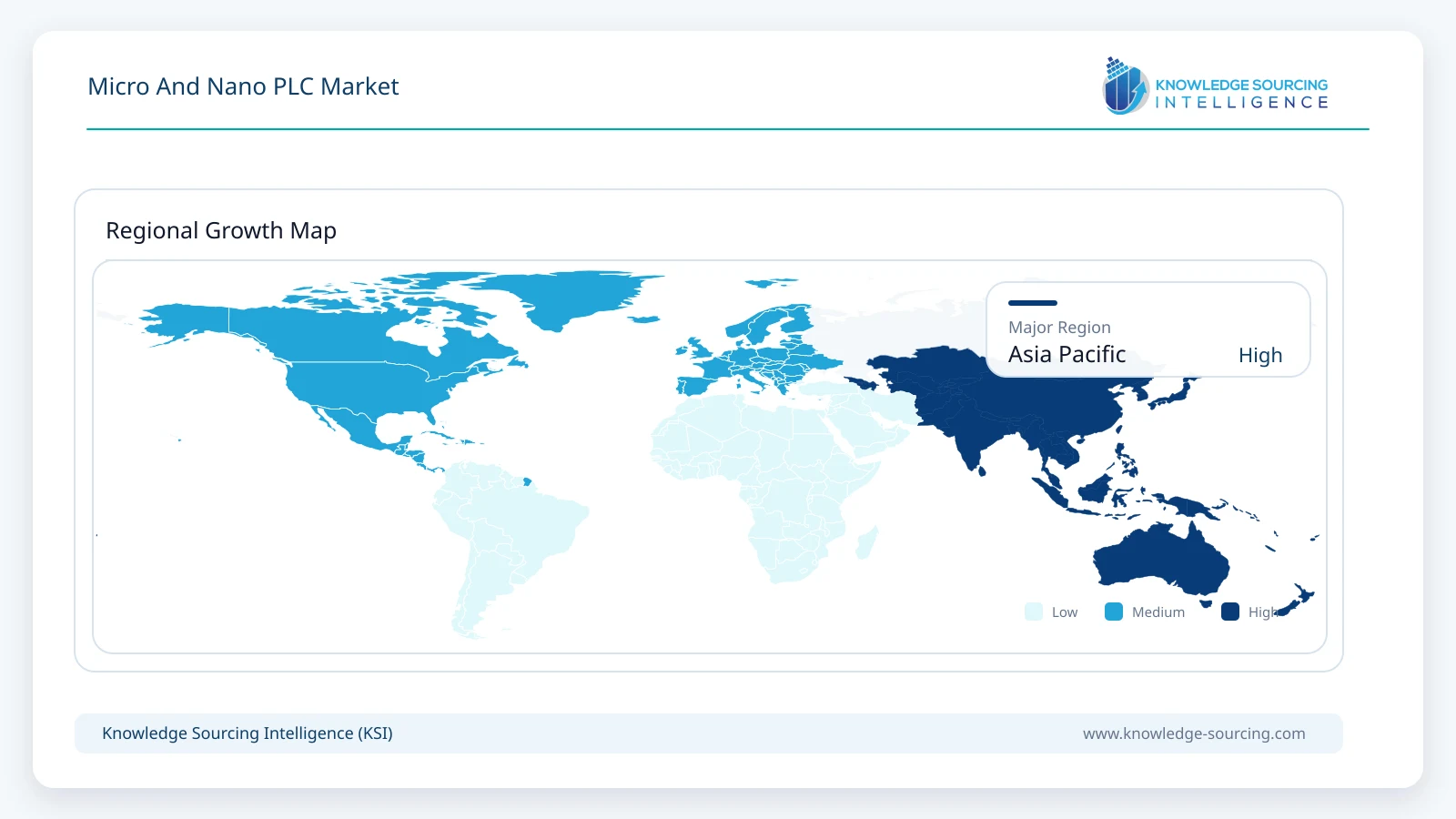
Asia Pacific is estimated at approximately USD 4.00 billion in 2026. The region combines the world's largest manufacturing base with high volumes of machinery production, electronics assembly, automotive manufacturing and infrastructure investment. China, Japan, South Korea, India and Southeast Asia support strong demand from both global automation suppliers and regional PLC manufacturers. Mitsubishi Electric, Omron, Panasonic, Delta Electronics, Keyence and multiple Chinese automation companies have significant regional positions, while Siemens, Schneider, Rockwell and ABB continue to localize sales and engineering support. Factory modernization and SME automation are expected to keep Asia Pacific the largest regional market through 2031.
Market Drivers
Automation of Small and Mid-Sized Machines
Compact PLCs provide an economical control platform for OEM machinery, conveyors, pumps, packaging equipment and building systems. As more small machines are automated, controller volumes rise across both developed and emerging manufacturing markets.
Industrial Ethernet and Data Collection
Machine-level data is increasingly required for monitoring, traceability and maintenance. Ethernet ports, web servers, OPC UA, Modbus TCP and cloud connectivity are therefore becoming standard in compact controllers.
Replacement of Relay and Legacy PLC Systems
Older relay logic and first-generation compact PLCs are being replaced by controllers with better diagnostics, memory, networking and software support. Migration programs such as Siemens' S7-1200 to S7-1200 G2 transition support this replacement cycle.
Growth of OEM Machine Exports
Machine builders increasingly standardize on compact PLC families that can be sold globally with common software and certification. This favors scalable product families with broad distributor and support networks.
Cybersecurity and Lifecycle Requirements
Industrial customers are demanding secure communication, patchability and documented product lifecycles even for small controllers. Vendors with stronger security features and software ecosystems can therefore capture premium demand.
Market Restraints
Long Product Lifecycles
PLCs are often used for many years once a machine is commissioned. Reliable legacy systems can remain in service for a decade or more, limiting annual replacement demand.
Intense Price Competition
Micro and nano PLCs are cost-sensitive products with many global and regional suppliers. Price competition is particularly strong in Asia and in standardized machine-control applications.
Engineering Ecosystem Switching Costs
Customers often remain with incumbent controller families because programs, libraries, training and spare-part inventories are tied to specific engineering environments. This slows adoption by newer suppliers.
Competition from Smart Relays and Industrial PCs
At the low end, smart relays can replace nano PLCs for simple logic tasks, while at the high end industrial PCs and edge controllers can absorb applications requiring advanced computing. Compact PLC vendors must therefore defend both boundaries.
Cybersecurity Compliance Costs
Adding secure boot, encrypted communications, vulnerability management and longer software support increases development cost. Smaller vendors may find it difficult to meet the same lifecycle expectations as multinational suppliers.
Competitive Landscape
The market is led by diversified industrial automation suppliers with large installed bases and mature engineering ecosystems. Siemens, Schneider Electric, Rockwell Automation, Mitsubishi Electric, Omron and ABB are central competitors, while Delta Electronics, Panasonic, Keyence, IDEC, Phoenix Contact, WAGO, Unitronics and Beckhoff broaden the competitive field across different machine and regional niches.
Product differentiation increasingly centers on software usability, communications, cybersecurity, motion control and ecosystem compatibility rather than basic ladder-logic execution. Siemens uses TIA Portal and Xcelerator integration, Schneider positions M221 inside EcoStruxure, Rockwell connects Micro800 to the Allen-Bradley environment, and WAGO and Phoenix Contact emphasize open Linux/CODESYS architectures.
Regional suppliers continue to pressure pricing, particularly in Asia. This encourages multinational vendors to improve compact-controller performance while simplifying engineering and reducing cabinet footprint. The market is therefore likely to remain fragmented despite strong global brands.
Recent Developments
May 2026: Siemens updated its S7-1200 G2 migration guidance, reflecting active market rollout of the new generation and expanded hardware, motion-control and migration functionality.
2026: Schneider Electric maintained the Modicon M221 as its core compact logic controller and released an updated January 2026 user guide for the current platform.
2026: WAGO continued commercialization of the PFC100 Generation 2 controller, combining CODESYS 3.5, real-time Linux, web visualization and integrated cybersecurity features in a compact PLC.
2025: Omron updated the CP2E product catalog and CP-series documentation, reinforcing the platform's positioning for small-to-medium machines, machine-to-machine communication and data collection.
2025: IDEC updated FC6A MicroSmart Plus documentation and connectivity support, including EtherNet/IP and MQTT Sparkplug B capability for compact-machine automation.
Market Outlook
The micro and nano PLC market is expected to maintain high-single-digit growth through 2031 as machine automation expands and compact controllers absorb functions that previously required larger PLC platforms. Hardware will remain the largest component, but software and connectivity will become more important in product differentiation.
Micro PLCs will remain the dominant type because they offer the best balance of cost, I/O capacity and processing power for mainstream OEM machinery. Nano PLCs and smart relays will remain important for very simple applications but face stronger pressure from integrated building controls and low-cost embedded alternatives.
Asia Pacific will remain the largest regional market due to its manufacturing scale and equipment-production base. Competitive advantage will increasingly depend on engineering software, cybersecurity, migration support, communications and the ability to scale from entry-level control into broader automation architectures.
Micro And Nano PLC Market Scope
| Report Metric | Details |
|---|---|
| Total Market Size in 2026 | USD 10.3 billion |
| Total Market Size in 2031 | USD 15.0 billion |
| Forecast Unit | Billion |
| Growth Rate | 7.8% |
| Study Period | 2021 to 2031 |
| Historical Data | 2021 to 2024 |
| Base Year | 2025 |
| Forecast Period | 2026 – 2031 |
| Segmentation | Type, Component, Architecture, Industry Vertical, Geography |
| Companies |
|
Market Segmentation
By Type
Micro PLC
Nano PLC
By Component
Hardware
Software
Services
By Architecture
Fixed and Compact PLC
Modular PLC
By Industry Vertical
Automotive and Machine Building
Food and Beverage
Chemicals and Fertilizers
Metals and Mining
Oil and Gas
Power and Utilities
Water and Wastewater
Pharmaceuticals
Home and Building Automation
Others
By Geography
North America
United States
Canada
Mexico
South America
Brazil
Argentina
Others
Europe
Germany
France
United Kingdom
Italy
Spain
Others
Middle East and Africa
Saudi Arabia
UAE
South Africa
Others
Asia Pacific
China
Japan
India
South Korea
Taiwan
Southeast Asia
Others
Table of Contents
1. INTRODUCTION
1.1. Market Overview
1.2. Market Definition
1.3. Scope of the Study
1.4. Market Segmentation
1.5. Currency
1.6. Assumptions
1.7. Base and Forecast Years Timeline
2. RESEARCH METHODOLOGY
2.1. Research Design
2.2. Secondary Research
2.3. Primary Validation
2.4. Market Estimation and Forecasting
2.5. Data Triangulation and Quality Control
3. EXECUTIVE SUMMARY
3.1. Key Findings
3.2. Global Market Size, 2026-2031
3.3. Segment Summary
3.4. Regional Summary
4. MARKET DYNAMICS
4.1. Market Drivers
4.1.1. Automation of Small and Mid-Sized Machines
4.1.2. Industrial Ethernet and Data Collection
4.1.3. Replacement of Relay and Legacy PLC Systems
4.1.4. Growth of OEM Machine Exports
4.1.5. Cybersecurity and Lifecycle Requirements
4.2. Market Restraints
4.2.1. Long Product Lifecycles
4.2.2. Intense Price Competition
4.2.3. Engineering Ecosystem Switching Costs
4.2.4. Competition from Smart Relays and Industrial PCs
4.2.5. Cybersecurity Compliance Costs
5. MICRO AND NANO PLC MARKET BY TYPE
5.1. Introduction
5.2. Micro PLC
5.3. Nano PLC
6. MICRO AND NANO PLC MARKET BY COMPONENT
6.1. Introduction
6.2. Hardware
6.3. Software
6.4. Services
7. MICRO AND NANO PLC MARKET BY ARCHITECTURE
7.1. Introduction
7.2. Fixed and Compact PLC
7.3. Modular PLC
8. MICRO AND NANO PLC MARKET BY INDUSTRY VERTICAL
8.1. Introduction
8.2. Automotive and Machine Building
8.3. Food and Beverage
8.4. Chemicals and Fertilizers
8.5. Metals and Mining
8.6. Oil and Gas
8.7. Power and Utilities
8.8. Water and Wastewater
8.9. Pharmaceuticals
8.10. Home and Building Automation
8.11. Others
9. MICRO AND NANO PLC MARKET BY GEOGRAPHY
9.1. North America
9.1.1. United States
9.1.2. Canada
9.1.3. Mexico
9.2. South America
9.2.1. Brazil
9.2.2. Argentina
9.2.3. Others
9.3. Europe
9.3.1. Germany
9.3.2. France
9.3.3. United Kingdom
9.3.4. Italy
9.3.5. Spain
9.3.6. Others
9.4. Middle East and Africa
9.4.1. Saudi Arabia
9.4.2. UAE
9.4.3. South Africa
9.4.4. Others
9.5. Asia Pacific
9.5.1. China
9.5.2. Japan
9.5.3. India
9.5.4. South Korea
9.5.5. Taiwan
9.5.6. Southeast Asia
9.5.7. Others
10. COMPETITIVE ENVIRONMENT AND ANALYSIS
10.1. Major Players and Strategy Analysis
10.2. Hardware and Software Positioning
10.3. Cybersecurity and Connectivity
10.4. Recent Developments
10.5. Competitive Dashboard
11. COMPANY PROFILES
11.1. Siemens AG
11.2. Schneider Electric SE
11.3. Rockwell Automation, Inc.
11.4. Mitsubishi Electric Corporation
11.5. OMRON Corporation
11.6. ABB Ltd.
11.7. Delta Electronics, Inc.
11.8. Panasonic Industry Co., Ltd.
11.9. KEYENCE Corporation
11.10. IDEC Corporation
11.11. Phoenix Contact GmbH & Co. KG
11.12. WAGO GmbH & Co. KG
11.13. Unitronics Ltd.
11.14. Beckhoff Automation GmbH & Co. KG
11.15. FATEK Automation Corporation
12. APPENDIX
12.1. Currency
12.2. Assumptions
12.3. Base and Forecast Years Timeline
12.4. Abbreviations
Navigate
Trusted by the world's leading organizations











