
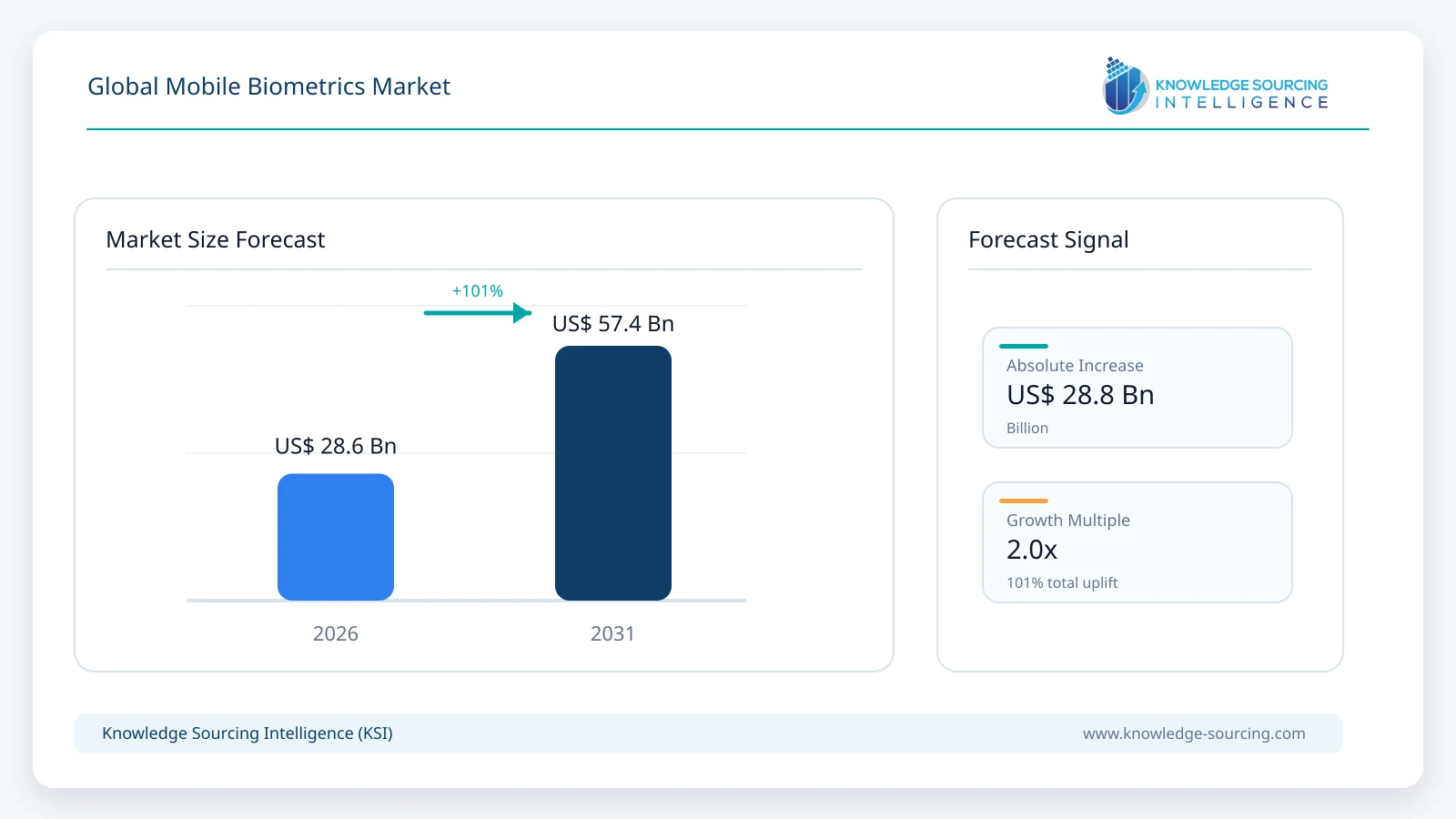
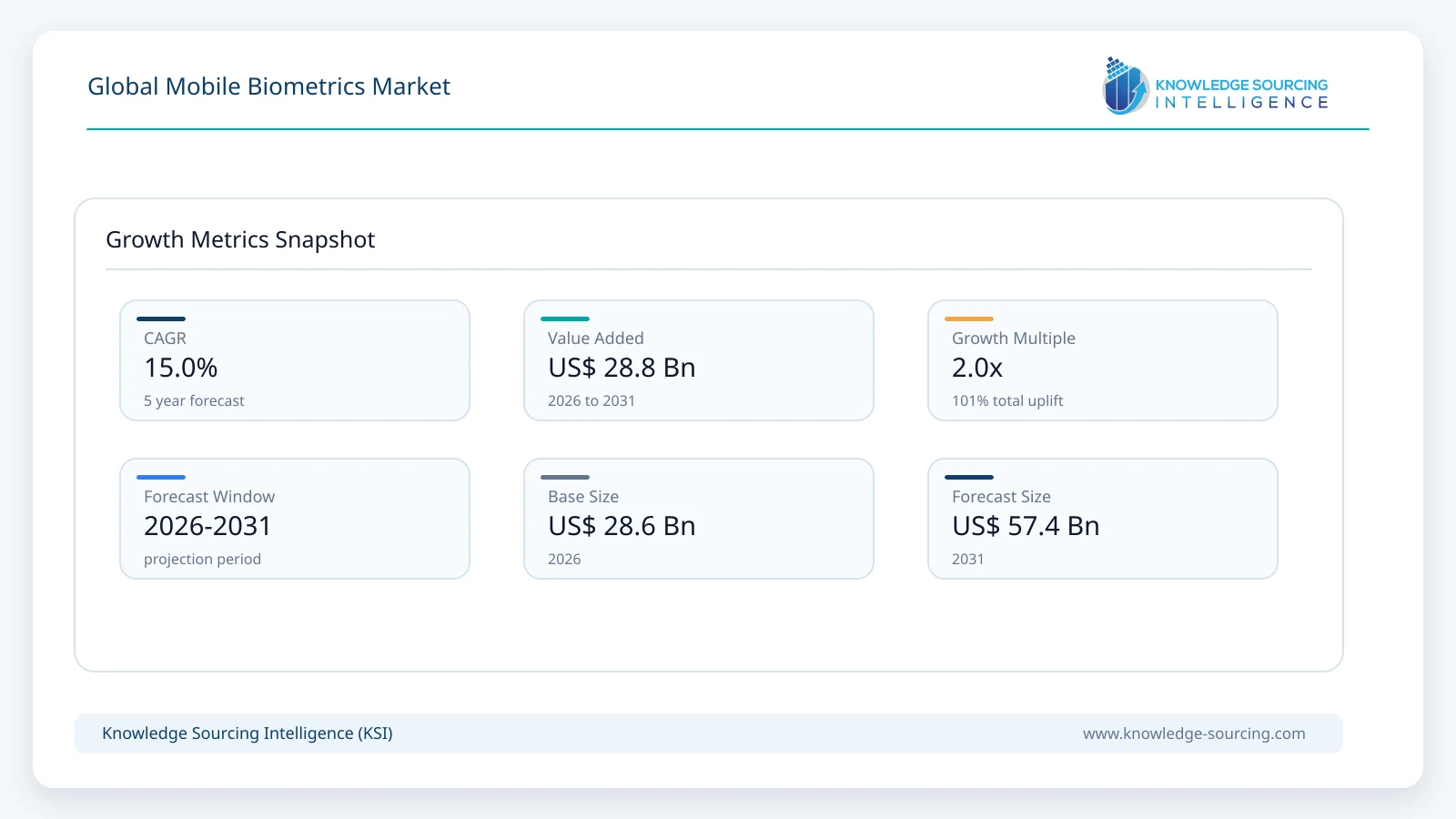
The mobile biometrics market is estimated at USD 28.60 billion in 2026 and is projected to reach USD 57.40 billion by 2031, growing at a CAGR of approximately 15.0% during the forecast period.
Highlights:
- 1Hardware accounts for approximately 41% of global mobile biometrics revenue in 2026.
- 2Facial recognition is projected to grow at approximately 17.8% annually through 2031.
- 3Mobile banking and payment applications generate about USD 9.7 billion of market value in 2026.
- 4Asia Pacific accounts for approximately 42% of global mobile biometrics revenue in 2026.
- 5Passkeys are turning on-device biometrics into a reusable authentication layer across apps and payments.
- 6Mobile digital identity and contactless fingerprint capture are extending biometrics beyond device unlocking.
Market Overview
Mobile biometric systems use physical or behavioral characteristics to authenticate or identify an individual through a mobile device. Fingerprint recognition remains the most widely deployed dedicated sensing modality because capacitive, optical and ultrasonic readers can be integrated into side buttons, rear housings or displays. Facial recognition uses the device camera or depth-sensing system, while voice, iris and behavioral signals address narrower use cases. Android classifies biometrics by security strength and requires stronger implementations to operate through its BiometricPrompt and hardware-backed key infrastructure, while Apple integrates Face ID and Touch ID directly into passkey-based account access. These platform controls matter because app developers generally consume a trusted biometric result rather than handling raw biometric templates themselves.
The commercial market therefore extends beyond the sensor. Mobile banks, payment networks, digital identity issuers and enterprises increasingly pay for identity proofing, liveness detection, fraud analysis, biometric matching, orchestration and authentication services. The FIDO passkey model accelerates this shift because a fingerprint or face scan can unlock a cryptographic credential without transmitting the biometric template to the remote service. This separates biometric verification from password databases and allows the same mobile authentication capability to support account login, payment approval, digital credentials and regulated identity verification.
Market Trends
Passkeys are moving mobile biometrics from device unlock into mainstream account authentication
Mobile biometrics is becoming an infrastructure layer for passwordless authentication rather than a feature used mainly to unlock a handset. FIDO Alliance reported in May 2026 that 5 billion passkeys were in active use; 75% of surveyed consumers had enabled passkeys on at least some accounts, and 68% of surveyed organizations were deploying, piloting or rolling them out for workforce authentication. Apple and Android both support platform-level biometric verification for passkeys, while Mastercard is extending device biometrics into payment authentication. This changes market economics because authentication events can grow even when smartphone replacement volumes slow. Software vendors benefit from enrollment, policy, risk, liveness and account-recovery requirements layered around the biometric check.
Mobile devices are becoming capture platforms for higher-assurance identity workflows
A second trend is the expansion of the smartphone from a local authenticator into a portable identity-capture device. Mobile driver licenses can now be provisioned into phone wallets and used for identity verification, while camera-based facial and fingerprint technologies are being evaluated for field identification. NIST completed Phase One qualification testing of its Fast Capture program in August 2026, covering contactless rapid tenprint acquisition. Thales was among the vendors that qualified under the program and is applying the technology to mobile biometric identification for public-security users. IDEMIA is simultaneously expanding mobile ID issuance and wallet acceptance in the United States, demonstrating how credentials, biometrics and mobile wallets are converging.
Market Drivers
Passwordless authentication and biometric payments create recurring demand beyond smartphone shipments
The strongest growth driver is the expansion of biometric authentication into services that generate repeated transactions throughout a device lifecycle. Passkeys replace passwords with cryptographic credentials that can be unlocked using a fingerprint, face scan or device credential, reducing exposure to phishing and credential stuffing. FIDO adoption data indicates that passkeys have already moved beyond early deployment, while Mastercard is expanding payment-passkey use and announced in September 2026 that it would collaborate with Google Pay to bring device-biometric card-payment experiences to eligible users in India. As banks, merchants and digital platforms adopt these flows, demand shifts toward biometric SDKs, orchestration, fraud detection and identity-assurance services even if mobile hardware unit growth remains limited.
Digital identity, eKYC and mobile government credentials expand high-assurance use cases
Governments and regulated industries increasingly use smartphones for remote identity proofing and credential presentation. Singapore introduced passkeys for Singpass in June 2026, adding a phishing-resistant login method to its national digital identity platform alongside face verification and existing authentication options. In the United States, IDEMIA supported the April 2026 launch of California mobile ID in Samsung Wallet and introduced a next-generation Kentucky mobile ID earlier in the year. Similar adoption increases demand for document capture, facial verification, liveness detection, credential binding and secure mobile-wallet integration. These workflows carry higher software and service value than simple device unlocking and are helping mobile biometrics expand into travel, onboarding, public services and age or identity verification.
Market Restraint
Privacy requirements, spoofing risk and a weak handset cycle limit frictionless market expansion
Biometric adoption is constrained by the sensitivity of biometric data and by rapidly evolving attack methods. Deepfakes, injection attacks, presentation attacks and account-recovery weaknesses can undermine otherwise strong biometric matching, requiring liveness detection, secure execution environments and fallback controls. Android therefore separates biometric implementations by security class and restricts the privileges available to weaker modalities. Regulators and enterprise buyers also require clear controls around consent, retention, template storage and cross-border data handling. Hardware demand faces an additional near-term constraint from the smartphone cycle: IDC expects 2026 smartphone shipments to fall sharply to just over one billion units as memory costs squeeze lower-end devices. This reduces new-unit sensor volumes even as authentication software and services continue to expand on the installed base.
Segment Analysis
By Component - Hardware and Software
Hardware remains the largest component in 2026 because fingerprint sensors, depth-sensing elements, secure components and other biometric-capable device hardware are deployed across a very large installed base. However, software is the faster-growing revenue pool and is projected to approach USD 23.5 billion by 2031. Growth is being driven by liveness detection, biometric SDKs, passkey orchestration, identity proofing and risk analytics that can be deployed across multiple device generations. Goodix and Qualcomm continue to advance ultrasonic fingerprint hardware, while firms such as FaceTec, iProov, Daon, Entrust and Aware compete more directly in software-led verification and authentication workflows.
By Technology - Fingerprint Recognition
Fingerprint recognition remains the largest technology because it combines low latency, mature supply chains and broad support across Android price tiers. In-display solutions continue to move from optical to ultrasonic sensing in premium devices; Goodix states that its ultrasonic fingerprint sensor reached large-scale commercialization in 2025, while Qualcomm markets 3D Sonic technology for under-display authentication. Facial recognition is the fastest-growing major modality and is projected to exceed USD 20 billion in market value by 2031 as banks, digital identity programs and remote onboarding systems use selfie capture, liveness detection and face matching. Voice and iris recognition remain more specialized, while behavioral biometrics increasingly complement rather than replace physical modalities.
By Application - Mobile Banking
Mobile banking and payments form the largest current application because financial institutions use device biometrics for app login, transaction approval, step-up authentication and remote onboarding. The segment is supported by payment-passkey deployment and by banks replacing SMS-based authentication with stronger device-bound methods. Identity verification is expected to outpace the market as mobile driver licenses, eKYC and remote account opening spread across government, travel and regulated services. Access-control applications remain important in enterprise and physical-security settings but generally generate lower per-user value than full identity-proofing workflows.
By End User - BFSI
BFSI remains the largest end-user group because biometric authentication is embedded in mobile banking, wallet, payment and customer-onboarding journeys. Financial institutions also face strong incentives to reduce phishing, account takeover and social-engineering fraud, supporting higher spending on liveness and risk controls. Government and public-sector use is projected to grow faster from a smaller base as national digital identity platforms, mobile credentials and frontline identification move onto smartphones. IT and telecommunications providers contribute through subscriber verification, workforce access and identity services, while consumer-electronics companies remain central to the hardware and platform layer.
By Geography - Asia Pacific
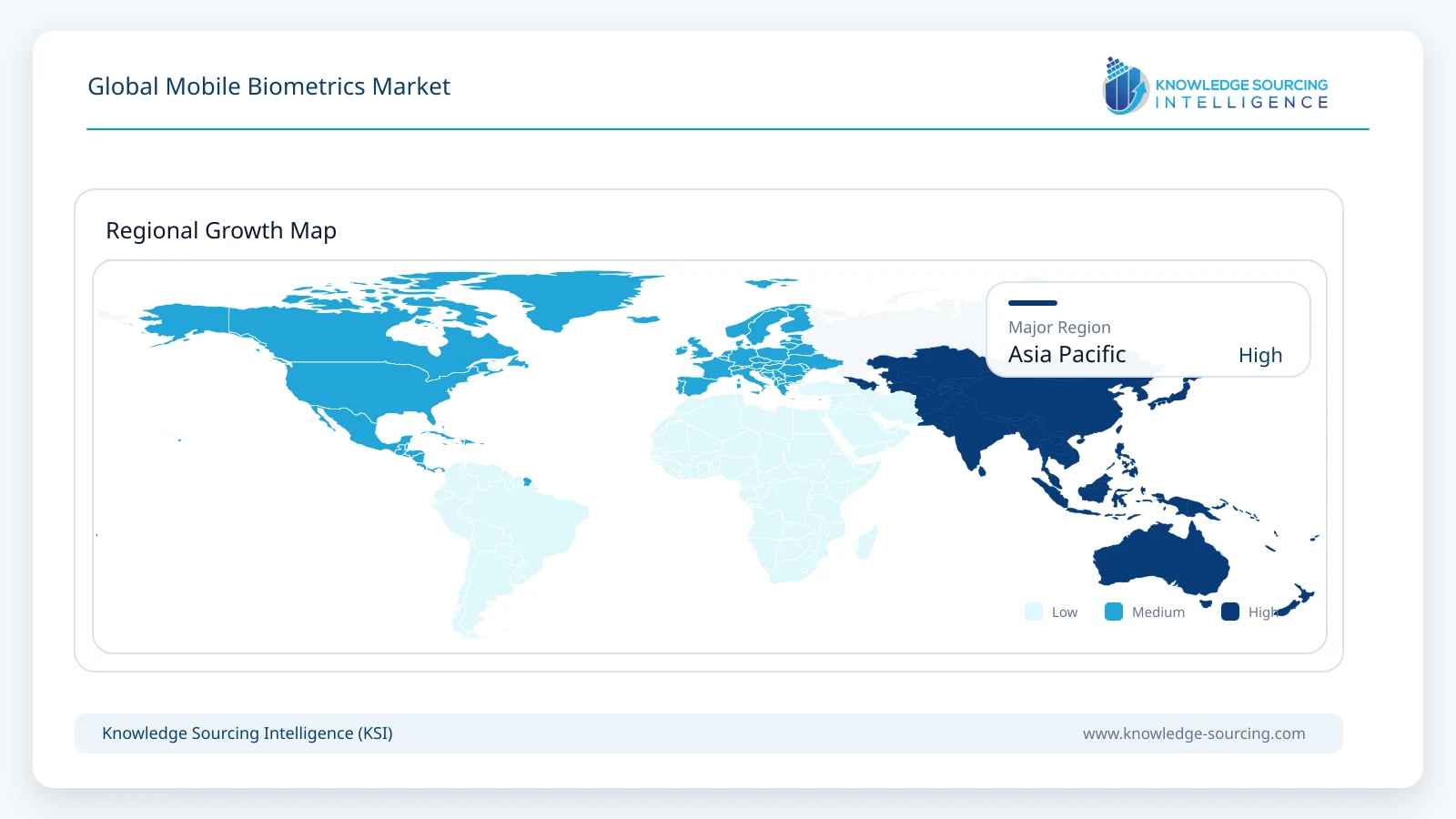
Asia Pacific is the largest regional market and is projected to approach USD 25 billion by 2031. The region combines the world’s largest smartphone user base with large digital-payment ecosystems, national identity programs and strong handset manufacturing. India is an important test market for biometric payments and passkeys, while Singapore is extending passkeys through Singpass and China, South Korea and Japan support advanced mobile-device supply chains. North America remains a major software and identity-verification market, particularly through financial services and mobile driver licenses. The Middle East and Africa is expected to record one of the fastest growth rates as mobile-first identity and financial-access programs expand from a lower installed base.
Competitive Environment
Competition spans three distinct layers. Device and semiconductor companies such as Apple, Google, Qualcomm, Goodix, Fingerprint Cards and Synaptics control operating-system integration, sensors and secure authentication interfaces. Identity technology suppliers such as Thales, IDEMIA and NEC serve government, financial-services and enterprise programs, while specialist software vendors including FaceTec, iProov, Daon, Aware, Veridas, Entrust and Precise Biometrics compete in biometric matching, liveness, orchestration and identity proofing. The market is therefore less concentrated than the smartphone platform layer alone would suggest.
Competitive differentiation increasingly depends on security certification, presentation-attack resistance, device coverage, latency, privacy architecture and the ability to work with passkeys or digital credentials. Hardware suppliers are competing on thinner sensors, larger sensing areas and wet-finger or under-display performance. Software vendors are competing on liveness, deepfake resistance, document-to-face matching and integration speed. Large identity providers also benefit from government references and credential issuance capabilities, while mobile platform companies can distribute biometric authentication to billions of devices through operating-system updates rather than standalone deployments.
Recent Developments
September 2026: Goodix announced that its ultrasonic and capacitive fingerprint technologies were integrated into the nubia NaviX Ultra AI-agent smartphone, using biometric checks for both AI authorization and everyday authentication.
September 2026: Mastercard and Google Pay announced plans to bring device-biometric card-payment experiences to eligible Mastercard users in India, extending smartphone biometrics into everyday payment authorization.
August 2026: NIST completed Phase One FastCAP qualification testing for contactless rapid fingerprint capture; Thales reported successful qualification for technology used in mobile biometric identification.
June 2026: Singapore GovTech launched passkeys in beta for Singpass, adding phishing-resistant device authentication to the national digital identity platform.
May 2026: FIDO Alliance reported approximately 5 billion passkeys in active use and broad consumer and workforce adoption across ten surveyed countries.
April 2026: IDEMIA supported the launch of California mobile ID in Samsung Wallet, expanding mobile credential use for identity verification and participating TSA checkpoints.
Mobile Biometrics Market Scope
| Report Metric | Details |
|---|---|
| Total Market Size in 2026 | USD 28.60 billion |
| Total Market Size in 2031 | USD 57.40 billion |
| Forecast Unit | Billion |
| Growth Rate | 15.0% |
| Study Period | 2021 to 2031 |
| Historical Data | 2021 to 2024 |
| Base Year | 2025 |
| Forecast Period | 2026 – 2031 |
| Segmentation | Component, Technology, Application, End User, Geography |
| Companies |
|
Market Segmentation
By Component
Hardware
Software
Services
By Technology
Fingerprint Recognition
Facial Recognition
Voice Recognition
Iris and Other Biometrics
By Application
Mobile Banking and Payments
Identity Verification and Digital ID
Access Control
Others
By End User
BFSI
Government and Defense
IT and Telecommunication
Consumer Electronics
Others
By Geography
North America
USA
Canada
Mexico
South America
Brazil
Argentina
Others
Europe
Germany
France
United Kingdom
Spain
Italy
Others
Middle East and Africa
Saudi Arabia
UAE
Israel
Others
Asia Pacific
China
India
Japan
South Korea
Singapore
Indonesia
Others
Table of Contents
1. EXECUTIVE SUMMARY
2. MARKET SNAPSHOT
2.1. Market Overview
2.2. Market Definition
2.3. Market Segmentation
3. BUSINESS LANDSCAPE
3.1. Market Drivers
3.1.1. Passwordless Authentication and Biometric Payments Create Recurring Demand Beyond Smartphone Shipments
3.1.2. Digital Identity, eKYC and Mobile Government Credentials Expand High-Assurance Use Cases
3.2. Market Restraint
3.2.1. Privacy Requirements, Spoofing Risk and a Weak Handset Cycle Limit Frictionless Market Expansion
3.3. Market Opportunities
3.4. Porter's Five Forces Analysis
3.5. Industry Value Chain Analysis
3.6. Policies and Regulations
3.7. Strategic Recommendations
4. TECHNOLOGICAL OUTLOOK
4.1. Ultrasonic and Under-Display Fingerprint Sensors
4.2. Facial Liveness and Deepfake Detection
4.3. Passkeys and Device-Bound Authentication
4.4. Mobile Contactless Fingerprint Capture and Digital Credentials
5. GLOBAL MOBILE BIOMETRICS MARKET BY COMPONENT
5.1. Introduction
5.2. Hardware
5.3. Software
5.4. Services
6. GLOBAL MOBILE BIOMETRICS MARKET BY TECHNOLOGY
6.1. Introduction
6.2. Fingerprint Recognition
6.3. Facial Recognition
6.4. Voice Recognition
6.5. Iris and Other Biometrics
7. GLOBAL MOBILE BIOMETRICS MARKET BY APPLICATION
7.1. Introduction
7.2. Mobile Banking and Payments
7.3. Identity Verification and Digital ID
7.4. Access Control
7.5. Others
8. GLOBAL MOBILE BIOMETRICS MARKET BY END USER
8.1. Introduction
8.2. BFSI
8.3. Government and Defense
8.4. IT and Telecommunication
8.5. Consumer Electronics
8.6. Others
9. GLOBAL MOBILE BIOMETRICS MARKET BY GEOGRAPHY
9.1. Introduction
9.2. North America
9.2.1. USA
9.2.2. Canada
9.2.3. Mexico
9.3. South America
9.3.1. Brazil
9.3.2. Argentina
9.3.3. Others
9.4. Europe
9.4.1. Germany
9.4.2. France
9.4.3. United Kingdom
9.4.4. Spain
9.4.5. Italy
9.4.6. Others
9.5. Middle East and Africa
9.5.1. Saudi Arabia
9.5.2. UAE
9.5.3. Israel
9.5.4. Others
9.6. Asia Pacific
9.6.1. China
9.6.2. India
9.6.3. Japan
9.6.4. South Korea
9.6.5. Singapore
9.6.6. Indonesia
9.6.7. Others
10. COMPETITIVE ENVIRONMENT AND ANALYSIS
10.1. Major Players and Strategy Analysis
10.2. Market Share Analysis
10.3. Mergers, Acquisitions, Agreements and Collaborations
10.4. Competitive Dashboard
11. COMPANY PROFILES
11.1. Thales Group
11.2. IDEMIA
11.3. NEC Corporation
11.4. Apple Inc.
11.5. Google LLC
11.6. Qualcomm Incorporated
11.7. Goodix Technology Inc.
11.8. Fingerprint Cards AB
11.9. Synaptics Incorporated
11.10. Precise Biometrics AB
11.11. Aware, Inc.
11.12. FaceTec, Inc.
11.13. Daon, Inc.
11.14. iProov Limited
11.15. Entrust Corporation (Onfido)
11.16. Veridas
11.17. BIO-key International, Inc.
12. APPENDIX
12.1. Currency
12.2. Assumptions
12.3. Base and Forecast Years Timeline
12.4. Key Benefits for Stakeholders
12.5. Research Methodology
12.6. Abbreviations
Navigate
Trusted by the world's leading organizations











