
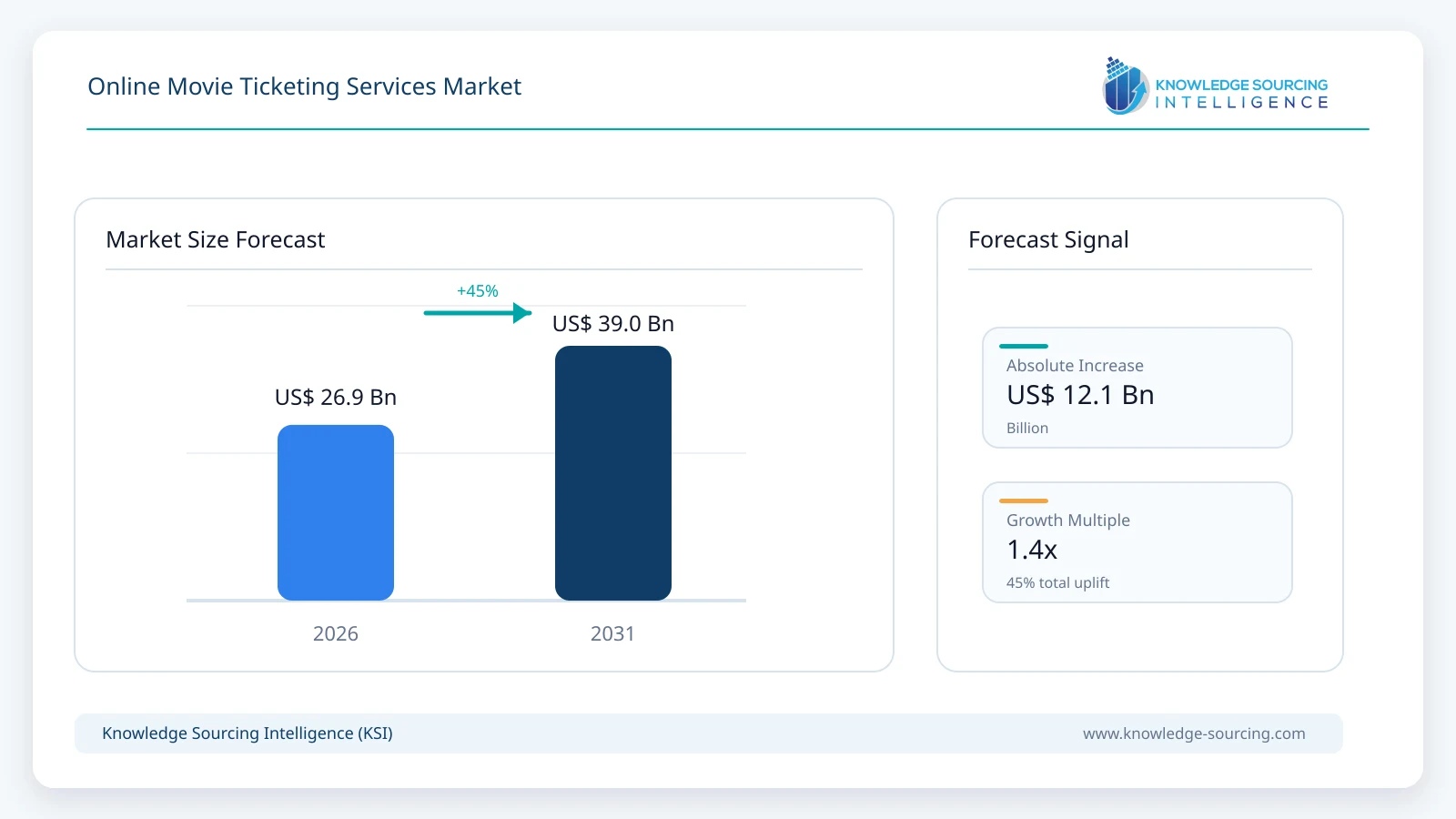
The online movie ticketing services market is forecast to grow at a CAGR of 7.7%, reaching USD 39.0 billion in 2031 from USD 26.9 billion in 2026.
Highlights:
- 1Mobile booking takes the leadSmartphones and Tablets account for 86.0% of the market in 2026, generating USD 23.13 billion, as consumers increasingly rely on mobile platforms for fast and convenient movie ticket purchases.
- 2Animation/Family gains momentumThe Animation/Family genre is set to grow at a CAGR of 8.8% through 2031, reflecting sustained audience demand for family-oriented theatrical content and convenient digital ticket access.
- 3North America sets the regional benchmarkThe region commands a 27.0% share in 2026, with the market reaching USD 7.26 billion, supported by mature digital ticketing infrastructure and high online booking adoption.
- 4Mobile platforms strengthen their positionSmartphones and Tablets are projected to reach USD 35.49 billion by 2031, raising their share to 91.0% as mobile-first ticket purchasing continues to reshape the moviegoing experience.
The Online Movie Ticketing Services Market covers digital platforms and applications that allow consumers to discover films, compare cinema showtimes, select seats, purchase or reserve tickets, receive digital admission credentials, and manage related moviegoing transactions. The market includes cinema-owned websites and applications, dedicated online movie-ticketing platforms, and broader entertainment platforms that incorporate theatrical ticketing into a wider consumer proposition. It excludes the value of cinema exhibition itself, film production, theatrical distribution, and subscription video-on-demand services except where those activities directly influence online theatrical ticket transactions.
Online ticketing has become an important part of cinema economics because it changes how consumers interact with exhibitors before entering a theatre. A digital transaction can shift seat selection, payment, ticket delivery, loyalty enrollment, promotional offers, and concession purchases away from the physical box office. This creates commercial value beyond the ticket transaction. Operators can obtain customer data, manage inventory in real time, promote premium formats, and connect admissions with food, beverage, memberships, and other entertainment purchases.
The demand environment is shaped by the practical benefits of advance booking. Consumers can check availability, select preferred seats, compare showtimes, and secure tickets before travelling to a cinema. These benefits become particularly important for premium screens, opening weekends, high-demand films, evening shows, and locations with reserved seating. For cinema operators, advance digital purchases also provide better visibility into demand and can improve staffing, auditorium allocation, promotional planning, and concession preparation.
Official company disclosures demonstrate the extent to which online transactions have become embedded in cinema operations. AMC Entertainment reported that approximately 73% of its U.S. tickets were purchased online during 2025. Approximately 87% of those online ticket purchases were made through AMC's own website and mobile applications. The company also reported approximately 39 million member households in its Stubs loyalty programs at the end of 2025. These figures indicate that online ticketing is no longer simply an alternative to the physical box office. For large exhibitors, it can represent the principal customer-entry point into the cinema relationship.
Buyer priorities vary by participant. Consumers prioritize convenience, seat availability, transparent pricing, payment flexibility, reliable ticket confirmation, and easy cancellation or refund processes where permitted. Cinema operators prioritize control over ticket inventory, transaction reliability, customer retention, fee economics, data ownership, loyalty integration, and the ability to attach ancillary purchases to the admission transaction. Third-party platforms prioritize broad cinema coverage, discovery, transaction volume, supplier relationships, and differentiated consumer features.
The industry therefore has several revenue mechanisms. Ticketing platforms can earn booking or convenience fees, commissions, advertising income, promotional revenue, membership revenue, and transaction-related income. Cinema operators can use digital channels to sell admissions while increasing concession sales, premium-format upgrades, loyalty participation, and repeat visitation. The economic importance of online ticketing consequently depends not only on the number of tickets sold digitally but also on the additional customer value generated around each transaction.
Adoption varies by geography, cinema infrastructure, payment behavior, smartphone penetration, consumer familiarity with digital commerce, and the maturity of local cinema chains. Developed cinema markets generally have established online booking ecosystems, while emerging markets can show faster migration from physical ticket counters as smartphones, digital payments, and organized cinema chains expand. In both cases, the quality of inventory integration remains critical. A platform that cannot provide accurate seat availability or reliable transaction confirmation risks losing consumer trust regardless of its interface quality.
The competitive structure is also unusual because many major participants are cinema operators themselves. AMC Theatres, Cinemark Holdings, Cineplex, PVR INOX, and VOX Cinemas can control both theatre inventory and digital booking interfaces. Fandango and Atom Tickets operate as dedicated ticketing platforms, while BookMyShow and District extend movie ticketing into broader entertainment ecosystems. This creates competition between first-party and aggregated ticketing models.
Market Drivers
Higher consumer preference for advance seat selection
Reserved seating gives online movie ticketing a functional advantage over traditional counter-based purchasing. Consumers can assess available seats before travelling to the cinema and avoid uncertainty around sold-out shows. The benefit becomes stronger for premium auditoriums and high-demand releases, where preferred seats can disappear quickly after tickets go on sale.
Cinema operators benefit from the same mechanism because advance transactions provide visibility into auditorium-level demand. Operators can adjust promotional activity, allocate screens, prepare concessions, and manage staffing with better information. Digital booking also allows cinemas to sell premium seating and formats before customers arrive.
The commercial implication is that ticketing platforms increasingly need accurate, real-time integration with cinema inventory. The transaction itself is relatively simple; the difficult part is maintaining reliable information across showtimes, seat maps, pricing categories, promotional rules, payment systems, and ticket issuance.
Loyalty programs are connecting ticketing with repeat visitation
Movie-ticketing platforms have become an important mechanism for building customer relationships. Loyalty programs can connect ticket purchases with points, discounts, subscriptions, premium-format access, food and beverage rewards, and targeted offers.
AMC provides a strong example. Its Stubs ecosystem had approximately 39 million member households at the end of 2025, while its A-List subscription allows members to book tickets online in advance with reserved seating. The commercial significance is that digital ticketing becomes part of a broader retention mechanism.
For operators, a loyal digital customer can have greater lifetime value than a one-time ticket purchaser because the same account can support repeated admissions, concession purchases, membership payments, and targeted promotions. This encourages exhibitors to invest in first-party applications and websites rather than relying exclusively on external aggregators.
Smartphone-based commerce expands the role of movie-ticketing applications
Smartphones allow consumers to search for films and complete transactions without accessing a physical ticket counter or desktop computer. Mobile applications can also use location information to surface nearby cinemas, send showtime notifications, store loyalty credentials, display QR codes, and provide digital receipts.
The commercial advantage is the reduction of friction between discovery and purchase. A consumer watching a trailer or receiving a release notification can move directly to ticket selection. Applications can also integrate concession ordering and promotional campaigns.
Atom Tickets illustrates this broader transaction model. Its service supports online ticket purchases and digital ticket delivery, while participating theatres can offer advance concession ordering. This indicates that the ticketing transaction can act as an entry point for additional cinema spending rather than remaining limited to admission.
Event films generate concentrated advance-booking demand
Theatrical demand is highly dependent on film release schedules. Major franchise films, sequels, adaptations, concert films, anime releases, and other event titles can produce substantial advance sales shortly after tickets become available.
Fandango's 2025 experience with Wicked: For Good demonstrates this mechanism. The company reported that the film became its strongest first-day ticket pre-seller of 2025 and later its best PG-rated ticket pre-seller of all time at the comparable point in the sales cycle.
Such demand peaks place greater requirements on digital ticketing infrastructure. Platforms must process high transaction volumes, maintain accurate seat inventories, manage payment traffic, and prevent double-booking. A platform's commercial reputation can therefore depend heavily on its performance during a small number of exceptionally busy release periods.
Expansion of digital payments supports online conversion
Online movie ticketing depends on convenient electronic payment. As consumers become more accustomed to digital commerce, ticketing platforms can remove several steps associated with cash transactions and physical ticket counters.
The effect is particularly important in markets where mobile payments, cards, digital wallets, and other electronic payment methods are widely used. Cinema operators can also connect payment information with loyalty accounts and promotional systems. This enables targeted discounts and reduces the operational dependence on physical cash handling.
However, payment convenience alone does not guarantee conversion. Consumers still compare the final ticket price, booking fees, seat charges, taxes, and other mandatory costs. Transparent checkout design is therefore becoming as important as payment availability.

Market Restraints and Challenges
Ticketing fees can create consumer resistance and regulatory exposure
Online ticketing platforms often add convenience or booking fees to ticket prices. These charges can support the economics of digital platforms, but consumers may resist them when the fee appears late in the checkout process or when the digital service is perceived as merely replacing an existing physical purchase process.
Canada provides a direct regulatory example. The Competition Tribunal found that Cineplex had engaged in drip pricing by adding a mandatory C$1.50 online booking fee to the advertised ticket price and ordered the company to pay a C$38.9 million penalty. The Competition Bureau continues to identify the case as an example of the requirement to display complete prices upfront.
The impact extends beyond one operator. Ticketing companies must design checkout systems that clearly communicate compulsory charges before purchase completion. Failure to do so can affect consumer trust, conversion rates, regulatory compliance, and brand reputation.
Dependence on cinema inventory limits platform differentiation
Third-party ticketing services depend on agreements with cinema operators to obtain showtimes, seat inventories, prices, and booking rights. Where a major exhibitor prioritizes its own website or application, independent platforms may have limited access to inventory or may face less favorable economics.
This creates a structural challenge for aggregators. Their value depends partly on breadth of inventory, while cinema operators have a commercial incentive to retain direct customer relationships.
The resulting competition is not purely about application design. It involves distribution agreements, transaction economics, data ownership, promotional relationships, loyalty integration, and access to premium inventory.
Demand volatility creates infrastructure and forecasting pressure
Movie ticketing demand can fluctuate sharply depending on film releases, holidays, weather, school calendars, local events, and the performance of individual titles. A platform can experience relatively modest transaction volumes on ordinary days and intense demand when a major release opens.
This creates an infrastructure challenge. Systems must be designed for peak transaction loads without imposing excessive costs during lower-demand periods. Payment gateways, seat-reservation systems, customer databases, authentication systems, and notification services must remain reliable when demand surges.
For smaller operators, the investment required to maintain high availability can be difficult to justify solely through ticketing fees. This favors platforms with larger transaction volumes or diversified entertainment services.
Refunds, cancellations, and transaction failures complicate customer service
Digital ticketing creates an expectation of immediate confirmation. When a payment succeeds but ticket issuance fails, or when a customer receives a ticket but the showtime changes, the platform becomes responsible for resolving the transaction.
The problem becomes more complex when third-party platforms, cinema operators, payment processors, and ticketing technology providers are involved in the same transaction. Responsibility for refunds can become unclear from the customer's perspective.
Companies therefore need reliable reconciliation systems, customer support processes, automated refund mechanisms, and clear terms and conditions. These functions add operating costs that are often overlooked when ticketing is evaluated solely through transaction fees.
Consumer privacy and cybersecurity requirements increase technology costs
Ticketing platforms process names, contact information, payment-related data, purchase histories, loyalty activity, and potentially location information. The broader the digital service becomes, the greater the amount of customer data stored and processed.
Security failures can affect both consumers and cinema operators. Ticketing platforms therefore need appropriate authentication, payment-security controls, access management, data retention procedures, and incident-response mechanisms.
Privacy compliance also affects personalization. Companies may want to use purchase histories to recommend films or promotions, but such practices must operate within applicable privacy and consumer-protection requirements.
Major Segment Analysis
Smartphones and Tablets
Smartphones and tablets represent the most commercially important device segment because they combine ticket discovery, transaction completion, digital ticket storage, location services, loyalty access, and post-purchase engagement within one device.
The strongest demand comes from consumers who value convenience and immediate access to cinema inventory. Mobile ticketing removes the need to visit a box office or use a desktop computer. A consumer can select a cinema, compare showtimes, choose a seat, complete payment, and receive a digital ticket while travelling or while already away from the cinema.
The segment also matters because mobile applications can maintain an ongoing customer relationship after the ticket has been purchased. Push notifications can communicate upcoming showtimes, new releases, loyalty offers, booking reminders, or promotional campaigns. Digital tickets can remain inside the application until admission, reducing dependence on printed tickets.
For cinema operators, mobile applications provide a first-party channel through which ticketing and ancillary services can be combined. AMC's 2025 filing provides direct evidence of this model. Approximately 73% of its U.S. tickets were purchased online, while approximately 87% of those online purchases were made through AMC's own website and mobile applications.
This first-party share has important revenue implications. When the exhibitor controls the application, it can retain greater control over customer communications, loyalty enrollment, promotional offers, transaction data, and ancillary sales. The segment's importance is reinforced by the overall market's projected 8.9% CAGR, reflecting continued adoption of convenient digital ticketing channels.
Third-party platforms face a different commercial requirement. Their applications must provide sufficient discovery and convenience to justify the use of an intermediary. Broad cinema coverage, personalized recommendations, transparent inventory, reliable seat selection, payment flexibility, and additional entertainment features can help support this proposition.
The competitive question will therefore not be whether mobile ticketing becomes relevant. It is already commercially significant. The more important question is which companies can turn mobile ticketing into a recurring customer relationship while maintaining transaction economics.
Regional Analysis
North America
North America remains one of the most mature markets for online movie ticketing, supported by established cinema chains, reserved seating, digital payments, loyalty programs, and dedicated ticketing platforms. The region is projected to hold a 25.0% market share by 2031, with the segment expected to expand at a 6.10% CAGR during the forecast period.
The United States has a strong ecosystem of cinema-owned applications and third-party ticketing services. Major exhibitors continue to drive digital adoption through mobile booking, loyalty integration, premium seating, and personalized offers. Fandango also operates at substantial scale, with NBCUniversal describing its network as serving more than 50 million unique visitors per month and providing ticket access across approximately 31,000 U.S. movie screens.
Canada has a similarly developed digital booking environment, but it also demonstrates the regulatory risks associated with online fees. The Cineplex drip-pricing decision has made transparent presentation of mandatory ticketing charges a material compliance issue.
Future demand will depend less on basic digitization and more on loyalty integration, subscriptions, premium seating, mobile commerce, concessions, personalized promotions, and data-driven customer retention.
Europe
European demand is supported by established cinema chains, high digital-commerce usage, and a large network of multiplex and premium cinema operators. The United Kingdom, Germany, France, Italy, and Spain provide important demand centers.
The market is more fragmented than the United States because consumer behavior, payment systems, languages, and regulatory requirements vary across countries. Cinema operators must therefore adapt applications and pricing systems to local market conditions.
The commercial opportunity lies in improving first-party booking, loyalty integration, premium-format sales, and mobile engagement. However, consumer-protection, privacy, accessibility, and digital-payment requirements increase the cost of operating standardized platforms across multiple jurisdictions.
Asia-Pacific
Asia-Pacific provides a broad range of market conditions and represents the largest regional opportunity, accounting for a 43.0% share in 2026, with a segment value of USD 11.57 billion. China, India, Japan, South Korea, Australia, Taiwan, Thailand, and Indonesia differ considerably in cinema infrastructure, consumer payment behavior, platform concentration, and digital adoption. The region is expected to strengthen its position, reaching a 46.0% share by 2031, supported by expanding digital ticketing and entertainment consumption.
India is particularly relevant because large organized cinema chains coexist with broad mobile commerce adoption. BookMyShow has developed beyond movie ticketing into a broader entertainment platform, while PVR INOX operates its own digital booking ecosystem. This creates competition between cinema-owned platforms and multi-category entertainment marketplaces, supporting continued digital ticketing adoption.
China, Japan, and South Korea offer large and digitally mature entertainment markets, although local platform structures and consumer behavior differ. Southeast Asian markets can provide additional growth opportunities as organized cinema infrastructure, smartphone penetration, and digital payment ecosystems develop.
The main constraints include fragmented cinema ownership in some markets, differing payment preferences, local competition, and varying levels of cinema penetration outside major urban areas.
Middle East & Africa
The Middle East is supported by investment in modern cinema infrastructure, particularly in the Gulf markets. Saudi Arabia and the United Arab Emirates have become important cinema markets within the region, supported by modern multiplex formats and digitally oriented consumers.
Online ticketing is well suited to these markets because new multiplex developments can be designed around digital booking, reserved seating, loyalty programs, and mobile payments from the beginning.
Africa presents more varied conditions. Major urban markets can support digital ticketing where organized cinema chains and reliable payment infrastructure exist, while lower cinema density and uneven connectivity constrain adoption elsewhere.
The regional opportunity therefore depends heavily on cinema infrastructure deployment rather than ticketing technology alone.
Latin America
Latin America includes major cinema markets such as Brazil, Mexico, and Argentina, along with smaller markets where digital ticketing adoption depends on cinema chain coverage and payment infrastructure.
Brazil and Mexico provide the strongest commercial opportunities within the supplied country segmentation because of their population size, urban concentration, established cinema infrastructure, and growing use of digital commerce.
The main constraint is uneven purchasing power. Consumers can remain price-sensitive toward convenience fees and premium seating charges, making transparent pricing and promotional offers important to transaction conversion.
Third-party aggregators can benefit from fragmented cinema supply, while major exhibitors can defend first-party channels through loyalty programs and direct promotional relationships.
Competitive Landscape
The competitive structure consists of three broad models.
The first is the cinema-owned platform model, represented by AMC Theatres, Cinemark Holdings, Cineplex, PVR INOX Limited, and VOX Cinemas. These companies control theatre inventory and can directly connect ticketing with loyalty, concessions, subscriptions, premium formats, and customer communications. Their strongest competitive advantage is ownership of the underlying cinema relationship.
The second is the dedicated ticketing platform model, represented by Fandango and Atom Tickets. These companies can create value by aggregating cinema inventory and simplifying discovery. Their differentiation depends on breadth of theatre access, user experience, transaction reliability, promotional features, and partnerships.
The third is the broader entertainment marketplace model, represented by Big Tree Entertainment Pvt. Ltd. through BookMyShow and District by Zomato/Eternal. These platforms can position movie ticketing alongside other leisure activities, allowing users to interact with multiple entertainment categories within the same digital ecosystem.
The competitive distinction is therefore not simply application functionality. It is the ability to control inventory, retain customers, maintain transaction economics, and expand the value of each booking.
Partnerships remain important because third-party platforms require cinema access, while exhibitors can benefit from external discovery and incremental demand. The strongest relationships are likely to be those where both parties gain measurable value from additional ticket sales without undermining direct customer relationships.
Technology positioning will increasingly center on reliable inventory synchronization, mobile applications, payment integration, digital ticket issuance, loyalty systems, personalization, and customer-service automation. However, technology investment must produce measurable commercial outcomes. A more sophisticated interface has limited value if ticket availability is inaccurate or checkout charges are unclear.
Geographic expansion will remain relevant for platforms that can aggregate fragmented cinema markets. For cinema operators, the more defensible strategy is often deeper penetration within their existing theatre networks through first-party applications and membership programs.
Recent Developments
September 2026: BookMyShow confirmed advance digital ticket sales for Lollapalooza India 2027, with RuPay presales beginning August 30 and Early Bird tickets launching September 2 through its ticketing platform.
August 2026: Swiggy Dineout launched “Order-in-Cinemas” with Cinepolis and Asian Cinemas, adding QR-based in-seat ordering and cinema discovery features including movie releases, booking links, screenings, and offers.
July 2026: Fandango unified its entertainment services under one brand, combining movie ticketing, rentals, purchases, and free streaming into a connected digital consumer experience.
June 2026: Cinemark’s Summer Movie Clubhouse opened online ticket sales through Cinemark.com and its mobile app, covering more than 285 locations and reinforcing app-based advance movie-ticket purchasing.
April 2026: Cinemark continued expanding its digital customer journey, enabling moviegoers to access showtimes, reserve seats, and purchase tickets and concessions through its website and mobile applications.
Regulatory and Policy Environment
The regulatory environment for online movie ticketing is fragmented because the service sits at the intersection of cinema admissions, e-commerce, payments, consumer protection, privacy, taxation, accessibility, and competition law.
Consumer-protection rules have become particularly relevant to online pricing. Canada's Cineplex case provides a direct example. The Competition Tribunal found that Cineplex had engaged in drip pricing through a mandatory online booking fee and ordered a C$38.9 million penalty. The Competition Bureau has subsequently used the case to reinforce the principle that businesses should display complete mandatory prices upfront.
The commercial implication is substantial. Ticketing platforms need checkout systems that distinguish clearly between base admission prices, optional upgrades, taxes, and mandatory fees. Companies that rely on low advertised prices followed by unavoidable charges face greater regulatory and reputational exposure.
Privacy regulation is another important consideration because online ticketing platforms collect customer information and transaction histories. Loyalty systems can increase the volume of personal and behavioral data held by operators. Companies therefore need appropriate data governance, security controls, consent mechanisms where required, and transparent privacy policies.
Payment regulation also affects platform design. Digital ticketing services depend on secure electronic payment processing and must accommodate local payment methods where consumer preferences vary. Payment failures, chargebacks, fraud prevention, and refund processing can materially affect operating costs.
Tax rules can also influence final ticket prices. In India, cinema admission falls within the GST framework, and the Central Board of Indirect Taxes and Customs maintains the applicable tax schedules. The market analysis should therefore distinguish between ticketing-service fees and taxes applied to cinema admissions rather than treating all checkout charges as platform revenue.
Accessibility requirements can affect application and website design. Digital booking interfaces should provide appropriate accessibility features where required by local law or policy. This can influence application development, website architecture, seat-selection interfaces, payment flows, and customer support.
Competition policy can become relevant where dominant cinema operators restrict ticket availability, impose restrictive platform terms, or use pricing structures that affect independent ticketing services. As online booking becomes a larger proportion of cinema transactions, regulators have greater reason to examine how digital platforms influence consumer choice and pricing transparency.
Outlook and Strategic Implications
The Online Movie Ticketing Services Market is likely to move from basic digitization toward deeper integration with the economics of cinema operations. The central commercial question will increasingly be how much value a digital transaction creates beyond admission.
Investment priorities are likely to concentrate on mobile applications, first-party customer accounts, reliable inventory management, payment infrastructure, loyalty systems, analytics, cybersecurity, and integration with concession ordering. Companies will need to prioritize systems that reduce transaction friction while maintaining reliable seat and pricing information.
Procurement trends will favor platforms that can integrate multiple functions rather than isolated ticketing software. Cinema operators have an economic reason to connect ticketing with loyalty, concessions, subscriptions, premium-format upgrades, customer communications, and promotional campaigns. The result is a gradual shift from ticketing technology toward broader cinema-commerce platforms.
Mobile devices should remain a central interface because they allow ticket discovery, booking, payment, digital admission, loyalty, and post-purchase communication within the same environment. The competitive advantage will depend less on simply offering a mobile application and more on whether that application becomes the consumer's preferred route into the cinema relationship.
First-party channels are likely to remain strategically important for major cinema operators. AMC's 2025 figures demonstrate the potential scale of direct digital transactions, with approximately 87% of its online U.S. ticket purchases flowing through its own website and applications. This model allows operators to maintain direct customer relationships while integrating ticketing with memberships and other services.
Third-party ticketing platforms will nevertheless retain a role where they offer broader inventory discovery, easier comparison, cross-cinema search, promotional advantages, or entertainment services that individual exhibitors cannot provide. Their strongest opportunity lies in reducing the friction associated with discovering and comparing cinema options.
The risk profile will remain concentrated around consumer pricing, platform reliability, privacy, cybersecurity, payment failures, and dependency on cinema inventory agreements. Regulatory scrutiny of mandatory digital fees is likely to encourage greater price transparency. The Cineplex decision illustrates the financial consequences of failing to present mandatory charges appropriately.
Demand will also remain dependent on the quality and frequency of theatrical content. Ticketing platforms cannot create sustained transaction volume independently of cinema attendance. Their role is to make the purchase process more accessible, predictable, and commercially valuable when consumers decide to attend.
Strategically, the strongest companies will be those that balance transaction volume with customer lifetime value. A platform that processes a large number of low-value bookings but lacks customer retention may have weaker economics than an integrated service that generates repeat purchases, membership revenue, concession sales, and targeted promotional engagement.
Over the 2026–2031 forecast period, competition should therefore be assessed across five dimensions: inventory access, customer ownership, transaction economics, digital experience, and ancillary monetization. These factors provide a more useful framework than application functionality alone.
The market's next stage will be defined by the integration of ticketing into the broader cinema customer journey. Advance booking, reserved seating, mobile payment, digital admission, loyalty, subscriptions, premium formats, concessions, and personalized offers can increasingly operate within one transaction ecosystem. Companies that can connect these functions without adding unnecessary fees or checkout complexity will have stronger opportunities to defend customer relationships.
For investors and technology suppliers, the most attractive opportunities are likely to emerge around first-party commerce infrastructure, mobile engagement, inventory synchronization, payment reliability, loyalty technology, and scalable transaction systems. For cinema operators, the priority will be to retain control over high-value customer interactions while using external platforms selectively to expand discovery and reach.
The resulting market will not be determined solely by the number of tickets purchased online. Its commercial development will depend on how effectively digital ticketing improves occupancy management, customer retention, ancillary spending, and the economics of each cinema visit while maintaining transparent pricing and dependable service.
Online Movie Ticketing Services Market Scope:
| Report Metric | Details |
|---|---|
| Total Market Size in 2026 | USD 26.9 billion |
| Total Market Size in 2031 | USD 39.0 billion |
| Forecast Unit | Billion |
| Growth Rate | 7.7% |
| Study Period | 2021 to 2031 |
| Historical Data | 2021 to 2024 |
| Base Year | 2025 |
| Forecast Period | 2026 – 2031 |
| Segmentation | Device, Genre, Geography |
| Companies |
|
Market Segmentation
By Device
Smartphones and Tablets
PCs and Laptops
By Genre
Action and Adventure
Comedy
Drama
Thriller, Suspense, and Horror
Romance
Animation and Family
Science Fiction and Fantasy
Others
By Geography
North America
United States
Canada
Latin America
Brazil
Mexico
Argentina
Rest of Latin America
Europe
United Kingdom
Germany
France
Italy
Spain
Rest of Europe
Middle East and Africa
Saudi Arabia
United Arab Emirates
Rest of the Middle East and Africa
Asia-Pacific
China
India
Japan
South Korea
Australia
Taiwan
Thailand
Indonesia
Rest of Asia-Pacific
Table of Contents
1. INTRODUCTION
1.1. Market Overview
1.2. Market Definition
1.3. Scope of the Study
1.4. Market Segmentation
1.5. Currency
1.6. Assumptions
1.7. Base and Forecast Years Timeline
1.8. Key benefits for the stakeholders
2. RESEARCH METHODOLOGY  
2.1. Research Design
2.2. Research Process
3. EXECUTIVE SUMMARY
3.1. Key Findings
3.2. Analyst View
4. MARKET DYNAMICS
4.1. Market Drivers
4.2. Market Restraints
4.3. Porter’s Five Forces Analysis
4.3.1. Bargaining Power of Suppliers
4.3.2. Bargaining Power of Buyers
4.3.3. The Threat of New Entrants
4.3.4. Threat of Substitutes
4.3.5. Competitive Rivalry in the Industry
4.4. Industry Value Chain Analysis
5. ONLINE MOVIE TICKETING SERVICES MARKET BY PLATFORM
5.1. Introduction
5.2. Smartphones and Tablets
5.3. PCs and Laptops
6. ONLINE MOVIE TICKETING SERVICES MARKET BY GENRE
6.1. Introduction
6.2. Action/Adventure
6.3. Comedy
6.4. Drama
6.5. Suspense, Thriller, and Horror
6.6. Others
7. ONLINE MOVIE TICKETING SERVICES MARKET BY GEOGRAPHY
7.1. Global Overview
7.2. North America
7.2.1. United States
7.2.2. Canada
7.2.3. Mexico
7.3. South America
7.3.1. Brazil
7.3.2. Argentina
7.3.3. Rest of South America
7.4. Europe
7.4.1. United Kingdom
7.4.2. Germany
7.4.3. France
7.4.4. Italy
7.4.5. Spain
7.4.6. Rest of Europe
7.5. Middle East and Africa
7.5.1. Saudi Arabia
7.5.2. United Arab Emirates
7.5.3. Rest of the Middle East and Africa
7.6. Asia-Pacific
7.6.1. China
7.6.2. India
7.6.3. Japan
7.6.4. South Korea
7.6.5. Taiwan
7.6.6. Thailand
7.6.7. Indonesia
7.6.8. Rest of Asia-Pacific
8. COMPETITIVE ENVIRONMENT AND ANALYSIS
8.1. Major Players and Strategy Analysis
8.2. Market Share Analysis
8.3. Mergers, Acquisitions, Agreements, and Collaborations
8.4. Competitive Dashboard
9. COMPANY PROFILES
9.1. Bigtree Entertainment Pvt. Ltd.
9.2. PVR Cinemas
9.3. Atom Tickets LLC
9.4. Wave Cinemas
9.5. Vue
9.6. Fandango
9.7. Paytm
9.8. Justtickets
9.9. Fandango
9.10. Regal
Navigate
Trusted by the world's leading organizations











