
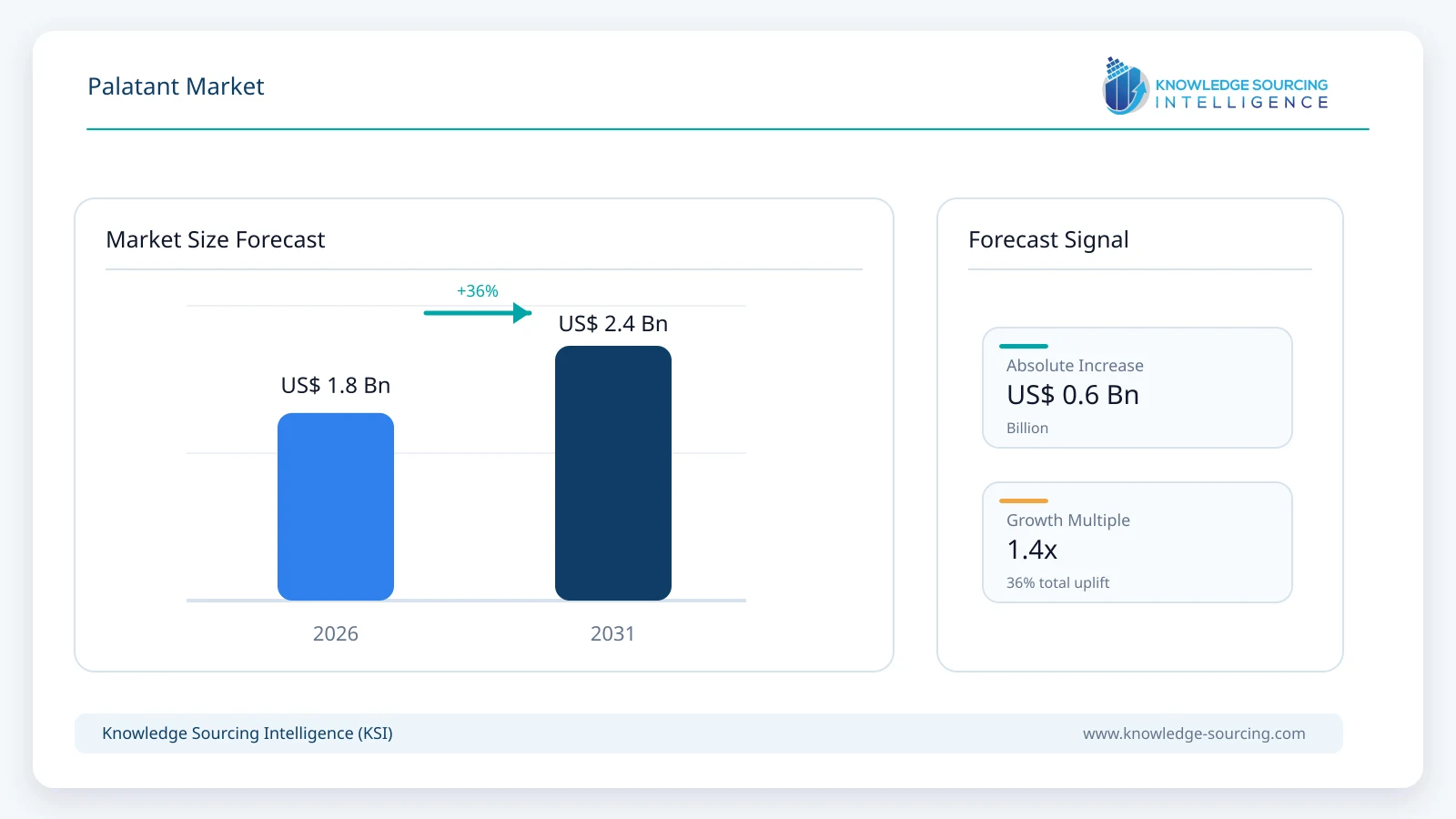
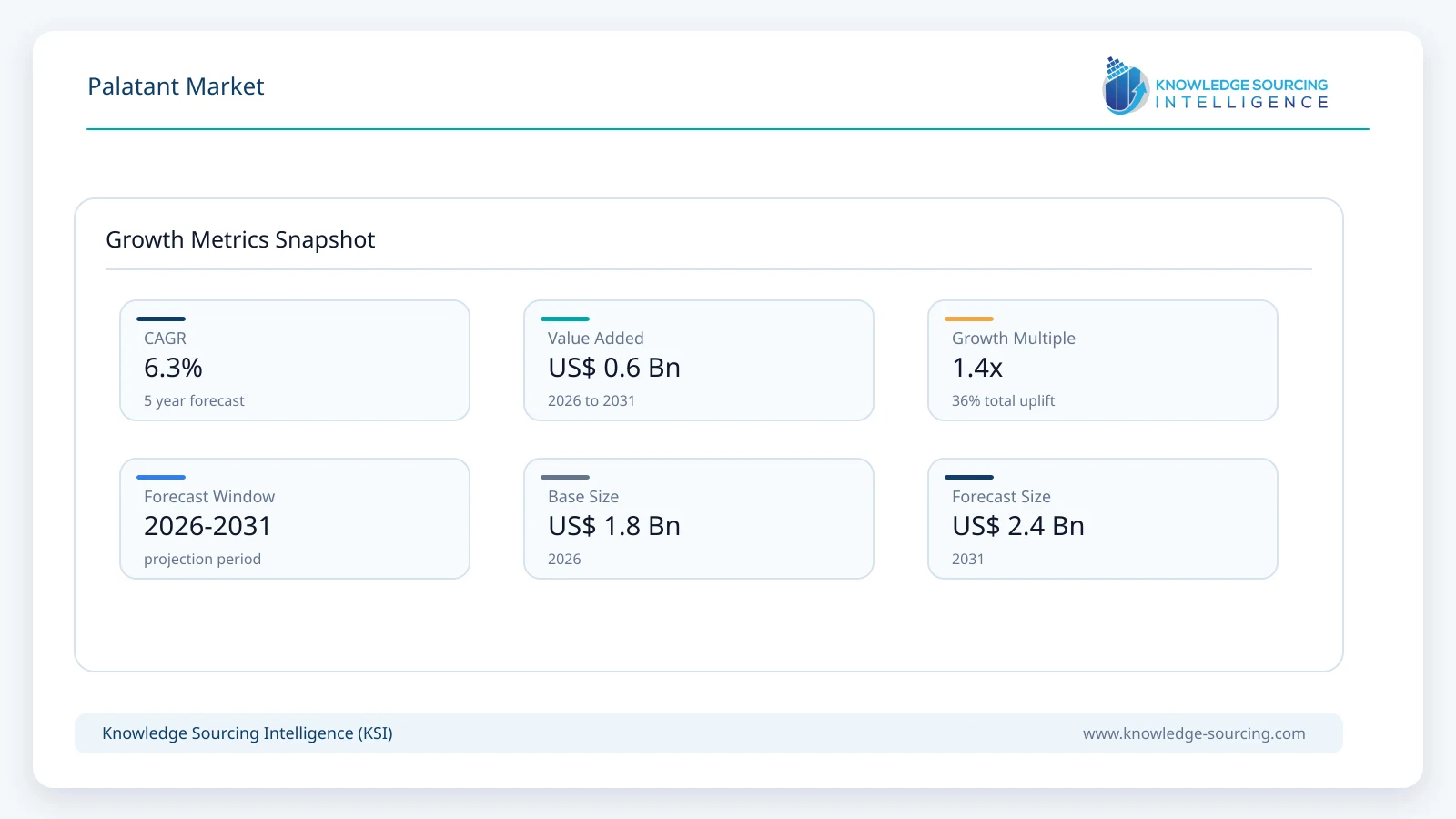
The Palatant Market is set to reach USD 2.439 billion in 2031, growing at a CAGR of 6.3% between 2026 and 2031, from USD 1.796 billion in 2026.
Highlights:
- 1Palatants enhance feed intake by masking bitter and unpleasant tastes, encouraging animals to consume balanced nutrition without resistance.
- 2They improve palatability in high-energy and high-protein livestock rations to support optimal growth and productivity in poultry and swine operations.
- 3Palatants facilitate easier transition into new feeds during weaning and adaptation phases for young livestock.
- 4Palatants play a key role in medication delivery within animal feed, ensuring consistent therapeutic intake across diverse feeding conditions.
Market Overview
The global Palatant Market is expected to experience significant growth, as palatants enhance the taste, aroma, and other sensory properties of feed and pet food. This improvement makes these products more appealing to animals, leading to increased consumption.
According to the FAO data of October 2025, the global commercial animal-feed industry accounts for approximately US$400 billion in turnover each year. It produces about 1 billion tonnes of livestock feed, which creates a considerable base for the application of feed palatability solutions.
Around 6 billion tonnes of dry feed matter is consumed by livestock annually, which is an enormous amount where palatability and feed intake can significantly influence nutritional performance.
Livestock creates a continued demand for efficient feeding systems and formulation technologies that facilitate repeat and consistent animal consumption.
The wet pet food segment offers further opportunity to drive innovation around palatant development. In October 2025, Kemin stated that, according to the data accumulated from the last five years in EMEA, more than 30% of new launches were on wet cat food only, while wet dog and cat food account for over 40% of the new product innovation work.
In 2025, Kemin conducted research to identify e palatability of seven wet cat-food formulations varying retort temperature, processing time, and F? values across a 30-cat palatability study, evidencing an increasing focus on co-optimizing palatants with processing conditions.
Palatant application is increasingly more formulation-specific, with liquid palatants that play a role primarily in aroma, while powder palatants provide flavor and moisture-management benefits depending on whether they are used in a dry or wet food format.
In April 2026, Symrise advanced its sustainable pet-nutrition strategy with an investment in Bond Pet Foods, a precision fermentation specialist developing animal-free proteins that form the basis of novel protein systems capable of generating complementary palatability solutions.
Palatant technologies are shifting from traditional animal fats and protein digests to yeast extracts, plant powders and insect hydrolysates, amino-acid systems, fermented products and Maillard-modified formulations.
Market Drivers
Rising Pet Ownership and Premiumization of Pet Food
Rising pet ownership is driving market growth and expanding the addressable consumer base. This drives premiumization and demand for highly palatable, specialized diets, prompting pet-food manufacturers to use more sophisticated palatability systems to improve food acceptability, repeat consumption, aroma, and taste.
According to the data from the American Pet Products Association (APPA), 95 million U.S. households owned at least one pet in 2025, helping to maintain a key demand base for commercial pet food and palatability-enhancing ingredients in the United States.
As per the same source, April 2026 data show that the number of dog owners in the U.S. is growing, as the proportion of the country’s households that own dogs increased from 51% in 2025 to 53% in 2026, resulting in the addition of about 4 million dog-owning households.
Pet industry spending in the U.S. for 2025 reached $158 billion, an annual increase of 3.7% from year to year, with continued consumer spending on pet products and food.
In addition, pet spend is expected to stay on an upward trend globally. For instance, U.S. pet-industry spending will exceed $165 billion by 2026, according to APPA, making way for pet food formulations with more value-added appeal.
The growing pet owner base will also support the palantant market. As the FEDIAF stats for 2026 demonstrated, there are approximately 306 million pets in Europe owned by 140 million EU households, which is almost half of all households.
Pet Food Sales in Europe totalled €29.4 billion per year, with around 8.6 million tonnes of pet food products being sold each year, enhancing demand for formulation ingredients like palatants.
The trend towards rising humanization of pets and expectations for quality. APPA's recent consumer research examines shifting shopping habits and highlights the latest expectations of pet owners regarding their pets, underscoring the growing potential for distinctiveness in high-value food products.
Palatability is also core to premium and niche nutrition. For instance, Royal Canin launched a highly palatable, nutrient-dense therapeutic diet portfolio in July 2026 featuring two formulas of little fuss for dogs with reduced appetite or recovering from illness, further demonstrating an ongoing product-level focus on palatability.
Major Segment Analysis
Organic
By nature, the Palatant Market is segmented into Organic and Conventional palatants. Organically derived palatants are gaining traction as pet food manufacturers respond to growing demand for clean-label, recognizable, and sustainably sourced ingredients, while conventional palatants continue to maintain strong adoption due to their consistent palatability performance, formulation flexibility, availability, and cost-effectiveness. Organically sourced palatants are gaining attention as pet owners increasingly seek pet foods formulated with recognizable, minimally processed, and naturally derived ingredients. Palatants derived from animal, plant, yeast, and fermentation-based sources can improve the sensory appeal of pet foods while supporting clean-label positioning.
Clean-label preferences are supporting demand for naturally derived palatants. AAFCO permits the term “natural” for feed or feed ingredients derived from plant, animal, or mined sources that have not undergone a chemically synthetic process, subject to its specified conditions.
Premiumization is creating opportunities for organic palatants. Premium and natural pet-food formulations can use palatability as a product-differentiation tool while maintaining ingredient-positioning claims.
Organic certification can increase formulation complexity. Manufacturers need to ensure that ingredients, processing methods, handling, and labeling comply with applicable organic requirements.
Major suppliers are actively consolidating and investing to capture this demand. For instance, Symrise unified its Diana Pet Food, ADF, IsoNova, and Schaffelaarbos brands into a single Symrise Pet Food division and invested $65.5 million in a new South Carolina production facility. Kemin built a dedicated, fully integrated palatant plant in Missouri, and AFB International, a palatant-focused specialist, is applying AI to predict palatability outcomes.
Ingredient sourcing is becoming an important competitive factor. Organic palatant manufacturers need consistent access to qualifying animal, plant, yeast, or fermentation-derived raw materials while maintaining palatability performance.
Moreover, the underlying technology base is shifting toward fermentation-derived and plant-based systems, with yeast- and enzymatic-hydrolysis-based digests and plant-based palatants, such as Kemin's PALASURANCE P Series and Zoetis Palatant, growing fastest because they avoid the sourcing constraints of single-protein diets while still supporting a clean-label positioning.
Geographical Outlook
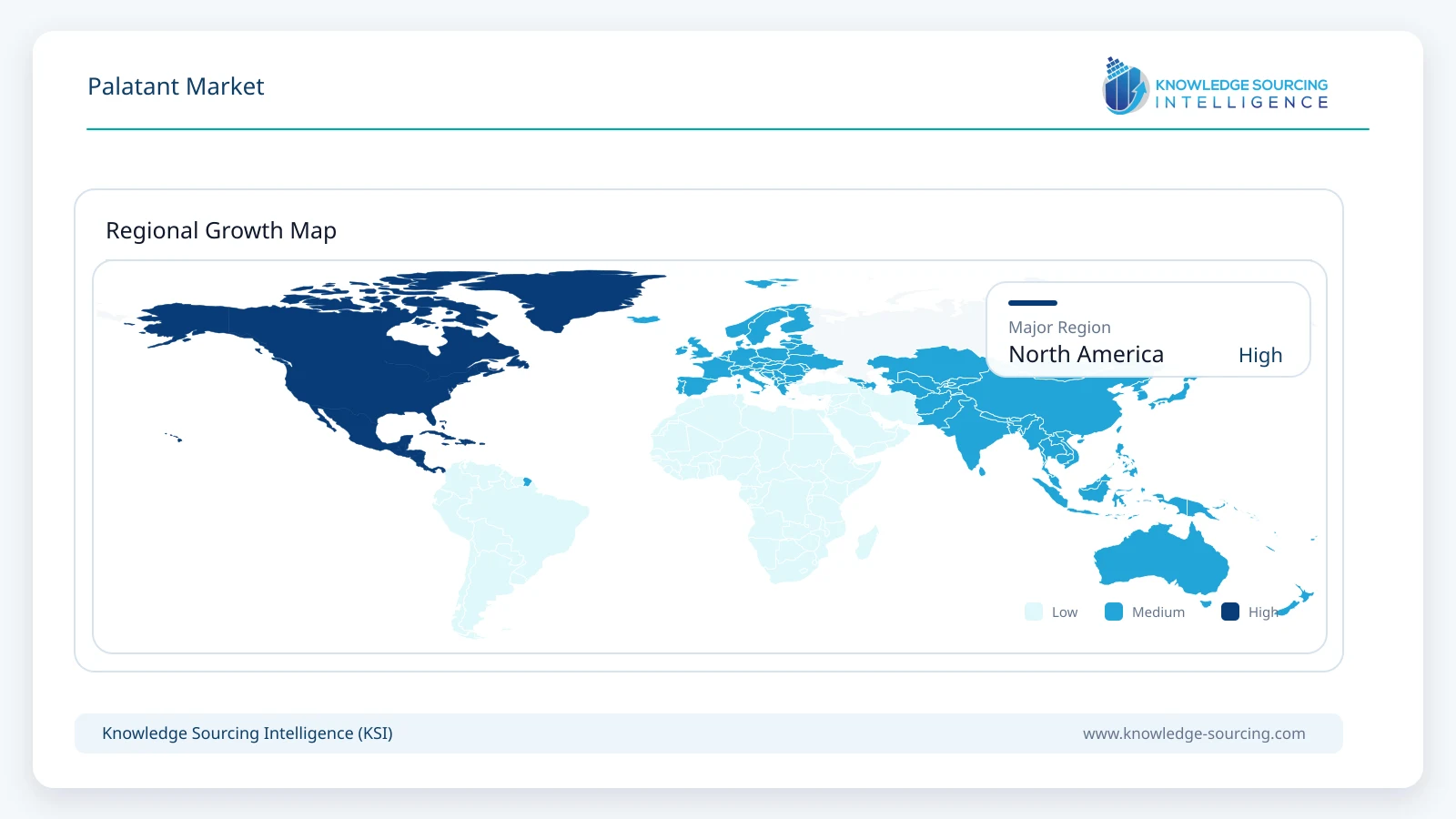
North America: the US
The United States palatant market is projected to show considerable growth owing to the growing pet palatability.
Progressive strength of pet owners in the United States supports the transition towards premium pet food and healthy diet intake. According to the American Pet Products Association (APPA) data, 31% of dog owners report that premium food remains the most commonly fed option.
Food accounts for a considerable share of the total pet budget in the United States and as the industry expands, it will positively influence the transition towards premiumization and clean-label pet food ingredients. The 2026 projections by APPA show spending to reach at USD 165 billion.
Key market players such as Kerry Group plc and Kemin Industries Inc. enjoy a wide customer base and have partnered with US pet food manufacturers to offer palatant solutions tailored to give functional benefits.
Owing to its high market potential and adoption scope for premium pet food ingredients, various foreign players such as Symrise have invested to optimize such potential through their extensive palatability measures under its “Diana Pet Food”, which has enabled it to comply with market trends.
Collaborative measures such as implementation of “Next Generation Pet Food Program” by Big Idea Ventures and Mars Pet Care in May 2026 highlight development of new protein sources and novel ingredients for pet nutrition. Such measures have bolstered the overall market outlook.
Key Developments
March 2026: Ohly published new findings for its OHLY-GO® palatability enhancers, including Meaty Red and Roasted yeast-based solutions, demonstrating stronger first-bite preference and consumption in dog-feeding studies.
October 2025: Kemin highlighted PALIVATE™ WP.65 Dry in wet cat-food palatability trials, evaluating how retort temperature, time and processing conditions affect performance and sensory acceptance of palatants.
Company Profiles
ADM (via its Pancosma brand, integrated after the 2019 Neovia acquisition) focuses on high-margin specialty feed additives rather than commodity complete feeds. Its core strategy centers on science-based palatants that stimulate animals’ olfactory and gustatory receptors to boost feed intake, mask off-notes from alternative ingredients, and improve overall performance and profitability for producers.
ADM emphasizes mechanism-of-action research, proprietary technologies (such as Iso-Fusion), and multi-functional solutions that combine flavors, sweeteners, and bioactives.
Palatant Market Scope:
| Report Metric | Details |
|---|---|
| Total Market Size in 2026 | USD 1.796 billion |
| Total Market Size in 2031 | USD 2.439 billion |
| Forecast Unit | Billion |
| Growth Rate | 6.3% |
| Study Period | 2021 to 2031 |
| Historical Data | 2021 to 2024 |
| Base Year | 2025 |
| Forecast Period | 2026 – 2031 |
| Segmentation | Nature, Form, Source, Application, Distribution Channel, Region |
| Companies |
|
Market Segmentation
By Nature
Organic
Conventional
By Form
Dry
Liquid
By Source
Meat-Based
Vegetable-Based
Others
By Application
Animal Feed
Poultry
Cattle
Swine
Others
Pet Food
Dog
Cat
Others
By Distribution Channel
Online
Offline
By Region
North America
USA
Canada
Mexico
South America
Brazil
Argentina
Others
Europe
United Kingdom
Germany
France
Spain
Others
Middle East and Africa
Saudi Arabia
South Africa
Others
Asia Pacific
China
Japan
India
South Korea
Taiwan
Thailand
Indonesia
Others
Table of Contents
1. EXECUTIVE SUMMARY
2. MARKET SNAPSHOT
2.1. Market Overview
2.2. Market Definition
2.3. Scope of the Study
2.4. Market Segmentation
3. MARKET DYNAMICS
3.1. Market Drivers
3.2. Market Restraints
3.3. Market Opportunities
3.4. Porter’s Five Forces Analysis
3.5. Industry Value Chain Analysis
4. BUSINESS LANDSCAPE
4.1. Regulatory & Compliance Landscape
4.2. Feed & Pet Food Manufacturer Analysis
4.3. Pricing & Cost Analysis
4.4. Import/ Export Analysis
4.5. Stretagic Analysis
5. TECHNOLOGY AND INNOVATION OUTLOOK
5.1. Palatant Formulation & Hydrolysis Technologies
5.2. Flavor Generation & Enhancement Technologies
5.3. Palatant Coating & Delivery Technologies
5.4. Emerging Ingredients & Next-Generation Palatants
6. PALATANT MARKET BY NATURE (2021-2031)
6.1. Introduction
6.2. Organic
6.3. Conventional
7. PALATANT MARKET BY FORM (2021-2031)
7.1. Introduction
7.2. Dry
7.3. Liquid
8. PALATANT MARKET BY SOURCE (2021-2031)
8.1. Introduction
8.2. Meat-Based
8.3. Vegetable-Based
8.4. Others
9. PALATANT MARKET BY APPLICATION (2021-2031)
9.1. Introduction
9.2. Animal Feed
9.2.1. Poultry
9.2.2. Cattle
9.2.3. Swine
9.2.4. Others
9.3. Pet Food
9.3.1. Dog
9.3.2. Cat
9.3.3. Others
10. PALATANT MARKET BY DISTRIBUTION CHANNEL (2021-2031)
10.1. Introduction
10.2. Online
10.3. Offline
11. PALATANT MARKET BY REGION (2021-2031)
11.1. Introduction
11.2. Introduction
11.3. North America
11.3.1. By Nature
11.3.2. By Form
11.3.3. By Source
11.3.4. By Application
11.3.5. By Distribution Channel
11.3.6. By Country
11.3.6.1. USA
11.3.6.1.1. By Source
11.3.6.1.2. By Pet Type
11.3.6.2. Canada
11.3.6.2.1. By Pet Type
11.3.6.3. Mexico
11.3.6.3.1. BY Pet Type
11.4. South America
11.4.1. By Nature
11.4.2. By Form
11.4.3. By Source
11.4.4. By Application
11.4.5. By Distribution Channel
11.4.6. By Country
11.4.6.1. Brazil
11.4.6.2. Argentina
11.4.6.3. Others
11.5. Europe
11.5.1. By Nature
11.5.2. By Form
11.5.3. By Source
11.5.4. By Application
11.5.5. By Distribution Channel
11.5.6. By Country
11.5.6.1. United Kingdom
11.5.6.2. Germany
11.5.6.3. France
11.5.6.4. Spain
11.5.6.5. Others
11.6. Middle East and Africa
11.6.1. By Nature
11.6.2. By Form
11.6.3. By Source
11.6.4. By Application
11.6.5. By Distribution Channel
11.6.6. By Country
11.6.6.1. Saudi Arabia
11.6.6.2. South Africa
11.6.6.3. Others
11.7. Asia Pacific
11.7.1. By Nature
11.7.2. By Form
11.7.3. By Source
11.7.4. By Application
11.7.5. By Distribution Channel
11.7.6. By Country
11.7.6.1. China
11.7.6.2. Japan
11.7.6.3. India
11.7.6.4. South Korea
11.7.6.5. Taiwan
11.7.6.6. Thailand
11.7.6.7. Indonesia
11.7.6.8. Others
12. COMPETITIVE ENVIRONMENT AND ANALYSIS
12.1. Major Players and Strategy Analysis
12.2. Market Share Analysis
12.3. Mergers, Acquisitions, Agreements, and Collaborations
12.4. Competitive Dashboard
13. COMPANY PROFILES
13.1. Kemin Industries Inc.
13.2. AFB International
13.3. Diana Pet Food (Symrise)
13.4. Trilogy Flavors, Inc.
13.5. Ohly GmbH (ABF Ingredients)
13.6. Innovad
13.7. ADM
13.8. Kerry Group plc
13.9. Trouw Nutrition (Nutreco)
13.10. Profypet
14. RESEARCH METHODOLOGY
15. LIST OF FIGURES
16. LIST OF TABLES
Navigate
Trusted by the world's leading organizations











