
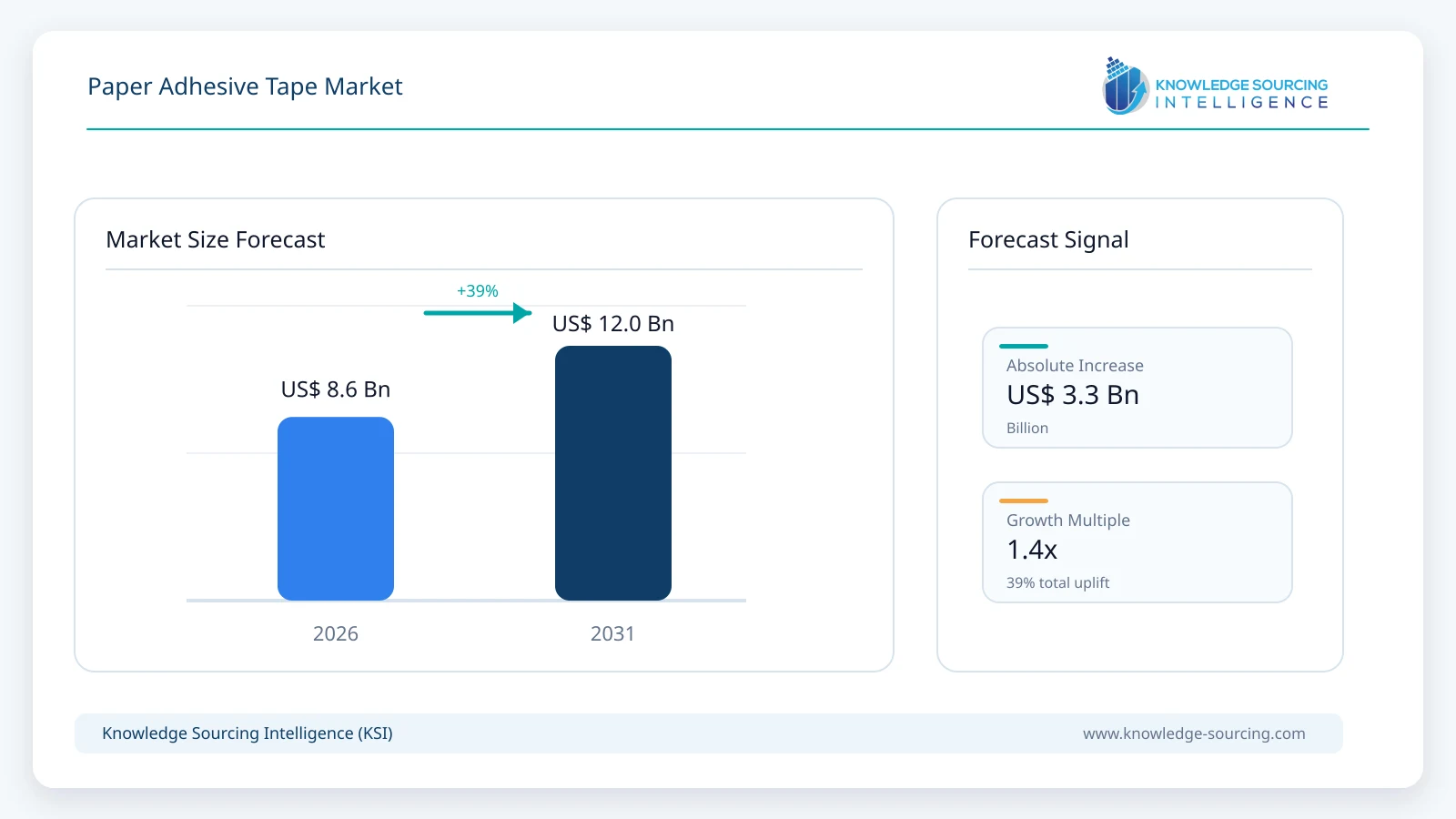
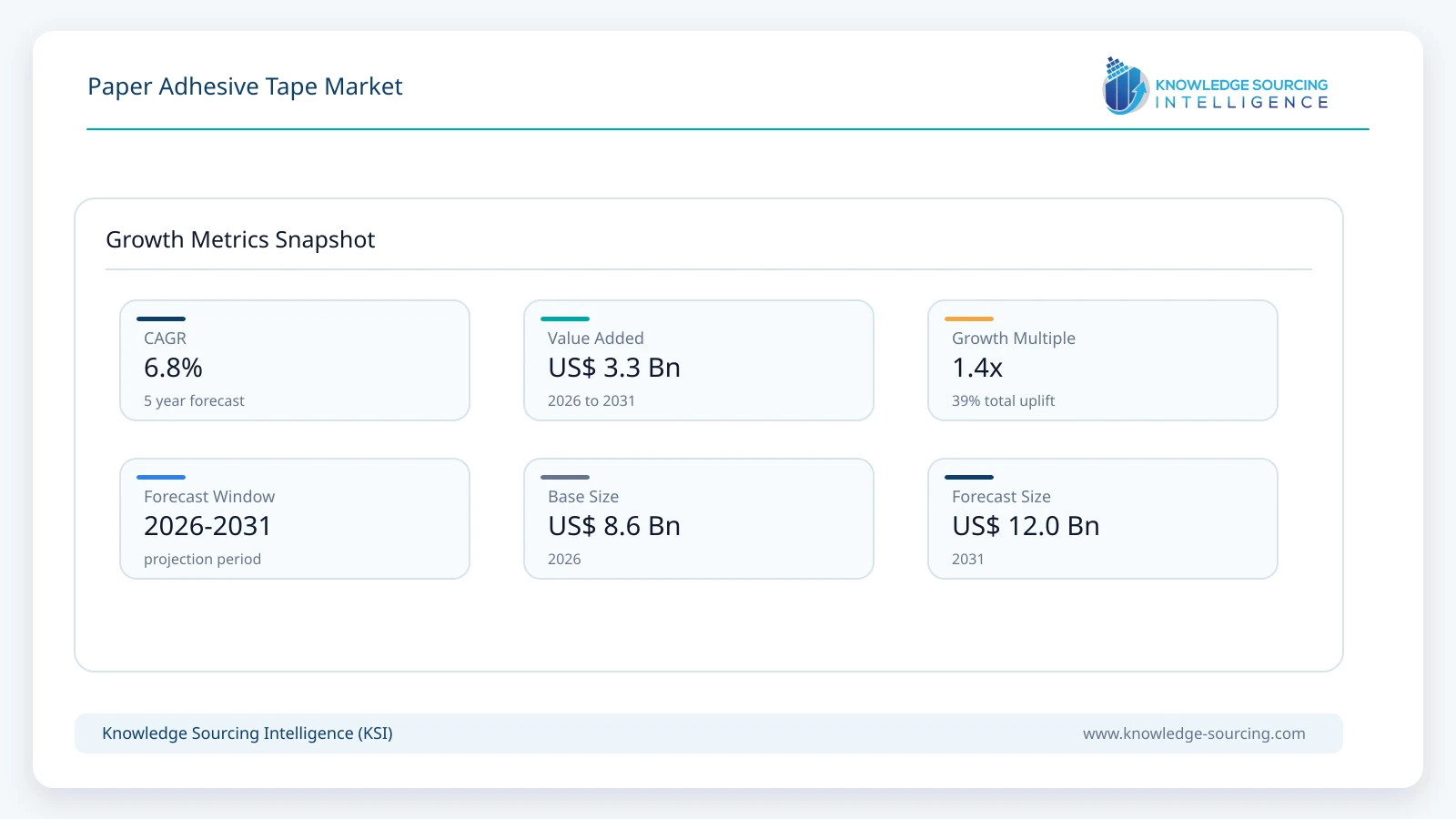
The Paper Adhesive Tape market is forecast to grow at a CAGR of 6.8%, reaching USD 11.96 billion in 2031 from USD 8.62 billion in 2026.
Highlights:
- 1Packaging demand is providing the broadest commercial base, supported by carton sealing, reinforcement, bundling, opening, and fiber-based packaging applications.
- 2Water-based and lower-solvent adhesive technologies are gaining attention where manufacturers seek lower emissions and improved process conditions.
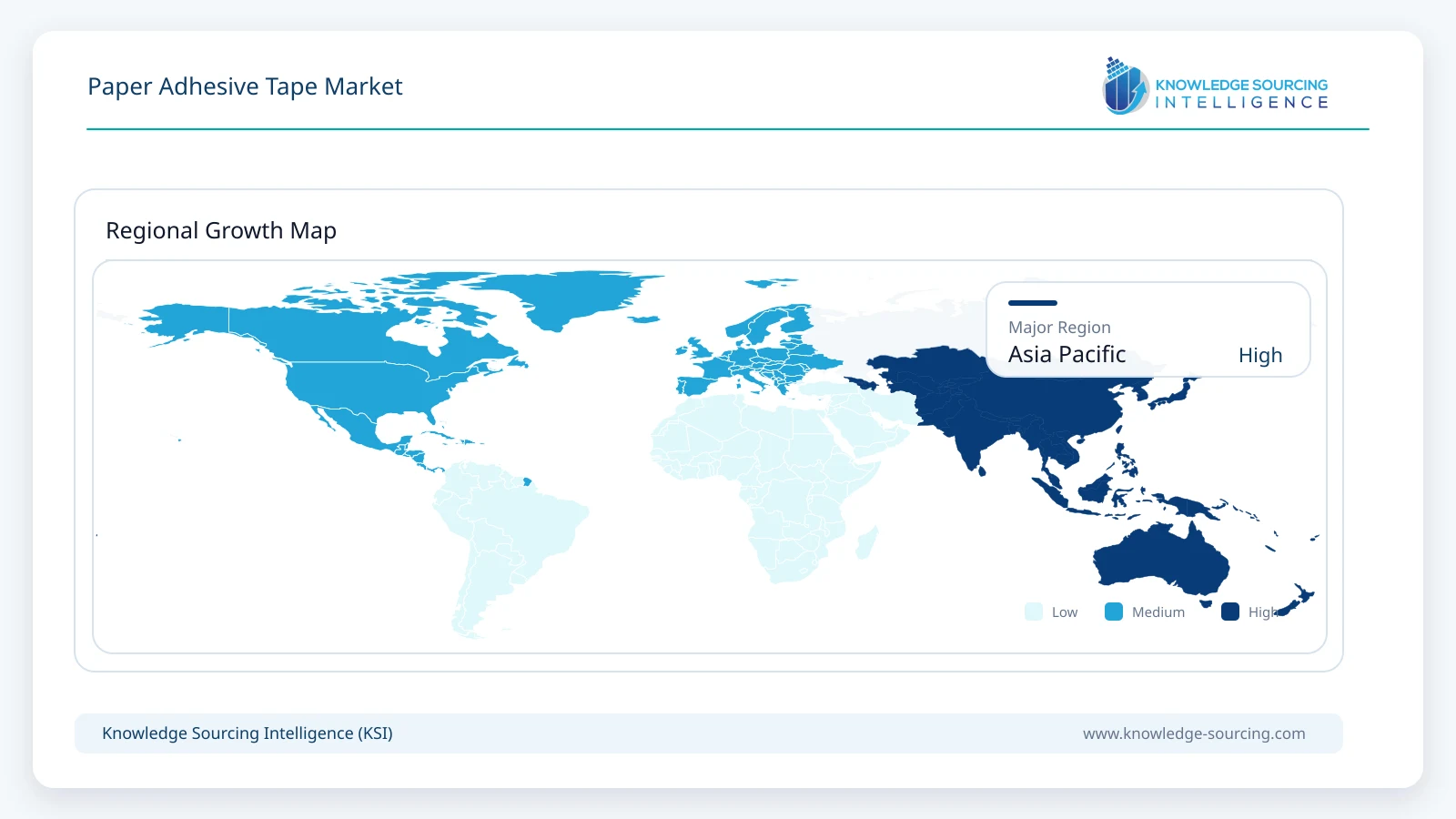
- 3Asia Pacific represents a major manufacturing and packaging demand center, supported by its large industrial base and extensive consumer-goods supply chains.
- 4Paper-backed products are becoming more technically sophisticated, combining renewable or recycled materials with stronger adhesion and automated application capability.
- 5Packaging regulations are influencing tape specifications, particularly where recyclability, material composition, and packaging waste management affect customer requirements.
- 6Competition is shifting toward application solutions, with suppliers combining tape performance, technical support, testing, and sustainability documentation.
The Paper Adhesive Tape Market covers pressure-sensitive and adhesive-coated tape products that use paper as the primary backing or carrier and are supplied in rolls, sheets, strips, or application-specific formats. The market includes tapes differentiated by adhesive chemistry, converting process, coating configuration, thickness, tensile strength, tack, removability, temperature resistance, and suitability for manual or automated application.
Paper adhesive tape occupies an important position between commodity packaging consumables and technically specified industrial materials. Buyers purchase it not only for bonding or sealing but also for masking, bundling, temporary fixation, surface protection, reinforcement, labeling, carton closure, and assembly operations. Consequently, purchasing decisions often depend on the required performance of the complete tape construction rather than the adhesive alone. Paper grade, coating, adhesive formulation, release treatment, unwind characteristics, and converting quality can all affect production performance.
The market has a broad customer base. Packaging converters and distributors represent an important demand pool because paper tapes can be incorporated into carton sealing, bundling, tear-open systems, reinforcement, and other packaging operations. Automotive manufacturers and body shops use masking and process tapes where clean removal, controlled adhesion, paint compatibility, temperature resistance, and surface protection determine product selection. Construction users purchase paper-backed tapes for masking, finishing, temporary fixing, bundling, and selected surface-protection applications.
Buyer behavior is becoming more specification-driven. Large packaging operations increasingly evaluate tapes according to line speed, applicator compatibility, failure rates, storage conditions, substrate performance, and disposal characteristics. A tape that costs more per roll can remain commercially attractive when it reduces carton damage, rework, manual intervention, or line stoppages. This shifts purchasing decisions away from simple price-per-roll comparisons toward total application cost.
Sustainability is adding another purchasing criterion, particularly in packaging. Paper-based tape can support packaging designs that contain a higher proportion of fiber-based material when the tape itself is compatible with established recycling processes. tesa, for example, markets paper-based packaging solutions that have been tested for recycling alongside paper or board using recognized industry methods. Its portfolio includes paper-based tear, reinforcement, and closing tapes designed for integration with fiber-based packaging.
This does not mean that every paper adhesive tape is automatically recyclable with paper. Adhesive formulation, release coating, backing treatment, tape quantity, and recycling-system conditions influence actual compatibility. Buyers therefore increasingly require documented test results rather than broad environmental claims. Tesa'sproducts illustrate this distinction through references to INGEDE Method 12, PTS-RH 021:2012, and Cepi laboratory testing for different products.
The competitive structure includes diversified adhesive manufacturers, specialty tape producers, packaging-material suppliers, and regional converters. The companies listed for this market include Nitto Denko Corporation, Avery Dennison Corporation, tesa SE, 3M Company, Henkel, Berry Global Group, Inc., ACHEM Technology Corporation, and Intertape Polymer Group Inc. Competition is therefore not based on a single product characteristic. Suppliers differentiate through adhesive formulation, backing quality, coating capability, converting capacity, application engineering, geographic availability, technical support, and sustainability credentials.
The market's economic direction will depend heavily on packaging volumes, industrial production, automotive manufacturing, construction activity, paperboard conversion, and replacement of selected plastic-intensive packaging components. Over the 2026–2031 forecast period, procurement decisions are expected to place greater emphasis on consistent application performance and compatibility with recycling-oriented packaging designs.
Market Drivers
Expansion of Fiber-Based Packaging Applications
Packaging is the most commercially important demand mechanism for paper adhesive tape because the tape is consumed alongside cartons, corrugated boxes, paperboard packaging, and other fiber-based formats. Growth in packaged goods distribution creates recurring tape consumption because packaging operations use tape continuously rather than as a durable capital product.
The commercial requirement extends beyond simply closing a box. High-volume fulfillment operations require tapes that unwind consistently, maintain adhesion during transport, tolerate variations in board quality, and work with manual or automated dispensers. tesa's current paper packaging range, for example, includes products designed for manual and automated applications and for carton sealing across different weight classes.
For buyers, reliability is particularly important because a tape failure can damage the product inside the carton, generate returns, or interrupt a packaging line. Suppliers therefore compete on tensile strength, tack, shear resistance, printability, temperature performance, and compatibility with packaging machinery.
The commercial implication is that packaging growth favors suppliers capable of supplying consistent specifications at scale. Commodity products remain price-sensitive, but technically differentiated products can command stronger customer retention when their performance is integrated into automated packaging processes.
Demand for Recyclability-Compatible Packaging Components
Packaging manufacturers are under pressure to reduce material complexity and improve the recoverability of packaging waste. Paper adhesive tape can support this objective when its backing and adhesive system are compatible with the relevant recycling process.
The European Union's Packaging and Packaging Waste Regulation, Regulation (EU) 2025/40, entered into force on February 11, 2025, and generally applies from August 12, 2026. The regulation covers packaging and packaging waste regardless of material and establishes requirements concerning packaging design, composition, recoverability, waste management, and prevention.
For tape suppliers, the commercial effect is indirect but important. Packaging designers may increasingly evaluate tape as part of the complete packaging system instead of treating it as an isolated consumable. This creates demand for documented recyclability testing, responsibly sourced paper, reduced use of fossil-based inputs, and adhesive systems that do not interfere with fiber recovery.
Tesa'sproduct development provides an example of this direction. Its paper-based tape solutions use responsibly sourced paper, recycled paper cores, and solvent-free coating processes, while selected products have been tested against recognized recycling methods.
Growth of Automated Packaging Operations
Automation changes the performance requirements for adhesive tape. Manual operators can compensate for minor unwind inconsistencies or adhesion variations, whereas automated equipment requires predictable roll geometry, controlled unwind force, reliable adhesion, and consistent application.
E-commerce fulfillment, contract packaging, food distribution, consumer goods manufacturing, and logistics operations are therefore creating demand for tapes that operate at higher speeds with fewer interruptions. Henkel's 2025 packaging initiatives illustrate the wider movement toward right-sized and automated packaging processes, where adhesive selection is evaluated alongside packaging machinery and process efficiency.
This creates opportunities for suppliers that can provide application engineering rather than only finished tape. A manufacturer that can test tape behavior on a customer's equipment has greater scope to secure recurring business because switching suppliers may require new trials, machine adjustments, and quality validation.
Increased Adoption of Lower-Emission Adhesive Technologies
Adhesive chemistry remains a major differentiator in paper tape. Solvent-based systems can deliver particular performance characteristics, but manufacturers face pressure to reduce solvent use, processing emissions, and energy consumption where technically feasible.
Water-based and solvent-free systems are therefore receiving greater development attention. The transition is not universal because adhesive selection depends on substrate, temperature, tack, aging, shear, removability, production speed, and end-use requirements.
Henkel's recent adhesive developments illustrate the broader direction toward solvent-free and lower-carbon technologies. In 2025, the company introduced solvent-free packaging adhesive systems and also announced lower-carbon adhesive initiatives based on supplier collaboration.
For paper tape manufacturers, the implication is that adhesive formulation becomes an increasingly important part of product differentiation. Customers are likely to compare environmental attributes alongside technical performance rather than accepting sustainability as a substitute for reliability.
Expansion of Technical Tape Use in Industrial Applications
Paper adhesive tape demand is not limited to packaging. Automotive and construction applications require controlled adhesion, clean removal, surface protection, masking, and temporary fixation. Automotive refinishing is particularly sensitive to paint compatibility, edge definition, temperature exposure, and residue.
3M's masking tape portfolio demonstrates how paper-backed products can be engineered for controlled removal and application-specific performance. Its Scotch General Use Masking Tape 2025, for example, uses a paper-based construction and specifies clean-removal performance, renewable-resource content, and post-consumer recycled content in the product system.
The industrial opportunity, therefore, lies in products where performance requirements justify higher unit values. Suppliers can improve margins by developing tapes for defined processes rather than competing solely in general-purpose applications.
Market Restraints and Challenges
Raw Material Cost Volatility
Paper, natural rubber, synthetic polymers, resins, release coatings, and other chemical inputs influence tape manufacturing costs. Paper prices can move with pulp availability, energy costs, forestry conditions, transportation, and regional supply-demand balances. Adhesive raw materials can also be exposed to petrochemical and specialty-chemical price cycles.
The effect is most visible in price-sensitive packaging applications. Large buyers often negotiate annual contracts, volume discounts, and price-adjustment mechanisms, limiting the ability of tape manufacturers to immediately pass input-cost increases through to customers.
Suppliers can mitigate this pressure through formulation optimization, multi-source procurement, production planning, material substitution where performance permits, and longer-term supply agreements.
Recycling Compatibility Is Application-Specific
Paper backing alone does not guarantee recycling compatibility. Adhesive chemistry, coating weight, release layers, tape quantity, and the characteristics of the recycling facility can determine whether a tape integrates effectively into a paper recovery stream.
This creates a documentation challenge. Packaging customers increasingly want evidence supporting recyclability claims. Suppliers must therefore invest in testing and certification rather than relying on the appearance of the backing material.
The requirement raises development costs but also creates differentiation for manufacturers that can provide recognized test evidence. tesa's use of INGEDE and PTS-RH testing demonstrates how suppliers are moving toward documented claims rather than general descriptions of recyclability.
Performance Trade-Offs in Sustainable Formulations
Replacing conventional materials can create technical compromises. A lighter paper backing may reduce material consumption but can affect tensile strength. A bio-based adhesive may require formulation changes to achieve the same tack, aging performance, or temperature resistance. A recycling-friendly construction may also need validation across different board grades and recycling systems.
Industrial customers generally will not accept lower productivity to obtain a sustainability benefit. The tape must still meet production specifications. Consequently, research and development spending must address both environmental attributes and mechanical performance.
Competition from Non-Paper Tape Technologies
Paper adhesive tape competes with plastic film tapes, strapping products, hot melt bonding systems, liquid adhesives, labels, and other fastening technologies. The competitive threat varies by application.
In automated packaging, for example, a packaging operator may compare paper tape with plastic tape or direct adhesive application. Henkel has highlighted automated packaging approaches where hot melt adhesive can reduce tape consumption in right-sized packaging processes.
Paper tape therefore needs to justify its use through process compatibility, recycling advantages, application convenience, branding, clean removal, or other measurable benefits.
Fragmented End-User Requirements
The same tape construction may not perform equally across all paperboard, corrugated board, metal, plastic, painted, or coated surfaces. Temperature, humidity, storage time, application pressure, and surface cleanliness also affect performance.
This fragmentation increases technical-sales requirements. Suppliers serving industrial customers must provide application guidance and sample testing. Standardized products remain important, but higher-value applications require closer cooperation between tape manufacturers, converters, equipment suppliers, and end users.
Major Segment Analysis:
Packaging Application
The Packaging segment represents the most commercially important application because paper adhesive tape is repeatedly consumed in carton sealing, bundling, reinforcement, opening systems, transport securing, and packaging conversion.
Packaging buyers generally prioritize five characteristics: secure adhesion, predictable unwind, compatibility with equipment, resistance to handling conditions, and acceptable total cost. Sustainability has become an additional purchasing factor, particularly for brands and packaging converters operating under recyclability targets.
The strongest opportunity is not necessarily the replacement of every plastic tape with paper tape. Instead, demand is developing where paper tape can meet the required mechanical performance while simplifying the material composition of the package. Tesa's paper-based packaging portfolio includes tear tapes, reinforcement tapes, and closing tapes designed to be processed with standard packaging systems and disposed of alongside board material under specified recycling conditions.
Packaging manufacturers also have different procurement structures. Large multinational brands may specify tape characteristics centrally and purchase through approved suppliers. Regional converters and distributors may prioritize availability, price, roll dimensions, and application support. E-commerce fulfillment operators tend to emphasize throughput, automated dispensing, package security, and labor productivity.
This creates several competitive tiers. General-purpose carton sealing remains relatively price-sensitive. Specialty reinforcement, tear-opening, high-tack, printable, and machine-applied tapes provide greater scope for technical differentiation.
Regulation will strengthen the importance of packaging-system compatibility. The EU PPWR applies to all packaging placed on the EU market and establishes requirements around packaging design, composition, recoverability, and waste management.
For suppliers, this means product development should increasingly begin with the recycling pathway of the complete package. Tape manufacturers that can demonstrate reliable adhesion while maintaining compatibility with fiber recovery will have stronger positioning with multinational packaging buyers.
Regional Analysis
North America
North American demand is supported by established packaging, automotive, construction, distribution, and industrial manufacturing sectors. The United States represents the largest demand base within the region because of its extensive consumer-goods distribution network and broad industrial customer base. Canada provides additional demand through packaging, construction, manufacturing, and resource-related industries, while Mexico benefits from automotive manufacturing, consumer goods production, and cross-border supply chains.
Buyer behavior varies by application. Packaging customers emphasize throughput and carton security, while automotive users place greater weight on clean removal and surface protection. Industrial customers are also more likely to qualify products through technical trials before approving a new supplier.
The region provides opportunities for premium paper tapes where product performance reduces labor or process losses. However, price competition remains relevant in general-purpose packaging, particularly when buyers have multiple qualified suppliers.
Europe
Europe is strategically important because packaging regulation is directly influencing material selection. Regulation (EU) 2025/40 entered into force in February 2025 and generally applies from August 2026, creating a stronger regulatory framework for packaging composition, recyclability, and waste management.
Germany, France, the United Kingdom, Spain, and other European markets contain mature packaging and industrial manufacturing bases. European buyers tend to place greater emphasis on documented sustainability performance, responsible sourcing, recycling compatibility, and lifecycle considerations.
This favors suppliers capable of providing certified paper sources and validated recycling performance. It also increases the importance of technical documentation during procurement. Tesa's paper-based portfolio, for example, includes products with certified or tested sustainability attributes and is being developed for packaging applications that can integrate with existing machinery.
Asia Pacific
Asia Pacific is expected to remain a major demand center because China, India, Japan, South Korea, Taiwan, Thailand, and Indonesia collectively host extensive manufacturing and packaging ecosystems.
China provides scale in industrial production and packaging conversion. India combines expanding manufacturing activity with a large domestic consumer market. Japan and South Korea provide stronger demand for technically specified industrial tapes, particularly where precision, consistency, and process reliability matter. Taiwan's electronics and industrial manufacturing base supports specialized adhesive applications, while Thailand and Indonesia contribute through automotive, food, consumer goods, and export-oriented manufacturing.
The region also presents substantial price sensitivity. Domestic and regional suppliers can compete aggressively in standardized tape categories, while international manufacturers generally have stronger opportunities in specialized applications requiring technical validation or global quality consistency.
Middle East & Africa
Demand in the Middle East and Africa is concentrated around packaging, construction, logistics, consumer goods, and selected industrial activities. Saudi Arabia represents an important market because of industrial investment, infrastructure development, and the expansion of domestic manufacturing capacity.
The region's opportunity depends on packaging conversion capacity, import economics, local distribution networks, and construction activity. Climate conditions can also affect tape performance, making temperature and humidity resistance important for selected applications.
International suppliers can compete through product reliability and technical support, while regional distributors remain important for inventory availability and customer access.
South America
Brazil provides the largest commercial base in South America because of its diversified manufacturing, food and beverage, agricultural, consumer goods, packaging, and construction sectors. Argentina and other South American markets contribute additional demand but can face greater macroeconomic volatility.
Purchasing decisions often balance price, availability, and performance. Imported specialty tapes can face logistical and currency-related pressures, which increases the value of regional inventory and local distribution.
The region provides opportunities for packaging tapes where domestic corrugated-board production and consumer-goods distribution generate recurring consumption. However, suppliers must manage currency volatility and customer sensitivity to input costs.
Competitive Landscape
The competitive structure consists of diversified adhesive and materials companies alongside specialized tape manufacturers. Nitto Denko Corporation, Avery Dennison Corporation, tesa SE, 3M Company, Henkel, Berry Global Group, Inc., ACHEM Technology Corporation, and Intertape Polymer Group Inc. bring different combinations of adhesive chemistry, coating capability, converting expertise, industrial relationships, geographic reach, and application engineering.
Competition is increasingly based on the complete value proposition rather than tape price alone. Product differentiation can come from adhesive formulation, paper sourcing, tensile strength, clean removal, high-temperature performance, printability, automated application, and recycling compatibility.
A major competitive distinction is technical integration. Packaging customers increasingly need tapes that operate with existing dispensers and automated lines without creating additional process steps. Suppliers that provide testing and application support can therefore compete more effectively for qualified accounts.
Sustainability is another competitive dimension. tesa has expanded paper-based products with responsibly sourced paper, recycled cores, bio-based content, solvent-free processing, and recycling tests. 3M similarly markets paper-based masking products with renewable-resource and recycled-content attributes.
Henkel's activities demonstrate another competitive route: adhesive technology can be positioned as part of the wider packaging system. Its Packaging RecycLab, for example, is designed to assess fiber-based packaging concepts under realistic conditions, linking adhesive selection with packaging recyclability and process requirements.
The market is therefore likely to develop around three broad competitive approaches: cost-efficient standardized products, application-specific industrial tapes, and sustainability-oriented solutions supported by technical validation.
Recent Developments
August 2026: Avery Dennison Performance Tapes introduced its Sustainable ADvantage portfolio, incorporating FSC-certified paper liners, recycled and renewable content, improved recyclability, and solvent-free acrylic adhesive technologies.
April 2026: Henkel expanded its barrier and heat-seal coating portfolio for paper-based food and non-food packaging. The water-based solutions are designed to provide barrier and heat-sealing functionality while remaining compatible with recycling-oriented paper packaging systems. The development is commercially relevant because adhesive and coating technologies are becoming part of the wider transition toward recyclable fiber-based packaging.
February 2026: Saica Group launched a recycled paper adhesive tape made from 100% recycled Group-sourced fibres, delivering linerless, repulpable protection for paper reels while working with standard wrapping machinery.
July 2025: 3M highlighted its Scotch brand's continued adhesive-tape development and industrial applications during the brand's centennial year. The company specifically referenced Scotch Performance Paper Box Sealing Tape 570 for automated dispensing and sustainable recycling, reinforcing the role of paper-based tape in industrial packaging applications.
Regulatory and Policy Environment
Regulatory influence on paper adhesive tape is primarily indirect because the product is generally governed through requirements applicable to its end-use packaging, chemicals, workplace emissions, product safety, waste management, and environmental claims.
The most important recent policy development for packaging applications is the European Union's Packaging and Packaging Waste Regulation, Regulation (EU) 2025/40. The regulation entered into force on February 11, 2025, and generally applies from August 12, 2026. It covers packaging and packaging waste irrespective of material and introduces requirements relating to manufacturing, composition, recoverability, reuse, waste management, and prevention.
For paper tape suppliers, the regulation increases the importance of designing tape products that are compatible with the packaging's intended end-of-life route. It also creates greater demand for technical evidence supporting environmental claims.
The European Commission has emphasized resource efficiency, circular use of materials, improved recycling, and reduced dependence on primary resources under the new packaging framework.
Other regions are developing their own packaging-waste and extended-producer-responsibility frameworks. In India, for example, recent Central Pollution Control Board requirements have strengthened compliance obligations for producers, importers, and brand owners concerning plastic packaging under the Plastic Waste Management framework. Although these requirements do not directly regulate paper adhesive tape, they influence the broader packaging-material selection environment by increasing attention to packaging composition and waste-management responsibilities.
Industry testing standards are also commercially relevant. Suppliers use recognized methods such as INGEDE and PTS testing to substantiate recycling compatibility for particular tape constructions. These assessments are important because recycling performance cannot be inferred solely from the use of paper as the backing material.
The regulatory direction therefore favors measurable claims, documented material sourcing, validated recycling performance, and product designs that fit established waste-management systems.
Outlook and Strategic Implications
The Paper Adhesive Tape Market will be shaped less by a single technology shift and more by changes in packaging design, industrial procurement, recycling requirements, and manufacturing efficiency.
Packaging is likely to remain the principal commercial application. The strongest opportunities will arise where paper tape can provide reliable carton sealing, reinforcement, opening, bundling, or transport securing without creating additional recycling complications. Suppliers should prioritize products that work on automated lines because machine compatibility can create longer customer relationships and higher switching costs.
Procurement teams are likely to evaluate total application economics more closely. Tape cost per roll will remain important, but line speed, failure rates, labor requirements, package damage, storage conditions, and recycling compatibility will increasingly enter supplier qualification. This favors manufacturers capable of quantifying application performance rather than selling environmental attributes alone.
Technology development will continue around water-based, solvent-free, bio-based, recycled-content, and lower-carbon formulations. However, commercial adoption will depend on whether these systems maintain tack, shear, temperature resistance, aging stability, and application consistency. Henkel's recent development work illustrates how lower-carbon and water-based technologies are being integrated with existing packaging processes rather than treated as standalone sustainability products.
Paper backing will also become more engineered. Lightweight constructions, stronger fibers, controlled porosity, improved tear resistance, and better printability can expand applications without simply increasing material consumption. Product developers will need to balance paper reduction with the mechanical requirements of automated packaging and industrial use.
Regional strategies should differ. Europe requires the strongest focus on recyclability evidence and regulatory compliance. North America offers opportunities in packaging automation, automotive masking, and industrial applications. Asia Pacific requires competitive pricing combined with scalable supply and technical differentiation. Middle Eastern markets require distribution and climate-performance capabilities, while South America requires careful management of price, inventory, and currency exposure.
Competitive positioning will increasingly depend on partnerships and application engineering. Suppliers can strengthen customer relationships by working with packaging machinery manufacturers, converters, paperboard producers, automotive manufacturers, and recycling organizations. Testing services can become a commercial tool because customers need evidence that a new tape construction will operate correctly within their production and recycling systems.
The principal risks include raw-material price volatility, substitution by plastic tapes or direct adhesive application, inconsistent recycling infrastructure, and customer resistance to higher unit prices. Another risk is the overstatement of sustainability benefits. If recyclability claims are not supported by relevant testing, suppliers can face customer qualification problems and regulatory scrutiny.
Strategically, manufacturers should prioritize three areas. First, they should expand paper-based products that meet clearly defined packaging and industrial performance requirements. Second, they should invest in adhesive chemistry and coating processes that reduce environmental impact without sacrificing productivity. Third, they should build stronger technical evidence around recyclability, responsible sourcing, carbon footprint, and process efficiency.
The market's most attractive opportunities are therefore likely to sit at the intersection of paper-based packaging, automated application, reliable adhesive performance, and documented recycling compatibility. Suppliers that can combine those attributes while maintaining competitive delivered costs will be better positioned to capture specification-led demand during 2026–2031.
Paper Adhesive Tape Market Scope:
| Report Metric | Details |
|---|---|
| Total Market Size in 2026 | USD 8.62 billion |
| Total Market Size in 2031 | USD 11.96 billion |
| Forecast Unit | Billion |
| Growth Rate | 6.8% |
| Study Period | 2021 to 2031 |
| Historical Data | 2021 to 2024 |
| Base Year | 2025 |
| Forecast Period | 2026 – 2031 |
| Segmentation | Type, Application, Geography |
| Companies |
|
Market Segmentation
By Type
- Solvent-Based
- Water-Based
- Others
By Application
- Packaging
- Automotive
- Construction
By Geography
- North America
- United States
- Canada
- Mexico
- South America
- Brazil
- Argentina
- Others
- Europe
- Germany
- France
- United Kingdom
- Spain
- Others
- Middle East and Africa
- Saudi Arabia
- Israel
- Others
- Asia Pacific
- China
- India
- Japan
- South Korea
- Taiwan
- Thailand
- Indonesia
- Others
Table of Contents
1. INTRODUCTION
1.1. Market Overview
1.2. Market Definition
1.3. Market Segmentation
2. RESEARCH METHODOLOGY
2.1. Research Approach
2.2. Research Data
2.3. Market Size Estimation
2.4. Data Validation and Triangulation
2.5. Assumptions
3. EXECUTIVE SUMMARY
3.1. Research Highlights
4. MARKET DYNAMICS
4.1. Market Drivers
4.2. Market Restraints
4.3. Porter's Five Forces Analysis
4.3.1. Bargaining Power of Suppliers
4.3.2. Bargaining Power of Buyers
4.3.3. Threat of Substitutes
4.3.4. Threat of New Entrants
4.3.5. Competitive Rivalry
4.4. Industry Value Chain Analysis
5. GLOBAL PAPER ADHESIVE TAPE MARKET BY TYPE
5.1. Introduction
5.2. Solvent-Based
5.3. Water-Based
5.4. Others
6. GLOBAL PAPER ADHESIVE TAPE MARKET BY APPLICATION
6.1. Introduction
6.2. Packaging
6.3. Automotive
6.4. Construction
7. GLOBAL PAPER ADHESIVE TAPE MARKET BY GEOGRAPHY
7.1. Introduction
7.2. North America
7.2.1. United States
7.2.2. Canada
7.2.3. Mexico
7.3. South America
7.3.1. Brazil
7.3.2. Argentina
7.3.3. Others
7.4. Europe
7.4.1. Germany
7.4.2. France
7.4.3. United Kingdom
7.4.4. Spain
7.4.5. Others
7.5. Middle East and Africa
7.5.1. Saudi Arabia
7.5.2. Israel
7.5.3. Others
7.6. Asia Pacific
7.6.1. China
7.6.2. India
7.6.3. Japan
7.6.4. South Korea
7.6.5. Taiwan
7.6.6. Thailand
7.6.7. Indonesia
7.6.8. Others
8. COMPETITIVE ENVIRONMENT AND ANALYSIS
8.1. Major Players and Strategy Analysis
8.2. Emerging Players and Market Opportunities
8.3. Mergers, Acquisitions, Agreements, and Collaborations
8.4. Vendor Competitiveness Matrix
9. COMPANY PROFILES
9.1. Nitto Denko Corporation
9.2. Avery Dennison Corporation
9.3. tesa SE
9.4. 3M Company
9.5. Henkel
9.6. Berry Global Group, Inc.
9.7. ACHEM Technology Corporation
9.8. Intertape Polymer Group Inc.
Navigate
Trusted by the world's leading organizations











