
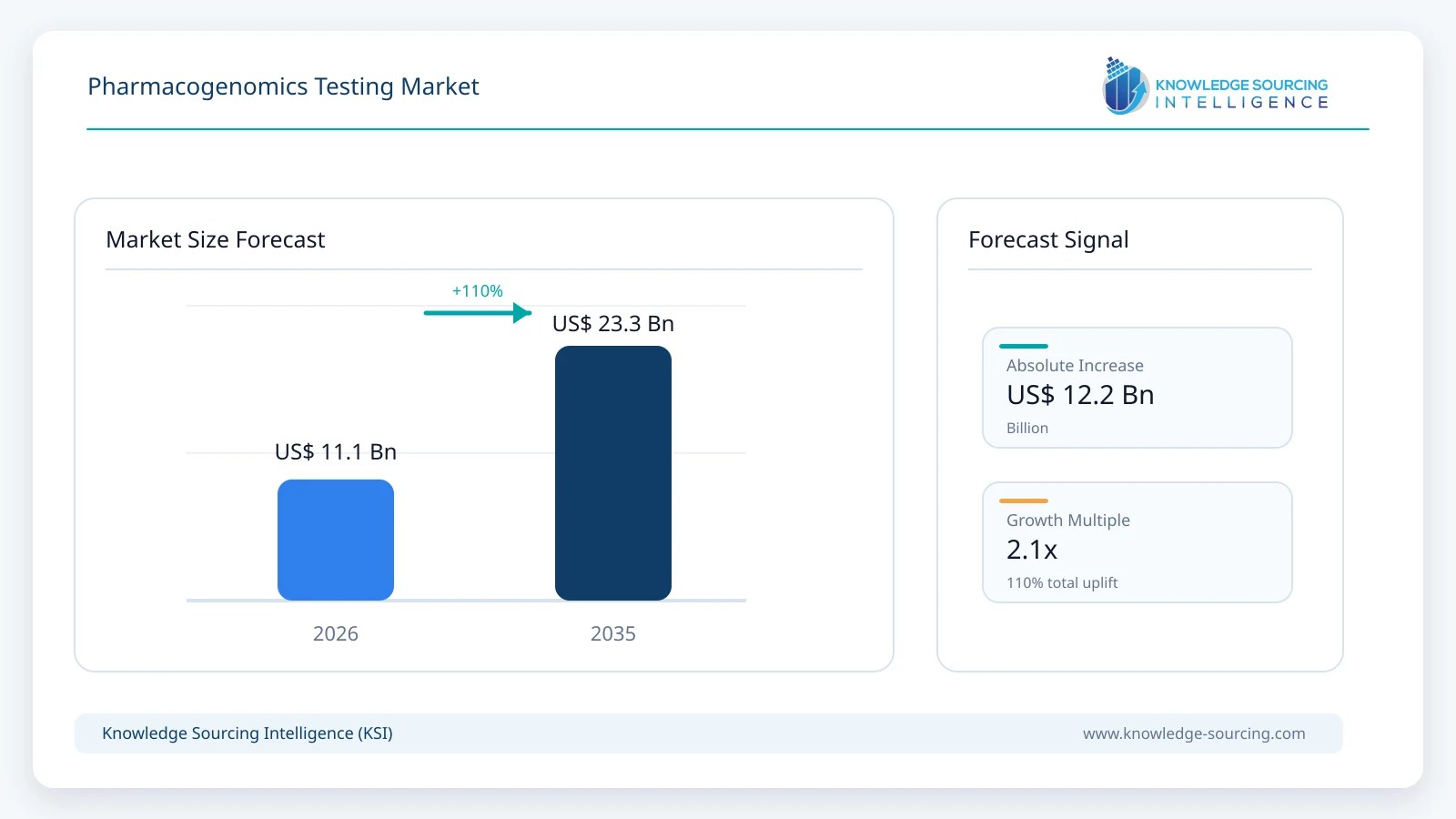
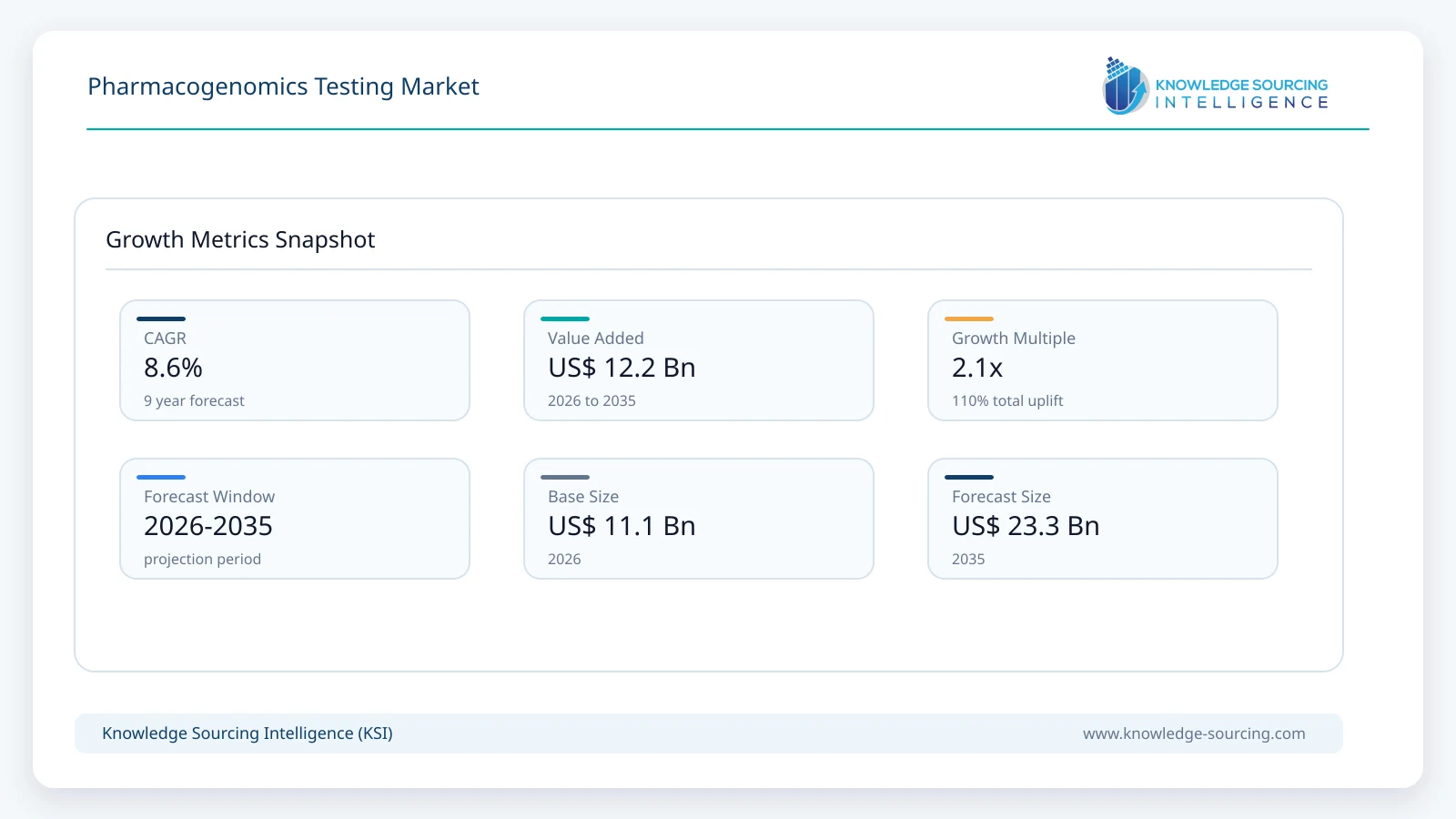
The Pharmacogenomics Testing Market is anticipated to grow at a CAGR of 8.6% from USD 11.1 billion in 2026 to USD 23.34 billion in 2035.
Highlights:
- 1Increasing demand for personalized medicine is expanding pharmacogenomics testing adoption because drug response varies significantly among patients.
- 2Growth of precision oncology programs is strengthening utilization because targeted therapies increasingly require biomarker-guided treatment selection.
- 3Rising awareness of adverse drug reactions is increasing demand because healthcare providers seek safer prescribing strategies.
- 4Pharmaceutical companies are increasing pharmacogenomic integration because clinical development increasingly depends on patient stratification.
Pharmacogenomics testing enables prediction of drug response because genetic variations influence absorption, distribution, metabolism, and elimination pathways. This capability improves medication selection and supports more effective treatment planning. Healthcare providers are increasingly adopting pharmacogenomic testing because adverse drug reactions continue contributing to healthcare costs and treatment failures. The resulting demand supports expansion of molecular diagnostic technologies.
Precision medicine depends on individualized therapeutic strategies because patient populations often exhibit significant genetic diversity affecting treatment outcomes. This dependency increases demand for diagnostic solutions capable of identifying clinically actionable genetic variants. Healthcare systems are strengthening pharmacogenomics programs because personalized prescribing improves treatment efficiency and patient safety. The resulting integration of genetic information into clinical practice supports market development.
Regulatory interest continues increasing because pharmacogenomic biomarkers increasingly influence prescribing guidelines and drug labeling recommendations. Healthcare organizations are investing in validated testing platforms as evidence supporting clinical utility continues expanding. This investment increases demand for quality-controlled laboratory services and analytical technologies. The resulting ecosystem expansion supports broader adoption.
Market Dynamics
Market Drivers
Increasing Focus on Personalized Medicine: Therapeutic outcomes depend on individual biological variability because patients metabolize medications differently. Healthcare providers are increasing pharmacogenomic testing adoption as personalized medicine strategies become more prominent. This increase strengthens demand for technologies capable of identifying drug-response biomarkers. The resulting improvement in treatment precision supports market growth.
Rising Incidence of Adverse Drug Reactions: Medication-related complications create significant healthcare challenges because inappropriate drug selection can reduce treatment effectiveness and increase patient risk. Healthcare systems are expanding pharmacogenomic programs as prevention of adverse drug reactions becomes a priority. This expansion increases demand for predictive genetic testing solutions. The resulting focus on medication safety supports adoption.
Expansion of Precision Oncology: Cancer treatment increasingly depends on biomarker-guided therapeutic strategies because molecular characteristics influence treatment response. Healthcare providers are incorporating pharmacogenomic testing as oncology care becomes more individualized. This incorporation increases demand for genetic analysis technologies. The resulting integration supports market development.
Growing Clinical Evidence Base: Clinical implementation depends on evidence demonstrating healthcare value because physicians require confidence in diagnostic utility. Research organizations are generating increasing pharmacogenomic evidence as personalized medicine programs expand. This increase strengthens demand for validated testing platforms. The resulting improvement in clinical confidence supports adoption.
Market Restraints
Clinical implementation challenges persist because physician awareness and pharmacogenomic education remain inconsistent.
Reimbursement limitations continue affecting adoption because coverage policies vary across healthcare systems.
Interpretation complexity remains significant because multiple genetic and non-genetic factors influence treatment response.
Market Opportunities
Expansion of Preventive Healthcare Models: Preventive healthcare increasingly emphasizes risk reduction because healthcare systems seek improved long-term outcomes. Providers are evaluating pharmacogenomic testing as proactive medication management strategies expand. This evaluation increases demand for predictive diagnostic solutions. The resulting opportunity supports market growth.
Integration into Electronic Health Records: Clinical adoption requires accessible information because prescribing decisions occur within fast-paced healthcare environments. Healthcare organizations are integrating pharmacogenomic information into digital workflows as precision medicine programs mature. This integration increases utilization of testing services. The resulting improvement in clinical usability supports expansion.
Growth of Companion Diagnostics: Targeted therapies require biomarker-guided patient selection because treatment effectiveness varies across patient populations. Diagnostic developers are expanding pharmacogenomic capabilities as personalized therapies continue advancing. This expansion increases demand for validated testing platforms. The resulting alignment between therapeutics and diagnostics creates commercial opportunities.
AI-Driven Prescribing Support: Genetic testing generates increasingly complex information because multiple variants influence therapeutic outcomes. Organizations are implementing artificial intelligence tools as pharmacogenomic adoption expands. This implementation improves interpretation efficiency and prescribing support. The resulting enhancement supports broader utilization.
Supply Chain Analysis
The pharmacogenomics testing supply chain begins with suppliers of reagents, extraction kits, sequencing consumables, and molecular biology technologies because genetic analysis depends on high-quality laboratory inputs. Demand is increasing for specialized consumables as testing volumes continue expanding. This requirement strengthens the importance of reliable supply networks. The resulting emphasis on analytical quality influences downstream performance.
Sample preparation providers occupy a critical position because accurate genetic testing requires preservation of nucleic acid integrity. Diagnostic laboratories are increasing investments in workflow standardization as pharmacogenomic implementation expands. This investment increases demand for automated preparation technologies. The resulting improvement in reproducibility supports broader adoption.
Genetic analysis platform providers form the core technology layer because diagnostic reliability depends on accurate variant detection. Healthcare organizations are expanding pharmacogenomics capabilities as precision medicine adoption accelerates. This expansion increases demand for sequencing systems, PCR technologies, and microarray platforms. The resulting technology development supports market growth.
Bioinformatics providers complete the value chain because pharmacogenomic information requires interpretation before clinical application. Healthcare systems are strengthening analytical capabilities as testing complexity increases. This strengthening increases demand for decision-support software and reporting solutions. The resulting integration of diagnostics and clinical workflows enhances scalability.
Government Regulations
Region | Regulation/Framework | Impact on Market |
United States | FDA Pharmacogenomic Biomarker Guidance | Supports personalized prescribing |
United States | CLIA Laboratory Standards | Governs testing quality |
European Union | In Vitro Diagnostic Regulation (IVDR) | Strengthens diagnostic compliance |
United Kingdom | NHS Genomic Medicine Service | Encourages pharmacogenomic integration |
Market Segmentation
By Technology
PCR-based testing remains widely utilized because healthcare providers require rapid and cost-effective identification of clinically actionable genetic variants. Diagnostic laboratories are expanding adoption as personalized prescribing programs continue growing. This expansion increases demand for scalable molecular testing solutions. The resulting balance between efficiency and accessibility supports segment growth.
By Therapeutic Area
Oncology represents a major therapeutic area because treatment selection increasingly depends on molecular biomarkers affecting therapeutic response. Healthcare providers are expanding pharmacogenomic testing as precision oncology programs continue advancing. This expansion increases demand for genetic analysis technologies. The resulting integration into cancer care supports market growth.
Regional Analysis
North America
North America represents the largest demand center for pharmacogenomics testing because healthcare systems increasingly prioritize personalized prescribing and medication safety. Healthcare providers are expanding pharmacogenomic testing adoption as adverse drug reactions continue creating clinical and economic burdens. This expansion increases demand for technologies capable of identifying genetic factors that influence therapeutic response. Hospitals and diagnostic laboratories face growing pressure to improve treatment outcomes because conventional prescribing approaches often rely on population-level evidence rather than individual biological characteristics. Organizations are integrating pharmacogenomic information into clinical workflows to address these limitations. The resulting incorporation of genetic insights into prescribing decisions strengthens market adoption across oncology, cardiology, psychiatry, and primary care applications.
Pharmaceutical companies contribute significantly to demand because biomarker-guided drug development increasingly depends on patient stratification strategies. Research organizations are expanding pharmacogenomic investigations as precision medicine initiatives continue evolving. This expansion increases utilization of genetic testing technologies capable of supporting therapeutic optimization. Academic medical centers continue strengthening implementation programs because clinical evidence supporting pharmacogenomics continues growing. The resulting convergence of diagnostics, therapeutics, and healthcare delivery supports sustained market growth.
Government-supported precision medicine initiatives continue reinforcing adoption because healthcare innovation increasingly depends on individualized treatment strategies. Healthcare systems are generating larger pharmacogenomic datasets as implementation programs expand. This increase strengthens demand for bioinformatics infrastructure and clinical decision-support tools. The resulting ecosystem supports continued regional leadership.
Europe
Europe maintains strong demand for pharmacogenomics testing because healthcare systems increasingly emphasize evidence-based personalized medicine. Hospitals and diagnostic laboratories are expanding utilization as treatment optimization becomes more dependent on genetic information. This expansion increases demand for validated pharmacogenomic testing services and analytical technologies. Healthcare providers face growing pressure to improve medication effectiveness because healthcare systems seek to reduce treatment failures and adverse drug events. Institutions are investing in pharmacogenomic implementation programs to address these objectives. The resulting improvement in prescribing precision supports broader adoption across the region.
Translational medicine initiatives continue driving market development because healthcare innovation increasingly requires integration of molecular insights into clinical practice. Research institutions are increasing pharmacogenomic studies as personalized healthcare programs mature. This increase strengthens demand for molecular testing technologies and interpretation platforms. Pharmaceutical collaborations continue expanding because pharmacogenomic biomarkers improve therapeutic development efficiency and patient selection strategies. The resulting integration of research and clinical implementation supports long-term market growth.
Population health initiatives contribute additional demand because individualized treatment strategies improve healthcare resource utilization. Academic organizations are expanding pharmacogenomic databases as molecular medicine programs continue developing. This expansion increases demand for testing and bioinformatics solutions. The resulting ecosystem development strengthens market adoption.
Asia Pacific
Asia Pacific represents one of the fastest-growing markets because governments increasingly prioritize precision medicine and genomic healthcare infrastructure. Healthcare systems are expanding pharmacogenomic testing capabilities as national healthcare modernization strategies emphasize personalized medicine adoption. This expansion increases demand for genetic testing platforms, sequencing technologies, and clinical interpretation systems. Research organizations face growing expectations to generate population-specific pharmacogenomic evidence because genetic diversity influences medication response patterns. Institutions are investing in large-scale pharmacogenomic programs to address these requirements. The resulting growth in personalized medicine strengthens regional market development.
National genomics initiatives continue supporting adoption because healthcare innovation increasingly relies on understanding genetic variability across populations. Research centers are generating larger pharmacogenomic datasets as government funding for precision medicine expands. This increase strengthens demand for molecular diagnostics and analytical infrastructure. Pharmaceutical companies are increasing investment in pharmacogenomic research because personalized therapies continue gaining importance. The resulting ecosystem growth supports sustained market expansion.
Healthcare accessibility remains uneven because advanced molecular testing capabilities remain concentrated within major healthcare centers. Organizations are strengthening collaborative healthcare networks as precision medicine demand increases. This strengthening improves technology access and implementation. The resulting expansion supports long-term growth opportunities.
Rest of the World
The Rest of the World market continues developing because healthcare systems increasingly recognize the value of pharmacogenomics in improving medication safety and treatment effectiveness. Governments are evaluating personalized medicine strategies as healthcare modernization initiatives increasingly focus on reducing avoidable adverse drug outcomes. This evaluation increases demand for genetic testing solutions capable of supporting individualized prescribing decisions. Healthcare providers face infrastructure constraints because pharmacogenomic implementation requires specialized laboratory capabilities and clinical expertise. Institutions are prioritizing high-impact therapeutic areas to maximize healthcare value. The resulting targeted implementation supports gradual market expansion.
Oncology and neuropsychiatric applications continue generating substantial demand because treatment response variability remains a major clinical challenge. Research organizations are expanding pharmacogenomic investigations as international scientific collaboration strengthens. This expansion increases demand for molecular testing technologies and interpretation platforms. Global partnerships continue supporting adoption because expertise transfer remains essential for capability development. The resulting collaboration improves access to advanced personalized medicine solutions.
Economic considerations continue influencing adoption because healthcare budgets remain constrained across many emerging regions. Organizations are seeking cost-effective implementation strategies that balance clinical utility with operational sustainability. This requirement increases focus on scalable pharmacogenomic workflows. The resulting emphasis on value-driven adoption supports sustainable market development.
Pipeline Analysis
Pharmacogenomics testing increasingly supports therapeutic development because treatment response variability often originates from genetic differences affecting drug metabolism and target engagement. Pharmaceutical companies are expanding pharmacogenomic biomarker research as precision medicine strategies require more effective patient stratification. This expansion increases demand for technologies capable of identifying clinically relevant genetic variants. Research organizations are generating larger pharmacogenomic datasets because therapeutic innovation increasingly depends on understanding biological variability. The resulting integration of pharmacogenomics into drug development strengthens long-term market demand.
Oncology pipelines remain a major growth driver because targeted therapies increasingly depend on biomarker-guided treatment selection. Researchers are increasing pharmacogenomic investigations as precision oncology programs require improved understanding of therapeutic response mechanisms. This requirement increases demand for advanced molecular testing platforms capable of supporting personalized treatment strategies. Drug developers continue investing in pharmacogenomic biomarkers because patient stratification increasingly influences clinical trial success and regulatory outcomes. The resulting reliance on genetic evidence reinforces market growth.
Cardiovascular and neuropsychiatric research continue creating additional opportunities because treatment effectiveness often varies significantly across patient populations. Clinical researchers are incorporating pharmacogenomic analysis into study designs as personalized healthcare becomes more prominent. This incorporation increases utilization throughout clinical development and translational research programs. The resulting expansion of application areas supports sustained adoption of pharmacogenomic testing technologies.
Competitive Landscape
Thermo Fisher Scientific
Thermo Fisher Scientific remains strategically distinct because it combines molecular diagnostics technologies, genomic analysis platforms, and laboratory workflow solutions within a comprehensive life sciences ecosystem. Pharmacogenomics testing increasingly requires accurate detection of clinically relevant genetic variants because prescribing decisions depend on reliable molecular information. Healthcare organizations are expanding pharmacogenomic implementation as precision medicine initiatives continue advancing. This expansion increases demand for integrated technologies capable of supporting high-throughput testing and standardized laboratory workflows. The resulting reliance on scalable molecular infrastructure strengthens Thermo Fisher’s position within the market.
Demand is increasing for streamlined pharmacogenomic testing because healthcare providers seek efficient integration of genetic information into routine clinical practice. This increase strengthens the value of suppliers capable of supporting end-to-end laboratory operations. Thermo Fisher continues enhancing molecular diagnostics capabilities to address evolving clinical requirements. The resulting operational breadth improves competitive positioning.
Illumina
Illumina remains strategically distinct because its sequencing platforms provide foundational infrastructure for advanced pharmacogenomic analysis. Pharmacogenomics testing increasingly depends on comprehensive genetic characterization because multiple variants can influence therapeutic response and medication safety. Healthcare providers are expanding adoption of genomic medicine as personalized treatment strategies become more prominent. This expansion increases demand for sequencing technologies capable of supporting precise variant identification. The resulting dependence on scalable sequencing infrastructure strengthens Illumina’s position within the market.
Demand is shifting toward broader genomic testing because healthcare systems increasingly seek comprehensive molecular insights rather than isolated biomarker assessments. This shift increases the importance of sequencing ecosystems capable of supporting precision medicine initiatives. Illumina continues strengthening sequencing and bioinformatics capabilities to address these requirements. The resulting ecosystem approach supports long-term competitiveness.
QIAGEN
QIAGEN remains strategically distinct because it integrates molecular sample preparation expertise with advanced diagnostic analytics and bioinformatics solutions. Pharmacogenomics testing depends on accurate genetic analysis because therapeutic recommendations require reliable molecular evidence. Laboratories are increasing focus on workflow reproducibility as pharmacogenomic implementation expands. This focus increases demand for technologies capable of improving analytical consistency and interpretation quality. The resulting requirement strengthens QIAGEN’s position within pharmacogenomics workflows.
Demand for advanced clinical interpretation continues increasing because genetic variants often influence treatment response through complex biological mechanisms. This increase strengthens the importance of analytical platforms capable of converting molecular information into actionable prescribing guidance. QIAGEN continues expanding bioinformatics capabilities to address these challenges. The resulting integration of laboratory and computational expertise supports sustained competitiveness.
F. Hoffmann-La Roche Ltd.
Roche remains strategically distinct because it combines diagnostic innovation with extensive pharmaceutical development expertise. Pharmacogenomics testing increasingly supports personalized treatment strategies because therapeutic outcomes often depend on genetic variability among patients. Healthcare providers are expanding molecular testing as biomarker-guided therapies continue gaining clinical importance. This expansion increases demand for diagnostic solutions capable of supporting individualized treatment decisions. The resulting connection between diagnostics and therapeutics strengthens Roche’s strategic advantage.
Demand is shifting toward integrated healthcare models because precision medicine increasingly requires coordination between diagnostic information and therapeutic interventions. This shift increases the value of organizations capable of operating across both domains. Roche continues strengthening precision medicine initiatives supported by advanced molecular diagnostics. The resulting ecosystem approach reinforces market relevance.
Agilent Technologies
Agilent Technologies remains strategically distinct because of its expertise in genomic analysis technologies and laboratory workflow optimization. Pharmacogenomics testing increasingly relies on high-quality molecular analysis because prescribing decisions depend on accurate genetic information. Healthcare organizations are strengthening pharmacogenomic capabilities as precision medicine adoption continues increasing. This strengthening increases demand for technologies supporting reproducible testing workflows. The resulting focus on analytical quality supports Agilent’s position within the market.
Demand for efficient laboratory operations continues increasing because healthcare systems seek scalable implementation strategies for molecular diagnostics. This increase strengthens the importance of workflow optimization technologies capable of supporting high-throughput testing. Agilent continues developing capabilities aligned with evolving clinical requirements. The resulting emphasis on operational performance supports long-term participation.
Myriad Genetics
Myriad Genetics remains strategically distinct because of its long-standing focus on molecular diagnostics and personalized medicine applications. Pharmacogenomics testing increasingly supports treatment optimization because healthcare providers seek to reduce variability in therapeutic outcomes. Healthcare systems are expanding personalized medicine programs as genetic information becomes more relevant to prescribing decisions. This expansion increases demand for clinically validated pharmacogenomic testing services. The resulting focus on individualized care strengthens Myriad Genetics’ position within the market.
Demand is increasing for actionable genetic insights because healthcare providers require practical tools capable of supporting treatment decisions. This increase strengthens the value of organizations with established expertise in clinical genetic testing. Myriad Genetics continues strengthening pharmacogenomic capabilities designed to support personalized healthcare. The resulting emphasis on clinical utility supports competitive differentiation.
Quest Diagnostics
Quest Diagnostics remains strategically distinct because of its extensive diagnostic laboratory network and broad healthcare provider reach. Pharmacogenomics testing increasingly requires scalable service delivery because healthcare systems seek wider access to personalized medicine capabilities. Healthcare providers are expanding utilization of molecular diagnostics as genetic information becomes more integrated into prescribing decisions. This expansion increases demand for laboratory services capable of supporting routine pharmacogenomic implementation. The resulting accessibility strengthens Quest Diagnostics’ market position.
Demand is shifting toward population-scale personalized medicine because healthcare organizations increasingly recognize the value of individualized prescribing. This shift increases the importance of diagnostic providers capable of delivering consistent testing services across diverse clinical settings. Quest Diagnostics continues expanding precision medicine capabilities to address these requirements. The resulting focus on healthcare accessibility supports long-term growth.
Laboratory Corporation of America Holdings (Labcorp)
Labcorp remains strategically distinct because it combines large-scale diagnostic testing operations with extensive genomic medicine capabilities. Pharmacogenomics testing increasingly depends on broad clinical access because personalized prescribing strategies require integration across healthcare environments. Healthcare providers are increasing adoption of pharmacogenomic testing as precision medicine initiatives continue expanding. This adoption increases demand for laboratory services capable of delivering reliable genetic analysis and interpretation. The resulting integration of genomic testing into clinical practice strengthens Labcorp’s position within the market.
Demand for comprehensive diagnostic services continues increasing because healthcare systems increasingly require centralized testing infrastructure capable of supporting precision medicine implementation. This increase strengthens the value of organizations with extensive laboratory networks and molecular expertise. Labcorp continues expanding pharmacogenomic offerings aligned with evolving healthcare requirements. The resulting focus on scalable clinical implementation supports sustained competitiveness.
Key Developments
In September 2025, Quest Diagnostics, a leading provider of diagnostic information services, announced an advanced pharmacogenomic (PGx) laboratory test service designed to help providers understand the patient's individual genetic response to select drug therapies.
In July 2025, Medicover Genetics announced the launch of Pharmacogenomic Preventive and Diagnostic Testing, comprehensive pharmacogenetics solutions for preventive and personalized prescribing.
Future Market Outlook
The future of the pharmacogenomics testing market depends on the increasing need to improve medication effectiveness through individualized treatment strategies because patient responses to therapy often vary according to genetic factors. Demand is shifting toward proactive genetic testing as healthcare providers seek to optimize prescribing decisions before treatment initiation. This shift increases reliance on technologies capable of identifying clinically relevant pharmacogenomic biomarkers. Technology developers are improving testing accessibility and analytical performance to address expanding healthcare requirements. The resulting advancement supports broader implementation across clinical environments.
Artificial intelligence is becoming increasingly important because pharmacogenomic information involves complex relationships among genetic variants, drug pathways, and clinical outcomes. Healthcare organizations are integrating decision-support systems as precision medicine programs continue expanding. This integration improves interpretation efficiency and strengthens clinical usability. Physicians are seeking more accessible prescribing guidance because pharmacogenomic adoption increasingly depends on workflow integration. The resulting convergence of genetics and digital healthcare strengthens market development.
Electronic health record integration continues influencing future growth because pharmacogenomic information generates maximum clinical value when available during prescribing decisions. Healthcare systems are expanding investments in digital precision medicine infrastructure as personalized healthcare becomes more prominent. This expansion increases demand for interoperable testing and reporting solutions. The resulting enhancement in clinical accessibility supports wider adoption.
Pharmacogenomics testing increasingly functions as a core component of precision medicine because medication response variability remains a major challenge across multiple therapeutic areas. Healthcare providers continue expanding adoption because personalized prescribing improves treatment efficiency and patient safety. Diagnostic laboratories are strengthening pharmacogenomic capabilities because demand for individualized healthcare continues increasing. Technology developers continue improving scalability because broader implementation requires greater affordability and standardization. These interconnected developments position pharmacogenomics testing as an essential element of future healthcare delivery.
The market continues evolving around the need to transform genetic information into actionable therapeutic guidance. Demand is expanding because oncology, cardiovascular medicine, neuropsychiatry, drug development, and preventive healthcare increasingly depend on individualized treatment strategies. This expansion creates opportunities for organizations capable of combining molecular innovation, analytical expertise, and clinical utility. Companies that successfully address these requirements are likely to strengthen their competitive positions as precision medicine and personalized healthcare continue expanding globally.
Pharmacogenomics Testing Market Scope:
| Report Metric | Details |
|---|---|
| Total Market Size in 2026 | USD 11.1 billion |
| Total Market Size in 2035 | USD 23.34 billion |
| Forecast Unit | USD Billion |
| Growth Rate | 8.6% |
| Study Period | 2021 to 2035 |
| Historical Data | 2021 to 2024 |
| Base Year | 2025 |
| Forecast Period | 2026 – 2035 |
| Segmentation | Product & Service, Technology, Application, Geography |
| Companies |
|
Market Segmentation
Product Type
Technology
Application
Geography
- North America
- South America
- Europe
- Middle East and Africa
- Asia Pacific
Table of Contents
1. EXECUTIVE SUMMARY
1.1 Market Snapshot
1.2 Key Findings
1.3 Analyst Insights
1.4 Strategic Recommendations
2. RESEARCH METHODOLOGY
2.1 Research Design
2.2 Data Collection Methodology
2.3 Market Size Estimation
2.4 Forecasting Model
2.5 Assumptions & Limitations
3. PHARMACOGENOMICS TESTING MARKET OVERVIEW, SIZE & FORECAST
3.1 Market Definition & Scope
3.2 Industry Overview
3.3 Industry Evolution
3.4 Key Market Trends
3.5 Historical Market Size Analysis (2021–2025)
3.6 Market Forecast Analysis (2026–2035)
3.7 Pharmacogenomics Ecosystem Overview
3.8 Precision Medicine and Personalized Therapy Landscape
3.9 Testing Volume Analysis
3.10 User Adoption Analysis
3.11 Drug-Gene Interaction Landscape
3.12 Companion and Complementary Diagnostics Overview
3.13 Clinical Utility and Healthcare Outcomes Assessment
4. MARKET DYNAMICS
4.1 Market Drivers
4.2 Market Restraints
4.3 Market Opportunities
4.4 Market Challenges
5. INDUSTRY LANDSCAPE
5.1 Industry Value Chain Analysis
5.2 Pricing Analysis
5.3 Reimbursement Landscape
6. INNOVATION LANDSCAPE
6.1 Emerging Technologies in Pharmacogenomics Testing
6.2 Product Innovation Analysis
6.3 Next-Generation Sequencing-Based Pharmacogenomics Advancements
6.4 Multiplex Genotyping and Panel Testing Innovations
6.5 Clinical Decision Support System Integration
6.6 Clinical Trial Analysis
6.7 Pipeline Analysis
6.8 AI Integration in Pharmacogenomic Interpretation
6.9 Digital Health and Electronic Health Record Integration
6.10 Technology Roadmap
7. REGULATORY LANDSCAPE
7.1 Regulatory Framework
7.2 Approval Pathways
7.3 Compliance Requirements
8. PHARMACOGENOMICS TESTING MARKET LANDSCAPE ANALYSIS
8.1 Analysis by Technology Platform
8.2 Analysis by Gene Family
8.3 Analysis by Testing Methodology
8.4 Analysis by Therapeutic Area
8.5 Analysis by Clinical Application
8.6 Analysis by Testing Setting
8.7 Analysis by End User
9. PHARMACOGENOMICS TESTING MARKET SEGMENT ANALYSIS (2021–2035)
9.1 By Product & Service
9.1.1 Instruments
9.1.2 Reagents & Consumables
9.1.3 Software & Clinical Decision Support Solutions
9.1.4 Pharmacogenomic Testing Services
9.2 By Technology
9.2.1 Polymerase Chain Reaction (PCR)
9.2.2 DNA Microarrays
9.2.3 Next-Generation Sequencing (NGS)
9.2.4 Sanger Sequencing
9.2.5 Other Technologies
9.3 By Gene Family
9.3.1 CYP450 Genes
9.3.2 HLA Genes
9.3.3 TPMT Genes
9.3.4 DPYD Genes
9.3.5 UGT Genes
9.3.6 Other Pharmacogenomic Markers
9.4 By Therapeutic Area
9.4.1 Oncology
9.4.2 Psychiatry and Mental Health
9.4.3 Cardiology
9.4.4 Neurology
9.4.5 Pain Management
9.4.6 Infectious Diseases
9.4.7 Other Therapeutic Areas
9.5 By End User
9.5.1 Hospitals and Health Systems
9.5.2 Diagnostic Laboratories
9.5.3 Academic & Research Institutes
9.5.4 Pharmaceutical & Biotechnology Companies
9.5.5 Other End Users
10. PHARMACOGENOMICS TESTING MARKET GEOGRAPHICAL ANALYSIS (2021–2035)
10.1 North America
10.2 Europe
10.3 Asia-Pacific
10.4 South America
10.5 Middle East & Africa
11. PHARMACOGENOMICS TESTING MARKET COUNTRY ANALYSIS (2021–2035)
11.1 United States
11.2 Canada
11.3 Germany
11.4 United Kingdom
11.5 France
11.6 Netherlands
11.7 Switzerland
11.8 China
11.9 Japan
11.10 South Korea
11.11 India
11.12 Australia
11.13 Brazil
11.14 Saudi Arabia
12. COMPETITIVE LANDSCAPE
12.1 Market Share Analysis
12.2 Strategic Developments
12.3 Mergers & Acquisitions, Partnerships & Collaborations
12.4 Product Launches
13. COMPANY PROFILES
13.1 QIAGEN N.V.
13.1.1 Company Overview
13.1.2 Financials
13.1.3 Product Portfolio
13.1.4 Recent Developments
13.2 F. Hoffmann-La Roche Ltd
13.3 Thermo Fisher Scientific Inc.
13.4 Illumina, Inc.
13.5 Myriad Genetics, Inc.
13.6 Natera, Inc.
13.7 Labcorp Holdings Inc.
13.8 Quest Diagnostics Incorporated
13.9 SOPHiA GENETICS SA
13.10 Bio-Rad Laboratories, Inc.
13.11 Invitae Corporation
13.12 Genomind, Inc.
13.13 OneOme, LLC
13.14 GeneDx, LLC
13.15 Molecular You Corporation
14. PHARMACOGENOMICS TESTING MARKET COMMERCIAL FORECAST ANALYSIS
14.1 Forecast by Instruments
14.2 Forecast by Reagents & Consumables
14.3 Forecast by Software & Clinical Decision Support Solutions
14.4 Forecast by Pharmacogenomic Testing Services
14.5 Forecast by Oncology Applications
14.6 Forecast by Psychiatry Applications
14.7 Forecast by Cardiology Applications
14.8 Forecast by CYP450-Based Testing
15. INVESTMENT & FUNDING ANALYSIS
15.1 Venture Capital Trends
15.2 Government Funding
15.3 R&D Investments
16. FUTURE OUTLOOK
16.1 Key Growth Opportunities
16.2 Future Industry Trends
Navigate
Trusted by the world's leading organizations











