
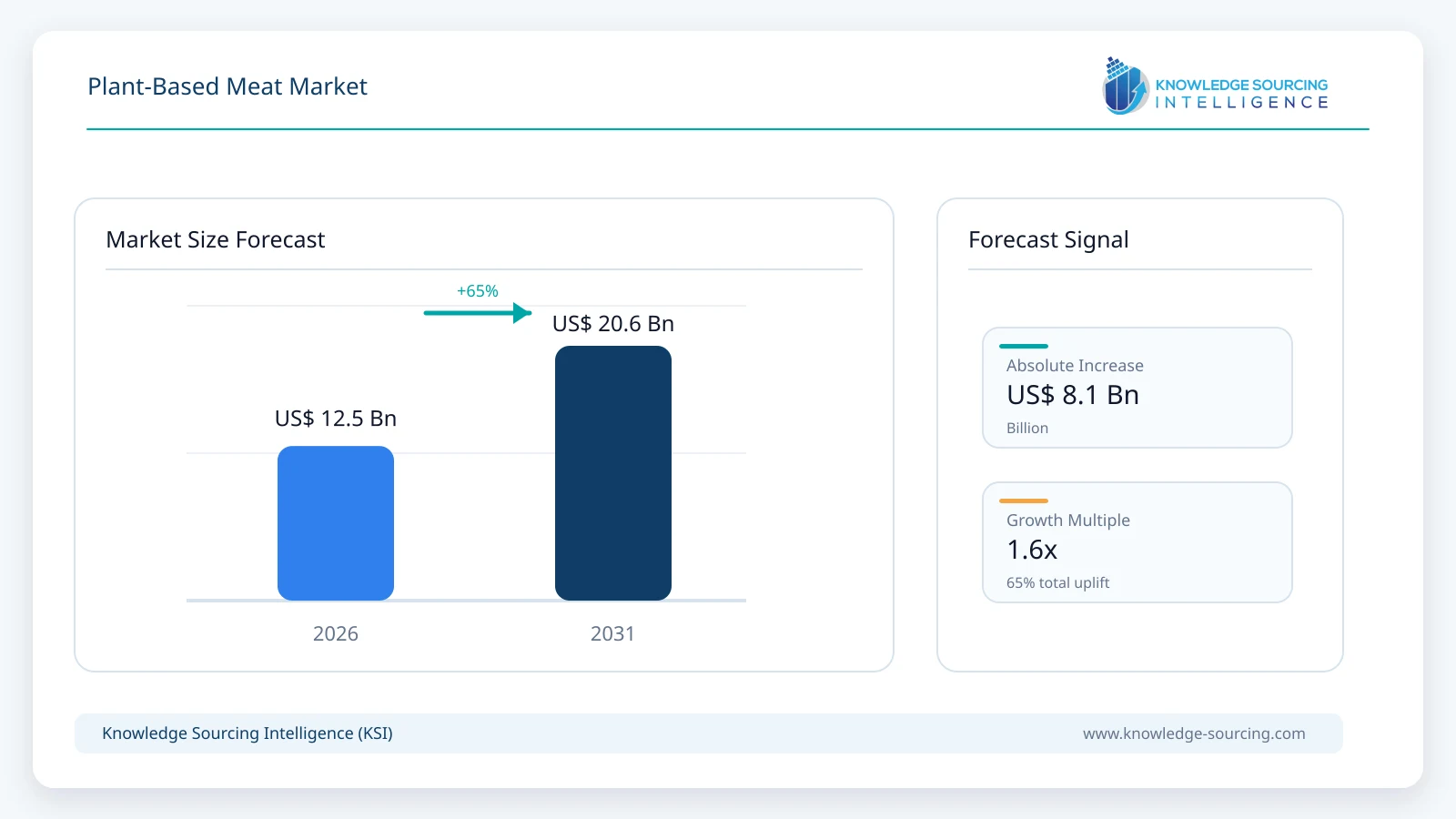
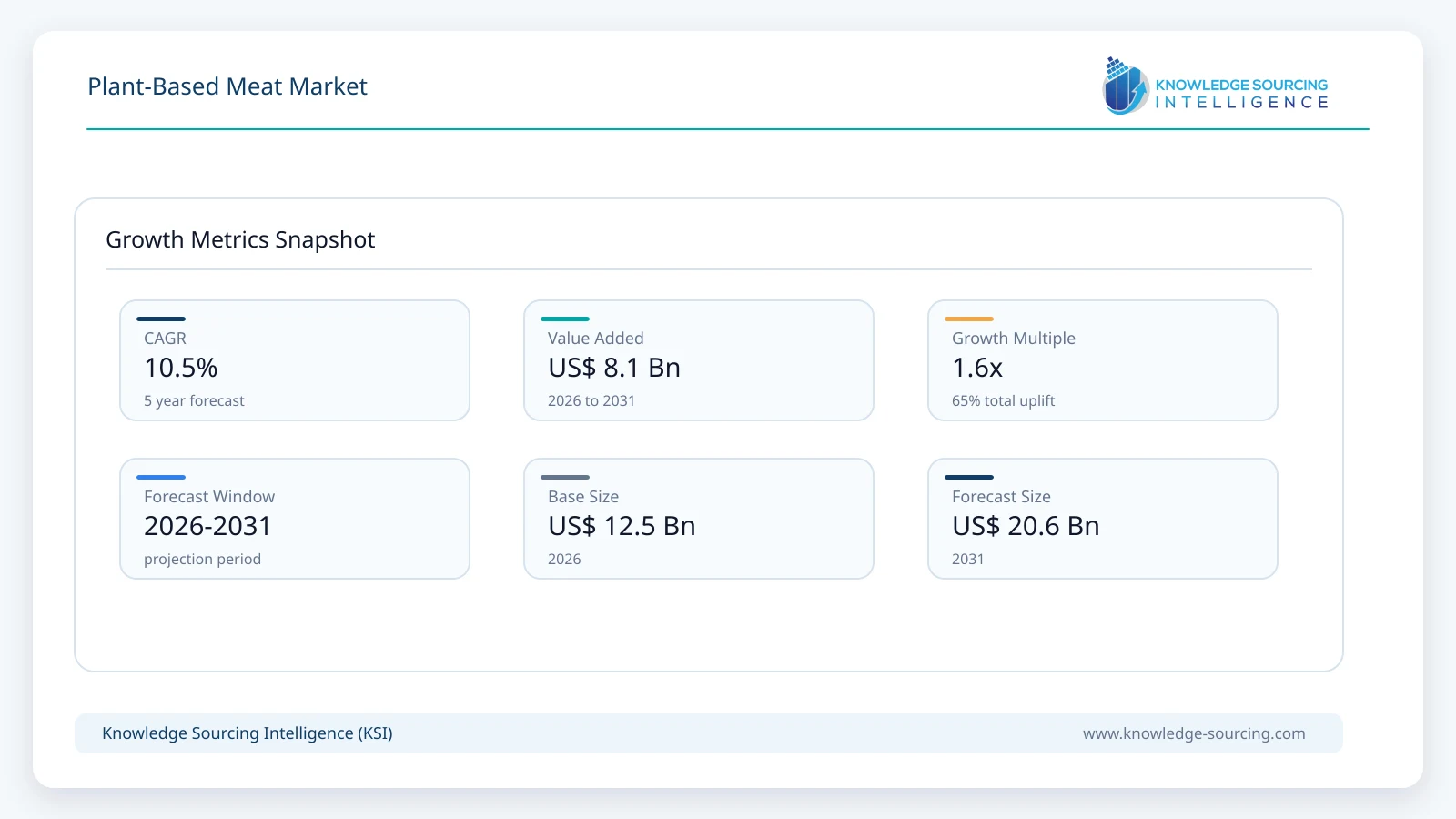
The global plant-based meat market is forecast to grow from USD 12.500 billion in 2026 to USD 20.607 billion in 2031, representing a CAGR of 10.52% during the forecast period.
Highlights:
- 1Beef-style alternatives account for approximately 37% of global plant-based meat market value in 2026, supported by established burger, ground-meat and steak-style product formats.
- 2Soy-based meat accounts for approximately 41% of global market value in 2026, reflecting established processing infrastructure, protein functionality and broad availability.
- 3Burgers and patties account for approximately 32% of global market value in 2026, although strips, chunks and whole-cut products are gaining importance.
- 4Retail accounts for approximately 62% of market value in 2026, supported by supermarket, hypermarket and specialist-channel distribution.
- 5Supermarkets and hypermarkets account for approximately 55% of market value in 2026, remaining the principal route to mainstream household penetration.
- 6Europe accounts for approximately 46% of global market value in 2026, supported by strong plant-based meat consumption in the United Kingdom, Germany, the Netherlands, France and other Western European markets.
- 7The United States remains the largest individual country market, accounting for approximately 28% of global plant-based meat and seafood retail sales in 2025.
Plant-based meat includes food products formulated primarily from plant-derived proteins and designed to replace conventional beef, chicken, pork, seafood and other animal-meat products in similar meal occasions. The market includes burgers, patties, sausages, ground meat, nuggets, strips, pieces and whole-cut analogues produced using soy, pea, wheat and other plant proteins. Conventional tofu, tempeh and other traditional plant foods are excluded unless they are specifically formulated and marketed as direct meat substitutes.
The category is entering a more disciplined commercial phase. Global plant-based meat and seafood retail sales reached an estimated USD 6.6 billion in 2025, with Europe and North America accounting for more than 80% of retail value. Global sales increased from 2024, primarily because of European growth, while the U.S. market continued to contract. This geographic divergence shows that future growth depends less on broad category awareness and increasingly on product quality, pricing, distribution and consumer relevance within individual markets.
Product development is also changing the addressable market. Earlier plant-based meat portfolios were heavily concentrated in burgers, mince and sausages because these formats are technically easier to replicate. Manufacturers are now introducing steak-style products, chicken pieces, strips and other structured formats as extrusion, ingredient functionality and texture engineering improve. Beyond Meat expanded Beyond Steak Filet into conventional retail during 2026, while Impossible Foods entered steak-style products with Impossible Steak Bites, demonstrating the industry's shift toward more complex meal occasions.
Market Trends
Whole-Cut and Structured Meat Analogues Are Expanding
Plant-based meat innovation is shifting toward products that recreate the fibrous structure and eating experience of intact animal muscle rather than relying primarily on ground-meat formats. High-moisture extrusion, protein structuring, fat distribution and ingredient binding are enabling manufacturers to produce chicken pieces, steak bites, strips and filet-style products with improved bite and moisture retention. Beyond Meat launched Beyond Steak Filet into Wegmans and H-E-B stores in June 2026 after initially selling the product directly to consumers, and subsequently expanded distribution further during the year. The product combines plant protein, mycelium and avocado oil and represents a broader move toward premium whole-cut formats. Impossible Foods introduced Impossible Steak Bites in 2025 as its first steak-style offering. These developments expand plant-based meat into meal occasions that historically had limited direct substitutes and reduce dependence on the mature burger and ground-meat category.
Protein Content and Ingredient Quality Are Becoming More Important
Plant-based meat brands increasingly compete on nutritional positioning rather than sustainability or animal welfare alone. Consumers evaluating meat alternatives compare protein content, saturated fat, sodium, fiber, ingredient lists and degree of processing, creating pressure for formulations that provide clear nutritional benefits alongside taste. Beyond Meat's 2026 product launches emphasize avocado oil, protein content, reduced saturated fat and third-party clean-label certification, illustrating how product communication is changing. Beyond Chicken Pieces Spicy Buffalo, launched nationally through Kroger in April 2026, provides 21 grams of plant protein per serving and uses avocado oil, while Beyond Steak Filet provides 28 grams of plant protein. This positioning is particularly important as the category seeks repeat purchases from flexitarian consumers who also buy conventional meat and therefore compare products across both taste and nutritional value rather than viewing plant-based meat as a separate dietary category.
Market Performance Is Diverging Between Europe and North America
The plant-based meat category is no longer following one global demand pattern. GFI estimates that global plant-based meat and seafood retail sales reached USD 6.6 billion in 2025, with Europe contributing approximately USD 3.6 billion compared with USD 1.9 billion in North America. European growth helped increase global retail sales, while the United States experienced a 10% decline in plant-based meat and seafood dollar sales and an 11% decline in unit sales during 2025. This divergence is commercially significant because it demonstrates that category awareness alone does not guarantee continued growth. Price, distribution, consumer perceptions around processing and product quality increasingly determine performance. Manufacturers are therefore moving away from assuming that one product architecture will scale equally across all markets and are placing greater emphasis on local eating habits, formats, retail positioning and price points.
Product Mix Is Moving Beyond the Conventional Burger
The U.S. market remains challenging overall, but individual formats are performing differently. GFI reported that shreds, chunks and strips achieved both dollar and unit growth in 2025 and gained distribution even while most major plant-based meat formats declined. This suggests that consumers remain receptive to the category when products address meal occasions where plant-based alternatives have historically been weak. The change also explains increasing manufacturer attention to chicken pieces, strips, bacon alternatives and steak-style formats. These products can be incorporated into stir-fries, salads, bowls, sandwiches and prepared meals, giving consumers more flexibility than a conventional burger patty. Product innovation through 2031 is therefore expected to focus increasingly on versatile meal components and whole-cut analogues rather than relying exclusively on the formats that drove the category's initial commercial expansion.
Market Drivers
Flexitarian Consumption Provides the Largest Addressable Consumer Base
The market's long-term opportunity depends primarily on consumers who continue to eat animal meat but periodically substitute plant-based alternatives. This group is substantially larger than the vegan or vegetarian population and can generate meaningful demand if plant-based products meet expectations on taste, price and convenience. GFI reports that 96% of U.S. households purchasing plant-based meat and seafood in 2025 also purchased conventional meat, demonstrating that the category competes primarily for individual meal occasions rather than replacing animal meat completely. This purchasing behavior changes product strategy. Manufacturers increasingly design products to resemble conventional meat closely, use familiar formats and merchandise products alongside animal protein rather than only within specialty vegan sections. The ability to persuade mainstream meat consumers to substitute even a small number of weekly meals represents a larger growth opportunity than relying on expansion of strictly plant-based diets.
Improved Processing Technology Is Raising Product Quality
Taste and texture remain fundamental to repeat purchase, making food-processing innovation one of the most important drivers of category development. High-moisture extrusion allows plant proteins to form fibrous structures that better approximate muscle tissue, while advances in protein isolation, fat encapsulation, flavor systems and binding improve juiciness and cooking behavior. The industry is also using increasingly diverse ingredients, including pea, soy, wheat, fungi-derived components and combinations of plant proteins to achieve specific texture and nutritional objectives. Whole-cut products demonstrate the commercial impact of these improvements because manufacturers can now target steak, chicken breast and other structured meat occasions that were difficult to reproduce using earlier extrusion systems. As technical performance improves, plant-based meat becomes less dependent on consumer willingness to compromise on taste, expanding the potential market among flexitarians and conventional meat buyers.
Wider Retail Availability Supports Mainstream Trial
Mainstream retail remains essential because consumers are more likely to trial plant-based meat when products are available within their normal food-shopping routine. Major brands increasingly use national supermarket networks rather than relying on natural-food and specialty channels. Beyond Meat's 2026 expansion included Kroger, Wegmans, H-E-B, Whole Foods Market, Sprouts Farmers Market and other conventional retailers, illustrating the importance of broad distribution. Large retailers can provide substantial volume and visibility but also impose stronger requirements around sales velocity, promotions and shelf productivity. The result is a more competitive environment in which brands need to demonstrate repeat purchasing rather than simply secure initial distribution. Products that combine strong sensory performance with clear nutritional positioning are therefore more likely to retain mainstream shelf space as retailers rationalize slower-moving plant-based ranges.
Market Restraints and Challenges
Price Parity With Conventional Meat Remains Difficult
Price continues to constrain plant-based meat adoption, particularly among consumers without a medical or ethical reason to avoid animal products. GFI's 2025 U.S. analysis found that most plant-based meat and seafood types remained priced between one and three times higher than equivalent conventional products, although the gap narrowed in some categories as animal-meat prices increased. Plant-based beef was a notable exception, with the price difference declining substantially. Manufacturing economics remain challenging because suppliers require isolated or concentrated proteins, specialized extrusion, flavor systems and relatively smaller production volumes than conventional meat processors. Promotional activity can temporarily reduce the price gap, but frequent discounting weakens margins and may not produce durable consumer loyalty. Scaling production, improving protein-processing efficiency and simplifying formulations therefore remain important if the industry is to move from premium substitution toward regular household consumption.
Taste, Texture and Processing Perceptions Affect Repeat Purchase
The industry has achieved significant improvements in sensory performance, but plant-based meat still competes directly with products that consumers know extremely well. Small differences in texture, browning, aroma or juiciness can therefore reduce repeat purchase, particularly among flexitarian consumers who can easily return to animal meat. At the same time, some buyers perceive heavily formulated meat analogues as overly processed, creating tension between technological complexity and clean-label expectations. Manufacturers increasingly respond by shortening ingredient lists, emphasizing recognizable oils and proteins, improving nutritional profiles and developing formats that require less intense flavor replication. The challenge is especially important because the category's initial growth created high awareness, meaning future expansion depends increasingly on converting trial into repeat consumption rather than simply introducing consumers to the concept.
Retail Distribution Has Become More Selective
Plant-based meat distribution has become less forgiving as retailers focus more heavily on sales velocity and shelf productivity. GFI reported that overall U.S. plant-based meat and seafood distribution declined by approximately 8% across both conventional multi-outlet and natural channels during 2025, although selected formats such as strips, chunks and bacon alternatives gained distribution. This creates a competitive environment in which weaker products can lose shelf space even as the overall category remains strategically relevant. Manufacturers need stronger retail data, promotional effectiveness and differentiated products to justify listings. The trend favors established brands with national distribution capabilities but also creates opportunities for newer products that address underdeveloped meal occasions. Market growth through 2031 therefore depends not only on producing additional SKUs but on improving sales productivity within existing retail space.
Plant-Based Meat Market Segment Analysis
By Meat Type
Beef Alternatives
Beef-style plant-based meat is projected to reach approximately USD 7.3 billion by 2031, remaining the largest meat-type segment because burgers, ground meat and increasingly steak-style products are among the category's most established formats. Beef alternatives benefit from strong consumer familiarity and extensive use across burgers, tacos, pasta sauces, ready meals and foodservice applications. Manufacturers have also made substantial progress in replicating browning, fat release and savory flavor, reducing the sensory gap with conventional products. Price competitiveness has improved relative to several other plant-based categories because conventional beef prices have increased, with GFI reporting a comparatively narrow price gap between plant-based and conventional beef in the U.S. during 2025. Chicken alternatives gain share through nuggets, pieces and strips, but beef remains the largest revenue pool through 2031.
By Protein Source
Soy-Based Meat
Soy-based plant-based meat is projected to generate approximately USD 8.2 billion by 2031, retaining the largest protein-source position due to established global supply, strong protein functionality and decades of food-processing experience. Soy protein isolates and concentrates provide useful binding, water retention and texturization characteristics, making them suitable for burgers, ground meat, nuggets and structured products. The ingredient also benefits from comparatively mature processing infrastructure and broad availability across North America, Europe and Asia. Pea protein continues to gain importance because of allergen considerations, neutral flavor and strong association with newer plant-based brands, while mycoprotein and other protein sources offer additional differentiation. However, soy's processing flexibility and established economics allow it to remain the largest underlying protein platform through the forecast period, particularly among manufacturers seeking to combine volume production with proven technical performance.
By Form
Burgers and Patties
Burgers and patties are projected to generate approximately USD 6.2 billion by 2031, remaining the largest individual product-form segment despite faster growth in strips, pieces and whole-cut products. Burgers were central to the first commercial wave of modern plant-based meat because the ground format reduces the technical difficulty of recreating intact muscle while providing a familiar use case across retail and foodservice. The category has consequently developed strong brand recognition, established manufacturing processes and widespread supermarket placement. Growth moderates as consumers seek greater variety, but burger products remain important for both household consumption and restaurant menus. Newer formats increasingly complement rather than replace the segment, enabling manufacturers to broaden usage occasions while retaining a familiar core portfolio. The burger category therefore remains the largest value pool even as its share of total plant-based meat gradually declines.
By End User
Retail
Retail is projected to account for approximately USD 12.8 billion of global plant-based meat revenue by 2031, maintaining the largest end-user position as household consumption remains central to category scale. Supermarkets and other retailers provide consumers with access to frozen, refrigerated and shelf-stable plant-based meat across several price points and meal occasions. Retail also allows manufacturers to broaden their product range beyond the limited number of items typically carried on restaurant menus. The segment remains competitive because shelf space is increasingly tied to sales performance, but successful brands can reach large consumer populations without dependence on individual foodservice partnerships. Foodservice remains strategically important for product trial and normalization, yet retail retains the larger revenue opportunity because consumers purchasing plant-based meat for home preparation can use products across multiple weekly meals and formats.
By Distribution Channel
Supermarkets and Hypermarkets
Supermarkets and hypermarkets are projected to generate approximately USD 11.3 billion in plant-based meat sales by 2031, remaining the largest distribution channel. These outlets provide the scale required to move plant-based meat from a specialist category toward mainstream protein consumption and allow consumers to compare products directly with animal meat and other meal solutions. Merchandising strategies increasingly place meat alternatives either alongside conventional proteins or in highly visible refrigerated and frozen sections rather than isolating them within dedicated vegan aisles. Large retailers can also support promotions and private-label development, which are important for narrowing price differences. Online retail grows more rapidly from a smaller base and provides strong discovery opportunities, but supermarkets retain the largest market contribution because grocery purchasing remains predominantly store-based across most major markets.
Major Region
Europe
Europe is projected to reach approximately USD 9.5 billion by 2031, remaining the largest regional plant-based meat market. GFI's 2026 State of the Industry report estimates European plant-based meat and seafood retail sales at approximately USD 3.6 billion in 2025, compared with USD 1.9 billion in North America, making Europe the clear global retail leader.
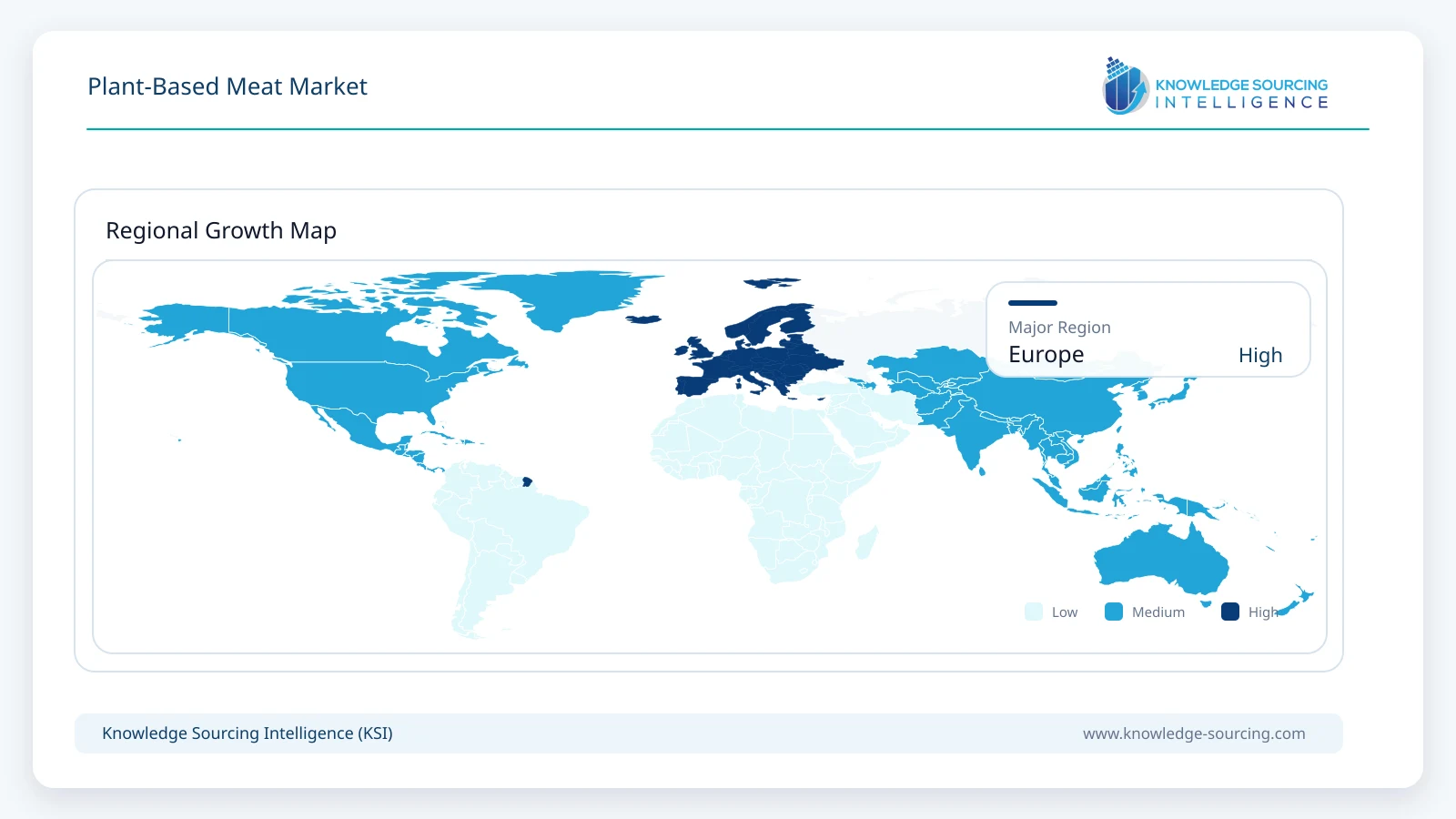
The region benefits from mature plant-based consumption in the United Kingdom, Germany, the Netherlands and other Western European countries, extensive supermarket availability and continued innovation by regional manufacturers. Regulatory discussions around meat-related product terminology create some marketing uncertainty, but they do not remove underlying demand for alternative proteins. Europe also has strong technical and manufacturing capabilities in extrusion, ingredient processing and food science, supporting continued product improvement through 2031.
Major Country
United States
The United States is projected to generate approximately USD 5.4 billion in plant-based meat revenue by 2031, remaining the largest individual country market despite recent retail weakness. GFI estimates that the U.S. represented approximately 28% of global plant-based meat and seafood retail sales in 2025, but domestic plant-based meat and seafood dollar sales declined by 10% during the year. The market therefore combines substantial scale with a demanding commercial environment. Major brands are responding by reformulating products, emphasizing protein and nutrition and launching formats beyond traditional burgers. Beyond Meat's 2026 national retail launches across chicken, breakfast sausage and steak-style products illustrate this strategy. The U.S. remains strategically important because its large grocery and restaurant sectors provide significant scale, but future growth increasingly depends on improving repeat purchase, product differentiation and price competitiveness rather than awareness alone.
Competitive Environment and Analysis
The global plant-based meat market includes specialist alternative-protein companies, multinational packaged-food suppliers and conventional meat companies expanding into non-animal protein. Beyond Meat and Impossible Foods remain highly visible category specialists and continue investing in product reformulation, whole-cut formats and broader retail availability. MorningStar Farms maintains a large established frozen portfolio, while Quorn competes through mycoprotein-based products across several meat-substitute categories. Gardein, The Vegetarian Butcher, Garden Gourmet, Tofurky, Vivera, Planted, Heura, THIS and other companies broaden competition across North America and Europe. Competitive advantage increasingly depends on repeat purchase rather than novelty, placing greater emphasis on taste, texture, nutritional profile, pricing and retailer productivity. Larger manufacturers benefit from procurement scale and distribution, while specialist brands can differentiate through focused product development and strong alternative-protein identities. The category remains fragmented relative to conventional meat, leaving room for consolidation and portfolio rationalization as companies prioritize products with sustainable consumer demand.
Recent Developments
September 2026: Beyond Meat expanded Beyond Steak Filet into Erewhon locations in Southern California following earlier retail launches at Wegmans, H-E-B and Meijer.
June 2026: Beyond Meat launched Beyond Steak Filet at Wegmans and H-E-B, expanding a whole-cut product previously sold through its direct-to-consumer channel into conventional retail.
April 2026: Beyond Meat launched Beyond Chicken Pieces Spicy Buffalo across more than 2,000 Kroger stores in the United States.
April 2026: Beyond Meat rolled out updated Beyond Breakfast Sausage links and patties through major U.S. retailers including Kroger and Sprouts Farmers Market.
2026: GFI reported that global retail plant-based meat and seafood sales reached approximately USD 6.6 billion in 2025, with Europe generating the strongest regional growth.
2025: Impossible Foods introduced Impossible Steak Bites, extending its portfolio into steak-style whole-muscle alternatives.
Regulatory and Policy Environment
Plant-based meat producers operate within general food-safety, ingredient, allergen and labeling regulations, while product terminology remains a particularly important issue in Europe. EU Regulation 2015/2283 governs novel foods and can require authorization where manufacturers use new ingredients or production processes without an established history of consumption in the Union. Meat-related naming rules are also evolving. European institutions have continued discussing whether terms associated with animal meat should be reserved for animal-derived products, increasing uncertainty around names such as steak and certain animal-specific descriptors. The regulatory issue affects packaging and marketing rather than the ability to sell plant-based products themselves, but companies operating across several European jurisdictions need to monitor changes carefully because label redesigns and market-specific terminology can increase compliance costs.
Market Outlook
Growth is unlikely to be uniform: Europe currently provides stronger retail momentum, while the United States remains a large but more challenging market where brands need to rebuild volume and repeat purchasing.
Beef alternatives, soy-based products, burgers and supermarket distribution remain the largest market segments, although strips, pieces, whole cuts and other newer formats gradually increase their share. Manufacturers are shifting toward higher-protein formulations, simpler ingredient positioning and improved sensory quality while continuing efforts to narrow the price difference with animal meat.
The category's long-term commercial potential depends less on converting consumers to fully plant-based diets and more on increasing the frequency with which mainstream meat consumers choose alternative proteins. Companies that improve taste, price, convenience and nutritional credibility simultaneously are therefore positioned to capture the strongest growth through 2031.
Plant-Based Meat Market Market Scope:
| Report Metric | Details |
|---|---|
| Total Market Size in 2026 | USD 12.500 billion |
| Total Market Size in 2031 | USD 20.607 billion |
| Forecast Unit | USD Billion |
| Growth Rate | 10.52% |
| Study Period | 2021 to 2031 |
| Historical Data | 2021 to 2024 |
| Base Year | 2025 |
| Forecast Period | 2026 – 2031 |
| Segmentation | Meat Type, Protein Source, Form, End-User, Distribution Channel, Geography |
| Companies |
|
Market Segmentation
By Meat Type
Beef
Chicken
Pork
Fish and Seafood
Others
By Protein Source
Soy-Based
Pea Protein-Based
Wheat Gluten-Based
Mycoprotein-Based
Other Protein Sources
By Form
Burgers and Patties
Sausages
Ground Meat
Nuggets
Strips, Pieces and Whole Cuts
Others
By End User
Retail
Foodservice
Institutional
By Distribution Channel
Supermarkets and Hypermarkets
Specialty Stores
Online Retail
Convenience Stores
Others
By Geography
North America
United States
Canada
Mexico
South America
Brazil
Argentina
Others
Europe
United Kingdom
Germany
Netherlands
France
Spain
Italy
Others
Middle East and Africa
UAE
Saudi Arabia
Israel
South Africa
Others
Asia Pacific
China
Japan
Australia
India
South Korea
Singapore
Thailand
Indonesia
Others
Table of Contents
1. EXECUTIVE SUMMARY
2. MARKET SNAPSHOT
2.1. Market Overview
2.2. Market Definition
2.3. Scope of the Study
2.4. Market Segmentation
3. BUSINESS LANDSCAPE
3.1. Market Drivers
3.2. Market Restraints
3.3. Market Opportunities
3.4. Porter’s Five Forces Analysis
3.5. Industry Value Chain Analysis
3.6. Raw Material and Protein Ingredient Outlook
3.7. Retail Pricing and Price-Parity Analysis
3.8. Policies and Regulations
3.9. Strategic Recommendations
4. TECHNOLOGICAL OUTLOOK
4.1. High-Moisture Extrusion
4.2. Protein Texturization
4.3. Fat Encapsulation and Juiciness Systems
4.4. Whole-Cut Meat Analogue Technology
4.5. Flavor and Color Development
4.6. Clean-Label Formulation
5. PLANT-BASED MEAT MARKET BY MEAT TYPE
5.1. Introduction
5.2. Beef
5.3. Chicken
5.4. Pork
5.5. Fish and Seafood
5.6. Others
6. PLANT-BASED MEAT MARKET BY PROTEIN SOURCE
6.1. Introduction
6.2. Soy-Based
6.3. Pea Protein-Based
6.4. Wheat Gluten-Based
6.5. Mycoprotein-Based
6.6. Other Protein Sources
7. PLANT-BASED MEAT MARKET BY FORM
7.1. Introduction
7.2. Burgers and Patties
7.3. Sausages
7.4. Ground Meat
7.5. Nuggets
7.6. Strips, Pieces and Whole Cuts
7.7. Others
8. PLANT-BASED MEAT MARKET BY END USER
8.1. Introduction
8.2. Retail
8.3. Foodservice
8.4. Institutional
9. PLANT-BASED MEAT MARKET BY DISTRIBUTION CHANNEL
9.1. Introduction
9.2. Supermarkets and Hypermarkets
9.3. Specialty Stores
9.4. Online Retail
9.5. Convenience Stores
9.6. Others
10. PLANT-BASED MEAT MARKET BY GEOGRAPHY
10.1. Introduction
10.2. North America
10.2.1. United States
10.2.2. Canada
10.2.3. Mexico
10.3. South America
10.3.1. Brazil
10.3.2. Argentina
10.3.3. Others
10.4. Europe
10.4.1. United Kingdom
10.4.2. Germany
10.4.3. Netherlands
10.4.4. France
10.4.5. Spain
10.4.6. Italy
10.4.7. Others
10.5. Middle East and Africa
10.5.1. UAE
10.5.2. Saudi Arabia
10.5.3. Israel
10.5.4. South Africa
10.5.5. Others
10.6. Asia Pacific
10.6.1. China
10.6.2. Japan
10.6.3. Australia
10.6.4. India
10.6.5. South Korea
10.6.6. Singapore
10.6.7. Thailand
10.6.8. Indonesia
10.6.9. Others
11. COMPETITIVE ENVIRONMENT AND ANALYSIS
11.1. Major Players and Strategy Analysis
11.2. Market Share Analysis
11.3. Mergers, Acquisitions, Agreements, and Collaborations
11.4. Competitive Dashboard
12. COMPANY PROFILES
12.1. Beyond Meat, Inc.
12.2. Impossible Foods Inc.
12.3. MorningStar Farms
12.4. Quorn Foods
12.5. Gardein / Conagra Brands
12.6. The Vegetarian Butcher
12.7. Garden Gourmet / Nestlé
12.8. Tofurky
12.9. Planted Foods AG
12.10. Heura Foods
12.11. THIS
12.12. Vivera
12.13. Moving Mountains Foods
12.14. Hungry Planet, Inc.
12.15. Daring Foods
13. APPENDIX
13.1. Market Definition and Scope
13.2. Product Inclusion and Exclusion Criteria
13.3. Currency and Conversion Assumptions
13.4. Base Year and Forecast Period
13.5. Market Estimation Approach
13.6. Segment Modelling
13.7. Primary and Secondary Research Framework
13.8. Data Triangulation and Validation
13.9. Abbreviations
Navigate
Trusted by the world's leading organizations











