
The reinforcement learning market is anticipated to expand at a high CAGR over the forecast period.
Highlights:
- 1Growing enterprise investment in autonomous decision-making systems is creating sustained demand across manufacturing, finance, telecommunications, and mobility applications.
- 2Cloud-based deployment represents an important commercial opportunity as organisations seek scalable training infrastructure without major capital investment.
- 3North America remains the leading regional market due to extensive AI investment, advanced semiconductor infrastructure, and enterprise software adoption.
- 4Integration of reinforcement learning with generative AI, simulation platforms, and digital twins is expanding commercial applications.
- 5Government AI governance frameworks and responsible AI initiatives are encouraging greater emphasis on explainability, validation, and model monitoring.
- 6Competition increasingly centres on computing performance, integrated software ecosystems, implementation expertise, and industry-specific AI solutions.
The reinforcement learning (RL) market comprises software platforms, algorithms, development frameworks, infrastructure, and professional services that enable artificial intelligence systems to learn optimal actions through interaction with dynamic environments. Unlike supervised learning, reinforcement learning continuously improves decision-making by receiving rewards or penalties based on outcomes, making it suitable for optimisation problems where predefined rules are insufficient. Commercial adoption has expanded beyond research laboratories into production environments across finance, industrial automation, autonomous mobility, telecommunications, healthcare, logistics, and retail operations.
Demand is being shaped by organisations seeking autonomous decision-making capabilities rather than conventional predictive analytics. Buyers increasingly require AI systems capable of adapting to changing operational conditions, minimising manual intervention, and improving long-term performance. Financial institutions employ reinforcement learning for portfolio optimisation and fraud response, manufacturers use it to improve production scheduling and robotics, while automotive companies integrate RL into autonomous driving development and advanced driver assistance systems. Cloud providers and semiconductor vendors are also stimulating adoption by supplying scalable computing infrastructure required for model training.
Purchasing decisions increasingly depend on deployment flexibility, computational efficiency, explainability, integration with existing machine learning operations (MLOps), and compatibility with enterprise data architectures. Organisations are prioritising platforms capable of reducing model development time while supporting governance requirements for AI deployment. As enterprise AI budgets mature, procurement teams increasingly evaluate total lifecycle costs, availability of skilled implementation partners, and compatibility with existing cloud ecosystems.
The competitive structure includes hyperscale cloud providers, semiconductor companies, enterprise software vendors, AI specialists, and consulting organisations. Hardware acceleration, foundation AI models, simulation environments, and domain-specific reinforcement learning frameworks are becoming important differentiators. Vendors are increasingly competing through integrated AI ecosystems that combine compute resources, software libraries, development tools, and consulting services rather than standalone algorithms.
Market Drivers
Rising enterprise demand for autonomous operational optimisation
Businesses increasingly require AI systems capable of making sequential decisions in environments where conditions change continuously. Conventional machine learning models generally predict outcomes, whereas reinforcement learning determines optimal actions over time. Manufacturers, logistics providers, and telecommunications operators are adopting RL to improve resource allocation, scheduling efficiency, and network optimisation. Suppliers are responding by introducing industry-specific development frameworks that reduce implementation complexity and accelerate deployment.
Expansion of AI computing infrastructure
The availability of advanced graphics processing units, AI accelerators, and cloud-based computing resources has reduced infrastructure barriers associated with reinforcement learning training. Semiconductor manufacturers continue introducing hardware designed specifically for large-scale AI workloads, while cloud providers offer managed machine learning environments that simplify experimentation. These developments reduce deployment costs for enterprise customers and broaden access to reinforcement learning capabilities.
Growing adoption of digital twins and simulation platforms
Reinforcement learning performs particularly well within simulated environments where models can safely explore millions of scenarios before deployment. Industrial companies, automotive manufacturers, and robotics developers increasingly invest in digital twins to evaluate production systems, autonomous vehicles, and warehouse automation. Simulation-based learning reduces operational risk while shortening product development cycles. Technology suppliers therefore continue expanding simulation software integrated with reinforcement learning capabilities.
Demand for intelligent robotics and automation
Industrial automation strategies increasingly require robots capable of adapting to changing environments rather than following fixed programming logic. Warehousing, electronics manufacturing, automotive assembly, and healthcare automation all benefit from reinforcement learning algorithms that improve robotic decision-making through continuous learning. Equipment manufacturers and systems integrators are expanding AI-enabled automation portfolios to address this requirement, strengthening commercial demand for reinforcement learning technologies.
Market Restraints and Challenges
High computational requirements
Training reinforcement learning models frequently requires extensive computational resources, prolonged training periods, and specialised AI hardware. Smaller enterprises often struggle to justify these infrastructure investments, particularly when expected returns remain uncertain. Cloud deployment reduces capital expenditure but may increase operational costs for large-scale training. Vendors increasingly address this challenge through algorithm optimisation and more efficient hardware acceleration.
Limited availability of specialised expertise
Successful reinforcement learning implementation requires expertise spanning optimisation theory, machine learning engineering, simulation design, software development, and domain-specific operations. Many organisations lack experienced personnel capable of developing production-grade reinforcement learning systems. Consulting firms and managed AI service providers increasingly bridge this capability gap, although talent shortages continue affecting deployment timelines.
Model validation and governance requirements
Enterprise buyers increasingly require transparent AI systems that comply with internal governance standards and emerging regulatory expectations. Reinforcement learning models may produce complex decision pathways that are difficult to interpret, particularly in regulated industries such as banking and healthcare. Organisations therefore invest in monitoring tools, validation frameworks, and human oversight mechanisms before expanding production deployment.
Data quality and environment complexity
Although reinforcement learning differs from supervised learning, successful deployment still depends upon realistic training environments and accurate operational data. Poor simulation quality, incomplete environmental modelling, or changing real-world conditions may reduce model effectiveness. Organisations increasingly combine digital twins, synthetic data generation, and continuous retraining strategies to improve operational reliability.
Major Segment Analysis
Cloud-Based Deployment
Cloud-based deployment represents one of the most commercially important segments because reinforcement learning workloads demand scalable computing capacity that many enterprises cannot economically maintain on-premises. Training complex reinforcement learning models often requires thousands of parallel computing processes, making elastic cloud infrastructure an attractive procurement option.
Enterprise buyers favour cloud deployment because it provides rapid access to AI development environments, managed machine learning platforms, scalable storage, and specialised hardware without significant upfront investment. Organisations can expand computing resources during intensive model training and reduce consumption after deployment, improving cost efficiency.
Competition within this segment extends beyond infrastructure pricing. Vendors differentiate through integrated development environments, pre-trained AI frameworks, security capabilities, governance tools, and interoperability with enterprise data platforms. Managed AI services further reduce implementation complexity for customers lacking internal reinforcement learning expertise.
As reinforcement learning applications expand into robotics, finance, and industrial automation, recurring cloud consumption generates long-term revenue opportunities for infrastructure providers while strengthening customer retention through integrated AI ecosystems.
Regional Analysis
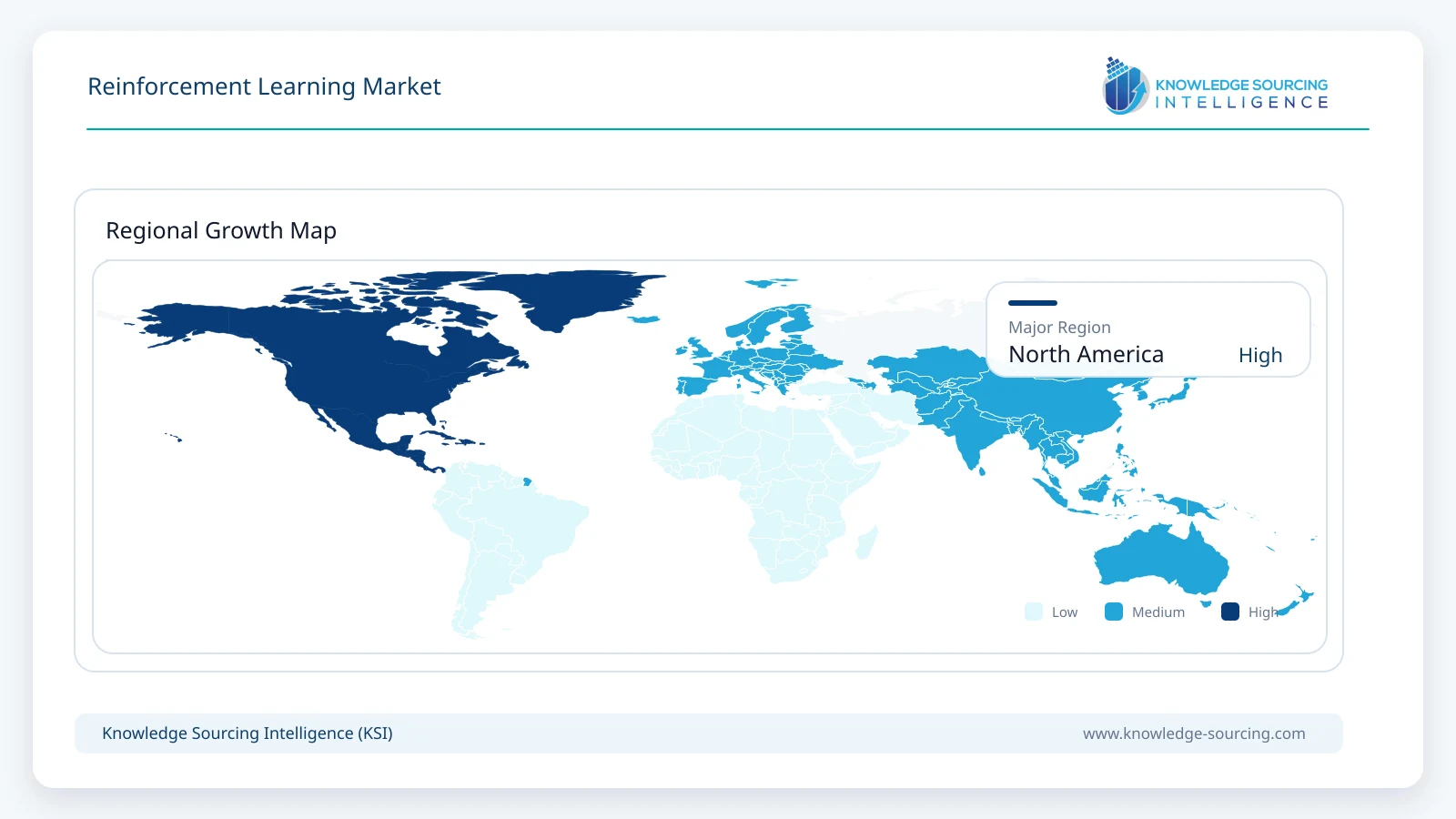
North America maintains the largest commercial opportunity due to extensive investment in artificial intelligence research, advanced semiconductor manufacturing capabilities, mature cloud infrastructure, and widespread enterprise AI adoption. Large technology companies continue investing heavily in reinforcement learning research for autonomous systems, enterprise software, robotics, and optimisation applications. Financial services, defence, and healthcare organisations also support sustained demand.
Europe benefits from industrial automation investment, advanced automotive manufacturing, and expanding AI governance initiatives. European enterprises increasingly deploy reinforcement learning for production optimisation, energy management, and mobility solutions while maintaining strong emphasis on responsible AI, transparency, and regulatory compliance. High implementation standards encourage demand for enterprise-grade software and consulting services.
Asia Pacific represents the fastest expanding regional opportunity due to accelerating digital industrialisation, expanding cloud infrastructure, government AI strategies, and significant investment in manufacturing automation. China, Japan, South Korea, and India continue supporting AI research while manufacturers adopt reinforcement learning for robotics, quality control, and smart factory initiatives. Growing technology investment also supports local AI software development.
Middle East and Africa demonstrates increasing adoption through national artificial intelligence programmes, smart city initiatives, energy sector digitalisation, and public-sector technology investment. Adoption remains concentrated among large enterprises and government organisations, although limited specialist talent continues to constrain broader implementation.
South America presents emerging opportunities as financial institutions, telecommunications providers, and industrial companies expand digital operations. Economic uncertainty and uneven technology infrastructure continue moderating investment levels, although cloud adoption is improving accessibility for reinforcement learning deployments across the region.
Competitive Landscape
Competition within the reinforcement learning market reflects the convergence of cloud computing, enterprise software, semiconductor technology, and specialised AI development. Microsoft Corporation, Alphabet Inc. (Google LLC), Amazon Web Services, Inc., NVIDIA Corporation, IBM Corporation, Intel Corporation, Wayve Technologies Ltd., Covariant, InstaDeep Ltd., and Tata Consultancy Services Limited compete through different combinations of infrastructure, AI software, consulting expertise, and application-specific capabilities.
Large cloud providers compete by integrating reinforcement learning development environments with broader AI ecosystems, while semiconductor companies focus on computational performance and energy-efficient AI processing. Specialist AI firms differentiate through domain expertise in robotics, autonomous mobility, and optimisation applications. Consulting organisations strengthen market positioning by combining implementation services with enterprise integration capabilities.
Strategic partnerships between software developers, cloud providers, semiconductor manufacturers, and industry customers are becoming increasingly important as enterprises seek complete AI deployment solutions rather than individual software components. Geographic expansion, industry-specific AI models, and integrated MLOps capabilities continue shaping competitive positioning.
Recent Developments
April 2026: Meta established a dedicated Applied AI Engineering organisation focused on reinforcement learning, evaluation pipelines, and post-training technologies to accelerate development of next-generation foundation models supporting its superintelligence initiatives.
April 2026: NVIDIA highlighted new reinforcement learning advances, including ProRL, demonstrating longer-horizon reinforcement learning with entropy control, KL regularisation, and reference-policy reset techniques that improved reasoning, coding, and scientific benchmark performance.
April 2026: OpenAI released GPT-5.5, incorporating enhanced post-training methodologies that further expanded reinforcement learning-based optimisation for reasoning, coding, and complex decision-making performance with strengthened safety mechanisms.
Regulatory and Policy Environment
Governments increasingly recognise artificial intelligence as strategic national infrastructure, resulting in greater regulatory attention to transparency, accountability, cybersecurity, and responsible deployment. The European Union's AI Act establishes risk-based compliance obligations for certain AI applications, influencing procurement decisions among multinational enterprises. Similar governance initiatives are emerging across North America and Asia-Pacific through national AI strategies and sector-specific guidance.
Financial institutions deploying reinforcement learning must comply with operational resilience, data governance, and model risk management requirements established by financial regulators. Healthcare deployments require adherence to medical data protection frameworks, while autonomous mobility applications must satisfy safety certification and validation requirements before commercial deployment.
Public investment programmes supporting semiconductor manufacturing, cloud infrastructure, advanced computing, and AI research continue strengthening regional innovation ecosystems while encouraging broader enterprise adoption.
Outlook and Strategic Implications
Commercial demand for reinforcement learning is expected to broaden as enterprises move beyond predictive analytics toward autonomous optimisation and adaptive decision-making. Investment priorities will increasingly focus on scalable AI infrastructure, simulation technologies, digital twins, specialised processors, and integrated MLOps platforms capable of supporting continuous model improvement.
Procurement strategies are likely to prioritise cloud-native deployment, responsible AI governance, interoperability with existing enterprise systems, and long-term service support rather than standalone algorithm performance. Organisations will increasingly evaluate vendors based on implementation expertise, security capabilities, lifecycle management, and industry-specific experience.
Competitive positioning will continue shifting toward complete AI ecosystems combining software, infrastructure, consulting, and hardware acceleration. Organisations capable of delivering integrated reinforcement learning solutions with measurable operational outcomes are expected to strengthen commercial performance over the forecast period. At the same time, regulatory compliance, talent availability, computational costs, and model explainability will remain important considerations influencing enterprise investment decisions.
Reinforcement Learning Market Scope:
| Report Metric | Details |
|---|---|
| Forecast Unit | Billion |
| Study Period | 2021 to 2031 |
| Historical Data | 2021 to 2024 |
| Base Year | 2025 |
| Forecast Period | 2026 – 2031 |
| Segmentation | Component, Algorithm Type, Deployment, End-User Industry, Geography |
| Companies |
|
Market Segmentation
By Component
By Algorithm Type
By Deployment
By End-user Industry
By Geography
Table of Contents
1. EXECUTIVE SUMMARY
2. MARKET SNAPSHOT
2.1. Market Overview
2.2. Market Definition
2.3. Scope of the Study
2.4. Market Segmentation
3. BUSINESS LANDSCAPE
3.1. Market Drivers
3.2. Market Restraints
3.3. Market Opportunities
3.4. Porter’s Five Forces Analysis
3.5. Industry Value Chain Analysis
3.6. Policies and Regulations
3.7. Strategic Recommendations
4. TECHNOLOGICAL OUTLOOK
5. Reinforcement Learning Market By Component
5.1. Introduction
5.2. Solutions
5.3. Services
6. Reinforcement Learning Market By Algorithm Type
6.1. Introduction
6.2. Model-Based Reinforcement Learning
6.3. Model-Free Reinforcement Learning
7. Reinforcement Learning Market By Deployment
7.1. Introduction
7.2. On-Premises
7.3. Cloud-Based
8. Reinforcement Learning Market By End-User Industry
8.1. Introduction
8.2. Banking, Financial Services, and Insurance (BFSI)
8.3. Retail and E-Commerce
8.4. Healthcare
8.5. Manufacturing
8.6. Automotive
8.7. IT and Telecommunications
8.8. Others
9. Reinforcement Learning Market By Geography
9.1. Introduction
9.2. North America
9.2.1. United States
9.2.2. Canada
9.2.3. Mexico
9.3. South America
9.3.1. Brazil
9.3.2. Argentina
9.3.3. Others
9.4. Europe
9.4.1. United Kingdom
9.4.2. Germany
9.4.3. France
9.4.4. Italy
9.4.5. Spain
9.4.6. Others
9.5. Middle East and Africa
9.5.1. Saudi Arabia
9.5.2. United Arab Emirates
9.5.3. Others
9.6. Asia Pacific
9.6.1. China
9.6.2. India
9.6.3. Japan
9.6.4. South Korea
9.6.5. Australia
9.6.6. Others
10. COMPETITIVE ENVIRONMENT AND ANALYSIS
10.1. Major Players and Strategy Analysis
10.2. Market Share Analysis
10.3. Mergers, Acquisitions, Agreements, and Collaborations
10.4. Competitive Dashboard
11. COMPANY PROFILES
11.1. Microsoft Corporation
11.2. Alphabet Inc. (Google LLC)
11.3. Amazon Web Services, Inc.
11.4. NVIDIA Corporation
11.5. IBM Corporation
11.6. Intel Corporation
11.7. Wayve Technologies Ltd.
11.8. Covariant
11.9. InstaDeep Ltd.
12. APPENDIX
12.1. Currency
12.2. Assumptions
12.3. Base and Forecast Years Timeline
12.4. Key Benefits for Stakeholders
12.5. Research Methodology
12.6. Abbreviations
Navigate
Trusted by the world's leading organizations











