
The retail data monetization market is anticipated to expand at a high CAGR over the forecast period.
Highlights:
- 1First-Party Data Is Becoming a Strategic Retail AssetRetailers are increasingly using transaction, loyalty, e-commerce, and customer-interaction data to improve merchandising, personalization, advertising, and supplier collaboration. The expansion of digital commerce increases the volume and commercial usefulness of these proprietary datasets.
- 2Retail Media Is Strengthening Data MonetizationRetail media networks are creating direct commercial channels through which retailers can use first-party customer signals for audience targeting, campaign activation, measurement, and closed-loop attribution. Walmart reported that global advertising revenue increased 38% in the quarter reported in August 2026, while Walmart Connect U.S. grew 43%, excluding VIZIO.
- 3AI Is Increasing the Value of Retail DataAI and advanced analytics are being integrated into retail planning, pricing, customer engagement, discovery, fulfillment, and advertising. The resulting demand for clean, connected, governed, and accessible data is increasing the importance of data platforms and associated services.
- 4E-Commerce Is Expanding the Data Generation BaseThe U.S. Census Bureau estimated seasonally adjusted retail e-commerce sales at USD 340.2 billion in the second quarter of 2026, representing a 12.2% increase from the second quarter of 2025 and 17.1% of total retail sales. Higher digital transaction activity creates additional behavioral and transactional data that can support monetization.
- 5Privacy Governance Is Becoming Central to MonetizationGDPR, the Digital Personal Data Protection framework in India, Brazil's LGPD, China's Personal Information Protection Law, and U.S. state privacy requirements are increasing the importance of consent management, purpose limitation, data minimization, security, governance, and auditable data use.
The Retail Data Monetization Market encompasses the technologies, platforms, solutions, and services that enable retailers to convert proprietary data into measurable business and commercial value. Relevant data can include transaction records, loyalty information, product interactions, online browsing behavior, customer engagement signals, inventory information, purchasing patterns, and other operational or behavioral datasets generated through retail activities. Monetization can occur through internal value creation, such as improved pricing, merchandising, customer retention, demand forecasting, and inventory decisions, as well as through external commercial activities involving suppliers, brands, advertisers, agencies, and other approved business partners.
The market is being influenced by the continued shift toward omnichannel retail. The U.S. Census Bureau reported that retail e-commerce sales reached USD 340.2 billion in the second quarter of 2026 on a seasonally adjusted basis, up 3.8% from the first quarter and 12.2% from the second quarter of 2025. E-commerce represented 17.1% of total U.S. retail sales during the quarter. This expansion increases the amount of structured and near-real-time information available to retailers across digital transactions and customer journeys.
The United Kingdom provides another indication of the growing role of digital retail. The Office for National Statistics reported that internet sales accounted for 27.8% of total retail sales in Great Britain in the second quarter of 2026. The same official dataset shows that the annual internet-sales share was 27.4% in 2025, compared with 27.1% in 2024. These developments strengthen the underlying data-generation environment for retail analytics, personalization, customer segmentation, advertising measurement, and data-enabled supplier services.
Retail data monetization is also becoming closely connected with retail media. Retailers can use first-party signals to create audiences, support advertising activation, evaluate campaign performance, and connect media exposure with purchase outcomes. Walmart's 2026 announcements demonstrate this direction. Walmart described its commerce media strategy as combining first-party signals, audience activation, measurement, commerce, content, and connected television. In August 2026, Walmart reported 38% growth in global advertising revenue and 43% growth for Walmart Connect U.S., excluding VIZIO.
Privacy regulation remains a defining market consideration. The European Union's General Data Protection Regulation establishes requirements around lawful processing and consent. India's Digital Personal Data Protection Rules, 2025 were officially published by the Ministry of Electronics and Information Technology in November 2025, establishing a more detailed compliance framework around India's personal-data protection regime. China's Personal Information Protection Law continues to regulate collection, processing, use, transfer, and protection of personal information, while China's 2026 regulatory activity has continued to emphasize compliance in areas such as applications, software development kits, and internet advertising.
Consequently, the market is shifting away from simple data aggregation toward governed data products and controlled data-sharing environments. Retailers increasingly require technologies that can integrate fragmented data sources, manage permissions, protect personal information, produce reliable analytics, and provide measurable commercial outcomes. This environment supports demand for both software solutions and professional services, while large retailers remain important buyers because of their extensive transaction volumes, customer bases, supplier relationships, and advertising ecosystems.
Retail Data Monetization Market Analysis
Growth Drivers
The growth of the Retail Data Monetization Market is supported by the increasing commercial value of first-party data. Retailers collect information from physical stores, websites, mobile applications, loyalty programs, marketplaces, customer-service interactions, and connected commerce environments. When these datasets are integrated and governed effectively, they can support more accurate customer segmentation, demand forecasting, assortment planning, personalized promotions, advertising targeting, and supplier analytics.
Retail media is an important driver because it provides retailers with a direct mechanism for converting proprietary customer signals into advertising revenue. The model generally combines retailer-owned audiences with advertising inventory and closed-loop measurement. This allows brands and suppliers to evaluate campaign outcomes using retail transaction or conversion signals rather than relying solely on external digital identifiers. Walmart's 2026 reporting illustrates the commercial significance of this model, with global advertising revenue increasing 38% in its second-quarter fiscal 2027 results and Walmart Connect U.S. increasing 43%, excluding VIZIO.
The continued expansion of e-commerce is another structural driver. Online transactions generate detailed information concerning product searches, basket composition, purchase frequency, conversion behavior, customer preferences, and promotional response. The U.S. Census Bureau's second-quarter 2026 estimate of USD 340.2 billion in seasonally adjusted retail e-commerce sales demonstrates the scale of digital retail activity in one of the world's largest markets. As the volume of digital transactions increases, retailers have more opportunities to create analytical products and improve internal decision-making.
AI adoption is further increasing demand for accessible and reliable retail data. AI systems depend on relevant and sufficiently structured datasets to produce useful recommendations and predictions. Retailers are applying AI to customer engagement, discovery, pricing, inventory, planning, fulfillment, fraud prevention, and marketing. Consequently, data monetization platforms increasingly need capabilities for data integration, quality management, governance, real-time processing, analytics, and secure access.
Cloud infrastructure is also supporting adoption. Cloud-based environments allow retailers to scale storage and computing resources according to data volumes and analytical workloads. They can also simplify integration across e-commerce, store, customer, supply-chain, and advertising systems. However, deployment choices remain influenced by security requirements, existing IT architecture, data residency obligations, operational preferences, and the sensitivity of the information being processed.
Challenges and Opportunities
Privacy, cybersecurity, data quality, and fragmented technology environments remain major challenges. Retailers often operate multiple systems acquired or developed over different periods, creating duplicated customer records, inconsistent product identifiers, incompatible data structures, and disconnected analytics environments. These issues can reduce the reliability of monetized data products and increase the effort required to create standardized datasets.
Privacy regulation creates another challenge because retailers cannot treat all customer information as freely commercializable. Personal information may be subject to requirements concerning lawful processing, purpose limitation, consent, transparency, access rights, deletion, security, retention, and cross-border transfers. China's 2026 regulatory guidance, for example, continues to emphasize minimum necessary collection, transparency, lawful processing, and protection against unauthorized access or leakage. India's 2025 DPDP Rules also strengthen the compliance framework applicable to digital personal data.
These requirements nevertheless create opportunities for privacy-focused data monetization. Retailers that can provide aggregated, appropriately protected, permissioned, and auditable insights can offer brands useful intelligence without unnecessarily exposing identifiable customer information. Data clean rooms, consent-management capabilities, privacy-enhancing technologies, secure collaboration environments, and governed analytics can therefore become important components of monetization strategies.
Another opportunity is the development of data products for suppliers. Retailers can package category-level performance information, audience insights, promotional response, product availability, demand patterns, and campaign measurement into structured analytical services. Such offerings can generate recurring commercial value while simultaneously improving supplier relationships. The opportunity is particularly significant for large retailers that possess broad geographic coverage, substantial loyalty memberships, extensive product catalogs, and high transaction volumes.
Supply Chain Analysis
The retail data monetization supply chain begins with data generation across physical and digital retail touchpoints. Point-of-sale systems, e-commerce platforms, mobile applications, loyalty programs, customer-service channels, marketplaces, connected devices, and advertising interactions can generate different categories of information. Operational systems may additionally contribute inventory, product, pricing, fulfillment, and supply-chain information.
The next stage involves data ingestion and integration. Retailers consolidate information from multiple systems into data warehouses, data lakes, lakehouse environments, customer-data platforms, or other enterprise data architectures. Data integration tools are required to standardize identifiers, reconcile records, remove duplication, and establish relationships between customers, products, transactions, campaigns, and channels.
Data governance and security form the next layer. Retailers must establish appropriate access controls, data classifications, retention rules, consent mechanisms, security measures, and audit processes. Personally identifiable information may require additional restrictions compared with aggregated or anonymized information. The resulting governance framework influences which datasets can be used internally and which can be shared with external commercial partners.
Analytics and AI technologies then convert integrated data into commercially useful outputs. These outputs can include audience segments, customer insights, demand forecasts, campaign measurement, pricing recommendations, product recommendations, inventory signals, and supplier dashboards. The final stage involves internal business use or controlled external commercialization through data products, analytics services, retail media, supplier platforms, or strategic data partnerships.
Key technology dependencies include cloud computing, data integration, analytics software, AI infrastructure, identity and access management, cybersecurity, data-quality tools, consent-management systems, and governance platforms. Professional-services providers can support architecture design, implementation, integration, migration, analytics development, and compliance programs.
Government Regulations
Jurisdiction | Key Regulation / Agency | Market Impact Analysis |
|---|---|---|
European Union | General Data Protection Regulation (GDPR) | GDPR establishes requirements for lawful processing of personal data and consent where consent is the applicable legal basis. Retailers monetizing customer information therefore require stronger controls over purpose, access, transparency, security, and data use. |
United States | Federal Trade Commission (FTC) – Consumer Privacy and Data Security Enforcement | FTC enforcement activity increases the importance of transparent data practices, appropriate security, truthful privacy representations, and responsible handling of consumer information. Retailers and technology providers must align monetization activities with applicable consumer-protection requirements. |
India | Digital Personal Data Protection Act, 2023 and Digital Personal Data Protection Rules, 2025 – MeitY | The 2025 Rules provide a detailed framework supporting implementation of India's digital personal-data protection regime. Retailers and data processors operating in India need stronger controls around notices, consent, security, data handling, and accountability, influencing the design of data monetization platforms. |
Brazil | Lei Geral de Proteção de Dados Pessoais (LGPD) – ANPD | LGPD governs the processing of personal data and establishes rights and obligations for data subjects and processing organizations. Retailers therefore require transparent and controlled processes when using customer information for analytics, personalization, advertising, or external data services. |
China | Personal Information Protection Law (PIPL) and related regulatory requirements | PIPL establishes requirements for personal-information processing, including lawful purpose, necessity, transparency, security, and individual rights. China's 2026 compliance activities continue to address unlawful collection and use of personal information, increasing demand for governance and security capabilities. |
Retail Data Monetization Market Segment Analysis
By Offering: Solution
The Solution segment includes software platforms and technology environments that enable retailers to collect, integrate, govern, analyze, activate, and commercialize data. The segment is becoming increasingly important as retailers move from isolated analytics projects toward enterprise-wide data environments connecting stores, e-commerce, loyalty, advertising, supply-chain, and customer systems.
Data integration is a fundamental capability within this segment because retail data is generated across heterogeneous systems. A monetization solution must be able to combine transaction information with customer, product, campaign, and operational datasets while maintaining appropriate controls. Data-quality and identity-resolution capabilities are particularly important because inconsistent customer or product records can reduce the accuracy of audience segmentation and analytical outputs.
Analytics and AI are additional sources of demand. Retailers increasingly require platforms that can transform historical and real-time information into actionable insights. Applications can include customer segmentation, product recommendations, demand forecasting, promotion analysis, pricing, campaign measurement, and inventory optimization. These applications increase the commercial value of data by connecting analytical outputs with measurable retail outcomes.
Privacy and governance capabilities are becoming equally important. Retail data monetization solutions increasingly need consent controls, role-based access, audit trails, data classification, encryption, anonymization or pseudonymization capabilities, and policy enforcement. These functions help retailers separate data that can be broadly analyzed from information requiring stricter controls.
Cloud deployment is supporting solution adoption because it can provide scalable infrastructure for high-volume workloads and facilitate integration with modern analytics and AI services. However, on-premises and hybrid environments remain relevant for retailers with legacy infrastructure, strict data-control requirements, or specific operational constraints. Therefore, the solution segment is expected to encompass multiple deployment approaches rather than a single architecture.
Recent company activity demonstrates the direction of this segment. At NRF 2026, SAP announced AI-enhanced retail innovations focused on planning, operations, fulfillment, and commerce, emphasizing the integration of data and AI throughout retail workflows. Google Cloud's current retail portfolio also highlights real-time AI, data analytics, retail discovery, customer personalization, and enterprise data infrastructure. These developments indicate that retail data solutions are increasingly being designed as connected environments rather than isolated reporting tools.
By Enterprise Size: Large
Large enterprises represent an important segment because they generally operate extensive store networks, digital channels, loyalty ecosystems, supplier relationships, and advertising operations. These organizations generate large and diverse datasets, creating both a strong requirement for data infrastructure and greater potential to convert information into commercial value.
Large retailers can monetize data through several channels. Retail media is one of the most visible mechanisms because retailers can use first-party signals to build audiences, support advertising activation, measure outcomes, and provide brands with performance insights. Other mechanisms include supplier analytics, category insights, demand intelligence, customer analytics, and internal optimization.
Large enterprises also face complex governance requirements because data may be generated across multiple countries and business units. Their platforms therefore need to support role-based access, data lineage, policy management, security, auditability, and regional compliance. Integration with existing enterprise resource planning, customer-data, e-commerce, point-of-sale, and advertising systems is another important requirement.
Walmart's 2026 developments illustrate the scale of this opportunity. In February 2026, Walmart Data Ventures introduced Scintilla In-Store, a platform designed to connect real-time data and actionable metrics with supplier field activities at store level. In June 2026, Walmart announced a broader commerce-media strategy built around first-party signals, audience activation, measurement, and omnichannel customer touchpoints. These initiatives demonstrate how large retailers can use proprietary information to support both operational and external commercial applications.
Large enterprises are also likely to demand professional services alongside technology solutions. Implementing a retail data monetization environment may require data architecture, system integration, governance design, analytics development, cybersecurity, migration, and organizational change management. This creates opportunities for technology and consulting providers that can combine retail domain knowledge with data and AI capabilities.
Geographical Analysis
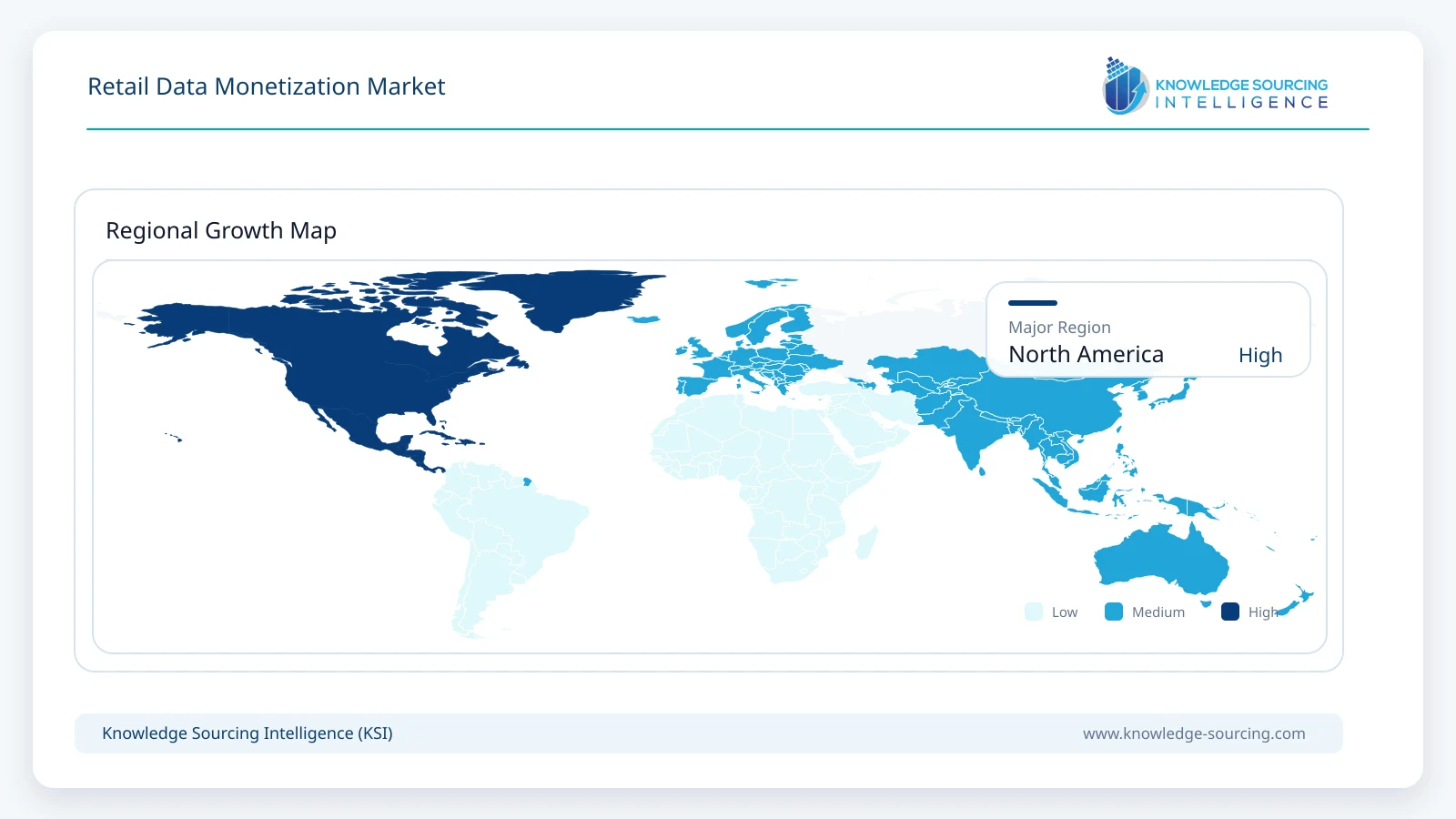
United States (North America)
The United States represents a major market for retail data monetization because of its large retail sector, advanced e-commerce infrastructure, mature digital advertising ecosystem, and growing retail media activity. U.S. Census Bureau data shows that seasonally adjusted retail e-commerce sales reached USD 340.2 billion in the second quarter of 2026, up 12.2% from the same quarter of 2025. E-commerce represented 17.1% of total retail sales during the period.
The U.S. market is also characterized by extensive investment in retail media and first-party data capabilities. Walmart's 2026 results provide a significant example, with Walmart Connect U.S. advertising revenue growing 43% excluding VIZIO in the company's second-quarter fiscal 2027 reporting. The combination of e-commerce activity, loyalty data, advertising demand, and closed-loop measurement supports continued investment in data platforms and services.
Brazil (South America)
Brazil represents an important South American market because of its large consumer base and established digital-commerce ecosystem. The country's LGPD provides a formal framework for personal-data processing, making privacy governance a central consideration for retailers using customer information for personalization, analytics, loyalty programs, and advertising. The market opportunity is strongest where retailers can combine digital transaction data with loyalty and customer-engagement information while maintaining appropriate controls.
United Kingdom (Europe)
The United Kingdom has a mature digital retail environment and a strong regulatory focus on personal-data protection. Official ONS data shows that internet sales represented 27.8% of total retail sales in Great Britain in the second quarter of 2026, while the annual ratio was 27.4% in 2025. This level of digital retail activity provides retailers with substantial transaction and behavioral datasets that can support customer analytics, personalization, supplier insights, and retail media.
The market also requires careful governance because customer information is subject to applicable data-protection requirements. Retailers therefore have an incentive to build controlled environments that can separate identifiable information from aggregated commercial insights and provide appropriate transparency and security.
Saudi Arabia (Middle East and Africa)
Saudi Arabia is an important market within the Middle East because of its ongoing digital-transformation agenda and expanding technology ecosystem. Retailers increasingly require digital platforms capable of supporting omnichannel customer engagement, loyalty, analytics, and personalized services. Data monetization opportunities can emerge through supplier intelligence, customer analytics, digital advertising, and data-enabled retail operations.
Growth in this market will depend on the development of digital retail infrastructure, cloud adoption, cybersecurity capabilities, data governance, and retailer readiness to commercialize insights responsibly. Large retailers and digitally enabled enterprises are likely to remain important adopters because they can generate sufficient transaction and customer data to justify dedicated monetization capabilities.
China (Asia-Pacific)
China represents a major retail data environment because of its large digital-commerce ecosystem and extensive integration of online, mobile, social, and payment interactions. Retailers can use these connected touchpoints to support personalization, customer segmentation, product discovery, marketing, and operational optimization.
Data governance remains critical. China's Personal Information Protection Law regulates personal-information processing and includes requirements concerning lawful purpose, necessity, transparency, and security. In 2026, Chinese authorities continued targeted personal-information protection activities covering applications, software development kits, internet advertising, and other areas. These developments increase the importance of compliant data architectures and controlled monetization practices.
Competitive Environment and Analysis
The competitive environment consists of enterprise technology providers, consulting and systems-integration companies, cloud and analytics providers, and specialized data and monetization companies. Competition is increasingly centered on the ability to connect data infrastructure with measurable retail outcomes rather than simply providing storage or reporting functionality.
Accenture participates through consulting, technology implementation, AI, cloud, data, and retail transformation capabilities. Its relevance to the market is associated with helping retailers connect customer, commerce, operational, and analytical systems and develop enterprise-level data and AI strategies.
Adstra, formerly ALC, represents a specialized data and identity-oriented participant. Its positioning is more focused on data-driven audience and identity capabilities than on broad enterprise software. The company name should therefore be presented using its current identity rather than the legacy ALC name alone.
Thales, which acquired Gemalto in 2019, is relevant through its digital identity, cybersecurity, data-protection, and secure technology capabilities. The company should be identified as Thales rather than Gemalto as a standalone current company in a 2026 report.
Google provides cloud infrastructure, data analytics, AI, machine-learning, and retail technology capabilities. Its current Google Cloud retail materials highlight real-time AI, retail discovery, data analytics, customer personalization, and large-scale data infrastructure. These capabilities can support retailers seeking to build data environments capable of generating operational and commercial insights.
IBM participates through enterprise data, analytics, AI, hybrid cloud, automation, and consulting capabilities. Its relevance to retail data monetization is strongest where retailers require enterprise-grade governance, analytics, AI deployment, and integration across complex technology environments.
Infosys combines consulting, technology services, AI, data, and retail transformation capabilities. At NRF 2026, Infosys emphasized enterprise-wide data readiness, AI-powered transformation, intelligent pricing, personalized engagement, and adaptive commerce. In August 2026, Infosys announced a ten-year agreement with Crocs to accelerate IT-system transformation using its AI-first platforms, demonstrating continued activity in technology transformation for a global retail-oriented enterprise.
Monetize Solutions is a specialized participant focused on data, cloud, analytics, and monetization capabilities. Its positioning is particularly relevant to the market because its solutions address the conversion of data and analytics into commercial opportunities.
SAP is another major enterprise technology participant. At NRF 2026, SAP announced AI-enhanced retail innovations spanning planning, operations, fulfillment, and commerce. Its integrated enterprise data and AI approach supports retailers seeking to connect operational information with analytics and intelligent decision-making.
Competition is therefore likely to develop around five capabilities: data integration, AI and analytics, privacy and governance, retail media activation, and measurable business outcomes. Providers that can combine these capabilities while supporting different deployment models are positioned to address the requirements of large retailers with complex technology environments.
Recent Market Developments
August 2026: Walmart completed its acquisition of Vibe.co, a self-service streaming television advertising platform. The transaction strengthens Walmart Connect by combining Vibe.co's campaign activation capabilities with Walmart's first-party insights, commerce-media infrastructure, and measurement capabilities, expanding opportunities to connect advertising activity with commerce outcomes.
August 2026: Infosys announced a ten-year strategic agreement with Crocs to accelerate transformation of the footwear company's global IT systems. The agreement includes the use of Infosys AI-first platforms to modernize core systems, streamline operations, and support scalable growth, reinforcing demand for integrated data and AI capabilities across large retail enterprises.
June 2026: Walmart announced a broader global commerce-media strategy centered on first-party signals, audience activation, measurement, and connected omnichannel touchpoints. Walmart reported 38% growth in global advertising revenue in its latest quarter at the time and 43% growth for Walmart Connect U.S., excluding VIZIO, highlighting the increasing commercial value of retailer-owned data.
February 2026: Walmart Data Ventures introduced Scintilla In-Store, extending its first-party insights platform into store-level supplier execution. The platform combines real-time data, actionable metrics, and supplier tasks, illustrating how retail data can move beyond analytics toward operational decision-making and measurable supplier value.
January 2026: SAP announced AI-enhanced retail innovations at NRF 2026 covering planning, operations, fulfillment, and commerce. The company positioned data and AI as core components of a connected retail operating environment, supporting the development of more integrated retail analytics and decision-making capabilities.
Retail Data Monetization Market Scope:
| Report Metric | Details |
|---|---|
| Forecast Unit | Billion |
| Study Period | 2021 to 2031 |
| Historical Data | 2021 to 2024 |
| Base Year | 2025 |
| Forecast Period | 2026 – 2031 |
| Segmentation | Offering, Deployment Model, Enterprise Size, Geography |
| Companies |
|
Market Segmentation
By Offering
- Solution
- Services
By Deployment Model
- On-Premises
- Cloud
By Enterprise Size
- Small
- Medium
- Large
By Geography
- North America
- United States
- Canada
- Mexico
- South America
- Brazil
- Argentina
- Others
- Europe
- United Kingdom
- Germany
- France
- Italy
- Others
- Middle East and Africa
- Saudi Arabia
- United Arab Emirates
- Israel
- Others
- Asia-Pacific
- Japan
- China
- India
- Australia
- South Korea
- Others
Table of Contents
1. INTRODUCTION
1.1. Market Overview
1.2. Market Definition
1.3. Scope of the Study
1.4. Currency
1.5. Assumptions
1.6. Base and Forecast Years Timeline
2. RESEARCH METHODOLOGY
2.1. Research Design
2.2. Secondary Sources
3. EXECUTIVE SUMMARY
4. MARKET DYNAMICS
4.1. Market Segmentation
4.2. Market Drivers
4.3. Market Restraints
4.4. Market Opportunities
4.5. Porter’s Five Forces Analysis
4.5.1. Bargaining Power of Suppliers
4.5.2. Bargaining Power of Buyers
4.5.3. Threat of New Entrants
4.5.4. Threat of Substitutes
4.5.5. Competitive Rivalry in the Industry
4.6. Market Life Cycle Analysis - Regional Snapshot
4.7. Market Attractiveness
5. RETAIL DATA MONETIZATION MARKET BY OFFERING
5.1. Solution
5.2. Services
6. RETAIL DATA MONETIZATION MARKET BY DEPLOYMENT MODEL
6.1. On-Premises
6.2. Cloud
7. RETAIL DATA MONETIZATION MARKET BY ENTERPRISE SIZE
7.1. Small
7.2. Medium
7.3. Large
8. RETAIL DATA MONETIZATION MARKET BY GEOGRAPHY
8.1. North America
8.1.1. United States
8.1.2. Canada
8.1.3. Mexico
8.2. South America
8.2.1. Brazil
8.2.2. Argentina
8.2.3. Others
8.3. Europe
8.3.1. United Kingdom
8.3.2. Germany
8.3.3. France
8.3.4. Italy
8.3.5. Others
8.4. Middle East and Africa
8.4.1. Saudi Arabia
8.4.2. United Arab Emirates
8.4.3. Israel
8.4.4. Others
8.5. Asia-Pacific
8.5.1. Japan
8.5.2. China
8.5.3. India
8.5.4. Australia
8.5.5. South Korea
8.5.6. Others
9. COMPETITIVE INTELLIGENCE
9.1. Company Benchmarking and Analysis
9.2. Recent Investments and Deals
9.3. Strategies of Key Players
10. COMPANY PROFILES
10.1. Accenture
10.2. Adstra (formerly ALC)
10.3. Thales (formerly Gemalto)
10.4. Google
10.5. IBM
10.6. Infosys
10.7. Monetize Solutions
10.8. SAP
List of Figures
List of Tables
Navigate
Trusted by the world's leading organizations











