
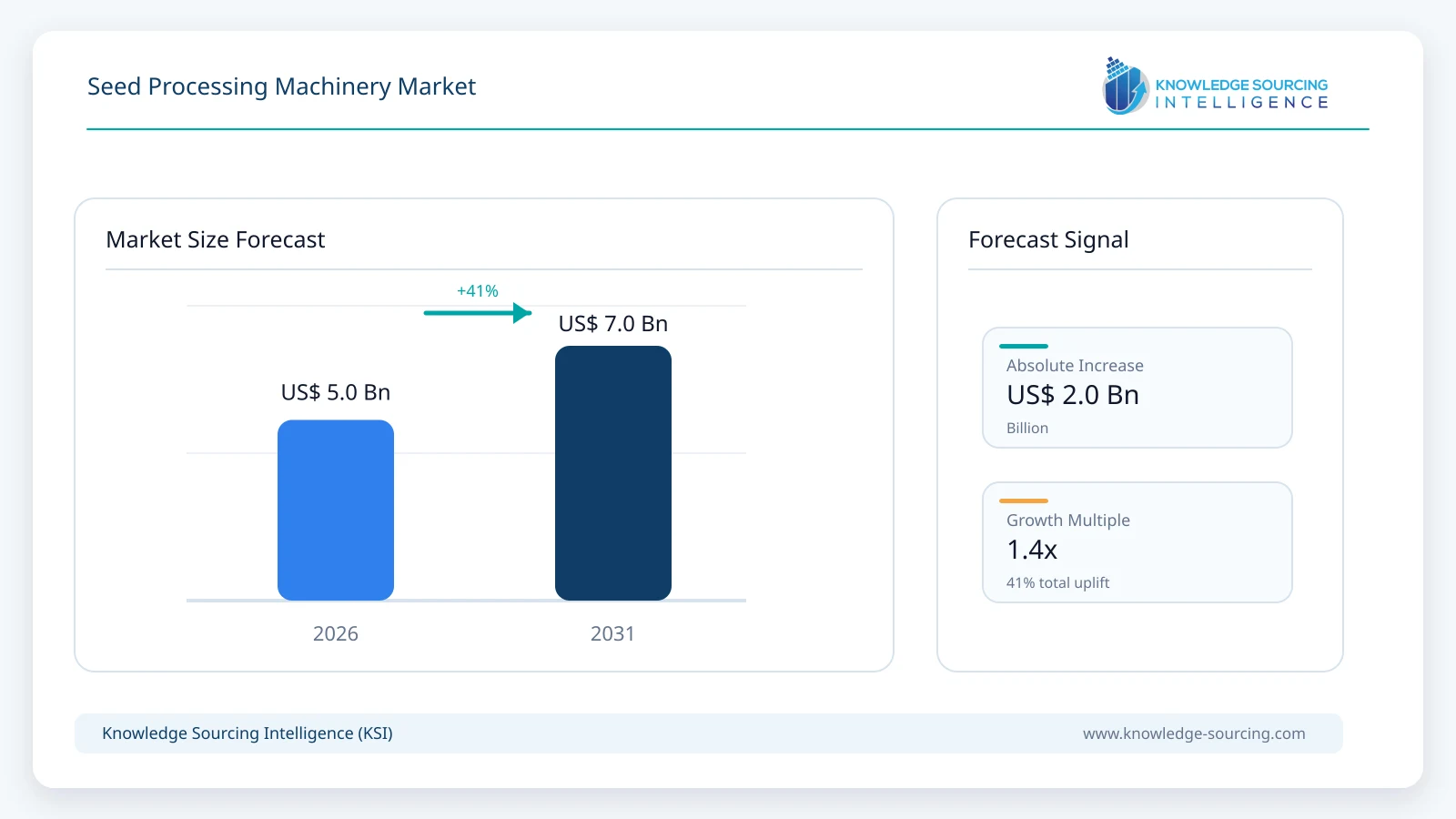
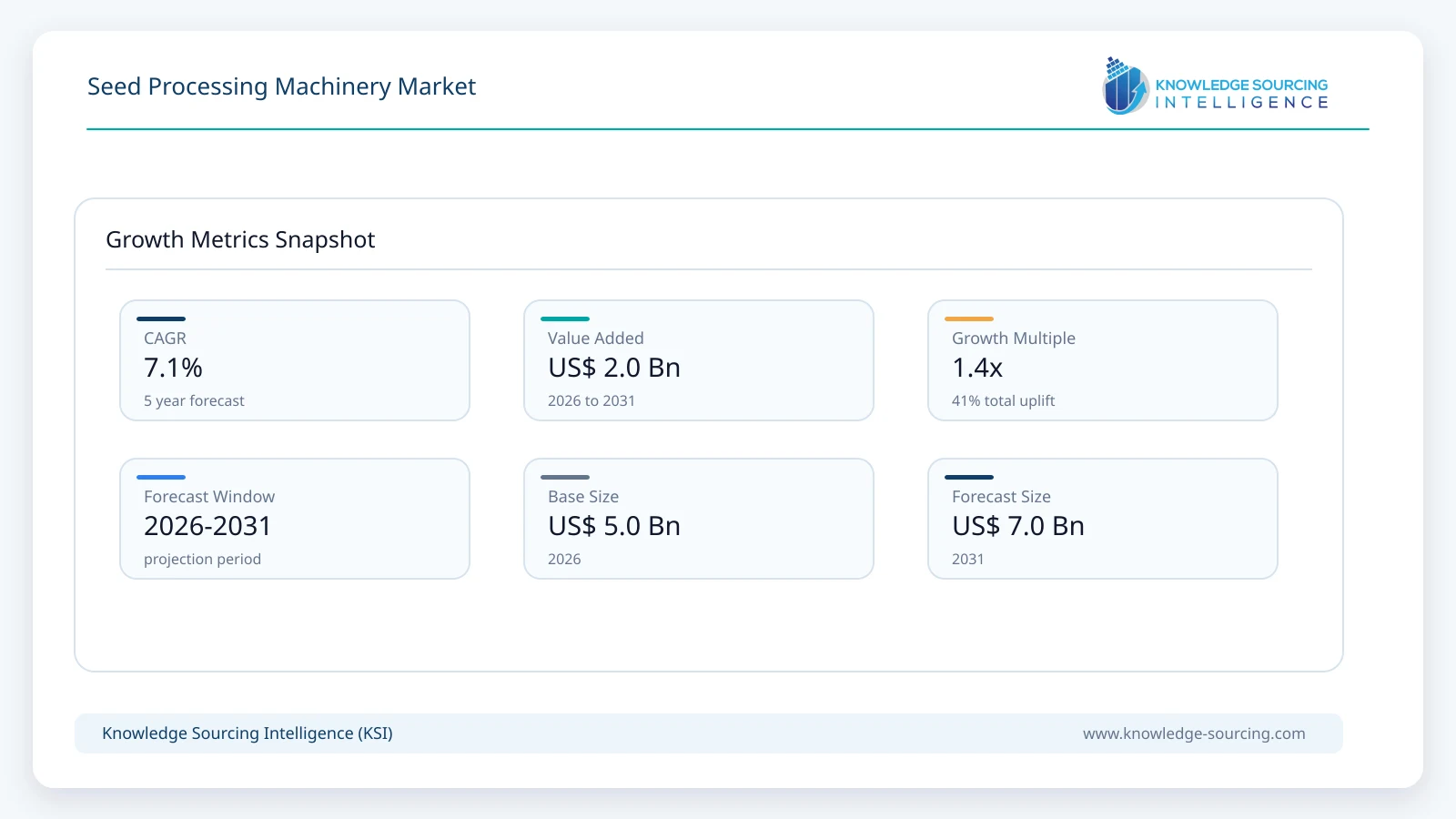
The global seed processing machinery market is estimated at USD 4.95 billion in 2026 and is projected to reach approximately USD 6.98 billion by 2031, growing at about 7.1% annually.
Highlights:
- 1Cleaners generate approximately USD 1.44 billion of global machinery revenue in 2026.
- 2Coating equipment is projected to grow about 8.0% annually through 2031.
- 3OEM equipment represents roughly 78% of market revenue in the 2026 base year.
- 4Aftermarket machinery and upgrades are projected to grow about 8.2% annually.
- 5Seed-industry customers account for approximately 58% of total equipment demand in 2026.
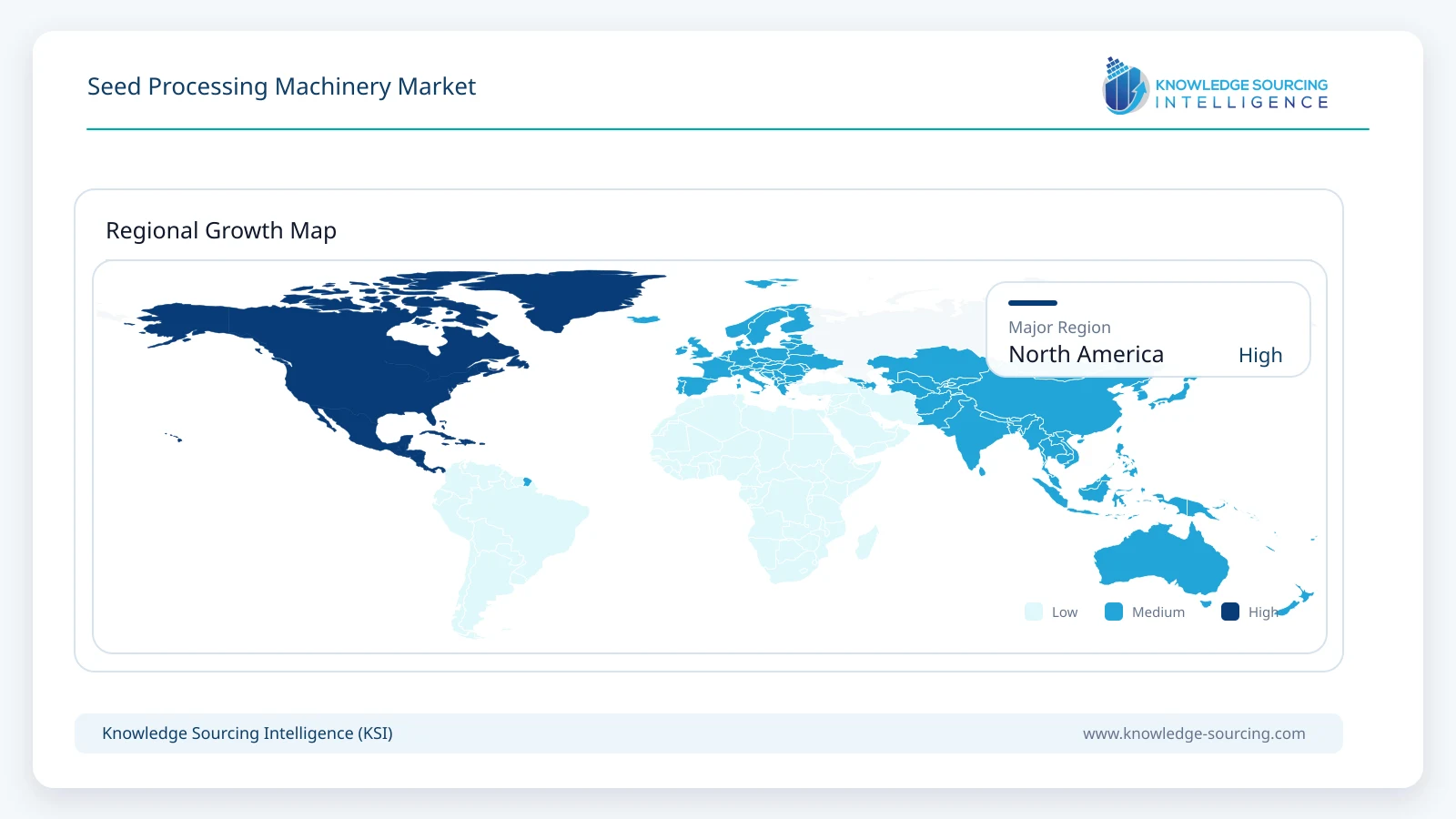
- 6North America generates approximately USD 1.53 billion of machinery demand in 2026.
- 7Asia Pacific is projected to grow about 8.3% annually through 2031.
Seed processing is moving from mechanical cleaning toward integrated quality-management systems. Commercial seed companies increasingly evaluate machinery on recovery rate, varietal purity, germination protection, traceability, throughput and the ability to change between crop lots without contamination. This is particularly important for hybrid maize, vegetables, oilseeds, forage crops and other high-value seed categories where a small processing loss can have a disproportionate commercial impact. Modern facilities therefore combine air-screen cleaning, length and density separation, optical sorting, controlled drying, seed treatment and automated conveying rather than operating each process as an isolated machine.
International certification frameworks reinforce the requirement for consistent processing quality. The OECD Seed Schemes now include 64 participating countries and support harmonized varietal certification for seed moving in international trade. USDA programs similarly recognize accredited seed conditioning and testing procedures, while phytosanitary systems place increasing emphasis on treatment, contamination control and traceability. These standards do not mandate a specific machine, but they increase the commercial value of equipment that can deliver repeatable purity, controlled moisture, accurate treatment application and documented process conditions across multiple seed lots.
Trade data provide a useful lower-bound indicator of equipment movement. World Bank WITS data show that India imported about USD 90.5 million of machines classified under HS 843710 in 2024, while Nigeria imported USD 60.4 million, the European Union USD 48.0 million and the United States USD 43.1 million. China exported approximately USD 287.7 million under the same heading in 2024, with the European Union, the United States, Germany, Italy, the United Kingdom and Denmark also major exporters. HS 843710 captures cleaning, sorting and grading machines for seed and grain but excludes many dryers, coating systems, controls and project-engineering services, so it is used as a trade benchmark rather than a complete market measure.
Market Trends
Optical Sorting Is Moving Deeper into Seed Quality Control
Optical sorting is shifting from a premium add-on toward a standard quality-control step in higher-value processing lines. Multi-camera systems can identify discoloration, physical defects and foreign material that conventional screening cannot remove reliably. The next development is software-led classification. PETKUS used AGRITECHNICA 2025 to highlight its OS G Iris platform with new IRIS software and an OS f system using artificial intelligence to support germination-related analysis. Westrup has also expanded optical sorting through its partnership with 3U Vision and installed an Optica Mini system at Sejet Plant Breeding in Denmark during 2026. These developments show that the technology is moving beyond commodity color separation toward crop-specific quality decisions and smaller production lots.
Integrated Lines Are Replacing Standalone Equipment Purchases
Large processors increasingly prefer turnkey systems in which cleaning, grading, drying, treatment, conveying and process controls are engineered as one line. This reduces transfer losses, simplifies operator training and gives suppliers greater control over throughput and product quality. Cimbria's 2025 continuous-flow dryer installation at VNR Seeds in India formed part of a 180,000-square-foot seed-line infrastructure project, while its European projects combine cleaners, indented cylinders, gravity separation, optical sorting and treatment in a single flow. PETKUS similarly positions complete plants and EPCM services alongside its individual machines. As project complexity rises, engineering, commissioning and lifecycle service are becoming as important as the machine itself.
Drying and Treatment Systems Are Becoming More Precise and Energy Efficient
Seed drying must remove moisture without reducing viability, which makes temperature, relative humidity and residence-time control critical. Seed Processing Holland's 2025 technical material emphasizes dehumidification, heat pumps, heat recovery, humidity sensing, recipe management and closed-loop operation, with energy savings of up to 50% possible in specific configurations. Treatment systems are evolving in parallel through more accurate dosing, automated cleaning and improved coating uniformity. These changes are particularly relevant to vegetable, hybrid and treated field seed, where seed value is high enough to justify investment in tighter process control and lower reject rates.
Market Drivers
Certified Seed Systems Are Raising the Minimum Quality Standard for Processing
The commercial use of certified seed requires processors to maintain physical purity, varietal identity and consistent quality through conditioning and handling. OECD certification procedures now span 64 participating countries, creating a broad international framework for high-quality seed moving across borders. USDA seed programs also recognize accredited conditioning and testing activities. As seed systems formalize, processors have stronger incentives to replace basic screens and manual inspection with machines capable of repeatable cleaning, grading, density separation and documented treatment. The effect is strongest in export-oriented seed businesses, where one rejected lot can offset the savings from lower-cost processing equipment.
Hybrid and Specialty Seeds Increase the Economic Value of Gentle, Accurate Processing
Hybrid maize, vegetable seed, oilseed, forage and specialty crop seed can carry materially higher value per kilogram than commodity grain. Processing economics therefore depend not only on throughput but also on recovery, germination protection and minimizing mechanical damage. This favors adjustable cleaners, gravity separators, low-impact conveying, precision coaters and controlled dryers. BASF's Nunhems vegetable-seed business announced a EUR 40 million modernization and expansion of its seed processing facilities in the Netherlands in April 2026, with completion expected by the end of 2028. Investments of this type indicate that large seed companies are continuing to expand high-specification processing capacity even in mature markets.
Emerging-Market Modernization Is Expanding Demand for Complete Seed Facilities
Demand is also being created by countries seeking to strengthen domestic seed multiplication, reduce losses and improve availability of quality planting material. India, parts of Africa, Southeast Asia and Eastern Europe continue to commission new conditioning lines and seed parks. Cimbria's installation at VNR Seeds and earlier SeedCo projects in southern Africa illustrate the scale of these investments, while PETKUS continues to supply turnkey corn and field-seed lines across Asian markets. The opportunity extends beyond first-time equipment purchases because newly mechanized facilities subsequently generate demand for controls, spare parts, optical sorting modules and treatment upgrades.
Market Restraints
High Capital Cost Slows Full-Line Modernization for Smaller Processors
A modern seed plant can require coordinated spending on cleaning, drying, grading, separation, treatment, material handling, dust control, automation and laboratory quality systems. Smaller processors frequently replace one bottleneck at a time rather than funding a complete line, particularly where seasonal utilization is low or financing costs are high. The result is a long replacement cycle in which older mechanical equipment remains in service alongside newer optical or automated modules. Suppliers therefore need modular designs and retrofit capability to address customers that cannot justify a full greenfield investment.
Crop Variability and Short Processing Windows Increase Engineering Complexity
Seed size, shape, density, moisture, fragility and treatment requirements differ widely across cereals, pulses, oilseeds, vegetables and forage crops. A configuration optimized for one crop can produce unacceptable damage or recovery losses on another. Processors also operate within narrow seasonal windows, which increases the cost of downtime and places pressure on spare-parts availability and field service. These conditions favor suppliers with test centers, crop-specific process knowledge and strong regional support, but they also increase project-engineering costs and can extend purchasing decisions.
Seed Processing Machinery Market Segment Analysis
By Type
Cleaners Remain the Core Processing Investment
Cleaners remain central because every downstream process depends on consistent removal of foreign material, undersized seed and broken kernels. Air-screen and fine-cleaning systems are increasingly specified with easier screen changes, variable airflow, automated settings and dust-control interfaces so one line can serve multiple crops. The segment benefits from both new projects and recurring replacement demand because cleaning capacity often becomes the first bottleneck as plants increase throughput. Premium processors increasingly pair mechanical cleaners with gravity and optical separation, making the cleaner the anchor machine around which a complete line is configured.
By Type
Coaters Gain from Higher Adoption of Treated and Value-Added Seed
Coating and treatment machinery is growing faster as seed companies add crop-protection products, biologicals, micronutrients, polymers and other treatments while tightening application accuracy. Modern coaters are designed to improve uniformity, reduce chemical waste and simplify recipe changeover. Automated self-cleaning, closed handling and drying integration are becoming more important as processors manage more formulations and smaller lots. The segment is particularly attractive in vegetable, maize, sunflower and other commercial seed categories where treatment quality directly affects product differentiation and field performance.
By Revenue Model
OEM Revenue Is Supported by Turnkey Project Procurement
New equipment sales remain the larger revenue pool because integrated seed plants involve multiple machines, controls and engineering services purchased together. OEM demand is strongest where commercial seed companies add capacity, build regional hubs or replace older mechanical lines with automated systems. Project suppliers increasingly compete on plant layout, commissioning, throughput guarantees and the ability to scale a facility later, making turnkey engineering an important part of OEM value rather than an ancillary service.
By Revenue Model
Aftermarket Growth Is Being Lifted by Controls and Retrofit Upgrades
The installed base is creating a growing market for screens, wear parts, sensors, drives, treatment components, optical-sorting modules, software updates and preventive maintenance. Processors can often improve quality or throughput without replacing the complete line, especially when the mechanical structure remains sound. Remote diagnostics and service agreements further increase recurring supplier revenue and help customers reduce downtime during seasonal production peaks. This favors manufacturers with strong local service networks and long equipment lifecycles.
By End User
Seed Companies Prioritize Purity, Germination and Traceability
Commercial seed producers represent the most specification-intensive customer group because the finished product is planting material rather than a commodity grain input. Their machinery requirements emphasize gentle handling, varietal purity, precise sizing, treatment uniformity and contamination control. Vegetable and hybrid seed companies also process smaller and more valuable lots, creating demand for flexible machines that can change recipes quickly and clean down thoroughly between varieties. These operating requirements support higher equipment value per tonne than basic grain cleaning applications.
By Geography
North America Remains a Large Replacement and Automation Market
North America combines a mature commercial seed industry with a large installed base of cleaning, conditioning and treatment equipment. Demand therefore includes substantial replacement, modernization and aftermarket activity rather than only greenfield capacity.
Buyers emphasize labor reduction, optical inspection, traceability and dependable service because processing windows are short and plant downtime is costly. The region also supports a broad base of specialist manufacturers supplying air-screen cleaners, gravity separators and custom seed-conditioning systems.
By Geography
Asia Pacific Expands through Capacity Addition and Seed-System Modernization
Asia Pacific is adding processing capacity as commercial seed production expands and governments strengthen domestic seed systems. India is already the largest reported 2024 importer under HS 843710, while China is the largest exporter, illustrating the region's dual role as both a major equipment market and manufacturing base. Investments increasingly range from economical cleaning and grading lines to advanced turnkey plants with optical sorting, controlled drying and coating. Local service, financing and the ability to handle diverse crop mixes remain important competitive factors.
Technology Outlook
AI-Assisted Optical Inspection and Germination-Related Sorting
The next generation of optical sorters is using higher-resolution imaging and software models to classify defects that are difficult to distinguish through color alone. PETKUS has presented AI-supported germination analysis in its OS f platform, while Westrup's partnership with 3U Vision broadens access to compact and high-capacity optical systems. Over the forecast period, these machines are expected to move upstream from final quality inspection into process-control loops that automatically adjust cleaning and separation settings based on incoming seed characteristics.
Connected Controls and Remote Lifecycle Support
Centralized controls allow operators to manage airflow, screen settings, drying conditions, treatment recipes and material routing from one interface. As more facilities combine equipment from multiple process stages, suppliers are using digital controls to reduce setup time and improve repeatability. Remote diagnostics are also becoming commercially important because seed plants cannot tolerate prolonged downtime during harvest and conditioning periods. This is increasing the value of software, sensors and service agreements within the overall machinery market.
Energy-Efficient Drying and More Accurate Treatment Application
Drying and treatment are receiving greater attention because both processes can damage seed if poorly controlled. Heat pumps, dehumidification, heat recovery and moisture sensing can reduce energy consumption while preserving viability, while improved coaters use tighter dosing and better mixing to reduce chemical use and improve uniformity. These technologies are likely to gain share in high-value seed plants first, before moving into broader field-seed applications as equipment costs decline and processors place more weight on lifecycle efficiency.
Recent Developments
April 2026: BASF Nunhems announced EUR 40 million for next-generation seed processing facilities in the Netherlands, with completion planned by end-2028.
February 2026: Westrup supported Sejet Plant Breeding in Denmark with an Optica Mini optical sorter to automate defect removal and improve purity.
November 2025: PETKUS showcased IRIS sorting software, AI-supported germination analysis, automated coater cleaning and a new fine-seed gravity separator at AGRITECHNICA.
March 2025: Westrup reported more than 100% growth in net profit for FY2024/25 and highlighted its new worldwide optical-sorting partnership with 3U Vision.
2025: Cimbria installed a continuous-flow dryer at VNR Seeds in Raipur as part of India’s largest seed-line infrastructure project.
Competitive Landscape
Competition is fragmented across global turnkey suppliers, regional engineering companies and specialist machine manufacturers. Cimbria, PETKUS and Westrup compete strongly in integrated seed and grain processing lines, while Seed Processing Holland is prominent in vegetable and fine-seed conditioning, drying and treatment. AGI/MILLTEC and several Asian suppliers address high-volume emerging-market demand, while North American specialists such as Oliver Manufacturing, LMC and Bench Industries compete in separation and custom conditioning systems. Differentiation increasingly depends on crop-specific process knowledge, test-center capability, automation, optical sorting integration and after-sales support rather than mechanical capacity alone.
Ownership and partnership structures are also changing the competitive environment. Cimbria became part of Grain & Protein Technologies following the 2024 carve-out of AGCO's Grain & Protein business, giving the brand access to a broader global agribusiness platform. Westrup's collaboration with 3U Vision expands its optical-sorting portfolio, while its relationship with Fowler Westrup and Premium Seeds Machines broadens seed enhancement and drying capability. These combinations allow suppliers to cover more of the processing line and increase recurring revenue through service, software, retrofit and spare parts.
Seed Processing Machinery Market Scope:
| Report Metric | Details |
|---|---|
| Total Market Size in 2026 | USD 4.95 billion |
| Total Market Size in 2031 | USD 6.98 billion |
| Forecast Unit | Billion |
| Growth Rate | 7.1% |
| Study Period | 2021 to 2031 |
| Historical Data | 2021 to 2024 |
| Base Year | 2025 |
| Forecast Period | 2026 – 2031 |
| Segmentation | Type, Revenue Model, End-User, Geography |
| Companies |
|
Market Segmentation
BY TYPE
Pre-Cleaners
Cleaners
Dryers
Graders
Coaters
Separators
Polishers
Others
BY REVENUE MODEL
OEM
Aftermarket Sales
BY END-USER
Grain Industry
Seed Industry
BY GEOGRAPHY
North America
USA
Canada
Mexico
South America
Brazil
Argentina
Others
Europe
Germany
France
United Kingdom
Spain
Others
Middle East and Africa
Saudi Arabia
UAE
Others
Asia Pacific
China
India
Japan
South Korea
Indonesia
Thailand
Others
Table of Contents
1. EXECUTIVE SUMMARY
2. MARKET SNAPSHOT
2.1. Market Overview
2.2. Market Definition
2.3. Scope of the Study
2.4. Market Segmentation
3. BUSINESS LANDSCAPE
3.1. Market Drivers
3.1.1. Certified Seed Systems Are Raising the Minimum Quality Standard for Processing
3.1.2. Hybrid and Specialty Seeds Increase the Economic Value of Gentle, Accurate Processing
3.1.3. Emerging-Market Modernization Is Expanding Demand for Complete Seed Facilities
3.2. Market Restraints
3.2.1. High Capital Cost Slows Full-Line Modernization for Smaller Processors
3.2.2. Crop Variability and Short Processing Windows Increase Engineering Complexity
3.3. Market Opportunities
3.4. Porter's Five Forces Analysis
3.5. Industry Value Chain Analysis
3.6. Policies and Regulations
3.7. Strategic Recommendations
4. TECHNOLOGICAL OUTLOOK
4.1. AI-Assisted Optical Inspection and Germination-Related Sorting
4.2. Connected Controls and Remote Lifecycle Support
4.3. Energy-Efficient Drying and More Accurate Treatment Application
5. SEED PROCESSING MACHINERY MARKET BY TYPE
5.1. Introduction
5.2. Pre-Cleaners
5.3. Cleaners
5.4. Dryers
5.5. Graders
5.6. Coaters
5.7. Separators
5.8. Polishers
5.9. Others
6. SEED PROCESSING MACHINERY MARKET BY REVENUE MODEL
6.1. Introduction
6.2. OEM
6.3. Aftermarket Sales
7. SEED PROCESSING MACHINERY MARKET BY END-USER
7.1. Introduction
7.2. Grain Industry
7.3. Seed Industry
8. SEED PROCESSING MACHINERY MARKET BY GEOGRAPHY
8.1. Introduction
8.2. North America
8.2.1. USA
8.2.2. Canada
8.2.3. Mexico
8.3. South America
8.3.1. Brazil
8.3.2. Argentina
8.3.3. Others
8.4. Europe
8.4.1. Germany
8.4.2. France
8.4.3. United Kingdom
8.4.4. Spain
8.4.5. Others
8.5. Middle East and Africa
8.5.1. Saudi Arabia
8.5.2. UAE
8.5.3. Others
8.6. Asia Pacific
8.6.1. China
8.6.2. India
8.6.3. Japan
8.6.4. South Korea
8.6.5. Indonesia
8.6.6. Thailand
8.6.7. Others
9. COMPETITIVE ENVIRONMENT AND ANALYSIS
9.1. Major Players and Strategy Analysis
9.2. Market Share Analysis
9.3. Mergers, Acquisitions, Agreements and Collaborations
9.4. Competitive Dashboard
10. COMPANY PROFILES
10.1. Cimbria A/S (Grain & Protein Technologies)
10.2. PETKUS Technologie GmbH
10.3. Westrup ApS / Fowler Westrup Group
10.4. Alvan Blanch Development Company Ltd.
10.5. Seed Processing Holland B.V.
10.6. Lewis M. Carter Manufacturing, LLC
10.7. A & K Development Company
10.8. Oliver Manufacturing Co., Inc.
10.9. AGI / MILLTEC
10.10. Bühler AG
10.11. Satake Corporation
10.12. Spectrum Industries
10.13. SYNMEC International Trading Ltd.
10.14. Akyurek Technology
10.15. Damas Seed Processing A/S
10.16. JK Machinery a.s.
10.17. Bench Industries
10.18. ArrowCorp / Clipper Grain & Seed Cleaning
11. APPENDIX
11.1. Currency
11.2. Assumptions
11.3. Base and Forecast Years Timeline
11.4. Key Benefits for Stakeholders
11.5. Research Methodology
11.6. Abbreviations
Navigate
Trusted by the world's leading organizations











