
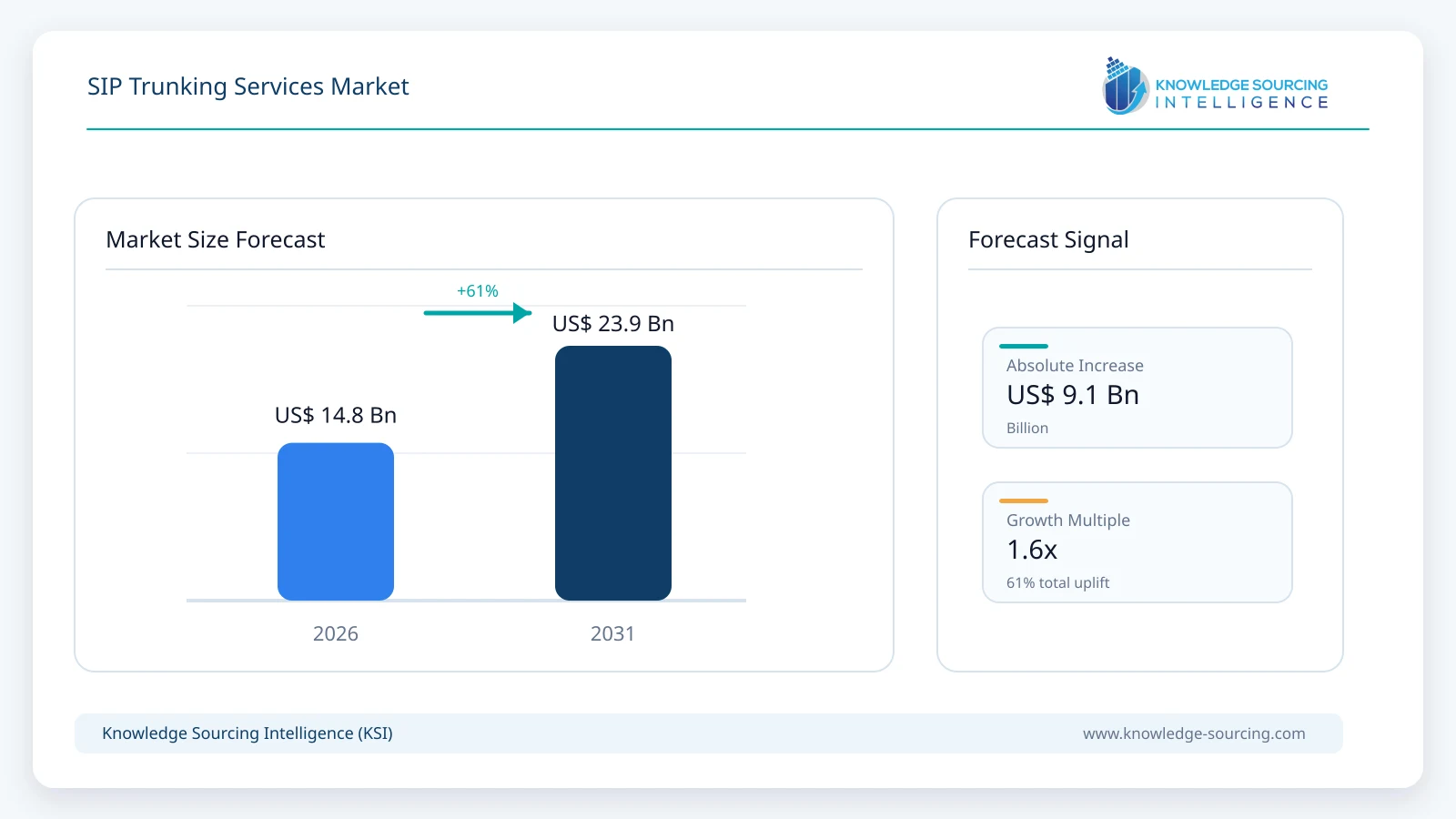
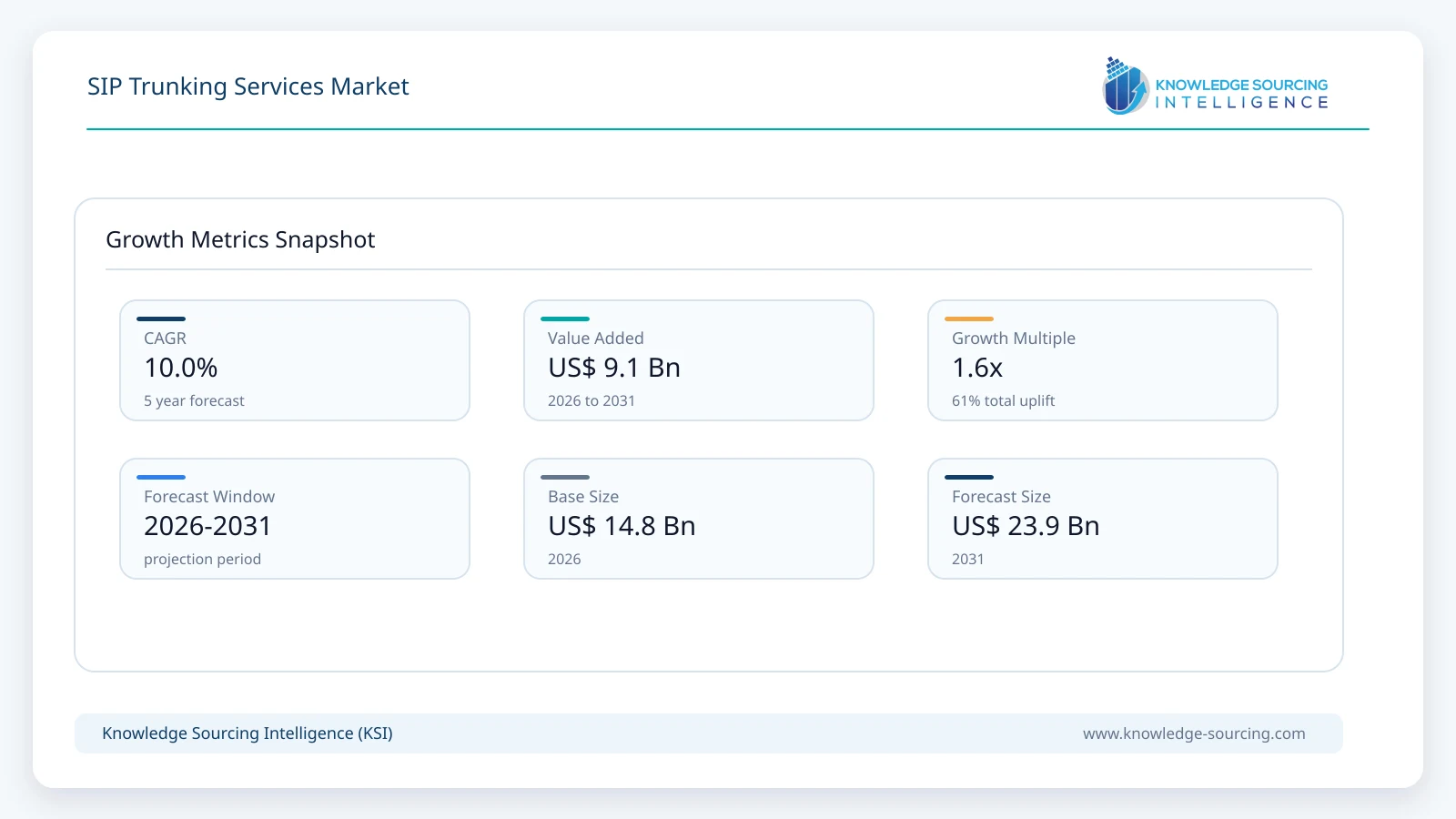
The SIP Trunking Services Market is forecast to grow at a CAGR of 10.0%, reaching USD 23.9 billion in 2031 from USD 14.8 billion in 2026.
Highlights:
- 1Legacy network replacement is sustaining demandEnterprises are replacing TDM-based voice connections while preserving existing PBX investments and telephone numbers.
- 2Large enterprises represent an important revenue segmentMulti-site organizations require higher trunk capacity, redundancy, centralized routing, and managed network support.
- 3Cloud collaboration is reshaping procurementSIP connectivity is increasingly purchased alongside Microsoft Teams, Webex, SBC, contact-center, and unified communications services.
- 4North America remains commercially importantEstablished enterprise telecom infrastructure, extensive PSTN replacement activity, and mature business VoIP adoption support demand.
- 5Regulation directly influences service designEmergency calling, caller authentication, numbering, lawful communications, and PSTN migration requirements affect deployment architecture.
- 6Competition is shifting toward integrated connectivityCarriers and communications providers increasingly differentiate through network reach, managed security, cloud integration, service guarantees, and provisioning capabilities.
The SIP Trunking Services Market covers carrier-grade voice connectivity that uses Session Initiation Protocol (SIP) to connect enterprise telephony environments with public telephone networks over IP infrastructure. The service can replace traditional TDM-based voice circuits while supporting existing private branch exchanges (PBXs), IP-PBXs, unified communications platforms, contact centers, Microsoft Teams environments, and other enterprise communication systems. Commercial offerings typically combine SIP sessions, numbering, PSTN access, network connectivity, session border controller capabilities, security, quality-of-service management, monitoring, and technical support.
The commercial importance of SIP trunking comes from its position between legacy telephony and broader enterprise communications modernization. Enterprises do not necessarily replace their entire voice environment at once. Many retain existing PBXs, telephone numbers, contact-center applications, analogue interfaces, or specialized voice equipment while migrating the underlying connection from traditional circuits to IP. SIP trunking therefore provides an incremental migration path. This characteristic broadens its addressable customer base beyond organizations that are ready to adopt fully hosted communications.
Demand during the 2026-2031 forecast period is expected to be shaped by three overlapping procurement priorities: reducing the cost of maintaining legacy voice infrastructure, increasing the flexibility of enterprise call capacity, and connecting established telephony systems to cloud-based collaboration platforms. AT&T, for example, positions its IP Flexible Reach service around combining voice and data connectivity, supporting existing PBXs, scaling concurrent call channels, and connecting Microsoft Teams to the PSTN.
The buyer base extends across enterprises with geographically distributed offices, contact centers, customer-service operations, healthcare facilities, banks, retailers, government agencies, educational institutions, manufacturers, and telecommunications organizations. The procurement decision is rarely based on call minutes alone. Buyers evaluate number portability, geographic coverage, concurrent-call capacity, network resilience, emergency calling, interoperability with their PBX or collaboration platform, security controls, service-level commitments, and the supplier's ability to support multiple locations.
Large enterprises generally approach SIP trunking as a network architecture decision rather than an isolated voice purchase. They may consolidate trunks from numerous branches into regional hubs, deploy redundant connections, integrate multiple PSTN providers, and use centralized routing policies. Cisco's Webex Calling architecture, for example, supports SIP trunks to local gateways or dedicated instances and permits route groups to be used for redundancy and additional capacity.
Small and medium-sized businesses have different economics. They typically prioritize simple deployment, predictable monthly costs, reduced equipment requirements, and managed support. The ability to use existing telephony equipment can reduce the upfront cost of migration. AT&T explicitly identifies cost control, consolidation of voice and data, and flexible concurrent-call capacity as business benefits of SIP trunking.
The service economics are also changing as vendors combine SIP connectivity with managed SBCs, cloud communications, direct routing, SD-WAN, dedicated internet, security, and contact-center capabilities. This increases the value of the customer relationship beyond the underlying voice circuit. At the same time, it places greater pressure on suppliers to demonstrate measurable reliability, provisioning speed, geographic reach, interoperability, and operational support.
The market is therefore transitioning from a standalone replacement for PRI and other legacy circuits toward an enterprise connectivity component that supports hybrid voice architectures. This does not eliminate traditional SIP trunking. Instead, it changes the basis on which customers evaluate it. A service that can connect legacy PBXs, cloud collaboration platforms, multiple sites, and PSTN networks through a controlled architecture has greater commercial relevance than a basic voice circuit.
The FCC's current definitions also illustrate the technical distinction between conventional fixed voice and interconnected VoIP. Interconnected VoIP requires broadband connectivity, IP-compatible customer equipment, and the ability to originate and receive calls through the PSTN. The FCC's reporting framework measures simultaneous interconnected VoIP calling capacity, which is particularly relevant to enterprise trunk provisioning.
From 2026 through 2031, purchasing decisions are expected to increasingly emphasize operational resilience, security, compliance, cloud interoperability, and geographic consistency. The market's revenue opportunity will consequently depend not only on new SIP trunk deployments but also on capacity expansion, multi-site consolidation, managed services, numbering, redundancy, and integration with enterprise collaboration environments.
Market Drivers
Replacement of Legacy Voice Circuits
The replacement of TDM-based voice infrastructure remains a direct source of SIP trunking demand. Traditional PRI and other circuit-based arrangements often require dedicated capacity that is difficult to scale in line with changing call volumes. SIP trunking allows enterprises to provision concurrent calling capacity through IP infrastructure and adjust capacity more closely to operational requirements.
The commercial mechanism is particularly relevant for enterprises operating many locations. Instead of maintaining separate voice circuits at every branch, organizations can centralize voice connectivity and route calls through fewer strategically located network points. This can reduce circuit complexity and simplify carrier management.
Buyers are therefore assessing SIP trunking as part of infrastructure rationalization programs. Suppliers respond by offering number migration, installation support, managed SBCs, redundant access, and PBX integration. AT&T's IP Flexible Reach, for instance, supports shared trunks across multiple locations and enables customers to combine voice and data on integrated access.
The commercial implication is a shift from circuit-by-circuit purchasing toward portfolio-level contracts. Vendors capable of managing large numbers of locations can capture recurring revenue from both connectivity and associated managed services.
Expansion of Cloud-Based Collaboration
The adoption of cloud collaboration platforms is creating another demand pathway for SIP connectivity. Enterprises may adopt Microsoft Teams, Webex, or other collaboration applications while retaining existing telephone numbers and requiring PSTN access. SIP trunking and direct-routing architectures bridge these environments.
This is especially relevant for organizations pursuing gradual migration. A complete transition to a cloud-native voice platform can involve number portability, endpoint replacement, emergency-service configuration, regulatory approvals, application integration, and user retraining. SIP-based connectivity allows companies to modernize portions of the architecture without immediately replacing every voice component.
Cisco's 2025 expansion plans for Webex Calling in India demonstrate this direction. Cisco announced dedicated data-center deployments in Mumbai and Chennai and the ability to connect Webex Calling to the PSTN through licensed Indian telecommunications providers.
For suppliers, this creates opportunities to package SIP trunking with cloud PSTN, SBC-as-a-service, collaboration integration, professional services, and managed voice. The revenue model consequently becomes broader than traditional trunk capacity.
Growth in Distributed Enterprise Operations
Organizations with branches, stores, clinics, bank offices, factories, campuses, and regional contact centers require voice services that can operate consistently across multiple sites. SIP trunking allows call routing to be centralized while retaining local numbers and supporting distributed users.
The requirement is particularly strong where call demand fluctuates. Retailers may experience seasonal peaks, healthcare providers may require different capacity across facilities, and financial institutions may operate centralized customer-service functions alongside local branches.
A network-based SIP architecture can also provide alternate routing when a site becomes unavailable. Rogers, for example, describes its SIP service as being delivered over dedicated IP access and highlights redundancy, diversity, rerouting, and scalable call capacity within its enterprise service architecture.
Suppliers can therefore compete through network resilience rather than price alone. Buyers with business-critical voice applications are more willing to pay for redundancy when the cost of call interruption exceeds the incremental service charge.
Demand for Predictable Communications Costs
SIP trunking can reduce the structural cost of maintaining voice infrastructure by combining voice and data connectivity and allowing customers to purchase capacity according to concurrent calling requirements. The financial benefit varies by network architecture, traffic profile, access costs, and incumbent carrier contracts, so enterprises increasingly evaluate total cost of ownership rather than headline calling rates.
The purchasing calculation includes hardware maintenance, access circuits, PBX support, carrier contracts, numbering, international calling, disaster recovery, and operational staff. A service with slightly higher recurring charges may still be preferred if it eliminates multiple legacy contracts or simplifies management.
This favors providers that can present consolidated commercial packages. Managed services, centralized billing, reporting portals, and professional services become important parts of the purchasing decision.
Migration From Traditional PSTN Infrastructure
Government and regulatory initiatives to retire aging PSTN infrastructure provide an additional structural demand catalyst. The United Kingdom provides a clear example. Ofcom confirmed in January 2026 that BT planned to retire the UK PSTN by 31 January 2027 and emphasized the need for customers to migrate to digital voice services while protecting vulnerable users and maintaining access to emergency services.
PSTN retirement does not automatically translate into SIP trunking for every customer, since hosted VoIP and other digital voice architectures can also serve the requirement. However, businesses with existing PBXs and structured telephony environments have an economic reason to consider SIP trunking as an intermediate or long-term architecture.
Market Restraints and Challenges
Network Quality and Internet Dependency
SIP trunking depends on the performance of the underlying IP network. Latency, jitter, packet loss, congestion, routing failures, and insufficient bandwidth can degrade voice quality. The issue becomes more material when customers use public internet access instead of managed connectivity.
This creates a procurement challenge for enterprises that previously relied on dedicated TDM circuits with predictable characteristics. Suppliers mitigate the risk through dedicated access, traffic prioritization, redundant connections, managed SBCs, monitoring, and service-level agreements.
Rogers explicitly distinguishes its dedicated SIP access from public internet congestion and links the architecture to voice quality and business continuity.
Regulatory and Emergency-Calling Complexity
Voice services connected to the PSTN remain subject to regulatory obligations that vary by country. Emergency calling, caller location, numbering, lawful interception, caller authentication, and customer identification can affect technical design and operating costs.
In the United States, interconnected VoIP providers are subject to requirements associated with emergency calling and caller location. FCC rules require interconnected VoIP providers to support E911 capabilities and obtain registered service locations from customers.
These requirements become more complex for multinational enterprises because a single voice architecture may span jurisdictions with different numbering and emergency-service rules.
Security, Fraud, and Caller Authentication
IP-based voice networks introduce security considerations that are different from traditional circuit-switched environments. SIP infrastructure can be targeted through toll fraud, unauthorized registration, denial-of-service attacks, spoofing, and other forms of abuse.
The FCC has expanded robocall mitigation and caller-authentication obligations across relevant voice providers. Its framework includes STIR/SHAKEN-related requirements and robocall mitigation certifications for providers operating within the U.S. voice ecosystem.
Suppliers must therefore invest in SBCs, fraud monitoring, authentication, traffic analytics, access controls, and incident response. These measures increase operating costs but also provide differentiation in enterprise procurement.
Integration With Legacy Enterprise Equipment
Although SIP trunking can preserve existing PBXs, compatibility is not universal. Older PBXs, analogue devices, fax systems, alarm systems, contact-center applications, and specialized communications equipment may require gateways or additional configuration.
The resulting migration can involve testing, number mapping, routing changes, SBC configuration, failover validation, and staged cutovers. Large enterprises may require months of planning because voice interruption can affect customer service and revenue.
Providers that offer migration engineering and managed implementation can therefore compete more effectively than suppliers that sell connectivity alone.
Major Segment Analysis:
Large Enterprises
The large enterprise segment represents a commercially important portion of the SIP Trunking Services Market because these organizations typically operate the largest number of concurrent voice channels, locations, telephone numbers, and integration points.
Large enterprises often have complex voice estates built through years of acquisitions, branch expansion, technology upgrades, and geographic growth. Their challenge is not simply replacing telephone lines. They must create a consistent voice architecture across headquarters, branches, contact centers, regional offices, and remote operations while preserving business-critical numbers and applications.
The procurement criteria are consequently broader than price. Large organizations assess carrier coverage, network resilience, service-level agreements, geographic numbering, interoperability, emergency calling, security, provisioning time, disaster recovery, and integration with existing PBXs and collaboration platforms.
Capacity planning is another differentiator. A large organization may require different concurrent-call levels across locations and may need to reallocate capacity as offices open, close, consolidate, or move to cloud collaboration. SIP trunking allows capacity to be structured around actual calling requirements rather than fixed legacy circuit configurations.
Redundancy also has a stronger commercial value in this segment. Enterprises can deploy multiple trunks, route groups, access circuits, or providers to maintain service during network failures. Cisco's architecture illustrates this approach by allowing trunks to be grouped into route groups for redundancy and additional capacity.
Large buyers are also increasingly interested in hybrid architectures. Rather than choosing between a traditional PBX and cloud communications, they may operate both. SIP trunking can connect premises-based systems to PSTN services while cloud users receive voice through collaboration platforms. This makes the trunk a shared connectivity layer within a broader enterprise communications architecture.
Competition in this segment therefore favors providers with national or international networks, strong carrier interconnections, managed security capabilities, professional services, and established enterprise account management. Large customers also have greater negotiating power, increasing pressure on suppliers to justify pricing through service quality, coverage, integration, and contractual performance.
The segment's revenue relevance extends beyond the original trunk contract. Expansion opportunities include additional call capacity, redundant connectivity, number migration, managed SBCs, security, cloud PSTN, direct routing, professional services, and network upgrades. This creates a higher customer lifetime value than a basic voice-only relationship.
Regional Analysis
North America
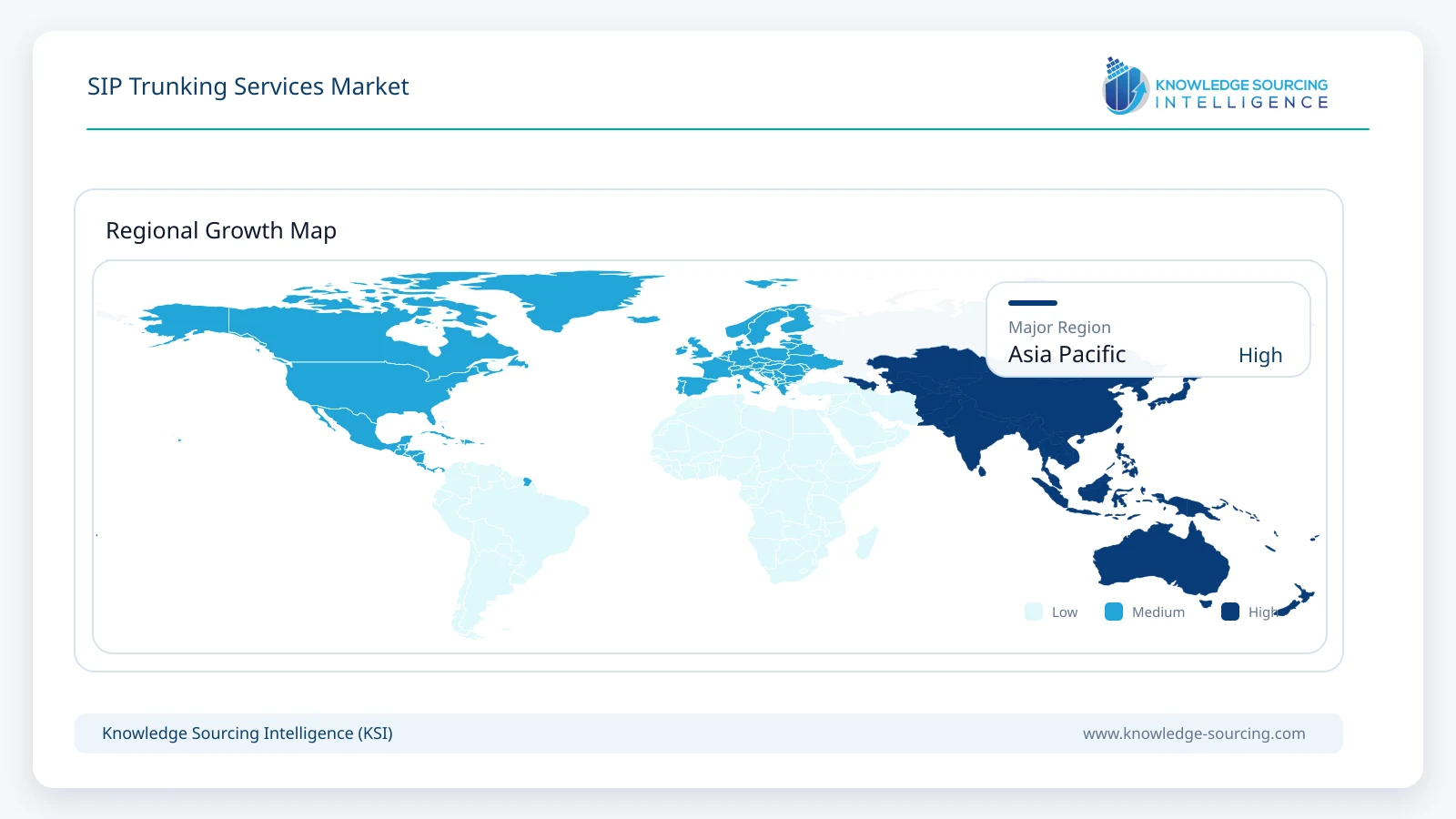
North America remains a major market for SIP trunking because of its large enterprise customer base, mature business communications infrastructure, and established migration from legacy voice networks toward IP-based services.
The United States has a particularly important role because enterprise telecom providers already operate extensive IP, fiber, cloud connectivity, and voice networks. Customers commonly seek integration between premises PBXs, Microsoft Teams, cloud collaboration, contact centers, and PSTN services.
Regulation is an important commercial factor. The FCC classifies interconnected VoIP separately from conventional fixed voice and maintains reporting requirements based on simultaneous calling capacity. Caller authentication and robocall mitigation requirements also increase the technical responsibilities of providers.
Canada presents opportunities for managed enterprise voice because businesses increasingly operate distributed locations and require reliable IP connectivity. Rogers' SIP offering combines enterprise voice with dedicated IP access and supports scalable call capacity, demonstrating the importance of network integration in the Canadian market.
Mexico offers additional opportunity as enterprises modernize communications infrastructure, although regulatory requirements, network availability, and differences in enterprise IT maturity can affect deployment models.
Europe
Europe's SIP trunking opportunity is strongly connected to PSTN retirement and the migration toward IP-based communications. The United Kingdom is particularly notable because BT's planned PSTN retirement by January 2027 creates a defined migration deadline for businesses using legacy infrastructure.
Ofcom's regulatory framework also emphasizes emergency access, customer protection, and clear migration communications. These requirements make service reliability and emergency-call capability central to enterprise purchasing.
Across the European Union, the European Electronic Communications Code provides the overarching framework for electronic communications services, including consumer protection, number portability, emergency communications, and competition. The Commission completed its review of the Code in January 2026.
Germany, France, the United Kingdom, and Spain therefore offer established enterprise markets, while the opportunity in other European countries varies according to PSTN retirement schedules, regulatory implementation, business broadband availability, and enterprise cloud adoption.
Asia Pacific
Asia Pacific presents a mixed but expanding opportunity. China, India, Japan, South Korea, and other markets differ substantially in telecom regulation, numbering, network architecture, and enterprise procurement behavior.
India is particularly relevant because cloud communications suppliers must align deployments with local telecom requirements. Cisco's October 2025 announcement of dedicated Webex Calling data centers in Mumbai and Chennai, together with PSTN connectivity through licensed Indian telecom providers, illustrates how localization and regulatory compliance can influence cloud voice architecture.
India's Unified Licence framework also places specific conditions around Internet Telephony and numbering. The Department of Telecommunications distinguishes Internet Telephony from licensed real-time voice services and establishes restrictions around PSTN/PLMN connectivity and use of the national numbering scheme under the Internet Service authorization.
Japan and South Korea have sophisticated enterprise communications infrastructures, supporting demand for reliable IP voice and cloud collaboration integration. China represents a large enterprise communications opportunity, although licensing, data governance, numbering, and carrier relationships can influence supplier access.
The region's growth constraints include regulatory fragmentation, different national numbering systems, varying enterprise network quality, and the need for local partnerships.
Middle East and Africa
The Middle East and Africa market is supported by enterprise digitization, multinational operations, government communications modernization, financial services, hospitality, healthcare, and contact-center activity.
Saudi Arabia and Israel are important technology-oriented markets where enterprise buyers can have sophisticated requirements for cloud connectivity, security, and communications resilience. Multinational enterprises also seek standardized voice architectures across regional offices, creating opportunities for providers with international coverage.
However, deployment economics vary considerably between countries. International connectivity costs, local licensing, numbering rules, network availability, and requirements for in-country infrastructure can influence supplier selection.
Providers with local carrier relationships and managed deployment capabilities are better positioned to address these differences than suppliers offering standardized offshore services.
South America
South America presents opportunities in Brazil, Argentina, and other markets as enterprises modernize voice infrastructure and expand cloud-based communications. Brazil's large enterprise and financial-services base provides a particularly relevant customer pool.
The main commercial considerations include network quality, regulatory compliance, local numbering, international calling economics, and availability of reliable enterprise connectivity. Customers with geographically distributed operations are more likely to justify managed SIP architectures because centralization can reduce the complexity of multiple voice contracts.
Economic volatility and currency fluctuations can, however, delay infrastructure investment and increase sensitivity to recurring service costs. Suppliers that provide flexible commercial models and local technical support can reduce these barriers.
Competitive Landscape
The competitive structure comprises large telecommunications carriers, enterprise network providers, cloud communications companies, specialist VoIP suppliers, and managed communications providers. The companies included in the competitive scope are Lumen Technologies, Cisco, Legacy VoIP, Verizon, GTT Communications, AT&T, Twilio, Voyant Communications, Fusion Connect, Inc., and Rogers Communications.
Competition is not based on a single technical feature. Large carriers such as Lumen Technologies, Verizon, AT&T, and Rogers Communications can differentiate through network ownership, enterprise connectivity, geographic coverage, numbering capabilities, managed services, and integration with broader network portfolios. AT&T, for example, combines SIP trunking with dedicated network access, Microsoft Teams integration, managed SBC options, and professional services. Verizon similarly positions IP Trunking as a global enterprise voice service supporting premises-based and cloud business phone systems.
Cisco occupies a different position by connecting SIP-based voice architecture with collaboration and unified communications platforms. Its Webex Calling architecture supports local gateways, third-party SBCs, SIP trunks, and route groups, allowing customers to retain different PSTN arrangements across locations.
Twilio and specialist communications providers compete through programmable communications, cloud-based voice infrastructure, APIs, and flexible integration models. This creates competitive pressure on traditional carriers because enterprises can increasingly separate the application layer from the underlying network.
GTT Communications, Voyant Communications, Fusion Connect, Legacy VoIP, and other specialist providers can compete through focused enterprise service, managed voice, network interoperability, customer support, and tailored deployment models. Fusion Connect's SIP Trunking proposition, for example, emphasizes redundant network architecture, service guarantees, and U.S.-based support.
The competitive model is therefore moving toward bundled architectures. Suppliers that can combine SIP trunks with connectivity, cloud PSTN, security, SBC management, collaboration integration, analytics, and professional services can defend higher-value accounts.
Partnerships are equally important. Enterprise voice frequently requires cooperation among telecom carriers, cloud collaboration platforms, local licensed operators, SBC vendors, and network providers. This is particularly important in countries where PSTN access or numbering requires local authorization.
Geographic expansion is also becoming more selective. Rather than building every component in every market, suppliers can combine owned network infrastructure with partner access and cloud-based platforms. This allows broader enterprise coverage without replicating the full cost structure of a facilities-based telecom operator.
Recent Developments
July 2026: didlogic became a documented SIP provider in LiveKit’s official telephony documentation, enabling developers to configure inbound and outbound SIP trunks through a dedicated integration quickstart.
July 2026: DIDWW launched local outbound SIP trunking for Indonesian phone numbers, expanding its local call termination coverage to 58 countries through its global telephony network.
January 2026: Ofcom reiterated that BT planned to retire the UK's PSTN by 31 January 2027 and emphasized customer protection and timely migration to digital voice services. Commercial relevance: The defined retirement timetable creates a clear migration requirement for businesses still dependent on legacy voice infrastructure and supports demand for IP-based alternatives.
January 2026: GTT expanded its global SIP trunking service availability to Japan through its GTT Envision platform, supporting multinational enterprises migrating voice infrastructure toward cloud-based telephony.
October 2025: Cisco announced plans to expand Webex Calling in India through dedicated data centers in Mumbai and Chennai and support PSTN connectivity through licensed Indian telecommunications providers. Commercial relevance: The development strengthens the linkage between cloud calling, SIP/PSTN connectivity, local infrastructure, and regulatory compliance in a major enterprise communications market.
Regulatory and Policy Environment
SIP trunking operates within the broader regulatory framework governing voice communications, numbering, emergency services, interconnection, consumer protection, and network security. Requirements differ substantially by country, making regulatory capability an important supplier qualification.
In the United States, interconnected VoIP providers must meet emergency-calling requirements, including E911 capabilities and registered-location procedures. Providers also operate under caller-authentication and robocall mitigation rules that affect how SIP-originated traffic is authenticated and monitored.
The FCC's Broadband Data Collection framework separately recognizes interconnected VoIP subscriptions and measures maximum simultaneous calls, a methodology that reflects the importance of capacity rather than simply counting telephone numbers.
Europe is governed by the European Electronic Communications Code, which addresses electronic communications networks and services, number portability, consumer protection, emergency communications, accessibility, and competition. The European Commission's framework for emergency communications also requires effective access to 112 and improved caller-location information.
PSTN retirement policies have direct commercial consequences. The UK's planned 2027 PSTN retirement is creating a migration deadline, while Ofcom continues to emphasize protection for vulnerable customers and reliable emergency access during the transition.
India presents a different regulatory model. The Department of Telecommunications' Unified Licence framework defines the scope of Internet Telephony and establishes conditions concerning PSTN/PLMN connectivity and numbering. Cloud calling suppliers therefore need appropriate licensed telecom partners and deployment structures that comply with national requirements.
For suppliers, regulatory compliance is becoming a product-design consideration rather than a back-office function. Number portability, emergency calling, caller identification, lawful requirements, data location, and local licensing can determine whether a particular SIP architecture is commercially deployable.
Outlook and Strategic Implications
The 2026-2031 outlook for the SIP Trunking Services Market will be determined by the pace of legacy voice retirement, enterprise cloud-calling adoption, network modernization, and the continuing requirement for reliable PSTN access.
Investment is likely to concentrate on IP backbone capacity, redundant access, managed SBC infrastructure, security, automated provisioning, network monitoring, and cloud interconnection. Suppliers that continue to treat SIP trunking as a standalone voice product may face pricing pressure as basic connectivity becomes easier to substitute. Providers with broader enterprise network portfolios can instead position SIP as part of an integrated communications architecture.
Procurement is also likely to become more outcome-oriented. Large enterprises will assess service availability, failover performance, migration support, regulatory compliance, number portability, security, and total operating cost alongside per-channel pricing. This favors vendors that can provide measurable service-level commitments and centralized management.
Cloud collaboration will remain a major architectural influence. Enterprises will increasingly operate hybrid environments in which traditional PBXs, Microsoft Teams, Webex, contact-center platforms, and other cloud applications coexist. SIP trunks can serve as the interconnection layer, particularly where organizations need to preserve existing numbers and telephony investments.
The role of managed SBCs should expand because enterprises increasingly want to outsource specialized voice security and interoperability functions. Suppliers can create additional recurring revenue by managing authentication, routing, fraud controls, redundancy, and application connectivity rather than limiting the commercial relationship to call capacity.
Regulatory migration will create geographically uneven opportunities. The UK provides a clear example of a defined PSTN retirement deadline, while other markets will progress according to national policy and carrier investment. Suppliers should therefore prioritize countries where regulatory migration, enterprise modernization, and network readiness converge.
The main risks include pricing commoditization, public-internet quality limitations, cyber threats, regulatory fragmentation, numbering constraints, and customer migration directly to fully hosted communications platforms. SIP trunking suppliers must also manage the possibility that some customers bypass traditional trunking by adopting cloud-native voice platforms with integrated PSTN access.
The strongest strategic opportunity lies in serving customers that are not ready for a full voice-platform replacement. These enterprises need a controlled path from legacy PBX infrastructure toward cloud communications. Providers that can support that transition through SIP trunking, direct routing, managed SBCs, numbering, professional services, redundant connectivity, and cloud integration can retain relevance throughout the migration cycle.
Over the forecast period, the market should therefore be viewed less as a simple replacement market for PRI circuits and more as an enterprise voice interconnection market. Its commercial trajectory will depend on how effectively providers connect legacy investments with cloud-based communications while meeting increasingly demanding requirements for reliability, security, regulatory compliance, and operational simplicity.
SIP Trunking Services Market Scope:
| Report Metric | Details |
|---|---|
| Total Market Size in 2026 | USD 14.8 billion |
| Total Market Size in 2031 | USD 23.9 billion |
| Forecast Unit | Billion |
| Growth Rate | 10.0% |
| Study Period | 2021 to 2031 |
| Historical Data | 2021 to 2024 |
| Base Year | 2025 |
| Forecast Period | 2026 – 2031 |
| Segmentation | Enterprise Size, End-User, Geography |
| Companies |
|
Market Segmentation
By Enterprise Size
- Small
- Medium
- Large
By End User
- IT and Telecommunications
- Healthcare
- Retail
- BFSI
- Government
- Manufacturing
- Education
- Others
By Geography
- North America
- United States
- Canada
- Mexico
- South America
- Brazil
- Argentina
- Others
- Europe
- Germany
- France
- United Kingdom
- Spain
- Others
- Middle East and Africa
- Saudi Arabia
- Israel
- Others
- Asia Pacific
- China
- India
- South Korea
- Japan
- Others
Table of Contents
1. INTRODUCTION
1.1. Market Overview
1.2. COVID-19 Scenario
1.3. Market Definition
1.4. Market Segmentation
2. RESEARCH METHODOLOGY
2.1. Research Data
2.2. Assumptions
3. EXECUTIVE SUMMARY
3.1. Research Highlights
4. MARKET DYNAMICS
4.1. Market Drivers
4.2. Market Restraints
4.3. Porter’s Five Forces Analysis
4.3.1. Bargaining Power of Suppliers
4.3.2. Bargaining Power of Buyers
4.3.3. Threat of Substitutes
4.3.4. Threat of New Entrants
4.3.5. Competitive Rivalry in Industry
4.4. Industry Value Chain Analysis
5. SIP TRUNKING SERVICES MARKET BY ENTERPRISE SIZE
5.1. Introduction
5.2. Small
5.3. Medium
5.4. Large
6. SIP TRUNKING SERVICES MARKET BY END USER
6.1. Introduction
6.2. IT and Telecommunications
6.3. Healthcare
6.4. Retail
6.5. BFSI
6.6. Government
6.7. Manufacturing
6.8. Education
6.9. Others
7. SIP TRUNKING SERVICES MARKET BY GEOGRAPHY
7.1. Introduction
7.2. North America
7.2.1. United States
7.2.2. Canada
7.2.3. Mexico
7.3. South America
7.3.1. Brazil
7.3.2. Argentina
7.3.3. Others
7.4. Europe
7.4.1. Germany
7.4.2. France
7.4.3. United Kingdom
7.4.4. Spain
7.4.5. Others
7.5. Middle East and Africa
7.5.1. Saudi Arabia
7.5.2. Israel
7.5.3. Others
7.6. Asia Pacific
7.6.1. China
7.6.2. India
7.6.3. South Korea
7.6.4. Japan
7.6.5. Others
8. COMPETITIVE ENVIRONMENT AND ANALYSIS
8.1. Competitive Benchmarking and Analysis
8.2. Recent Investments and Deals
8.3. Strategies of Key Players
9. COMPANY PROFILES
9.1. Lumen Technologies
9.2. Cisco
9.3. Legacy VoIP
9.4. Verizon
9.5. GTT Communications
9.6. AT&T
9.7. Twilio
9.8. Voyant Communications
9.9. Fusion Connect, Inc.
9.10. Rogers Communications
Navigate
Trusted by the world's leading organizations











