
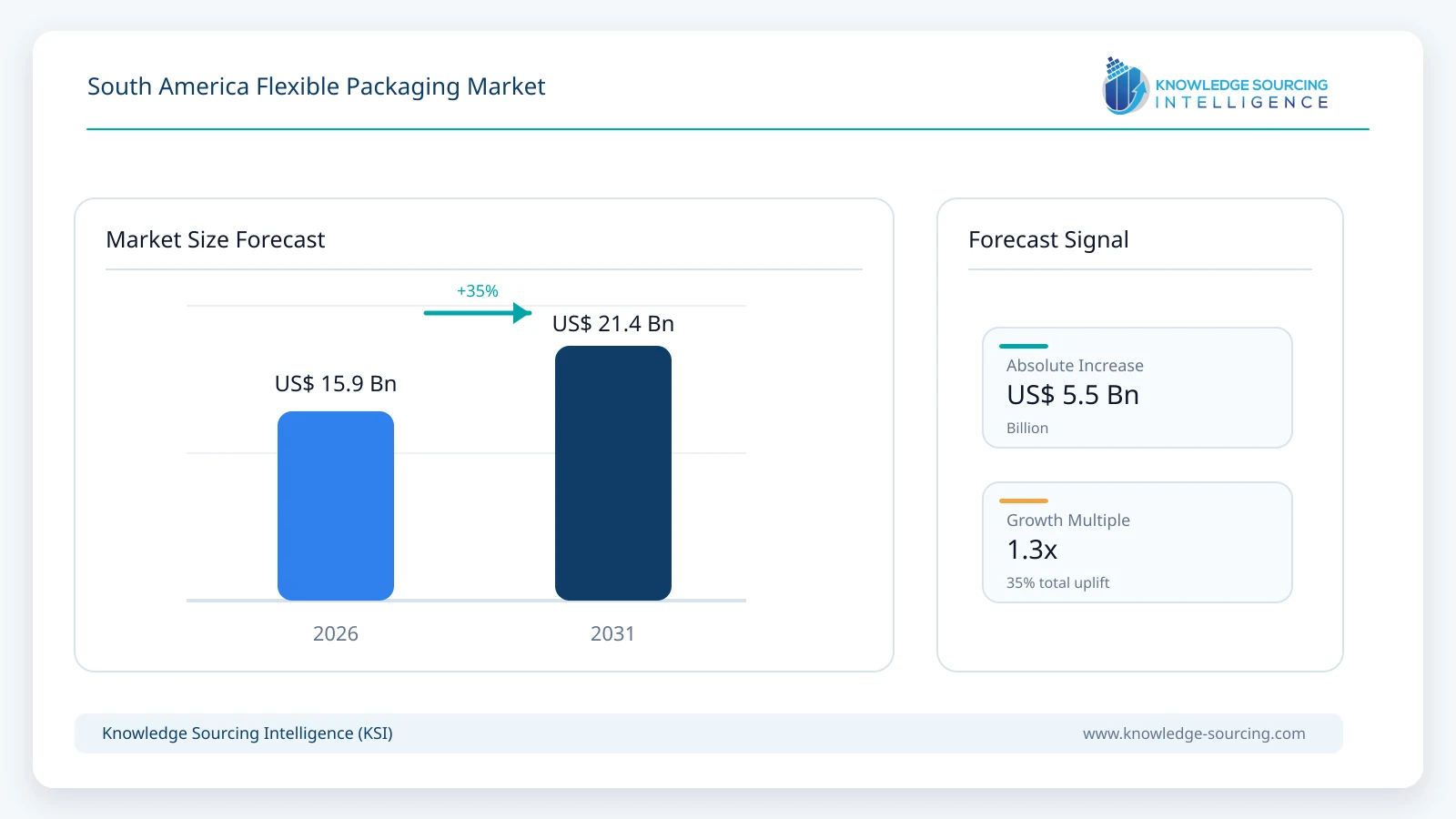
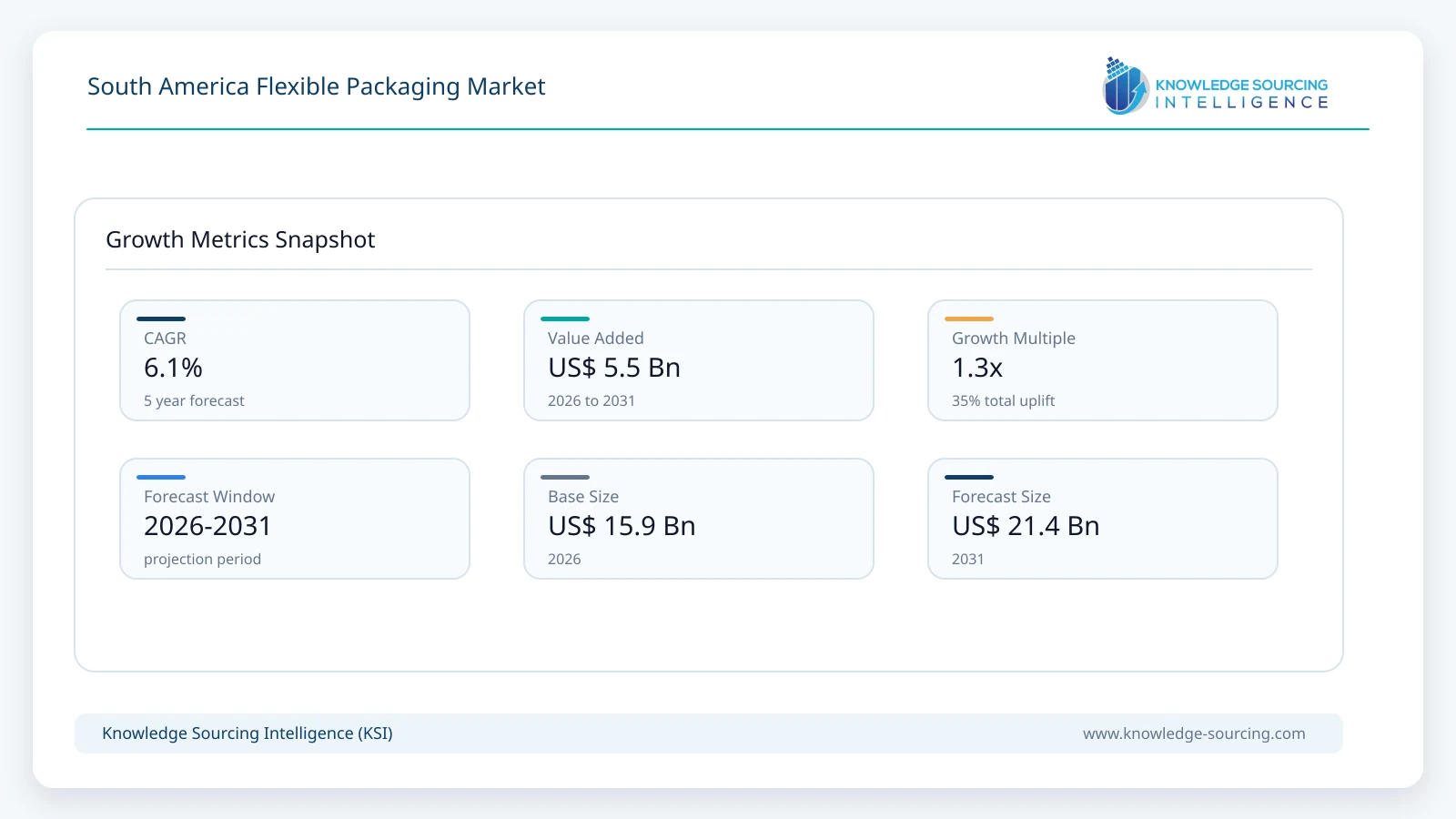
The South America flexible packaging market is forecast to grow at a CAGR of approximately 6.1%, increasing from USD 15.9 billion in 2026 to USD 21.4 billion in 2031.
Highlights:
- 1Films account for approximately 45% of South America flexible packaging market value in 2026, supported by food, agricultural, industrial and secondary-packaging applications.
- 2Plastic represents approximately 78% of market value in 2026, with polyethylene and polypropylene remaining the principal flexible-packaging polymers.
- 3Food and beverages account for approximately 43% of market value in 2026, reflecting the scale of processed food, meat, dairy, coffee, snacks and beverage production.
- 4Brazil accounts for approximately 58% of South America flexible packaging market value in 2026, supported by the region’s largest food-processing, plastics-converting and consumer-products industries.
- 5Colombia is projected to record the fastest growth among the major country markets at approximately 7.5% annually between 2026 and 2031.
Flexible packaging includes films, pouches, bags, wraps and related structures manufactured primarily from plastic polymers, paper, aluminium foil, bioplastics and combinations of these materials. Demand is concentrated in food and beverages, personal care, pharmaceuticals, pet food, household products and agricultural applications. Brazil provides the region’s largest manufacturing and consumption base and offers a useful indicator of underlying industry conditions: the Brazilian flexible plastic packaging industry generated R$40.1 billion in revenue during 2025, an increase of 6.2%, while production declined slightly to 2.321 million tonnes and capacity utilization stood at 70.4%. The industry contained 3,888 companies and more than 116,000 formal employees, illustrating its substantial scale and fragmented supplier structure.
Flexible packaging is particularly important in South America because a significant portion of regional agricultural and food production must move through long distribution chains between processors, retailers, ports and export customers. Low package weight, high product-to-package ratios and the ability to combine oxygen, moisture, aroma, puncture and light barriers make flexible structures particularly suitable for meat, poultry, coffee, dairy products, pet food, grains, frozen products and dry packaged foods. Brazilian industry data demonstrate the scale of this relationship with food and agribusiness: agribusiness demand for flexible plastic packaging increased 9.7% in 2025 even as several consumer categories softened, making it the industry’s strongest-performing major application. The underlying export base remains substantial, with Brazilian agribusiness exports reaching USD 169.2 billion in 2025 and representing 48.5% of the country’s total exports, creating sustained requirements for films, bags, pouches, vacuum structures and transport-oriented secondary packaging.
Material consumption remains dominated by polyethylene, but the nature of this demand is changing as converters move toward structures that use fewer incompatible layers and can incorporate recycled resin without materially compromising performance. ABIEF reports that LDPE and LLDPE represented approximately 73% of Brazilian flexible plastic packaging material consumption in 2025, while recycled material accounted for only about 5% of volume. This gap is becoming commercially important because Brazil’s regulatory framework is moving much faster than current recycled-material penetration. The market therefore is not simply shifting away from plastic; instead, value is moving toward higher-performance polyethylene and polypropylene structures that can provide barrier properties, sealing performance and downgauging while also improving recyclability. International suppliers such as Amcor compete alongside vertically integrated regional producers including Valgroup and a broad domestic converting base that serves multinational FMCG customers, regional food processors and agricultural users.
Market Trends
Mono-Material Structures Are Replacing Difficult-to-Recycle Laminates
Flexible packaging historically achieved high moisture, oxygen and aroma barriers by combining several polymer films, metallized layers and adhesives, but these multilayer structures can be difficult to recycle because their constituent materials cannot easily be separated. Converters are consequently redesigning demanding applications around polyethylene or polypropylene families so that packaging can remain compatible with established recycling streams. In October 2025, Valgroup and Dow introduced a polyethylene coffee package in Brazil that eliminated the internal metallization typically used in high-barrier coffee packaging while retaining product-protection requirements. The development is significant because coffee is one of the more technically demanding dry-food applications due to oxygen, moisture and aroma sensitivity. The transition toward mono-material structures therefore represents more than a marketing change: converters must reproduce the barrier, stiffness, sealing and machinability of established laminates while remaining economically competitive on existing packing lines.
Recycled Content Is Becoming a Packaging-Design Requirement
Brazil’s plastic-packaging regulations are turning recycled content and post-consumer recovery into measurable design requirements rather than voluntary sustainability targets. Decree 12,688 established a national reverse-logistics system covering plastic packaging and sets the national recovery target at 32% in 2026, increasing to 38% by 2031, while the applicable national recycled-content target rises from 22% to 31% over the same period. The regulation also requires manufacturers and importers to consider recyclability and circular-economy principles during product and packaging design, although specific exemptions and separate rules apply to certain regulated packaging categories. These requirements create a direct incentive for converters to develop structures that can accept PCR resin without compromising seal integrity, tensile strength or appearance. Valgroup’s 2026 collaboration with Sidel illustrates the direction of development: the companies introduced recyclable stretch films capable of incorporating up to 30% post-consumer recycled resin while maintaining industrial packaging performance.
Packaging Materials and Packing Equipment Are Being Developed Together
Flexible-packaging innovation is increasingly moving from material development alone toward integrated optimization of film, filling, sealing and secondary-packaging equipment. This is important because recyclable mono-material structures can behave differently from established multilayer laminates in terms of sealing temperatures, stiffness, friction and machine speeds. Valgroup and Sidel’s 2026 collaboration combines recyclable stretch film with EvoFilm secondary-packaging equipment and eliminates the need for conventional heat-shrink ovens in selected beverage applications, reducing energy requirements while supporting lower material use. Amcor took a similar integrated approach in Brazil in June 2026 by installing its first Moda rotary vacuum-sealing technology in partnership with Barra Mansa Alimentos, combining sealing equipment, flexible materials and technical support for protein packaging. These developments indicate that competitive advantage increasingly depends on the ability to ensure that more recyclable packaging can run reliably on commercial production lines rather than simply demonstrating material recyclability in isolation.
Market Drivers
Expansion of Food, Protein and Agribusiness Supply Chains
Food, protein and agribusiness provide the strongest structural demand base for flexible packaging in South America because the region is both a large domestic consumer market and a major exporter of agricultural and animal-protein products. Brazilian agribusiness exports reached USD 169.2 billion in 2025 and accounted for 48.5% of national exports, while flexible-packaging demand from the agribusiness segment increased 9.7% during the year. Protein processing creates particularly demanding packaging requirements because chilled and frozen meat products require puncture resistance, oxygen barriers, seal integrity and reliable vacuum performance over long distribution distances. Brazil slaughtered a record 42.94 million cattle in 2025, up 8.2%, alongside 6.69 billion chickens and 60.69 million hogs, both also record levels. These production volumes support recurring demand for vacuum bags, shrink films, thermoforming webs, lidding materials and other high-barrier flexible structures used throughout processing and export logistics.
Plastic-Packaging Circularity Requirements
Brazil’s reverse-logistics framework creates one of the clearest regulatory drivers affecting regional flexible-packaging development. The national plastic-packaging recovery requirement increases from 32% in 2026 to 38% in 2031, while applicable recycled-content requirements rise from 22% to 31%, creating a defined timetable for packaging redesign, PCR sourcing and traceability. This matters because recycled resin represented only approximately 5% of Brazilian flexible-plastic packaging material consumption in 2025, leaving a substantial gap between current material usage and the direction of regulation. Flexible-packaging manufacturers therefore must invest not only in recycled resin but also in compatibilizers, film formulation, downgauging and mono-material design to preserve functional performance. The regulation also increases the importance of collection, sorting and PCR-processing capacity outside the converter itself, making collaboration between resin producers, recyclers, converters, brand owners and packaging-equipment suppliers increasingly important to market development through 2031.
Increasing Demand for Higher-Performance Protein Packaging
Record meat production and expanding export requirements are increasing the technical performance demanded from flexible packaging rather than simply increasing basic film volumes. Brazil’s 2025 slaughter of 42.94 million cattle, 6.69 billion chickens and 60.69 million hogs represented record levels across all three categories, increasing the quantity of chilled, frozen and processed products moving through domestic and international supply chains. Protein packaging typically requires stronger oxygen and moisture barriers, puncture resistance, vacuum retention and seal integrity than basic commodity films, which raises the value contribution of specialty structures. Amcor’s June 2026 installation of its first Moda rotary vacuum-sealing lines in Brazil with Barra Mansa Alimentos demonstrates the investment taking place around this demand. The development combines packaging equipment and high-performance flexible materials, illustrating how protein processors are increasingly evaluating packaging according to throughput, shelf-life protection, automation and total operating performance rather than film price alone.
Market Restraints
Weak Capacity Utilization and Limited Volume Growth
The Brazilian market entered 2026 with significant unused converting capacity despite positive nominal revenue growth. Flexible-plastic packaging production declined 0.5% to 2.321 million tonnes during 2025, apparent consumption fell 0.9% and the industry operated at only 70.4% of installed capacity, while revenue increased 6.2% to R$40.1 billion. Food-sector demand declined approximately 3%, illustrating that value growth does not necessarily represent corresponding physical-volume expansion. This environment creates pressure on converters because companies must defend plant utilization while managing polymer prices, interest rates, exchange-rate movements and customer demands for lower packaging costs. International suppliers are also reporting uneven flexible-packaging demand: Huhtamaki’s global Flexible Packaging segment recorded an 8% decline in reported sales and a 3% fall in comparable sales during the first quarter of 2026 as lower volumes and currency effects offset pricing. Persistent spare capacity can therefore intensify price competition even as investment requirements increase.
Recycling Infrastructure Lags Circularity Targets
The technical and collection infrastructure required for circular flexible packaging remains less mature than the policy targets now being introduced. Recycled material represented only about 5% of Brazilian flexible-plastic packaging volume in 2025, while applicable national recycled-content requirements begin substantially above that level and increase during the forecast period. Flexible packaging is more difficult to recover than many rigid containers because small formats, films, printing inks, adhesives, contamination and multilayer structures can reduce collection and recycling economics. Food-contact applications introduce additional limitations because PCR resin may require higher levels of purification and traceability. The industry consequently faces a dual investment burden: converters must redesign packaging while recyclers and waste-management systems must increase collection, sorting and high-quality resin output. Without corresponding expansion in recycling infrastructure, rapid growth in mandated or customer-requested PCR content could create shortages of suitable recycled resin, higher material costs or inconsistent quality for demanding film applications.
Segment Analysis
By Product Type: Films
Films represent the largest product category because they are used both as finished packaging formats and as the primary material input for pouches, bags, wraps, lidding, shrink and stretch applications. The segment is projected to reach approximately USD 9.6 billion by 2031, supported by food processing, meat packaging, beverage secondary packaging, agribusiness and industrial applications. The scale of Brazilian production illustrates the importance of this category, with flexible-film output accounting for the majority of the country’s converted flexible-plastic volume. Future value growth increasingly comes from performance improvements rather than simple increases in tonnage, particularly through thinner structures, higher barrier properties, recyclable PE and PP formulations and the use of PCR resin. Developments such as Valgroup’s recyclable stretch films and polyethylene coffee packaging illustrate how film producers are attempting to combine material reduction, recyclability and production-line performance, allowing the category to remain the principal value pool even as individual packages use less material.
By Material: Plastic
Plastic remains the dominant material because it provides a combination of low weight, heat sealability, moisture resistance, toughness and compatibility with high-speed packing equipment that paper and aluminium cannot reproduce across all flexible-packaging applications. The plastic segment is projected to reach approximately USD 16.5 billion by 2031, with polyethylene remaining the most important polymer family. ABIEF reports that LDPE and LLDPE represented 73% of flexible plastic packaging material consumption in Brazil during 2025, emphasizing the importance of polyethylene to both commodity and higher-value film applications. Growth within this segment increasingly depends on changing the composition of plastic packaging rather than replacing other materials outright. Mono-material PE structures, PCR incorporation, downgauging and improved barrier coatings are enabling converters to respond to regulation while retaining the mechanical and sealing characteristics required by customers. Polypropylene continues to play an important role in BOPP, snack packaging, labels and higher-stiffness applications where optical and barrier performance are important.
By End-User Industry: Food and Beverage
Food and beverage is the largest end-user segment and is projected to reach approximately USD 9.3 billion by 2031, reflecting the breadth of flexible packaging used across meat, dairy, coffee, bakery, confectionery, grains, sauces, frozen products, snacks, pet food and beverages. The segment combines very high-volume commodity applications with technically demanding high-barrier structures, creating a broad revenue base for both regional converters and multinational suppliers. South America’s large agricultural and protein industries reinforce demand because product shelf life, transport distances and export requirements increase the importance of effective moisture, oxygen and aroma barriers. Brazil’s record 2025 production of cattle, poultry and pork provides a particularly strong underlying demand base, while coffee and other export products create additional requirements for specialty structures. Future growth is expected to favor recyclable formats capable of matching the performance of conventional multilayer packaging, making material science and production-line compatibility central to supplier competitiveness.
Country Outlook
Brazil
Brazil is the largest South American flexible packaging market, accounting for approximately 58% of regional market value in 2026, and is projected to reach around USD 12.2 billion by 2031. Its leadership reflects the scale of domestic food processing, agribusiness, personal care, household products, pharmaceuticals and plastics conversion rather than dependence on a single application. The country already produces 2.321 million tonnes of flexible plastic packaging annually through a supplier base of 3,888 companies, but capacity utilization of 70.4% indicates that near-term market growth will depend increasingly on product mix and value addition rather than rapid expansion of basic film tonnage. High-barrier protein packaging, recyclable mono-material structures, downgauged films and PCR-compatible packaging are therefore expected to capture a greater portion of value growth. Brazil’s new reverse-logistics and recycled-content framework further increases the commercial importance of packaging redesign and traceability, while major domestic and multinational converters continue investing in equipment and material technologies aimed at improving productivity and circularity.
Colombia
Colombia is expected to record the fastest country-level expansion among the major South American flexible packaging markets, supported by growth in packaged-food production, plastics conversion, urban retail and increasingly stringent circular-economy requirements. The Colombian flexible packaging market is projected to reach approximately USD 2.5 billion by 2031. The country’s broader plastics industry entered 2026 with relatively stable momentum, with real sales increasing approximately 1.5% during 2025, employment rising 2.3% and exports remaining positive, while annual industry sales exceeded COP 35 trillion. The sector also supported approximately 250,000 direct jobs and had developed plastics-recycling capacity close to 500,000 tonnes annually, providing an expanding manufacturing and circularity base for films, pouches and other flexible formats. At the same time, tighter packaging and plastics regulation is encouraging converters and brand owners to increase recyclable structures, recycled inputs and material efficiency, making sustainability-related redesign an increasingly important source of value growth through the forecast period.
Competitive Environment and Analysis
The competitive environment combines multinational packaging groups with large Latin American film producers and thousands of domestic converters. Amcor has one of the broadest multinational footprints and competes across protein, food, dairy, pet food, healthcare, home care and personal-care packaging, while Huhtamaki, Mondi, Sonoco and Sealed Air participate through selected flexible and specialty-packaging categories. Regional competition is particularly strong in Brazil, where Valgroup combines BOPP, polyethylene and laminated-film manufacturing with recycling and resin capabilities, while Videplast, Zaraplast, Valfilm, Copobras, Inplasul and other domestic producers serve large FMCG and industrial customers. Oben Group has expanded its regional film position through acquisitions and investments in BOPP and other oriented-film technologies. Competitive differentiation increasingly depends on barrier performance, recyclable design, printing, PCR integration, technical service and the ability to validate new structures on customers’ packaging equipment, while local production and short lead times continue to support regional suppliers against larger multinational companies.
Market Share Analysis
The South America flexible packaging market remains fragmented despite increasing consolidation among larger suppliers. Brazil alone had 3,888 flexible-plastic packaging companies in 2025, meaning no single converter approaches control of the overall regional market across all formats and applications. Amcor has one of the strongest multinational positions, particularly in technically demanding food, protein and healthcare applications, while Valgroup is among the largest vertically integrated regional suppliers and benefits from internal film, resin and recycling capabilities. Oben Group has strengthened its position in oriented films, while Videplast, Zaraplast, Valfilm and Copobras maintain substantial domestic footprints. Market share differs materially by application: multinational suppliers are stronger in high-barrier structures and global-brand accounts, whereas regional converters compete effectively in commodity films, agricultural applications and locally branded consumer goods. Larger suppliers are gaining advantages in material science, PCR sourcing and mono-material development, but market fragmentation is likely to remain structurally high because customers require localized production, short runs and application-specific converting capabilities.
Recent Developments
June 2026: Amcor installed the first Moda rotary vacuum-sealing lines in Brazil through its partnership with Barra Mansa Alimentos, expanding integrated packaging and equipment capabilities for protein processing.
June 2026: Valgroup and Sidel introduced a secondary beverage-packaging solution combining EvoFilm equipment with recyclable stretch films capable of incorporating up to 30% PCR resin.
October 2025: Brazil introduced Decree 12,688 establishing national plastic-packaging reverse-logistics, recovery and recycled-content requirements beginning in 2026.
October 2025: Valgroup and Dow launched a polyethylene coffee package designed for recycling while retaining the barrier characteristics required for coffee.
2025–2026: Colombian plastics-recycling capacity approached 500,000 tonnes per year after approximately 100,000 tonnes of additional annual capacity was added over recent years.
Market Outlook
The South America flexible packaging market is forecast to increase. Food and beverage remains the principal end-user category because the region’s agricultural, protein, coffee and processed-food industries generate large recurring requirements for barrier films, pouches, vacuum structures and secondary packaging. Films retain the largest product position, while plastic remains the dominant material; however, the composition of future demand changes as mono-material structures, downgauging and recycled resin capture a larger share of value. Brazil remains the dominant country market through 2031 but is expected to show more moderate physical-volume growth than value growth because unused converting capacity remains significant. Colombia develops from a substantially smaller base but records faster expansion as plastics conversion, food manufacturing, recycling capacity and circular-economy regulation progress.
The most important structural change through 2031 is the movement from conventional flexible packaging toward packaging that must simultaneously satisfy barrier, machine-performance and circularity requirements. Brazil’s regulatory targets establish a measurable timetable for recovery and recycled content, while major food and consumer-products companies increasingly require suppliers to demonstrate recyclability and material efficiency. This creates opportunities for companies capable of developing recyclable polyethylene and polypropylene structures, integrating PCR without excessive performance loss and working directly with equipment manufacturers to maintain filling and sealing productivity. Competitive advantage therefore shifts away from film production capacity alone toward material science, packaging design, technical service, recycling access and customer-specific validation. The market should continue growing despite relatively modest underlying film-volume expansion because higher-value recyclable, high-barrier and technically engineered structures increase average value per unit of packaging.
South America Flexible Packaging Market Scope
| Report Metric | Details |
|---|---|
| Total Market Size in 2026 | USD 15.9 billion |
| Total Market Size in 2031 | USD 21.4 billion |
| Forecast Unit | Billion |
| Growth Rate | 6.1% |
| Study Period | 2021 to 2031 |
| Historical Data | 2021 to 2024 |
| Base Year | 2025 |
| Forecast Period | 2026 – 2031 |
| Segmentation | Product Type, Material, End-User Industry, Country |
| Companies |
|
Market Segmentation
By Product Type
Pouches
Bags
Wraps
Films
Others
By Material
Plastic
Polyethylene
Polypropylene
Polyvinyl Chloride
Others
Paper
Aluminium Foil
Bioplastics
By End-User Industry
Food and Beverage
Personal Care
Pharmaceutical
Others
By Country
Brazil
Argentina
Colombia
Others
Table of Contents
1. INTRODUCTION
1.1. Market Overview
1.2. Market Definition
1.3. Scope of the Study
1.4. Market Segmentation
1.5. Currency
1.6. Assumptions
1.7. Base and Forecast Years
1.8. Key Benefits to Stakeholders
2. RESEARCH METHODOLOGY
2.1. Research Design
2.2. Secondary Research
2.3. Primary Research
2.4. Market Estimation
2.5. Segment Modelling
2.6. Data Triangulation and Validation
3. EXECUTIVE SUMMARY
3.1. Key Findings
3.2. South America Flexible Packaging Market Size, 2026-2031
3.3. Product Type Outlook
3.4. Material Outlook
3.5. End-User Outlook
3.6. Country Opportunity Summary
4. MARKET DYNAMICS
4.1. Market Drivers
4.1.1. Expansion of Food, Protein and Agribusiness Supply Chains
4.1.2. Plastic-Packaging Circularity Requirements
4.1.3. Increasing Demand for Higher-Performance Protein Packaging
4.2. Market Restraints
4.2.1. Weak Capacity Utilization and Limited Volume Growth
4.2.2. Recycling Infrastructure Lagging Circularity Targets
4.3. Porter’s Five Forces Analysis
4.4. Industry Value Chain Analysis
4.5. Regulatory Environment
4.6. Flexible Packaging Recycling and Circularity
5. SOUTH AMERICA FLEXIBLE PACKAGING MARKET BY PRODUCT TYPE
5.1. Introduction
5.2. Pouches
5.3. Bags
5.4. Wraps
5.5. Films
5.6. Others
6. SOUTH AMERICA FLEXIBLE PACKAGING MARKET BY MATERIAL
6.1. Introduction
6.2. Plastic
6.2.1. Polyethylene
6.2.2. Polypropylene
6.2.3. Polyvinyl Chloride
6.2.4. Others
6.3. Paper
6.4. Aluminium Foil
6.5. Bioplastics
7. SOUTH AMERICA FLEXIBLE PACKAGING MARKET BY END-USER INDUSTRY
7.1. Introduction
7.2. Food and Beverage
7.3. Personal Care
7.4. Pharmaceutical
7.5. Others
8. SOUTH AMERICA FLEXIBLE PACKAGING MARKET BY COUNTRY
8.1. Introduction
8.2. Brazil
8.3. Argentina
8.4. Colombia
8.5. Others
9. COMPETITIVE ENVIRONMENT AND ANALYSIS
9.1. Major Players and Strategy Analysis
9.2. Market Share Analysis
9.3. Mergers, Acquisitions, Agreements, and Collaborations
9.4. Competitive Dashboard
10. COMPANY PROFILES
10.1. Amcor plc
10.2. Huhtamaki Oyj
10.3. Mondi plc
10.4. Sonoco Products Company
10.5. Sealed Air Corporation
10.6. Klabin S.A.
10.7. Valgroup
10.8. Videplast Indústria de Embalagens Ltda.
10.9. Zaraplast S.A.
10.10. Valfilm
10.11. Copobras S.A.
10.12. Inplasul Indústria de Plásticos Sudoeste Ltda.
10.13. Oben Group
10.14. Innovia Films
10.15. Antilhas Embalagens
Navigate
Trusted by the world's leading organizations











