
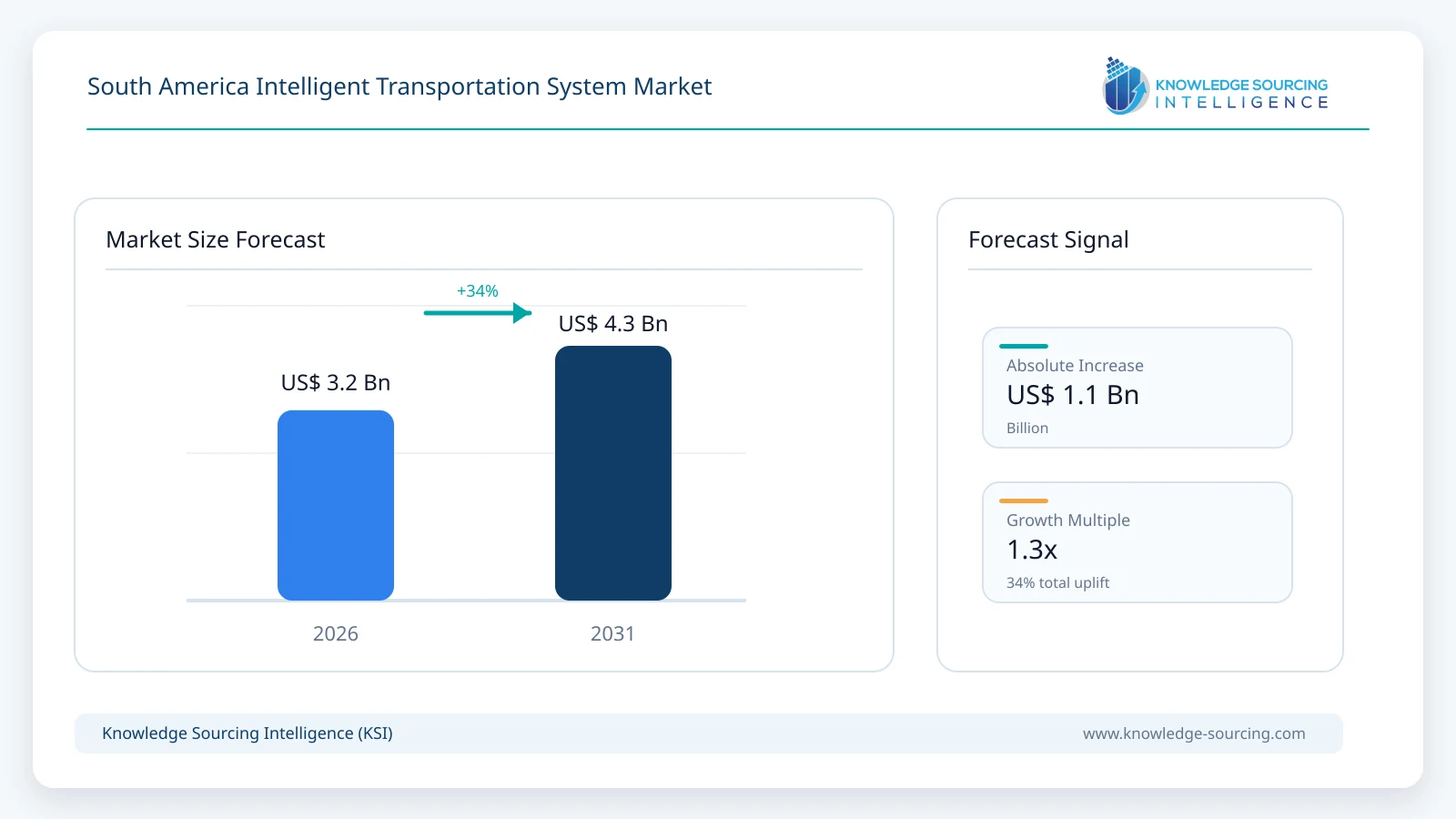
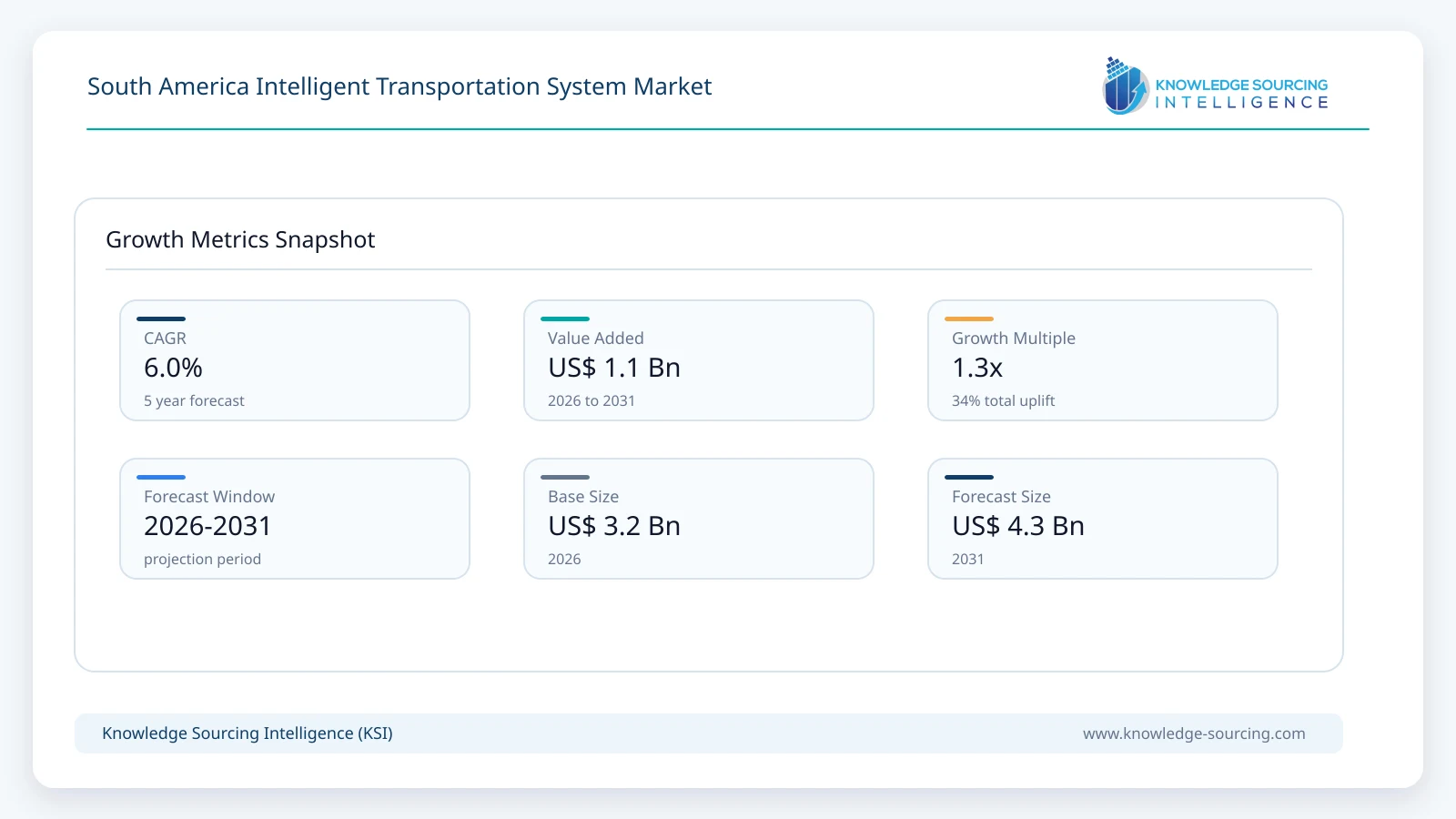
South America Intelligent Transportation System Market is forecast to grow at a CAGR of 6.0%, reaching USD 4.31 billion in 2031 from USD 3.22 billion in 2026.
Highlights:
- 1Rising congestion in metropolitan corridors is accelerating investment in integrated traffic management infrastructure.
- 2Electronic tolling and smart mobility platforms are expanding through public-private transport modernization programs.
- 3Connected transport initiatives increasingly combine roadside infrastructure, communications, and real-time analytics.
- 4Public transport modernization is strengthening demand for intelligent passenger information and fleet management systems.
- 5National digital transport policies are encouraging phased deployment of interoperable Intelligent Transportation System architectures.
Demand is concentrated in urban corridors where congestion, road safety concerns, freight movement, and public transport reliability have become priority issues for transport authorities. Rather than procuring standalone hardware, public agencies increasingly seek interoperable solutions capable of managing multiple transport functions through centralized control centers. This shift has expanded opportunities for software providers, communications specialists, roadside equipment manufacturers, and system integrators able to deliver complete operational platforms.
Procurement decisions are shaped by lifecycle operating costs, interoperability with existing transport infrastructure, cybersecurity requirements, maintenance capability, and long-term vendor support. Municipal governments, highway concessionaires, metropolitan transit agencies, and national transport authorities remain the principal buyers, although concession operators are assuming a growing role as toll roads and urban mobility projects expand under public-private partnership models. Buyers increasingly require suppliers to demonstrate compliance with internationally recognized communications standards while supporting integration with legacy infrastructure that often varies considerably between cities and countries.
Government investment in transport digitization continues to provide the primary foundation for market activity. Brazil, Chile, Colombia, Peru, and Argentina have each introduced programs that prioritize safer road operations, digital traffic management, intelligent tolling, or public transport modernization. According to Peru's Ministry of Transport and Communications, the country approved its National Intelligent Transport Systems Master Plan to establish a coordinated framework for digital road management and interoperable ITS deployment across the national highway network. Similar initiatives across South America increasingly emphasize data-driven transport planning, incident response, and traveler information services as part of broader mobility improvement strategies.
Commercial value is distributed across software platforms, roadside detection equipment, communication networks, traffic control centers, electronic tolling infrastructure, onboard public transport technologies, cloud-based data services, and long-term maintenance contracts. Recurring revenues from software upgrades, system maintenance, cybersecurity services, and analytics are becoming increasingly important as transport authorities prioritize operational continuity over one-time infrastructure investments.
Key Market Indicators
Indicator | Latest Evidence | Commercial Meaning |
Peru National ITS Master Plan | Approved in 2025 | Establishes a structured framework for nationwide ITS deployment and interoperability. |
Brazil federal highway network | More than 75,000 km managed under federal responsibility | Creates long-term demand for corridor monitoring, incident management, and traffic control technologies. |
Chile electronic tolling | Extensive urban free-flow toll network operating across Santiago | Demonstrates regional maturity in intelligent toll collection and traffic management. |
Colombia 5G Infrastructure Program | Multiple highway concession projects incorporating digital transport systems | Expands opportunities for integrated ITS deployment alongside road modernization. |
Regional transport investment | Growing use of Public-Private Partnerships (PPPs) | Encourages procurement of scalable ITS platforms supported by long-term service contracts. |
Key indicator: Peru approved its National Intelligent Transport Systems Master Plan in 2025.
Commercial meaning: The program establishes standardized deployment priorities and improves opportunities for interoperable ITS suppliers across future public road projects.
Market Drivers
Expansion of highway concession programs is increasing demand for integrated corridor management
Road concessionaires across Brazil, Chile, Colombia, and Peru are expanding investment beyond pavement construction toward digital highway operations that improve safety, traffic flow, and operational efficiency. Modern concession agreements increasingly include requirements for automatic incident detection, variable message signs, traffic monitoring cameras, weather monitoring stations, and electronic toll collection. These systems reduce response times while improving asset utilization and customer service. Suppliers are responding by offering integrated platforms that combine roadside equipment, communications infrastructure, analytics, and centralized control software instead of standalone traffic management products. As concession operators seek long-term operating efficiencies, service contracts and lifecycle support are becoming a larger share of supplier revenues. Official transport ministries and concession programs across the region continue to incorporate ITS requirements into new highway development and modernization projects.
Public transport modernization is strengthening investment in passenger information and fleet management
Urban transit agencies are under growing pressure to improve service reliability while controlling operating costs. Cities throughout South America continue expanding bus rapid transit systems, metropolitan rail networks, and integrated public transport services that depend on real-time operational visibility. Fleet management systems, automatic vehicle location technologies, passenger information displays, smart ticketing, and dispatch optimization enable operators to improve schedule adherence and respond more effectively to service disruptions. Public agencies increasingly evaluate suppliers on software integration capability, cybersecurity, predictive maintenance functions, and compatibility with existing transport infrastructure. Technology providers have expanded cloud-based monitoring platforms and analytics capabilities to support continuous operational improvement rather than isolated hardware deployments, creating additional recurring revenue opportunities through maintenance, software licensing, and managed services.
Road safety initiatives are accelerating the deployment of intelligent traffic monitoring infrastructure
Road safety remains a priority across South America, where transport authorities continue investing in technologies that reduce collision risks and improve emergency response. Intelligent traffic monitoring systems support continuous surveillance, automatic incident detection, adaptive signal control, speed enforcement, and coordinated emergency vehicle management. These capabilities enable transport agencies to identify congestion patterns, respond to accidents more rapidly, and optimize network performance using real-time operational data. Government road safety strategies increasingly incorporate ITS technologies alongside conventional infrastructure upgrades, creating demand for integrated sensor networks, video analytics, communications equipment, and centralized command centers. System integrators capable of combining multiple technologies into unified operational environments are therefore gaining a competitive advantage over suppliers focused solely on individual hardware components.
Connected mobility initiatives are increasing demand for interoperable digital transport platforms
South American transport authorities are gradually shifting toward connected mobility ecosystems that combine roadside infrastructure, communications networks, cloud computing, and data-sharing platforms. Procurement increasingly emphasizes interoperability because cities often operate legacy equipment supplied by multiple vendors over several decades. Buyers seek solutions that support future Connected Intelligent Transport Systems (C-ITS), vehicle-to-infrastructure communications, multimodal journey planning, and regional traffic data exchange without requiring complete infrastructure replacement. In response, suppliers including established ITS platform developers continue investing in open architectures, cybersecurity capabilities, software-defined traffic management systems, and scalable cloud services. This evolution is expanding opportunities beyond equipment sales into long-term software maintenance, cybersecurity support, analytics services, and digital mobility management solutions that generate recurring commercial value.
Market Restraints and Challenges
Complex integration with ageing transport infrastructure. Much of South America's transport infrastructure was developed over several decades using proprietary equipment and communication protocols that were not designed for modern Intelligent Transportation System (ITS) architectures. Municipal authorities frequently require new solutions to remain compatible with legacy traffic controllers, surveillance equipment, and communication networks rather than replacing entire systems. This increases engineering complexity, extends implementation schedules, and raises project costs. System integrators therefore invest heavily in middleware, interoperability testing, and customized software development, while buyers increasingly evaluate suppliers based on integration capability and long-term technical support rather than hardware specifications alone.
Lengthy public procurement and funding approval cycles. ITS deployment across South America depends largely on public investment, concession agreements, and municipal transport budgets, making procurement processes considerably longer than those in private-sector infrastructure markets. Multi-stage tender evaluations, environmental approvals, budget authorizations, and contract reviews often delay project implementation by several months. Large metropolitan projects also require coordination between transport agencies, municipal governments, telecommunications providers, and concession operators before implementation begins. These extended procurement cycles create revenue uncertainty for suppliers and increase project financing requirements, particularly for companies undertaking large turnkey system integration contracts.
Cybersecurity and data governance requirements are increasing implementation costs. Modern ITS platforms continuously exchange operational data among roadside infrastructure, traffic control centers, cloud environments, and connected vehicles. Transport authorities therefore require stronger cybersecurity controls, encrypted communications, secure software updates, and continuous network monitoring to reduce operational risk. International suppliers continue expanding cybersecurity capabilities within their ITS portfolios, but compliance increases development costs and requires specialized technical expertise throughout the project lifecycle. Buyers increasingly assess vendors on their ability to provide secure long-term software maintenance alongside physical infrastructure, raising barriers for smaller suppliers with limited digital service capabilities.
Dependence on imported technology and specialist components. Although several South American countries have established transport equipment manufacturing capabilities, many ITS deployments continue to depend on imported sensors, communication devices, processors, imaging equipment, and specialized software platforms. Currency fluctuations, logistics disruptions, customs procedures, and trade restrictions can therefore increase project costs and extend delivery schedules. Suppliers increasingly respond by expanding regional service centers, strengthening local distribution networks, and sourcing selected components within South America where commercially feasible. Nevertheless, high-value electronics and specialized communication technologies remain largely dependent on international supply chains.
Major Segment Analysis
Advanced Traffic Management System (ATMS)
Advanced Traffic Management Systems (ATMS) represent one of the most commercially important segments within South America's Intelligent Transportation System market because they serve as the operational foundation for urban traffic control, highway management, and incident response. Transport authorities increasingly seek centralized platforms capable of integrating traffic signals, surveillance cameras, vehicle detectors, weather monitoring stations, dynamic message signs, and emergency response systems through a unified control environment. Rather than investing in isolated traffic control equipment, buyers prioritize scalable architectures that improve operational visibility while supporting future expansion.
Purchasing decisions within this segment are influenced by software interoperability, cybersecurity, system reliability, maintenance capability, and compatibility with existing transport infrastructure. Metropolitan transport agencies, highway concessionaires, and municipal governments typically require suppliers to demonstrate successful deployment experience before awarding large contracts, creating relatively high entry barriers for new participants. Suppliers compete through integrated software platforms, analytics capabilities, cloud-enabled operations, and long-term maintenance services rather than hardware performance alone. As connected mobility initiatives expand across South America, ATMS platforms are expected to remain central to broader ITS deployments by supporting data exchange across multiple transport applications, including incident management, traffic monitoring, and connected vehicle services.
Regional Analysis
Country | Main Demand Signal | Principal Constraint |
Brazil | Highway concessions, urban congestion management, smart mobility investment | Integration across diverse legacy transport infrastructure |
Argentina | Urban traffic optimization and public transport modernization | Fiscal constraints affecting public infrastructure spending |
Chile | Mature electronic tolling systems and digital highway operations | Expansion beyond metropolitan corridors |
Colombia | Highway concession projects and intelligent corridor management | Complex multi-agency procurement processes |
Peru | National ITS planning and road network modernization | Limited deployment outside primary transport corridors |
Rest of South America | Urban mobility improvement and selective smart city investments | Budget limitations and uneven digital infrastructure |
Brazil represents the region's largest concentration of ITS deployment opportunities owing to its extensive federal highway network, large metropolitan areas, and continued investment through road concession programs. Demand extends across adaptive traffic management, electronic tolling, corridor surveillance, fleet management, and incident response systems. Metropolitan regions including São Paulo and Rio de Janeiro continue investing in digital traffic operations to improve network efficiency while supporting increasing freight and passenger movement.
Argentina continues to prioritize intelligent traffic control and public transport management in major urban areas, particularly where congestion and service reliability remain operational priorities. Procurement activity is generally concentrated within municipal modernization programs and transport infrastructure upgrades, although investment levels remain sensitive to public budget availability and broader economic conditions. Suppliers therefore increasingly emphasize scalable deployments that can be expanded in phases rather than requiring large upfront capital commitments.
Chile maintains one of the region's most established intelligent tolling environments, particularly across Santiago's urban motorway network. Free-flow toll collection, digital traffic monitoring, and integrated highway operations provide a mature foundation for continued ITS investment. Current procurement increasingly focuses on system upgrades, cybersecurity improvements, data analytics, and enhanced interoperability rather than first-time infrastructure deployment.
Colombia is expanding ITS adoption alongside highway modernization under concession-based infrastructure programs. Intelligent corridor management, traffic monitoring, and electronic tolling are receiving greater attention as authorities seek improved road safety and operational efficiency. Demand is supported by transport infrastructure investment, although project implementation often requires coordination among multiple public agencies and concession operators.
Peru is strengthening ITS adoption through national transport modernization initiatives, including the approved National Intelligent Transport Systems Master Plan, which establishes a coordinated framework for future deployment across the national road network. Investment priorities include traffic management, incident response, digital highway operations, and interoperable transport platforms capable of supporting long-term network modernization.
Across the Rest of South America, ITS deployment remains concentrated in larger metropolitan areas where congestion, public transport efficiency, and road safety justify investment. Smaller economies generally pursue targeted projects focused on traffic monitoring, intelligent signaling, and fleet management, while broader adoption continues to depend on infrastructure funding, institutional capacity, and phased transport modernization programs.
Competitive Landscape
Competition in the South America Intelligent Transportation System market is primarily project driven, with suppliers competing through system integration capability, software functionality, long-term service support, and compliance with public procurement requirements rather than hardware pricing alone. Large transport projects generally require vendors to combine traffic management software, roadside equipment, communications infrastructure, cybersecurity, and lifecycle maintenance within a single deployment, favoring companies with broad solution portfolios and regional implementation experience.
Yunex Traffic, SWARCO AG, Siemens AG, Kapsch TrafficCom, Thales Group, Cubic Transportation Systems, Hitachi, and TransCore compete across traffic management, electronic toll collection, intelligent signaling, public transport technologies, and mobility software. Competitive differentiation increasingly depends on interoperability with legacy infrastructure, cloud-enabled traffic operations, cybersecurity capabilities, predictive analytics, and long-term maintenance contracts. Suppliers are also expanding partnerships with telecommunications providers, engineering firms, and local system integrators to strengthen project execution and after-sales support. High technical qualification requirements, lengthy public procurement procedures, and proven deployment experience continue to create barriers for new entrants, particularly in large metropolitan traffic management and national highway modernization projects.
Recent Developments
September 2026: Medellín signed a cooperation agreement with South Korea’s Ministry of Land, Infrastructure and Transport to develop its Mobility Master Plan and pilot intelligent traffic-management and data-driven safety solutions through 2029.
August 2026: Brazil’s ANTT authorized electronic Free Flow toll collection across five plazas on the BR-060/364 corridor in Goiás and Mato Grosso, eliminating physical toll booths and enabling uninterrupted vehicle passage.
August 2026: Brazil launched a new CNH do Brasil application function enabling drivers to view Free Flow electronic-toll passages, access charges, contest transactions and monitor payment deadlines digitally.
Regulatory and Policy Environment
Transport policy across South America is increasingly shifting from conventional road expansion toward digitally managed transport networks that improve operational efficiency, road safety, and network resilience. Governments are integrating Intelligent Transportation Systems into broader transport modernization programs rather than treating them as standalone technology investments. This approach encourages procurement of interoperable platforms capable of supporting traffic monitoring, incident response, electronic toll collection, public transport management, and connected mobility applications.
Brazil continues incorporating digital traffic management and electronic tolling technologies into federal and concession-based highway projects, while Chile maintains regulatory support for free-flow tolling and intelligent motorway operations. Colombia's transport modernization strategy increasingly integrates digital infrastructure into concession programs to improve corridor management and operational performance. Peru's National Intelligent Transport Systems Master Plan provides one of the region's most comprehensive policy frameworks by establishing technical guidance for interoperable ITS implementation across the national road network. Collectively, these initiatives are encouraging suppliers to develop standards-based platforms that can support future expansion while complying with evolving cybersecurity, communications, and data management requirements.
Outlook and Strategic Implications
Demand for Intelligent Transportation Systems across South America is expected to remain closely linked to transport infrastructure modernization, highway concession activity, urban mobility investment, and government road safety programs during the 2026–2031 forecast period. While funding availability and public procurement timelines will continue to influence annual project activity, transport authorities increasingly recognize digital traffic management as an operational necessity rather than an optional infrastructure upgrade. This shift is expected to support continued investment in integrated software platforms, intelligent corridor management, electronic toll collection, and connected mobility services.
Commercial opportunities are gradually moving beyond hardware supply toward long-term software licensing, cybersecurity services, predictive analytics, cloud-based traffic management, and lifecycle maintenance. Suppliers capable of integrating multiple technologies into interoperable platforms while supporting legacy infrastructure are likely to remain well positioned for large public-sector contracts.
Key strategic priorities across the value chain include:
Transport authorities: Prioritize interoperable architectures that reduce future integration costs and simplify network expansion.
System integrators: Strengthen local engineering capability and lifecycle service offerings to improve competitiveness in public tenders.
Technology providers: Expand cybersecurity, cloud management, artificial intelligence-based traffic analytics, and connected vehicle capabilities alongside traditional traffic management solutions.
Infrastructure concessionaires: Continue integrating ITS into highway modernization projects to improve operational efficiency, safety performance, and long-term asset management.
Investors and infrastructure developers: Focus on concession-backed projects and metropolitan transport modernization programs where long-term maintenance and software service revenues complement infrastructure investment.
As intelligent mobility strategies mature across South America, competitive advantage will depend less on supplying individual traffic devices and more on delivering secure, interoperable, and scalable transport management ecosystems capable of supporting increasingly connected road networks.
South America Intelligent Transportation System Market Scope:
| Report Metric | Details |
|---|---|
| Total Market Size in 2026 | USD 3.22 billion |
| Total Market Size in 2031 | USD 4.31 billion |
| Forecast Unit | Billion |
| Growth Rate | 6.0% |
| Study Period | 2021 to 2031 |
| Historical Data | 2021 to 2024 |
| Base Year | 2025 |
| Forecast Period | 2026 – 2031 |
| Segmentation | Type, Application, Geography |
| Companies |
|
Market Segmentation
By Type
ATMS (Advanced Traffic Management System)
ATIS (Advanced Traffic Information System)
APTS (Advanced Public Transportation System)
ATPS (Advanced Transportation Pricing System)
Cooperative Intelligent Transport Systems (C-ITS)
By Application
Collision Avoidance System
Traffic Monitoring
Parking Availability
Traffic Signal Control System
Fleet Management and Asset Monitoring
Road User Charging / Electronic Toll Collection
Smart Mobility Management
Emergency Vehicle Notification
Incident Management
Connected Vehicle Services
Public Transport Passenger Information
Others
By Geography
Brazil
Argentina
Chile
Colombia
Peru
Rest of South America
Table of Contents
1. INTRODUCTION
2. RESEARCH METHODOLOGY
3. EXECUTIVE SUMMARY
4. MARKET DYNAMICS
4.1. Market Overview and Segmentations
4.2. Drivers
4.3. Restraints
4.4. Opportunities
4.5. Porter's Five Forces
4.6. Supplier Outlook
4.7. Industry Outlook
4.8. Industry Value Chain Analysis
4.9. Scenario Analysis
5. SOUTH AMERICA INTELLIGENT TRANSPORTATION SYSTEM MARKET BY TYPE
5.1. ATMS (Advanced Traffic Management System)
5.2. ATIS (Advanced Traffic Information System)
5.3. APTS (Advanced Public Transportation System)
5.4. ATPS (Advanced Transportation Pricing System)
5.5. Cooperative Intelligent Transport Systems (C-ITS)
6. SOUTH AMERICA INTELLIGENT TRANSPORTATION SYSTEM MARKET BY APPLICATION
6.1. Collision Avoidance System
6.2. Traffic Monitoring
6.3. Parking Availability
6.4. Traffic Signal Control System
6.5. Fleet Management and Asset Monitoring
6.6. Road User Charging / Electronic Toll Collection
6.7. Smart Mobility Management
6.8. Emergency Vehicle Notification
6.9. Incident Management
6.10. Connected Vehicle Services
6.11. Public Transport Passenger Information
6.12. Others
7. SOUTH AMERICA INTELLIGENT TRANSPORTATION SYSTEM MARKET BY GEOGRAPHY
7.1. Brazil
7.2. Argentina
7.3. Chile
7.4. Columbia
7.5. Peru
7.6. Rest of South America
8. COMPETITIVE INTELLIGENCE
8.1. Market Share of Key Players
8.2. Investment Analysis
8.3. Recent Deals
8.4. Strategies of Key Players
9. COMPANY PROFILES
9.1. Yunex Traffic
9.2. Transcore
9.3. SWARCO AG
9.4. Thales Group
9.5. Siemens AG
9.6. Kapsch Traffic Com
9.7. Cubic Transportation Systems
9.8. Hitachi
Navigate
Trusted by the world's leading organizations











