
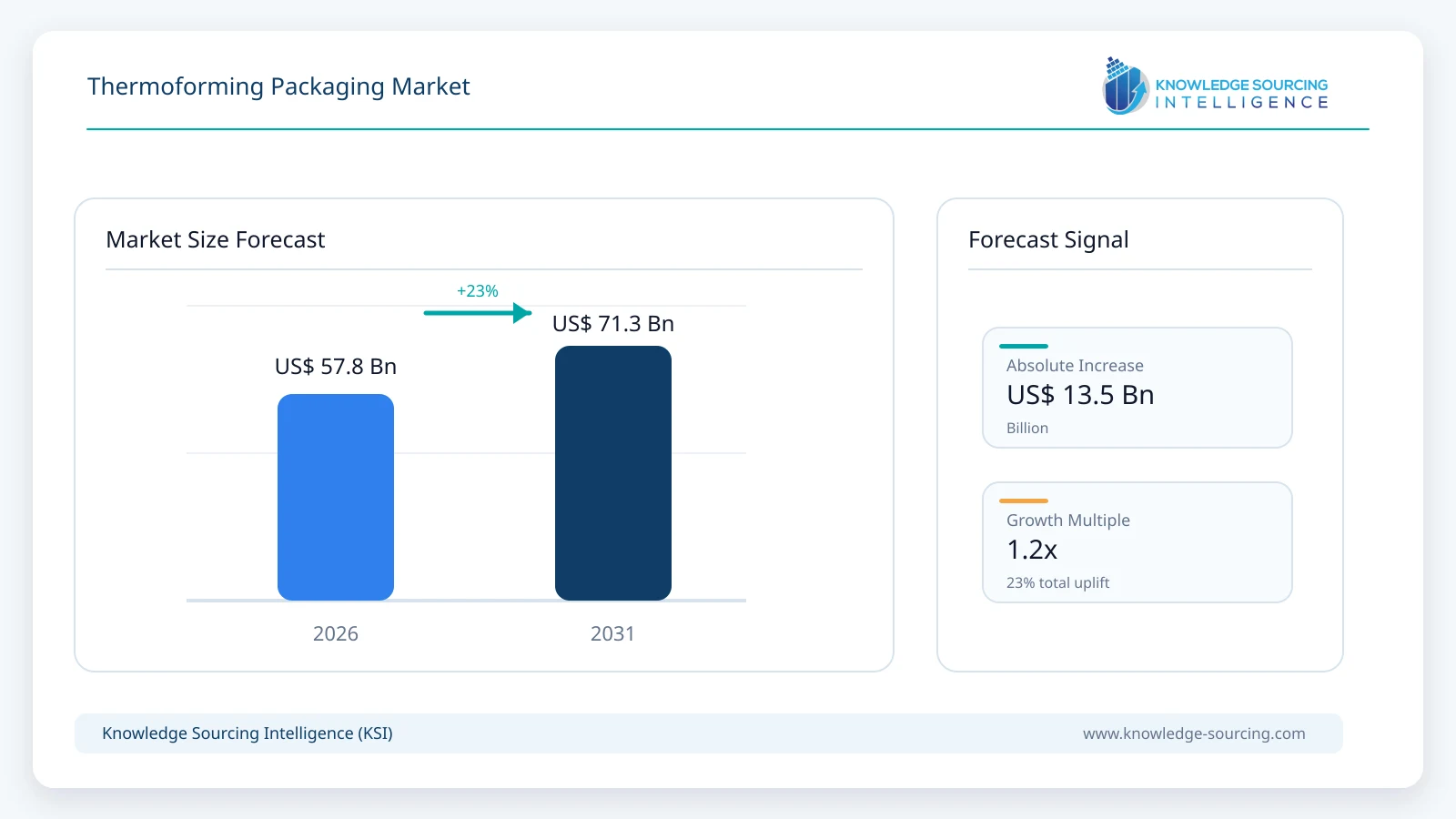
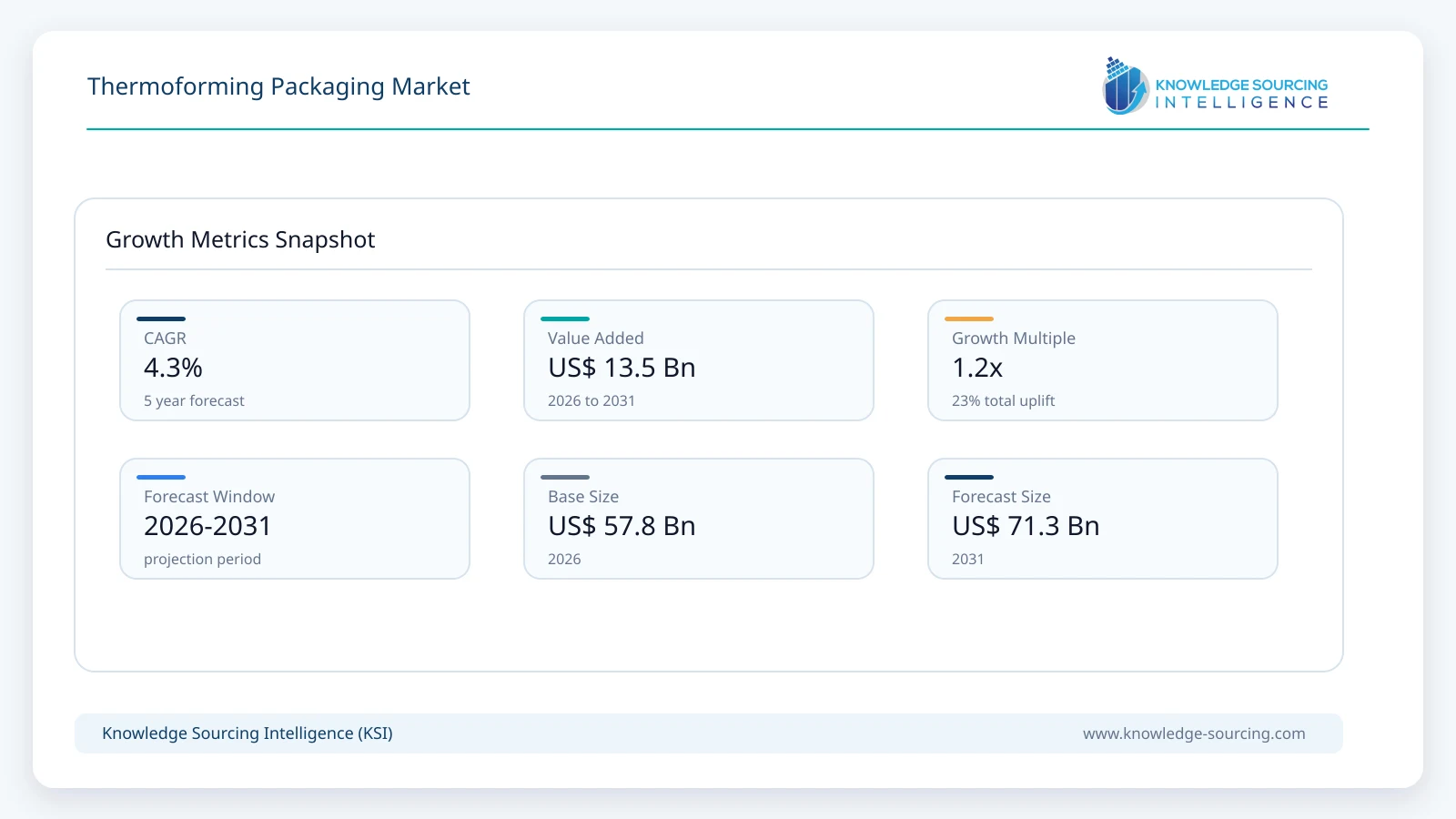
The Thermoforming Packaging Market is forecast to grow at a CAGR of 4.3%, reaching USD 71.3 billion in 2031 from USD 57.8 billion in 2026.
Highlights:
- 1Food packaging remains a major demand catalyst because trays, cups, containers, lids, and clamshells support portion control, product visibility, freshness, transport efficiency, and retail presentation.
- 2PET represents an important material opportunity where clarity, stiffness, food-contact performance, and recycled-content pathways align with customer packaging specifications.
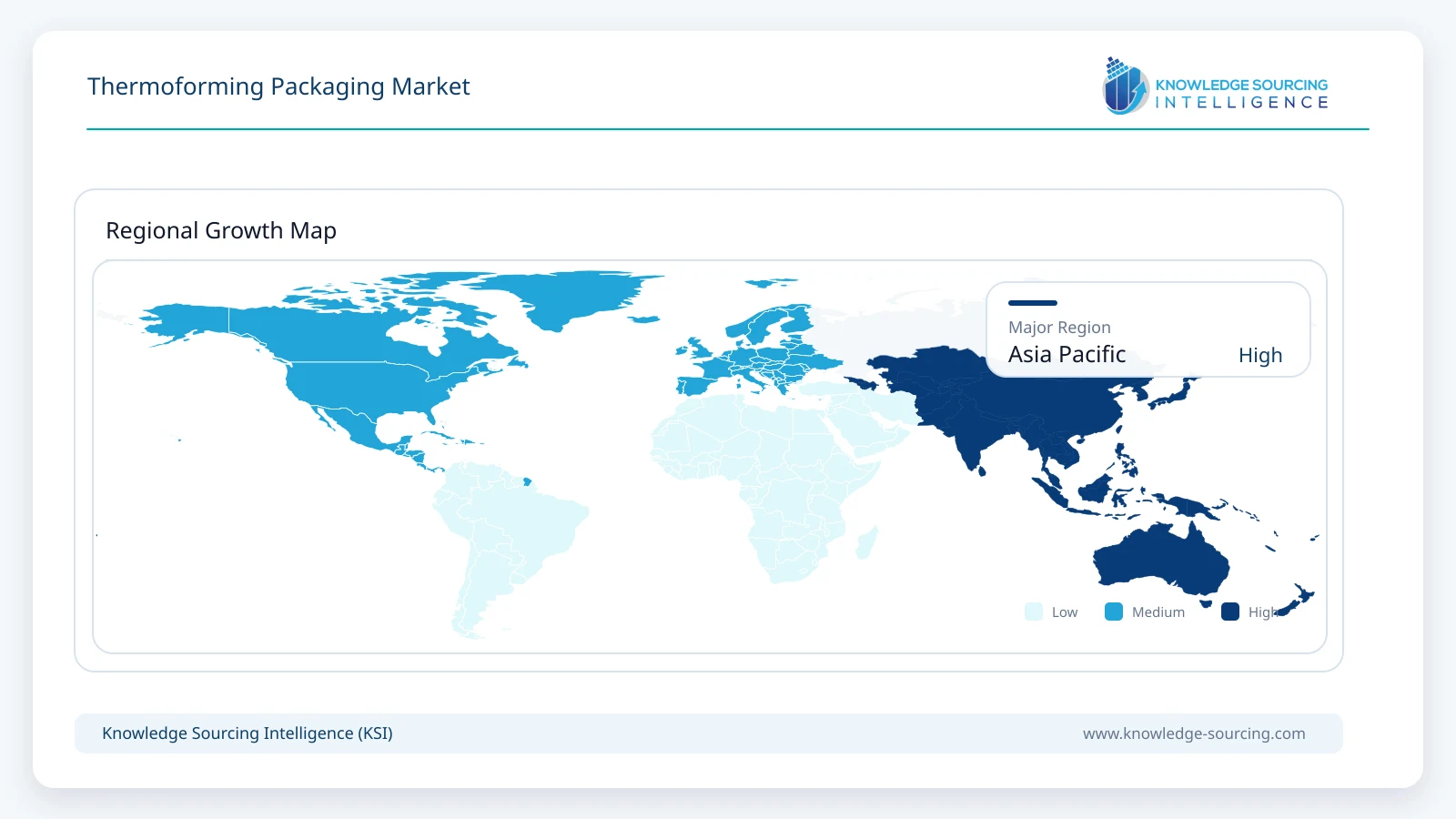
- 3Asia Pacific offers substantial manufacturing and consumption potential due to expanding food processing, consumer-product production, healthcare manufacturing, and packaging conversion capacity.
- 4Medical thermoforming is becoming more specification-driven, with cleanroom production, validation, traceability, and sterilization compatibility influencing supplier selection.
- 5Recycling regulation is affecting package design decisions by increasing the commercial importance of material identification, recycled content, recyclability, and producer-responsibility requirements.
- 6Competition is increasingly based on integrated capability, including engineering, tooling, forming, sealing, material development, quality systems, and regional supply infrastructure.
The Thermoforming Packaging Market covers the manufacture and commercial supply of packaging components produced by heating thermoplastic sheet or film and forming it over a mold. The resulting formats include clamshells, blisters, trays, cups, containers, lids, and other shaped components used to protect, display, contain, transport, or organize products. The market encompasses material selection, sheet production or sourcing, tooling, forming, trimming, sealing, decoration, quality control, and packaging conversion.
Thermoforming occupies an important position in rigid and semi-rigid packaging because manufacturers can produce application-specific geometries without relying on the comparatively high material and tooling intensity associated with some alternative forming processes. The commercial proposition varies by application. Food producers prioritize seal integrity, visibility, shelf life, temperature performance, stackability, and material compliance. Medical and pharmaceutical buyers place greater weight on sterility, dimensional consistency, validation, traceability, and compatibility with sterilization processes. Retail and consumer-product manufacturers generally place greater emphasis on product visibility, tamper resistance, shelf presentation, handling, and unit economics.
The demand environment is therefore determined less by a single packaging trend and more by the operating requirements of the industries purchasing thermoformed products. Prepared foods, fresh produce, dairy, bakery products, medical devices, pharmaceutical delivery systems, electronics, personal-care products, hardware, and industrial components all use different thermoforming specifications. TOPPAN, for example, identifies thermoformed applications across prepared and frozen foods, produce, retail, medical packaging, and pharmaceutical applications, while its medical operation provides cleanroom-manufactured trays, blisters, tubs, and related formats.
Buyer procurement decisions increasingly involve the complete package system rather than only the formed plastic component. Customers evaluate resin availability, recycled-content qualification, forming performance, tooling costs, cycle times, sealing requirements, logistics, quality documentation, and end-of-life considerations. This favors suppliers that can combine engineering, tooling, material expertise, forming, sealing, and quality management. Dordan, for example, combines package design, tooling, thermoforming, and cleanroom manufacturing, while Blisterpak operates design, tooling, thermoforming, printing, sealing, and contract-packaging capabilities.
Material economics remain central to market performance. PET is particularly relevant where clarity, stiffness, food-contact suitability, and recycled-content options are required. PP is important where microwaveability, thermal resistance, and lightweight food containers are priorities. HIPS remains relevant where rigidity and cost are important, while PVC continues to serve selected blister and retail applications. PE and HDPE provide options for applications requiring specific toughness, chemical resistance, or processing characteristics. Material selection is consequently determined by the required combination of barrier properties, stiffness, impact performance, heat resistance, transparency, sealing behavior, regulatory status, and cost.
Regulation is changing the purchasing equation. In the European Union, Regulation (EU) 2025/40 on packaging and packaging waste entered into force on 11 February 2025 and applies from 12 August 2026. The European Commission issued additional implementation guidance in June 2026 to clarify selected provisions. In the United States, FDA requirements and review processes remain important for food-contact materials and recycled plastics used in food packaging. FDA evaluates recycled plastic processes for potential contamination and food-contact suitability, creating a technical qualification requirement for suppliers seeking to expand recycled-content applications.
Consequently, commercial competition is shifting toward packaging performance combined with material efficiency, recycled-content capability, compliance support, supply continuity, and customer-specific engineering. The market's next phase will depend on how effectively thermoformers manage resin economics, recycling requirements, tooling investment, quality assurance, and regional production while preserving the cost advantages that make thermoforming attractive.
Market Drivers
Expansion of Prepared Food, Fresh Produce, and Convenience Packaging
Food manufacturers purchase thermoformed packaging when the package must perform several functions simultaneously: contain the product, protect it during distribution, support merchandising, and maintain acceptable product quality through the intended shelf period. Clear clamshells allow retailers and consumers to inspect produce, while trays and bowls can accommodate prepared meals, deli products, bakery products, and other ready-to-eat formats. TOPPAN specifically supplies clamshells for berries, eggs, and leafy greens and thermoformed trays and bowls for prepared and frozen foods.
The commercial implication is that packaging suppliers are competing on package geometry, sealing performance, material reduction, machinability, stacking, and compatibility with automated filling and sealing equipment. Food producers do not simply purchase a plastic tray; they purchase a component that must operate within an existing packaging line. Suppliers capable of validating the formed package with sealing equipment can reduce qualification work for customers and strengthen account retention.
Healthcare Packaging Requirements Are Supporting Higher-Specification Thermoforming
Medical device and pharmaceutical applications impose requirements that are materially different from ordinary retail packaging. A thermoformed medical tray may need to maintain device positioning, protect delicate components, support sterile barrier packaging, withstand sterilization, and remain dimensionally consistent throughout distribution. These requirements raise the importance of controlled production environments, process validation, documentation, and quality systems.
TOPPAN's TEQ operation provides medical thermoforming under ISO 13485 and ISO 9001 systems and uses controlled environments, validation procedures, and traceability processes. Dordan similarly operates ISO 13485-certified systems and an ISO Class 8 cleanroom for medical packaging.
This creates an attractive commercial niche for suppliers able to move from prototype development to validated production. Healthcare buyers tend to place greater emphasis on quality history and regulatory documentation than on the lowest nominal unit price. Once a packaging design is validated and integrated into a medical product's manufacturing process, switching suppliers can involve tooling, validation, documentation, and qualification costs. This can create longer customer relationships and greater value per program for capable thermoformers.
Demand for Lightweighting and Recycled-Content Solutions
Packaging buyers are examining resin consumption because material cost, transportation weight, producer-responsibility charges, and environmental requirements increasingly influence total package economics. Thermoforming provides design flexibility that can support material reduction through geometry optimization, gauge management, cavity design, and efficient nesting. However, lightweighting cannot compromise stiffness, sealing, impact resistance, or automated handling.
Recycled-content adoption is also creating new qualification requirements. FDA states that recycled plastics intended for food-contact applications must be assessed for contamination, suitability of the recycling process, and intended conditions of use. Its database contains reviewed processes for recycled PET and other materials. This means recycled-content claims increasingly require documented material provenance and process controls rather than simply substituting recycled resin into an existing specification.
Greater Integration Between Packaging Design and Production Equipment
Thermoformed packaging must be designed around forming behavior, tooling, trimming, sealing, filling, stacking, and downstream handling. Packaging suppliers that control several of these stages can reduce development iterations and production variability. Blisterpak, for example, combines design, CNC and die-shop capabilities, thermoforming, printing, sealing, and programs for low- and medium-volume orders.
The purchasing implication is important for brands launching new products or modifying existing packaging. A supplier that can engineer the package and tooling together can address material distribution, draft, cavity geometry, sealing surfaces, and automation requirements before full production. This can reduce tooling revisions and shorten qualification cycles.
Growth of Regionalized Packaging Supply Chains
Large packaging buyers increasingly require suppliers to support production close to their own manufacturing and distribution operations. Regional manufacturing reduces freight exposure, shortens replenishment cycles, and can simplify inventory management for bulky formed packaging that consumes significant logistics space relative to its weight.
TOPPAN's thermoforming network includes multiple U.S. sites as well as operations in Poland and Mexico. Placon established a 150,000-square-foot third-party logistics facility in Costa Rica in June 2025 to support medical packaging customers in Central and South America and reduce regional supply-chain friction. These actions illustrate how geographic proximity can become part of the product proposition rather than merely a logistics consideration.
Market Restraints and Challenges
Resin Price Volatility and Margin Exposure
Thermoformers are exposed to changes in polymer prices because resin and sheet represent a substantial portion of packaging input costs. PET, PP, HIPS, PVC, and PE can experience different supply-demand conditions depending on feedstock economics, production outages, regional capacity, and recycled-resin availability. Packaging contracts may not always allow immediate recovery of cost increases, placing pressure on converter margins.
Suppliers mitigate this exposure through material sourcing diversification, contractual price mechanisms, inventory planning, gauge reduction, and optimization of scrap rates. The challenge is more complex for recycled materials because price and availability depend on collection, sorting, cleaning, and reprocessing economics rather than only virgin-polymer markets.
Recycled Material Qualification and Supply Consistency
Recycled content creates a technical trade-off between sustainability objectives and consistent processing performance. Variation in feedstock can influence color, intrinsic viscosity, contamination, moisture, melt behavior, or mechanical characteristics. For food-contact applications, regulatory suitability adds another qualification layer.
FDA's framework illustrates why food-contact recycled plastics require evidence about source controls, recycling processes, contaminant removal, and intended use. Thermoformers therefore need stronger incoming-material specifications, supplier audits, testing protocols, and traceability systems when increasing recycled content.
Regulatory Fragmentation Across Markets
Packaging suppliers serving multiple regions must manage different rules concerning recycled content, labeling, producer responsibility, food contact, waste management, and packaging design. The EU's PPWR adds a broad regulatory framework affecting packaging placed on the European market, while India continues to operate an extended-producer-responsibility framework under its Plastic Waste Management Rules. India's Ministry of Environment, Forest and Climate Change reported that its 2024 amendments strengthened online reporting and EPR implementation for plastic packaging.
Regulatory fragmentation can increase documentation and compliance costs, especially for companies selling identical packaging platforms into several countries. The mitigation strategy is to develop material and design architectures that meet the strictest commercially relevant requirements where economically practical.
Tooling Economics for Customized and Lower-Volume Programs
Thermoforming is attractive when production volumes justify tooling and setup costs, but highly customized designs can become expensive when volumes are low or product specifications change frequently. Mold complexity, cavity count, material gauge, trimming requirements, and sealing geometry all influence the economics of a program.
Suppliers are addressing this constraint through rapid prototyping, standardized tooling approaches, modular systems, shared production programs, and digital design processes. Blisterpak's combination-run model, for example, groups compatible low- and medium-volume orders to distribute setup and tooling economics across programs.
Major Segment Analysis
Polyethylene Terephthalate (PET)
PET is a commercially important material segment because it combines clarity, stiffness, dimensional performance, and broad packaging familiarity with established recycling infrastructure in many markets. These characteristics make PET particularly relevant to food containers, produce packaging, clamshells, trays, and selected healthcare and consumer applications.
For food manufacturers, PET can support high product visibility while providing sufficient rigidity for stacking, transportation, and retail handling. The ability to incorporate recycled PET is another commercial consideration. FDA maintains a specific review framework for recycled plastics used in food-contact applications and publishes favorable opinions for qualifying recycling processes.
Buyer requirements are becoming more precise. A food company considering PET thermoforming may evaluate recycled-content percentage, optical clarity, sealability, stiffness, thickness distribution, food-contact status, recyclability claims, and compatibility with existing forming and filling equipment. For healthcare customers, PET-based materials may be assessed against sterilization, clarity, dimensional stability, barrier, and validation requirements.
Competition within PET thermoforming therefore extends beyond resin price. Suppliers differentiate through access to recycled PET, material formulation, sheet quality, forming consistency, lightweighting capability, tooling design, and customer-specific engineering. Placon's EcoStar product family demonstrates the direction of this market, with the company introducing thermoformed food packaging containing recycled PET and continuing to expand its PET product range.
The commercial opportunity is strongest where PET can satisfy both performance and circularity requirements without requiring major changes to packaging equipment. However, the segment remains exposed to recycled-feedstock availability, quality variation, resin pricing, and differences in recycling infrastructure across countries. Suppliers that can document recycled content and maintain consistent forming performance are better positioned to convert sustainability requirements into repeat packaging programs.
Regional Analysis
North America
North America has a mature thermoforming base supported by foodservice, prepared foods, fresh produce, healthcare, consumer goods, electronics, and industrial applications. Procurement tends to emphasize supply reliability, package performance, tooling responsiveness, food-contact compliance, and total delivered cost.
The United States also has a technically developed medical thermoforming ecosystem. Suppliers such as Dordan operate cleanroom production and ISO 13485-certified quality systems, while TOPPAN maintains multiple thermoforming facilities and healthcare capabilities across the region.
Regulatory pressure around food-contact substances and recycled plastics is encouraging more documented material qualification. FDA's recycled-plastics review process is particularly relevant to PET and other recycled polymers used in food-contact packaging. Canada and Mexico add cross-border supply opportunities, particularly for companies operating integrated North American manufacturing networks.
Europe
Europe is a regulation-led market in which packaging design increasingly has to account for recyclability, material efficiency, producer responsibility, and packaging waste requirements. The PPWR entered into force in February 2025 and began applying from August 2026, with the European Commission issuing implementation guidance in June 2026.
For thermoformers, the commercial consequence is greater attention to material selection, package design, recycled content, recyclability, and supporting documentation. Food and healthcare remain important application areas, while suppliers with European production can reduce logistics complexity for regional customers. The main constraint is the cost and technical work required to adapt existing package designs to evolving requirements.
Asia Pacific
Asia Pacific combines large consumer markets with substantial food processing, electronics, healthcare manufacturing, and industrial production. China, India, Japan, South Korea, Indonesia, and Thailand each present different combinations of domestic consumption, export manufacturing, regulatory development, and packaging infrastructure.
Regulatory developments are strengthening the emphasis on material circularity. China implemented GB/T 45091-2024 on limits for restricted substances in recycled plastics from June 2025, while GB/T 45090-2024 on identification and marking of recycled plastics also took effect in June 2025. A further national standard project covering identification marks for easy collection and recycling of plastic packaging was initiated in 2025.
India presents a substantial packaging conversion opportunity alongside stronger producer-responsibility requirements. India's Ministry of Environment reported the generation and transfer of large volumes of EPR certificates under its plastic-packaging framework and highlighted enhanced online reporting requirements. The regional challenge is uneven recycling infrastructure and different regulatory requirements between countries.
Middle East and Africa
Demand in the Middle East and Africa is concentrated around food processing, retail, consumer products, healthcare, and industrial activity. Gulf markets provide opportunities for packaged foods, retail products, and healthcare applications, while South Africa has a comparatively developed packaging and recycling ecosystem.
Purchasers in these markets are generally sensitive to import dependence, logistics costs, resin availability, and supply continuity. Local or regional converting capacity can therefore provide a meaningful commercial advantage. Suppliers with standardized product platforms and flexible production capabilities can serve customers across multiple applications while controlling tooling and inventory complexity.
South America
South America offers demand opportunities from food processing, fresh produce, consumer goods, healthcare, and retail. Brazil is the largest market in the supplied geographic segmentation and provides a broader manufacturing base than many neighboring countries.
Regional competition is influenced by resin availability, currency conditions, freight costs, and customer concentration. Medical packaging presents a higher-specification opportunity, particularly where multinational device manufacturers require consistent quality systems and regional supply. Placon's Costa Rica logistics investment illustrates the broader importance of locating packaging inventory close to medical manufacturing clusters in Latin America.
Competitive Landscape
The competitive structure of the Thermoforming Packaging Market includes global packaging groups, specialized thermoformers, regional manufacturers, and integrated packaging suppliers. Competition is not based solely on forming capacity. Customers assess engineering support, tooling ownership, material availability, quality certifications, geographic coverage, production flexibility, and the supplier's ability to maintain specifications over long production programs.
Amcor plc competes through broad packaging capabilities and increasing emphasis on healthcare thermoforming, food applications, recycled-content solutions, and geographically distributed manufacturing. Its 2025 and 2026 announcements show investment in thermoformed healthcare trays, rollstock, cleanroom capabilities, and food-packaging applications.
TOPPAN Holdings Inc. has built its thermoforming portfolio through acquisitions and operates an integrated platform spanning food, retail, medical, pharmaceutical, and consumer packaging. Its network combines thermoforming, tooling, sealing machinery, and regional production.
Novolex Holdings, Inc. participates in thermoformed food packaging through trays, containers, hinged-lid products, and related formats. Its product portfolio demonstrates the importance of serving foodservice and prepared-food requirements with standardized and application-specific tray formats.
Placon Corporation competes through thermoformed food, medical, and consumer packaging, with particular emphasis on recycled PET materials and regional customer support. Its recent Costa Rica logistics investment indicates an effort to shorten supply chains for medical customers in Central and South America.
VisiPak, a Division of Sinclair & Rush, Inc. has a strong position in clear packaging, stock clamshells, blisters, trays, and customized thermoformed solutions. Sinclair & Rush states that VisiPak developed from clear packaging into a broader portfolio of clamshells, blisters, and trays.
Blisterpak, Inc. competes through integrated design, tooling, thermoforming, printing, sealing, and contract packaging, with production programs ranging from smaller runs to larger automated requirements.
Dordan Manufacturing, Inc. competes through vertically integrated engineering, tooling, thermoforming, cleanroom manufacturing, and quality systems. Its capabilities cover medical, electronics, automotive, industrial, and consumer applications.
Across these companies, the competitive model is moving toward capability depth rather than a single-product proposition. Large suppliers can compete through geographic reach and portfolio breadth, while specialist thermoformers can compete through customization, engineering responsiveness, lower-volume flexibility, tooling control, and application-specific expertise.
Recent Developments
June 2026: Amcor announced cleanroom certification at its Carolina, Puerto Rico thermoforming facility, expanding its healthcare thermoforming network and strengthening regional sterile-packaging supply capabilities.
February 2026: Amcor announced continued investment in thermoforming capabilities for ready meals and dairy foods, highlighting recycle-ready designs, lightweight constructions, extended shelf-life formats, and food-packaging applications.
June 2025: Placon opened a 150,000-square-foot third-party logistics facility in Costa Rica to support medical-packaging customers across Central and South America and improve regional inventory and distribution.
Regulatory and Policy Environment
The regulatory environment is becoming an important determinant of thermoformed packaging design and procurement. In Europe, Regulation (EU) 2025/40 establishes a harmonized framework for packaging and packaging waste. It entered into force on 11 February 2025 and applies from 12 August 2026. The European Commission issued implementation guidance in June 2026 to provide additional clarity on selected provisions.
For thermoformers selling food-contact packaging in the United States, FDA requirements govern the safety status of food-contact substances. Recycled plastics introduce additional scrutiny because the recycling process must demonstrate adequate contaminant control and suitability for the intended food-contact application.
India's Plastic Waste Management framework also affects packaging producers and importers through extended producer responsibility. The Ministry of Environment's 2024 amendments strengthened online reporting and clarified obligations involving plastic packaging and obligated entities. Its 2024–25 annual report stated that more than 104 lakh tonnes of EPR certificates had been generated by registered plastic-waste processors, with 86.96 lakh tonnes transferred online to registered producers, importers, and brand owners at the time reported.
China is also strengthening technical requirements around recycled plastics. GB/T 45090-2024, concerning identification and marking of recycled plastics, became effective in June 2025, while GB/T 45091-2024 addresses restricted substances in recycled plastics. A 2025 national standard project further addressed identification for plastic packaging designed for easier collection and recycling.
These policies do not eliminate plastic thermoforming demand; instead, they change the economics of material selection and package design. Suppliers must increasingly demonstrate where material originates, how it performs, whether it can enter applicable recycling streams, and whether claims about recycled content or recyclability can be supported. This favors companies with stronger documentation, testing, material traceability, and design capabilities.
Thermoforming Packaging Market Scope
| Report Metric | Details |
|---|---|
| Total Market Size in 2026 | USD 57.8 billion |
| Total Market Size in 2031 | USD 71.3 billion |
| Forecast Unit | Billion |
| Growth Rate | 4.3% |
| Study Period | 2021 to 2031 |
| Historical Data | 2021 to 2024 |
| Base Year | 2025 |
| Forecast Period | 2026 – 2031 |
| Segmentation | Material, Type, End-User, Geography |
| Companies |
|
Market Segmentation
By Material
Polyethylene Terephthalate (PET)
Polypropylene (PP)
Polyvinyl Chloride (PVC)
Polystyrene/High-Impact Polystyrene (PS/HIPS)
Polyethylene/High-Density Polyethylene (PE/HDPE)
Other Plastics
By Type
Clamshell Packaging
Blister Packaging
Thermoformed Trays
Containers and Cups
Lids and Other Thermoformed Components
Others
By End-User
Food and Beverage
Pharmaceuticals
Medical Devices and Healthcare
Electronics
Cosmetics and Personal Care
Consumer Goods and Retail
Industrial and Automotive
Others
By Geography
North America
USA
Canada
Mexico
South America
Brazil
Argentina
Others
Europe
Germany
France
United Kingdom
Spain
Italy
Others
Middle East and Africa
Saudi Arabia
UAE
South Africa
Others
Asia Pacific
China
India
Japan
South Korea
Indonesia
Thailand
Others
Table of Contents
1. EXECUTIVE SUMMARY
2. MARKET SNAPSHOT
2.1. Market Overview
2.2. Market Definition
2.3. Scope of the Study
2.4. Market Segmentation
3. BUSINESS LANDSCAPE
3.1. Market Drivers
3.2. Market Restraints
3.3. Market Opportunities
3.4. Sustainability and Circular Economy Trends
3.5. Porter’s Five Forces Analysis
3.6. Industry Value Chain Analysis
3.7. Policies and Regulations
3.8. Strategic Recommendations
4. TECHNOLOGICAL OUTLOOK
4.1. Vacuum Thermoforming
4.2. Pressure Thermoforming
4.3. Twin-Sheet Thermoforming
4.4. Inline and Roll-Fed Thermoforming
4.5. Automation and Robotics
4.6. Recycled-Content and Lightweight Thermoforming
5. THERMOFORMING PACKAGING MARKET BY MATERIAL
5.1. Introduction
5.2. Polyethylene Terephthalate (PET)
5.3. Polypropylene (PP)
5.4. Polyvinyl Chloride (PVC)
5.5. Polystyrene/High-Impact Polystyrene (PS/HIPS)
5.6. Polyethylene/High-Density Polyethylene (PE/HDPE)
5.7. Other Plastics
6. THERMOFORMING PACKAGING MARKET BY TYPE
6.1. Introduction
6.2. Clamshell Packaging
6.3. Blister Packaging
6.4. Thermoformed Trays
6.5. Containers and Cups
6.6. Lids and Other Thermoformed Components
6.7. Others
7. THERMOFORMING PACKAGING MARKET BY END-USER
7.1. Introduction
7.2. Food and Beverage
7.3. Pharmaceuticals
7.4. Medical Devices and Healthcare
7.5. Electronics
7.6. Cosmetics and Personal Care
7.7. Consumer Goods and Retail
7.8. Industrial and Automotive
7.9. Others
8. THERMOFORMING PACKAGING MARKET BY GEOGRAPHY
8.1. Introduction
8.2. North America
8.2.1. USA
8.2.2. Canada
8.2.3. Mexico
8.3. South America
8.3.1. Brazil
8.3.2. Argentina
8.3.3. Others
8.4. Europe
8.4.1. Germany
8.4.2. France
8.4.3. United Kingdom
8.4.4. Spain
8.4.5. Italy
8.4.6. Others
8.5. Middle East and Africa
8.5.1. Saudi Arabia
8.5.2. UAE
8.5.3. South Africa
8.5.4. Others
8.6. Asia Pacific
8.6.1. China
8.6.2. India
8.6.3. Japan
8.6.4. South Korea
8.6.5. Indonesia
8.6.6. Thailand
8.6.7. Others
9. COMPETITIVE ENVIRONMENT AND ANALYSIS
9.1. Major Players and Strategy Analysis
9.2. Competitive Positioning and Market Share Analysis
9.3. Mergers, Acquisitions, Agreements, and Collaborations
9.4. Competitive Dashboard
10. COMPANY PROFILES
10.1. Amcor plc
10.2. TOPPAN Holdings Inc.
10.3. Novolex Holdings, Inc.
10.4. Placon Corporation
10.5. VisiPak, a Division of Sinclair & Rush, Inc.
10.6. Blisterpak, Inc.
10.7. Dordan Manufacturing, Inc.
11. APPENDIX
11.1. Currency
11.2. Assumptions
11.3. Base and Forecast Years Timeline
11.4. Key Benefits for the Stakeholders
11.5. Research Methodology
11.6. Abbreviations
Navigate
Trusted by the world's leading organizations











