
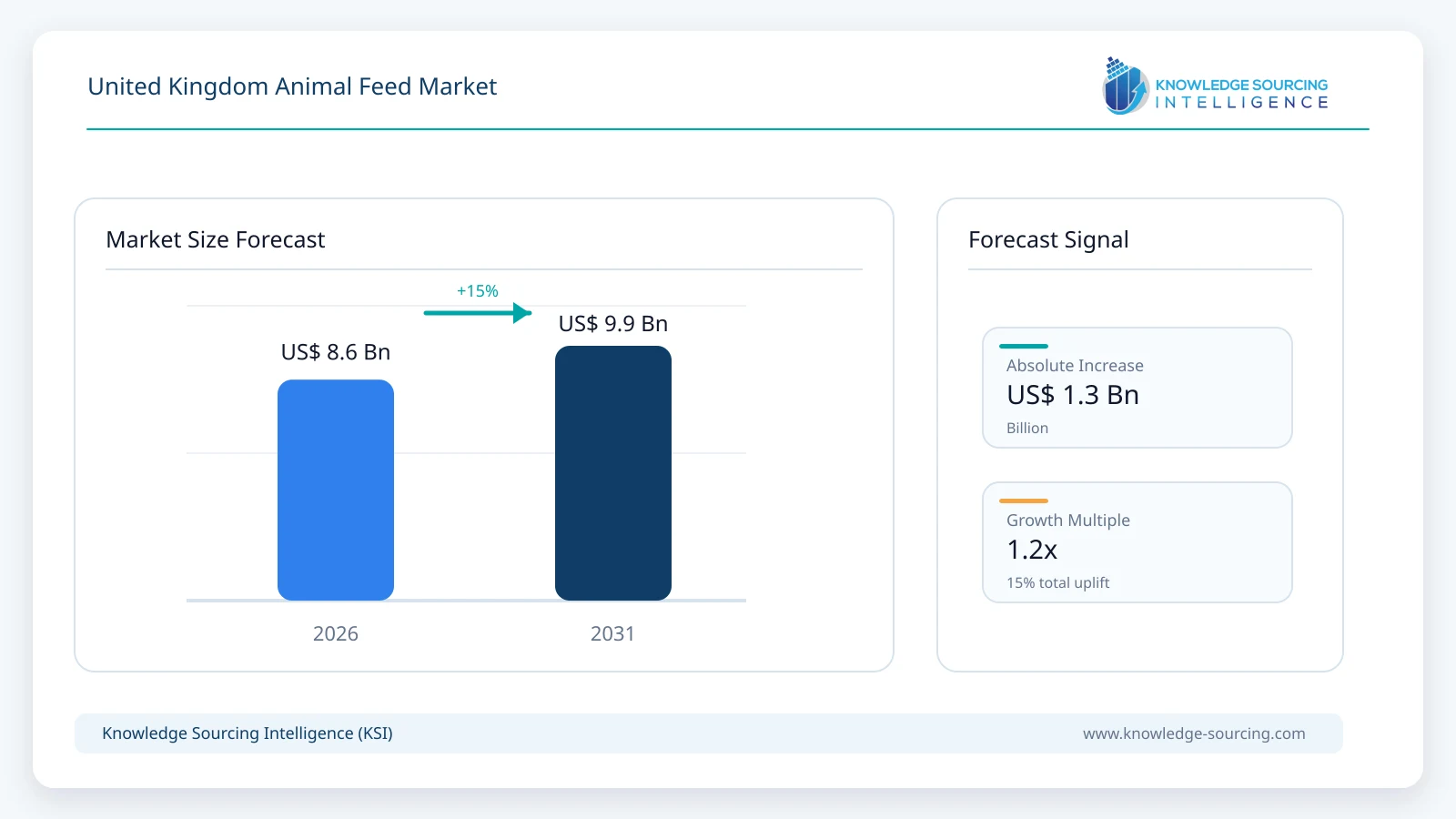
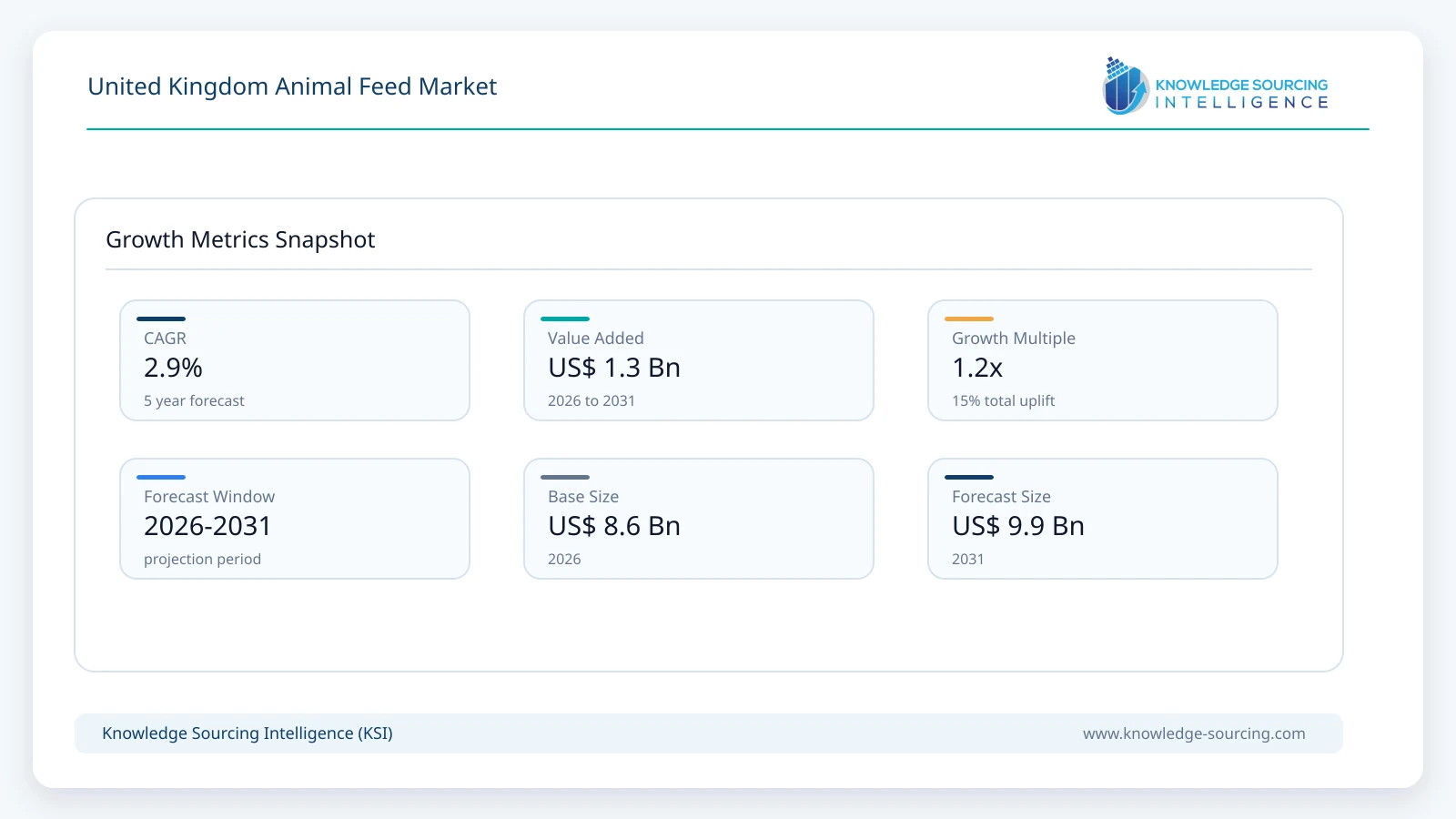
The United Kingdom animal feed market is estimated at USD 8.55 billion in 2026 and is projected to reach USD 9.86 billion by 2031, growing at a CAGR of 2.9% during the forecast period.
Highlights:
- 1Compound feed accounts for approximately 66% of market revenue in 2026.
- 2Poultry feed demand is projected to expand at approximately 3.2% annually through 2031.
- 3Commercial mills account for approximately 72% of UK animal-feed market value in 2026.
- 4Feed demand is being sustained by livestock productivity even as cattle and sheep populations decline.
- 5Lower-carbon formulations, precision nutrition and alternative feed ingredients are gaining commercial importance.
The UK feed industry combines large national compound-feed businesses, vertically integrated poultry feed operations and a substantial network of independent regional manufacturers serving dairy, beef, sheep, pig and poultry farms. Production remains highly exposed to agricultural commodity markets because wheat, barley, oilseed meals, maize and agricultural co-products account for a large proportion of formulation cost. In 2025, compound animal feed represented approximately £4.36 billion of UK agricultural intermediate consumption, while straight feeds represented a further £1.91 billion. Compound-feed production increased despite lower selling prices, demonstrating that underlying physical demand was stronger than the headline change in nominal expenditure suggested.
The feed-production mix is also changing. Cattle feed strengthened during 2024/25 as supportive beef and dairy economics encouraged producers to maintain output, while poultry demand is increasingly split between commercial compounders and vertically integrated poultry businesses. AHDB reported total GB feed production of 11.4 million tonnes during July 2024-April 2025, while cereal demand for animal feed remained above 13 million tonnes entering 2026. These volumes provide a relatively stable underlying demand base, although species-level requirements can change quickly with milk prices, poultry placements, pig profitability, grazing conditions and animal-disease events.
Market Trends
Precision Nutrition and Feed-Efficiency Focus
UK livestock producers are placing greater emphasis on feed efficiency, nutritional consistency and measurable animal performance as labor, energy and livestock-production costs remain elevated. Feed suppliers are consequently differentiating their products through ration formulation, forage analysis, nutritional advisory services and species-specific feeding programmes rather than relying solely on commodity-based compound feed. Dairy and beef operations increasingly evaluate feed according to margin over purchased feed, milk solids, daily liveweight gain and forage utilization, while poultry and pig businesses place greater emphasis on feed conversion ratios and production consistency.
This shift benefits companies with integrated nutritional and technical-support capabilities. NWF, Wynnstay, Mole Valley Feed Solutions, ForFarmers, Harbro and other major suppliers combine manufactured feed with ration formulation, farm advisory and performance-monitoring services. Greater availability of farm data also allows formulations to be adjusted more frequently in response to forage quality, ingredient prices and production objectives, increasing the commercial value of technical nutrition alongside the physical feed product.
Lower-Carbon Feed Formulations
Environmental performance is becoming a more visible consideration in raw-material procurement and feed formulation. Feed manufacturers are evaluating ingredient sourcing, transport distances, feed conversion, methane-reduction strategies and the carbon footprint associated with protein and energy ingredients. This does not mean lower-carbon ingredients automatically replace the lowest-cost formulation, but environmental data is becoming increasingly relevant for dairy, meat and egg supply chains that have downstream emissions-reduction commitments.
ForFarmers and ADM extended their collaboration in February 2026 around palm-kernel meal carrying a verified carbon footprint 25% below conventional alternatives, illustrating how ingredient-level emissions information is entering commercial feed procurement. UK manufacturers are also making greater use of co-products, locally available raw materials and precision formulation to reduce waste while maintaining livestock performance. The market opportunity is therefore moving toward formulations that combine economic efficiency with increasingly measurable environmental outcomes.
Market Drivers
Livestock Productivity Sustains Commercial Feed Demand
Commercial feed demand is being sustained by the economics of livestock output even though the total populations of several major species are declining. UK cattle numbers fell to approximately 9.3 million in 2025 and the sheep flock declined to about 30.5 million, but dairy cattle numbers were broadly stable and poultry increased by 4.1% to more than 183 million birds. Strong beef, lamb and dairy prices during portions of 2025 also encouraged farmers to increase feeding intensity where additional purchased feed generated profitable incremental production.
This relationship was visible in feed-production statistics. Compound-feed output increased in 2025, and AHDB reported cattle feed as the main source of recent production growth. NWF's feed volumes rose 2.4% to 559,000 tonnes in its 2026 financial year as favorable livestock economics supported ruminant demand during much of the period. Feed consumption is therefore increasingly driven by production efficiency and animal output rather than a straightforward relationship with livestock population growth.
Forage Variability Increases Purchased Feed Requirements
Weather and forage availability materially affect UK concentrate-feed consumption because cattle and sheep systems continue to depend on grass, silage and other home-grown feed. Poor grass growth or depleted forage reserves can increase purchased concentrate requirements even without growth in livestock numbers. AHDB expected compound-feed demand to remain elevated through 2026 partly because challenging grass-growing conditions had reduced forage availability and increased the requirement for cereals and purchased feed. Wheat use for animal feed was projected at approximately 7 million tonnes during the 2025/26 marketing year.
Feed suppliers benefit when farms need to compensate for variable forage quality, but the commercial opportunity increasingly involves balancing purchased feed against available forage rather than simply selling higher tonnage. Dairy, beef and sheep suppliers consequently combine compound feeds and blends with forage testing, ration formulation and alternative feeds, enabling formulations to change as silage quality, grass availability and commodity prices fluctuate.
Market Restraint
Raw-Material Price Volatility
Raw-material volatility remains the most important structural restraint because feed manufacturers operate on relatively high material costs while customers are highly sensitive to changes in ration economics. Wheat, barley, maize, soybean meal, rapeseed meal and other agricultural commodities respond to crop yields, international trade flows, exchange rates, energy costs and geopolitical disruption, creating significant swings in both purchasing cost and selling price.
The UK market experienced this effect during 2025 when compound-feed production increased by approximately 2%, but the value of compound-feed expenditure declined because cattle, pig, sheep and poultry feed prices all fell. NWF similarly reported higher feed volumes in its 2026 financial year while revenue declined from £204.6 million to £193.0 million because average commodity prices were lower. These conditions can constrain nominal market growth even when physical feed demand is expanding, while sharp upward movements can pressure livestock margins and cause producers to reformulate rations or reduce purchased-feed intensity.
Segment Analysis
By Type: Compound Feed
Compound feed remains the largest product category because commercial poultry, dairy, pig, beef and sheep operations require nutritionally balanced formulations that can deliver consistent performance across different stages of production. UK expenditure on compound feed alone reached approximately £4.36 billion in 2025, making it substantially larger than individual straight-feed or forage categories. Continued demand is supported by the scale of commercial poultry production, greater use of concentrates in high-output dairy systems and the requirement for precise protein, energy, mineral and additive combinations that cannot be replicated reliably through unformulated raw materials alone.
The segment is projected to approach USD 6.5 billion by 2031. Growth in physical tonnage is expected to remain moderate, but suppliers are gradually increasing revenue per tonne through specialist formulations, nutrition services, performance products and feeds designed around specific productivity or environmental objectives. Compound feed therefore remains the core revenue pool even though straights and forage continue to play important roles in UK livestock diets.
By Livestock: Poultry
Poultry represents the largest livestock feed application, accounting for approximately 39% of UK animal-feed revenue in 2026 when commercial poultry feed and vertically integrated production are considered together. The segment benefits from the country's large broiler and egg industries and from the feed-intensive nature of commercial poultry production, where virtually all nutritional requirements are delivered through manufactured formulations.
The UK poultry population increased by 4.1% to approximately 183 million birds in 2025, driven principally by a 7.6% increase in broilers to around 121 million. Integrated poultry units also remain an important component of national feed production. AHDB's July 2026 data recorded 297,000 tonnes of poultry feed from commercial compounders during the month plus another 207,000 tonnes produced by integrated poultry operations. Poultry feed demand is therefore less dependent on grazing or forage conditions than ruminant feed and is expected to remain one of the more consistent growth areas through 2031.
By Production System: Commercial Mills
Commercial mills remain the dominant production channel, supplying compound feeds, blends, straights and specialist products to independent livestock farms throughout the United Kingdom. The industry contains several large national manufacturers alongside a substantial regional network, creating a market where logistics, mill proximity, formulation capability and farm-level technical service remain important competitive factors.
Commercial-mill revenue is projected to expand at approximately 2.7% CAGR between 2026 and 2031, slightly below integrated production as poultry companies continue investing in internally produced feed. Commercial suppliers nonetheless retain a considerably larger overall revenue base and serve more diversified livestock categories. Regional manufacturers also remain competitive because transport cost can represent a meaningful component of delivered feed economics, allowing businesses such as GLW Feeds, Duffields, Massey Feeds, Harbro, Fane Valley Feeds and I'Anson to maintain strong positions alongside larger national suppliers.
Competitive Environment
The UK animal feed sector remains relatively fragmented outside several large manufacturers and integrated poultry operations. AB Agri's ABN business, ForFarmers UK and 2Agriculture have substantial positions in compound feed, while NWF Agriculture, Wynnstay, Mole Valley Feed Solutions and other regional manufacturers maintain strong positions in ruminant nutrition. Northern Ireland has a distinct manufacturing base led by companies including Thompson's, Fane Valley Feeds and United Feeds.
Mill utilization, geographic coverage and raw-material purchasing scale are major competitive factors because feed is relatively expensive to transport over long distances compared with its selling value. This supports regional competition even where national companies possess procurement advantages. Consolidation remains active where companies seek greater production density or access to new livestock regions. The UK Competition and Markets Authority cleared Boparan's acquisition through 2Agriculture of ForFarmers' Burston and Radstock feed mills in March 2025 after an in-depth review of competition in poultry feed.
Recent Developments
July 2026: NWF reported feed volumes of 559,000 tonnes, up 2.4% year on year, while its earlier investment in moist-feed production generated customer demand ahead of plan.
March 2026: Harbro completed the acquisition of J&W Tait's feed and fertiliser sales operations in Orkney, expanding its direct reach in northern Scotland and the islands.
February 2026: ForFarmers and ADM expanded their collaboration around lower-carbon palm-kernel meal carrying a verified 25% reduction in CO2 footprint compared with conventional alternatives.
August 2025: GLW Feeds acquired the Martley animal-feed mill in Worcestershire to expand production coverage across the West Midlands, Southwest England and Wales.
March 2025: The UK Competition and Markets Authority cleared 2Agriculture's acquisition of ForFarmers' Burston and Radstock poultry-feed mills following a Phase 2 investigation.
United Kingdom Animal Feed Market Scope
| Report Metric | Details |
|---|---|
| Total Market Size in 2026 | USD 8.55 billion |
| Total Market Size in 2031 | USD 9.86 billion |
| Forecast Unit | Billion |
| Growth Rate | 2.9% |
| Study Period | 2021 to 2031 |
| Historical Data | 2021 to 2024 |
| Base Year | 2025 |
| Forecast Period | 2026 – 2031 |
| Segmentation | Type, Livestock, Production System |
| Companies |
|
Market Segmentation
By Type
Compound Feed
Straight Feed
Fodder and Forage
Others
By Livestock
Poultry
Cattle
Swine
Sheep
Aquaculture
Others
By Production System
Commercial Mills
Integrated Producers
Table of Contents
1. EXECUTIVE SUMMARY
2. MARKET SNAPSHOT
2.1. Market Overview
2.2. Market Definition
2.3. Market Segmentation
2.4. Research Methodology
3. BUSINESS LANDSCAPE
3.1. Market Drivers
3.1.1. Livestock Productivity Sustains Commercial Feed Demand
3.1.2. Forage Variability Increases Purchased Feed Requirements
3.2. Market Restraint
3.2.1. Raw-Material Price Volatility
3.3. Market Opportunities
3.4. Porter's Five Forces Analysis
3.5. Industry Value Chain Analysis
3.6. Feed Safety and Regulatory Environment
3.7. Strategic Recommendations
4. MARKET TRENDS
4.1. Precision Nutrition and Feed-Efficiency Focus
4.2. Lower-Carbon Feed Formulations
4.3. Feed-Mill Consolidation and Production Efficiency
5. UNITED KINGDOM ANIMAL FEED MARKET BY TYPE
5.1. Introduction
5.2. Compound Feed
5.3. Straight Feed
5.4. Fodder and Forage
5.5. Others
6. UNITED KINGDOM ANIMAL FEED MARKET BY LIVESTOCK
6.1. Introduction
6.2. Poultry
6.3. Cattle
6.4. Swine
6.5. Sheep
6.6. Aquaculture
6.7. Others
7. UNITED KINGDOM ANIMAL FEED MARKET BY PRODUCTION SYSTEM
7.1. Introduction
7.2. Commercial Mills
7.3. Integrated Producers
8. COMPETITIVE ENVIRONMENT AND ANALYSIS
8.1. Major Players and Strategy Analysis
8.2. Market Share Analysis
8.3. Mergers, Acquisitions, Agreements and Collaborations
8.4. Competitive Dashboard
9. COMPANY PROFILES
9.1. AB Agri Ltd. / ABN
9.2. ForFarmers UK Limited
9.3. 2Agriculture Limited
9.4. NWF Agriculture
9.5. Wynnstay Group Plc
9.6. Mole Valley Feed Solutions
9.7. Harbro Limited
9.8. Fane Valley Feeds Limited
9.9. John Thompson & Sons Limited
9.10. W.L. Duffield & Sons Limited
9.11. GLW Feeds Limited
9.12. I'Anson Brothers Limited
9.13. Massey Feeds
9.14. United Feeds Limited
9.15. Chestnutt Animal Feeds Limited
10. APPENDIX
10.1. Currency
10.2. Assumptions
10.3. Base and Forecast Years Timeline
10.4. Key Benefits for Stakeholders
10.5. Research Methodology
10.6. Abbreviations
Navigate
Trusted by the world's leading organizations











