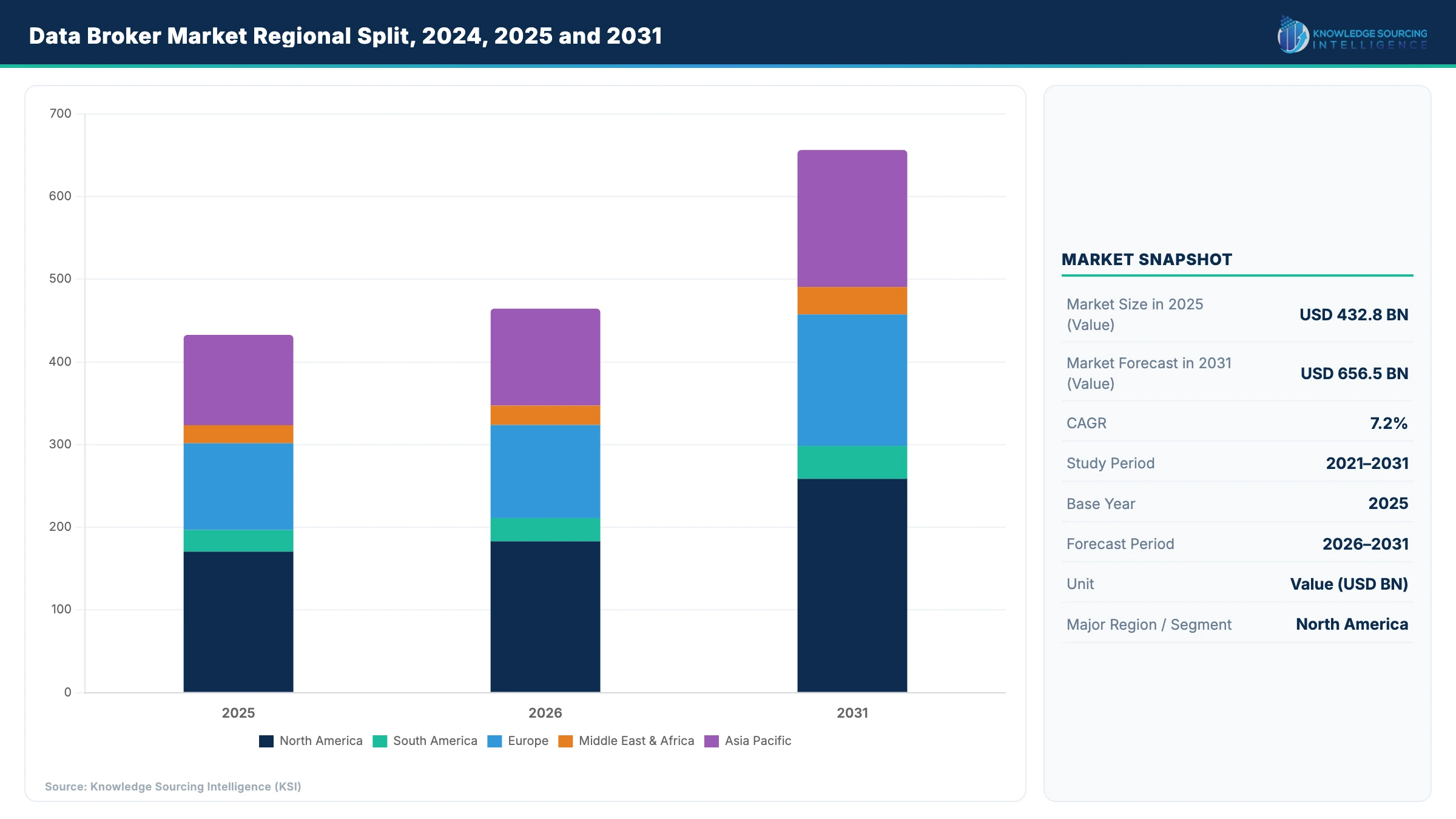
North America dominates the data broker market, accounting for 40% share in 2026, followed by Europe and Asia Pacific regions. The growth in Asia Pacific will outpace mature markets due to huge investments in digitalization and lax government regulations with respect to data security. Though, efforts are being made by various governments to ensure customer data is safe and within the geographic boundaries of the nation.
The governments are ensuring the data brokers register themselves to increase accountability.
For e.g., California Delete Act (SB 362), passed in 2023, strengthens consumer privacy by requiring data brokers to register with the state and mandating they delete consumer personal information upon request.
Digitalization, Internet of Things (IoT) penetration, government regulations are some of the key factors fuelling the market growth and consolidation by key market players.
Data Broker Market Size By Region, 2025, 2026 and 2031 (USD billion)
Region | 2025 | 2026 | 2031 | CAGR (2026 -2031) |
North America | 177.4 | 186.7 | 239.6 | 5.1% |
South America | 26.0 | 28.3 | 42.0 | 8.2% |
Europe | 106.0 | 112.4 | 154.3 | 6.5% |
Middle East and Africa | 23.8 | 24.2 | 31.5 | 5.5% |
Asia Pacific | 99.5 | 112.9 | 189.1 | 10.9% |
Source: Knowledge Sourcing Intelligence
Need specialized data cuts or competitive intelligence?
Our analyst team provides bespoke market sizing, supplier audits, and country-level feasibility reports tailored to your enterprise roadmap.
Speak With an Industry Analyst →Global Data Broker Market - Strategic Insights and Forecasts (2026-2031)
Data brokers are the companies that collect the information of users through the internet legally and further, provide this data to various companies operating across different industry verticals for the development of new marketing strategies. The burgeoning number of social media users worldwide, coupled with the high penetration of mobile devices, is further generating huge amounts of consumer data,
Ask an Industry Analyst
Have questions regarding this briefing or market projections? Inquire with our sector lead.
Related Infographics & Data
View All →
Surgical Mask Market Size and Forecast, 2026-2031
Aug 10, 2026
AI-Based Cancer Screening Market Regional Split, 2026, 2027 and 2031
May 21, 2026
Global UAV Battery Market Analysis, 2026
May 7, 2026
Email Security Market Share Analysis, By Solution Type, 2025, 2026 and 2031
Apr 23, 2026
Semiconductor Manufacturing Material Market Share by Material Type, 2025
Apr 21, 2026Additional Market Research Reports
Power-to-X Market Size, Share & Growth Forecast (2026-2031)
This Power-to-X market is fueled by the demand to transform excess renewable electricity into storable, transportable and sector-flexible energy carriers to bridge the gap between times when wind and solar energy is produced and when industry, transport and heating actually requires it. Power-to-X is a collection of electrolysis and downstream synthesis processes that convert electricity into hydrogen, synthetic fuel or chemical feedstock for decarbonizing sectors which are hard to abate by direct electrification, such as aviation, maritime shipping, and heavy industry.Policy frameworks are becoming more and more explicit growth catalysts. The European Commission's Renewable Energy Directive III implementation roadmap is driving up the use of renewable hydrogen in refining and transportation, thus raising the demand for electrolyzers and future power purchase agreements, and International Maritime Organisation (IMO) greenhouse gas reduction standards are changing the way low-carbon marine fuel is purchased by shipping companies. If the U.S. market is expanding at a lower rate than the EAP market then it is doing so due to federal incentive-driven growth, as the Hydrogen Shot is beginning to drive growth in the United States and there are broader commitments to net zero in the U.S. as well.A structurally significant development is the introduction of a dual-demand dynamic in which defense-industrial procurement of modular e-fuel production for military energy security is starting to overlap with the commercial e-fuel scaling ambition, thus creating a national-security procurement pathway in addition to the climate-policy demand historically driving the market.
Fermentative Hydrogen Production Market Size, Share & Growth Forecast (2026-2031)
The global Fermentative Hydrogen Production market is being driven by the emergence of dark and photo-fermentation as the most commercially advanced pathways within the broader biological hydrogen production landscape. Fermentative hydrogen production uses anaerobic and photosynthetic bacteria to convert organic substrates, food waste, agricultural residues, wastewater sludge, and industrial organic effluents into hydrogen gas, offering a production route that pairs naturally with existing anaerobic digestion and wastewater treatment infrastructure and simultaneously addresses organic waste management alongside clean fuel generation.Dark fermentation has become the leading pathway within biological hydrogen production specifically because it does not require light input, allowing it to run continuously using standard anaerobic digestion equipment and organic waste streams that are already being collected and processed at municipal and industrial waste facilities. Photo-fermentation, frequently deployed as a complementary second-stage process, uses photosynthetic bacteria to extract additional hydrogen yield from the organic acids left over after dark fermentation, allowing operators to sequence both pathways within a single integrated system to maximize hydrogen output from a given feedstock volume.Research and pilot-scale investment in fermentative hydrogen production has accelerated as nanocatalyst-enhanced dark fermentation, genome-resolved microbial engineering, and hybrid dark-photo fermentation systems have demonstrated measurable yield improvements, narrowing the historical cost and efficiency gap between fermentative hydrogen and both conventional grey hydrogen and electrolysis-based green hydrogen.
Biological Hydrogen Production Market Size, Share & Growth Forecast (2026-2031)
The global Biological Hydrogen Production market is being fuelled by the need for a truly carbon-neutral route to hydrogen that isn't reliant on fossil fuels (like for grey hydrogen and blue hydrogen) or requires significant electricity consumption (like green hydrogen based on electrolysis). Biohydrogen, also known as biological hydrogen, is a type of hydrogen production that involves the use of microorganisms, bacteria, cyanobacteria and microalgae, and produces hydrogen gas from organic waste, biomass or sunlight via dark fermentation, photo-fermentation and biophotolysis, which can address organic waste streams and provide a clean-burning fuel.The government's hydrogen strategies are growing increasingly clear on the need to diversify the production portfolio, and not exclusively rely on electrolysis. EU Hydrogen Strategy and U.S. Inflation Reduction Act's hydrogen production tax credit are directing funds towards scalable low-carbon hydrogen pathways, with the U.S. and EU announcing large-scale hydrogen hubs across the region in 2025, providing an opportunity to incorporate biohydrogen into future hydrogen supply chains alongside electrolysis and other hydrogen production methods, while offering a complementary technology in the broader hydrogen transition.The rapid industrialization, high amount of organic waste generated, intensive government roadmap for hydrogen, and continued investment in research and development in Asia-Pacific have made the region a clear leader regarding hydrogen deployment, while the cost-effectiveness and scalability of hydrogen production by dark fermentation have made it the primary process in the region compared to photo-fermentation and biophotolysis.