
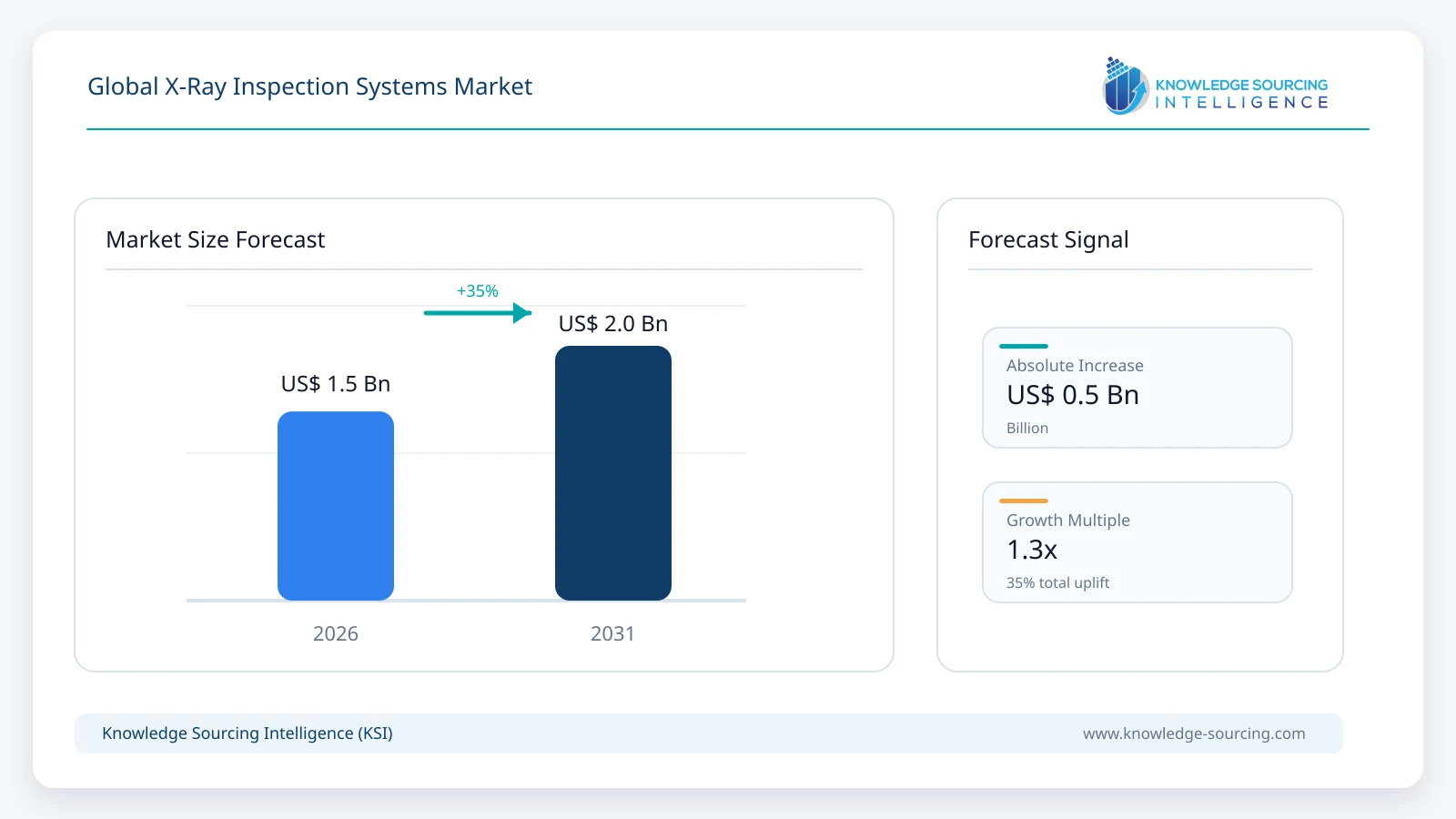
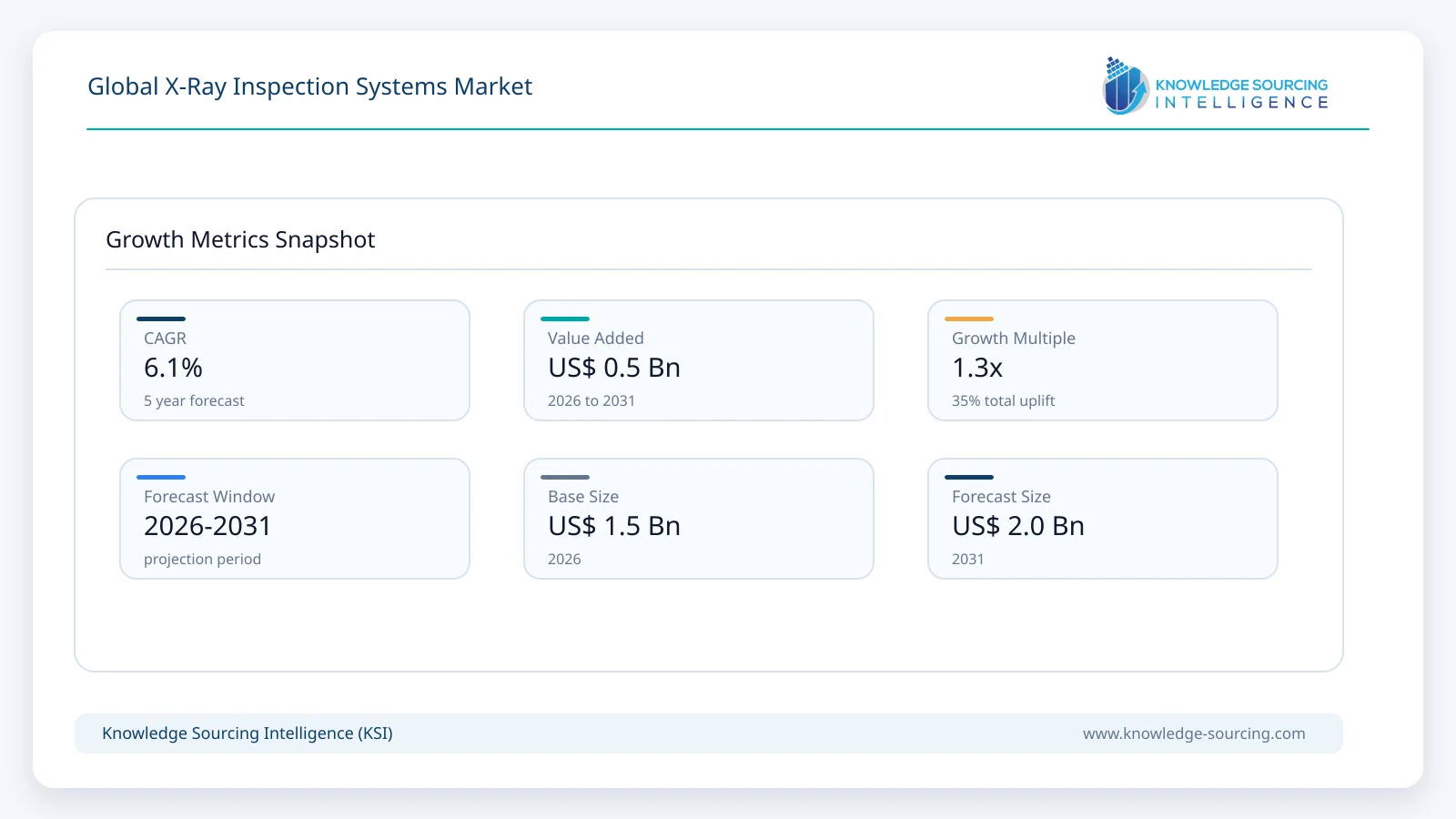
The global X-ray inspection systems market is estimated at USD 1.47 billion in 2026 and is projected to reach USD 1.98 billion by 2031, growing at a CAGR of approximately 6.1% during this period.
Highlights:
- 12D X-ray inspection systems account for approximately 62% of global market value in 2026.
- 2Computed tomography inspection is projected to grow at approximately 9.5% annually through 2031.
- 3Food and beverage applications generate about USD 412 million of market value in 2026.
- 4Asia Pacific accounts for approximately 35% of global X-ray inspection revenue in 2026.
- 5AI-assisted image analysis is improving defect recognition and reducing unnecessary product rejects.
- 6Semiconductor packaging and EV battery manufacturing are widening demand for high-resolution inspection.
Industrial X-ray inspection works by transmitting X-rays through a product or component and measuring differences in absorption. Dense materials absorb more radiation and appear differently from surrounding material in the resulting image. This allows manufacturers to locate internal defects that cannot be seen with cameras or surface metrology. Food systems commonly look for metal, glass, stone and bone while also checking fill level, missing items and package integrity. Electronics systems focus on solder joints, voids, vias and multilayer assemblies. Industrial CT reconstructs multiple projections into a three-dimensional representation that can be measured without cutting the part.
The commercial market is becoming more software-led as equipment suppliers add automated defect recognition, production monitoring and traceable inspection records. High-speed systems increasingly combine improved detectors with algorithms that classify anomalies and reduce false rejects. Industrial CT suppliers are improving acquisition speed so that 3D inspection can move closer to production environments rather than remaining limited to laboratories. Integration with factory networks is also becoming more important. Manufacturers want inspection results to connect with quality systems, production databases and process-control tools so that defects can be traced back to the relevant line, machine or batch.
Market Trends
AI-assisted image analysis is moving from decision support toward automated inspection
Artificial intelligence is becoming more important in applications where rule-based image processing produces too many false rejects or struggles with natural product variation. Sesotec is adding AI-based THiNK functions to its RAYCON platform for anomaly recognition. Nordson Test & Inspection is also combining advanced analytics with X-ray inspection for electronics manufacturing. These systems do not eliminate the need for stable imaging conditions, but they can improve classification when defect appearance varies from one product to another. The commercial effect is strongest where rejected products are costly or where inspection volumes make manual review impractical. Software capability is therefore becoming a larger part of system differentiation alongside detector resolution and line speed.
Higher-resolution 3D inspection is expanding in semiconductors, batteries and complex assemblies
Three-dimensional X-ray and computed tomography are gaining ground as manufacturers produce smaller and more complex assemblies. Advanced semiconductor packaging creates hidden interconnects that are difficult to evaluate using conventional optical inspection. Comet Yxlon is applying X-ray and CT to through-glass vias, solder bumps and other advanced-packaging structures. Similar requirements are emerging in electric-vehicle batteries, castings and aerospace components where internal voids, cracks or misalignment can affect reliability. Faster reconstruction and improved detector technology are making CT more practical for production support. This is gradually widening the addressable market beyond metrology laboratories and failure-analysis teams.
Inspection systems are becoming connected parts of the factory quality architecture
Manufacturers increasingly expect X-ray equipment to exchange information with production and quality-management systems. Anritsu supports remote monitoring and industrial connectivity across its product-inspection equipment, while industrial metrology vendors are linking imaging data with broader quality software. Connected inspection allows users to monitor reject patterns, compare performance across lines and preserve evidence for audits. It also supports preventive maintenance because changes in image quality, calibration or reject behavior can be identified earlier. This trend favors suppliers that can combine hardware with usable software, service support and integration tools rather than selling the scanner as a standalone machine.
Market Drivers
Food safety and product-integrity requirements support a broad installed base
Food and beverage manufacturers remain the largest end users of inline X-ray inspection. The technology can identify dense foreign materials that metal detectors may miss and can inspect products inside foil or metallized packaging. Modern systems also check count, mass distribution, fill level and package completeness. This makes one machine useful for both contaminant detection and quality assurance. Demand is strongest in processed foods, meat, dairy, bakery, prepared meals and packaged products with high throughput. As producers automate more of the line, X-ray inspection becomes easier to integrate with reject devices, checkweighers and centralized quality records. Replacement demand also remains important as older systems are upgraded for better sensitivity and lower false-reject rates.
Advanced electronics and semiconductor packaging increase the need for hidden-defect inspection
Electronics and semiconductor manufacturers are creating denser assemblies with smaller features and more hidden connections. Optical inspection cannot see through many package structures, which increases the importance of X-ray. Printed circuit boards require inspection of solder joints and ball-grid arrays. Semiconductor packages increasingly use advanced interconnects and stacked structures. Battery electronics and power modules add another source of demand. These applications support higher-value systems because buyers need fine resolution, repeatable positioning and more advanced image analysis. The result is a faster growth profile than mature food-inspection applications even though the installed base is smaller.
Automated manufacturing raises the value of non-destructive inspection data
Automotive, battery and aerospace producers are using more automated quality control as production tolerances tighten. X-ray and CT can inspect castings, welds, electronic assemblies and internal structures without destroying the part. This is especially valuable when the component is expensive or when destructive sampling would provide too little information about process variation. Inline and near-line systems can also feed defect data back into manufacturing processes. The ability to connect an internal defect with a specific batch or process condition increases the value of inspection beyond pass-or-fail sorting. This supports investment in faster systems and better software across high-value manufacturing environments.
Market Restraint
Capital cost and application complexity restrict adoption in lower-value inspection tasks
Advanced X-ray and CT systems remain more expensive than simpler inspection technologies. Users may need radiation shielding, application development, validation and operator training in addition to the scanner itself. Inspection performance also depends on the density contrast between the defect and the surrounding material. Very low-density contaminants can remain difficult to distinguish, while thick or dense products may require more powerful sources and longer exposure times. Industrial CT adds further complexity because reconstruction and interpretation can increase cycle time. These constraints do not prevent adoption in high-value applications, but they make the business case weaker when product value is low or when a metal detector, vision system or conventional gauge can solve the same problem at lower cost.
Segment Analysis
By Type - 2D X-Ray Inspection Systems
Two-dimensional systems remain the largest type because they are well suited to high-speed inline inspection. They are widely deployed in food, beverage, pharmaceuticals and electronics where the inspection task can be completed from one or several fixed views. KSI projects the segment to reach approximately USD 1.14 billion by 2031. Continued demand comes from replacement of older inspection lines, improved detector sensitivity and greater use of automated image analysis. Three-dimensional systems grow faster from a smaller base. Their value is strongest where defect position, internal geometry and volumetric measurement matter. The 3D segment is projected to approach USD 840 million by 2031 as industrial CT moves further into semiconductor, battery, automotive and aerospace inspection.
By Technology - Digital Radiography
Digital radiography remains the largest technology because it combines rapid acquisition with established inline inspection workflows. It is expected to exceed USD 1.1 billion in market value by 2031. Flat-panel and line-scan detectors continue to improve image quality while supporting automated processing. Computed tomography grows faster because it provides volumetric information that conventional radiography cannot. CT is particularly important for complex electronics, battery cells, precision castings and additive-manufactured parts. Computed radiography and film-based radiography remain relevant in narrower industrial applications, but they lose share as digital workflows improve and customers place greater value on immediate image access, analytics and traceable data.
By Industry Vertical - Food and Beverage
Food and beverage remains the largest industry vertical because X-ray inspection is already integrated into many high-throughput production lines. KSI projects the segment to reach approximately USD 525 million by 2031. Growth is supported by replacement demand, higher sensitivity and broader use of quality checks beyond foreign-material detection. Electronics and semiconductor inspection expands faster and is projected to approach USD 520 million by 2031. Advanced packaging, printed circuit boards and power electronics require inspection of hidden joints and internal structures. Automotive and electric-vehicle manufacturing also supports demand for casting, electronics and battery inspection, while aerospace and pharmaceutical applications remain smaller but technically demanding.
By Geography - Asia Pacific
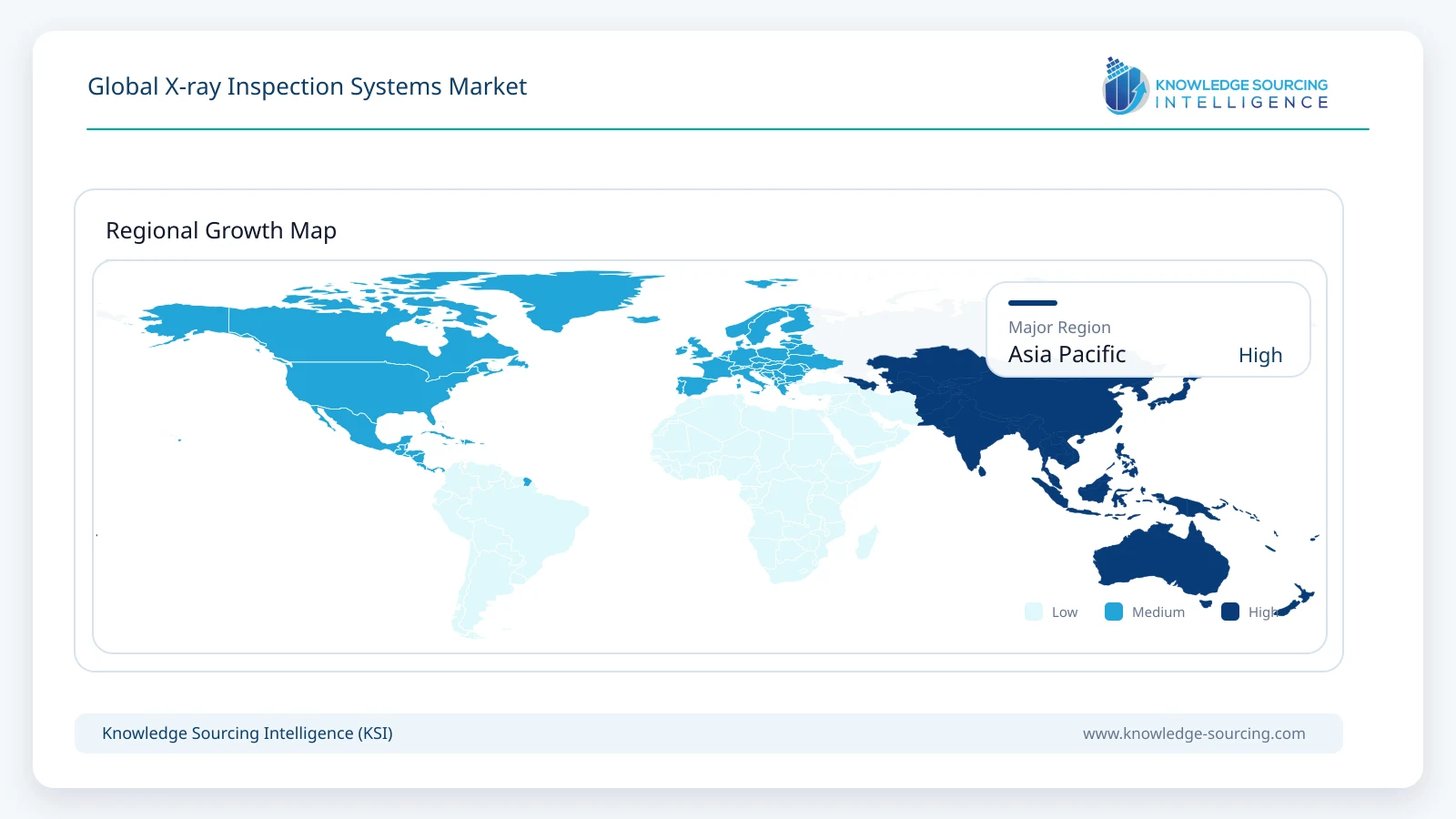
Asia Pacific is the largest regional market and is projected to reach approximately USD 732 million by 2031. The region combines large food-processing industries with major electronics, semiconductor, automotive and battery manufacturing hubs. China, Japan and South Korea are important for advanced manufacturing, while Southeast Asia and India are expanding electronics and food-processing capacity. North America remains a major market because of its installed base in food production, aerospace, automotive and electronics. Europe benefits from strong industrial automation and metrology demand. Growth in the Middle East, Africa and South America is more selective and is concentrated in food processing, pharmaceuticals and industrial quality-control projects.
Competitive Environment
Mettler-Toledo, Anritsu and Ishida are prominent suppliers of high-speed product-inspection systems. Their portfolios are designed for food, beverage and packaged products where line speed, contaminant sensitivity and low false-reject rates are critical. Minebea Intec also competes strongly in food inspection and combines X-ray with broader weighing and inspection equipment. Competition in this part of the market is influenced by installed-base service, application support and the ability to integrate inspection with existing production lines.
Nikon Metrology, Comet Yxlon and ZEISS Industrial Quality Solutions compete more heavily in industrial radiography and computed tomography. These suppliers address automotive, aerospace, semiconductor, battery and precision-manufacturing applications. Their systems place greater emphasis on resolution, 3D reconstruction, dimensional analysis and metrology integration. VisiConsult also participates in industrial X-ray with systems for non-destructive testing and automated inspection. The move toward production CT is increasing competition around scan speed and software automation.
Nordson Test & Inspection and GÖPEL electronic are important in electronics inspection. They serve manufacturers that need X-ray visibility into solder joints and hidden connections. Shimadzu and Hitachi High-Tech participate in selected industrial imaging and analytical applications. Across the market, competitive differentiation is increasingly based on inspection accuracy, software usability, factory connectivity and service responsiveness. Suppliers with a broad application engineering base are better positioned to adapt one imaging platform to different products and manufacturing processes.
Recent Developments
June 2026: Comet Yxlon presented X-ray inspection approaches for through-glass vias used in advanced semiconductor packaging.
May 2026: Sesotec introduced the compact RAYCON EX2 and expanded AI-enabled X-ray inspection at interpack 2026.
May 2026: Anritsu showcased its XR76 series with improved sensitivity and lower false-reject rates at interpack 2026.
April 2026: Ishida announced a new X-ray inspection range for food manufacturers ahead of interpack 2026.
March 2026: Nordson Test & Inspection showcased X-ray and complementary inspection technologies at IPC APEX EXPO.
February 2026: Nikon Metrology demonstrated the VOXLS 40 C 450 and other X-ray CT systems during its European Open Week.
X-Ray Inspection Systems Market Scope
| Report Metric | Details |
|---|---|
| Total Market Size in 2026 | USD 1.47 billion |
| Total Market Size in 2031 | USD 1.98 billion |
| Forecast Unit | Billion |
| Growth Rate | 6.1% |
| Study Period | 2021 to 2031 |
| Historical Data | 2021 to 2024 |
| Base Year | 2025 |
| Forecast Period | 2026 – 2031 |
| Segmentation | Type, Technology, Industry Vertical, Geography |
| Companies |
|
Market Segmentation
By Type
2D X-Ray Inspection Systems
3D X-Ray Inspection Systems
By Technology
Digital Radiography
Computed Tomography
Computed Radiography
Film-Based Radiography
By Industry Vertical
Food and Beverage
Electronics and Semiconductor
Automotive and Electric Vehicles
Aerospace and Defense
Pharmaceuticals and Medical Devices
General Manufacturing
Others
By Geography
North America
United States
Canada
Mexico
South America
Brazil
Argentina
Others
Europe
Germany
France
United Kingdom
Italy
Spain
Others
Middle East and Africa
Saudi Arabia
UAE
South Africa
Others
Asia Pacific
China
Japan
India
South Korea
Thailand
Indonesia
Others
Table of Contents
1. EXECUTIVE SUMMARY
2. MARKET SNAPSHOT
2.1. Market Overview
2.2. Market Definition
2.3. Scope of the Study
2.4. Market Segmentation
3. BUSINESS LANDSCAPE
3.1. Market Drivers
3.1.1. Food Safety and Product-Integrity Requirements
3.1.2. Advanced Electronics and Semiconductor Packaging
3.1.3. Automated Manufacturing and Non-Destructive Quality Control
3.2. Market Restraint
3.2.1. Capital Cost and Application Complexity
3.3. Market Opportunities
3.4. Porter's Five Forces Analysis
3.5. Industry Value Chain Analysis
3.6. Policies and Regulations
3.7. Strategic Recommendations
4. TECHNOLOGICAL OUTLOOK
4.1. High-Resolution Digital Radiography
4.2. Industrial Computed Tomography
4.3. Computed Laminography
4.4. Dual-Energy and Multi-Energy Inspection
4.5. AI-Based Image Analysis
4.6. Connected Inspection and Quality Software
5. GLOBAL X-RAY INSPECTION SYSTEMS MARKET BY TYPE
5.1. Introduction
5.2. 2D X-Ray Inspection Systems
5.3. 3D X-Ray Inspection Systems
6. GLOBAL X-RAY INSPECTION SYSTEMS MARKET BY TECHNOLOGY
6.1. Introduction
6.2. Digital Radiography
6.3. Computed Tomography
6.4. Computed Radiography
6.5. Film-Based Radiography
7. GLOBAL X-RAY INSPECTION SYSTEMS MARKET BY INDUSTRY VERTICAL
7.1. Introduction
7.2. Food and Beverage
7.3. Electronics and Semiconductor
7.4. Automotive and Electric Vehicles
7.5. Aerospace and Defense
7.6. Pharmaceuticals and Medical Devices
7.7. General Manufacturing
7.8. Others
8. GLOBAL X-RAY INSPECTION SYSTEMS MARKET BY GEOGRAPHY
8.1. Introduction
8.2. North America
8.2.1. United States
8.2.2. Canada
8.2.3. Mexico
8.3. South America
8.3.1. Brazil
8.3.2. Argentina
8.3.3. Others
8.4. Europe
8.4.1. Germany
8.4.2. France
8.4.3. United Kingdom
8.4.4. Italy
8.4.5. Spain
8.4.6. Others
8.5. Middle East and Africa
8.5.1. Saudi Arabia
8.5.2. UAE
8.5.3. South Africa
8.5.4. Others
8.6. Asia Pacific
8.6.1. China
8.6.2. Japan
8.6.3. India
8.6.4. South Korea
8.6.5. Thailand
8.6.6. Indonesia
8.6.7. Others
9. COMPETITIVE ENVIRONMENT AND ANALYSIS
9.1. Major Players and Strategy Analysis
9.2. Product and Technology Positioning
9.3. Recent Investments and Product Development
9.4. Competitive Dashboard
10. COMPANY PROFILES
10.1. Mettler-Toledo International Inc.
10.2. Anritsu Corporation
10.3. Ishida Co., Ltd.
10.4. Minebea Intec GmbH
10.5. Sesotec GmbH
10.6. Thermo Fisher Scientific Inc.
10.7. Nikon Corporation (Nikon Metrology)
10.8. Comet Holding AG (Comet Yxlon)
10.9. Carl Zeiss AG (ZEISS Industrial Quality Solutions)
10.10. Nordson Corporation (Nordson Test & Inspection)
10.11. VisiConsult X-ray Systems & Solutions GmbH
10.12. Illinois Tool Works Inc.
10.13. Shimadzu Corporation
10.14. GÖPEL electronic GmbH
10.15. VJ Technologies, Inc.
10.16. Hitachi High-Tech Corporation
11. APPENDIX
11.1. Currency
11.2. Assumptions
11.3. Base and Forecast Years Timeline
11.4. Key Benefits for Stakeholders
11.5. Research Methodology
11.6. Abbreviations
Navigate
Trusted by the world's leading organizations











