Potato Chips Market Trends & Forecast According to a research study published by Knowledge Sourcing Intelligence (KSI), the potato chips market will expand from USD...

Potato Chips Market Trends & Forecast
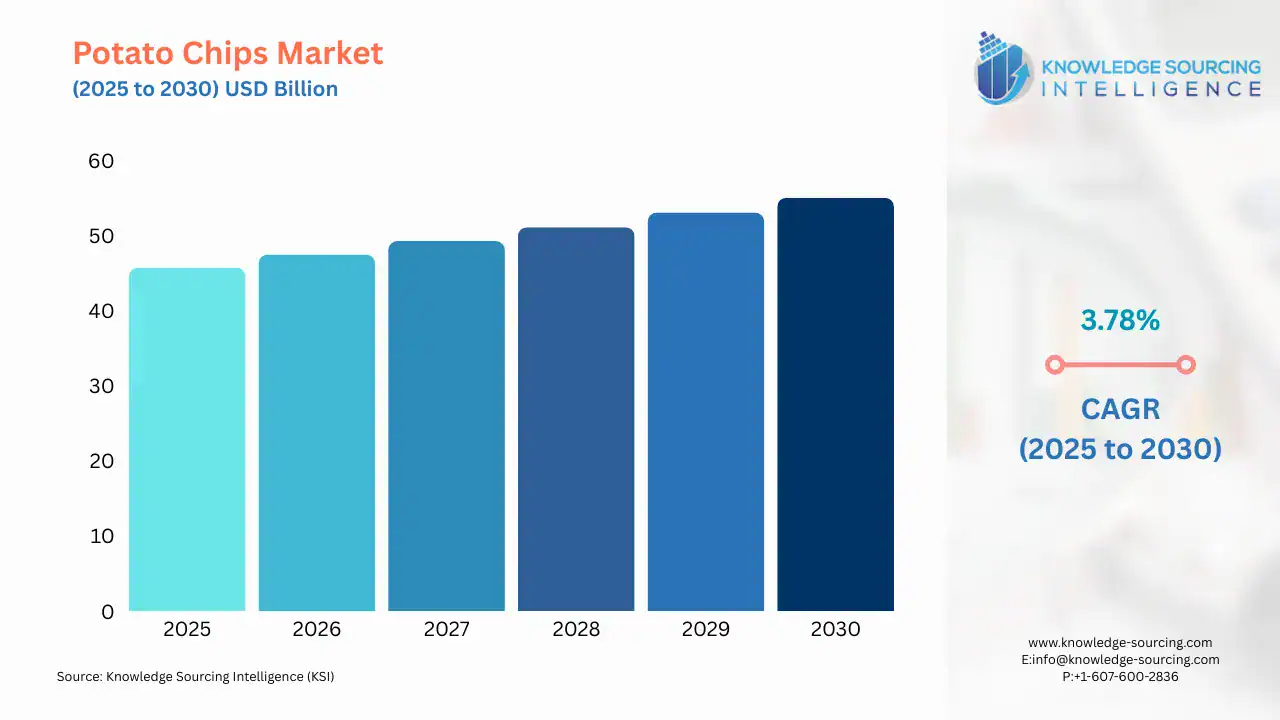
According to a research study published by Knowledge Sourcing Intelligence (KSI), the potato chips market will expand from USD 45.757 billion in 2025 to USD 55.072 billion in 2030 at a CAGR of 3.78% during the forecast period.The potato chips market is projected to grow steadily, driven by high global demand for snack foods. Potato chips, available in organic, conventional, baked, fried, plain, and flavored varieties, are popular due to their convenience and appeal as healthy snacking options. The expanding food and beverage industry, coupled with rising consumer demand, encourages manufacturers to innovate and diversify potato chip offerings. Additionally, the expanding consumption of beverages like tea, coffee, alcohol, and beer, with potato chips serving as a preferred accompaniment, is also driving the market. Further, increasing disposable income and family income globally boost purchasing power, enabling consumers to spend on premium snacks.
Get In-Depth Analysis of the Potato Chips Market
This article provides an overview. Our comprehensive market report offers detailed data, competitive insights, and strategic analysis to navigate the global potato chips industry.- ? Market Size & Growth Projections
- ? Key Player Profiles & Market Share
- ? Regional Trends & Consumer Preferences
Potato Chips Market Report Highlights
- There is a growing consumer preference for quick, portable potato chips drives market expansion globally.
- There is increasing adoption of baked and organic potato chips due to rising health awareness.
- The Asia-Pacific region is going through rapid growth, driven by rapid urbanization and rising disposable incomes, boosting potato chip consumption in the region.
- The market is increasingly trending towards flavored potato chips, fueled by diverse taste profiles and beverage pairings.
- Health-conscious consumers are shifting toward baked and organic chips, which have fewer calories.
- The growing food and beverage industry, along with innovative flavors and online distribution channels, are additional factors further propelling the market, despite challenges like fluctuating raw material costs.
Report Coverage:
| Report Metric | Details |
| Potato Chips Market Size in 2025 | USD 45.757 billion |
| Potato Chips Market Size in 2030 | USD 55.072 billion |
| Growth Rate | CAGR of 3.78% |
| Drivers |
|
| Restraints |
|
| Segmentation |
|
| List of Major Companies in Potato Chips Market |
|
Potato Chips Market Drivers and Restraints
Growth Drivers:- Rising Demand for Convenient Snacks: Manufacturers are increasing their production facilities' capacities to meet the increasing trend of consumer demand for quick snack options, and with the booming snack culture among the younger generations, it is further projected to witness an upward trajectory.
- Growing Popularity: At a cocktail party or at the time of a small gathering with family members or friends, potato chips serve as an excellent appetizer or a side dish with drinks and beverages. These chips, with slight dressings of cream or sauces, add flavor and texture.
- Increasing disposable income, urbanization and modern lifestyle: Increasing disposable income and family income globally boost purchasing power, enabling consumers to spend on premium snacks. For instance, in the Asia-Pacific region, particularly China and India, there is a key growth due to rapid urbanization, modern lifestyles, and a young population favoring potato chips with beverages.
- Growing heath awareness for reducing fried snacks: One of the key factor challenging the market is growing health awareness. Potato chips are generally fried and contains lots of sodium, which is a key factor for health concerns.
- Profit Margin Volatility due to Fluctuating price: The procurement cost and profit margin of the potato chip manufacturers can be impacted due to fluctuating potato prices and poor crop yield, which could hamper the market growth.
Discover the Snack Food Market
Potato chips are a cornerstone of the global snack food industry. Explore our Snack Food Market report to understand consumer trends, market dynamics, and growth opportunities.Potato Chips Market Developments
- Product Launch: In March 2025, HEINZ launched a dip for potato chips. The product “HEINZ Chip Dip” is in a wide-mouth format. Its other combos are also prepared to launch in the coming time.
- Product Launch and Portfolio Expansion: In May 2025, PepsiCo’s Simba has launched a new variant of potato chips in collaboration with the South African sauce brand Wellington’s. It is a tomato sauce flavour, sold in both 36g (small) and 120g (large) packages.
Potato Chips Market Segmentation
Knowledge Sourcing Intelligence has segmented the Global Potato Chips Market based on type, preparation type, product type, distribution channel and region: Potato Chips Market, By Type- Organic
- Conventional
- Baked Chips
- Fried Chips
- Plain
- Flavored
- Online
- Offline
- Hypermarket/Supermarket
- Convenience Store
- Grocery Store
- Others
- North America
- USA
- Canada
- Mexico
- Europe
- UK
- Germany
- France
- Italy
- Spain
- Others
- Asia Pacific
- China
- India
- Japan
- South Korea
- Taiwan
- Thailand
- Indonesia
- Others
- South America
- Brazil
- Argentina
- Others
- Middle East and Africa (MEA)
- Saudi Arabia
- UAE
- Others
Potato Chips Market Key Players
- Burts Snacks Limited
- Calbee, Inc.
- Campbell Soup Company
- PepsiCo
- Utz Brands, Inc.
- Herr Foods Inc.
- Intersnack Group GmbH & Co. KG
- Great Lakes Potato Chips
- The Lorenz Bahlsen Snack-World GmbH & Co KG
- Martin’s Snack
- Mars Inc.
Go from Insight to Action with Our Market Research
You've seen the overview. Now, get the detailed data and strategic analysis you need to stay ahead in the snack food market. Explore our related, in-depth reports. Each report includes comprehensive data, forecasts, and competitive analysis to empower your business decisions.Need specialized data cuts or competitive intelligence?
Our analyst team provides bespoke market sizing, supplier audits, and country-level feasibility reports tailored to your enterprise roadmap.
Speak With an Industry Analyst →Ask an Industry Analyst
Have questions regarding this briefing or market projections? Inquire with our sector lead.
Related Press Releases
View All →
ADC Manufacturing & CDMO Market is expected to reach USD 10.49 billion by 2031
Aug 7, 2026
Lifestyle-Associated Cancer Epidemiology Market is expected to reach USD 13.12 billion by 2031
Aug 5, 2026
Psycho-Oncology Digital Health Market is anticipated to surpass USD 290.01 million in 2031 at a CAGR of 8.5%
Jul 30, 2026
Intratumoral Injection Therapy Market is expected to reach USD 630.39 million by 2031
Jul 24, 2026
Palliative Care in Oncology Market is expected to reach USD 244.1 billion by 2031
Jul 22, 2026More Press Releases
Oncology Drug Resistance Testing Market is projected to reach USD 3.41 billion in 2031 at a CAGR of 6.6 %
The oncology drug resistance testing market is expanding due to rising cancer prevalence, increasing drug resistance, and growing adoption of precision oncology. Advances in NGS-based testing, companion diagnostics, and targeted therapies, alongside FDA approvals and investments in personalized medicine, are accelerating demand for effective resistance monitoring across hospitals and clinical diagnostics worldwide.
TROP-2 Targeted Therapy Market is anticipated to surpass USD 3.29 billion in 2031 at a CAGR of 8.6 %
The TROP-2 Targeted Therapy market is expanding rapidly due to increasing precision oncology adoption, rising cancer prevalence, and growing use of antibody-drug conjugates. North America leads the market, while Asia Pacific shows the fastest growth. Continuous clinical trials, regulatory approvals, and strategic collaborations are accelerating innovation and commercial adoption worldwide.
Second Primary Cancer Prevention Market is expected to reach USD 24.7 billion by 2031
The Second primary cancer prevention refers to strategies aimed at reducing the risk of developing a new, unrelated cancer in individuals with a prior cancer diagnosis. Growing cancer survivorship, advances in treatment, and increasing awareness of long-term health outcomes have heightened the importance of prevention and surveillance programs. Key approaches include routine screening, genetic risk assessment, lifestyle modification, and long-term follow-up care. Government agencies and healthcare organisations increasingly emphasise survivorship care plans and evidence-based screening protocols to detect new malignancies at earlier stages. Continued investments in early detection technologies and personalised risk assessment are expected to support advancements in second primary cancer prevention.