
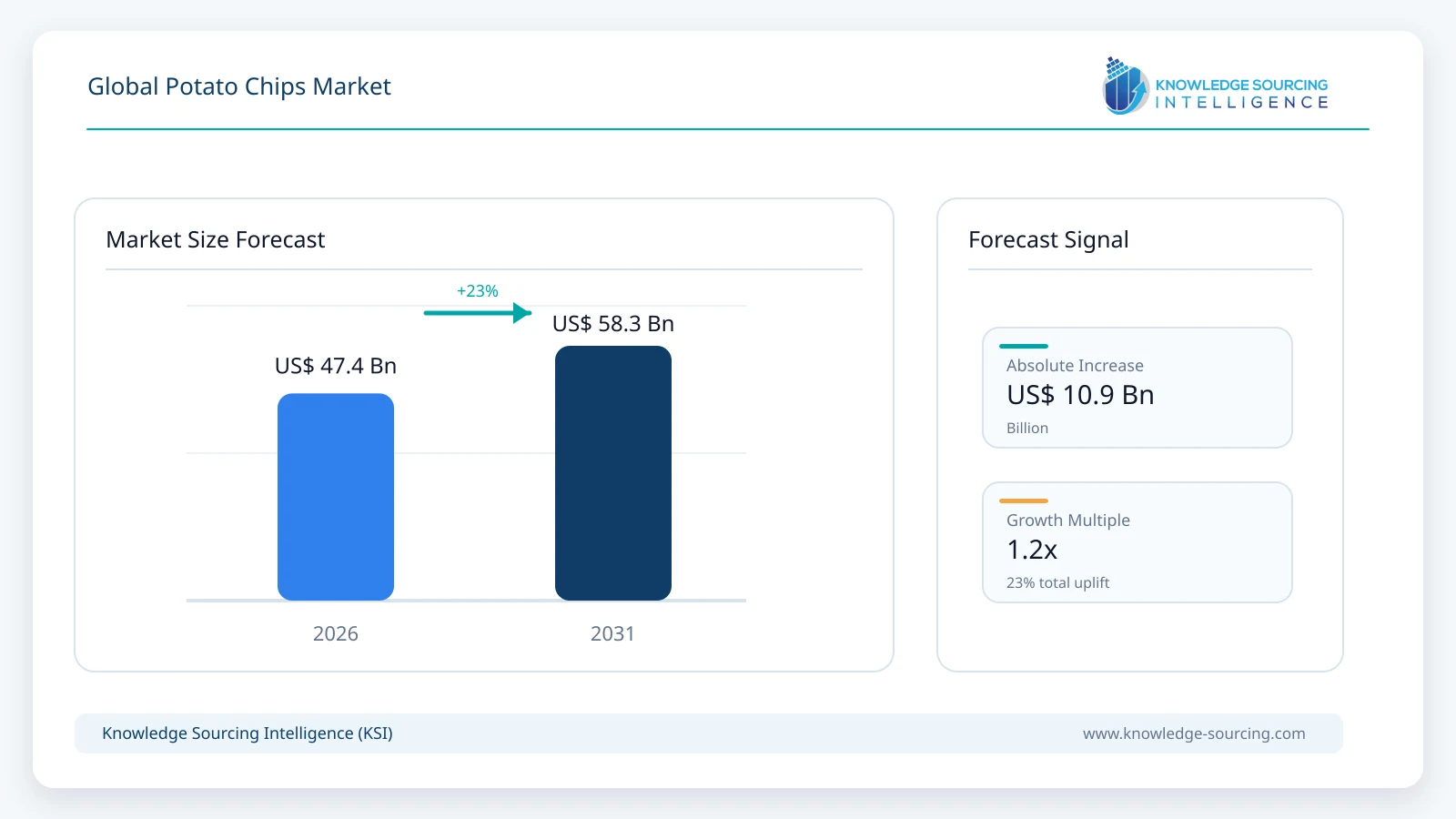
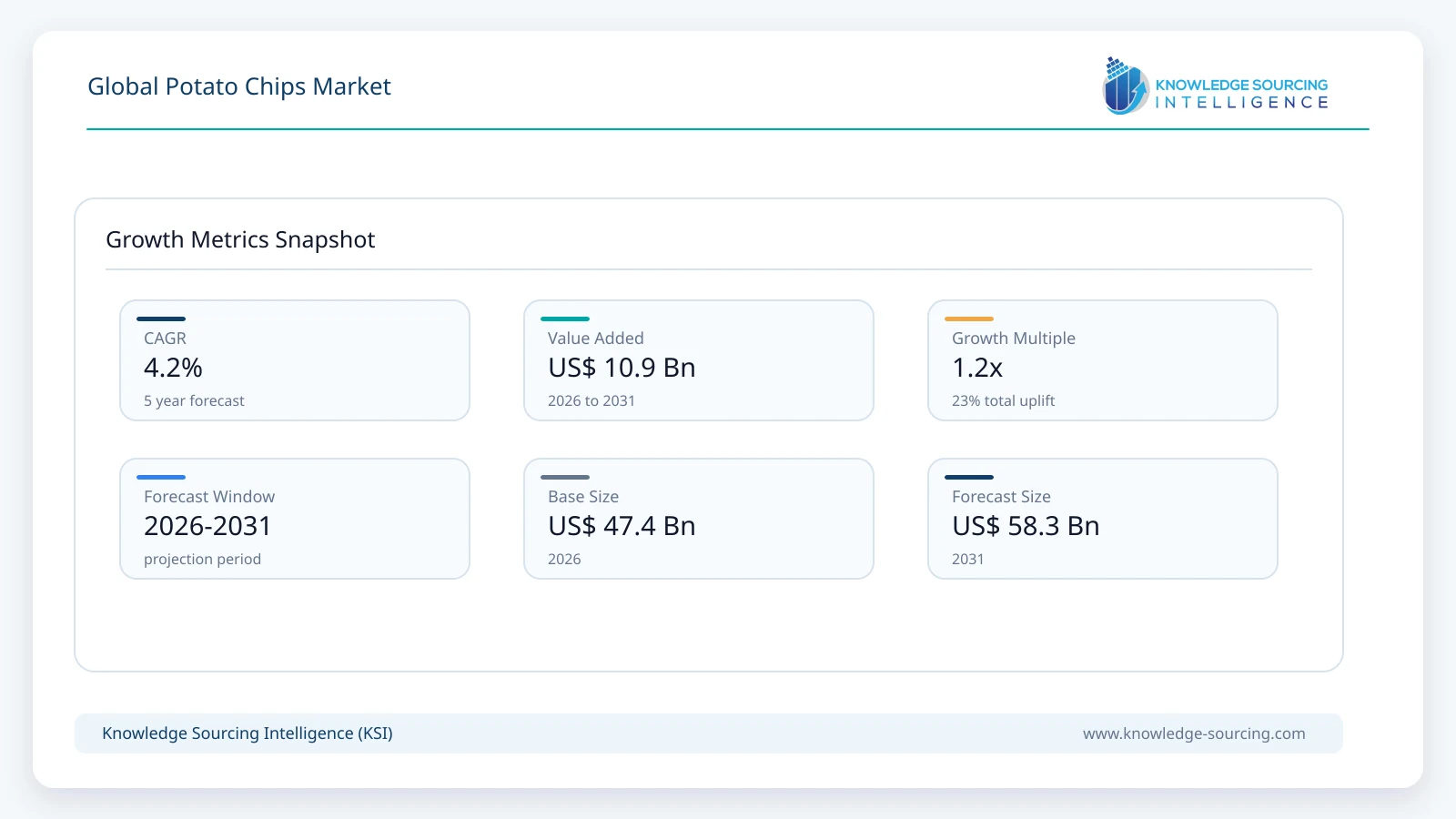
The global potato chips market is estimated to attain a market size of USD 58.3 billion by 2031, growing at a 4.2% CAGR from USD 47.4 billion in 2026.
Highlights:
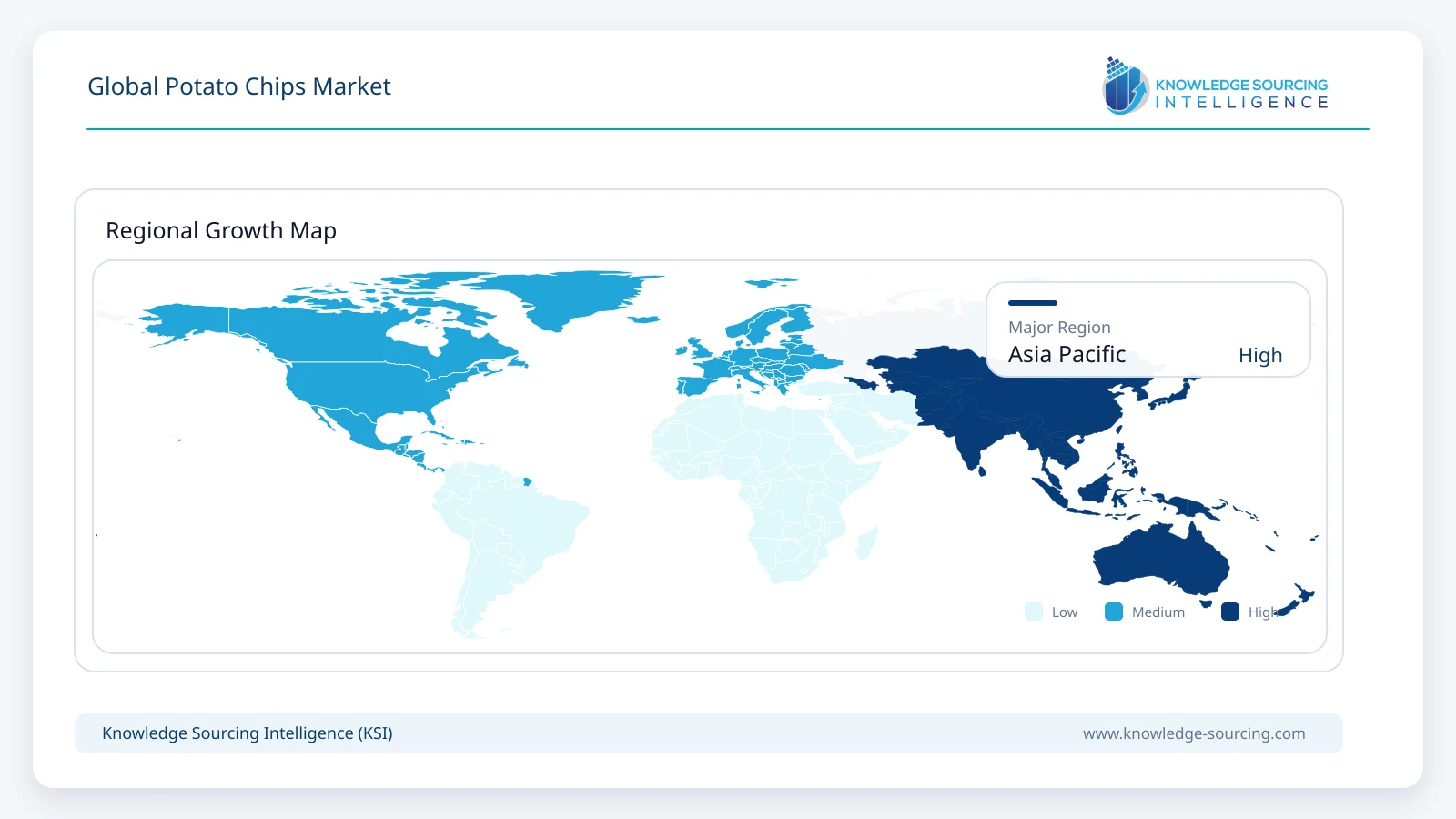
- 1Asia Pacific is estimated to be the largest regional potato chips market in 2026, accounting for approximately 33.5% of global revenue. Its share is projected to increase to around 36.0% by 2031 as packaged-snack penetration, domestic manufacturing and modern retail expand across China, India, Indonesia and other developing Asian markets.
- 2Fried potato chips remain the dominant preparation format, representing approximately 88% of global market revenue in 2026. Their share is expected to moderate as baked and alternative preparation formats expand, but conventional fried chips continue to benefit from established manufacturing infrastructure, taste familiarity and broad price-point availability.
- 3Flavoured potato chips are the largest product segment, estimated at approximately USD 29.4 billion in 2026. The segment is projected to approach USD 38.5 billion by 2031 as manufacturers increase limited-edition launches, locally adapted seasoning profiles, restaurant-inspired flavours and cross-brand collaborations.
- 4Baked potato chips represent one of the faster-growing product opportunities.The segment is estimated at approximately USD 4.7 billion in 2026 and could reach around USD 7.6 billion by 2031 as manufacturers develop lower-fat formulations and alternative-oil propositions. PepsiCo has announced ingredient updates to Lay’s Baked using olive oil and products positioned with substantially lower fat than conventional potato chips.
- 5Online retail is projected to gain the most distribution share, increasing from approximately 12% of global potato chip sales in 2026 to around 16% by 2031. Digital grocery, quick commerce, multipack purchasing and discovery of specialty or premium flavours support faster expansion than mature physical channels.
- 6Competitive activity remains high despite the maturity of the category.PepsiCo continues to expand Lay’s through new formulations, brand experiences and market-specific flavours, while Utz is increasing limited-edition launches and better-for-you positioning. Calbee is expanding international production and distribution, and Intersnack reported approximately EUR 4.5 billion in 2025 sales across a broad savoury-snack portfolio.
Market Overview
The global potato chips market remains one of the largest and most established segments of the savoury-snack industry. Growth is expected to remain moderate compared with emerging snack categories because potato chips already have high penetration across developed markets. However, the category continues to expand through flavour innovation, premiumisation, wider distribution in developing economies, new cooking methods and a shift toward products positioned around simpler ingredients, alternative oils and lower-fat formulations.
Market growth is increasingly influenced by value rather than only unit-volume expansion. Recent performance from large snack manufacturers illustrates this distinction. Utz reported second-quarter 2026 net sales growth of 1.4%, supported by favourable pricing while volume and mix declined, whereas branded salty-snack organic sales increased 3.3%. In the first quarter of 2026, the company reported 5.2% growth in branded salty-snack sales and stated that its branded retail sales outpaced the broader salty-snack category. These trends indicate that pricing, premiumisation and portfolio mix are becoming increasingly important contributors to category value growth.
Potato chips also remain strategically significant within larger global food portfolios. PepsiCo generated nearly USD 94 billion in net revenue in 2025, with convenient foods representing approximately 58% of company revenue and the company identifying itself as a global leader in savoury snacks. Lay’s remains one of PepsiCo’s flagship global brands and is sold across more than 200 countries and territories.
The market is nevertheless exposed to agricultural and supply-chain constraints. Calbee reported that domestic potato-chip sales were flat in its fiscal year ended March 2026 partly because of lower potato yields in Hokkaido, even while consolidated group sales increased 5.5%. The company has identified potato procurement as a material business risk because weather conditions and declining farmer numbers can affect available quantity, quality, and cost.
Major Market Trends
Premium Oils and Ingredient Simplification
Potato chip manufacturers are increasingly using oils and ingredient composition as points of differentiation. The development is most visible in premium and better-for-you products where consumers are evaluating not only calorie or fat content but also the perceived quality of cooking oils and ingredient lists. PepsiCo announced that Lay’s Baked would transition to olive oil while a reduced-fat Lay’s Kettle Cooked product would use avocado oil. Utz has similarly expanded Boulder Canyon products prepared with avocado oil and has introduced front-of-pack claims on selected flagship potato chips including “No Artificial Colors,” “No Artificial Flavors” and “Only 3 Simple Ingredients.”
This development does not imply that conventional fried chips are being displaced. Rather, manufacturers are creating clearer ladders between mass-market, premium, and better-for-you propositions. Alternative oils can support higher price points, while simplified formulations give established brands additional means of differentiation without changing the basic product architecture. This is particularly important in North America and Western Europe where potato chip penetration is already high and incremental growth increasingly depends on product mix.
Limited-Edition and Cross-Category Flavour Innovation
Flavour innovation has become one of the most visible competitive tools in the potato chips market. Manufacturers are using short production runs, restaurant collaborations, seasonal launches, and combinations inspired by familiar foods to create trial and stimulate repeat engagement. Utz launched Lemonade Potato Chips in 2025 and brought the product back in 2026 after reporting more than USD 1 million in first-year sales. The company also introduced Sizzlin’ Summer Burger flavoured Rippled Potato Chips in 2026.
PepsiCo has adopted a similar strategy through brand collaborations and flavour transfers. In February 2026, the company introduced a portfolio-wide flavour-swap programme, including Ruffles carrying Doritos Cool Ranch seasoning. In Canada, Lay’s partnered with Subway in June 2026 to introduce Italian Herbs & Cheese flavoured potato chips available through Subway restaurants. These initiatives demonstrate how large snack companies are increasingly using flavour as a marketing platform rather than treating it only as a permanent SKU extension.
Brand Experiences Beyond the Retail Shelf
Large potato chip brands are increasingly extending consumer engagement beyond conventional supermarket promotion. PepsiCo opened a Lay’s potato-themed restaurant in Shanghai in April 2026 as a test-and-learn concept combining food, fashion, chef partnerships and experiential marketing. The company subsequently described such restaurant concepts as a way of expanding Lay’s into away-from-home consumption occasions.
This approach is especially relevant in mature categories where brand familiarity is already high. Experiential activity allows companies to strengthen cultural relevance, build social-media visibility, and develop new connections between packaged snacks and meals. The effect on immediate category volume may be modest, but it can increase brand salience and provide manufacturers with additional mechanisms for defending market share.
Segment Analysis
By Ingredient Type
Conventional Potato Chips
Conventional potato chips account for the majority of the global market, with an estimated 94% share in 2026, equivalent to approximately USD 44.6 billion. The segment includes mainstream products produced from conventionally grown potatoes and sold through mass retail, convenience channels, discount formats, and foodservice.
Conventional products benefit from extensive agricultural supply chains, established processing facilities and lower average production costs than certified organic alternatives. They are also available across virtually every major price point, ranging from private-label products to premium kettle-style chips. KSI expects the segment to reach approximately USD 53.1 billion by 2031, although its overall share gradually moderates as organic and specialist products grow faster.
Organic Potato Chips
Organic potato chips are estimated at approximately USD 2.8 billion in 2026 and are projected to exceed USD 5.2 billion by 2031. The segment remains relatively small, but its growth is supported by premium natural-food retail, specialty grocery channels and consumer interest in certified ingredients and simpler formulations.
Organic products generally operate at higher price points because of raw-material sourcing, certification and smaller production scale. Growth is therefore concentrated in higher-income markets and premium urban retail. Organic positioning is also increasingly combined with alternative oils, non-GMO claims and limited ingredient lists, creating a broader premium proposition rather than relying solely on certification.
By Preparation Method
Fried Potato Chips
Fried potato chips are estimated to account for approximately 88% of global market revenue in 2026, equivalent to nearly USD 41.7 billion. The segment is projected to remain dominant throughout the forecast period and reach approximately USD 49.0 billion by 2031.
Traditional frying provides the texture, flavour and production economics that underpin the global potato-chip category. Kettle-cooked and ridged varieties are included within fried products rather than treated as separate preparation methods because their manufacturing still relies primarily on frying. Manufacturers continue to innovate within the segment through batch cooking, alternative oils, premium potato varieties and differentiated texture.
Baked Potato Chips
Baked potato chips represent approximately USD 4.7 billion in 2026 and are forecast to reach around USD 7.6 billion by 2031. Their share is projected to increase from approximately 10% to 13% over the period.
The segment benefits from lower-fat positioning and continuing product development by large snack manufacturers. However, baked chips face technical challenges around texture, seasoning adhesion and consumer expectations of indulgence. As a result, growth is expected to come from improved formulations rather than wholesale substitution of fried chips.
Other Preparation Methods
Other preparation formats, including vacuum-fried and emerging lower-oil processing techniques, represent a small but faster-growing segment. These products are increasingly used by premium and specialty manufacturers to create differentiated texture or nutritional propositions. Their combined share is expected to remain below that of baked products through 2031.
By Flavour
Plain and Salted Potato Chips
Plain and salted products are estimated at approximately USD 18.0 billion in 2026, representing around 38% of global market revenue. Their share is expected to decline moderately as consumers increasingly purchase flavoured products.
Plain and salted chips nevertheless remain strategically important because they serve as core products for virtually every major manufacturer and provide a familiar reference point for premium oil, potato-variety and texture positioning.
Flavoured Potato Chips
Flavoured potato chips are estimated at approximately USD 29.4 billion in 2026 and are projected to reach roughly USD 38.5 billion in 2031. Their share increases from about 62% to 66% over the forecast period.
Growth is supported by regional flavour adaptation, limited editions and restaurant-inspired seasonings. Manufacturers can use flavour innovation to refresh established brands without requiring significant changes to production infrastructure. The ability to rotate seasonal varieties also allows companies to test demand before converting successful concepts into permanent products.
Distribution Channel Outlook
Supermarkets and hypermarkets remain the largest distribution channel, accounting for approximately 52% of global revenue in 2026. Their share is expected to moderate to around 48% by 2031 as e-commerce and alternative retail formats expand. Large grocery retailers remain essential because of their scale, high household penetration, promotional capability and ability to support broad flavour assortments.
Convenience stores account for approximately 20% of market revenue and remain important for single-serve and impulse purchases. Online retail is estimated at about 12% in 2026 and is projected to rise to approximately 16% by 2031, making it the fastest-growing major channel. Digital channels allow consumers to access premium brands and unusual flavours that may receive limited physical shelf space, while grocery delivery and quick-commerce platforms make snack products increasingly available for immediate-consumption purchases.
Market Drivers
Expansion of Flavour-Led Product Development
Potato chips provide manufacturers with a flexible base for flavour development. Seasonal launches, collaborations and locally adapted seasonings can create incremental sales without requiring entirely new production platforms. This lowers product-development barriers and allows brands to respond quickly to changing consumer tastes.
Growing Better-for-You Subsegments Within an Established Category
Baked products, alternative cooking oils and simplified ingredient labels are allowing manufacturers to address health-conscious consumers without leaving the potato-chip category. The continued development of olive-oil and avocado-oil products demonstrates that ingredient quality is becoming a more visible source of value differentiation.
Increasing Packaged-Snack Penetration in Asia Pacific
Asia Pacific combines large population bases with expanding modern retail and domestic snack manufacturing. Calbee’s international strategy includes increased potato-chip production in Indonesia and further development of retail distribution in Greater China, while PepsiCo continues to invest in Lay’s brand-building in China.
Investment in Manufacturing and Supply-Chain Capacity
Large manufacturers continue to invest in production and logistics, supporting category availability and reducing constraints in high-growth markets. Calbee’s Setouchi Hiroshima Factory increased production capacity during 2025, while its overseas strategy includes additional potato-chip production investment in Indonesia.
Expansion of Premium and Natural-Channel Brands
Specialist brands prepared with avocado oil, kettle-cooked formats or simplified ingredients are increasingly moving beyond traditional natural-food retail into mainstream channels. Utz has identified Boulder Canyon as a leading natural-channel potato-chip brand and is expanding distribution of its premium avocado-oil products.
Market Restraints
Potato Crop Variability
Potato chips depend on raw potatoes with suitable solids, size and processing characteristics. Poor harvests can affect both availability and production efficiency. Calbee specifically identified lower Hokkaido potato yields as a constraint on domestic potato-chip sales during fiscal 2026 and identifies crop conditions as an ongoing procurement risk.
Oil, Seasoning and Packaging Cost Inflation
Potatoes are only one component of total manufacturing cost. Vegetable oils, seasoning systems, flexible packaging, energy and transport can materially affect profitability. Manufacturers may respond through price increases, reduced pack sizes or productivity programmes, but prolonged inflation can weaken consumer volume.
Sodium and Nutrition Pressure
Potato chips remain exposed to nutrition concerns because many products contain meaningful levels of sodium and fat. The U.S. FDA continues to pursue voluntary sodium-reduction targets across processed and packaged food categories, while the UK has introduced advertising and promotional restrictions affecting less-healthy food categories including crisps and savoury snacks.
Acrylamide Control in Fried and Baked Products
European food manufacturers must manage acrylamide formation in potato products. EU Regulation 2017/2158 establishes mitigation measures and benchmark levels covering sliced potato crisps from fresh potatoes as well as potato-dough crisps and snacks, including fried and oven-baked products. This creates additional requirements around raw-material selection, processing temperatures and production control.
Competition from Alternative Savoury Snacks
Potato chips compete against tortilla chips, extruded snacks, popcorn, nuts, protein snacks, vegetable chips and other formats for the same snacking occasions. Large manufacturers increasingly manage multi-category portfolios, which can shift promotional investment toward faster-growing categories when consumer demand changes.
Regional Outlook
Asia Pacific
Asia Pacific is estimated to account for approximately 33.5% of global potato chip revenue in 2026, increasing to around 36.0% by 2031. China, Japan and India are the major contributors, while Indonesia and Southeast Asia provide additional growth opportunities.
Japan is particularly important because of the scale of Calbee, which reports a 72.3% domestic share of potato-based snacks together with Japan Frito-Lay for the fiscal year ended March 2026. Calbee procures approximately 371,000 tonnes of potatoes from around 1,600 contracted farms, illustrating the scale of integrated sourcing required for mature potato-snack markets.
North America
North America accounts for approximately 28% of global market revenue in 2026. The United States is highly developed, with strong participation from PepsiCo, Utz, Campbell’s and a large private-label base.
Growth is increasingly generated by premium products, flavour extensions and value management rather than large increases in per-capita consumption. Utz’s 2026 results show that branded salty-snack retail sales continued to grow even as category volumes remained relatively restrained, illustrating the importance of pricing and mix in the regional outlook.
Europe
Europe represents approximately 25.5% of market revenue in 2026. Intersnack is one of the region’s largest savoury-snack manufacturers and reported approximately EUR 4.5 billion in 2025 sales, with brands covering potato chips, baked products and other savoury snacks across more than 30 countries.
Calbee is also expanding its European presence through the Seabrook potato-chip business in the UK. The company has reported increased sales through wider national retail distribution and is using Seabrook as a platform for further European growth.
South America
South America represents approximately 7% of global revenue. Brazil is the largest regional opportunity, supported by a large packaged-food industry and extensive modern retail infrastructure. Price sensitivity and currency volatility make smaller pack sizes and local manufacturing particularly important.
Middle East and Africa
The Middle East and Africa account for approximately 6% of global market revenue. Growth is supported by modern grocery penetration, young populations and investment in domestic snack manufacturing. The Gulf region supports premium imported brands, while African markets remain more dependent on affordability, local production economics and distribution reach.
Competitive Landscape
The global market is fragmented at the regional level but contains several companies with substantial international scale. PepsiCo remains the most geographically diversified participant through Lay’s and associated potato-chip brands. Intersnack operates more than 40 production sites and has a broad European, Asian and Oceania presence, while Calbee combines a dominant Japanese potato-snack position with expanding international operations.
Utz is a significant North American branded salty-snack manufacturer with potato-chip brands including Utz, Zapp’s, Boulder Canyon, Tim’s Cascade and Dirty Potato Chips. Campbell’s participates through Cape Cod and Kettle Brand. Mars became a larger participant in the broader potato-crisps category after completing its acquisition of Kellanova in December 2025, bringing Pringles into the Mars Snacking portfolio.
Recent Developments
September 2026: PepsiCo highlighted the global Lay’s farm-to-flavour supply chain, reinforcing the brand’s emphasis on potato sourcing and agricultural traceability.
June 2026: Lay’s Canada and Subway Canada introduced Italian Herbs & Cheese flavoured potato chips through Subway restaurants.
May 2026: Utz introduced Sizzlin’ Summer Burger Rippled Potato Chips and brought back Lemonade Potato Chips following more than USD 1 million in reported sales for the flavour in 2025.
April 2026: PepsiCo opened a Lay’s potato-themed restaurant in Shanghai, using the site as an experiential brand platform and test-and-learn model.
December 2025: Mars completed its acquisition of Kellanova, adding Pringles and other major snack brands to Mars Snacking.
October 2025: Utz announced new ingredient-positioning claims for selected flagship potato chips and continued expansion of Boulder Canyon avocado-oil kettle chips.
Market Outlook
The potato chips market is expected to add approximately USD 10.9 billion in annual revenue between 2026 and 2031. Growth remains slower than in many emerging snack categories because potato chips already have high penetration, but the scale of the category continues to create substantial absolute opportunities.
The strongest areas of incremental growth are expected to be flavoured products, baked and alternative preparation formats, premium oils, organic products, online distribution and Asia Pacific. Conventional fried potato chips remain the commercial core of the market and will continue to account for the majority of revenue through 2031.
Manufacturers are therefore unlikely to succeed by relying on category growth alone. Competitive performance will increasingly depend on flavour development, raw-material security, pricing architecture, retailer relationships, manufacturing productivity and the ability to create products that appeal to both indulgence-driven and more ingredient-conscious consumers.
Potato Chips Market Scope:
| Report Metric | Details |
|---|---|
| Total Market Size in 2026 | USD 47.4 billion |
| Total Market Size in 2031 | USD 58.3 billion |
| Forecast Unit | Billion |
| Growth Rate | 4.2% |
| Study Period | 2021 to 2031 |
| Historical Data | 2021 to 2024 |
| Base Year | 2025 |
| Forecast Period | 2026 – 2031 |
| Segmentation | Ingredient Type, Preparation Method, Flavour, Distribution Channel |
| Companies |
|
Market Segmentation
By Ingredient Type
Conventional
Organic
By Preparation Method
Fried
Traditional Thin-Cut
Ridged
Kettle-Cooked
Baked
Others
Vacuum-Fried
Other Alternative Processing Methods
By Flavour
Plain / Salted
Flavoured
By Distribution Channel
Supermarkets and Hypermarkets
Convenience Stores
Online Retail
Specialty and Food Stores
Others
By Geography
North America
United States
Canada
Mexico
South America
Brazil
Argentina
Colombia
Others
Europe
United Kingdom
Germany
France
Italy
Spain
Netherlands
Others
Middle East and Africa
Saudi Arabia
UAE
South Africa
Israel
Others
Asia Pacific
China
Japan
India
South Korea
Indonesia
Thailand
Australia
Others
Table of Contents
1. INTRODUCTION
1.1. Market Overview
1.2. Market Definition
1.3. Scope of the Study
1.4. Market Segmentation
1.5. Currency
1.6. Assumptions
1.7. Base and Forecast Years Timeline
2. RESEARCH METHODOLOGY
2.1. Research Design
2.2. Secondary Research
2.3. Primary Research
2.4. Market Estimation
2.5. Forecast Methodology
2.6. Data Triangulation and Validation
3. EXECUTIVE SUMMARY
3.1. Key Findings
3.2. Global Market Size, 2026-2031
3.3. Incremental Revenue Opportunity
3.4. Segment Growth Outlook
3.5. Regional Opportunity Summary
3.6. Analyst View
4. MARKET DYNAMICS
4.1. Market Drivers
4.1.1. Expansion of Flavour-Led Product Development
4.1.2. Growth of Better-for-You Potato Chip Formats
4.1.3. Increasing Packaged-Snack Penetration in Asia Pacific
4.1.4. Investment in Manufacturing and Supply-Chain Capacity
4.1.5. Expansion of Premium and Natural-Channel Brands
4.2. Market Restraints
4.2.1. Potato Crop and Yield Variability
4.2.2. Cooking Oil, Seasoning and Packaging Cost Inflation
4.2.3. Sodium and Nutrition Pressure
4.2.4. Acrylamide Mitigation Requirements
4.2.5. Competition from Alternative Savoury Snacks
4.3. Market Opportunities
4.4. Porter’s Five Forces Analysis
4.5. Industry Value Chain Analysis
4.6. Potato Procurement and Contract Farming
4.7. Cooking Oils and Seasoning Inputs
4.8. Packaging and Distribution Economics
5. GLOBAL POTATO CHIPS MARKET BY INGREDIENT TYPE
5.1. Introduction
5.2. Conventional
5.2.1. Market Trends and Opportunities
5.2.2. Growth Prospects
5.2.3. Geographic Lucrativeness
5.3. Organic
5.3.1. Market Trends and Opportunities
5.3.2. Growth Prospects
5.3.3. Geographic Lucrativeness
6. GLOBAL POTATO CHIPS MARKET BY PREPARATION METHOD
6.1. Introduction
6.2. Fried
6.2.1. Traditional Thin-Cut
6.2.2. Ridged
6.2.3. Kettle-Cooked
6.3. Baked
6.4. Others
6.4.1. Vacuum-Fried
6.4.2. Other Alternative Processing Methods
7. GLOBAL POTATO CHIPS MARKET BY FLAVOUR
7.1. Introduction
7.2. Plain / Salted
7.3. Flavoured
8. GLOBAL POTATO CHIPS MARKET BY DISTRIBUTION CHANNEL
8.1. Introduction
8.2. Supermarkets and Hypermarkets
8.3. Convenience Stores
8.4. Online Retail
8.5. Specialty and Food Stores
8.6. Others
9. GLOBAL POTATO CHIPS MARKET BY GEOGRAPHY
9.1. North America
9.1.1. By Ingredient Type
9.1.2. By Preparation Method
9.1.3. By Flavour
9.1.4. By Distribution Channel
9.1.5. By Country
9.1.5.1. United States
9.1.5.2. Canada
9.1.5.3. Mexico
9.2. South America
9.2.1. By Ingredient Type
9.2.2. By Preparation Method
9.2.3. By Flavour
9.2.4. By Distribution Channel
9.2.5. By Country
9.2.5.1. Brazil
9.2.5.2. Argentina
9.2.5.3. Colombia
9.2.5.4. Others
9.3. Europe
9.3.1. By Ingredient Type
9.3.2. By Preparation Method
9.3.3. By Flavour
9.3.4. By Distribution Channel
9.3.5. By Country
9.3.5.1. United Kingdom
9.3.5.2. Germany
9.3.5.3. France
9.3.5.4. Italy
9.3.5.5. Spain
9.3.5.6. Netherlands
9.3.5.7. Others
9.4. Middle East and Africa
9.4.1. By Ingredient Type
9.4.2. By Preparation Method
9.4.3. By Flavour
9.4.4. By Distribution Channel
9.4.5. By Country
9.4.5.1. Saudi Arabia
9.4.5.2. UAE
9.4.5.3. South Africa
9.4.5.4. Israel
9.4.5.5. Others
9.5. Asia Pacific
9.5.1. By Ingredient Type
9.5.2. By Preparation Method
9.5.3. By Flavour
9.5.4. By Distribution Channel
9.5.5. By Country
9.5.5.1. China
9.5.5.2. Japan
9.5.5.3. India
9.5.5.4. South Korea
9.5.5.5. Indonesia
9.5.5.6. Thailand
9.5.5.7. Australia
9.5.5.8. Others
10. COMPETITIVE ENVIRONMENT AND ANALYSIS
10.1. Major Players and Strategy Analysis
10.2. Market Positioning
10.3. Product and Flavour Innovation
10.4. Premium and Better-for-You Portfolio Development
10.5. Distribution Strategy
10.6. Manufacturing Expansion
10.7. Mergers, Acquisitions and Partnerships
10.8. Competitive Dashboard
11. COMPANY PROFILES
11.1. PepsiCo, Inc.
11.2. Calbee, Inc.
11.3. Utz Brands, Inc.
11.4. Intersnack Group GmbH & Co. KG
11.5. The Campbell’s Company
11.6. Mars, Incorporated
11.7. Herr Foods Inc.
11.8. The Lorenz Bahlsen Snack-World GmbH & Co. KG
11.9. Burts Snacks Limited
11.10. Great Lakes Potato Chip Co.
11.11. Martin’s Famous Potato Chips, Inc.
11.12. Old Dutch Foods Ltd.
12. APPENDIX
12.1. Market Definition and Product Inclusion Criteria
12.2. Currency and Conversion Assumptions
12.3. Base Year and Forecast Period
12.4. Market Estimation Approach
12.5. Primary and Secondary Research Framework
12.6. Data Triangulation
12.7. Forecast Assumptions
12.8. Abbreviations
12.9. Key Benefits for Stakeholders
Navigate
Trusted by the world's leading organizations











