
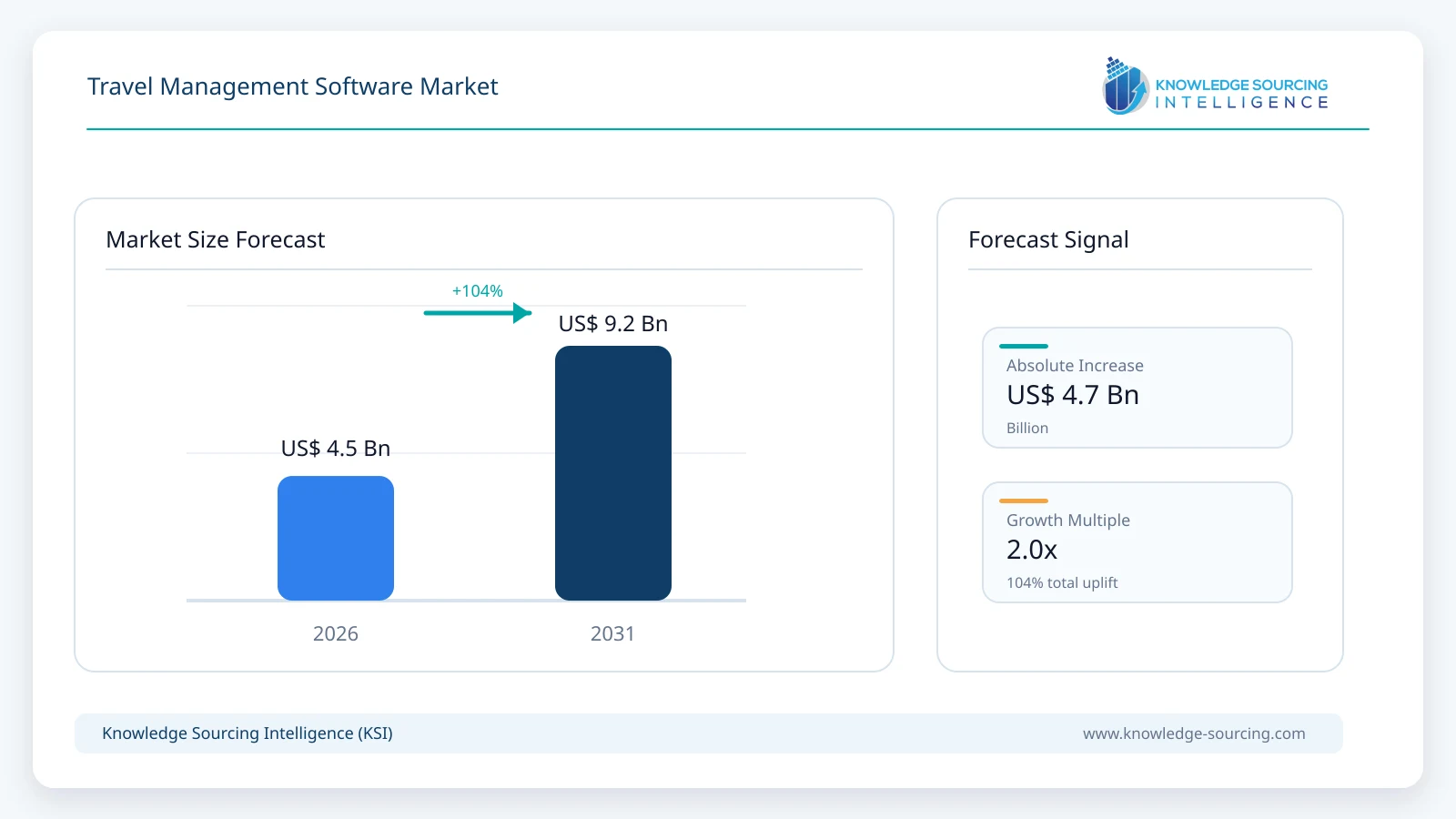
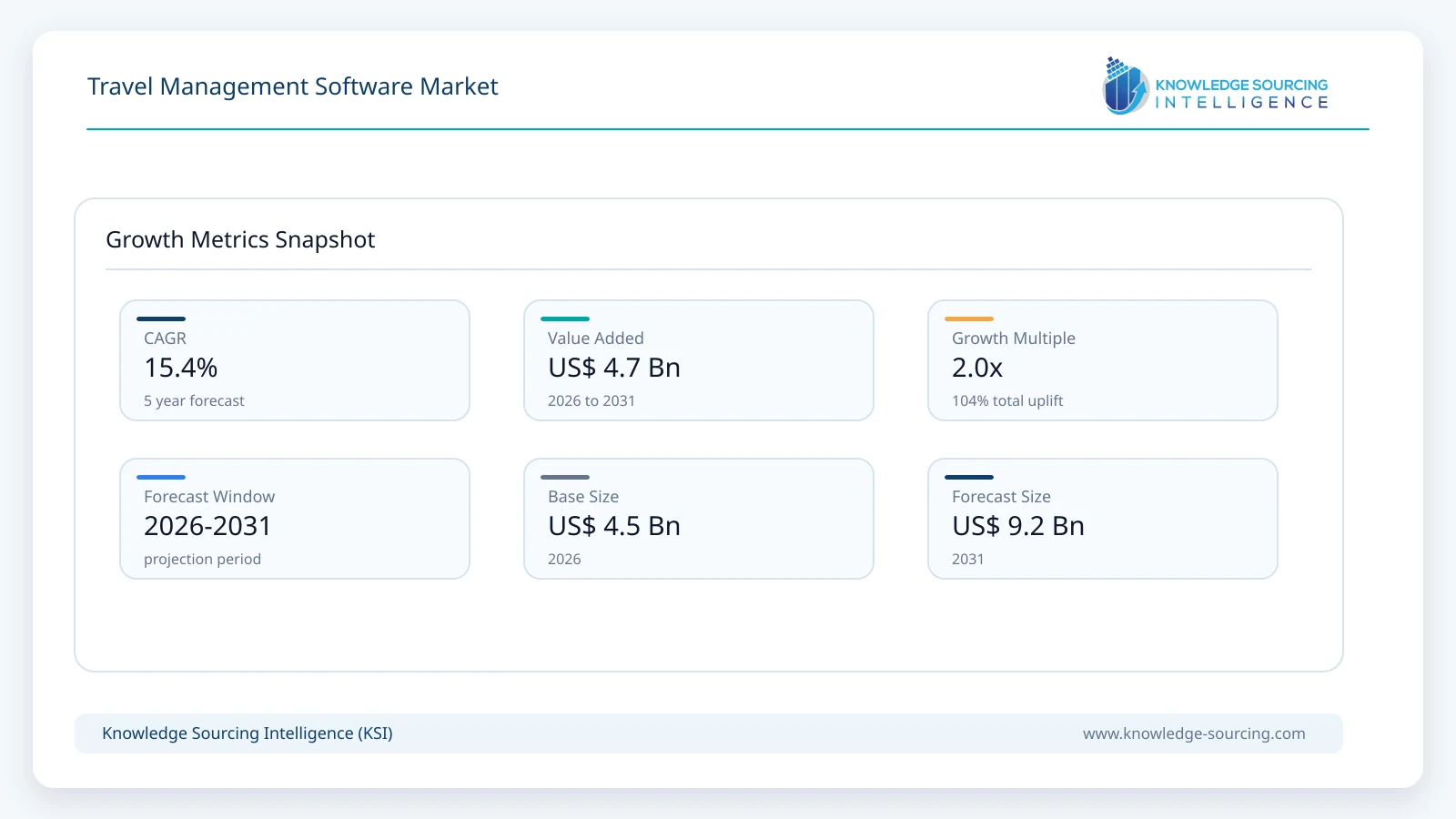
The global Travel Management Software market is forecast to grow at a CAGR of 15.4%, reaching USD 9.2 billion in 2031 from USD 4.5 billion in 2026.
Highlights:
- 1Market GrowthTravel Management Software market is set to expand from USD 4.5 billion in 2026 to USD 9.2 billion by 2031, registering a robust CAGR of 15.4%.
- 2Cloud-Based DeploymentCloud solutions dominate due to seamless integration with finance systems, real-time itinerary updates, multi-location access, and frequent product enhancements without local infrastructure.
- 3APAC LeadershipAsia Pacific holds ~41% of global business travel spend (USD 700.9 billion in 2026), driven by China, India, and regional expansion needs for multilingual and local-tax support.
- 4Integrated Travel & ExpenseDemand shifts toward platforms linking booking, corporate cards, policy enforcement, automated expense reports, and ERP systems to reduce manual finance work.
- 5Enterprise SegmentLarge enterprises drive higher value through complex multi-unit policies, APIs, analytics, role-based controls, and deep finance-system connectivity over simple booking tools.
- 6North America & EuropeMature markets emphasize spend visibility, AI-driven automation, cross-border compliance (e.g., EU ViDA), and strong ERP/card integrations for cost control.
Market Overview
Travel management software brings business travel booking, itinerary control, expense reporting, policy enforcement, payments, traveler support, and travel data into connected workflows. Demand is tied to the volume and cost of corporate travel, but software buying decisions increasingly depend on spend visibility, automation, policy control, employee usability, and integration with finance systems.
Global business travel remains a large underlying demand pool for these systems. GBTA forecasts USD 1.71 trillion in global business travel spending and approximately 1.84 billion business trips in 2026. Spending is rising faster than trip volume, which is increasing the need for companies to monitor travel costs, enforce policies, compare supplier rates, and connect travel activity with financial controls.
Corporate buyers are moving beyond standalone booking tools. Finance teams want travel reservations, corporate-card transactions, receipts, approvals, reimbursement, and policy checks to flow into the same financial environment. Oracle's current Fusion Cloud Financials architecture allows travel itineraries to flow from travel partners into expense workflows and can automatically create expense reports from eligible trip and card transactions.
The commercial opportunity therefore extends beyond booking volume. Vendors that connect travel data with expense control, payment data, compliance, analytics, and enterprise resource planning systems can address a larger share of the corporate travel workflow. At the same time, buyers face higher expectations for data security, integration quality, traveler safety, regional tax handling, and policy accuracy.
Key Market Indicators
Indicator | Latest Evidence | Commercial Meaning |
|---|---|---|
Global business travel spending | USD 1.71 trillion in 2026 | A large and growing spend base creates demand for software that controls travel costs and improves visibility. |
Global business trips | 1.84 billion in 2026 | High transaction volume increases the value of automated booking, itinerary, expense, and traveler-management workflows. |
Business travel spending growth | 7.2% in 2026 | Higher spend growth than trip growth increases pressure on companies to monitor price and policy leakage. |
APAC business travel spending | USD 700.9 billion in 2026 | APAC represents roughly 41% of the approved global spending forecast, making regional scale important for software vendors. |
Manufacturing and utilities share | 42% of global business travel spend | These sectors form an important underlying customer pool for travel-management systems. |
Europe business travel spending | EUR 389.9 billion in 2026 | Large regional travel flows support demand for policy, booking, expense, and compliance tools. |
Market Drivers
Higher travel costs are increasing the value of spend control.
GBTA expects business travel spending to rise faster than trip volume in 2026, with higher transportation and travel prices contributing to the difference. Companies therefore have a stronger reason to compare fares, manage hotel rates, enforce booking rules, and track unused travel inventory. Software vendors can capture this demand by linking travel decisions with finance data rather than treating booking as an isolated task.
Integrated travel and expense workflows reduce manual finance work.
Travel managers increasingly need reservation data to reach finance systems without repeated data entry. Oracle's current travel integration supports itinerary imports, booking updates, policy checks, and automatic creation of trip-based expense reports. Emburse Nexonia similarly connects travel booking with expense management and accounting systems, including ERP integrations.
Corporate travel programs are placing greater weight on measurable value.
GBTA's 2026 research found that companies remain committed to business travel but are becoming more selective about where and why employees travel. Its survey also found that organizations are dealing with higher costs and seeking greater visibility and control. This shifts software demand toward analytics, supplier benchmarking, policy enforcement, and reporting rather than simple reservation functionality.
AI is moving from experimentation into expense and travel workflows.
Emburse launched AI capabilities in February 2025 for expense and invoice processes, including document transcription, spend classification, audit, and risk assessment. In July 2025, the company added integrated itinerary management to its Emburse Enterprise mobile application, bringing travel details and expense submission into one interface. These releases show how suppliers are using automation to reduce manual work across the travel lifecycle.
Cross-border travel creates demand for stronger data and compliance controls.
International companies must handle different currencies, tax rules, corporate policies, travel suppliers, payment methods, and employee requirements. The European Union's VAT in the Digital Age package, adopted in March 2025, will introduce progressively stronger digital reporting requirements, including cross-border B2B digital reporting from July 2030. Travel and expense platforms will need data structures that can support these changes.
Market Restraints and Challenges
Deep integration with finance systems raises implementation effort.
Travel software must often connect with ERP platforms, corporate cards, travel management companies, booking channels, HR systems, expense tools, and accounting workflows. Oracle's documentation shows that travel integration requires configuration of travel partners, administrators, validation rules, and itinerary data flows. Integration errors can increase implementation time and reduce user trust, especially in large organizations with complex finance structures.
Data quality can limit automation benefits.
Automated expense creation depends on accurate itinerary, card, receipt, traveler, and policy information. Oracle's workflow includes validation of imported itineraries and comparison between booked and actual travel expenses. Poor data matching can create exceptions that still require manual review, reducing the savings expected from automation.
Enterprise switching costs can slow replacement decisions.
Large companies often have established ERP, card, travel-agency, HR, and expense systems. Replacing one component can affect several connected workflows, user permissions, historical records, and reporting structures. Vendors therefore compete not only on product features but also on migration support, APIs, implementation services, data security, and compatibility with existing systems.
Travel-price volatility complicates forecasting and policy design.
GBTA expects airfares, hotel rates, ground transportation, and meeting costs to remain under pressure during 2026 because of energy, labor, and operating costs. Travel-management platforms must accommodate changing supplier prices while maintaining policy thresholds that remain practical for employees. Poorly designed controls can push travelers outside approved channels, reducing the effectiveness of managed travel programs.
Security, privacy, and regulatory obligations increase product requirements.
Travel platforms handle employee identity information, itineraries, payment records, expense receipts, corporate policies, and sometimes sensitive traveler-location information. Vendors selling to multinational enterprises must meet security and privacy expectations across multiple jurisdictions. Compliance becomes a product-selection factor rather than a back-office issue, particularly for large enterprise deployments.
Major Segment Analysis
Cloud-Based Deployment
Cloud-based deployment is commercially important because travel management software depends on frequent data exchange between employees, travel suppliers, corporate cards, finance systems, and external booking platforms. A cloud architecture can provide centralized access across locations and support frequent product updates without requiring each customer to maintain local application infrastructure.
Oracle's current travel integration model illustrates the operational value of connected cloud workflows. It can receive itinerary data from travel partners, update trips before departure, apply validation rules, and create expense reports from eligible travel transactions. Emburse Nexonia similarly combines online travel booking, live itineraries, expense integration, and accounting connections.
Large enterprises remain an important buyer group because they typically have multiple business units, travel policies, corporate cards, finance systems, and approval structures. SMEs have different priorities, often placing greater weight on simple setup, low administration, mobile access, and integration with existing accounting software. Cloud deployment can serve both groups, but enterprise customers usually create greater demand for configurable workflows, APIs, analytics, role controls, and regional compliance.
Regional Analysis
North America
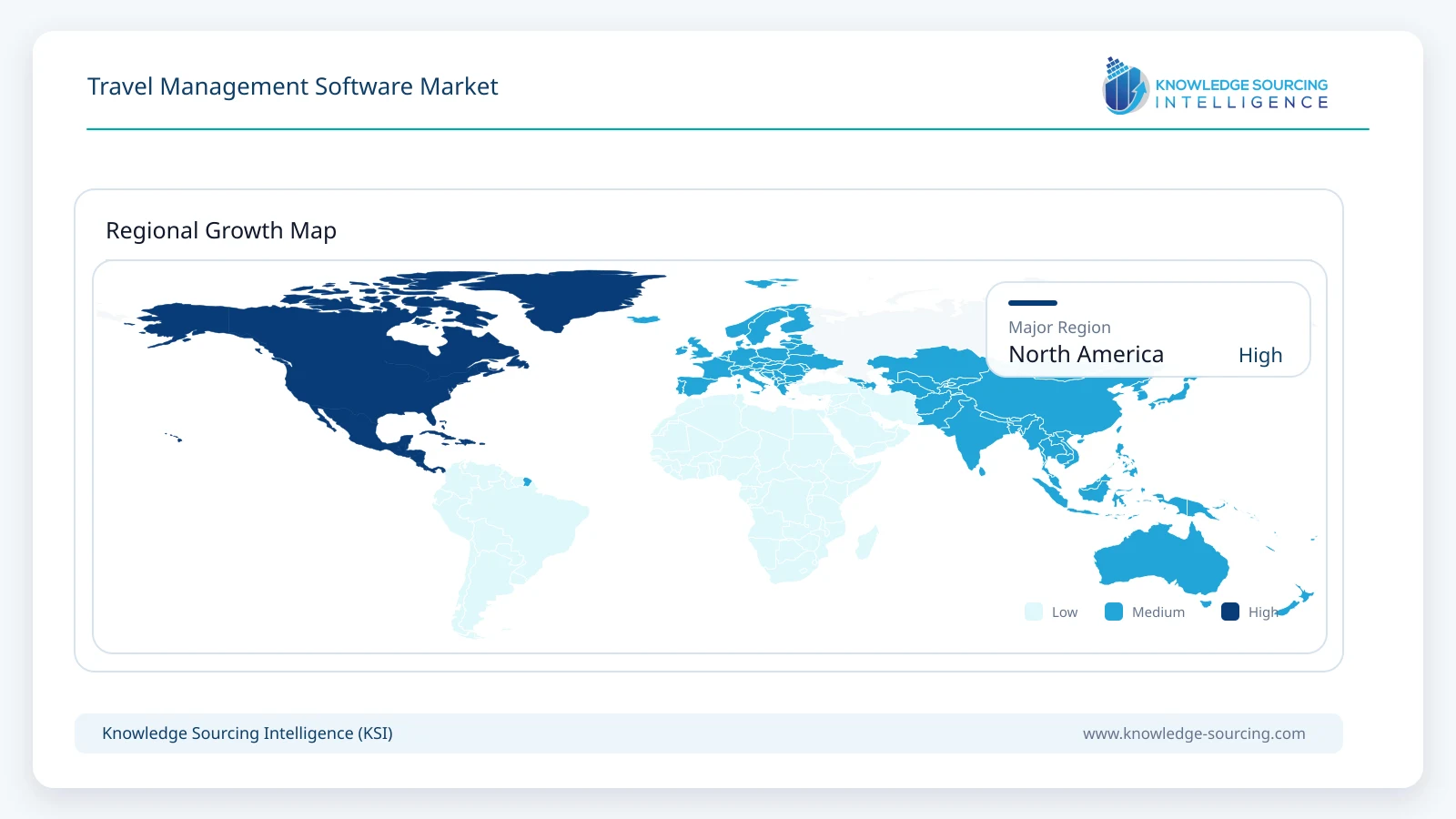
The United States remains a large corporate travel market and an important technology-buying center. GBTA expects the U.S. to account for USD 423.0 billion of global business travel spending in 2026, while technology and AI investment are supporting business travel activity. Customer meetings, internal collaboration, and business growth are important reasons for travel among North American organizations.
Software purchasing in North America is strongly connected to finance control and enterprise integration. Buyers commonly require corporate-card connections, expense automation, travel policy controls, reporting, and links to existing ERP systems. This favors vendors with mature APIs, enterprise implementation capabilities, and broad supplier connectivity.
Europe
Europe combines high business travel volumes with complex cross-border operating conditions. GBTA forecasts EUR 389.9 billion in European business travel spending for 2026. The region's travel programs must also address different national tax systems, currencies, labor rules, data requirements, and corporate policies.
The EU's ViDA package adds a longer-term compliance dimension. Digital reporting requirements for cross-border B2B transactions are scheduled from July 2030, creating a reason for finance and expense platforms to maintain structured transaction data and stronger links between travel spending and accounting systems.
Asia Pacific
APAC is the largest regional business travel market in the current GBTA forecast, with spending projected at USD 700.9 billion in 2026, equal to roughly 41% of the global forecast. China accounts for USD 408 billion, or 58% of APAC spending, while India, Japan, South Korea, Indonesia, and other markets also contribute to regional expansion.
The region's diversity creates a fragmented buying environment. Multinational enterprises need consistent policy and reporting across countries, while local companies may prioritize mobile access, ease of implementation, local payment methods, and cost. Vendors with regional data, multilingual interfaces, local tax support, and strong travel-supplier connections can address this variation more effectively than products designed around a single national market.
Middle East and Africa
Business travel conditions in the Middle East are more uneven because geopolitical disruption affects airline networks, travel times, and corporate activity. GBTA forecasts a 12.3% decline in Middle East business travel volume in 2026 under its current outlook, while its broader survey shows weaker expectations for travel to the region than for other destinations.
The UAE and Saudi Arabia remain relevant enterprise markets because of corporate investment, international business activity, and regional headquarters functions. Buyers in these markets place value on centralized travel controls, traveler safety, expense visibility, and support for international travel programs.
South America
Brazil provides the largest commercial opportunity within the specified South American coverage. GBTA identifies Brazil among the faster-growing major business travel markets in its 2026 forecast, with growth supported partly by economic activity and higher energy prices. Argentina also benefits from improving economic stability in the current business travel outlook.
Regional buyers face currency, supplier, tax, and cross-border payment considerations. Software vendors need strong local accounting and payment integrations when selling beyond multinational corporations.
Competitive Landscape
The competitive structure is technology-led and integration-driven, with enterprise software companies, specialist travel and expense providers, and regional vendors competing for control of corporate travel workflows. The supplied competitive set includes Emburse Nexonia, Ariett, Basware, Paychex, Expense8, Emburse Enterprise, Oracle Corporation, SkyJunction, and Coupa Software.
Emburse demonstrates the shift toward unified travel and expense management. Its Nexonia offering combines travel booking, live itineraries, unused-ticket tracking, expense integration, and accounting connections. Emburse also unified itinerary management and expense submission within its Enterprise mobile application in July 2025.
Oracle competes through integration with enterprise financial systems. Its current platform connects travel partners with expense workflows, supports automatic trip expense reports, and provides policy and itinerary controls. Its 2026 Expenses Agent release also applies AI to receipt extraction, card matching, policy validation, and exception handling.
The competitive advantage therefore extends beyond booking inventory. Vendors must connect travel data with corporate cards, expense policies, ERP systems, analytics, tax processes, and employee workflows. This creates switching costs for established customers and raises entry barriers for vendors that lack integration depth.
For the other companies in the supplied competitive set, including Ariett, Basware, Paychex, Expense8, Emburse Enterprise, SkyJunction, and Coupa Software, competitive positioning should be assessed around the specific travel, expense, finance, integration, and customer segments that each verified product serves. The market does not depend on a single product model, and supplier differentiation increasingly comes from workflow coverage and integration quality.
Recent Developments
August 2026: Emburse expanded its travel-and-expense ecosystem through strategic partnerships with Flight Centre Travel Group, TempoTrip, and World Travel, Inc., strengthening connected travel workflows, integrations, and AI-powered T&E management.
May 2026: Emburse unveiled an autonomous AI agent for travel-and-expense workflows that analyzes transactions, receipts, and itineraries to automatically prepare expense reports, reducing manual reporting effort.
February 2026: Emburse launched Emburse Assurance, an AI-powered expense-compliance solution providing pre-submission policy checks and post-submission detection of fraud, waste, and abuse across expense workflows.
January 2026: Oracle introduced its Expenses Agent as an AI-driven workflow for expense capture, receipt matching, policy validation, and exception handling. The release raises the competitive requirement for travel-management platforms to automate finance controls rather than only digitize travel booking.
February 2025: Basware released Travel and Expense enhancements improving reporting, expense visibility, approval controls, VAT refund reporting, category grouping, customizable terminology, and dimension visibility within its platform.
Regulatory and Policy Environment
Travel management software sits across travel, payments, employment, tax, accounting, data protection, and corporate-policy systems. Regulatory requirements therefore influence both product architecture and customer procurement. Platforms handling employee travel data must support access controls, audit trails, secure data transfer, and appropriate retention practices.
Tax reporting is becoming more digital in important markets. The European Union adopted its VAT in the Digital Age package in March 2025, with progressive implementation through 2035 and digital reporting requirements for cross-border B2B transactions beginning in July 2030. Travel and expense systems that feed financial reporting will need structured transaction data and reliable links with accounting systems.
Corporate travel also involves traveler safety and duty-of-care obligations. Emburse Nexonia, for example, incorporates traveler profiles, live itineraries, safety alerts, and travel-management controls. These functions matter for employers that need to locate travelers, communicate during disruptions, and maintain records of corporate travel activity.
Data protection remains a market-entry consideration, particularly for multinational deployments. Vendors must manage employee identity, location, payment, receipt, itinerary, and expense information across multiple jurisdictions. As travel systems become more integrated with finance and HR platforms, security and data governance become part of the buying decision rather than separate technical checks.
Outlook and Strategic Implications
The Travel Management Software Market is supported by a broad travel ecosystem, with demand increasingly shifting from standalone booking tools toward connected platforms that integrate travel, expense, payment, policy, compliance, and analytics. This transition is encouraging businesses to adopt more centralized and automated solutions, while growing corporate travel activity, digitalization, and demand for improved visibility and control continue to strengthen software adoption.
The strongest commercial opportunities are likely to sit around cloud deployment, integrated expense workflows, corporate-card connectivity, automated policy checks, AI-assisted expense processing, and regional compliance. Suppliers will need to prove that automation reduces manual work without creating new reconciliation, security, or policy problems.
For enterprise buyers, system compatibility and implementation risk will remain as important as feature breadth. For software suppliers, API quality, ERP connectivity, supplier content, data security, local tax support, mobile usability, and traveler-safety functions will influence customer retention and expansion.
Regional scale will also shape competition. APAC's roughly 41% share of forecast global business travel spending provides a large addressable base, while North America and Europe offer mature enterprise technology markets with complex integration and compliance needs.
Over 2026-2031, market performance will depend on whether vendors can convert growing corporate travel spend into better financial control. Products that connect the full travel-to-expense cycle, support regional rules, and deliver reliable automation should capture more enterprise value than tools limited to reservation or expense submission functions.
Travel Management Software Market Scope:
| Report Metric | Details |
|---|---|
| Total Market Size in 2026 | USD 4.5 billion |
| Total Market Size in 2031 | USD 9.2 billion |
| Forecast Unit | Billion |
| Growth Rate | 15.4% |
| Study Period | 2021 to 2031 |
| Historical Data | 2021 to 2024 |
| Base Year | 2025 |
| Forecast Period | 2026 – 2031 |
| Segmentation | Deployment, Enterprise Size, Industry Vertical, Region |
| Companies |
|
| Customization Scope | 15% Free Customization included with purchase — Request Custom Breakdown → |
| Sample & Data Access | PDF Sample, Excel Databook & Analyst Briefing — Download Free Sample → |
Market Segmentation
By Deployment
Cloud-Based
On-Premises
By Enterprise Size
Large Enterprises
Small and Medium Enterprises (SMEs)
By Industry Vertical
Manufacturing
Transportation
Retail and Logistics
Healthcare
Energy
Others
By Geography
North America
United States
Canada
Mexico
South America
Brazil
Argentina
Others
Europe
United Kingdom
Germany
France
Spain
Others
Middle East and Africa
Saudi Arabia
Israel
United Arab Emirates
Others
Asia-Pacific
China
Japan
India
South Korea
Thailand
Indonesia
Others
Table of Contents
1. INTRODUCTION
1.1. Market Overview
1.2. Market Definition
1.3. Scope of the Study
1.4. Market Segmentation
1.5. Currency
1.6. Assumptions
1.7. Base and Forecast Years Timeline
1.8. Key Benefits for the Stakeholders
2. RESEARCH METHODOLOGY
2.1. Research Design
2.2. Research Processes
3. EXECUTIVE SUMMARY
3.1. Key Findings
3.2. Analyst View
4. MARKET DYNAMICS
4.1. Market Drivers
4.2. Market Restraints
4.3. Porter’s Five Forces Analysis
4.3.1. Bargaining Power of Suppliers
4.3.2. Bargaining Power of Buyers
4.3.3. Threat of New Entrants
4.3.4. Threat of Substitutes
4.3.5. Competitive Rivalry in the Industry
4.4. Industry Value Chain Analysis
4.5. Analyst View
5. GLOBAL TRAVEL MANAGEMENT SOFTWARE MARKET BY DEPLOYMENT
5.1. Introduction
5.2. Cloud-Based
5.2.1. Market Trends and Opportunities
5.2.2. Growth Prospects
5.2.3. Geographic Attractiveness Insights
5.3. On-Premises
5.3.1. Market Trends and Opportunities
5.3.2. Growth Prospects
5.3.3. Geographic Attractiveness Insights
6. GLOBAL TRAVEL MANAGEMENT SOFTWARE MARKET BY ENTERPRISE SIZE
6.1. Introduction
6.2. Large Enterprises
6.2.1. Market Trends and Opportunities
6.2.2. Growth Prospects
6.2.3. Geographic Attractiveness Insights
6.3. Small and Medium Enterprises (SMEs)
6.3.1. Market Trends and Opportunities
6.3.2. Growth Prospects
6.3.3. Geographic Attractiveness Insights
7. GLOBAL TRAVEL MANAGEMENT SOFTWARE MARKET BY INDUSTRY VERTICAL
7.1. Introduction
7.2. Manufacturing
7.2.1. Market Trends and Opportunities
7.2.2. Growth Prospects
7.2.3. Geographic Attractiveness Insights
7.3. Transportation
7.3.1. Market Trends and Opportunities
7.3.2. Growth Prospects
7.3.3. Geographic Attractiveness Insights
7.4. Retail and Logistics
7.4.1. Market Trends and Opportunities
7.4.2. Growth Prospects
7.4.3. Geographic Attractiveness Insights
7.5. Healthcare
7.5.1. Market Trends and Opportunities
7.5.2. Growth Prospects
7.5.3. Geographic Attractiveness Insights
7.6. Energy
7.6.1. Market Trends and Opportunities
7.6.2. Growth Prospects
7.6.3. Geographic Attractiveness Insights
7.7. Others
7.7.1. Market Trends and Opportunities
7.7.2. Growth Prospects
7.7.3. Geographic Attractiveness Insights
8. GLOBAL TRAVEL MANAGEMENT SOFTWARE MARKET BY GEOGRAPHY
8.1. Introduction
8.2. North America
8.2.1. By Deployment
8.2.2. By Enterprise Size
8.2.3. By Industry Vertical
8.2.4. By Country
8.2.4.1. United States
8.2.4.1.1. Market Trends and Opportunities
8.2.4.1.2. Growth Prospects
8.2.4.2. Canada
8.2.4.2.1. Market Trends and Opportunities
8.2.4.2.2. Growth Prospects
8.2.4.3. Mexico
8.2.4.3.1. Market Trends and Opportunities
8.2.4.3.2. Growth Prospects
8.3. South America
8.3.1. By Deployment
8.3.2. By Enterprise Size
8.3.3. By Industry Vertical
8.3.4. By Country
8.3.4.1. Brazil
8.3.4.1.1. Market Trends and Opportunities
8.3.4.1.2. Growth Prospects
8.3.4.2. Argentina
8.3.4.2.1. Market Trends and Opportunities
8.3.4.2.2. Growth Prospects
8.3.4.3. Others
8.3.4.3.1. Market Trends and Opportunities
8.3.4.3.2. Growth Prospects
8.4. Europe
8.4.1. By Deployment
8.4.2. By Enterprise Size
8.4.3. By Industry Vertical
8.4.4. By Country
8.4.4.1. United Kingdom
8.4.4.1.1. Market Trends and Opportunities
8.4.4.1.2. Growth Prospects
8.4.4.2. Germany
8.4.4.2.1. Market Trends and Opportunities
8.4.4.2.2. Growth Prospects
8.4.4.3. France
8.4.4.3.1. Market Trends and Opportunities
8.4.4.3.2. Growth Prospects
8.4.4.4. Spain
8.4.4.4.1. Market Trends and Opportunities
8.4.4.4.2. Growth Prospects
8.4.4.5. Others
8.4.4.5.1. Market Trends and Opportunities
8.4.4.5.2. Growth Prospects
8.5. Middle East and Africa
8.5.1. By Deployment
8.5.2. By Enterprise Size
8.5.3. By Industry Vertical
8.5.4. By Country
8.5.4.1. Saudi Arabia
8.5.4.1.1. Market Trends and Opportunities
8.5.4.1.2. Growth Prospects
8.5.4.2. Israel
8.5.4.2.1. Market Trends and Opportunities
8.5.4.2.2. Growth Prospects
8.5.4.3. United Arab Emirates
8.5.4.3.1. Market Trends and Opportunities
8.5.4.3.2. Growth Prospects
8.5.4.4. Others
8.5.4.4.1. Market Trends and Opportunities
8.5.4.4.2. Growth Prospects
8.6. Asia-Pacific
8.6.1. By Deployment
8.6.2. By Enterprise Size
8.6.3. By Industry Vertical
8.6.4. By Country
8.6.4.1. China
8.6.4.1.1. Market Trends and Opportunities
8.6.4.1.2. Growth Prospects
8.6.4.2. Japan
8.6.4.2.1. Market Trends and Opportunities
8.6.4.2.2. Growth Prospects
8.6.4.3. India
8.6.4.3.1. Market Trends and Opportunities
8.6.4.3.2. Growth Prospects
8.6.4.4. South Korea
8.6.4.4.1. Market Trends and Opportunities
8.6.4.4.2. Growth Prospects
8.6.4.5. Thailand
8.6.4.5.1. Market Trends and Opportunities
8.6.4.5.2. Growth Prospects
8.6.4.6. Indonesia
8.6.4.6.1. Market Trends and Opportunities
8.6.4.6.2. Growth Prospects
8.6.4.7. Others
8.6.4.7.1. Market Trends and Opportunities
8.6.4.7.2. Growth Prospects
9. COMPETITIVE ENVIRONMENT AND ANALYSIS
9.1. Company and Strategy Analysis
9.2. Market Share Analysis
9.3. Mergers, Acquisitions, Agreements, and Collaborations
9.4. Competitive Dashboard
10. COMPANY PROFILES
10.1. Emburse Nexonia
10.2. Ariett
10.3. Basware
10.4. Paychex
10.5. Expense8
10.6. Emburse Enterprise
10.7. Oracle Corporation
10.8. SkyJunction
10.9. Coupa Software
LIST OF TABLES
LIST OF FIGURES





Frequently asked questions
What is the projected market size of travel management software by 2031?
Market projected to reach $9.2 billion by 2031, growing at 15.4% CAGR.
Which deployment model leads the Travel Management Software market?
Cloud-based solutions dominate due to seamless integration and real-time updates.
Which region leads the global Travel Management Software market growth?
Asia Pacific leads, driven by significant business travel spend from China and India.
What is the primary demand shift in travel management software platforms?
Demand shifts towards integrated booking, expense, and ERP-linked platforms.
Which enterprise segment generates the most value for vendors?
Large enterprises drive higher value through complex policies and deep system connectivity.
What are the key strategic focus areas for mature markets?
Mature markets prioritize spend visibility, AI automation, and strong ERP integrations.
Cite this report
Knowledge Sourcing Intelligence. (Oct 2026). Travel Management Software Market - Strategic Insights and Forecasts (2026-2031). https://www.knowledge-sourcing.com/report/travel-management-software-market