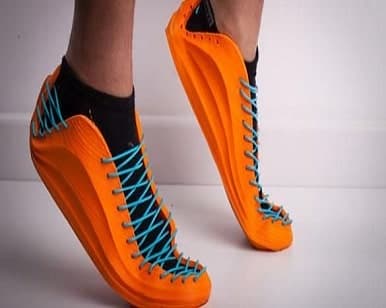
The 3D Printed Footwear market was valued at US$830.630 million in 2020 and will increase to US$3.296.967 million by 2027. Over the forecast period, this market is estimated to...
The 3D Printed Footwear market was valued at US$830.630 million in 2020 and will increase to US$3.296.967 million by 2027. Over the forecast period, this market is estimated to increase at a compound yearly growth rate of 21.77%.
The production of a three-dimensional object from a CAD model or a digital 3D model is known as 3D printing or additive manufacturing. The term "3D printing" can apply to a range of procedures in which material is deposited, connected, or solidified under computer control to make a three-dimensional object, with material added layer by layer. Any footwear specialist can construct a test shoe using 3D printing for footwear prototype before designing their final design, which has been around for a long now. However, because of the technological revolution, additive manufacturing has become cost-effective and productive enough to mass-produce accessible shoes in large quantities by the method of 3D printing of footwear.
According to analysts, the increasing demand for customized footwear will be the driving force behind the market's robust growth over the forecasted timeframe.
3D-printed footwear is anticipated to become one of the most popular consumer goods in the future. This transition will be driven by two major trends: first, customer demand for more individualized products, and second, the growing role of digital production. Consumers today are asking for tailored, individualized services. 3D printing, on the other hand, gives businesses a new degree of personalization by allowing them to create shoes that are specially fitted for their customers. While the possibility of mass-customized footwear is still being investigated, footwear companies are just getting started on making plans to sell custom footwear on a large scale. As more firms take risks with 3D printing, the utilization of the technology in footwear production will improve.
Adidas, the German sportswear company, is one of the pioneers in 3D printing in the footwear sector. Futurecraft 4D, AlphaEdge 4D, 4D Run 1.0, and several other 3D printed footwear lines have been successfully launched in recent years with a heavy focus on customized footwear. Key businesses are attracting customers with new types of 3D-printed footwear. New product introductions help vendors increase footwear sales and market share, propelling the global 3D-printed footwear market ahead. For example, Adidas announced the release of the Futurecraft 'STRUNG', the next edition of its 3D-printed sneakers, in June 2021. Furthermore, Adidas launched 4DFWD shoes with a Carbon 3D printed lattice midsole in May 2021.
Digitization and automation are other major elements pushing footwear 3D printing usage. Shoemaking is a time-consuming, multi-step process in which the majority of the work is still done by hand. A finished pair of shoes necessitates the use of specialized equipment and people. As a result, footwear manufacturers are constantly looking for ways to improve their manufacturing processes. A few shoe components can be 3D printed seamlessly, allowing shoe firms to expedite production. Unlike traditional manufacturing procedures, 3D printing does not require any additional tooling to make a product. As a result, after developing a digital model, specialist software applications would determine the printed speed and part orientation parameters on a build platform.
The 3D Printed Footwear's market expansion could be hindered by limited resources and weak results.
Although some businesses are claiming to be able to 3D print in rubber, the materials that 3D printers can print are still limited. If models can't be printed with materials that mimic EVA, TPR, PU, and other materials, print soles will be utilized primarily for specialty footwear or visual validation, rather than for general performance. Furthermore, printing a functional upper will take time. Shortly, the capacity to 3D print rubber or something comparable to it could be a reality. Because of the layer-by-layer procedure used to generate them, 3D printed parts are now weaker than conventionally manufactured parts. Because of current manufacturing methods, a sole's bulk will be consistent throughout, whereas a sole made of rubber will be more flexible.
During the projected period, the VAT Polymerization segment is expected to grow rapidly in the 3D Printed Footwear market.
By Technology, the 3D Printed Footwear market can be segmented into Filament Extrusion, VAT Polymerization, Power Bed Fusion, and Material Jetting. As it is the most commonly utilized process for curing resin (liquid photopolymer) with light, VAT Polymerization is likely to dominate the global market for 3D Printed Footwear. It is the most established and dependable 3D printing technology. The fixed section of the product can be made completely airtight and watertight using this technique. The 3D printed footwear market is expected to grow as it becomes more popular and widely used. In addition, VAT Polymerization printers can produce highly detailed prints with feature sizes as tiny as 0.3 mm.
During the forecasted time frame, the Thermoplastic Polyurethane (TPU) segment in the 3D Printed Footwear market is predicted to have a dominating share.
Polyurethane and Thermoplastic Polyurethane are the two main materials used in 3D printed footwear (TPU). A thermoplastic elastomer has qualities such as elasticity, oil absorption, resistance, transparency, and breathability, thermoplastic polyurethane is a thermoplastic elastomer. This material can be utilized on practically every aspect of a shoe, making it extremely efficient to work with. As a result, both the category and the 3D printed footwear industry are predicted to grow. In the 3D printed Footwear Market, TPU holds the most portion of the predicted timeframe.
During the projected period, the uppers segment is expected to grow rapidly in the 3D Printed Footwear market.
The 3D printed Footwear market is divided into three categories: insoles, midsoles, and uppers. Because they can be formed from nearly any material and are positioned at the top of the shoe, 3D printed Uppers are likely to capture a large piece of the market. It encourages people to use 3D printing technology and create personalized designs, which is projected to boost demand for the technology and propel the global 3D printed footwear market forward.
During the forecast period, the 3D Printed Footwear market in North America is predicted to have a dominating share.
The 3D Printed Footwear market is classified into five regions based on geography: North America, South America, Europe, the Middle East, Africa, and the Asia Pacific. The North American market is expected to account for the largest revenue share in the 3D Printed Footwear market over the projected period. Over the projected period, the significant increase in the number of local and worldwide vendors in countries such as the United States would aid the expansion of the 3D-printed footwear market in North America. According to the 3D printing Sentiment Index published by Ultimaker, a desktop 3D printing company, in November 2019, the United States is the most advanced country in 3D printing. Market expansion is expected to be fueled by several new product releases, as well as product enhancements and developments. Carbon, a US-based manufacturer of 3D printing technologies, announced its new L1 3D printer in February 2019. Stratasys Ltd. (Stratasys) announced the debut of their F120 3D printer in April 2019. Simple controls and remote self-monitoring are included with the new 3D printer. Furthermore, Aetrex Worldwide Inc. offers Aetrex, which can translate the data and build a 3D printed orthotic that fits the individual's foot perfectly.
Covid-19 Insights
The COVID-19 epidemic has had a negative influence on 3D Printed Footwear. In reaction to the COVID-19 outbreak, several end-user manufacturing units have paused output, disrupting the 3D printing footwear supply chain. COVID-19 has had a minor influence on the 3D printed footwear business since the markets affected by coronavirus are geographically positioned where it has the biggest impact. Because demand was low and manufacturing stalled in many facilities, the outbreak had a detrimental influence on the 3D printed footwear supply chain.
Garuav Singh
ContributorHave questions?
More Thought Articles
How EV Charger Manufacturers Can Capitalize on India’s Home Charging Revolution
India’s residential EV charging opportunity is expanding as policy support, EV adoption, and private parking infrastructure develop. Manufacturers can capture value beyond AC chargers through installation, smart charging, load management, solar integration, software, and after-sales services. Housing societies, automakers, and property developers offer scalable routes to residential charging customers.
Second-Life EV Battery Market in India: What Is Driving Demand from Manufacturers?
India’s second-life EV battery market is gaining relevance as electric vehicle adoption expands and batteries retain useful capacity after automotive service. Growing stationary-storage demand, battery data, refurbishment capabilities, EPR obligations, and critical-mineral policies are encouraging manufacturers to extend battery value through reuse before eventual recycling within India’s emerging circular battery ecosystem.
The Rise of Locally Manufactured Battery Separators in India’s EV Ecosystem
India’s battery industry is progressing from pack assembly toward domestic cell and material manufacturing, creating opportunities for lithium-ion battery separators. Policy support, ACC capacity expansion and R&D initiatives are strengthening the ecosystem. However, technical complexity, manufacturing yields, qualification requirements and economics mean localisation will likely advance gradually through coatings, testing and finishing.