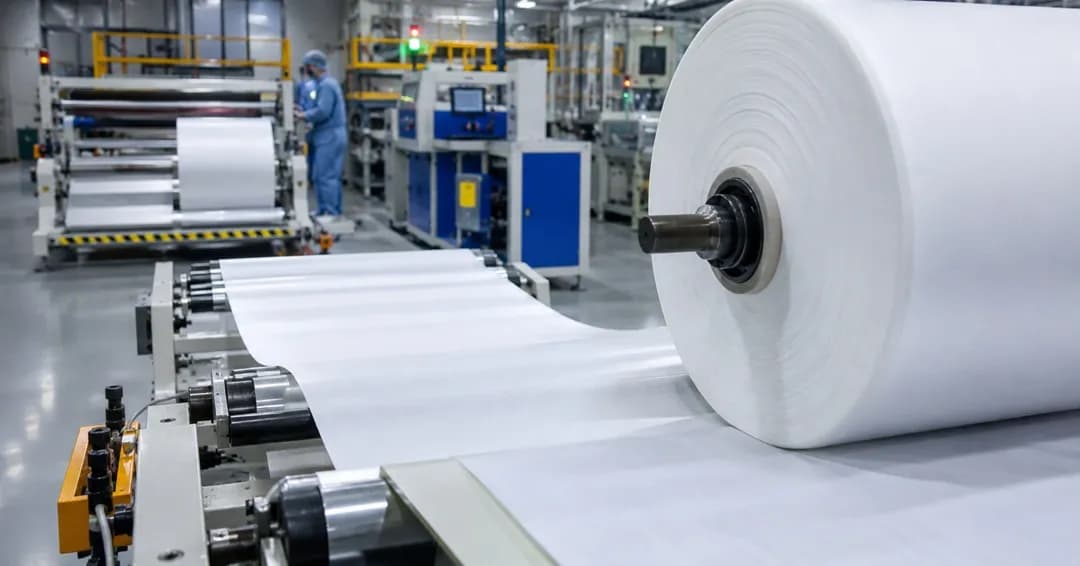
India’s battery industry is progressing from pack assembly toward domestic cell and material manufacturing, creating opportunities for lithium-ion battery separators. Policy support, ACC capacity expansion and R&D initiatives are strengthening the ecosystem. However, technical complexity, manufacturing yields, qualification requirements and economics mean localisation will likely advance gradually through coatings, testing and finishing.
India’s battery manufacturing ambitions are entering a more demanding phase. The first stage of the electric vehicle industry was largely about importing cells, assembling battery packs and building enough domestic integration to support rapidly growing vehicle production. The next stage is considerably more difficult because it involves manufacturing the cell itself and, eventually, producing the specialised materials that determine cell performance, safety and cost.
Battery separators belong firmly in this second category. The separator is a thin, porous membrane positioned between the cathode and anode of a lithium-ion cell. Its fundamental role is to prevent direct electrical contact while allowing lithium ions to pass through during charging and discharging. That sounds like a relatively narrow engineering function, but the material has to satisfy several demanding requirements at the same time. Mechanical strength, pore structure, ionic transport, thermal stability, dimensional consistency, electrolyte compatibility and resistance to physical damage all influence the reliability of the finished cell.
India is beginning to recognise that importance. The eMobility R&D Roadmap specifically includes a proposed research project on “New Paradigm Separators for Lithium-ion Batteries,” with targets covering ionic conductivity and charging speed, thermal stability, and safety requirements such as thermal propagation, fire resistance and mechanical integrity. The roadmap also calls for prototype development, manufacturing integration, quality control, cost analysis and scalability planning.
The timing is significant because domestic cell manufacturing is finally beginning to take shape. The PLI ACC programme carries an outlay of ?18,100 crore for 50 GWh of advanced chemistry cell capacity, with 40 GWh awarded to four beneficiaries. As of July 2026, the Ministry of Heavy Industries reported that a 1.4 GWh giga-scale ACC manufacturing plant had been established under the scheme, while the programme had attracted ?5,180 crore of investment and 1,277 direct jobs as of 31 May 2026. This still illustrates the early stage of India’s commercial cell manufacturing build-out.
That creates an unusual window for separator manufacturers. Demand is not yet fully mature, but the industrial infrastructure that could support great domestic demand is being established now.
Why Battery Separators Have Become a Strategic Localisation Target
Battery separators rarely receive the same attention as cathode materials or anodes because they do not directly determine the battery's headline energy density. Their contribution is more fundamental. They help maintain the physical separation of the electrodes throughout cell operation and therefore form part of the battery's basic safety architecture.
A separator must remain mechanically stable while being thin and porous enough to support efficient ion movement. It also needs to behave predictably when the cell experiences heat, pressure and repeated charge-discharge cycles. Excessive shrinkage or loss of integrity can increase the risk of an internal short circuit, while poor pore characteristics can affect resistance and charging performance.
The commercial challenge is therefore one of optimisation rather than simply material substitution. India's R&D roadmap reflects this complexity by linking separator development to thermal propagation, fire resistance, mechanical integrity and compatibility with existing cell manufacturing processes. That approach is important because a separator that performs well in laboratory testing is not automatically useful to a commercial cell producer. It has to run consistently through high-volume manufacturing and deliver predictable results across millions of cells.
This is where domestic production could eventually provide an advantage. Local suppliers can work more closely with cell manufacturers during qualification, modify products around specific cell architectures and respond more quickly to manufacturing problems. Those benefits may become more valuable as Indian cell factories move toward higher utilisation.
Domestic Cell Capacity Is Creating the Demand Pull
The separator opportunity ultimately depends on the growth of India's cell manufacturing base. Government policy is now creating that demand foundation.
The PLI ACC scheme was designed to establish 50 GWh of domestic advanced chemistry cell manufacturing capacity and reduce India's dependence on imported cells. In February 2026, the Ministry of Heavy Industries reported that at least ten manufacturers had announced about 178 GWh of cumulative cell capacity over the following five years, in addition to the PLI beneficiaries. The government also noted that the PLI programme had already increased demand for components such as cathode active materials, anode active materials and foils, while Indian companies were announcing component manufacturing and recycling facilities.
Separators fit naturally into this next layer of localisation. The opportunity also extends beyond passenger electric cars. Electric two-wheelers and three-wheelers are already important consumers of lithium-ion cells, while electric buses, commercial vehicles and stationary storage can broaden the addressable market. In July 2026, the Ministry of Heavy Industries released a global tender for a cumulative 10 GWh of additional ACC manufacturing capacity earmarked for grid-scale stationary storage. This expands the potential domestic cell market beyond transportation, although the capacity is still subject to the tender process.
That diversification is useful for separator producers because it reduces dependence on a single vehicle category and creates opportunities to develop products for different cell formats and operating requirements.
Localisation Can Develop Across Several Stages
Separator value-chain layer | Strategic importance for India | Practical localisation opportunity |
Specialty polymers and battery-grade feedstocks | Very high because raw-material purity affects film quality and cell performance | Difficult initially because specialised inputs require advanced material and process capabilities |
Microporous separator base film | Critical because it represents the core separator manufacturing technology | Major long-term opportunity, although capital intensity and process know-how create high entry barriers |
Ceramic and functional coatings | Increasingly important for thermal and mechanical performance | Attractive intermediate opportunity for Indian specialty-material companies |
Slitting and finishing | Necessary for supplying cell-specific dimensions and production requirements | More accessible entry point than complete film manufacturing |
Testing and metrology | Essential for qualification, quality assurance and process control | Strong opportunity for specialist laboratories and engineering companies |
Separator R&D | Important for faster charging, higher energy density and improved safety | Long-term opportunity for companies able to develop differentiated materials |
This layered development is probably the most realistic route for India. There is little commercial logic in attempting to reproduce the entire global separator supply chain immediately. Domestic companies can first develop expertise in coating, finishing, testing and application engineering while cell production scales.
Once those capabilities and customer relationships are established, upstream investment in base-film manufacturing becomes more credible.
The Technical Barrier Is Higher Than the Product Looks
Commercial lithium-ion separators are typically microporous polymer membranes manufactured to extremely tight specifications. Production involves controlled polymer processing, film formation, pore generation, stretching, heat treatment and finishing. Depending on the technology, manufacturers may use wet or dry processes, followed by functional coatings for specialised applications.
The resulting film is extremely thin, which makes manufacturing consistency difficult. A thicker separator can provide greater mechanical robustness but consumes space that could otherwise accommodate active battery materials. A highly porous membrane can facilitate ionic movement but may compromise mechanical properties if the structure is not carefully controlled. Improving thermal performance can involve ceramic or other coatings that add processing steps and cost.
This creates a difficult balance between performance and manufacturability. For Indian manufacturers, yield will be one of the most important commercial variables. A separator plant can have a large nominal production capacity but still struggle economically if excessive film is rejected because of thickness variations, contamination, pore defects or mechanical inconsistencies.
Clean manufacturing is another important consideration. Separator defects that appear minor at the film stage can become serious once the material is placed between electrodes. Process filtration, inspection and quality-control systems therefore need to be treated as part of the core manufacturing process.
The Indian industry will need expertise across polymer science, electrochemistry, precision coating, process control and battery testing. That combination of capabilities is considerably harder to build than a conventional plastics manufacturing operation.
Coated Separators Could Offer the First Scalable Entry Point
India may have a more practical near-term opportunity in separator coatings than in complete separator-film manufacturing. Ceramic and functional coatings can improve thermal stability, surface characteristics and mechanical performance. They also create an entry point for Indian specialty-material manufacturers that already possess capabilities in high-purity ceramics and fine-particle processing.
Hindalco provides a useful example of this emerging capability. Its specialty alumina business supplies boehmite and other high-purity alumina products for battery separator and edge-coating applications. The company states that boehmite offers thermal stability and is used in battery separator applications. Its FY2024-25 annual report also describes the development of low-soda boehmite for lithium-ion battery separator applications, including customer approval of the final product and work to scale the process through a pilot plant.
This does not mean India already has a fully domestic lithium-ion separator industry. It shows something more useful: parts of the supporting materials ecosystem are beginning to develop domestically.
A plausible industrial pathway could therefore involve imported base film being coated, finished and tested in India before manufacturers progressively move toward domestic production of the underlying film. That approach reduces the technological barrier while allowing suppliers to learn the qualification requirements of Indian cell producers.
Supply Security Could Become More Valuable Than Small Cost Savings
Local separator manufacturing is not solely about reducing import expenditure. Supply security could become an equally important commercial consideration as India's cell plants move toward continuous production.
A cell manufacturer may be able to tolerate a modest price premium for a material that is reliably available, locally supported and capable of being customised quickly. A production interruption caused by the unavailability of a qualified separator can be much more expensive than the difference between two suppliers' material prices.
This is particularly relevant because separator specifications are tied closely to cell design. A cell manufacturer cannot necessarily switch suppliers overnight. Changes in thickness, porosity, coating or surface characteristics can affect cell performance and require renewed validation.
India's present dependence on imported advanced chemistry cells illustrates the broader issue. The Ministry of Heavy Industries stated in February 2026 that domestic demand continued to be met largely through imports while the PLI ACC programme was being used to establish domestic manufacturing capabilities.
For separator manufacturers, this creates a potential competitive advantage that is difficult to capture in a simple cost comparison. A supplier located close to a cell plant can offer shorter replenishment cycles, faster technical intervention and potentially lower inventory requirements. That will not eliminate the cost disadvantage of smaller Indian producers, but it can narrow the commercial gap.
Cell Manufacturers Will Shape the Market
Battery and cell manufacturers themselves are likely to influence the development of domestic separator production because separator performance is closely linked to cell architecture.
A vertically integrated manufacturer can test a separator within its own development programme and evaluate how changes in pore structure, coating or surface treatment affect the electrodes, electrolyte and overall cell. That creates a much faster feedback loop than an independent materials supplier working without access to cell-level data.
The government's separator R&D roadmap follows a similar integrated model. It calls for material benchmarking, separator design, comprehensive testing, prototype batteries, manufacturing integration, quality control, cost analysis and scalability planning.
This is commercially important because separator development should not remain isolated inside materials laboratories. The material ultimately has to operate reliably within an industrial cell-assembly environment.
Domestic testing infrastructure will therefore become increasingly valuable. Laboratories capable of assessing mechanical properties, porosity, permeability, thermal shrinkage and electrochemical compatibility can shorten qualification cycles and help Indian suppliers identify manufacturing problems before they reach commercial production. In effect, testing becomes part of localisation.
Economics Will Remain the Biggest Barrier
The technology challenge is only half the problem. The economics of separator manufacturing will determine whether domestic suppliers can survive after the initial policy-supported investment cycle.
Established international manufacturers benefit from large production volumes, mature processes, extensive customer qualification and years of manufacturing experience. Indian companies entering the market will initially face smaller volumes and therefore higher unit costs.
Capital utilisation will matter greatly. A new separator plant needs enough customer demand to operate close to efficient capacity, but cell manufacturers may hesitate to commit large volumes until the supplier has demonstrated reliable production. That creates a familiar industrial chicken-and-egg problem.
The Factors That Will Determine Competitiveness
Competitive factor | Commercial significance | Main challenge for Indian manufacturers |
Production yield | Higher yield lowers the cost of every qualified metre produced | Establishing stable process control at commercial scale |
Polymer quality | Feedstock consistency influences pore structure and mechanical performance | Building dependable battery-grade material supply |
Coating uniformity | Uneven coating can affect thermal and electrochemical behaviour | Developing precision coating and inspection systems |
Manufacturing cleanliness | Contamination can cause cell defects and reduce yield | Maintaining stringent production environments |
Customer qualification | Determines how quickly a supplier can generate recurring revenue | Building confidence with cell manufacturers |
Energy consumption | Continuous film production can carry significant operating costs | Achieving efficient high-volume processing |
Plant utilisation | Fixed costs become more manageable as output increases | Domestic cell production is still ramping |
R&D capability | Enables performance-based differentiation rather than commodity pricing | Developing specialist battery-material talent |
The result is likely to be a market in which not every announced separator project succeeds. Companies with strong materials expertise but weak manufacturing economics may struggle, while companies with manufacturing discipline but insufficient technical differentiation may find it difficult to win automotive customers. The strongest businesses will probably combine both.
Policy Support Is Creating Conditions, Not Guaranteed Competitiveness
Government policy is giving battery-material manufacturers a more credible demand environment, but it cannot substitute for manufacturing capability.
The PLI ACC programme provides a substantial foundation for domestic cell production, while subsequent policy actions are expanding the potential market into stationary storage. In July 2026, the Ministry of Heavy Industries released a global tender for 10 GWh of additional ACC manufacturing capacity dedicated to grid-scale stationary storage under the PLI ACC framework.
For separator suppliers, the significance is straightforward. More domestic cell capacity means more opportunities for local material suppliers, provided those suppliers can meet technical and commercial requirements.
The R&D framework is equally important. India's e-Mobility R&D Roadmap does not treat separator development as a simple import-substitution exercise. It explicitly calls for prototype development, manufacturing equipment, cost analysis, performance data and scalability plans.
That is the right approach because the gap between laboratory success and mass production is where many advanced-material projects fail. India should therefore measure progress through qualified production and repeatable yields rather than announced capacity alone.
Safety Requirements Will Push Separator Performance Higher
Battery safety will become an increasingly important differentiator as EV manufacturers pursue higher charging rates and greater energy density.
A separator that performs adequately under moderate operating conditions may not provide the same margin when cells are subjected to higher thermal loads or faster charging. This creates pressure for improved thermal stability, mechanical integrity and resistance to deformation.
India's separator R&D roadmap explicitly identifies these areas, including thermal stability, fire resistance, mechanical integrity and compliance with safety requirements.
That could create an opportunity for domestic suppliers to compete through application-specific performance rather than attempting to undercut established producers on price.
Indian EVs operate in conditions that include high ambient temperatures, dense urban traffic and demanding stop-start duty cycles. Commercial vehicles can impose even more severe utilisation patterns. Separators designed around these operating conditions could eventually offer a meaningful differentiation strategy.
The commercial opportunity is therefore not necessarily to manufacture an identical substitute for an imported product. It may be to develop a product better suited to particular Indian battery architectures and operating environments.
The Next Five Years Should Be Viewed as a Qualification Cycle
Between 2026 and 2030, India's separator industry is more likely to move through gradual qualification and capacity development than immediate import independence.
The first phase will probably involve domestic coating, slitting, finishing, testing and application engineering. These activities have lower barriers than complete base-film manufacturing and can establish relationships between material suppliers and cell manufacturers.
The second phase should see greater investment in domestic separator-film production as cell factories increase utilisation and demand becomes more predictable.
The third phase will be technological differentiation. Companies may explore ceramic-coated, multilayer, high-temperature and other advanced separator architectures that support higher-performance cells.
This sequence is commercially sensible because it allows manufacturers to build knowledge progressively. It also gives Indian cell producers a chance to develop domestic second sources without being forced to abandon established imported materials before local suppliers are ready.
Complete import substitution should therefore not be treated as the only measure of success. A domestic supplier that initially provides coating, testing or specialised separator products can still contribute meaningful value to the ecosystem. Over time, those businesses can create the process knowledge and customer relationships required for deeper localisation.
The Bigger Opportunity Is the Battery Materials Ecosystem
The separator opportunity extends beyond the separator itself.
Successful domestic production would create demand for specialty polymers, ceramic powders, coating chemicals, filtration equipment, precision film machinery, inspection systems and advanced testing. It would also require a larger pool of polymer scientists, electrochemists, materials engineers and process-control specialists.
That is precisely the type of industrial capability India needs if its EV ambitions are to move beyond vehicle assembly and battery-pack integration. The PLI ACC programme is already producing this effect in other areas. The Ministry of Heavy Industries has reported growing domestic interest in cathode materials, anode materials, foils, component manufacturing and battery recycling. Separators can become another important layer in that ecosystem.
The strongest argument for local manufacturing is therefore not that India must produce every battery component domestically at any cost. It is that strategic materials should gradually move closer to domestic production when there is enough demand and technical capability to make that shift economically rational. Separators meet both conditions increasingly well.
Conclusion: The Separator Could Become a Test of India's Battery Manufacturing Depth
India's EV industry is moving from battery-pack localisation toward cell and material localisation, and separators are an important part of that transition.
The component is small, thin and largely invisible to the end customer, but its performance affects safety, charging capability, manufacturing yield and cell reliability. That makes it strategically more important than its physical size suggests.
The policy environment is becoming more supportive, but implementation remains at an early stage. As of July 2026, the Ministry of Heavy Industries reported 1.4 GWh of established ACC manufacturing capacity under the PLI scheme, while a further 10 GWh has been put out to tender for grid-scale stationary storage. India has also explicitly identified advanced separator development as an R&D priority.
The industrial challenge now is execution. India will need companies capable of moving from specialty materials and coatings into high-quality separator manufacturing, supported by reliable testing, precision production equipment and close collaboration with domestic cell manufacturers. The country will also need to accept that qualification and process maturity take time.
A sensible development path is therefore gradual localisation rather than immediate self-sufficiency. Domestic coating and finishing can build expertise, testing capabilities can strengthen qualification infrastructure, and rising cell volumes can eventually justify investment in full separator-film production.
If that progression succeeds, locally manufactured separators could become more than another imported component replaced by a domestic equivalent. They could help establish a deeper Indian battery-materials industry in which polymer science, ceramics, precision manufacturing and electrochemistry increasingly operate within the same industrial ecosystem.
For India's EV sector, that would be a meaningful step forward because the long-term competitive advantage will not come simply from assembling more batteries. It will come from learning how to manufacture the difficult materials inside them with consistent quality and commercially viable economics.
Have questions?
More Thought Articles
From Data Centers to EV Charging: Where Low-Voltage DC Distribution Is Making an Impact
Low-voltage DC distribution is gaining relevance as AI data centers, EV charging hubs, solar systems, and battery storage increase demand for efficient power architectures. The article examines 800 VDC standardization, conversion losses, protection challenges, and greenfield opportunities, highlighting why hybrid AC/DC systems could become increasingly important across high-power infrastructure applications.
How EV Charger Manufacturers Can Capitalize on India’s Home Charging Revolution
India’s residential EV charging opportunity is expanding as policy support, EV adoption, and private parking infrastructure develop. Manufacturers can capture value beyond AC chargers through installation, smart charging, load management, solar integration, software, and after-sales services. Housing societies, automakers, and property developers offer scalable routes to residential charging customers.
Second-Life EV Battery Market in India: What Is Driving Demand from Manufacturers?
India’s second-life EV battery market is gaining relevance as electric vehicle adoption expands and batteries retain useful capacity after automotive service. Growing stationary-storage demand, battery data, refurbishment capabilities, EPR obligations, and critical-mineral policies are encouraging manufacturers to extend battery value through reuse before eventual recycling within India’s emerging circular battery ecosystem.