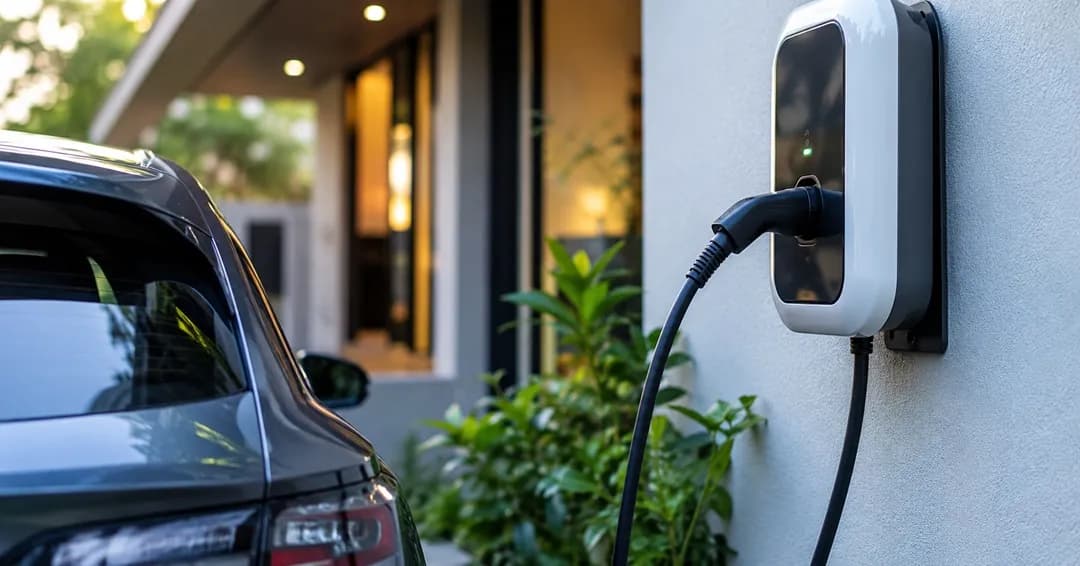
India’s residential EV charging opportunity is expanding as policy support, EV adoption, and private parking infrastructure develop. Manufacturers can capture value beyond AC chargers through installation, smart charging, load management, solar integration, software, and after-sales services. Housing societies, automakers, and property developers offer scalable routes to residential charging customers.
India’s EV charging market is entering a phase in which the location of charging may matter as much as the speed of charging. Public fast-charging stations receive considerable attention because they are visible indicators of infrastructure expansion, but private EV ownership creates a different and potentially more predictable source of demand. For a large proportion of passenger EV users, the vehicle spends several hours parked at home every day, making residential charging the most convenient way to replenish energy for routine travel.
This creates a meaningful opportunity for EV charger manufacturers, but capturing it will require more than increasing production of wall-mounted AC chargers. Residential charging has different economics, different customer expectations and different installation challenges from public charging. The manufacturers that understand those distinctions can build businesses around hardware, installation, software, load management, energy integration and after-sales service rather than competing only on charger price.
India’s regulatory framework is also becoming more supportive of residential charging. The Ministry of Power’s 2024 guidelines, issued on 17 September 2024, explicitly cover private parking spaces and semi-restricted locations such as group housing societies, while allowing homeowners to use an existing electricity connection for EV charging or request a separate metered connection with a dedicated EV charging tariff.
For charger manufacturers, this changes the commercial question. The opportunity is no longer simply whether home charging will develop, but which companies will capture the customer relationship created when an EV enters a household.
Why Home Charging Could Become the Foundation of Everyday EV Use
The fundamental advantage of residential charging is convenience rather than charging speed. An EV owner who returns home in the evening can connect the vehicle and leave it charging for several hours, allowing the battery to replenish while the vehicle would otherwise remain unused.
That makes AC charging particularly relevant to routine passenger-vehicle use. The Bureau of Indian Standards maintains specific standards for EV conductive charging systems, including IS 17017: Part 22: Section 1: 2021 for AC charge points for light electric vehicles. The standard covers the product specification for AC charging equipment, reinforcing the importance of compliant hardware as the residential market expands.
This creates an important product-design implication. Manufacturers should not assume that the highest possible charging power automatically represents the most attractive residential proposition. A charger that is safe, dependable, easy to install, compatible with the vehicle and capable of managing household electricity consumption can provide greater everyday value than a more powerful unit that adds unnecessary electrical complexity.
The customer is not really purchasing kilowatts. The customer is purchasing confidence that the vehicle will be ready when it is needed. That distinction should influence how manufacturers position their products, price their portfolios and allocate engineering resources.
The Residential Opportunity Extends Well Beyond Charger Hardware
Hardware will remain the entry point, but it should not become the entire business model. Once a residential charger is installed, the manufacturer has an opportunity to maintain a relationship with the household for many years.
Installation, remote diagnostics, software updates, maintenance contracts, warranty extensions and energy-management services can all create additional revenue. These services can also reduce the manufacturer's exposure to hardware commoditisation because customers become tied to a broader ecosystem rather than a single physical product.
Residential charging layer | Customer requirement | Potential manufacturer opportunity |
Charger hardware | Reliable and safe everyday charging | AC wallboxes, cables, connectors and protective equipment |
Installation | Correct electrical connection and commissioning | Certified installation, site surveys and installation fees |
Connectivity | Charging status and remote control | Mobile applications, cloud platforms and firmware services |
Load management | Avoidance of household or building overload | Dynamic power allocation and smart charging software |
Solar integration | Better use of rooftop generation | Solar-compatible chargers and energy-management partnerships |
Lifecycle support | Reliable operation after installation | Maintenance contracts, diagnostics and extended warranties |
The commercial advantage becomes particularly strong when manufacturers can combine these services into a single proposition. A homeowner may compare the price of two chargers, but an apartment society or property developer is more likely to evaluate total ownership cost, installation quality, service responsiveness and scalability. That gives established manufacturers an opportunity to differentiate themselves without constantly adding hardware features.
Apartment Communities May Offer a More Attractive Business Model Than Individual Homes
Detached houses are relatively straightforward charging environments because the homeowner typically controls the parking area and electricity connection. Apartment developments are more difficult because several parties may have a stake in the infrastructure, but that complexity can create a stronger commercial opportunity.
The Ministry of Power’s 2024 guidelines specifically recognise group housing societies and allow residents to establish private charging points in designated parking spaces. They also permit group housing societies to establish community charging stations in consultation with the distribution licensee, while addressing separate connections, increased sanctioned load and charging fees.
This gives charger manufacturers an opportunity to approach the housing society as a customer rather than treating every resident as an isolated buyer.
A manufacturer could provide a common charging-management platform through which residents access individual charging points while the society monitors electricity use, manages available electrical capacity and handles community charging arrangements. The equipment becomes only one component of a broader building-level service.
This model also creates economies of scale. Installation teams can serve several chargers at the same location, maintenance can be organised centrally and software can manage multiple users through one platform. As EV ownership rises within the same development, the manufacturer has an opportunity to expand the installation without having to acquire a completely new customer.
That is a considerably more attractive proposition than repeatedly selling individual wallboxes through one-off transactions.
Automakers Can Become an Important Route Into the Residential Market
The point at which a customer purchases an EV is also the point at which the customer begins thinking seriously about charging. That gives automakers and dealerships an unusually strong position in residential charger distribution.
A first-time EV buyer may not know whether a home needs additional electrical capacity, which charger is compatible with the vehicle or which installer can safely complete the job. A charger bundled with the vehicle can remove several of those uncertainties.
Manufacturers can work with automakers through co-branded equipment, approved charger programmes, dealer referrals or bundled installation services. The arrangement does not necessarily have to be exclusive. What matters is gaining access to customers at the moment when charging becomes an immediate requirement.
The opportunity is also relevant to property developers. New residential projects can incorporate dedicated parking provisions, electrical pathways and scalable charging infrastructure before residents begin purchasing EVs. Developers do not necessarily need to install a charger for every parking space on day one. They can create the underlying infrastructure and allow residents to add equipment as demand develops. For charger manufacturers, this creates a second route to market that is less dependent on direct consumer advertising.
Product Design Should Reflect Indian Residential Conditions
Residential chargers in India will operate in environments that differ significantly from controlled commercial installations. Parking spaces can be compact, electrical panels may be located some distance from the vehicle, and outdoor installations can face heat, dust and heavy monsoon exposure.
Manufacturers therefore need to prioritise practical engineering. Enclosure protection, cable management, mounting flexibility, thermal performance, clear status indicators and ease of servicing can have a greater effect on customer satisfaction than an increasingly long list of software features.
Compliance should also be treated as part of product design rather than an administrative exercise completed after engineering work. BIS identifies relevant standards covering EV charging systems, electrical safety and associated components, including IS 17017 and related electrical installation standards.
There is also an opportunity to standardise the installation process. A charger manufacturer that conducts a structured site assessment before installation can identify electrical capacity, cable routing, and protection requirements in advance. That reduces avoidable service problems and creates a more consistent customer experience. In residential charging, installation quality is effectively part of product quality.
Smart Charging Could Provide the Most Defensible Differentiation
Connectivity by itself is unlikely to remain a meaningful differentiator. Adding Wi-Fi and a mobile application is relatively straightforward, and consumers are unlikely to pay a premium indefinitely for features that provide little practical benefit.
The more valuable capability is automated energy management. The Ministry of Power’s 2024 framework encourages charging during solar hours (9 a.m. to 4 p.m.) and recognises the need to prepare the grid for rising EV charging demand. The guidelines therefore support a broader shift toward charging that can respond to electricity availability and household requirements rather than operating at maximum output whenever the vehicle is connected.
A smart charger could allow a user to specify when the vehicle needs to be ready and how much energy is required. The system could then determine when charging should begin, taking account of household load and configured charging limits.
This becomes even more valuable in households with rooftop solar. If the EV is at home during periods of solar generation, a connected charger can potentially coordinate vehicle charging with available generation and reduce reliance on grid electricity.
The important point is that consumers should not have to manage this process manually. The technology becomes commercially valuable when it removes decisions from the customer rather than creating another dashboard that the customer has to monitor.
Solar Integration Could Expand the Charger Manufacturer’s Addressable Market
The relationship between solar rooftop and EV charging is commercially attractive because both technologies increasingly sit within the same household energy ecosystem. Solar generates electricity during daylight hours, while an EV represents a flexible electricity load that can potentially be shifted according to generation and household requirements.
This gives charger manufacturers a route into the broader residential energy market. Partnerships with rooftop solar installers, inverter suppliers and energy-management companies could allow manufacturers to offer integrated solutions rather than selling chargers as standalone transportation equipment.
A premium residential package could combine an EV charger with solar monitoring, load management and automated charging schedules. Over time, the same software architecture could potentially coordinate other household loads and stationary storage.
Manufacturers should nevertheless avoid positioning these capabilities only as premium technology. The underlying function, which is controlling when electricity is delivered to the vehicle, can become useful across different customer segments as electricity costs, solar adoption and EV ownership increase.
Load Management Will Become Critical as EV Ownership Concentrates
India’s residential charging challenge will not emerge uniformly. It will become more visible in locations where EV ownership grows quickly within the same apartment complex, neighbourhood or residential development.
Consider a large housing project in which a small number of residents initially own EVs. Existing electrical infrastructure may handle the demand without difficulty. If that share rises substantially, simultaneous charging during evening hours could create a concentrated load that requires more careful management.
Manufacturers can address this through dynamic load balancing. Instead of allowing every charger to draw its maximum available power at the same time, a building-level system can allocate available capacity according to vehicle requirements and configured priorities.
This can postpone or reduce the need for expensive electrical upgrades in some applications, although actual requirements will depend on the building and distribution network. For housing societies, the value is therefore not simply lower electricity consumption. It is greater control over how limited electrical capacity is used. For manufacturers, multi-charger management also creates recurring software revenue and a stronger customer relationship.
Installation Networks Could Become a Strategic Asset
The charger itself is only one part of the residential installation. The quality of wiring, protection equipment, earthing, cable routing and commissioning can materially affect long-term performance.
This creates a strong case for manufacturers to build certified installation networks rather than relying entirely on independent electricians. A structured installation programme can include site surveys, standardised equipment lists, commissioning procedures and digital installation records.
Such a network also provides manufacturers with information about their installed base. That information can support preventive maintenance, remote diagnostics and targeted replacement programmes.
The opportunity is particularly important in apartment developments, where a single installation mistake can affect several customers or create disputes between residents, facility managers and the equipment supplier. A manufacturer that controls the installation experience can therefore defend its brand more effectively than a competitor that treats installation as an external activity.
After-Sales Service Can Create Recurring Revenue
Residential chargers are not disposable products, so the economics of the market should be evaluated over the entire equipment lifecycle rather than at the point of sale.
Remote diagnostics can identify faults before a technician visits the site. Firmware updates can improve performance without replacing hardware. Extended warranties and maintenance agreements can provide predictable revenue while giving customers greater confidence in the equipment.
Service also becomes an important differentiator as the installed base grows. Consumers may tolerate a slightly higher upfront price if the manufacturer has a reputation for resolving faults quickly and maintaining equipment reliably.
Manufacturers should be cautious about excessive subscription models, however. Customers are more likely to accept recurring payments for tangible services such as maintenance, advanced energy management or guaranteed support than for basic functions that competitors provide without additional charges. The objective should be to monetise genuine value rather than create artificial barriers around ordinary charger functionality.
Home Charging and Public Charging Will Grow Together
The expansion of home charging should not be interpreted as a substitute for public charging. The two address different use cases, and both will remain necessary as EV adoption broadens.
Home charging is particularly suited to predictable daily travel, while public charging serves long-distance journeys, drivers without private parking, commercial fleets and situations where rapid replenishment is necessary. India’s PM E-DRIVE scheme allocated ?2,000 crore for public EV charging infrastructure, demonstrating that public infrastructure remains a significant policy priority.
For charger manufacturers, this creates an opportunity to participate in both markets while maintaining differentiated product strategies. Public charging equipment is driven heavily by uptime, utilisation, power throughput, payment systems and return on infrastructure investment. Residential charging is driven more by convenience, safety, installation and household energy management.
Manufacturers that understand these different economics can diversify their businesses without assuming that one product architecture or sales model will work equally well everywhere.
The Most Attractive Customer Segments Are Not Necessarily the Most Obvious Ones
The temptation in an emerging market is to chase the largest possible number of individual consumers. That approach can create high customer-acquisition costs and fragmented installation requirements. A more commercially disciplined strategy would prioritise segments where one relationship can generate multiple installations or recurring service revenue.
Target customer | Primary requirement | Recommended proposition | Commercial advantage |
Individual EV owner | Convenient overnight charging | Reliable AC wallbox with optional connectivity | High-volume equipment sales |
Premium homeowner | Energy optimisation | Smart charger integrated with solar and load management | Higher-value hardware and services |
Housing society | Shared charging and electrical management | Multi-charger platform with monitoring and load balancing | Multiple users from one account |
Property developer | Future-proof EV infrastructure | Scalable electrical and charging architecture | Early access to residential projects |
Automaker or dealership | Hassle-free EV ownership | Certified charger and installation package | Direct access to vehicle buyers |
Apartment communities, property developers and automaker partnerships are particularly interesting because they can lower customer-acquisition costs. One partnership can create a pipeline of installations rather than requiring manufacturers to convince each homeowner individually.
This does not eliminate the direct-to-consumer opportunity, but it changes the economics of where sales teams should concentrate their effort.
Policy Is Removing Barriers, but Execution Will Determine Winners
India’s policy framework has become considerably clearer around residential charging. The 2024 Ministry of Power guidelines recognise private parking, group housing societies and other semi-restricted charging locations, while allowing homeowners to use existing electricity connections or request separate metered connections. The framework also addresses increased sanctioned load and community charging arrangements.
The wider EV infrastructure programme is also supporting the development of charging networks. PM E-DRIVE includes a ?2,000 crore allocation for EV public charging infrastructure, and the government issued operational guidelines for deployment under the scheme on 26 September 2025. As of 10 February 2026, the Ministry of Heavy Industries said that 29,151 public EV charging stations had been installed, based on inputs from Bharat Heavy Electricals Limited (BHEL). The PM E-DRIVE scheme was also extended to 31 March 2028 in August 2025, providing a longer policy horizon for the charging-infrastructure programme.
These measures improve the environment for infrastructure investment, but policy support alone will not determine which charger manufacturers succeed. Residential customers ultimately judge the product by practical outcomes, including whether installation is straightforward, charging is reliable, software works consistently, and service is available when something fails.
That is where competitive differentiation is likely to become more pronounced.
The Winning Strategy Will Be Built Around the Household, Not the Charger
India’s home charging revolution will probably develop less visibly than the expansion of public fast-charging networks, but its commercial importance could be greater than its visibility suggests. For private EV owners, the home is where charging can fit naturally into daily life, using long parking periods to replenish the vehicle without requiring a separate trip to a charging station.
For manufacturers, this creates a much broader opportunity than the sale of AC wallboxes. Hardware remains essential, but installation networks, connected services, load management, solar integration and lifecycle support can create recurring value and stronger customer retention.
The most effective companies will likely approach the market through several channels at once. Automaker partnerships can connect chargers with vehicle purchases, property developers can create access to new residential projects, and housing societies can provide concentrated clusters of charging demand. Solar companies can extend the proposition into household energy management, while service networks can protect the installed base over time.
The strategic objective should therefore be to make residential charging predictable rather than merely powerful. A customer should be able to arrive home, connect the vehicle and trust that the system will handle the rest without unnecessary intervention.
That is the commercial opportunity hidden inside India’s home charging revolution. The manufacturers that capture the greatest value may not be those that sell the most technically elaborate charger, but those that build the most dependable relationship between the vehicle, the household and the electricity system.
Explore More Reports:
Have questions?
More Thought Articles
From Data Centers to EV Charging: Where Low-Voltage DC Distribution Is Making an Impact
Low-voltage DC distribution is gaining relevance as AI data centers, EV charging hubs, solar systems, and battery storage increase demand for efficient power architectures. The article examines 800 VDC standardization, conversion losses, protection challenges, and greenfield opportunities, highlighting why hybrid AC/DC systems could become increasingly important across high-power infrastructure applications.
Second-Life EV Battery Market in India: What Is Driving Demand from Manufacturers?
India’s second-life EV battery market is gaining relevance as electric vehicle adoption expands and batteries retain useful capacity after automotive service. Growing stationary-storage demand, battery data, refurbishment capabilities, EPR obligations, and critical-mineral policies are encouraging manufacturers to extend battery value through reuse before eventual recycling within India’s emerging circular battery ecosystem.
The Rise of Locally Manufactured Battery Separators in India’s EV Ecosystem
India’s battery industry is progressing from pack assembly toward domestic cell and material manufacturing, creating opportunities for lithium-ion battery separators. Policy support, ACC capacity expansion and R&D initiatives are strengthening the ecosystem. However, technical complexity, manufacturing yields, qualification requirements and economics mean localisation will likely advance gradually through coatings, testing and finishing.