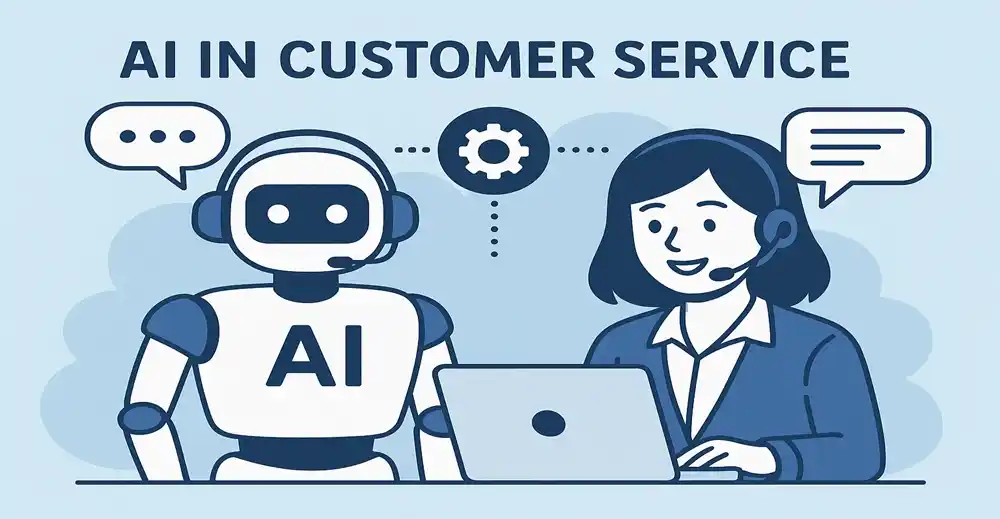
AI in Customer Service Market Size: The AI in the customer service market is estimated to attain a market size of US$1,634.989 million by 2030, growing at a 22.94% CAGR from a valuation of US$582.227 million...
AI in Customer Service Market Size:
The AI in the customer service market is estimated to attain a market size of US$1,634.989 million by 2030, growing at a 22.94% CAGR from a valuation of US$582.227 million in 2025.AI in Customer Service Market Key Highlights:
- AI enhances customer service with personalized chatbots and virtual assistants.
- Cloud-based AI solutions drive real-time, efficient customer support.
- North America leads with high AI adoption and e-commerce growth.
- Rising global internet access boosts demand for AI-driven customer service.
Factors Boosting AI in the Customer Service Market across different sectors:
- Retail: AI analyzes customer preferences and purchase history to offer tailored product recommendations and support, driving sales and loyalty in e-commerce and brick-and-mortar stores.
- Finance: AI-powered chatbots and fraud detection systems provide real-time support for transactions while ensuring regulatory compliance, reducing risks, and improving trust.
- Healthcare: AI automates appointment scheduling, triage, and follow-up care queries, enabling healthcare providers to manage high patient volumes while maintaining personalized engagement.
- Telecommunications: AI predicts and resolves network-related customer complaints proactively, minimizing downtime and improving service reliability across mobile and broadband sectors.
- Travel and Hospitality: AI enhances booking processes and provides 24/7 multilingual support for itinerary changes or travel disruptions, improving customer satisfaction in airlines, hotels, and travel platforms.
- Technology: AI handles routine technical queries with self-service options, reducing wait times and freeing human agents for complex issues in the SaaS and hardware sectors.
- Utilities: AI streamlines billing inquiries and outage reporting, using predictive analytics to anticipate service disruptions, enhancing customer trust in energy and water utilities.
- E-Gaming: AI delivers instant in-game support and personalized content recommendations, boosting player retention and monetization in the gaming industry.
- Logistics: AI tracks shipments and provides real-time updates to customers, automating query resolution for delivery statuses and improving efficiency in supply chain operations.
- Cross-Sector: AI unifies customer interactions across channels, such as chat, email, and social media, and scales support to meet demand spikes, ensuring consistent experiences across all sectors.
Trends and Opportunities for Key Market Players:
- Increase in global online retail sales:The increase in global online retail sales is forecasted to boost the demand for AI customer services. In the retail industry, AI customer services offer convenient and quick customer support, enhancing the customer experience. These services also help businesses reduce operating costs and increase customer acquisitions. The US Census Bureau reported that the nation's e-commerce or online retail sales continually expanded over the past few quarters.
What are the potential growth opportunities for AI in customer service in the retail sector?
- Personalized Customer Experiences: AI can analyze large amounts of customer data, such as purchase history, preferences, and browsing behavior, to deliver personalized recommendations and tailored interactions. This results in increasing customer retention and boosting sales.
- 24/7 Omnichannel Support: AI-powered chatbots and virtual assistants provide round-the-clock support across multiple channels, such as websites, apps, social media, and phone. Using this, retailers can ensure support without additional expenditures, improving customer satisfaction. Advanced natural language processing (NLP) enables seamless transitions between channels, ensuring consistent experiences.
The following companies are catering to this segment’s high-growth:
- Salesforce: The company offers generative AI integrated with customer data and CRM to scale customer service, improving efficiency with personalized support and automation. Solutions, such as Einstein GPT and Agentforce, include AI-powered chatbots and predictive analytics for proactive customer engagement.
- Microsoft (Azure AI): Microsoft provides AI tools to enhance customer experiences, streamline operations, and boost sales through Azure AI services. Retailers use Azure for chatbots, sentiment analysis, and personalized recommendations.
- Amazon Web Services (AWS): Amazon offers AI solutions for retail, including customer service automation and personalization, powering recommendation engines for retailers like Amazon. For instance, AWS Lex and Connect enable conversational AI for chatbots and contact centers.
- Rise in the e-commerce sector is boosting AI in the customer service market: AI is transforming customer service in e-commerce by enabling personalized, efficient, and scalable solutions. According to Salesforce, AI-powered chatbots, leveraging advanced natural language processing (NLP), manage routine inquiries like order tracking and returns, reducing response times by up to 80%. Virtual assistants, such as AWS Lex, provide 24/7 omnichannel support across websites, apps, and social platforms, ensuring seamless customer experiences. Predictive analytics, integrated into platforms like IBM Watson, anticipate challenges like delayed shipments and proactively engage customers, boosting customer retention by 5-10%.
What are the potential growth opportunities for AI in customer service in the e-commerce sector?
- Enhanced Fraud Detection: AI identifies and prevents fraudulent activities during support interactions. Strengthened security fosters trust, encouraging repeat purchases and reducing financial losses.
- Automation of High-Volume Inquiries: AI is used to handle repetitive tasks, such as checking order status and returns, reducing support costs by 20-30%, as per Tidio. E-commerce firms can redirect human agents to complex queries, enhancing first-contact resolution rates and reducing churn.
The companies listed below continue to innovate and launch products for this sector:
- Amazon: This e-commerce giant continues to lead with generative AI tools, such as Rufus, a conversational AI assistant launched in 2024, enhancing product discovery and customer support on its platform.
- Shopify: Shopify’s Sidekick, an AI-powered assistant, was enhanced in 2025 to provide real-time customer support and generate product descriptions, streamlining merchant-customer interactions. Shopify’s focus on empowering small-to-medium e-commerce businesses with AI tools drives widespread adoption.
Increased Technological Advancements in North America Propel Market Expansion:
North America, led by the United States, is a mature and technologically advanced region in the customer service industry. It has a higher adoption of AI-based customer support and has the presence of key outsourcing companies. The United States region is expected to have a considerable market share. The United States is one of the major AI-adopting countries. With the continuous trend of mechanical progressions and advancements over different industry verticals, the necessity for AI service solutions such as chatbots, generative AI, and virtual assistance is additionally anticipated to provide positive expansion. Major divisions such as banking, retail, and healthcare are expected to witness noteworthy growth in AI adoption, further bolstered by continuous ventures to drive the digitization of various industrial businesses. Besides, digital client engagement is on the rise in the United States, accelerated by the increasing tech-savvy population. According to Verint’s “2023 State of Digital Customer Experience” report, in which more than 2,000 surveys across the US were conducted to determine customers' preferences for brand engagement, 53% of the respondents aged 18 to 44 preferred digital channels, and 47% preferred phones. Such high engagement has motivated companies to adopt a much wider customer-centric approach to providing a seamless customer experience. Additionally, the USA is the hub for technological innovations, and favorable investment in artificial intelligence has provided new growth prospects for such technology. Various US-based AI providers are investing in launches and innovations. For instance, in August 2023, Freshworks Inc. launched its AI-powered “Customer Service Suite” that integrates agent-led conversational messaging, automated ticketing management, and self-service bots.The Following Companies are advancing the Developments through Strategic Collaborations and Product Launches:
- In March 2025, Deloitte Digital formed a collaboration with NICE to transform their customer service by offering end-to-end AI solutions designed to provide more proactive customer interactions.
- In February 2025, IBM introduced new AI Integration Services to assist enterprises in creating and scaling AI agents.
- In June 2024, Target released plans to establish a new GenAI device called Store Companion for its store team members by August 2024. Their GenAI-powered chatbot assists by replying to on-the-job handling questions, coaching new team members, and supporting store operations management. The objective is to simplify the teams' jobs, permitting them to work more effectively, offer quicker service, and upgrade the shopping experience by improving visitor engagement.
The Strategic Actions for Industry Leaders in AI in Customer Service:
- Integrating AI-driven recommendation engines to personalize support and boost conversions.
- Deploying 24/7 AI chatbots for seamless omnichannel customer support.
- Automating repetitive inquiries to reduce costs and optimize resource allocation.
- Leveraging predictive analytics for proactive engagement to enhance customer retention.
Have questions?
More Thought Articles
From Data Centers to EV Charging: Where Low-Voltage DC Distribution Is Making an Impact
Low-voltage DC distribution is gaining relevance as AI data centers, EV charging hubs, solar systems, and battery storage increase demand for efficient power architectures. The article examines 800 VDC standardization, conversion losses, protection challenges, and greenfield opportunities, highlighting why hybrid AC/DC systems could become increasingly important across high-power infrastructure applications.
How EV Charger Manufacturers Can Capitalize on India’s Home Charging Revolution
India’s residential EV charging opportunity is expanding as policy support, EV adoption, and private parking infrastructure develop. Manufacturers can capture value beyond AC chargers through installation, smart charging, load management, solar integration, software, and after-sales services. Housing societies, automakers, and property developers offer scalable routes to residential charging customers.
Second-Life EV Battery Market in India: What Is Driving Demand from Manufacturers?
India’s second-life EV battery market is gaining relevance as electric vehicle adoption expands and batteries retain useful capacity after automotive service. Growing stationary-storage demand, battery data, refurbishment capabilities, EPR obligations, and critical-mineral policies are encouraging manufacturers to extend battery value through reuse before eventual recycling within India’s emerging circular battery ecosystem.