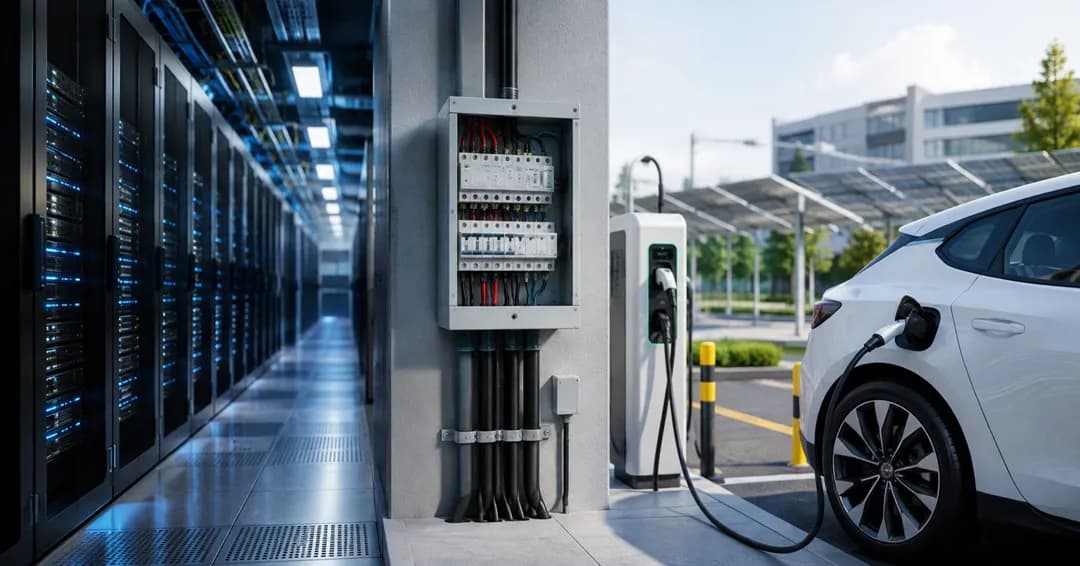
Low-voltage DC distribution is gaining relevance as AI data centers, EV charging hubs, solar systems, and battery storage increase demand for efficient power architectures. The article examines 800 VDC standardization, conversion losses, protection challenges, and greenfield opportunities, highlighting why hybrid AC/DC systems could become increasingly important across high-power infrastructure applications.
For more than a century, alternating current has shaped the architecture of modern electricity distribution. Utilities generate and deliver AC, buildings are wired around it, and an extensive ecosystem of transformers, switchgear, protection devices and electrical contractors has developed around established AC practices. That infrastructure is not going to disappear simply because direct current has become more interesting.
What is changing is the nature of the loads connected behind that infrastructure. Data centers, battery systems, solar photovoltaic installations, telecommunications equipment, LED lighting and electric vehicles all depend heavily on DC internally. In many cases, electricity enters a facility as AC, is converted to DC, converted again for distribution, and eventually reaches a DC load. Each conversion can be highly efficient, but none is completely lossless.
That creates a more practical question for infrastructure designers: when a facility contains large DC sources, DC storage systems and DC loads in close proximity, does it still make sense to route all of that energy through an AC architecture?
Low-voltage direct-current, or Low-Voltage DC Distribution, is emerging as one answer. Its strongest applications are not ordinary offices or small residential systems. The technology is gaining traction where power density is high, electricity demand is continuous, grid capacity is expensive, or several DC-native assets need to operate together.
Data centers provide the clearest example. Artificial intelligence is pushing rack power higher and making electrical distribution a central part of facility design. EV charging offers another compelling use case because high-power chargers, stationary batteries, solar generation and vehicle batteries can all participate in the same energy-management system.
The resulting opportunity is more nuanced than an AC-versus-DC debate. The likely outcome is a hybrid architecture in which AC remains essential at the utility interface while DC becomes an increasingly important internal distribution layer.
Why LVDC Is Becoming More Relevant
The basic argument for DC distribution is not that DC electricity is inherently superior to AC. The stronger argument is that unnecessary conversions can introduce energy losses, equipment requirements and additional points of failure.
A conventional data center may receive medium-voltage AC from the grid, step it down through transformers, pass it through UPS equipment, distribute it through AC switchgear and eventually convert it to DC at the server power supply. The precise architecture differs by operator and facility, but the basic chain involves several transformations before electricity reaches the computing electronics.
A DC architecture can move some of the conversion closer to the utility interface and distribute DC through part of the facility. Research into 380 VDC data-center systems has examined this approach for years, including its potential to reduce conversion stages and integrate DC sources such as renewable generation and batteries. The research also makes clear that protection, grounding and system design remain important engineering considerations.
The case becomes stronger as power demand increases. For a fixed power requirement, raising the distribution voltage reduces the current needed to deliver that power. Lower current can reduce resistive losses and the amount of conductor material required for high-power distribution.
That relationship is particularly important for AI infrastructure. A power architecture that works comfortably at moderate rack densities can become difficult to scale when individual racks require dramatically more electricity. At that point, increasing current through conventional low-voltage distribution can create challenges in cabling, busbars, power conversion and thermal management.
This is why LVDC should increasingly be viewed as a power-density technology as well as an efficiency technology. The commercial case becomes stronger when the electrical architecture itself is becoming a physical constraint.
Data Centers Are Moving From Experiments Toward Standardized LVDC Architectures
The Open Compute Project has established work around low-voltage DC power distribution for data centers, covering distribution architectures, energy storage, protection and interoperability. In April 2026, OCP announced new contributions covering proposed DC distribution architectures for AI facilities, alongside work on energy storage and broader AI data-center infrastructure.
The most significant development came in August 2026, when Google, Microsoft and NVIDIA announced collaboration within OCP to work toward establishing 800 VDC as an open, standardized power architecture for next-generation AI data centers. The initiative is designed to align system requirements and interfaces so suppliers can develop interoperable equipment rather than responding to numerous proprietary customer architectures.
That is commercially important because standardization can remove one of the biggest barriers to infrastructure adoption. A facility operator may accept an unfamiliar power architecture if equipment can be sourced from several qualified suppliers and if protection, certification and maintenance requirements are clearly defined.
OCP describes two potential transition paths. Existing AI facilities can use a dedicated side power rack that converts 480 VAC locally to higher-voltage DC, while future facilities can move toward direct medium-voltage AC to 800 VDC conversion at the facility level. This creates a path for incremental adoption rather than requiring every data center to replace its entire electrical infrastructure immediately.
The distinction between these approaches matters. A side power rack can provide a relatively contained upgrade for existing facilities, whereas direct medium-voltage-to-DC conversion represents a deeper architectural change. The second approach could deliver greater system-level benefits, but it also requires greater coordination between utilities, facility designers, power-equipment manufacturers and data-center operators.
AI Is Making Conversion Losses More Expensive
The scale of the demand is also visible in recent IEA data. Data centre electricity consumption increased by 17% in 2025, while consumption at AI-focused data centres rose by 50%. The IEA projects global data-centre electricity use to reach about 950 TWh by 2030, roughly double its 2025 level. These figures do not establish that LVDC is the preferred solution, but they strengthen the case for examining power-distribution efficiency and capacity as AI facilities scale.
The importance of conversion efficiency increases with the amount of power flowing through the system. A small percentage loss may not justify an architectural change in a small facility, but the same percentage applied continuously across a large AI campus can represent substantial electricity consumption.
Those losses also become heat. The electricity that is not delivered to the computing load does not simply disappear; it ultimately contributes to thermal output that must be managed. As a result, improvements in power-conversion efficiency can influence both electrical consumption and cooling requirements.
That does not mean every conversion stage should be removed. Power conversion provides voltage regulation, isolation, protection and other functions that can be essential to safe operation. The commercial question is whether the benefits provided by each stage justify the energy loss, capital cost and maintenance burden associated with it.
This is where high-density AI facilities differ from ordinary commercial buildings. An operator building a new hyperscale campus has an opportunity to design power delivery, cooling, energy storage and rack architecture as one system. A facility operating with relatively low rack density and recently installed AC equipment has far less incentive to change.
The strongest LVDC business cases therefore appear when several factors arrive at the same time: higher rack power, new construction, constrained electrical capacity, large-scale energy storage and a need for long-term scalability.
EV Charging Creates a Second Major Market for DC Distribution
The IEA's latest data show that fast and ultra-fast public chargers grew 40% from 1.5 million in 2024 to 2.2 million in 2025, confirming that higher-power charging is becoming a larger part of public charging infrastructure.
EV charging has a natural relationship with DC because vehicle batteries store electricity in DC form. In conventional AC charging, the conversion from AC to DC occurs inside the vehicle. DC fast charging moves the primary conversion equipment outside the vehicle and delivers controlled DC directly to the battery.
As charging power increases, the electrical infrastructure required at the charging site becomes more substantial. The International Energy Agency reports that the number of fast and ultra-fast public chargers increased by 40% globally between 2024 and 2025, reaching about 2.2 million units. It also reports that next-generation ultra-fast chargers are increasingly exceeding 250 kW, with some new systems moving toward megawatt-scale power levels.
This changes the design problem for charging operators. A small charging installation can usually rely on conventional AC distribution without much difficulty. A large charging hub with several high-power chargers, however, may need a substantial grid connection, transformers, switchgear, battery storage and energy-management equipment.
An internal DC network can potentially connect several of those resources more directly. Solar PV generates DC, stationary batteries store DC and the vehicle battery receives DC during fast charging. Connecting those resources through a common DC architecture can reduce some conversion requirements and give the operator greater control over how electricity moves around the site.
The value is therefore broader than efficiency. The DC network can become part of the site's strategy for managing peak demand.
Fleet Depots Could Offer a Stronger Case Than Passenger Charging
The economics of LVDC will vary significantly across charging applications. A residential charger or small workplace installation has little reason to adopt sophisticated DC distribution because the electrical load is too modest to justify the additional equipment.
Electric bus, truck and delivery-vehicle depots are different. These facilities can have large numbers of vehicles, high charging requirements and relatively predictable operating schedules. A fleet operator generally knows when vehicles return, when they need to leave and how much energy each vehicle requires.
That predictability creates an opportunity to coordinate charging with electricity prices, solar generation, stationary storage and available grid capacity. A vehicle that does not need to depart for several hours can be charged more slowly, while a vehicle with an imminent departure can receive priority.
A stationary battery can also supply short-duration charging peaks. The battery does not eliminate the need for a robust grid connection, but it can reduce the amount of power that has to be drawn from the grid at any particular moment.
The IEA's 2026 analysis points toward this broader evolution in charging infrastructure. Higher charging speeds are expanding while smart charging and vehicle-to-grid technologies are being explored as mechanisms for reducing peak demand and adding flexibility to electricity systems. At the same time, the agency warns that grid-capacity constraints could become more significant as EV adoption and charging demand increase.
This makes fleet charging a particularly relevant LVDC application because the infrastructure is large enough to justify energy management and predictable enough to make optimization practical.
Solar and Battery Storage Strengthen the DC Proposition
The strongest LVDC applications are likely to be those where multiple DC sources and loads exist within the same physical site.
Solar PV is a natural example because photovoltaic modules produce DC electricity. Battery storage is another because electrochemical batteries store DC energy. EV charging adds a major DC load, while data-center electronics provide another.
A site that combines all of these assets has a very different electrical profile from a conventional office that simply receives electricity from the grid. The U.S. Department of Energy's Kirtland Air Force Base DC microgrid provides an instructive demonstration. The project uses a bipolar ±375 VDC common bus and integrates solar PV, battery storage, natural-gas generation and EV chargers. DOE describes the microgrid as a real-world test bed for energy management, resilience, cybersecurity and protection.
The significance of this type of project is not that every commercial site will reproduce the same architecture. It demonstrates that DC distribution can serve as a common platform for coordinating several energy resources rather than being limited to one particular load.
That principle could become increasingly valuable at EV charging depots. A depot with solar and storage can potentially use the DC network to coordinate charging demand and stored energy while maintaining an AC connection to the grid.
The same logic can apply to industrial microgrids and selected commercial facilities where energy storage and renewable generation are already being installed for resilience or energy-cost management.
Application | Why LVDC is attractive | Conditions that strengthen adoption | Main commercial or technical barrier |
AI-focused data centers | Higher-voltage DC can support increasing rack power with lower current and potentially fewer conversion stages | Greenfield facilities, high rack density and continuous loads | Protection, certification and interoperability |
High-power EV charging hubs | Chargers, batteries and solar can be coordinated through a common DC architecture | High utilization and constrained grid capacity | Grid interconnection and capital cost |
Electric fleet depots | Predictable charging schedules make peak management more effective | Electric buses, trucks and delivery fleets | Storage economics and charging utilization |
Solar-plus-storage microgrids | Multiple DC sources can share a distribution platform | High renewable penetration and resilience requirements | Mixed AC loads and protection requirements |
Commercial buildings | Selected DC loads can be served without converting the whole building | New construction with PV, storage and EV charging | Existing AC infrastructure |
Telecom and edge facilities | Established DC practices can support battery-backed systems | Sites with substantial backup-power requirements | Many sites have comparatively modest power demand |
Commercial Buildings Are More Likely to Use Hybrid DC Systems
Commercial buildings offer a large theoretical market, but their diversity of electrical loads makes full DC conversion difficult to justify.
Computers, networking equipment, LED lighting, battery storage and EV chargers have strong DC characteristics. HVAC equipment, pumps, elevators and other systems may be better served through conventional AC infrastructure. Forcing all of these loads onto one architecture would not necessarily create a better building.
A hybrid approach is more practical. A building can retain an AC backbone while using dedicated DC distribution for specific loads or energy resources. This could include lighting systems, information technology spaces, battery storage and EV charging infrastructure.
New construction provides the best opportunity because the developer can design electrical rooms, cabling, power conversion and protection around the intended architecture from the beginning.
Retrofits are much harder. Existing buildings already contain transformers, switchgear, distribution circuits and maintenance practices that have been paid for. Replacing those assets before the end of their useful life can erase the financial benefit of improved efficiency.
This suggests that commercial LVDC adoption will probably follow capital-reinvestment cycles. Buildings undergoing major electrical upgrades will provide more realistic opportunities than facilities where the existing AC system is still relatively new.
Protection and Safety Could Determine How Quickly LVDC Scales
Efficiency is the easiest part of the LVDC argument to communicate. Protection is where the practical difficulty becomes much greater.
AC systems benefit from natural current-zero crossings that help conventional circuit breakers interrupt faults. DC does not provide the same natural interruption point. High-power DC systems therefore require purpose-designed protection equipment capable of interrupting fault currents safely.
As voltage and power increase, the requirements become more demanding. An 800 VDC distribution system serving high-density AI racks cannot be treated like a conventional low-voltage battery circuit. Protection coordination, grounding, insulation, fault detection and maintenance procedures all have to be considered at the system level.
That final point is commercially significant. The existence of a technical standard does not mean the ecosystem has reached the maturity of conventional AC distribution. Operators still need trained personnel, available equipment, established inspection practices and reliable maintenance procedures. IEC also published IEC TR 63282-102:2025, extending the 63282 series to low-voltage DC electric island power-supply systems up to 1,500 V, another indication that technical work on LVDC applications is continuing.
The current OCP 800 VDC initiative recognizes this issue. Google, Microsoft and NVIDIA are working with organizations including UL Solutions, NFPA, IEEE and IEC to advance safety certification and regulatory frameworks as part of the standardization effort.
For infrastructure owners, this is essential. A power architecture has to be safe and maintainable for decades, not merely efficient during commissioning tests.
Greenfield Projects Have a Structural Advantage
LVDC is most likely to gain ground where the electrical architecture can be designed from scratch.
A new AI data center can coordinate the utility connection, power conversion, DC distribution, rack architecture, cooling system and battery storage before construction begins. A new electric-truck depot can similarly design its grid connection, charging infrastructure, stationary battery and solar system as one integrated energy platform.
Existing facilities face a different calculation because much of the required AC infrastructure is already installed. The difference creates an important market dynamic. LVDC adoption is unlikely to occur evenly across the installed building stock. It will be concentrated initially in new high-value projects where the cost of electrical infrastructure is already a major part of the capital budget.
Expansion projects may offer another entry point. If an existing facility needs a substantial new power block, operators can introduce DC distribution into the new section without replacing every component in the original facility.
The current OCP architecture specifically recognizes this transition problem. Its proposed 800 VDC approach includes a side power rack that can convert existing 480 VAC locally, providing an intermediate route toward higher-voltage DC without requiring immediate upstream infrastructure replacement.
That kind of transitional architecture may prove more commercially important than an all-at-once conversion because it reduces capital risk.
Where the Economics Look Most Persuasive
The strongest LVDC opportunities share several characteristics: large electrical loads, high utilization, significant DC-native equipment and a financial incentive to manage power more effectively.
AI data centers currently meet those conditions most clearly. Large EV fleet depots are moving closer as charger power increases and grid constraints become more important. Solar-plus-storage microgrids can also create a compelling case where resilience or energy-management value is added to the efficiency equation.
Market environment | Relative LVDC opportunity | Main source of value | Buyer priorities |
New AI data center with high rack density | Very high | Power density, scalable distribution and conversion reduction | Reliability, safety, interoperability and lifecycle cost |
Large electric fleet depot | High | Peak-demand management and charging-storage integration | Throughput, uptime and electricity cost |
High-power highway charging hub | High | Grid-capacity optimization and energy management | Charger availability, storage and interconnection |
New solar-plus-storage microgrid | Moderate to high | Direct integration of generation and storage | Resilience, control and energy utilization |
New commercial building | Moderate | Selected DC loads and energy resources | Construction cost and operational simplicity |
Existing commercial retrofit | Low to moderate | Targeted efficiency and capacity improvements | Payback, disruption and asset reuse |
Small residential installation | Limited | Integration of PV, batteries and EV charging | Low cost and simple installation |
The market should therefore not be treated as a single LVDC opportunity with one adoption curve. Data centers will prioritize power density and reliability. Fleet depots will emphasize peak management and charging throughput. Microgrids will focus more heavily on resilience and controllability.
Suppliers that understand these differences will have an advantage over those attempting to sell the same architecture to every application.
Interoperability May Become More Important Than Efficiency
The technology can work, but commercial deployment requires an ecosystem.
Data-center operators do not want a power system that locks them into one supplier for power shelves, connectors, breakers or conversion equipment. Charging operators face a similar problem because their sites increasingly need to integrate chargers, batteries, solar systems, energy-management software and utility interfaces.
Open specifications can reduce this risk. The OCP collaboration involving Google, Microsoft and NVIDIA is significant because it aims to create common 800 VDC requirements rather than another proprietary architecture. OCP reports that more than 80 partners are developing 800 VDC-compatible infrastructure, including power racks, busbars, connectors, DC-DC converters and facility-level power equipment.
That kind of ecosystem development can reduce engineering costs and shorten procurement cycles. Suppliers can build against a defined specification, while operators gain greater confidence that equipment will remain available from multiple sources.
The same principle will matter in EV charging. A charging hub may operate for 15 or 20 years, meaning its owner cannot reasonably assume that the original equipment supplier will remain the only source of compatible hardware. Standardization is therefore not a secondary technical issue. It is part of the investment case.
The Future Is More Likely to Be Hybrid Than Fully DC
The most realistic outcome is not a wholesale transition from AC distribution to DC distribution. AC will remain essential at the utility interface and will continue to serve many conventional loads.
The change will occur behind that interface. An AI data center could receive medium-voltage AC, convert it to 800 VDC and distribute DC to high-density computing systems while using conventional AC for selected facility loads. Battery storage could connect more directly to the DC architecture, reducing repeated conversions between stored energy and the compute load.
A charging hub could use a similar arrangement. The utility would provide an AC connection, while solar generation, stationary storage and high-power charging equipment would operate around an internal DC network.
This hybrid architecture is commercially sensible because it allows operators to deploy DC where the value is measurable. There is no need to argue that DC is universally better than AC. The investment decision becomes much more specific: where does the facility have enough DC demand, power density or energy-storage activity to justify a dedicated DC layer? That is a question engineers and financial decision-makers can actually evaluate.
What Will Shape the Next Phase of Adoption
The next phase of LVDC adoption will depend on the development of the surrounding ecosystem as much as on the technology itself. Protection equipment, connectors, power converters, monitoring systems and installation practices all need to become easier to specify and procure.
Equipment costs will remain a decisive factor. If specialized DC protection and conversion equipment remains significantly more expensive than mature AC alternatives, adoption will be limited to applications with unusually strong requirements. As standardization increases production volumes, however, the cost difference could narrow.
The strongest projects will also be those where LVDC solves several problems simultaneously. An AI facility that uses higher-voltage DC to support rack density, integrate energy storage and reduce selected conversion stages has a broader value proposition than a project justified solely by a small efficiency improvement. A fleet depot that uses DC to coordinate charging, solar generation and stationary storage similarly has more reasons to invest than a depot that simply wants to reduce electrical losses.
Grid constraints could become an additional catalyst. The IEA expects EV electricity demand to grow substantially and warns that rising charging demand can create grid-capacity challenges in some regions. Smart charging and vehicle-to-grid systems can provide flexibility, but physical infrastructure remains necessary to deliver high charging power. LVDC can become relevant within that broader capacity-management strategy because it provides another way to coordinate electricity before it reaches the final load.
Conclusion: LVDC Is Becoming an Infrastructure Layer Rather Than a Replacement for AC
The renewed interest in low-voltage DC distribution is being driven by a convergence of practical infrastructure pressures rather than by a simple preference for one form of electricity over another.
AI data centers need to deliver more power to increasingly dense computing systems. EV charging facilities are moving toward higher charging speeds and greater site-level electrical demand. Solar generation and battery storage are increasing the number of DC sources connected to commercial and industrial sites. These trends make internal power architecture more important than it was when electrical distribution was largely designed around conventional building loads.
Data centers provide the clearest evidence of the shift. The Open Compute Project's 2026 work with Google, Microsoft and NVIDIA on an 800 VDC architecture demonstrates that high-voltage DC is moving into an open industry-development and standardization process for AI facilities. The emphasis on common interfaces, safety certification and multiple deployment paths suggests that the industry is trying to turn LVDC from a custom engineering exercise into a repeatable architecture.
EV charging offers a second significant route to adoption. Large charging hubs and fleet depots increasingly combine high-power chargers with stationary storage, renewable generation and sophisticated energy-management systems. Those characteristics make DC distribution particularly attractive where grid capacity is constrained or where operators need to manage substantial power flows within a relatively small site.
The technology still has meaningful barriers. Protection requirements are more demanding than those associated with conventional AC systems, the standards ecosystem continues to develop, and retrofit economics remain difficult. IEC TR 63282:2024 provides an important foundation for LVDC standardization while explicitly identifying areas requiring further technical work.
These constraints mean LVDC will not become the default architecture for every building. Its strongest growth is likely to occur in high-value applications where electrical capacity itself is becoming a limiting factor.
The most commercially interesting opportunities are therefore likely to remain concentrated in greenfield AI data centers, large EV fleet depots, high-power charging hubs, selected microgrids and new facilities with substantial solar and battery storage. The strategic shift is not from AC to DC. It is toward more deliberate use of both.
For infrastructure developers, the useful question is whether every conversion between AC and DC in a particular facility remains economically justified. In many conventional buildings, the answer will continue to be yes because existing AC infrastructure is inexpensive, mature and reliable. In a high-density AI data center or a large charging depot, the calculation can be very different.
As power requirements rise, the cost of current, conversion losses, grid capacity and thermal management becomes harder to separate from the overall economics of the facility. That is precisely where LVDC is beginning to make an impact.
The technology's long-term significance will ultimately depend on whether it can move beyond demonstrations and become easy to standardize, procure, install, protect and maintain. If that transition succeeds, LVDC will not need to replace AC to become commercially important. It will simply occupy the parts of the electrical system where distributing DC makes more practical and economic sense.
Explore More Reports:
Have questions?
More Thought Articles
How EV Charger Manufacturers Can Capitalize on India’s Home Charging Revolution
India’s residential EV charging opportunity is expanding as policy support, EV adoption, and private parking infrastructure develop. Manufacturers can capture value beyond AC chargers through installation, smart charging, load management, solar integration, software, and after-sales services. Housing societies, automakers, and property developers offer scalable routes to residential charging customers.
Second-Life EV Battery Market in India: What Is Driving Demand from Manufacturers?
India’s second-life EV battery market is gaining relevance as electric vehicle adoption expands and batteries retain useful capacity after automotive service. Growing stationary-storage demand, battery data, refurbishment capabilities, EPR obligations, and critical-mineral policies are encouraging manufacturers to extend battery value through reuse before eventual recycling within India’s emerging circular battery ecosystem.
The Rise of Locally Manufactured Battery Separators in India’s EV Ecosystem
India’s battery industry is progressing from pack assembly toward domestic cell and material manufacturing, creating opportunities for lithium-ion battery separators. Policy support, ACC capacity expansion and R&D initiatives are strengthening the ecosystem. However, technical complexity, manufacturing yields, qualification requirements and economics mean localisation will likely advance gradually through coatings, testing and finishing.