India's EV infrastructure will evolve through a mix of battery swapping, DC fast charging and AC destination charging rather than a single solution. Battery swapping suits high-utilisation two- and three-wheelers, while passenger cars depend on fixed charging. Segment-specific economics, infrastructure, standardisation and operating patterns will shape India's EV transition through 2031.
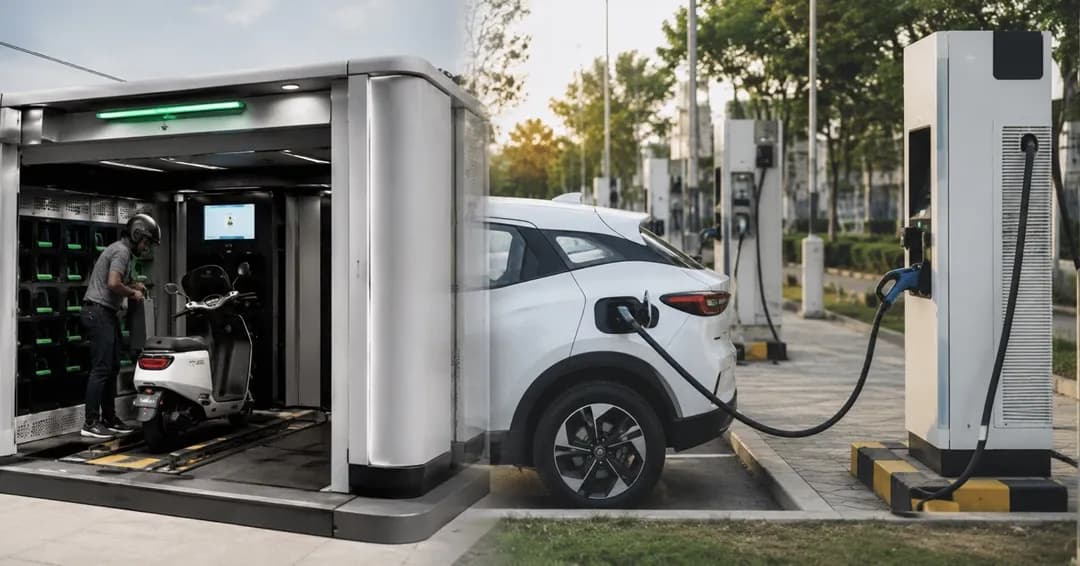
India's EV transition is not following the same pattern as car-led markets in Europe, the United States or China. Two- and three-wheelers account for most vehicle sales and much of the commercial EV activity, so the infrastructure question is broader than how quickly cars can be charged. The practical issue is which energy-delivery model works best for each vehicle type and duty cycle: battery swapping, DC fast charging or lower-power destination charging.
This is less a contest between technologies than a question of fit. Swapping moves battery ownership, financing and inventory risk to the network operator. Fast charging places more capital in sites, grid connections and charging equipment. Daily mileage, parking access, battery size, utilisation and customer ownership preferences will determine which model works in each segment.
Recent data supports this segment-by-segment view. The International Energy Agency estimates that India sold just under 1.3 million electric two-wheelers in 2025, equal to about 6% of total two-wheeler sales. Electric three-wheeler sales reached almost 800,000 and nearly 70% of the segment. The Ministry of Heavy Industries reported 29,151 public EV charging stations by December 2025, including 8,805 fast chargers. By May 2026, PM E-DRIVE proposals worth Rs. 503.86 crore had been approved for 4,874 chargers. The market is therefore expanding on both tracks, but the use cases are different.
Why Vehicle Segment Matters
Two- and three-wheelers dominate India's vehicle volumes and are also where electrification has progressed fastest. Electric three-wheelers are already mainstream in new sales, while electric two-wheelers remain a smaller share of a much larger market. Passenger cars, buses and trucks have different battery sizes, parking patterns and operating schedules, so they should not be treated as one infrastructure market.
For high-utilisation two- and three-wheeler fleets, battery swapping can solve two practical problems: downtime and the upfront cost of the battery. Delivery riders, e-rickshaw operators and fleet users may cover long daily distances and cannot always wait for a full charge. Battery-as-a-Service (BaaS) can reduce the vehicle's purchase price when the battery is excluded from the sale price, although the rider still pays for battery access through subscriptions or per-swap charges.
Charging time varies by vehicle, battery size and charger power. A DC fast-charging session commonly restores a useful portion of range in about 20 to 40 minutes, whereas light-vehicle swapping networks generally target a two- to three-minute exchange. Swapping delivers the greatest benefit when stations are dense and charged packs are available; otherwise, time saved at the station may be offset by travel or waiting.
Passenger vehicles follow a different pattern. Their battery packs are integrated with the vehicle platform, warranty, cooling system and software, and are too large for most manual swapping models. Home and workplace charging can meet much of a private car owner's daily requirement, while public DC fast charging is mainly needed for intercity travel, urban top-ups and drivers without dedicated parking. Fixed charging is therefore likely to remain the main model for passenger cars.
Different Economics, Different Risks
For operators, swapping and fast charging place capital and operating risk in different parts of the business.
Battery swapping is inventory-heavy. A station needs enough charged packs to meet demand, but the required buffer depends on usage patterns, recharge time and the promised service level. Too few packs create stock-outs; too many reduce the return on capital. The operator also carries battery-health, warranty, residual-value and vehicle-compatibility risks.
Swapping can manage grid demand more flexibly because batteries can be charged in sequence and, where tariffs permit, during lower-cost or solar-rich periods. This benefit is not automatic. A large network can still create substantial aggregate load, and battery life depends on charging rate, temperature control, depth of discharge and operating discipline.
Fast-charging investment is concentrated in the electricity connection, transformer and other upstream equipment, charger hardware, site preparation and parking bays. A single 150 kW charger does not always require a dedicated substation, but a multi-charger hub can require substantial grid upgrades. Low utilisation in the early years remains a major commercial risk. The PM E-DRIVE operational guidelines recognise this constraint by offering support for upstream infrastructure, including an 80% subsidy category for battery swapping and battery charging stations.
Frequent high-rate charging can increase battery degradation, particularly when cells are charged at high temperature or high state of charge. The effect is not uniform across vehicles. Battery chemistry, thermal management, charge limits and user behaviour all matter, and modern battery-management systems can reduce the impact. Battery-degradation research therefore does not support the broad assumption that every fast-charged fleet battery will lose value much faster than a normally charged battery.
Infrastructure Comparison for the India EV Market
Operational Metric | Battery Swapping (BaaS Model) | DC Fast Charging | AC Destination Charging |
Primary Cost Driver | Battery inventory, financing and utilisation | Grid connection, transformer, charger and site costs | Electrical connection, site access and installation volume |
Land Footprint per Unit | Compact for light-vehicle kiosks; larger for automated car or truck systems | Requires parking bays and space for electrical equipment | Usually uses existing home, workplace or destination parking |
Grid Infrastructure Impact | Can be managed through staggered charging; aggregate load still matters | High at multi-charger hubs; can be managed through capacity upgrades, storage and load controls | Low per point, although aggregate demand must still be planned |
Asset and Technology Risk | Higher exposure to battery ageing, financing and vehicle-interface changes | Moderate exposure to charger, connector and software changes | Lower, but hardware and software still require maintenance and replacement |
Primary Vehicle Fit | High-utilisation electric two- and three-wheeler fleets; selected bus and truck pilots | Passenger cars, intercity use, depots and selected commercial vehicles | Homes, workplaces, fleet depots and destinations with long dwell time |
The Standardisation Bottleneck
Standardisation remains the largest structural challenge for battery swapping, but a single universal pack is not the only possible answer. The Ministry of Power's January 2025 guidelines formally recognise battery swapping and BaaS, while the government has also stated that full interoperability across all EV users is not currently envisaged. The near-term market is therefore likely to rely on interoperable safety and communication rules within selected vehicle and operator ecosystems rather than one battery that fits every vehicle.
OEMs treat pack shape, voltage, cell chemistry, thermal management, BMS communication and vehicle software as part of the vehicle architecture. Mandating one physical format too early could restrict design choices. A practical standardisation path would first prioritise safety, connectors, communication, authentication, data access and battery-health reporting, while allowing more than one pack format.
That is why most Indian swapping networks remain closed or semi-open. Operators partner with selected OEMs and fleets, which makes it easier to control battery quality and demand but limits cross-network use. PM E-DRIVE now makes public battery swapping and charging stations eligible for support on upstream infrastructure, reducing part of the site cost but not the cost of battery inventory or the interoperability challenge.
Fixed charging has a clearer connector framework. The September 2025 PM E-DRIVE guidelines specify Light EV DC or Light EV AC/DC Combo connectors for electric two- and three-wheelers and CCS-II for electric cars, buses and trucks. Even so, a compatible connector does not guarantee a seamless experience; charger uptime, payment systems, vehicle voltage limits, software integration and queueing still affect usability.
Urban Land and Site Economics
Land and power availability strongly influence where each model can scale in Indian cities. Prime urban locations are expensive, while many residential areas lack dedicated parking or spare electrical capacity.
A public fast-charging hub needs parking bays and space for electrical equipment. This can be difficult in dense neighbourhoods, but fuel stations, malls, offices, hotels, public car parks and highway amenities can provide suitable sites when vehicles already have dwell time. The quality of the location, available power and charger utilisation are more important than land size alone.
Light-vehicle swapping kiosks can use smaller sites and can be placed at fuel outlets, shops, transport nodes and fleet depots. Company-reported figures show that the model has moved beyond pilots: Battery Smart lists more than 1,500 stations, while SUN Mobility reports more than 630 active swap stations. These networks are concentrated mainly in electric two- and three-wheelers, where repeat use and short turnaround can support the economics.
Likely Market Split Through 2031
Over the rest of the decade, India is more likely to develop a mixed charging system than choose one national winner.
Battery swapping has its strongest case in high-utilisation two- and three-wheeler fleets, especially in dense corridors where the same riders return to the network several times a week. It is likely to expand through fleet contracts, OEM partnerships and local networks rather than through immediate universal interoperability. Its success will depend on station density, subscription pricing, battery availability, financing costs and the operator's ability to keep packs in productive use.
Passenger cars will rely mainly on home, workplace and destination charging, supported by DC fast chargers for intercity travel and users without reliable private charging. For buses and trucks, the outcome is less settled. Depot charging, opportunity charging, high-power corridor charging and selected swapping models may coexist, depending on routes and turnaround requirements. It is too early to assume that one solution will dominate all heavy commercial vehicles.
India's EV infrastructure will therefore be multi-track. Swapping behaves like an inventory and energy-service business, where network density and battery utilisation drive returns. Public fast charging is more closely tied to site quality, grid capacity, charger uptime and traffic. AC charging remains the lowest-cost option wherever vehicles can remain parked for several hours. The companies most likely to succeed will be those that match the infrastructure model to the vehicle segment and operating pattern rather than treating charging technology as a single nationwide bet.
Need specialized data cuts or competitive intelligence?
Our analyst team provides bespoke market sizing, supplier audits, and country-level feasibility reports tailored to your enterprise roadmap.
Speak With an Industry Analyst →Ask an Industry Analyst
Have questions regarding this briefing or market projections? Inquire with our sector lead.
Related Thought Articles
View All →
How Indian Automakers Are Leveraging Compact EV Platforms to Reduce Vehicle Costs
Sep 4, 2026
Why EV Inverters Could Become the New Battleground for India’s Automotive Electronics Industry
Sep 3, 2026
From Data Centers to EV Charging: Where Low-Voltage DC Distribution Is Making an Impact
Sep 2, 2026
How EV Charger Manufacturers Can Capitalize on India’s Home Charging Revolution
Sep 1, 2026
Second-Life EV Battery Market in India: What Is Driving Demand from Manufacturers?
Aug 27, 2026More Thought Articles
The Rise of Locally Manufactured Battery Separators in India’s EV Ecosystem
India’s battery industry is progressing from pack assembly toward domestic cell and material manufacturing, creating opportunities for lithium-ion battery separators. Policy support, ACC capacity expansion and R&D initiatives are strengthening the ecosystem. However, technical complexity, manufacturing yields, qualification requirements and economics mean localisation will likely advance gradually through coatings, testing and finishing.
Why Hub Motors Are Becoming a Game Changer for India’s Electric Two-Wheeler Manufacturers
India’s electric two-wheeler market is increasingly prioritizing cost, efficiency, localization, and reliability. Hub motors are gaining relevance for commuter, fleet, and urban scooters because their simpler drivetrain architecture can reduce mechanical complexity and maintenance exposure. However, mid-drive systems will remain important for premium and performance-focused electric two-wheelers, supporting differentiated applications.
How Advanced Battery Thermal Management Is Transforming Cold-Weather EV Performance in India
Advanced battery thermal management is becoming increasingly important for India's EV market as vehicles operate across diverse temperature conditions. Adaptive heating, cooling, preconditioning, liquid thermal systems and intelligent software can improve range consistency, charging performance and battery durability, helping automakers deliver reliable, cost-effective EV performance across regions and vehicle segments.