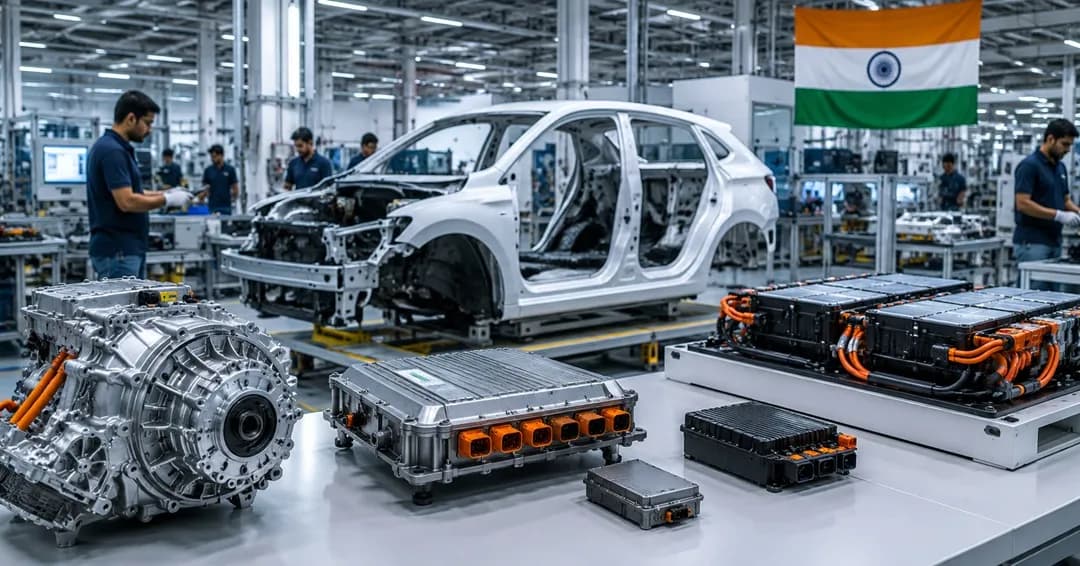
India’s EV revolution is increasingly driven by domestic component manufacturers developing batteries, power electronics, electric drivetrains, and smart technologies. Supported by PM E-DRIVE, PLI, and Make in India initiatives, companies such as Sona Comstar, Uno Minda, Bharat Forge, and Exide Industries are strengthening localization, innovation, exports, and long-term manufacturing competitiveness.
India’s electric mobility ecosystem continued to expand through 2025 and into 2026, supported by the PM Electric Drive Revolution in Innovative Vehicle Enhancement (PM E-DRIVE) scheme, which replaced the earlier FAME programme. The scheme has shifted the focus beyond vehicle adoption by encouraging domestic manufacturing, localised component production, charging infrastructure, and advanced battery technologies.
According to the Ministry of Heavy Industries, the PM E-DRIVE scheme has a total financial outlay of Rs. 10,900 crore. The programme supports the deployment of more than 2.8 million electric vehicles, including electric two-wheelers, three-wheelers, ambulances, trucks, and buses. In addition, Rs. 4,391 crore has been allocated for the procurement of 14,028 electric buses, while significant investments are also being directed toward expanding the country’s public charging infrastructure.
Government data further indicates that the Scheme supports more than 28 lakh EVs As of 27 January, 2026, a total of 22.12 lakh EVs have been sold under the Scheme, including 19.19 lakh e-2Ws and 2.93 lakh e-3Ws. Electric two-wheelers accounted for the overwhelming majority of these sales, reflecting India’s preference for affordable urban mobility solutions. The electric three-wheeler segment also achieved rapid adoption, particularly in commercial passenger transport and last-mile logistics.
The latest PM E-DRIVE dashboard also shows continued momentum during 2026, with EV registrations steadily increasing under the scheme as manufacturers expand production capacity and consumers benefit from government incentives. Alongside vehicle deployment, cumulative fuel savings and carbon dioxide emission reductions continue to improve as EV adoption rises nationwide. India's electric vehicle development has often been seen in the context of the electric vehicles introduced by vehicle manufacturers. But it is the complicated web of firms that produce components and supply the various technologies applied in electric vehicles, such as energy storage technologies, power transmission solutions, and control systems, that is responsible for driving the whole process of electric mobility. Without these companies, scaling electric mobility would remain an ambitious target rather than a commercial reality.
In recent years, India has devoted considerable attention to creating and developing its manufacturing industry as a result of the implementation of some policies, the growth in investment of the private sector, as well as the cooperation between car industry companies and the companies developing technologies and science. The initiated by the government actions aimed at the idea of localisation made manufacturers improve their production capacity of batteries, motors, controllers, and other sophisticated electronics. The next phase of electric mobility will likely be defined by efficiency rather than volume alone. Vehicle manufacturers are seeking lighter materials, longer battery life, faster charging, smarter electronics, and greater software integration. These expectations place component manufacturers at the centre of innovation. Their ability to improve performance while lowering production costs will influence how quickly electric vehicles become accessible across different consumer segments.
As India’s automotive sector adapts to changing mobility preferences, leading component manufacturers are emerging as strategic partners rather than conventional suppliers. Their investments in research, advanced manufacturing, digital technologies, and localised supply chains are shaping an ecosystem capable of supporting both domestic demand and global export opportunities.
India’s EV Ecosystem Is Becoming a Manufacturing Story
The electric vehicle sector in India has reached a point where production capacity is becoming as crucial as selling the units sold. Although demand from the drivers of electric two-wheelers, passenger cars, buses, and commercial fleets has continued to rise, the industry’s long-term prospects will hinge on the capability to manufacture key technologies within the country.
In the past years, many manufacturers have depended on imported batteries, electrical system controllers, magnets, semiconductors, and power electronics components. This dependence made the industry vulnerable to disruptions due to supply chain issues and exchange rate fluctuations. Recent geopolitical developments have made the weakness of the supply chains evident and stimulated Indian players to localise their production as much as possible.
Various governmental initiatives have sped up this process significantly by facilitating local production in the following areas: advanced chemistry cells manufacturing, automotive part production, and electronics and software production. State-sponsored incentives helped companies launch their production facilities and extend their research capacity in India. Besides, several suppliers are moving not just to assembling products but to creating their own technologies.
Another observable trend in the industry is the strengthening collaboration between automotive suppliers and IT companies. As electric vehicles comprise many more electronic components than traditional vehicles, the importance of software usage is surging. For example, battery efficiency optimisation, predictive maintenance, engine efficiency improvement, and energy management rely on intelligent systems integrating mechanical engineering and software technologies.
This evolution has created opportunities for Indian suppliers to move higher in the value chain. Instead of competing primarily on manufacturing costs, many are investing in engineering expertise, automation, precision manufacturing, and product innovation.
The result is an ecosystem that is gradually transforming from import dependence to technology-led manufacturing.
The figure below highlights the progress of the PM E-DRIVE Scheme by illustrating cumulative EV sales supported under the programme. Electric two-wheelers account for the largest share with 19.19 lakh units, followed by 2.93 lakh electric three-wheelers, demonstrating that affordable, high-volume mobility segments are driving India’s electric vehicle adoption and strengthening the domestic EV ecosystem.
PM E-DRIVE Scheme Progress: Electric Vehicle Sales by Category in India (as of January 27, 2026)
 Source: PIB
Component Manufacturers Have Become the Backbone of Electric Mobility
Although the mechanism of electric vehicles is simpler than that of internal combustion engine cars, they make use of sophisticated electrical, electronics, and thermal systems. This means that each component in the car affects driving distance, vehicle charging time, reliability and vehicle cost.
The most valuable type of technology in electric cars is battery technology since it comprises a large part of production costs. Better battery chemistry and design can contribute to higher efficiency of electric cars. The development of electric motors is also a remarkable point in this industry. Companies find ways of increasing motor efficiency, power delivery, and ability to reduce costs for certain types of materials used in electric motors. Electric motor efficiency means a lot because electric vehicles use millions of electric motors each day. Thermal regulation is increasingly becoming important. Batteries are to be kept within certain temperature limits, which is why thermal regulating devices are key tools in delivering efficiency across wide temperature differences.
Sensors, wiring harnesses, lightweight materials, and embedded software complete the technological ecosystem. These components work together to improve vehicle intelligence while enabling advanced safety features, predictive diagnostics, and over-the-air software updates. Component manufacturers therefore contribute far beyond supplying individual parts. They determine how efficiently an electric vehicle performs throughout its operating life.
Innovation Is Moving Beyond Batteries
Eco-friendly vehicles (EVs) are becoming increasingly popular everywhere. Although car manufacturers are working on ways to improve the batteries of their EVs, their focus is on many new technological developments in the electronic and electrical components of electric vehicles.
The first growing trend is the use of silicon carbide power electronics. This material has better performance compared to silicon. Battery Management Systems (BMS) are becoming more popular at this time. With BMS, the systems can monitor thousands of parameters while the vehicle is in use. In this case, engineers use artificial intelligence to solve potential battery-related issues and provide recommendations on issuing necessary repairs.
Electric motors are equally important in EVs In this regard, it is crucial to underline the fact that electric motors are becoming smaller and lighter while maintaining their excellent performance. According to engineers, some new technologies have been implemented, including magnets, winding technology, and cooling systems for electric motors. Materials science is another rapidly developing area of research. The most common materials that manufacturers are currently using include lightweight materials, for example, aluminium alloys, superstrong steel, and composite materials. One more trend is digital manufacturing. The rise of digitalisation allows making many production processes magical with an advanced smart factory equipped with various technologies such as industrial sensors and automatic inspection software.
Interestingly, many innovations now originate from Indian engineering teams rather than being adapted from overseas technologies. Growing collaboration between industry, academic institutions, and technology startups is strengthening indigenous product development across multiple component categories.
As electric mobility matures, competitive advantage will depend less on producing larger volumes and more on delivering smarter, safer, and more efficient technologies.
Government Policies Are Reshaping India’s EV Component Manufacturing Landscape
Public policies have played their part in transforming India's electric vehicle component sector. In the past, the government was only focused on boosting sales, but the current aim is to build a manufacturing ecosystem to ensure long-term development of the industry. The new strategy does not put stress on the import of technologies; it rather concentrates on the use of local capabilities. Furthermore, the FAME scheme started addressing initial demand for electric mobility and gave manufacturers incentives to increase local value addition of their products. Subsequently, when this technology became popular, the next step was to direct attention of the government to the production incentives for advanced battery production, auto components, and electronics.
The PLI for ACC and the automotive industry forced manufacturers to invest in the development of big factories for battery cells, electric motors, electronics, etc. Several states, for example, Tamil Nadu, Gujarat, Karnataka, Maharashtra, etc., have already adopted EV policies with many incentivising factors such as land allocation, capital inputs, electricity benefits, etc. The competition among the states has been encouraging investment in the establishment of industrial corridors for electric mobility production.
Equally significant is the government’s broader push under Make in India and Atmanirbhar Bharat, which encourages companies to build technological expertise rather than merely assemble imported parts. This approach is gradually strengthening domestic engineering capabilities and attracting global suppliers looking to diversify their manufacturing footprints.
Policy alone cannot create an industry, but it can reduce investment risks. In India’s case, it has provided manufacturers with greater confidence to expand production, establish research centres, and pursue long-term innovation strategies.
Localisation Is Becoming a Competitive Advantage
In the past, localisation was primarily seen in terms of reducing imports. Nowadays, it has developed into a strategic concept that creates more avenues for local production to rise in popularity due to better quality and a quicker production process. Producers of electric vehicles get a chance to enjoy the benefits of local supply because those who manufacture the parts are located nearby. It allows for savings on transportation costs. Localisation allows for achieving customisation as well. The manufacturers from the automotive industry need to adapt to the specifics of Indian roads, climate, traffic, etc.
So, local products are bound to be superior to the ones produced elsewhere. Another trend is that there are several production clusters in the region. Companies involved in the manufacturing of automobiles in Tamil Nadu, Karnataka, Maharashtra, Gujarat, and the Haryana region are all developing. Localisation helps suppliers to develop human resources and train engineers, technicians, software engineers, and quality control experts in the fields of battery technologies, embedded systems, power electronics, and advanced manufacturing. Perhaps the greatest advantage of localisation lies in resilience. Supply chain disruptions during recent years demonstrated the importance of diversified sourcing. Companies with stronger domestic supplier networks were often better positioned to maintain production compared with those relying heavily on overseas imports.
Challenges That Continue to Shape the Industry
Even with remarkable advancements, the electric vehicle (EV) components sector in India is struggling with several structural hurdles that require constant focus.
One issue remains the sourcing of raw materials for the batteries. Metals such as lithium, cobalt, nickel, and graphite come from a small number of countries, thus exposing manufacturers to both political and price fluctuations. Although India has begun the process of securing domestic deposits, as well as forming partnerships abroad, getting reliable access to strategic materials will remain a long-term task.
Another obstacle that the industry has to overcome is the availability of semiconductors. EVs require a lot more semiconductors than conventional cars, because they contain advanced systems for battery management, power electronics, sensors, and advanced driver assistants. Although the global situation with semiconductor supply has slightly improved after the pandemic, the demand still exceeds supply in certain specialised markets.
In addition, technology development requires huge investments. Setting up manufacturing facilities for batteries, machines, electronics, and automated quality inspection means a lot of money. The smaller suppliers usually cannot compete with larger multinational companies for research funds, thus making partnerships and collaborations inevitable.
The issue of infrastructure is another thing that needs to be solved. While the capacity of production facilities is growing, investments into charging infrastructure, testing facilities, recycling facilities, and logistics are also necessary. These supportive industries are crucial for sustainable growth in the future. Lastly, the industry lacks qualified specialists. Electric transport requires a combination of knowledge in mechanical, electrical, software engineering, and analytics. The task of creating interdisciplinary specialists in this field is essential for both academic and industrial organisations. Finally, manufacturers must navigate intense global competition. Countries with well-established automotive supply chains continue to invest aggressively in EV technologies, requiring Indian companies to differentiate themselves through quality, innovation, and cost efficiency rather than competing solely on labour costs.
These challenges are significant, but they also encourage companies to pursue continuous improvement and technological advancement.
Leading Indian EV Component Manufacturers Driving the EV Revolution
India’s electric mobility ecosystem is increasingly supported by domestic component manufacturers that are expanding beyond traditional automotive supplies into advanced electrification technologies. These companies are investing in battery systems, power electronics, electric drivetrains, charging infrastructure, and lightweight materials to meet the growing demand from electric two-wheelers, passenger vehicles, commercial fleets, and buses. Their focus on research and development, localization, and automation is reducing import dependence while strengthening India’s position in the global EV supply chain.
Bharat Forge has diversified its portfolio through electric mobility solutions, including e-axles, lightweight aluminium components, chassis systems, and powertrain technologies. The company continues to expand its manufacturing capabilities while supporting domestic and international EV manufacturers.
UNO Minda has become one of India’s prominent suppliers of EV-specific components, including onboard chargers, battery chargers, motor controllers, DC-DC converters, and intelligent lighting systems. The company is expanding its electrification portfolio through technology partnerships and investments in advanced electronics.
Sona BLW Precision Forgings (Sona Comstar) has established itself as a global supplier of differential assemblies, traction motors, motor control units, and electric driveline technologies. The company derives a significant share of its revenue from battery electric vehicle components and continues to secure orders from leading global OEMs.
Exide Industries is strengthening India’s battery manufacturing ecosystem through investments in lithium-ion cell manufacturing and battery pack technologies. The company is also expanding into advanced chemistry cells through strategic partnerships, supporting India’s objective of developing a localized battery value chain.
Company | Latest Key Development (2025–2026) |
Sona BLW Precision Forgings (Sona Comstar) | June 2025: Completed the acquisition of Escorts Kubota's Railway Business, strengthening its mobility technology portfolio while continuing expansion of EV driveline and traction motor solutions. |
Uno Minda Ltd. | February 2025: Formed a joint venture with Suzhou Inovance Automotive to manufacture high-voltage EV components in India, including e-axles, inverters, motors, and combined charging units. |
Sona Comstar | FY 2024–25 (completed June 2025): Annual Report confirmed completion of the Railway Business acquisition on 1 June 2025 as part of its broader mobility strategy. |
Uno Minda Ltd. | February 2025: M&A Committee approved formation of the EV powertrain Joint Venture with Inovance Automotive for localized manufacturing in India |
Export Opportunities Are Expanding Beyond Domestic Demand
India's EV component industry is progressively preparing to tap into overseas markets. While domestic consumption is still an important factor promoting growth, producers are taking advantage of the opportunity to supply parts for the world automotive industry.
Many foreign car makers are altering their practices of relying on concentrated supply chains and are focusing on procurement from different parts of the world. The advantages of India, namely a huge trained engineering labor force, improving quality of manufacturing, and relatively low labor costs, contribute to its attractiveness for global procurement.
Products like battery packs, wiring harnesses, electric motors, software battery management systems, charging devices, aluminium castings, and precision machining can be viewed as the most promising export products. Suppliers with sound quality management systems and certifications have the best chance to serve customers from Europe, North America, Southeast Asia, and the Middle East. The growth in exports results in an increase in manufacturing standards. The suppliers operating at the international level face high-quality, traceability, cyber-security, and sustainability requirements. Therefore, the companies need to implement improvements throughout the organisation. Sustainability is becoming a competitor differentiation factor in and of itself. International purchasers have started evaluating suppliers based on their carbon emissions, use of renewable energy, recycling initiatives, and responsible sourcing. Indian suppliers who make investments in sustainable production at an early stage can succeed.
Future Outlook
The electric vehicle (EV) parts sector in India is set to change from being a conventional manufacturing industry into a technology-based ecosystem. Although batteries and electric motors continue to play a vital role in EVs, it is the growth of technologies in areas such as battery management systems, power electronics, semiconductors, thermal management, and software systems that is determining how the industry moves forward.
The purpose of these technologies is to improve vehicle efficiency, prolong battery life, and reduce costs for buyers. The government schemes and initiatives in the form of the Prime Minister’s E-Drive plan, the Production Linked Incentive (PLI) schemes, and the “Make in India” program are aimed not only at generating investments in advanced chemistry cell manufacturing, battery recycling, electrical component manufacturing, and semiconductor production but also at creating partnerships between Indian manufacturers as well as research and tech companies. India now has a chance to become a global supplier of EV components, particularly as international producers switch to other sourcing options.
Conclusion
The transformation into electric mobility in India is not limited to car manufacturers alone, but it encompasses all parties operating in the ecosystem and component manufacturers that have been developing products related to EVs, ranging from batteries and electric drives to power electronics and smart charging solutions. Companies such as Sona Comstar, Uno Minda, Bharat Forge, and Exide Industries have been putting efforts into leveraging the technological advantages of India by means of R&D investments and innovative production methods to reduce the amount of imports and source from local manufacturers.
Have questions?
More Thought Articles
From Data Centers to EV Charging: Where Low-Voltage DC Distribution Is Making an Impact
Low-voltage DC distribution is gaining relevance as AI data centers, EV charging hubs, solar systems, and battery storage increase demand for efficient power architectures. The article examines 800 VDC standardization, conversion losses, protection challenges, and greenfield opportunities, highlighting why hybrid AC/DC systems could become increasingly important across high-power infrastructure applications.
How EV Charger Manufacturers Can Capitalize on India’s Home Charging Revolution
India’s residential EV charging opportunity is expanding as policy support, EV adoption, and private parking infrastructure develop. Manufacturers can capture value beyond AC chargers through installation, smart charging, load management, solar integration, software, and after-sales services. Housing societies, automakers, and property developers offer scalable routes to residential charging customers.
Second-Life EV Battery Market in India: What Is Driving Demand from Manufacturers?
India’s second-life EV battery market is gaining relevance as electric vehicle adoption expands and batteries retain useful capacity after automotive service. Growing stationary-storage demand, battery data, refurbishment capabilities, EPR obligations, and critical-mineral policies are encouraging manufacturers to extend battery value through reuse before eventual recycling within India’s emerging circular battery ecosystem.